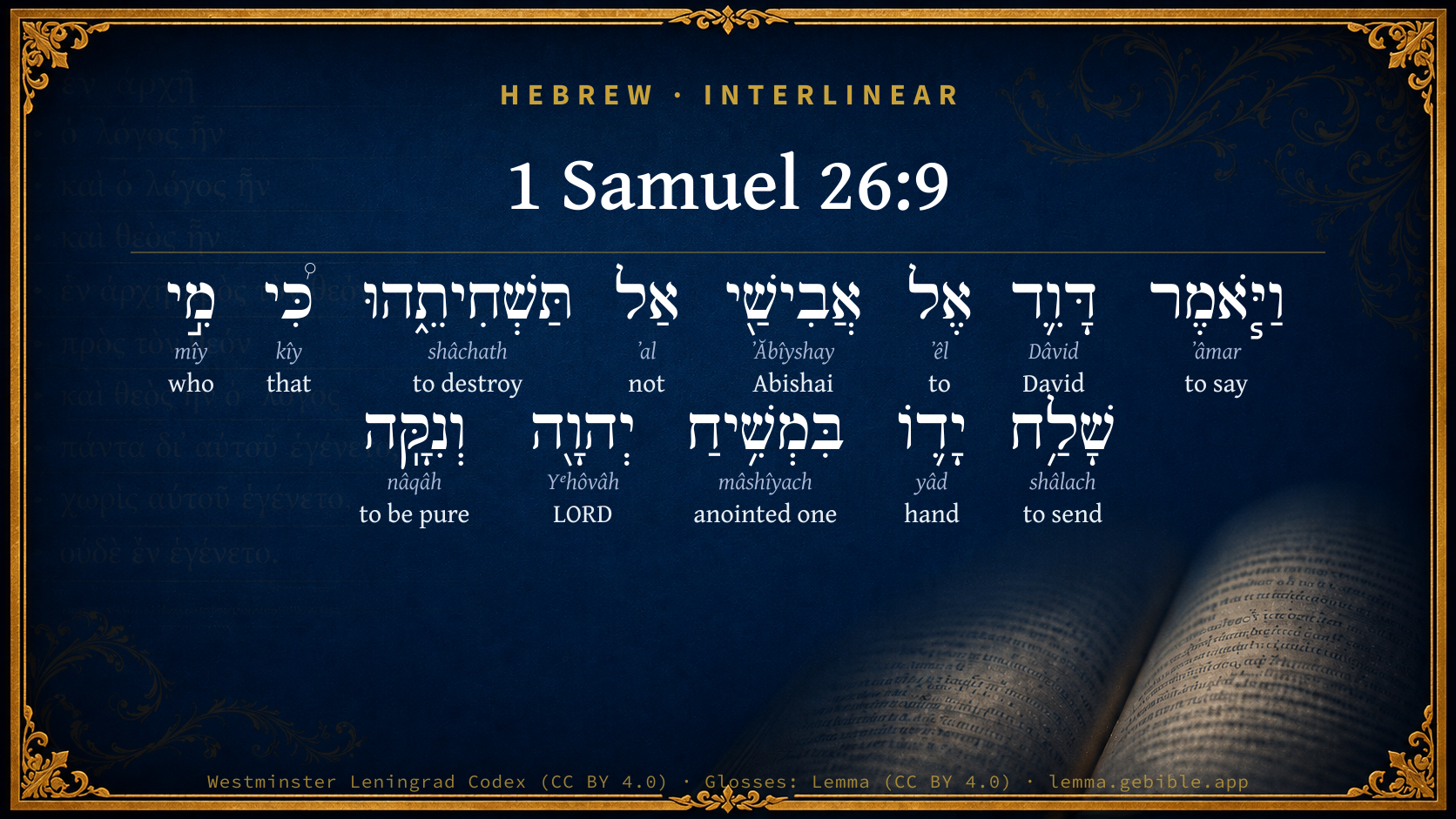
1 Samuel 26:9

Hebrew (Westminster Leningrad Codex) 1 Samuel 26:9 appears in the Hebrew Old Testament. The text above is from the Westminster Leningrad Codex. Each word links to its Strong’s number, a concise gloss, and parsing drawn from the Open Scriptures Hebrew Bible morphology. Click any word for its full Brown-Driver-Briggs (BDB) entry.
Download image
Cite this verse

1 Samuel 26:9 (World English Bible). Public Domain. Lemma interlinear Bible study tool, https://lemma.gebible.app/v/1-samuel/26/9.

Show BibTeX & RIS
BibTeX
RIS
English Translation
David said to Abishai, Don't destroy him; for who can put forth his hand against Yahweh's anointed, and be guiltless?
World English Bible · Public Domain
Download a study sheet

One document with this verse’s original text, its word-by-word gloss line, the meaning frame, cross-references with their text, attributed commentary, and full source and license credits — printable, and it pastes into notes with its structure intact.

This verse Autodidact and up

Study sheet (.html) Plain text (.txt)

A passage Seminary Student

Up to 50 verses in one chapter. A passage sheet keeps up to 6 commentary sources and 12 cross-references per verse, in the order this page ranks them, and says so on the sheet whenever that leaves anything out. Ask for a single verse and you get the Autodidact verse sheet above.

Everything on this page stays free to read, with no account — the sheet is a download of what is already on screen, not access to it.

Want to remove ads? Support Godless Engineer
Compare translations 3

The same verse in 3 English versions, stacked beneath the original-language interlinear above. Click any original word for its lexicon entry.

Each is an independent rendering of the whole verse — the interlinear is not word-aligned to these translations.

Highlighted words mark where these versions differ — a whole-verse word diff, not a word-by-word alignment.

  • World English Bible Public Domain
    David said to Abishai, Don't destroy him; for who can put forth his hand against Yahweh's anointed, and be guiltless?
  • King James Version Public Domain
    And David said to Abishai, Destroy him not: for who can stretch forth his hand against the LORD's anointed, and be guiltless?
  • unfoldingWord Literal Text CC BY-SA 4.0
    But David said to Abishai, “Do not destroy him. For who has stretched out his hand against the anointed one of Yahweh and been innocent?”

unfoldingWord Literal Text — © unfoldingWord, licensed CC BY-SA 4.0. Word-aligned USFM3 via Door43 (git.door43.org/unfoldingWord/en_ult).

Versions to compare (up to 4)

3 of 4 selected

Show all 18 translations

Every available English version of this verse, each an independent rendering of the whole verse.

  • World English Bible Public Domain
    David said to Abishai, Don't destroy him; for who can put forth his hand against Yahweh's anointed, and be guiltless?
  • Berean Standard Bible Public Domain
    But David said to Abishai, “Do not destroy him, for who can lift a hand against the LORD’s anointed and be guiltless?”
  • Majority Standard Bible Public Domain
    But David said to Abishai, “Do not destroy him, for who can extend a hand against the LORD’s anointed and be guiltless?”
  • King James Version Public Domain
    And David said to Abishai, Destroy him not: for who can stretch forth his hand against the LORD's anointed, and be guiltless?
  • American Standard Version (1901) Public Domain
    And David said to Abishai, Destroy him not; for who can put forth his hand against Jehovah's anointed, and be guiltless?
  • Revised Version (1885) Public Domain
    And David said to Abishai, Destroy him not: for who can put forth his hand against the LORD’S anointed, and be guiltless?
  • Geneva Bible (1599) Public Domain
    And Dauid sayde to Abishai, Destroy him not: for who can lay his hand on the Lordes anoynted, and be giltlesse?
  • Douay-Rheims (1899) Public Domain
    And David said to Abisai: Kill him not: for who shall put forth his hand against the Lord's anointed, and shall be guiltless?
  • Young's Literal Translation Public Domain
    And David saith unto Abishai, `Destroy him not; for who hath put forth his hand against the anointed of Jehovah, and been acquitted?'
  • Literal Standard Version CC BY-SA 4.0
    And David says to Abishai, “Do not destroy him; for who has put forth his hand against the anointed of YHWH and been acquitted?”
  • Unlocked Literal Bible CC BY-SA 4.0
    David said to Abishai, “Do not destroy him; for who can extend his hand against Yahweh's anointed one and be guiltless?”
  • unfoldingWord Literal Text CC BY-SA 4.0
    But David said to Abishai, “Do not destroy him. For who has stretched out his hand against the anointed one of Yahweh and been innocent?”
  • Darby Bible Public Domain
    And David said to Abishai, Destroy him not; for who can stretch forth his hand against Jehovah's anointed, and be guiltless?
  • World Messianic Bible Public Domain
    David said to Abishai, “Don’t destroy him, for who can stretch out his hand against the LORD’s anointed, and be guiltless?”
  • Webster's Bible Public Domain
    And David said to Abishai, Destroy him not; for who can stretch forth his hand against the LORD'S anointed and be guiltless?
  • Free Bible Version CC BY-SA 4.0
    But David said to Abishai, “No, don't kill him! Who can attack the Lord's anointed one and not be guilty of a crime?
  • Bible in Basic English Public Domain
    And David said to Abishai Do not put him to death; for who, without sin, may put out his hand against the man on whom the Lord has put the holy oil?
  • JPS Tanakh (1917) Public Domain
    And David said to Abishai: 'Destroy him not; for who can put forth his hand against the LORD'S anointed, and be guiltless?'

Literal Standard Version (2020), Covenant Press — licensed CC BY-SA 4.0. Text via the HelloAO Bible API (eBible.org). Unlocked Literal Bible (unfoldingWord) — licensed CC BY-SA 4.0. Text via the HelloAO Bible API (eBible.org). unfoldingWord Literal Text — © unfoldingWord, licensed CC BY-SA 4.0. Word-aligned USFM3 via Door43 (git.door43.org/unfoldingWord/en_ult). Free Bible Version, Dr. Jonathan Gallagher — licensed CC BY-SA 4.0. Text via the HelloAO Bible API (eBible.org).

Word by word

More ways to search: Search by grammar → Find every occurrence → Compare this word →

Practice this passage: Drill this verse → Learn its vocabulary →

אֲבִישַׁ֖י
ʼĂbîyshay
H52
“Abishai”
Noun, Proper
Part of Speech
Noun
Type
Proper
Full BDB Definition

Origin: from H1 and H7862

TWOT: None

Abishai = "my father is Jesse" or " my father is a gift" - grandson of Jesse, nephew of David via his sister Zeruiah, brother of Joab
  1. וַיֹּ֧אמֶר ʼâmar H559 “and · to say” Conjunction + Verb, Qal, Sequential Imperfect, 3rd Person, Masculine, Singular
  2. דָּוִ֛ד Dâvid H1732 “David” Noun, Proper
  3. אֶל ʼêl H413 “to” Preposition
  4. אַל ʼal H408 “not” Particle, Negative
  5. תַּשְׁחִיתֵ֑הוּ shâchath H7843 “to destroy · him” Verb, Hiphil, Jussive, 2nd Person, Masculine, Singular + Suffix, Personal, 3rd Person, Masculine, Singular
  6. כִּ֠י kîy H3588 “that” Conjunction
  7. מִ֣י mîy H4310 “who” Particle, Interrogative
  8. שָׁלַ֥ח shâlach H7971 “to send” Verb, Qal, Perfect, 3rd Person, Masculine, Singular
  9. יָד֛וֹ yâd H3027 “hand · his” Noun, Common, Both, Singular, Construct + Suffix, Personal, 3rd Person, Masculine, Singular
  10. בִּמְשִׁ֥יחַ mâshîyach H4899 “in/at · anointed one of” Preposition + Noun, Common, Masculine, Singular, Construct
  11. יְהוָ֖ה Yᵉhôvâh H3068 “LORD” Noun, Proper
  12. וְנִקָּֽה nâqâh H5352 “and · to be pure” Conjunction + Verb, Niphal, Sequential Perfect, 3rd Person, Masculine, Singular

About this verse

These counts appear in no published source. They are computed here, from the morphology-tagged text and Lemma’s own curated glosses. What Lemma adds →

13
words
13
distinct lemmas
Historical
section

Notable vocabulary

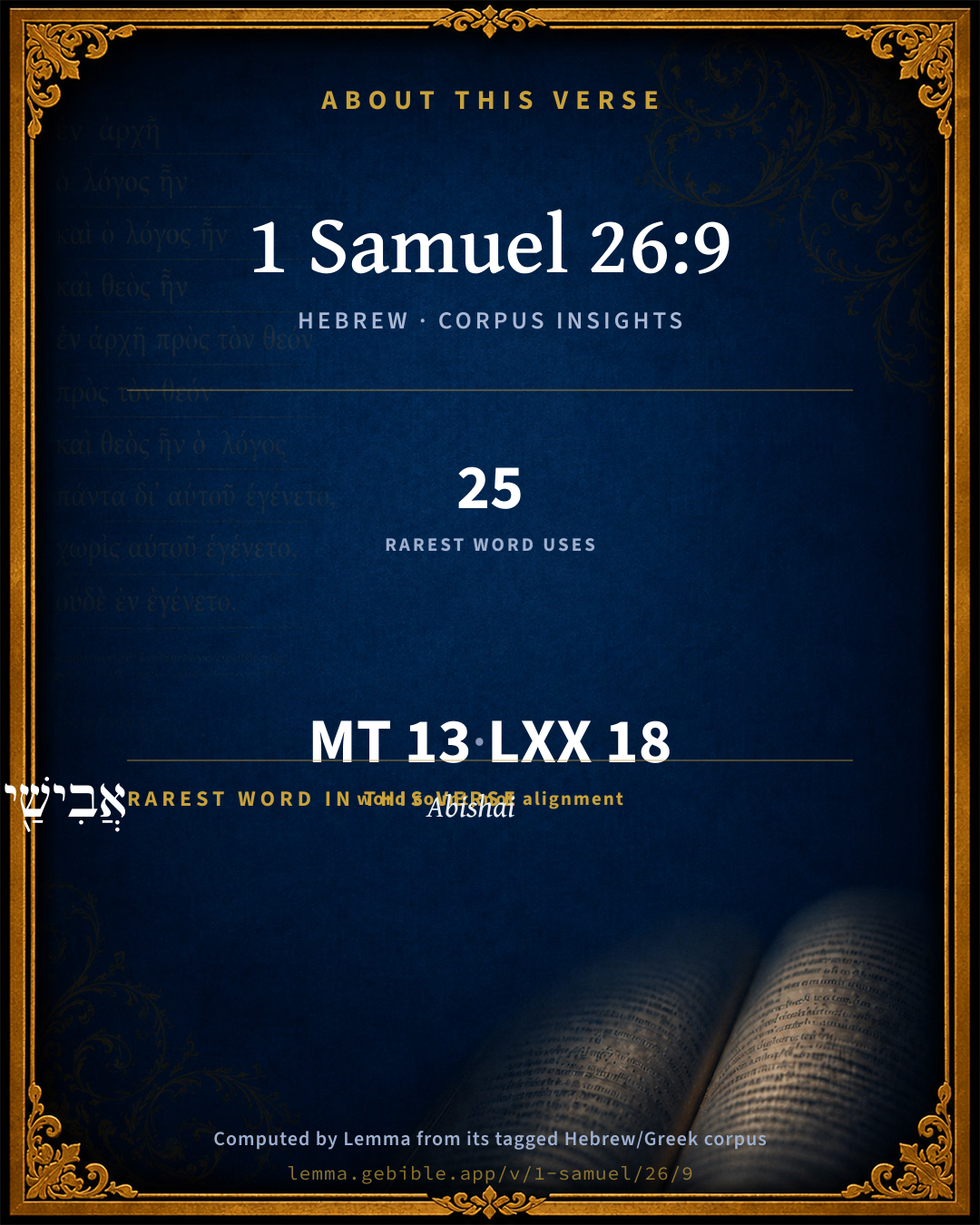
The rarest word here is אֲבִישַׁ֖י Abishai H52 — appearing just 25 times in the whole Hebrew Bible.

Shared distinctive vocabulary

אֲבִישַׁ֖י Abishai H52 occurs in 24 verses of the Hebrew Bible. Also found in:

Grammatical profile

  • 4 verbs
  • 5 nouns
  • 1 preposition
  • 1 conjunction
  • 2 particles

Verb forms

  • וַיֹּ֧אמֶר Qal · Sequential Imperfect
  • תַּשְׁחִיתֵ֑הוּ Hiphil · Jussive
  • שָׁלַ֥ח Qal · Perfect
  • וְנִקָּֽה Niphal · Sequential Perfect

Hebrew & Septuagint length

In English translation the verse runs 20 words from the Hebrew and 26 from the Septuagint (LXX English) — closely comparable.

A rough comparison of the two English renderings, which tokenize alike — not a word-level alignment.

Word counts can differ between the Hebrew and the Greek without any difference in meaning — e.g. the Hebrew direct-object marker אֵת has no separate Greek word, and Greek often adds the article ὁ.

In the original languages it is 13 Hebrew tokens and 18 Greek tokens — but the two are counted differently (Hebrew bundles its prefixes and suffixes into one token; the Greek is in lemma form), so that isn’t a like-for-like length.

Cross-references

4

Topical passages linked to 1 Samuel 26:9 in the Treasury of Scripture Knowledge — connected by theme and wording, ordered by reader-vote popularity; previews shown in the World English Bible.

  • 2 Samuel 1:14 David said to him, How were you not afraid to put forth your hand to destroy Yahweh's anointed?
  • 2 Samuel 1:16 David said to him, Your blood be on your head; for your mouth has testified against you, saying, I have slain Yahweh's anointed.
  • Psalms 105:15 "Don't touch my anointed ones! Do my prophets no harm!"
  • 1 Samuel 24:6–7 He said to his men, Yahweh forbid that I should do this thing to my lord, Yahweh's anointed, to put forth my hand against him, seeing he is Yahweh's anointed.

Cross-references courtesy of OpenBible.info (CC BY 4.0).

Hebrew and Greek witnesses Masoretic Hebrew ↔ Greek Septuagint

The same verse in the two great witnesses to the Old Testament, shown verse-for-verse.

These are two independent witnesses, not word-aligned to each other, and the Septuagint is shown in lemma (dictionary) form.

Hebrew 1 Samuel 26:9 Masoretic · Westminster Leningrad Codex

וַיֹּ֧אמֶר דָּוִ֛ד אֶל אֲבִישַׁ֖י אַל תַּשְׁחִיתֵ֑הוּ כִּ֠י מִ֣י שָׁלַ֥ח יָד֛וֹ בִּמְשִׁ֥יחַ יְהוָ֖ה וְנִקָּֽה

David said to Abishai, Don't destroy him; for who can put forth his hand against Yahweh's anointed, and be guiltless?

World English Bible · Public Domain

Greek LXX 1 Samuel 26:9 Septuagint · lemma form

καί εἶπον δαυίδ πρός αβεσσα μή ταπεινόω αὐτός ὅτι τίς ἐπιφέρω χείρ αὐτός ἐπί χριστός κύριος καί ἀθῳόω

And David said to Abessa, Do not lay him low, for who shall lift up his hand against the anointed of the Lord, and be guiltless?

LXX2012 (modern English Septuagint) · Public Domain

Hebrew: Westminster Leningrad Codex (CC BY 4.0). Greek: Septuagint (public domain); English from LXX2012 (modern English Septuagint) (Public Domain). How the Septuagint differs from the Hebrew →

Targum (Aramaic paraphrase)

1

The Targum is the ancient Jewish Aramaic paraphrase of the Hebrew Scriptures — an interpretive translation, not the Hebrew text itself. Onkelos (literal) and Pseudo-Jonathan (expansive) render the Torah, and Jonathan the Prophets. Coverage is partial: where no permissively-licensed English translation exists for a verse, only the Aramaic is shown. This is verse-level text, not a word-by-word alignment to the Hebrew.

  1. Targum Jonathan Prophets (Joshua–Malachi)
    וַאֲמַר דָוִד לַאֲבִישַׁי לָא תְחַבְּלִינֵיהּ אֲרֵי מַן אוֹשִׁיט יְדֵיהּ בִּמְשִׁיחָא דַייָ וְזָכֵי:

    (no public-domain English translation for this verse)

    Targum Jonathan — Aramaic: “Mikraot Gedolot” (public domain). English: “Sefaria Community Translation” (CC0 1.0 (public-domain dedication)); “London "Chaldee Paraphrase," 1871” (public domain). Text via Sefaria.

Commentary

Notes on 1 Samuel 26:9 from classic Christian and Jewish commentators (each source and its license shown beneath its notes). The classic Christian expositions comment on the surrounding passage and are grouped to its opening verse, so a note may address several verses; the Jewish commentaries on the Tanakh (Rashi and others) are per-verse, so they appear only where the commentator wrote on this verse.

Lemma curates 59 commentaries, every one of them public domain or Creative Commons licensed, each selected and text-cleaned for this edition rather than reprinted as found. About our sources →

Trapp's Complete Commentary

John Trapp

1Sa 26:9 And David said to Abishai, Destroy him not: for who can stretch forth his hand against the LORD’S anointed, and be guiltless?

Ver. 9. Destroy him not.] Hoc enim indecens et indignum mihi videtur. "Keep thee far from an ill matter." {Exo 23:7} "Meddle not with them that are given to change." {Pro 24:21} The Ruteni are said to have every day one new king or more, according as they are able to make themselves so. {a}

{a} Val. Max. Christian, p. 350.

John Trapp, A Commentary or Exposition upon All the Books of the Old and New Testament (1647–1656) — public domain. Text from a community e-Sword module.

The Biblical Illustrator

Joseph S. Exell

1Sa_26:9

Destroy him not.

Vengeance left with him to whom it belongs

Our attention has been called to the fact that the first great victory achieved by David was over his own spirit. As we pursue his history, we are glad to find that his first triumph of this noblest kind was not his last. His cruel and implacable foe, who had come out with three thousand armed men determined either to take him prisoner or to hunt him to death, was now entirely in his hands. It was a golden opportunity, and David made a golden use of it, for he refused to avenge himself, and suffered his deadly enemy to depart in peace. For three years he had lived the life of a fugitive, and in many ways and places had sought to shelter himself against the unrighteous and pitiless wrath of Saul. There were many things to enkindle his resentment and make forbearance towards Saul a most difficult virtue. Think of what be had lost, and what he had suffered! How strangely things combined together to make the worse appear the better course! The promise and the providence of God both seemed on the side of instant and complete vengeance! But David was versed in the Law of God: and in one of the earlier books of his incomplete, but precious, priceless Bible, he had read these commandments: Thou shalt not avenge nor bear any grudge against the children of thy people, but thou shalt love thy neighbour as thyself: I am the Lord. (Lev_12:1-8; Lev_13:1-59; Lev_14:1-57; Lev_15:1-33; Lev_16:1-34; Lev_17:1-16; Lev_18:1-30). Davids generous forbearance touched the heart of Saul, disarmed him of his rage, melted him into tears, and constrained him to become a suppliant at the feet of the man for whose blood he had been thirsting. This second display of magnanimity on Davids part was a greater triumph of saintly principle than the first. All the former reasons in favour of avenging himself still existed, and in greater force, because of the additional sufferings he had endured; and now there was to be added another reason of almost irresistible power, he had cast his pearl before swine which had turned again to rend him. His kindness had been shamefully abused, and evil had been returned for his good. The Kings life, which he had nobly spared, was consecrated afresh to the work of securing his destruction. To spare it a second time was for David to sharpen the sword by which he himself would be slain; and that surely would be charity degenerating into fanaticism. It is evident that Davids faith in God was one of the great roots out of which all these fruits of forbearance and patience and compassion grew. He was confident that God would in His own way and in His own time fulfil the promises which had been made; and, therefore, instead of taking the matter into his own hands, he could rest in the Lord and wait patiently for Him. They say that Revenge is sweet. There can be no doubt of the truth of this, for perverted natures have perverted tastes, and loathe what they ought to love, and banquet with delight on what they ought to abhor. David had feelings in his heart which would have been intensely gratified if he had taken vengeance on his enemy; but would not his revenge have been like the book the seer did eat in the Apocalypse, sweet in the mouth, but bitterness in the belly? Patience and meekness and forgiveness are often very hard to exercise, but when they become matters of memory, are they not things of beauty, and a joy forever? The poet tells of one who sat by the grave of the friend from whom he had parted in anger, and wept at the remembrance of his former harshness:--Cruel, cruel the words I said! Cruelly come they back today. Probably there are men now sleeping in the dust who in their lifetime wronged and injured you. If you forgave them, and prayed for them, and sought to bless them, does the memory of that Christ-likeness on your part ever give you a moments sorrow? Yes, revenge may be sweet, but, like all the pleasures of sin, it is but for a season. Mercy is Gods delight. He who receives it through Jesus secures his passport to the skies. He who learns to imitate it, lays up treasure for himself in heaven. Happy he who by the grace of God so carries himself toward them that curse him and despitefully use him, that he does not invoke his own condemnation, when, in his daily prayer, he cries, Forgive us our trespasses as we forgive them that trespass against us. (C. Vince.)

Who can stretch forth his hand against the Lord and be guiltless?--

Davids magnanimity

I. The persons here concerned are Saul and David and the state in which the text shews us these two was that of enmity. Consider, therefore, that the prince that was his captive now, and at his mercy had somewhile since descended so below himself, as to become the envier and detractor from his praise, was poorly jealous of the honours he had purchased, and tried to blast the laurels he had gathered, at the expense oil so much painful boil and hazard; and tis no little share of grace and goodness that can restrain a young aspiring hero from taking vengeance on the maligners of his praise, and from removing all impediments in his pursuit of fame and glory. When mens lives are so apparently sought after, they usually lay all respects aside, and listen to the dictates of unruly Nature. He was a false, perfidious prince. Nothing affects a generous mind so sensibly as being cheated under shew of friendship; and treachery is never viler than when tis covered with the mask of godliness. But further, be was perjured. He had but lately taken a solemn oath before the Lord and Jonathan, David should not be slain. And when a prince has thus abandoned common honesty, broken the sacred cords that knit societies, and keep up governments and mutual correspondences, he is justly delivered into the hands of those whose innocence and good credulity he had imposed on, and abused almost to their destruction. Oh, what a mighty measure of Gods grace must fill the heart of him that then could say, The Lord forbid that I should stretch forth my hand against the Lords anointed. There are some things besides our lives and persons, in which, if we are touched, we think ourselves extremely injured; and they are specially our friends, our fortunes and religion; and David was in every one of these affected more or less by Sauls implacable pursuit, and hunting after him. But notwithstanding all this, great as he was in court, great as he was in camp, and greater yet in favour of the people, he would not venture on the impious fact, still it was, The Lord forbid that I should stretch forth my hand against the Lords anointed. Tis surely with ambition, as with other passions, the imaginary joys are greater than the experienced and substantial ones: The hopes and expectations far exceed the pleasures of possession. Whatever cares belong to crowns, they lie concealed within their circles, and are more seldom seen than felt. But this temptation found no place with David, young, and gay, and vigorous as he was and even so near the crown, Ahab by conniving at Abishais blow, he might have been in full and sure possession of it; yet he suffered not himself to be transported beyond the bounds of rigid honesty and loyalty, and still cries out, The Lord forbid. Now, to conclude, and to complete this character, and lastly, to these great advantages of being son-in-law, a mighty man of valour, and accepted in the sight of all the people, of knowing Saul rejected, and himself designed for successor, the greatest yet of all advantages, and that is opportunity; that without which all others signify but little; and that with which alone men serve their turns, and make up the defects of all the rest; that pander to all sin, and fatal snare of virtue! That has ruined many thousand souls and betrayed them into most detestable commissions. Opportunity, that few have virtue, few have strength sufficient; to withstand, and of all opportunities, none are so strong, and work so powerfully upon the minds of men as those that look providential ones, and seem to come from God. Yet this was Davids opportunity, and yet withstood.

II. Consider the reason David gave for his refusal of Abishais and the soldiers proffer, It is the Lords anointed. The laws of God did certainly secure the lives of kings as well as other mens, if it did no more. The Lord shall smite him, or his day shall come, or he shall perish in the battle, that is, I leave him to Gods disposal; let God, the Judge of all the earth, do with him as he pleases. And though we think the leaving wicked kings to God is the lightest and the kindest expression of nothing in the world that can be; yet we would quickly alter our opinions and be of Davids mind, if we would give ourselves leave to consider:

1. That he hates injustice more.

2. That he is much more ready.

3. Much more able to punish it than we can be. (W. Fleetwood.)

The Biblical Illustrator, edited by Joseph S. Exell (c. 1880s–1900s) — public domain. Text from a community e-Sword module.

Tyndale Open Study Notes

Tyndale Open Resources

26:9 the Lord’s anointed: See study note on 24:6.

Tyndale Open Study Notes — © Tyndale Open Resources, licensed CC BY-SA 4.0. Text via the HelloAO Bible API.

Geneva Bible (1599)

Geneva Bible translators

To wit, in his own private cause: for Jehu slew two Kings at God’s appointment, 2 Kings 9:24.

Geneva Bible (1599) marginal notes — public domain. Text via Bolls.life.

Ellicott's Commentary for English Readers

(9) Against the Lord’s anointed.—David—taught, no doubt, by the prophet Samuel—looked upon the person of Saul as made sacred and inviolable by the royal anointing. Through the anointing Saul had become the possession of Jehovah; only Jehovah, then, could lawfully take away that sacred life. This he elaborates in the next verse. It is possible that these exalted sentiments respecting the Divine rights of kings were not uttered by David while standing in the dark night among Saul’s soldiers by the sleeping king, but subsequently, when he and Abishai were talking the incident over together.

A Bible Commentary for English Readers, edited by Charles John Ellicott (1878–1897) — public domain. Text from a community e-Sword module.

John Gill's Exposition

And David said to Abishai, destroy him not,.... He laid his commands upon him not to hurt him:

for who can stretch forth his hand against the Lord's anointed, and be guiltless? since Saul was king, and appointed to that office by the Lord, and was anointed by his order for it, and invested with it by him, his person was sacred, and not to be touched; nor could his life be taken away by any without being guilty of a very great crime indeed, which it might be justly expected the Lord would resent and punish.

John Gill's Exposition of the Whole Bible (1746–1763) — public domain (CC PDM 1.0). Text via the HelloAO Bible API.

Haydock's Catholic Bible Commentary

Guiltless. Saul was still his king, how wicked soever, and this title rendered his person inviolable. The eastern nations are very seldom guilty of rebellion, or of murdering their kings; a thing of which we find so many examples in the Roman, English, and French histories. (Calmet) --- A private man could not lay violent hands upon the king without a crime; and therefore David represses Abisai, and commits his cause to God, chap. xxiv. 13. (Menochius) --- He will not permit any one to destroy the life of the king, though he was already anointed to succeed him. (Worthington)

George Leo Haydock (1774–1849), Haydock's Catholic Family Bible and Commentary, 1859 edition — public domain. Excludes Psalms (Douay-Rheims chapter numbering differs from Protestant) and Deuterocanonical books (Catholic canon only).

Matthew Poole's English Annotations

Though Saul be a cruel tyrant, and rejected by God, yet he is our sovereign lord and king; and I, though designed king, as yet am but a private person, and his subject; and therefore cannot kill him without sin, nor will I consent that thou shouldst do it.

Matthew Poole's English Annotations on the Holy Bible (1683–1685) — public domain. Text from a community e-Sword/MySword module.

The Pulpit Commentary

Vers. 9-11. David forbids the deed as before, (1Sa_24:6) because of Saul"s office. As we there saw, this was an ingrained principle in David"s mind on which he constantly acted. Present with equal strength in Saul"s mind, it was the cause of moral ruin to the one, and of a noble forbearance and self-control to the other. David therefore leaves him in Jehovah"s hand, saying, As Jehovah liveth, Jehovah shall smite him; or his day, etc. Literally, "As Jehovah liveth (I will not smite him), but Jehovah shall smite him; either his day shall come and he shall die; or he shall go down into battle and perish." Whenever he falls, it shall be Jehovah"s doing, whether he die a natural death, or a violent one in battle. "The smiting of Jehovah" does not imply a sudden death. God smites men with disease (2Ki_15:5) and other troubles. What David means is that he will leave the matter entirely to God, but that if Saul"s death is to be a violent one, he must fall honourably, not by the hand of a subject, but in battle with Israel"s enemies. Jehovah forbid. The same phrase as in 1Sa_24:6. Cruse of water. i.e. water bottle, as in 1Ki_19:6.

The Pulpit Commentary (1880–1919), ed. H.D.M. Spence-Jones & Joseph S. Exell — public domain. Text from a community e-Sword module.

John Wesley's Explanatory Notes

Destroy him not, &c. - Though Saul be a tyrant, yet he is our Lord and king; and I, though designed king, as yet am his subject; and therefore cannot kill him without sin, nor will I consent that thou shouldst do it.

John Wesley, Explanatory Notes Upon the Whole Bible (1754–1765) — public domain. Text via the GEBible commentary corpus.

unfoldingWord translationNotes

Door43 World Missions Community

who can extend his hand against Yahweh's anointed one and be guiltless?

This rhetorical question can be translated as a statement. This can also be stated in positive form. AT: "No one can strike Yahweh's anointed one and be without guilt." or "Anyone who strikes Yahweh's anointed one will be guilty of murder." (See: Rhetorical Question and Litotes)

As Yahweh lives

"as certainly as Yahweh lives" or "as surely as Yahweh lives"

his day will come to die

"he will die a natural death"

translationWords

David

Yahweh

anoint

life

die

perish

unfoldingWord translationNotes — © Distant Shores Media and the Door43 World Missions Community, licensed CC BY-SA 4.0. Source: git.door43.org/Door43/en_tn.

Lesson kit

Teaching starters — assembled from the data on this page, not authored interpretation. Every prompt links to the verse data it draws on. Edit before teaching.

1 Samuel, in the Historical, opens this verse with 13 words (13 distinct Hebrew lemmas). Its most distinctive word is ʼĂbîyshay (“Abishai”). A historical commentator’s framing appears above. Read the whole chapter for the surrounding context.

Discussion questions

  1. The word ʼĂbîyshay carries the sense “Abishai.” How does it shape the verse?
  2. How does 1 Samuel 26:6, which shares the word «Abishai», read alongside this verse?
  3. The translations on this page render this verse differently — a whole-verse word diff, not a word-by-word alignment. What might account for the different wordings?
  4. «וַיֹּ֧אמֶר» is a Qal Sequential Imperfect verb. How does that grammatical form shape the action described?
  5. Compare how Trapp's Complete Commentary and The Biblical Illustrator read this verse. Where do they agree or differ?

Things to notice

Reading settings

Reading text

Shown beneath each verse's original-language words.

Old Testament
Old Testament edition

Read the OT as the Masoretic Hebrew (MT) or the Greek Septuagint (LXX).

English shown for the Greek Septuagint (in the Hebrew ↔ Greek comparison).

Comparing translations? Open the Compare panel on any verse page to stack up to four side by side.