
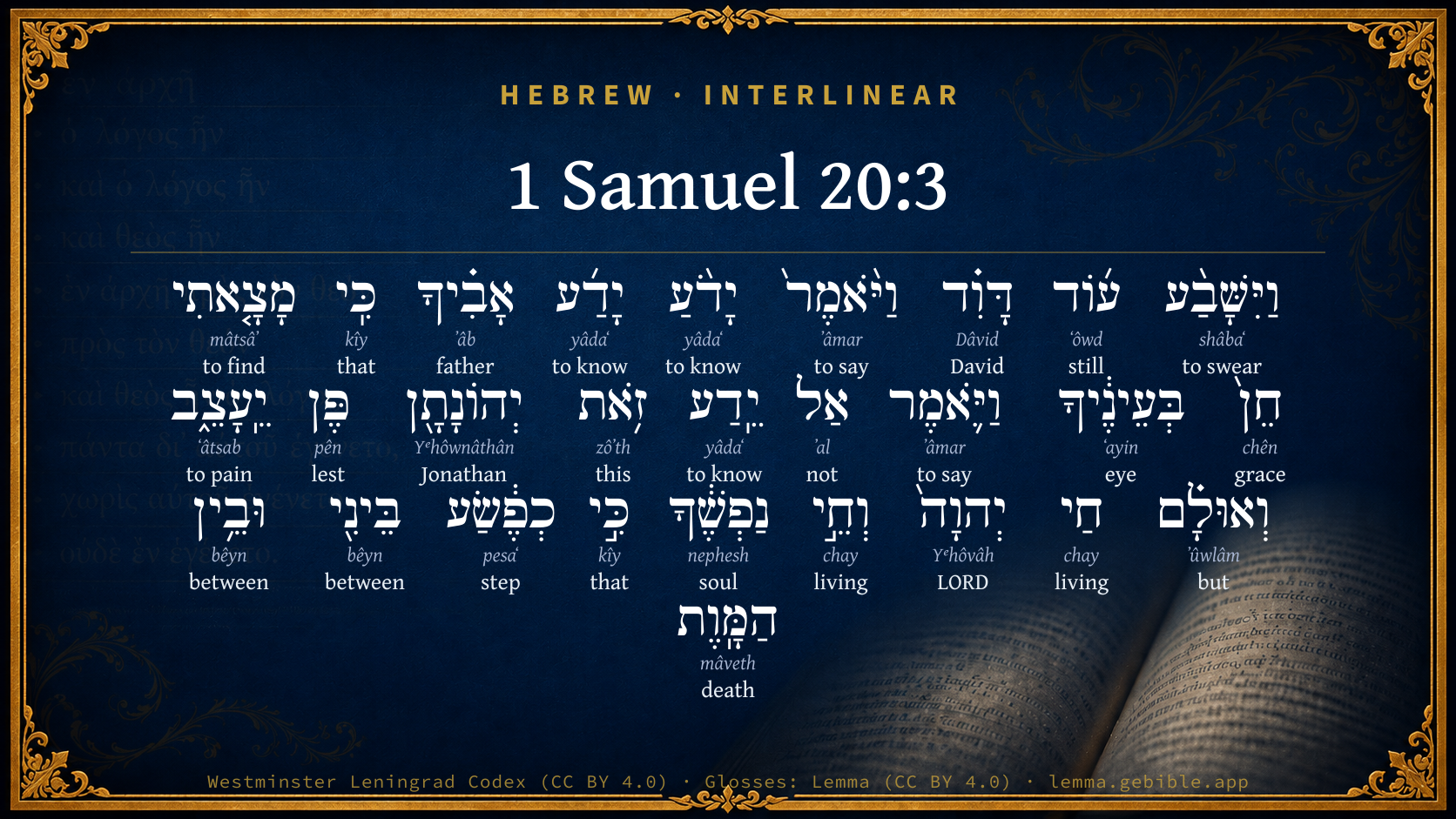
1 Samuel 20:3

Hebrew (Westminster Leningrad Codex) 1 Samuel 20:3 appears in the Hebrew Old Testament. The text above is from the Westminster Leningrad Codex. Each word links to its Strong’s number, a concise gloss, and parsing drawn from the Open Scriptures Hebrew Bible morphology. Click any word for its full Brown-Driver-Briggs (BDB) entry.
Download image
Cite this verse

1 Samuel 20:3 (World English Bible). Public Domain. Lemma interlinear Bible study tool, https://lemma.gebible.app/v/1-samuel/20/3.

Show BibTeX & RIS
BibTeX
RIS
English Translation
David swore moreover, and said, Your father knows well that I have found favor in your eyes; and he says, Don't let Jonathan know this, lest he be grieved: but truly as Yahweh lives, and as your soul lives, there is but a step between me and death.
World English Bible · Public Domain
Highlights
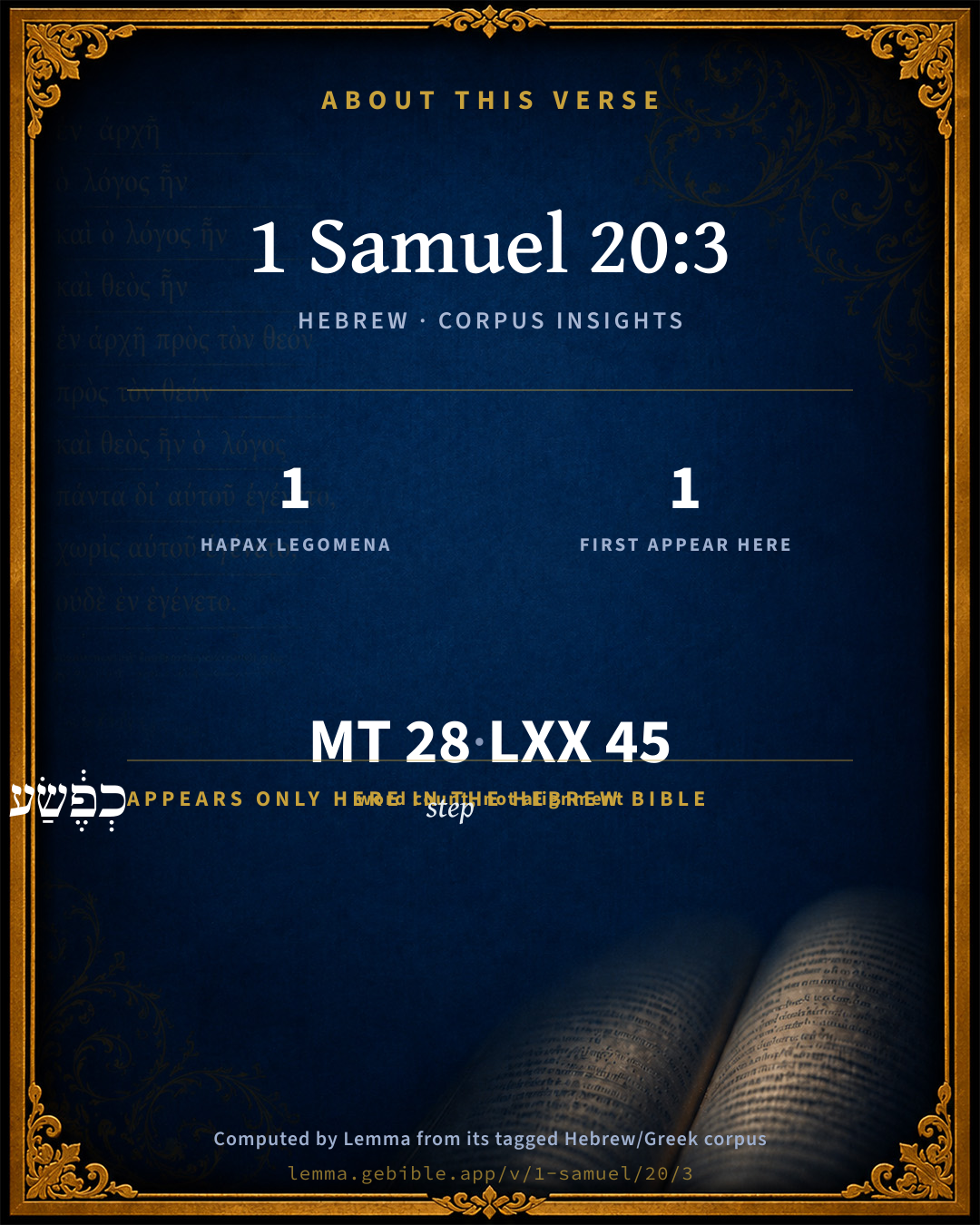
  • 1 hapax legomenon — only here in the Hebrew Bible
  • 1 first appearance in the Hebrew Bible
Full analysis ↓
Download a study sheet

One document with this verse’s original text, its word-by-word gloss line, the meaning frame, cross-references with their text, attributed commentary, and full source and license credits — printable, and it pastes into notes with its structure intact.

This verse Autodidact and up

Study sheet (.html) Plain text (.txt)

A passage Seminary Student

Up to 50 verses in one chapter. A passage sheet keeps up to 6 commentary sources and 12 cross-references per verse, in the order this page ranks them, and says so on the sheet whenever that leaves anything out. Ask for a single verse and you get the Autodidact verse sheet above.

Everything on this page stays free to read, with no account — the sheet is a download of what is already on screen, not access to it.

Want to remove ads? Support Godless Engineer
Compare translations 3

The same verse in 3 English versions, stacked beneath the original-language interlinear above. Click any original word for its lexicon entry.

Each is an independent rendering of the whole verse — the interlinear is not word-aligned to these translations.

Highlighted words mark where these versions differ — a whole-verse word diff, not a word-by-word alignment.

  • World English Bible Public Domain
    David swore moreover, and said, Your father knows well that I have found favor in your eyes; and he says, Don't let Jonathan know this, lest he be grieved: but truly as Yahweh lives, and as your soul lives, there is but a step between me and death.
  • King James Version Public Domain
    And David sware moreover, and said, Thy father certainly knoweth that I have found grace in thine eyes; and he saith, Let not Jonathan know this, lest he be grieved: but truly as the LORD liveth, and as thy soul liveth, there is but a step between me and death.
  • unfoldingWord Literal Text CC BY-SA 4.0
    And David swore besides and said, “Knowing, your father knows that I have found favor in your eyes. So he said, ‘May Jonathan not know this, lest he be grieved.’ But indeed, the life of Yahweh, and the life of your soul, surely like a step between me and between death!”

unfoldingWord Literal Text — © unfoldingWord, licensed CC BY-SA 4.0. Word-aligned USFM3 via Door43 (git.door43.org/unfoldingWord/en_ult).

Versions to compare (up to 4)

3 of 4 selected

Show all 18 translations

Every available English version of this verse, each an independent rendering of the whole verse.

  • World English Bible Public Domain
    David swore moreover, and said, Your father knows well that I have found favor in your eyes; and he says, Don't let Jonathan know this, lest he be grieved: but truly as Yahweh lives, and as your soul lives, there is but a step between me and death.
  • Berean Standard Bible Public Domain
    But David again vowed, “Your father knows very well that I have found favor in your eyes, and he has said, ‘Jonathan must not know of this, or he will be grieved.’ As surely as the LORD lives and as you yourself live, there is but a step between me and death.”
  • Majority Standard Bible Public Domain
    But David again vowed, “Your father knows very well that I have found favor in your eyes, and he has said, ‘Jonathan must not know of this, or he will be grieved.’ As surely as the LORD lives and as you yourself live, there is but a step between me and death.”
  • King James Version Public Domain
    And David sware moreover, and said, Thy father certainly knoweth that I have found grace in thine eyes; and he saith, Let not Jonathan know this, lest he be grieved: but truly as the LORD liveth, and as thy soul liveth, there is but a step between me and death.
  • American Standard Version (1901) Public Domain
    And David sware moreover, and said, Thy father knoweth well that I have found favor in thine eyes; and he saith, Let not Jonathan know this, lest he be grieved: but truly as Jehovah liveth, and as thy soul liveth, there is but a step between me and death.
  • Revised Version (1885) Public Domain
    And David sware moreover, and said, Thy father knoweth well that I have found grace in thine eyes; and he saith, Let not Jonathan know this, lest he be grieved: but truly as the LORD liveth, and as thy soul liveth, there is but a step between me and death.
  • Geneva Bible (1599) Public Domain
    And Dauid sware againe and sayd, Thy father knoweth that I haue found grace in thine eyes: therefore he thinketh, Ionathan shall not knowe it, lest he be sorie: but in deede, as the Lord liueth, and as thy soule liueth, there is but a step betweene me and death.
  • Douay-Rheims (1899) Public Domain
    And he swore again to David. And David said: Thy father certainly knoweth that I have found grace in thy sight, and he will say: Let not Jonathan know this, lest he be grieved. But truly as the Lord liveth, and thy soul liveth, there is but one step (as I may say) between me and death.
  • Young's Literal Translation Public Domain
    And David sweareth again, and saith, `Thy father hath certainly known that I have found grace in thine eyes, and he saith, Let not Jonathan know this, lest he be grieved; and yet, Jehovah liveth, and thy soul liveth, but -- as a step between me and death.'
  • Literal Standard Version CC BY-SA 4.0
    And David swears again and says, “Your father has certainly known that I have found grace in your eyes, and he says, Do not let Jonathan know this, lest he is grieved; and yet, YHWH lives, and your soul lives, but—as a step between me and death.”
  • Unlocked Literal Bible CC BY-SA 4.0
    Yet David vowed again and said, “Your father knows well that I have found favor in your eyes. He has said, 'Do not let Jonathan know this, or he will be grieved.' But as truly as Yahweh lives, and as you live, there is but a step between me and death.”
  • unfoldingWord Literal Text CC BY-SA 4.0
    And David swore besides and said, “Knowing, your father knows that I have found favor in your eyes. So he said, ‘May Jonathan not know this, lest he be grieved.’ But indeed, the life of Yahweh, and the life of your soul, surely like a step between me and between death!”
  • Darby Bible Public Domain
    And David swore again and again, and said, Thy father certainly knows that I have found favour in thy sight: and he has thought, Jonathan shall not know this, lest he be grieved; but truly [as] Jehovah liveth, and [as] thy soul liveth, there is but a step between me and death.
  • World Messianic Bible Public Domain
    David swore moreover, and said, “Your father knows well that I have found favor in your eyes; and he says, ‘Don’t let Jonathan know this, lest he be grieved;’ but truly as the LORD lives, and as your soul lives, there is but a step between me and death.”
  • Webster's Bible Public Domain
    And David swore moreover, and said, Thy father certainly knoweth that I have found grace in thy eyes; and he saith, Let not Jonathan know this, lest he should be grieved: But truly as the LORD liveth, and as thy soul liveth, there is but a step between me and death.
  • Free Bible Version CC BY-SA 4.0
    But David swore an oath again, saying, “Your father knows very well that I'm your friend, and so he's told himself, ‘Jonathan can't find out about this, otherwise he'll be really upset.’ I swear on the life of the Lord, and on your own life, my life is hanging by a thread.”
  • Bible in Basic English Public Domain
    But David took his oath again and said, Your father sees that I am dear to you; so he says to himself, Let Jonathan have no idea of this, for it will be a grief to him; but as the Lord is living, and as your soul is living, there is only a step between me and death.
  • JPS Tanakh (1917) Public Domain
    And David swore moreover, and said: 'Thy father knoweth well that I have found favour in thine eyes; and he saith: Let not Jonathan know this, lest he be grieved; but truly as the LORD liveth, and as thy soul liveth, there is but a step between me and death.'

Literal Standard Version (2020), Covenant Press — licensed CC BY-SA 4.0. Text via the HelloAO Bible API (eBible.org). Unlocked Literal Bible (unfoldingWord) — licensed CC BY-SA 4.0. Text via the HelloAO Bible API (eBible.org). unfoldingWord Literal Text — © unfoldingWord, licensed CC BY-SA 4.0. Word-aligned USFM3 via Door43 (git.door43.org/unfoldingWord/en_ult). Free Bible Version, Dr. Jonathan Gallagher — licensed CC BY-SA 4.0. Text via the HelloAO Bible API (eBible.org).

Word by word

More ways to search: Search by grammar → Find every occurrence → Compare this word →

Practice this passage: Drill this verse → Learn its vocabulary →

כְפֶ֔שַׂע
pesaʻ
H6587
“like/as · step”
Preposition + Noun, Common, Masculine, Singular, Absolute
Part of Speech
Preposition + Noun
Type
Common
Gender
Masculine
Number
Singular
State
Absolute
Full BDB Definition

Origin: from H6585

TWOT: 1841a

step
  1. וַיִּשָּׁבַ֨ע shâbaʻ H7650 “and · to swear” Conjunction + Verb, Niphal, Sequential Imperfect, 3rd Person, Masculine, Singular
  2. ע֜וֹד ʻôwd H5750 “still” Adverb
  3. דָּוִ֗ד Dâvid H1732 “David” Noun, Proper
  4. וַיֹּ֨אמֶר֙ ʼâmar H559 “and · to say” Conjunction + Verb, Qal, Sequential Imperfect, 3rd Person, Masculine, Singular
  5. יָדֹ֨עַ yâdaʻ H3045 “to know” Verb, Qal, Infinitive Absolute
  6. יָדַ֜ע yâdaʻ H3045 “to know” Verb, Qal, Perfect, 3rd Person, Masculine, Singular
  7. אָבִ֗יךָ ʼâb H1 “father · your” Noun, Common, Masculine, Singular, Construct + Suffix, Personal, 2nd Person, Masculine, Singular
  8. כִּֽי kîy H3588 “that” Conjunction
  9. מָצָ֤אתִי mâtsâʼ H4672 “to find” Verb, Qal, Perfect, 1st Person, Common, Singular
  10. חֵן֙ chên H2580 “grace” Noun, Common, Masculine, Singular, Absolute
  11. בְּעֵינֶ֔יךָ ʻayin H5869 “in/at · eyes · your” Preposition + Noun, Common, Both, Dual, Construct + Suffix, Personal, 2nd Person, Masculine, Singular
  12. וַיֹּ֛אמֶר ʼâmar H559 “and · to say” Conjunction + Verb, Qal, Sequential Imperfect, 3rd Person, Masculine, Singular
  13. אַל ʼal H408 “not” Particle, Negative
  14. יֵֽדַע yâdaʻ H3045 “to know” Verb, Qal, Jussive, 3rd Person, Masculine, Singular
  15. זֹ֥את zôʼth H2063 “this” Pronoun, Demonstrative, Feminine, Singular
  16. יְהוֹנָתָ֖ן Yᵉhôwnâthân H3083 “Jonathan” Noun, Proper
  17. פֶּן pên H6435 “lest” Conjunction
  18. יֵֽעָצֵ֑ב ʻâtsab H6087 “to pain” Verb, Niphal, Imperfect, 3rd Person, Masculine, Singular
  19. וְאוּלָ֗ם ʼûwlâm H199 “and · but” Conjunction + Adverb
  20. חַי chay H2416 “living” Adjective, Adjective, Masculine, Singular, Absolute
  21. יְהוָה֙ Yᵉhôvâh H3068 “LORD” Noun, Proper
  22. וְחֵ֣י chay H2416 “and · living” Conjunction + Adjective, Adjective, Masculine, Singular, Absolute
  23. נַפְשֶׁ֔ךָ nephesh H5315 “soul · your” Noun, Common, Both, Singular, Construct + Suffix, Personal, 2nd Person, Masculine, Singular
  24. כִּ֣י kîy H3588 “that” Conjunction
  25. בֵּינִ֖י bêyn H996 “between · me” Preposition + Suffix, Personal, 1st Person, Common, Singular
  26. וּבֵ֥ין bêyn H996 “and · between” Conjunction + Preposition
  27. הַמָּֽוֶת mâveth H4194 “the · death” Particle, Definite Article + Noun, Common, Masculine, Singular, Absolute

About this verse

These counts appear in no published source. They are computed here, from the morphology-tagged text and Lemma’s own curated glosses. What Lemma adds →

28
words
22
distinct lemmas
Historical
section

Notable vocabulary

1 hapax legomenon — a word that appears only here in the entire Hebrew Bible:

  • כְפֶ֔שַׂע step H6587

First appearance in Scripture

This word makes its first canonical appearance in the Hebrew Bible here:

  • כְפֶ֔שַׂע step H6587

Shared distinctive vocabulary

יֵֽעָצֵ֑ב to pain H6087 occurs in 17 verses of the Hebrew Bible. Also found in:

Grammatical profile

  • 8 verbs
  • 9 nouns
  • 2 adjectives
  • 1 pronoun
  • 2 prepositions
  • 3 conjunctions
  • 2 adverbs
  • 1 particle

Verb forms

  • וַיִּשָּׁבַ֨ע Niphal · Sequential Imperfect
  • וַיֹּ֨אמֶר֙ Qal · Sequential Imperfect
  • יָדֹ֨עַ Qal · Infinitive Absolute
  • יָדַ֜ע Qal · Perfect
  • מָצָ֤אתִי Qal · Perfect
  • וַיֹּ֛אמֶר Qal · Sequential Imperfect
  • יֵֽדַע Qal · Jussive
  • יֵֽעָצֵ֑ב Niphal · Imperfect

Repetition

Words recur within this verse — often emphatic in Hebrew:

  • יָדֹ֨עַ to know H3045 ×3
  • וַיֹּ֨אמֶר֙ to say H559 ×2
  • חַי living H2416 ×2
  • בֵּינִ֖י between H996 ×2
  • כִּֽי that H3588 ×2

Hebrew & Septuagint length

In English translation the verse runs 48 words from the Hebrew and 52 from the Septuagint (LXX English) — closely comparable.

A rough comparison of the two English renderings, which tokenize alike — not a word-level alignment.

Word counts can differ between the Hebrew and the Greek without any difference in meaning — e.g. the Hebrew direct-object marker אֵת has no separate Greek word, and Greek often adds the article ὁ.

In the original languages it is 28 Hebrew tokens and 45 Greek tokens — but the two are counted differently (Hebrew bundles its prefixes and suffixes into one token; the Greek is in lemma form), so that isn’t a like-for-like length.

Cross-references

16

Topical passages linked to 1 Samuel 20:3 in the Treasury of Scripture Knowledge — connected by theme and wording, ordered by reader-vote popularity; previews shown in the World English Bible.

  • Deuteronomy 6:13 You shall fear Yahweh your God; and him shall you serve, and shall swear by his name.
  • 1 Samuel 25:26 Now therefore, my lord, as Yahweh lives, and as your soul lives, seeing Yahweh has withheld you from blood guiltiness, and from avenging yourself with your own hand, now therefore let your enemies, and those who seek evil to my lord, be as Nabal.
  • 1 Samuel 27:1 David said in his heart, I shall now perish one day by the hand of Saul: there is nothing better for me than that I should escape into the land of the Philistines; and Saul will despair of me, to seek me any more in all the borders of Israel: so shall I escape out of his hand.
  • 2 Kings 2:6 Elijah said to him, "Please wait here, for Yahweh has sent me to the Jordan." He said, "As Yahweh lives, and as your soul lives, I will not leave you." They two went on.
  • 1 Samuel 1:26 She said, Oh, my lord, as your soul lives, my lord, I am the woman who stood by you here, praying to Yahweh.
  • 2 Kings 2:2 Elijah said to Elisha, Please wait here, for Yahweh has sent me as far as Bethel. Elisha said, As Yahweh lives, and as your soul lives, I will not leave you. So they went down to Bethel.
  • 2 Kings 2:4 Elijah said to him, Elisha, please wait here, for Yahweh has sent me to Jericho. He said, As Yahweh lives, and as your soul lives, I will not leave you. So they came to Jericho.
  • Deuteronomy 28:66 and your life shall hang in doubt before you; and you shall fear night and day, and shall have no assurance of your life.
  • 1 Samuel 17:55 When Saul saw David go forth against the Philistine, he said to Abner, the captain of the host, Abner, whose son is this youth? Abner said, As your soul lives, O king, I can't tell.
  • 2 Samuel 15:21 Ittai answered the king, and said, As Yahweh lives, and as my lord the king lives, surely in what place my lord the king shall be, whether for death or for life, even there also will your servant be.
  • Psalms 116:3 The cords of death surrounded me, The pains of Sheol got a hold of me. I found trouble and sorrow.
  • Jeremiah 4:2 and you shall swear, As Yahweh lives, in truth, in justice, and in righteousness; and the nations shall bless themselves in him, and in him shall they glory.
  • Jeremiah 38:16 So Zedekiah the king swore secretly to Jeremiah, saying, As Yahweh lives, who made us this soul, I will not put you to death, neither will I give you into the hand of these men who seek your life.
  • 1 Corinthians 15:30–31 Why do we also stand in jeopardy every hour?
  • 2 Corinthians 1:9–10 Yes, we ourselves have had the sentence of death within ourselves, that we should not trust in ourselves, but in God who raises the dead,
  • Hebrews 6:16 For men indeed swear by a greater one, and in every dispute of theirs the oath is final for confirmation.

Cross-references courtesy of OpenBible.info (CC BY 4.0).

Hebrew and Greek witnesses Masoretic Hebrew ↔ Greek Septuagint

The same verse in the two great witnesses to the Old Testament, shown verse-for-verse.

These are two independent witnesses, not word-aligned to each other, and the Septuagint is shown in lemma (dictionary) form.

Hebrew 1 Samuel 20:3 Masoretic · Westminster Leningrad Codex

וַיִּשָּׁבַ֨ע ע֜וֹד דָּוִ֗ד וַיֹּ֨אמֶר֙ יָדֹ֨עַ יָדַ֜ע אָבִ֗יךָ כִּֽי מָצָ֤אתִי חֵן֙ בְּעֵינֶ֔יךָ וַיֹּ֛אמֶר אַל יֵֽדַע זֹ֥את יְהוֹנָתָ֖ן פֶּן יֵֽעָצֵ֑ב וְאוּלָ֗ם חַי יְהוָה֙ וְחֵ֣י נַפְשֶׁ֔ךָ כִּ֣י כְפֶ֔שַׂע בֵּינִ֖י וּבֵ֥ין הַמָּֽוֶת

David swore moreover, and said, Your father knows well that I have found favor in your eyes; and he says, Don't let Jonathan know this, lest he be grieved: but truly as Yahweh lives, and as your soul lives, there is but a step between me and death.

World English Bible · Public Domain

Greek LXX 1 Samuel 20:3 Septuagint · lemma form

καί ἀποκρίνω δαυίδ ὁ ιωναθαν καί εἶπον γιγνώσκω οἶδα ὁ πατήρ σύ ὅτι εὑρίσκω χάρις ἐν ὀφθαλμός σύ καί εἶπον μή γιγνώσκω οὗτος ιωναθαν μή οὐ βούλομαι ἀλλά ζάω κύριος καί ζάω ὁ ψυχή σύ ὅτι καθώς εἶπον ἐνπλήθω ἀνά μέσος ἐγώ καί ὁ θάνατος

And David answered Jonathan, and said, Your father knows surely that I have found grace in your sight, and he said, Let not Jonathan know this, lest he refuse his consent: but as the Lord lives and your soul lives, as I said, the space is filled up between me and death.

LXX2012 (modern English Septuagint) · Public Domain

On this verse, Haydock's Catholic Bible Commentary discusses the Septuagint’s reading. Read the note in Commentary ↓

Hebrew: Westminster Leningrad Codex (CC BY 4.0). Greek: Septuagint (public domain); English from LXX2012 (modern English Septuagint) (Public Domain). How the Septuagint differs from the Hebrew →

Targum (Aramaic paraphrase)

1

The Targum is the ancient Jewish Aramaic paraphrase of the Hebrew Scriptures — an interpretive translation, not the Hebrew text itself. Onkelos (literal) and Pseudo-Jonathan (expansive) render the Torah, and Jonathan the Prophets. Coverage is partial: where no permissively-licensed English translation exists for a verse, only the Aramaic is shown. This is verse-level text, not a word-by-word alignment to the Hebrew.

  1. Targum Jonathan Prophets (Joshua–Malachi)
    וְקַיֵם עוֹד דָוִד וַאֲמַר מִדַע יְדַע אֲבוּךְ אֲרֵי אַשְׁכְּחִית רַחֲמִין בְּעֵינָךְ וַאֲמַר לָא יְדַע דָא יְהוֹנָתָן דִלְמָא יִתְנְסֵיס וּבְרַם קַיָם הוּא יְיָ וְחַיֵי נַפְשָׁךְ אֲרֵי כְפִסְעָא חֲדָא בֵּינָא וּבֵין מוֹתָא:

    (no public-domain English translation for this verse)

    Targum Jonathan — Aramaic: “Mikraot Gedolot” (public domain). English: “Sefaria Community Translation” (CC0 1.0 (public-domain dedication)); “London "Chaldee Paraphrase," 1871” (public domain). Text via Sefaria.

Commentary

Notes on 1 Samuel 20:3 from classic Christian and Jewish commentators (each source and its license shown beneath its notes). The classic Christian expositions comment on the surrounding passage and are grouped to its opening verse, so a note may address several verses; the Jewish commentaries on the Tanakh (Rashi and others) are per-verse, so they appear only where the commentator wrote on this verse.

Lemma curates 59 commentaries, every one of them public domain or Creative Commons licensed, each selected and text-cleaned for this edition rather than reprinted as found. About our sources →

Trapp's Complete Commentary

John Trapp

1Sa 20:3 And David sware moreover, and said, Thy father certainly knoweth that I have found grace in thine eyes; and he saith, Let not Jonathan know this, lest he be grieved: but truly [as] the LORD liveth, and [as] thy soul liveth, [there is] but a step between me and death.

Ver. 3. And David sware moreover.] Since Jonathan was so hard of belief, and the matter of so great importance, for better assurance David gave him, as he might do, a private oath. Ex animi sui sententia, was instead of such an oath among the heathens.

But truly as the Lord liveth, and as thy soul liveth,] i.e., By the life of God; that is his oath: and, As sure as thou art alive; that is his asseveration added to his oath. See the like, 1Sa 1:26; 1Sa 17:55; 2Sa 11:11; 2Sa 14:19 Jer 31:3.

There is but a step between me and death.] Praesentissimum est periculum meum in quo versor, {a} As we use to say of seafaring men, that there is but an inch board, or a handbreadth between them and death, and that they have fortunam rudentibus aptam, their estates hanging on ropes; so is it with man in his best estate; o quam exigui sunt mortalium termini! o quam exigui sunt mortalium animi! but especially with such as are proscribed and sought after to be slaughtered. But here David’s faith began to flag, as indeed it is a hard thing for the best faith, after long and sharp trial, not to buckle and hang the wing: Adeo nihil est in nobis magni, quod non queat minui; adeo nihil est ex omni parte beatum.

{a} Jun.

John Trapp, A Commentary or Exposition upon All the Books of the Old and New Testament (1647–1656) — public domain. Text from a community e-Sword module.

The Biblical Illustrator

Joseph S. Exell

1Sa_20:3

There is but a step between me and death.

Solemn News

Notice the views and feelings that will naturally possess a man who believes there is but a step between him and death, or that his end is near.

I. The world, with its pleasures, pursuits, and prospects, will, appear small. The mask is taken off now.

II. He will feel that his own personal salvation is to him above all things else in point of importance.

III. Next to his own salvation in point of importance, will be that of his family.

IV. He will not feel at home in the company of the wicked, or in any pursuit or pleasure upon which he could not ask the blessing of God.

V. He will desire to settle all, disputes and old grudges, and forgive his enemies.

VI. A man who believes there is but a step between him and death will desire to make his will. (T. Kelly.)

But a step

This was Davids description of his own condition. King Saul was seeking to destroy him. The bitter malice of that, king would not be satisfied with anything short of the blood of his rival.

1. There is a sense in which this text is no doubt literally true of every man--There is but a step between me and death; for life is so short that it is no exaggeration to compare it to a step.

2. But, in another sense, there is but a step between us and death, namely, that life is so uncertain. How unexpectedly it ends.

3. And this is all the more true when we consider that there are so many gates to the grave. We can die anywhere, at any time, by any means. Not alone abroad are we in danger, but at home in security we are still in peril. Wherever you are, you may well feel, There is but a step between me and death.

II. That to some this is specially true. To persons who have reached a ripe old age this is most certainly true: There is but a step between me and death? Now, do not object to think about it and talk about it. If you are all right with God, it can be no trouble to you to remember that as your years multiply, there must be so many the fewer in which you are to abide here below.

III. Suppose it is not so. There may be some here that will live to a very great age. Well, what then? If so, I should recommend you to follow the Scriptural advice, Seek ye first the kingdom of God, and His righteousness. Suppose that it is not true that there is but a step between you and death; nevertheless, while death is at a distance, health and strength furnish the best time for coming to Christ.

IV. But now suppose that it is so. Suppose that it is so, and suppose, as yet, that you have no good hope. If there is but a step between you and death, yet there is only a step between you and Jesus. There is only a step between you and salvation. God help you to take that step. Suppose that it is so, that you are moon to die; then set your house in order. (C. H. Spurgeon.)

The mystic stop

.

I. It is a certain step. All must take it.

II. It is an uncertain step.

1. When we must take it we cannot tell.

2. Where we must take it is altogether hid from us.

III. It is a final step. It is final because it puts an end to human distinctions.

IV. It is a parting step.

1. It parts us from this world of matter. We must bid farewell to flower and star.

2. It parts us from friends near and dear to us.

3. It parts us from ourselves. That tender union that subsists between soul and body is rudely torn asunder,

V. It is a solitary step. Death is a lonely thing.

VI. It is altogether a solemn step.

1. The step of birth is solemn.

2. The step of prayer is solemn.

3. Not less solemn is the step of death. Lord, prepare me for taking this step. (J. Dunlop.)

The nearness of death

This is true physically, morally, socially, influentially.

1. Physically--Breath is in the nostrils; we know not our narrow escapes from death; the point of a needle may destroy the life of the body, etc.

2. Morally--Character may be ruined in a moment; one sin broke up human history into ruin and sorrow, etc.

3. Socially--When character is ruined, society is closed against a man, etc.

4. Influentially--A mans influence should be the measure of his moral standing; by one false step influence may be impaired or destroyed. The fact that there is but a step between life and death should do five things:--

I. It should give high significance and value to time. Whatsoever thy hand findeth to do, etc.

II. It should awaken the most anxious vigilance. Only one step, and it may be the next!

III. It should stimulate to preparedness for the future.

IV. It should impart a tenderer interest to all the relationships of life.

V. It should lead to the right use of temporal possessions. (J. Parker, D. D.)

Certainty of death

it was seemingly true concerning David.

1. This teaches us how liable we are to be wrong in our judgments. We can only judge from appearances; therefore we should draw all inferences of importance with caution.

2. Yet this judgment of Davids, perhaps, was the instrumental cause of his preservation. It made him cautious. Thus Providence sports with our calculations; man knoweth not his appointed time, but is like the fishes ensnared in an evil net.

II. The text is really true concerning some individuals now in the world.

1. Let us in the first place look at the great number of the sick scattered over the face of this well-peopled world.

2. Go into the gloomy ceils of condemned criminals, whose life must, pay the forfeit of their crimes on the coming morning.

3. Look at the combatants that are now preparing for deadly battle; their countrys cause palpitates at their heart, and burns on their tongue. They are destined to fall in the struggle.

4. Listen to the cries of those mariners in distress; they are going up to the heavens, and now down to the depths.

5. View those men of apoplectic structure. How precarious the hold they have of life! Fresh and hale one minute--the next dead.

III. The declaration in the text may be true with regard to some of us.

1. Sentence of death has been passed on all men.

2. This sentence has never been repealed. It has not become obsolete; it is not like the antiquated page of an almanac of past times.

3. But this respite is not for any given length of time. It is frugally extended only from moment to moment. A respited criminal knows the length of his respite; we do not. (T. Macconnel.)

The Biblical Illustrator, edited by Joseph S. Exell (c. 1880s–1900s) — public domain. Text from a community e-Sword module.

Joseph Benson's Commentary

1Sa 20:3. David sware moreover — The matter being of great moment, and Jonathan doubting the truth of it, he confirms his word with an oath, which follows in the end of the verse. Only he interposeth a reason why Saul concealed it from Jonathan. Let not Jonathan know this, lest he be grieved — What a noble and generous turn does David here give to the behaviour of Saul to Jonathan, lest he should think ill of his father, by insinuating that he had kept this a secret from him out of affection, lest it should give him pain.

Joseph Benson's Commentary on the Old and New Testaments (1811–1818) — public domain. Text from a community e-Sword module.

Geneva Bible (1599)

Geneva Bible translators

I am in great danger of death.

Geneva Bible (1599) marginal notes — public domain. Text via Bolls.life.

Adam Clarke's Commentary

Verse 3. There is but a step between me and death.] My life is in the most imminent danger. Your father has, most assuredly, determined to destroy me.

The same figure used here, there is but a step between me and death, may be found in Juvenal, who, satirizing those who risk their lives for the sake of gain in perilous voyages, speaks thus: -

I nune et ventis animam committe, dolato

Confisus ligno, digitis a morte remotus

Quatuor aut septem, si sit latissima teda.

SAT. xii., ver. 57.

"Go now, and commit thy life to the winds, trusting to a hewn plank, four or seven fingers thick, if the beam out of which it has been cut have been large enough."

Adam Clarke's Commentary on the Bible (1810–1826) — public domain. Text from a community e-Sword/MySword module.

Ellicott's Commentary for English Readers

(3) Thy father certainly knoweth that I have found grace in thine eyes.—David urges that his fall, and even his death, had been decided upon by Saul, who, knowing how Jonathan loved him, would shrink from confiding to his son his deadly plans respecting his loved friend. David, with his clear, bright intellect, looked deeper into Saul’s heart than did the heroic, guileless son. He recognised only too vividly the intensity of the king’s hatred of him; and we see in the next verse that the mournful earnestness of the son of Jesse had its effect upon the prince, who consented to make the public trial of Saul’s real mind which his friend asked for.

A Bible Commentary for English Readers, edited by Charles John Ellicott (1878–1897) — public domain. Text from a community e-Sword module.

The Cambridge Bible for Schools and Colleges

gen. ed. J. J. S. Perowne

3. And David sware moreover] Added an oath to the assertion in 1Sa_20:1. The Sept. however reads simply, “And David answered Jonathan and said.”

Thy father certainly knoweth, &c.] Jonathan’s confidence that Saul would tell him all beforehand clearly implies that be supposed his father to be ignorant of the close friendship between him and David. David undeceives him on this point.

there is but a step, &c.] He stands, as it were, upon the very brink of a precipice.

The Cambridge Bible for Schools and Colleges (gen. ed. J. J. S. Perowne; Cambridge University Press, 1878–1918) — public domain. Text from a community e-Sword module.

John Gill's Exposition

And David sware moreover, and said,.... To assure Jonathan of the truth of it, that he did most certainly seek after his life, of which, as he had no doubt himself, by an oath he endeavoured to remove any that might be in Jonathan, who was not willing to believe his father could be guilty of so foul a crime:

thy father certainly knoweth that I have found grace in thine eyes: that he was high in his favour, that he had a great value for him, and he had a large share in his love and friendship, and that was the reason why he hid from him his base intentions:

and he saith, let not Jonathan know this, lest he be grieved; as he would be, both for the evil his father would be guilty of, and the danger David, his beloved friend, would be in:

but truly, as the Lord liveth, and as thy soul liveth, there is but a step between me and death; as appeared by his casting a javelin at him, Sa1 18:11, sending messengers to his own house to slay him, Sa1 19:11, and others to Naioth to seize him, Sa1 19:20, and coming himself thither with an intention to kill him, Sa1 19:22, and in each of these instances he had a narrow escape for his life; and this he declared in the most solemn manner by an oath, for the confirmation of the truth of it to Jonathan.

John Gill's Exposition of the Whole Bible (1746–1763) — public domain (CC PDM 1.0). Text via the HelloAO Bible API.

Albert Barnes' Notes on the Bible

And David sware moreover - Rather, “yet again.” He met Jonathan’s denial by repeating his statement and confirming it with an oath.

Albert Barnes' Notes on the Bible (1834–1885) — public domain. Text from a community e-Sword/MySword module.

Haydock's Catholic Bible Commentary

As I may say, is not in Hebrew. Septuagint, "the space between me and thy father is filled up, unto death." We can never more have any union, nor dwell together in safety. (Haydock)

George Leo Haydock (1774–1849), Haydock's Catholic Family Bible and Commentary, 1859 edition — public domain. Excludes Psalms (Douay-Rheims chapter numbering differs from Protestant) and Deuterocanonical books (Catholic canon only).

Matthew Poole's English Annotations

The matter being of great moment, and Jonathan doubting the truth of it, David confirms his word with an oath, which follows in the end of the verse; only he interposeth a reason why Saul concealed it from Jonathan.

Matthew Poole's English Annotations on the Holy Bible (1683–1685) — public domain. Text from a community e-Sword/MySword module.

The Pulpit Commentary

Vers. 3, 4. Thy father certainly knoweth, etc. Though Saul did not know the entireness of Jonathan"s love for David, yet he was aware of the friendship that existed between them, and consequently might keep his purpose a secret from Jonathan, especially if he considered that his frankness in speaking openly to his son and servants on a previous occasion had led to David"s escape. David, therefore, urges upon his friend a different course, to which he assents. But how are we to explain the entirely different views taken of Saul"s conduct by the two. When David tells his fears Jonathan utters an exclamation of horror, and says, "Thou shalt not die." Yet he knew that his father had talked to him and his Officers about putting David to death; that he had tried to kill him with his own hand, and on his escape had set people to watch his house with orders to slay him; and on David"s flight to the prophet had thrice sent emissaries to bring him away by force. The explanation probably lies in Saul s insanity. When he threw his javelin at David and during the subsequent proceed. ings he was out of his mind. The violent fit at Naioth had for the time cleared his reason, and he had come back sane. Jonathan regarded all that had taken place as the effect of a mind diseased, and concluded, therefore, that David might now return to his home and wife, and resume his duties and take his place at the royal table. Should the old craze come back about David being his rival and destined successor, Saul would be sure to talk about it, and then Jonathan would give him timely warning. But David was convinced that it was no craze, but that Saul, sane or insane, had determined upon his death.

Ver. 3. (GIBEAH.)

Only a step.

Our path in life lies along the brink of a river or the edge of a cliff; and we may by a step a single step at any moment meet our fate. The asseveration of David may be regarded as the expression of a strong conviction ("As Jehovah liveth," etc.) of

I THE SOLEMNITY OF DEATH. The event is a serious one. To leave familiar scenes and beloved friends, to "be missed" from our accustomed place is a saddening thought. But what gives solemnity to death as well as life is its moral aspect, its spiritual and Divine relations.

1. It terminates our earthly probation severs our immediate connection with the privileges, means, and opportunities by which character is proved and the soul prepared for another state. When this step is taken, all these things belong to the past.

2. It ushers us into the Divine presence; no longer partially concealed by the veil of material things, but fully revealed in light, which reveals the moral attitude of every human spirit and judges it "in righteousness." "After death" (and following close upon it) "the judgment". (Heb_9:28) "We must all be manifest before the judgment seat of Christ," etc. (2Co_5:10)

3. It fixes our future destiny, in weal or woe. "What is a man profited," etc.

II THE UNCERTAINTY OF LIFE. The step must be taken, but when we know not. That we may be duly impressed by a truth which all admit, hut few adequately realise, consider

1. The frailty of the body, and the innumerable dangers to which it is exposed. "Between us and hell or heaven there is nothing but life, the most fragile thing in existence (Pascal).

2. The facts of daily observation. What occurs to others so often, so suddenly and unexpectedly, may occur to ourselves. We have no guarantee that it will not. "Man"s uncertain life is like a raindrop on the bough, amid ten thousand of its sparkling kindred, and at any moment it may fall.

3. The declarations of the Divine word. "Man knoweth not his time," etc. (Ecc_9:12) "Ye know not what shall be on the morrow. For what is your life?" etc.. (Jam_4:14) Why should we be left in suchuncertainty?

(1) To teach us the sovereignty of God and our dependence upon him.

(2) To accord with our present probationary position, which necessitates the proper adjustment of motives to our freedom and responsibility.

(3) To enable us properly to perform the ordinary duties of life, in connection with which we are appointed to serve God here and prepare for his service hereafter.

(4) To check presumption in devoting undue attention to the affairs of this life and neglecting those of the life to come.

(5) To lead us not to put the event out of our minds altogether, but rather to constant preparation for it and for the life that lies beyond. "The last day is kept secret that every day may be watched" (Augustine). "Take ye heed, watch and pray, for ye know not when the time is". (Mar_13:33) "Be ye therefore ready also, etc.. (Luk_12:40)

III THE NECESSITY OF WATCHFUL PREPARATION. Seeing that at any instant the step may be taken, it plainly behoves us to be always ready.

1. By seeking and maintaining a right state of heart. (Joh_3:2, Joh_3:14)

2. By diligent, faithful, and persevering performance of duty.

3. By constant and prayerful committal of our souls into the hands of God. So, whenever the step is taken, it will be "only a step" out of the shadows and sorrows Of earth into the glory and joy of heaven. D.

HOMILIES BY D. FRASER Ver. 3.

Mortal peril.

Brave men have their times of depression, and believing men have their fits of discouragement. Of David"s courage there could be no question. He had faced death without flinching, both in defence of his flock from beasts of prey, and for the deliverance of Israel from the boastful Philistine. Yet he now recoiled, saying, "There is but a step between me and death." He felt as on the edge of a precipice. One push, and he was gone. We need not wonder at this; for it is one thing to meet an enemy in the open field, another thing to feel that one"s steps are dogged by treacherous malice, and not know but one may be attacked in his sleep, or struck from behind, or entrapped by some cruel stratagem. Of David"s faith in God there could be just as little question as of his bravery. All the successes he had gained had been triumphs of faith. But temperament goes for something too, and the son of Jesse had the sensitive nature which goes with poetic genius. He was capable of great exultation, but just as capable of sudden discouragement; and when he gave way to a foreboding, melancholy mood, his faith looked like unbelief. The young and healthy cannot, should not, wish to die. We can feel for Henry Kirke White, though his tone was too gloomy, when he wrote, deprecating his early fate

It is hard To feel the hand of Death arrest one"s steps Throw a chill blight o"er all one"s budding hopes, And hurl one"s soul untimely to the shades.

Poets, both heathen and Christian, have often deplored the disease and violence which cast young lives headlong from the precipice. And we regard the youthful David"s recoil from the cruel death which Saul designed for him as quite natural, and in no sense discreditable to his manhood. But there is more than this in his melancholy.

I THE OLD TESTAMENT WAY OF REGARDING DEATH. In the days before Christ, dimness overhung the doctrine of a future existence. "Life and incorruption" had not been brought to light. It was therefore reckoned a blessing to live long in Palestine. It was a sore calamity to die in one"s youth. The soldiers of Israel would encounter death in the excitement of battle; and such prophets as Elijah and Jonah could even wish for death in a hurt and discouraged mood of mind; but, as a rule, even the most devout Hebrews regarded death with sadness and reluctance. No wonder that David, brought up in the ideas of his own age, not of ours, should shrink from the cutting short of his days by violence, just when he had won distinction, and begun to be of service to his nation. The horror of it hung above him for many a day; for even after many wonderful escapes we hear him say, "I shall now perish one day by the hand of Saul." This sadness or reluctance in view of death never left an Old Testament worthy like David except in the hour of battle, or under some such strong emotion as once made him cry, "Would God I had died for thee, O Absalom, my son, my son!" At the end of his career he made express mention in his song of thanksgiving of his deliverance from the "sorrows" and the "snares of death". (2Sa 22) And when we see him in old age, anxiously nursed that his days might be prolonged, we catch no sign of a spirit longing to be free and assured of being with the Lord, such as one expects to find in the latter days of almost any eminent Christian. "Now the days of David drew nigh that he should die, and he charged Solomon his son, saying, I go the way of all the earth." Compare the language in Psa_13:3 Psa_30:9 Psa_88:11; and that of Hezekiah in Isaiah 38. Contrast with this the contempt of death which was admired and often exhibited by the heathen. But the Hebrew feeling on the subject was really the more exalted, as having a perception of the connection of death with sin, and a value for communion with the living God in the land which was his, and therefore theirs, of which the heathen mind knew nothing.

II BRIGHTER VIEW OF DEATH IN THE NEW TESTAMENT.

1. Contrast with the case of David in youth that of Stephen at Jerusalem, evidently young, or in the prime of life. His powers were at the full, and a distinguished career of usefulness among the Hellenist Jews opened before him. Those who entered into controversy with him "were not able to resist the wisdom and the spirit by which he spake." Suddenly the enraged Jews seized him, and dragged him before the Sanhedrim on the capital charge of blasphemy. Well did Stephen know that there was but a step between him and death; but no melancholy fell upon his spirit. "All that sat in the council, looking steadfastly on him, saw his face as it had been the face of an angel.

2. Contrast with the case of David in old age that of "such an one as Paulthe aged," and his feeling when he was "ready to be offered," and the time of his departure was at hand. He too was a man of sensitive temperament, and suffered keenly at times from dejection. He too was careful not to throw his life away. But when there seemed but a step between him and death, what an access of light, what an advance of consolation and hope, had the servant of God in the New Testament over the servant of God in the Old! David said, "I go the way of all the earth." But Paul, "We are confident, and willing rather to be absent from the body and present with the Lord." O happy ending of this troubled life! O welcome escape from fleshly impediment, weariness, temptation, insufficiency, and sorrow!

III CHRIST"S CONTEMPLATION OF HIS OWN DECEASE. He who is the Son of David, and the Lord of Stephen and of Paul, saw in the very prime of youthful manhood that there was but a step between him and death, and that too a death of harsh violence such as his ancestor had feared. There was, however, this difference between "the Man Christ Jesus" and all other men that he knew when, where, and how he should die. It was to be at Jerusalem, and at the time of the feast. He foretold the very day on which he should "be perfected," and indicated that it would be by crucifixion in saying that the Son of man would be "lifted up from the earth." From such knowledge it is well that we are exempt. To know the place, time, and manner of our death would tempt, perhaps, at first to carelessness; and then, as the date came near, would put a strain on our spirits very hard to be borne. Such a strain was upon Christ, and, as the bitter death approached, his spirit was "exceeding sorrowful." As David had his friend Jonathan to show him sympathy and endeavour to drive from his mind the presentiment of death, so Jesus Christ had his disciples, who, as lovers and friends, besought him not to think of dying; but he could not take comfort from them. The cup which his Father had given him to drink, should he not drink it? To him death was gain. He finished all his work and travail, then left the world and went to the Father. "Father, into thy hands I commit my spirit." We have much to learn from David, more from Stephen and Paul, most of all from our Lord Jesus. What if there be but a step between us and death? It is a step which cannot be taken but as, and when, and where our Lord appoints. "Lord Jesus, into thy hands I commit my spirit!" "Absent from the body, present with the Lord. F.

The Pulpit Commentary (1880–1919), ed. H.D.M. Spence-Jones & Joseph S. Exell — public domain. Text from a community e-Sword module.

John Wesley's Explanatory Notes

David swear - The matter being of great moment, and Jonathan doubting the truth of it, he confirms his word with an oath, which follows in the end of the verse. Only he interposeth a reason why Saul concealed it from Jonathan.

John Wesley, Explanatory Notes Upon the Whole Bible (1754–1765) — public domain. Text via the GEBible commentary corpus.

unfoldingWord translationNotes

Door43 World Missions Community

I have found favor in your eyes

Here the eyes represent seeing, and seeing represents thoughts or judgment. AT: "I have pleased you" or "you consider me favorably" (See: Metaphor)

he will be grieved

This can be stated in active form. AT: "this will grieve him" or "he will be very sad" (See: Active or Passive)

there is but a step between me and death

Here "step between me and death" is an idiom that refers to being very close to death. AT: "I am very close to death" (See: Idiom)

translationWords

vow

favor

know

Yahweh

unfoldingWord translationNotes — © Distant Shores Media and the Door43 World Missions Community, licensed CC BY-SA 4.0. Source: git.door43.org/Door43/en_tn.

Rashi

Rabbi Shlomo Yitzchaki (Rashi)

There is but a step. With one step I left from being before him, and he drove the spear into the wall. With that step, I was saved from death.

Rashi on the Tanakh — English translations: “The Judaica Press complete Tanach with Rashi, translated by A. J. Rosenberg” (CC BY 4.0); “Pentateuch with Rashi's commentary by M. Rosenbaum and A.M. Silbermann, 1929-1934” (public domain); “The Metsudah Tanach series, Lakewood, N.J” (CC BY 4.0); and “The Book of Joshua, Metsudah Publications, 1997” (CC BY 4.0). Text via Sefaria.

Lesson kit

Teaching starters — assembled from the data on this page, not authored interpretation. Every prompt links to the verse data it draws on. Edit before teaching.

1 Samuel, in the Historical, opens this verse with 28 words (22 distinct Hebrew lemmas). Its most distinctive word is pesaʻ (“step”). A historical commentator’s framing appears above. Read the whole chapter for the surrounding context.

Discussion questions

  1. The word pesaʻ carries the sense “step.” How does it shape the verse?
  2. 1 word here appears nowhere else in the Hebrew Bible. Why might the author reach for such rare wording?
  3. This is the first place “step” appears in Scripture (first appears here). What does its debut here establish?
  4. How does Genesis 6:6, which shares the word «to pain», read alongside this verse?
  5. What does the repetition of “to know” (3× in this one verse) do in this verse?
  6. These translations render this verse differently; the difference is in the English rendering, not the original. What questions does that raise?
  7. «וַיִּשָּׁבַ֨ע» is a Niphal Sequential Imperfect verb. How does that grammatical form shape the action described?
  8. Compare how Trapp's Complete Commentary and The Biblical Illustrator read this verse. Where do they agree or differ?

Things to notice

  • 1 word in this verse appears nowhere else in the Hebrew Bible.
  • 1 word makes its first canonical appearance in Scripture here.
  • This verse counts 28 Hebrew ↔ 45 Greek words.
  • These translations choose different wording for 25 words in this verse.
  • “to know” occurs 3× in this single verse.

Reading settings

Reading text

Shown beneath each verse's original-language words.

Old Testament
Old Testament edition

Read the OT as the Masoretic Hebrew (MT) or the Greek Septuagint (LXX).

English shown for the Greek Septuagint (in the Hebrew ↔ Greek comparison).

Comparing translations? Open the Compare panel on any verse page to stack up to four side by side.