
1 Samuel 21:2

Hebrew (Westminster Leningrad Codex) 1 Samuel 21:2 appears in the Hebrew Old Testament. The text above is from the Westminster Leningrad Codex. Each word links to its Strong’s number, a concise gloss, and parsing drawn from the Open Scriptures Hebrew Bible morphology. Click any word for its full Brown-Driver-Briggs (BDB) entry.
Download image
Cite this verse

1 Samuel 21:2 (World English Bible). Public Domain. Lemma interlinear Bible study tool, https://lemma.gebible.app/v/1-samuel/21/2.

Show BibTeX & RIS
BibTeX
RIS
English Translation
David said to Ahimelech the priest, The king has commanded me a business, and has said to me, Let no man know anything of the business about which I send you, and what I have commanded you: and I have appointed the young men to such and such a place.
World English Bible · Public Domain
Download a study sheet

One document with this verse’s original text, its word-by-word gloss line, the meaning frame, cross-references with their text, attributed commentary, and full source and license credits — printable, and it pastes into notes with its structure intact.

This verse Autodidact and up

Study sheet (.html) Plain text (.txt)

A passage Seminary Student

Up to 50 verses in one chapter. A passage sheet keeps up to 6 commentary sources and 12 cross-references per verse, in the order this page ranks them, and says so on the sheet whenever that leaves anything out. Ask for a single verse and you get the Autodidact verse sheet above.

Everything on this page stays free to read, with no account — the sheet is a download of what is already on screen, not access to it.

Want to remove ads? Support Godless Engineer
Compare translations 3

The same verse in 3 English versions, stacked beneath the original-language interlinear above. Click any original word for its lexicon entry.

Each is an independent rendering of the whole verse — the interlinear is not word-aligned to these translations.

Highlighted words mark where these versions differ — a whole-verse word diff, not a word-by-word alignment.

  • World English Bible Public Domain
    David said to Ahimelech the priest, The king has commanded me a business, and has said to me, Let no man know anything of the business about which I send you, and what I have commanded you: and I have appointed the young men to such and such a place.
  • King James Version Public Domain
    And David said unto Ahimelech the priest, The king hath commanded me a business, and hath said unto me, Let no man know any thing of the business whereabout I send thee, and what I have commanded thee: and I have appointed my servants to such and such a place.
  • unfoldingWord Literal Text CC BY-SA 4.0
    And David said to Ahimelech the priest, “The king has commanded me a matter and has said to me, ‘May a man not know anything the matter which I am sending you and which I have commanded you.’ And I have informed the young men about a certain unnamed place.

unfoldingWord Literal Text — © unfoldingWord, licensed CC BY-SA 4.0. Word-aligned USFM3 via Door43 (git.door43.org/unfoldingWord/en_ult).

Versions to compare (up to 4)

3 of 4 selected

Show all 18 translations

Every available English version of this verse, each an independent rendering of the whole verse.

  • World English Bible Public Domain
    David said to Ahimelech the priest, The king has commanded me a business, and has said to me, Let no man know anything of the business about which I send you, and what I have commanded you: and I have appointed the young men to such and such a place.
  • Berean Standard Bible Public Domain
    “The king has given me a mission,” David replied. “He told me no one is to know about the mission or charge. And I have directed my young men to meet me at a certain place.
  • Majority Standard Bible Public Domain
    “The king has given me a mission,” David replied. “He told me no one is to know about the mission on which I am sending you. And I have directed my young men to meet me at a certain place.
  • King James Version Public Domain
    And David said unto Ahimelech the priest, The king hath commanded me a business, and hath said unto me, Let no man know any thing of the business whereabout I send thee, and what I have commanded thee: and I have appointed my servants to such and such a place.
  • American Standard Version (1901) Public Domain
    And David said unto Ahimelech the priest, The king hath commanded me a business, and hath said unto me, Let no man know anything of the business whereabout I send thee, and what I have commanded thee: and I have appointed the young men to such and such a place.
  • Revised Version (1885) Public Domain
    And David said unto Ahimelech the priest, The king hath commanded me a business, and hath said unto me, Let no man know any thing of the business whereabout I send thee, and what I have commanded thee: and I have appointed the young men to such and such a place.
  • Geneva Bible (1599) Public Domain
    And Dauid saide to Ahimelech the Priest, The King hath commanded mee a certaine thing, and hath sayd vnto me, Let no man know whereabout I sende thee, and what I haue commanded thee: and I haue appointed my seruants to such and such places.
  • Douay-Rheims (1899) Public Domain
    And David said to Achimelech the priest: The king hath commanded me a business, and said: Let no man know the thing for which thou art sent by me, and what manner of commands I have given thee: and I have appointed my servants to such and such a place.
  • Young's Literal Translation Public Domain
    And David saith to Ahimelech the priest, `The king hath commanded me a matter, and he saith unto me, Let no man know anything of the matter about which I am sending thee, and which I have commanded thee; and the young men I have caused to know at such and such a place;
  • Literal Standard Version CC BY-SA 4.0
    And David says to Ahimelech the priest, “The king has commanded me [on] a matter, and he says to me, Let no man know anything of the matter about which I send you, and which I have commanded you; and [my] young men know [to go] to such and such a place.
  • Unlocked Literal Bible CC BY-SA 4.0
    David said to Ahimelech the priest, “The king has sent me on a mission and has said to me, 'Let no one know anything about the business I am sending you, and what I have commanded you.' I have directed the young men to a certain place.
  • unfoldingWord Literal Text CC BY-SA 4.0
    And David said to Ahimelech the priest, “The king has commanded me a matter and has said to me, ‘May a man not know anything the matter which I am sending you and which I have commanded you.’ And I have informed the young men about a certain unnamed place.
  • Darby Bible Public Domain
    And David said to Ahimelech the priest, The king has commanded me a business, and has said to me, Let no man know anything of the business whereon I send thee, and what I have commanded thee; and I have directed the young men to such and such a place.
  • World Messianic Bible Public Domain
    David said to Ahimelech the priest, “The king has commanded me to do something, and has said to me, ‘Let no one know anything about the business about which I send you, and what I have commanded you. I have sent the young men to a certain place.’
  • Webster's Bible Public Domain
    And David said to Ahimelech the priest, The king hath commanded me a business, and hath said to me, Let no man know any thing of the business about which I send thee, and what I have commanded thee: and I have appointed my servants to such and such a place.
  • Free Bible Version CC BY-SA 4.0
    “The king has given me an assignment,” David replied. “He told me ‘Nobody must know anything about the assignment I have sent you to do.’ As for my men, I've told them where to meet me.
  • Bible in Basic English Public Domain
    And David said to Ahimelech the priest, The king has given me orders and has said to me, Say nothing to anyone about the business on which I am sending you and the orders I have given you: and a certain place has been fixed to which the young men are to go.
  • JPS Tanakh (1917) Public Domain
    (21-3) And David said unto Ahimelech the priest: 'The king hath commanded me a business, and hath said unto me: Let no man know any thing of the business whereabout I send thee, and what I have commanded thee; and the young men have I appointed to such and such a place.

Literal Standard Version (2020), Covenant Press — licensed CC BY-SA 4.0. Text via the HelloAO Bible API (eBible.org). Unlocked Literal Bible (unfoldingWord) — licensed CC BY-SA 4.0. Text via the HelloAO Bible API (eBible.org). unfoldingWord Literal Text — © unfoldingWord, licensed CC BY-SA 4.0. Word-aligned USFM3 via Door43 (git.door43.org/unfoldingWord/en_ult). Free Bible Version, Dr. Jonathan Gallagher — licensed CC BY-SA 4.0. Text via the HelloAO Bible API (eBible.org).

Word by word

More ways to search: Search by grammar → Find every occurrence → Compare this word →

Practice this passage: Drill this verse → Learn its vocabulary →

פְּלֹנִ֖י
pᵉlônîy
H6423
“certain one”
Pronoun, Indefinite
Part of Speech
Pronoun
Type
Indefinite
Full BDB Definition

Origin: from H6395

TWOT: 1772a

a certain one
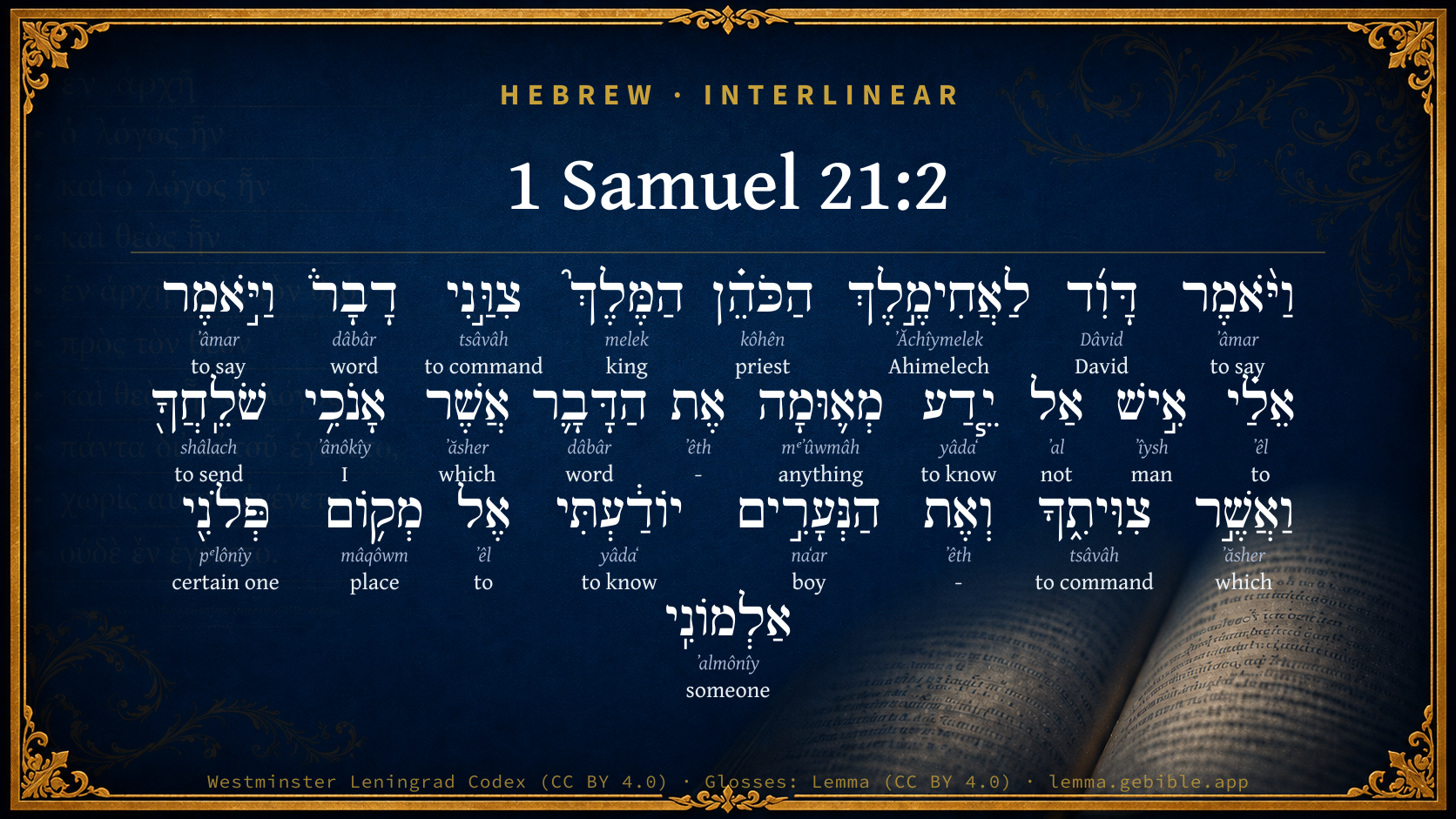
  1. וַיֹּ֨אמֶר ʼâmar H559 “and · to say” Conjunction + Verb, Qal, Sequential Imperfect, 3rd Person, Masculine, Singular
  2. דָּוִ֜ד Dâvid H1732 “David” Noun, Proper
  3. לַאֲחִימֶ֣לֶךְ ʼĂchîymelek H288 “to/for · Ahimelech” Preposition + Noun, Proper
  4. הַכֹּהֵ֗ן kôhên H3548 “the · priest” Particle, Definite Article + Noun, Common, Masculine, Singular, Absolute
  5. הַמֶּלֶךְ֮ melek H4428 “the · king” Particle, Definite Article + Noun, Common, Masculine, Singular, Absolute
  6. צִוַּ֣נִי tsâvâh H6680 “to command · me” Verb, Piel, Perfect, 3rd Person, Masculine, Singular + Suffix, Personal, 1st Person, Common, Singular
  7. דָבָר֒ dâbâr H1697 “word” Noun, Common, Masculine, Singular, Absolute
  8. וַיֹּ֣אמֶר ʼâmar H559 “and · to say” Conjunction + Verb, Qal, Sequential Imperfect, 3rd Person, Masculine, Singular
  9. אֵלַ֗י ʼêl H413 “to · me” Preposition + Suffix, Personal, 1st Person, Common, Singular
  10. אִ֣ישׁ ʼîysh H376 “man” Noun, Common, Masculine, Singular, Absolute
  11. אַל ʼal H408 “not” Particle, Negative
  12. יֵ֧דַע yâdaʻ H3045 “to know” Verb, Qal, Jussive, 3rd Person, Masculine, Singular
  13. מְא֛וּמָה mᵉʼûwmâh H3972 “anything” Noun, Common, Feminine, Singular, Absolute
  14. אֶת ʼêth H853 “-” Particle, Direct Object
  15. הַדָּבָ֛ר dâbâr H1697 “the · word” Particle, Definite Article + Noun, Common, Masculine, Singular, Absolute
  16. אֲשֶׁר ʼăsher H834 “which” Particle, Relative
  17. אָנֹכִ֥י ʼânôkîy H595 “I” Pronoun, Personal, 1st Person, Common, Singular
  18. שֹׁלֵֽחֲךָ֖ shâlach H7971 “sending · you” Verb, Qal, Participle Active, Masculine, Singular, Construct + Suffix, Personal, 2nd Person, Masculine, Singular
  19. וַאֲשֶׁ֣ר ʼăsher H834 “and · which” Conjunction + Particle, Relative
  20. צִוִּיתִ֑ךָ tsâvâh H6680 “to command · you” Verb, Piel, Perfect, 1st Person, Common, Singular + Suffix, Personal, 2nd Person, Masculine, Singular
  21. וְאֶת ʼêth H853 “and · -” Conjunction + Particle, Direct Object
  22. הַנְּעָרִ֣ים naʻar H5288 “the · boys” Particle, Definite Article + Noun, Common, Masculine, Plural, Absolute
  23. יוֹדַ֔עְתִּי yâdaʻ H3045 “to know” Verb, Poel, Perfect, 1st Person, Common, Singular
  24. אֶל ʼêl H413 “to” Preposition
  25. מְק֥וֹם mâqôwm H4725 “place of” Noun, Common, Masculine, Singular, Construct
  26. אַלְמוֹנִֽי ʼalmônîy H492 “someone” Adjective, Adjective, Masculine, Singular, Absolute

About this verse

These counts appear in no published source. They are computed here, from the morphology-tagged text and Lemma’s own curated glosses. What Lemma adds →

27
words
20
distinct lemmas
Historical
section

Notable vocabulary

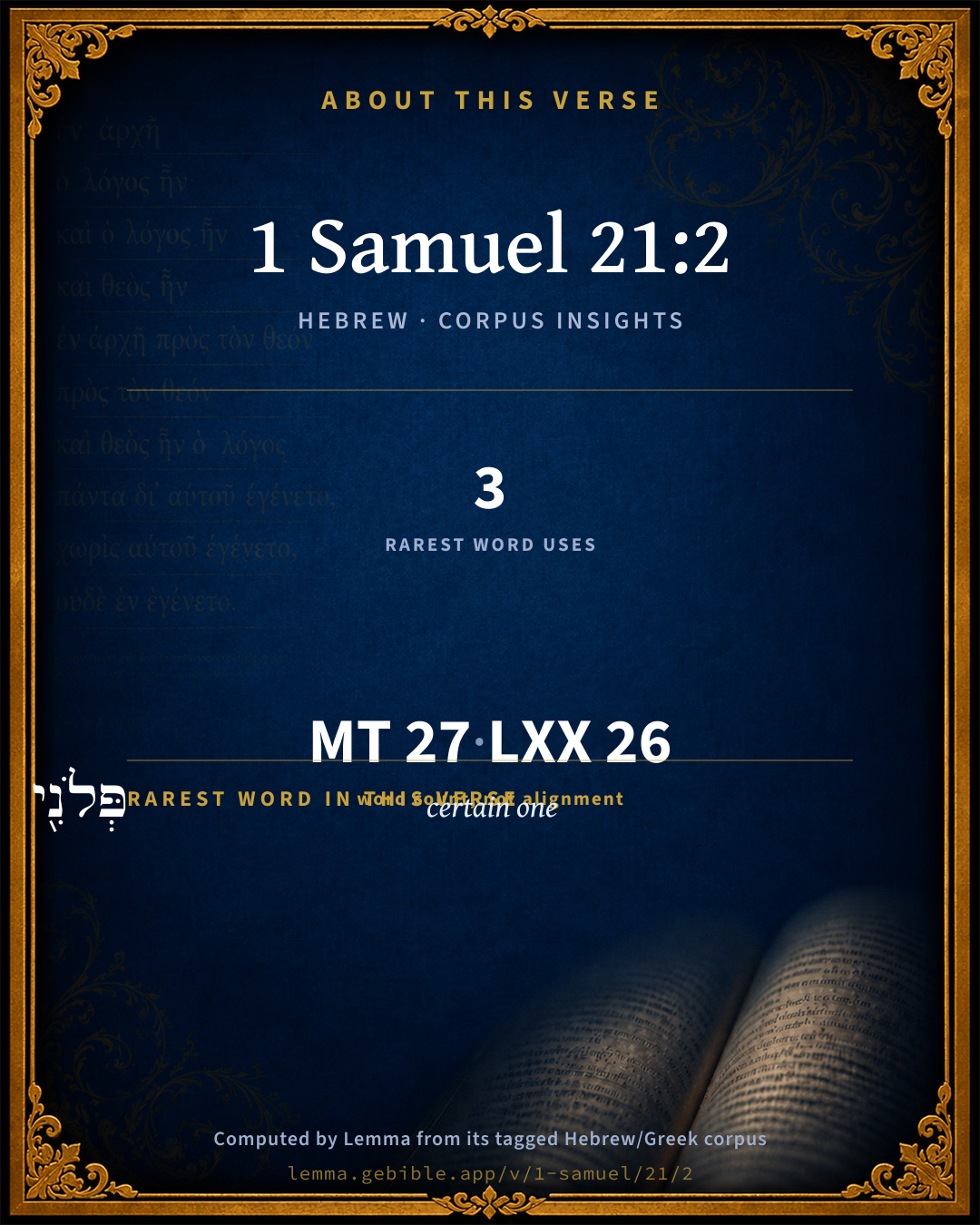
The rarest word here is פְּלֹנִ֖י certain one H6423 — appearing just 3 times in the whole Hebrew Bible.

Shared distinctive vocabulary

פְּלֹנִ֖י certain one H6423 occurs in 3 verses of the Hebrew Bible. Also found in:

Grammatical profile

  • 7 verbs
  • 10 nouns
  • 1 adjective
  • 2 pronouns
  • 2 prepositions
  • 5 particles

Verb forms

  • וַיֹּ֨אמֶר Qal · Sequential Imperfect
  • צִוַּ֣נִי Piel · Perfect
  • וַיֹּ֣אמֶר Qal · Sequential Imperfect
  • יֵ֧דַע Qal · Jussive
  • שֹׁלֵֽחֲךָ֖ Qal · Participle Active
  • צִוִּיתִ֑ךָ Piel · Perfect
  • יוֹדַ֔עְתִּי Poel · Perfect

Repetition

Words recur within this verse — often emphatic in Hebrew:

  • וַיֹּ֨אמֶר to say H559 ×2
  • צִוַּ֣נִי to command H6680 ×2
  • דָבָר֒ word H1697 ×2
  • יֵ֧דַע to know H3045 ×2
  • אֵלַ֗י to H413 ×2
  • אֲשֶׁר which H834 ×2

Hebrew & Septuagint length

In English translation the verse runs 50 words from the Hebrew and 55 from the Septuagint (LXX English) — closely comparable.

A rough comparison of the two English renderings, which tokenize alike — not a word-level alignment.

Word counts can differ between the Hebrew and the Greek without any difference in meaning — e.g. the Hebrew direct-object marker אֵת has no separate Greek word, and Greek often adds the article ὁ.

In the original languages it is 27 Hebrew tokens and 26 Greek tokens — but the two are counted differently (Hebrew bundles its prefixes and suffixes into one token; the Greek is in lemma form), so that isn’t a like-for-like length.

Cross-references

7

Topical passages linked to 1 Samuel 21:2 in the Treasury of Scripture Knowledge — connected by theme and wording, ordered by reader-vote popularity; previews shown in the World English Bible.

  • Galatians 2:12 For before some people came from James, he ate with the Gentiles. But when they came, he drew back and separated himself, fearing those who were of the circumcision.
  • Colossians 3:9 Don't lie to one another, seeing that you have put off the old man with his doings,
  • Genesis 27:20 Isaac said to his son, "How is it that you have found it so quickly, my son?" He said, "Because Yahweh your God gave me success."
  • Genesis 27:24 He said, "Are you really my son Esau?" He said, "I am."
  • 1 Samuel 19:17 Saul said to Michal, Why have you deceived me thus, and let my enemy go, so that he is escaped? Michal answered Saul, He said to me, Let me go; why should I kill you?
  • 1 Samuel 22:22 David said to Abiathar, I knew on that day, when Doeg the Edomite was there, that he would surely tell Saul: I have occasioned [the death] of all the persons of your father's house.
  • 1 Kings 13:18 He said to him, I also am a prophet as you are; and an angel spoke to me by the word of Yahweh, saying, Bring him back with you into your house, that he may eat bread and drink water. [But] he lied to him.

Cross-references courtesy of OpenBible.info (CC BY 4.0).

Hebrew and Greek witnesses Masoretic Hebrew ↔ Greek Septuagint

The same verse in the two great witnesses to the Old Testament, shown verse-for-verse.

These are two independent witnesses, not word-aligned to each other, and the Septuagint is shown in lemma (dictionary) form.

Hebrew 1 Samuel 21:2 Masoretic · Westminster Leningrad Codex

וַיֹּ֨אמֶר דָּוִ֜ד לַאֲחִימֶ֣לֶךְ הַכֹּהֵ֗ן הַמֶּלֶךְ֮ צִוַּ֣נִי דָבָר֒ וַיֹּ֣אמֶר אֵלַ֗י אִ֣ישׁ אַל יֵ֧דַע מְא֛וּמָה אֶת הַדָּבָ֛ר אֲשֶׁר אָנֹכִ֥י שֹׁלֵֽחֲךָ֖ וַאֲשֶׁ֣ר צִוִּיתִ֑ךָ וְאֶת הַנְּעָרִ֣ים יוֹדַ֔עְתִּי אֶל מְק֥וֹם פְּלֹנִ֖י אַלְמוֹנִֽי

David said to Ahimelech the priest, The king has commanded me a business, and has said to me, Let no man know anything of the business about which I send you, and what I have commanded you: and I have appointed the young men to such and such a place.

World English Bible · Public Domain

Greek LXX 1 Samuel 21:2 Septuagint · lemma form

καί ἔρχομαι δαυίδ εἰς νομβα πρός αβιμελεχ ὁ ἱερεύς καί ἐκἵστημι αβιμελεχ ὁ ἀπάντησις αὐτός καί εἶπον αὐτός τίς ὅτι σύ μόνος καί οὐδείς μετά σύ

And David said to the priest, The king gave me a command today, and said to me, Let no one know the matter on which I send you, and concerning which I have charged you: and I have charged my servants to be in the place that is called, The faithfulness of God, Phellani Maemoni.

LXX2012 (modern English Septuagint) · Public Domain

On this verse, Haydock's Catholic Bible Commentary discusses the Septuagint’s reading. Read the note in Commentary ↓

Hebrew: Westminster Leningrad Codex (CC BY 4.0). Greek: Septuagint (public domain); English from LXX2012 (modern English Septuagint) (Public Domain). How the Septuagint differs from the Hebrew →

Targum (Aramaic paraphrase)

1

The Targum is the ancient Jewish Aramaic paraphrase of the Hebrew Scriptures — an interpretive translation, not the Hebrew text itself. Onkelos (literal) and Pseudo-Jonathan (expansive) render the Torah, and Jonathan the Prophets. Coverage is partial: where no permissively-licensed English translation exists for a verse, only the Aramaic is shown. This is verse-level text, not a word-by-word alignment to the Hebrew.

  1. Targum Jonathan Prophets (Joshua–Malachi)
    וַאֲתָא דָוִד לְנוֹב לְוַת אֲחִימֶלֶךְ כַּהֲנָא וְאִתְבְּעִית אֲחִימֶלֶךְ לָקֳדָמוּת דָוִד וַאֲמַר לֵיהּ מָא דֵין אַתְּ בִּלְחוֹדָךְ וּגְבַר לֵית עִמָךְ:

    (no public-domain English translation for this verse)

    Targum Jonathan — Aramaic: “Mikraot Gedolot” (public domain). English: “Sefaria Community Translation” (CC0 1.0 (public-domain dedication)); “London "Chaldee Paraphrase," 1871” (public domain). Text via Sefaria.

Commentary

Notes on 1 Samuel 21:2 from classic Christian and Jewish commentators (each source and its license shown beneath its notes). The classic Christian expositions comment on the surrounding passage and are grouped to its opening verse, so a note may address several verses; the Jewish commentaries on the Tanakh (Rashi and others) are per-verse, so they appear only where the commentator wrote on this verse.

Lemma curates 59 commentaries, every one of them public domain or Creative Commons licensed, each selected and text-cleaned for this edition rather than reprinted as found. About our sources →

Trapp's Complete Commentary

John Trapp

1Sa 21:2 And David said unto Ahimelech the priest, The king hath commanded me a business, and hath said unto me, Let no man know any thing of the business whereabout I send thee, and what I have commanded thee: and I have appointed [my] servants to such and such a place.

Ver. 2. The king hath commanded me a business.] Here David uttereth two lies in a breath, - as before him Jacob had done three, {Gen 27:19-20} though lying be a blushful sin, - whereunto he addeth another lie, {1Sa 21:8} and all deliberate. The like he doth to Achish, king of Gath. {1Sa 21:8; 1Sa 21:10} If the best man’s faults were written in his forehead, it would make him pull his hat over his eyes, saith the proverb. Some go about to excuse David’s lying here: but that cannot be. The consequents of it were very sad, viz., that bloody massacre of the priests, and all the inhabitants of Nob, {1Sa 23:18-19} which he could not but foresee and suspect, when he saw Doeg - that flatter - present, {1Sa 22:22} and afterwards it made his soul melt for very heaviness, whilst he bewailed it, and begged pardoning and prevailing grace. {Psa 119:28-29}

John Trapp, A Commentary or Exposition upon All the Books of the Old and New Testament (1647–1656) — public domain. Text from a community e-Sword module.

Joseph Benson's Commentary

1Sa 21:2. The king hath commanded, &c. — This is a plain lie, extorted from him by fear, and one that was very pernicious to all the priests there. Whence David afterward declares his repentance for it, (1Sa 22:22,) and prays against the sin of lying, Psa 119:29. To such and such a place — To certain places which, he insinuates, it was not proper to mention, because the whole business required concealment.

Joseph Benson's Commentary on the Old and New Testaments (1811–1818) — public domain. Text from a community e-Sword module.

Tyndale Open Study Notes

Tyndale Open Resources

21:2 The king has sent me: David lied to conceal his outlaw status and to dispel Ahimelech’s worries.

Tyndale Open Study Notes — © Tyndale Open Resources, licensed CC BY-SA 4.0. Text via the HelloAO Bible API.

Geneva Bible (1599)

Geneva Bible translators

These infirmities that we see in the Saints of God, teach us that none hath his justice in himself, but receiveth it of God’s mercy.

Geneva Bible (1599) marginal notes — public domain. Text via Bolls.life.

Jamieson, Fausset & Brown

Robert Jamieson, A. R. Fausset & David Brown

The king hath commanded me a business, and hath said unto me, Let no man know--This was a direct falsehood, extorted through fear. David probably supposed, like many other persons, that a lie is quite excusable which is told for the sole purpose of saving the speaker's life. But what is essentially sinful, can never, from circumstances, change its immoral character; and David had to repent of this vice of lying (Psa 119:29).

Jamieson, Fausset & Brown — Commentary Critical and Explanatory on the Whole Bible (1871) — public domain (CC PDM 1.0). Text via the HelloAO Bible API.

Adam Clarke's Commentary

Verse 2. The king hath commanded me a business] All said here is an untruth, and could not be dictated by the Spirit of the Lord; but there is no reason to believe that David was under the influence of Divine inspiration at this time. It is well known that from all antiquity it was held no crime to tell a lie, in order to save life. Thus Diphilus: -

Ὑπολαμβανω το ψευδος επι σωτηριᾳ

Λεγομενον, ουδεν περιποιεισθαι δυσχερες.

"I hold it right to tell a lie, in order to procure my personal safety; nothing should be avoided in order to save life."

A heathen may say or sing thus; but no Christian can act thus, and save his soul, though he by doing so may save his life.

Adam Clarke's Commentary on the Bible (1810–1826) — public domain. Text from a community e-Sword/MySword module.

Ellicott's Commentary for English Readers

(2) The king hath commanded me.—This is one of the sad episodes in a glorious life. Overwhelmed with dismay at his sudden fall, home and wife, friends and rank, all had been taken from him, and he who had been on the very steps of the throne, the darling of the people, strangely successful in all that he had up to this time put his hand to, was now a proscribed exile, flying for his life. These things must plead as his excuse for his falsehood to Ahimelech, and his flight to and subsequent behaviour among the hereditary enemies of his race, the Philistines. But here, as in so many places, the Holy Spirit who guided the pen of the compiler of this true history could not lie, but fearlessly tells the repulsive truth which must ever be deeply damaging to the favourite hero of Israel. “The Holy Spirit is become the chronicler of men’s foolish, yea, sinful actions. He has narrated the lies of Abraham, the incest of Lot, the simulation of the man after God’s heart.”—Lange.

I have appointed my servants.—This portion of his words to Ahimelech was, no doubt, strictly true. It is unlikely that one in the high position of David at the court of Saul, possessing, too, such powers over men’s hearts, would be allowed to go even into exile without any friends or attendants. Those alluded to here probably joined him soon after his parting with Jonathan. Our Lord, in Mar_2:25-26, speaks of the priest giving the shewbread to David and to those that were with him, when both he and they that were with him were an hungred.

A Bible Commentary for English Readers, edited by Charles John Ellicott (1878–1897) — public domain. Text from a community e-Sword module.

The Cambridge Bible for Schools and Colleges

gen. ed. J. J. S. Perowne

2. The king, &c.] Again David has, recourse to a lie. See 1Sa_20:6, and note on 1Sa_19:17. The consequences of it were disastrous.

my servants] The young men, as in 1Sa_21:4. The words are David’s own, not the continuation of Saul’s directions. They were probably true. He must have had friends at court who were prepared to share his flight, and with whom he had made arrangements for a rendezvous.

The Cambridge Bible for Schools and Colleges (gen. ed. J. J. S. Perowne; Cambridge University Press, 1878–1918) — public domain. Text from a community e-Sword module.

John Gill's Exposition

And David said unto Ahimelech the priest,.... In reply to his question, and to account for such an appearance he made without an equipage:

the king hath commanded me a business, and hath said unto me, let no man know anything of the business thereabout I send thee, and what I have commanded thee; he pretended he was upon a secret expedition, by the order of Saul, which none were to know of, no, not his own servants, and that was the reason why he came to him alone; which was a downright lie, and was aggravated by its being told only for the sake of getting a little food; and especially told to an high priest, and at the tabernacle of God, and when he was come to inquire of the Lord there; and was attended with a dreadful consequence, the slaughter of the Lord's priests there, which afterwards lay heavy on David's mind, Sa1 22:22; and is the very sin he is thought to refer to in Psa 119:28. This shows the weakness of the best of men, when left to themselves; David who as much hated lying as any man did, fell into it himself:

and I have appointed my servants to such and such a place; to such a place, of such an one, not naming place nor person, that they might not be known; so the Targum calls it a place hidden and kept; and that David had some servants, though not now with him, who ate of the shewbread, appears from Mat 12:3; whom Jonathan might send after him, to a place agreed on and appointed between them; so that this might be true.

John Gill's Exposition of the Whole Bible (1746–1763) — public domain (CC PDM 1.0). Text via the HelloAO Bible API.

Albert Barnes' Notes on the Bible

A fresh instance of David’s unscrupulous readiness of invention (compare 1Sa 20:6).

Albert Barnes' Notes on the Bible (1834–1885) — public domain. Text from a community e-Sword/MySword module.

Haydock's Catholic Bible Commentary

The king, &c. This was an untruth, which David, like many other great men, might think lawful in such an emergency. But it is essentially evil. (Calmet) --- And such, which he deems it unnecessary to specify. Septuagint retains the Hebrew words, "Phelanni almoni." See Ruth iv. 1.

George Leo Haydock (1774–1849), Haydock's Catholic Family Bible and Commentary, 1859 edition — public domain. Excludes Psalms (Douay-Rheims chapter numbering differs from Protestant) and Deuterocanonical books (Catholic canon only).

Matthew Poole's English Annotations

The king hath commanded me a business: this seems to be a plain lie, extorted from him by fear and necessity. But as it was officious for himself, so it was pernicious to all the priests there. Whence David afterwards declares his repentance for this sin of lying, Psa 119:29.

To such and such a place; to a certain place which is not material nor convenient now to mention, because the whole business requires concealment.

Matthew Poole's English Annotations on the Holy Bible (1683–1685) — public domain. Text from a community e-Sword/MySword module.

Whedon's Commentary on the Bible

Daniel D. Whedon

2. The king hath commanded me a business — The statements of David in this verse, and the addition, in 1Sa_21:8, that the king’s business required such haste that he thought not to bring his weapons, are to be regarded as utter falsehood, pure fabrications, framed for the purpose of deceiving Ahimelech, allaying suspicion, and aiding himself in his escape. Perhaps the presence of Doeg, the Edomite, (1Sa_21:7,) led to his uttering this fictitious plea. This is one of the occasions on which the noble David sinned. We shall meet with other instances in the subsequent history. It should be remembered, however, that according to the morals of that age falsehood, like polygamy and other sins which the ethics of our Gospel system utterly condemn, was not looked upon as criminal. Prevarication and falsehood that did not amount to perjury seem not to have been regarded as violations of the ninth commandment. Accordingly, Otto von Gerlach well observes, in his comment on the ninth commandment, that “although it enjoins, when properly understood, full, entire, and unequivocal truthfulness towards our neighbour in every relation, yet the practical understanding of this meaning was very imperfectly attained to in the Old Testament times, since we find so many servants of God allowing themselves, in their perplexities, to have recourse to lying.” David subsequently deplored the fact that he had occasioned the death of all the priests of Nob, (1Sa_22:22,) but he showed not the least compunction over the falsehood by which he deceived the high priest, not even in the psalm (Psalms 52) which he composed on the occasion, and in which he accuses his enemy of lying.

My servants — David probably had a few followers with him, and had left them in the distance while he personally went to the high priest for bread. These were the young men referred to in 1Sa_21:4-5, and mentioned in Mar_2:25-26.

Daniel D. Whedon (gen. ed.), Commentary on the Old and New Testaments (1874–1909) — public domain. Text from a community e-Sword module.

The Pulpit Commentary

The king hath commanded me a business. This pretence of a private commission from the king was a mere invention, but his "appointing his servants to meet him at such and such a place" was probably the exact truth. After parting with Jonathan, David probably did not venture to show himself at home, but, while Saul still supposed him to be at Bethlehem, gave orders to some trusty officer to gather together a few of his most faithful men, and await him with them at some fit place. Meanwhile alone he sets out on his flight, and, having as yet no settled plan, goes to Nob, because it was out of the way of the road to Bethlehem, whither Saul would send to arrest him. Naturally such a visit would seem strange to Ahimelech; but David needed food and arms, and probably counsel; and. but for the chance of the presence of Doeg, no harm might have ensued. As it was, this visit of David completed the ruin of Eli"s house.

Ver. 2. (NOB)

The sins of good men.

Some of the most eminent servants of God mentioned in the Bible fell into grievous sins. This has often been to some a ground of objection to the Bible, and to others a subject of perplexity. But there is little reason for either. Consider it in relation to

I THE TRUTH OF SCRIPTURE. If men had been described therein as wholly free from sin there would have been much more reason for doubt or perplexity concerning its truth than now exists; for its representation of them

1. Proves the impartiality of the writers, who record the failings of good men as well as their excellencies, concealing nothing. It shows that the sacred writers were influenced by the highest principles, and even guided by a higher wisdom than their own.

2. Accords with the results of observation and experience, which teach that men are sinful, that those who are unquestionably good men are liable to fall, and that the most eminently pious are not perfect. Much of the Bible is chiefly a faithful picture of human nature, which (both without and under the power of Divine grace) is essentially the same in all ages.

3. Confirms the doctrines it contains: such as that man is fallen, sinful, and helpless; that his elevation, righteousness, and strength are of God; that he can attain these blessings only through faith and prayer and conflict; that he can continue to possess them only by the same means; and that when he ceases to rely on Divine strength he utterly fails.

II THE CHARACTER OF GOD. They were accepted and blessed by him notwithstanding their sins. Is he, therefore, unholy, unjust, or partial? Let it be remembered

1. That their sins were not sanctioned by him.

2. That they were forbidden by him.

3. That they were punished by him.

4. That they were forgiven only when repented of.

5. That they were in some cases mercifully borne with for a time because ofthe good which he saw in his servants, and in order to the ultimate removal of the evil.

6. That if such endurance of some things in them appears strange to us,under the higher light and grace vouchsafed, there are probably some things in ourselves, the evil of which we scarcely perceive, but which will appear hereafter in a different light to others.

7. That the principle on which God deals with the individual and the race isthat of a gradual education, the aim of which is that we should be "holy as he is holy.

III THE WORTH OF SUCH MEN. If they had continued in conscious and persistent transgression they could not have been held in honour or regarded as really good; (1Jn_3:6) but though their sins may not be excused, their names are worthy of being had in everlasting remembrance, because of

1. The surpassing virtues which distinguished their character.

2. The main current of their life so contrary to isolated instances oftransgression.

3. Their deep sorrow for sin, their lofty aspirations after holiness, and theirsure progress toward perfection.

IV THE EFFECT ON OTHERS. This has doubtless been injurious in some directions. But, on the other hand, it has been, as it must be when the subject is rightly viewed, beneficial in

1. Making others more watchful against falling. If such eminent servants ofGod fell, much more may we. "Let him that thinketh he standeth," etc.

2. Preventing despair when they have fallen. If those who fell could berestored, so can we.

3. Teaching them to look to Jesus Christ as the one perfect example, theonly propitiation for our sins, the all-sufficient source of "wisdom, righteousness, sanctification, and redemption." "Nothing can be an excuse or apology for sin; yet by God"s mercy it may be turned to account, and made to produce the opposite to itself. To some men"s errors the world has been indebted for their richest lessons and ripest fruit. To the lamentable lapse, the penitence and the punishment of David, we owe some of the most subduing, the most spiritually instructive and consolatory of his psalms psalms that have taught despair to trust, and have turned the heart of flint into a fountain of tears" (Binney). D.

The Pulpit Commentary (1880–1919), ed. H.D.M. Spence-Jones & Joseph S. Exell — public domain. Text from a community e-Sword module.

John Wesley's Explanatory Notes

The king, &c. - This seems to be a plain lie extorted from him, by fear. But it was pernicious to all the priests there. Whence David afterwards declares his repentance for this sin of lying, Psalm 1xix, 29. To such a place - To a certain place which it not convenient now to mention; because the whole business requires concealment.

John Wesley, Explanatory Notes Upon the Whole Bible (1754–1765) — public domain. Text via the GEBible commentary corpus.

Lesson kit

Teaching starters — assembled from the data on this page, not authored interpretation. Every prompt links to the verse data it draws on. Edit before teaching.

1 Samuel, in the Historical, opens this verse with 27 words (20 distinct Hebrew lemmas). Its most distinctive word is pᵉlônîy (“certain one”). A historical commentator’s framing appears above. Read the whole chapter for the surrounding context.

Discussion questions

  1. How does “certain one” (pᵉlônîy) shape what this verse is saying?
  2. How does Ruth 4:1, which shares the word «certain one», read alongside this verse?
  3. What does the repetition of “to say” (2× in this one verse) do in this verse?
  4. These translations render this verse differently; the difference is in the English rendering, not the original. What questions does that raise?
  5. «וַיֹּ֨אמֶר» is a Qal Sequential Imperfect verb. How does that grammatical form shape the action described?
  6. Compare how Trapp's Complete Commentary and Joseph Benson's Commentary read this verse. Where do they agree or differ?

Things to notice

Reading settings

Reading text

Shown beneath each verse's original-language words.

Old Testament
Old Testament edition

Read the OT as the Masoretic Hebrew (MT) or the Greek Septuagint (LXX).

English shown for the Greek Septuagint (in the Hebrew ↔ Greek comparison).

Comparing translations? Open the Compare panel on any verse page to stack up to four side by side.