Deuteronomy 9:27

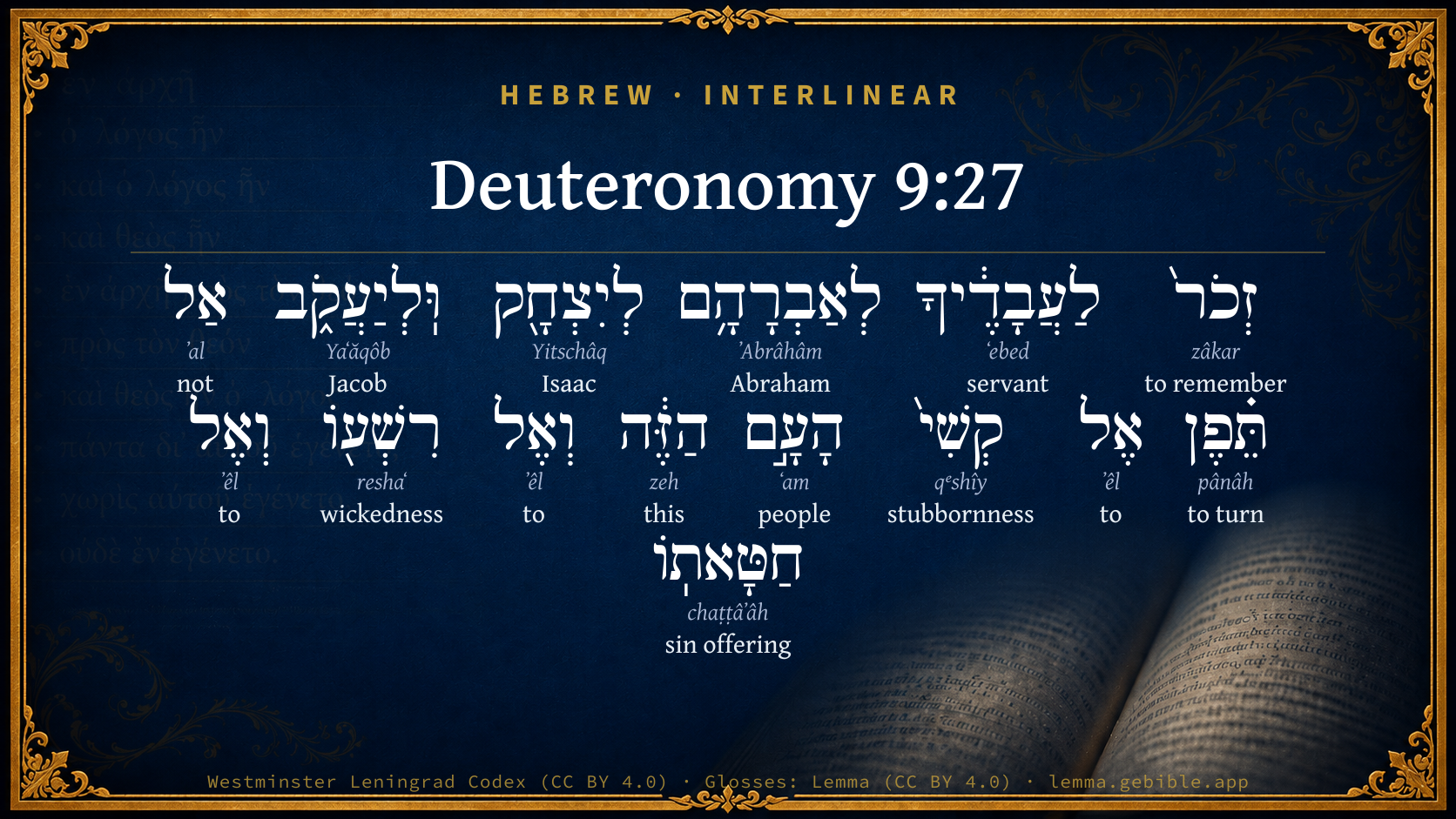
Hebrew (Westminster Leningrad Codex) Deuteronomy 9:27 appears in the Hebrew Old Testament. The text above is from the Westminster Leningrad Codex. Each word links to its Strong’s number, a concise gloss, and parsing drawn from the Open Scriptures Hebrew Bible morphology. Click any word for its full Brown-Driver-Briggs (BDB) entry.
Download image
Cite this verse

Deuteronomy 9:27 (World English Bible). Public Domain. Lemma interlinear Bible study tool, https://lemma.gebible.app/v/deuteronomy/9/27.

Show BibTeX & RIS
BibTeX
RIS
English Translation
Remember your servants, Abraham, Isaac, and Jacob; don't look to the stubbornness of this people, nor to their wickedness, nor to their sin,
World English Bible · Public Domain
Highlights
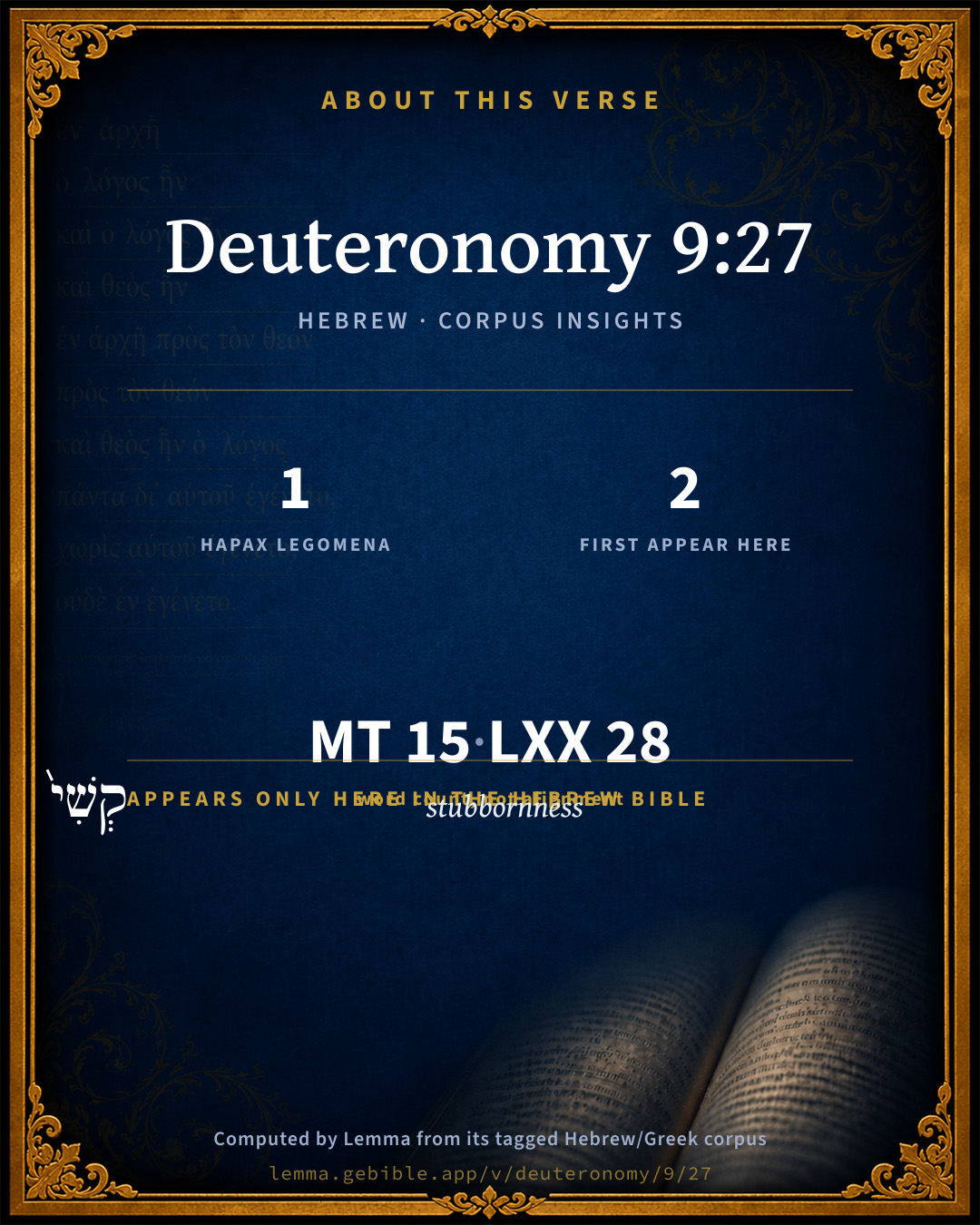
  • 1 hapax legomenon — only here in the Hebrew Bible
  • 2 first appearances in the Hebrew Bible
Full analysis ↓
Download a study sheet

One document with this verse’s original text, its word-by-word gloss line, the meaning frame, cross-references with their text, attributed commentary, and full source and license credits — printable, and it pastes into notes with its structure intact.

This verse Autodidact and up

Study sheet (.html) Plain text (.txt)

A passage Seminary Student

Up to 50 verses in one chapter. A passage sheet keeps up to 6 commentary sources and 12 cross-references per verse, in the order this page ranks them, and says so on the sheet whenever that leaves anything out. Ask for a single verse and you get the Autodidact verse sheet above.

Everything on this page stays free to read, with no account — the sheet is a download of what is already on screen, not access to it.

Want to remove ads? Support Godless Engineer
Compare translations 3

The same verse in 3 English versions, stacked beneath the original-language interlinear above. Click any original word for its lexicon entry.

Each is an independent rendering of the whole verse — the interlinear is not word-aligned to these translations.

Highlighted words mark where these versions differ — a whole-verse word diff, not a word-by-word alignment.

  • World English Bible Public Domain
    Remember your servants, Abraham, Isaac, and Jacob; don't look to the stubbornness of this people, nor to their wickedness, nor to their sin,
  • King James Version Public Domain
    Remember thy servants, Abraham, Isaac, and Jacob; look not unto the stubbornness of this people, nor to their wickedness, nor to their sin:
  • unfoldingWord Literal Text CC BY-SA 4.0
    Remember your servants, Abraham, Isaac, and Jacob. Do not turn to the stiffness of this people and to their wickedness and to their sin,

unfoldingWord Literal Text — © unfoldingWord, licensed CC BY-SA 4.0. Word-aligned USFM3 via Door43 (git.door43.org/unfoldingWord/en_ult).

Versions to compare (up to 4)

3 of 4 selected

Show all 18 translations

Every available English version of this verse, each an independent rendering of the whole verse.

  • World English Bible Public Domain
    Remember your servants, Abraham, Isaac, and Jacob; don't look to the stubbornness of this people, nor to their wickedness, nor to their sin,
  • Berean Standard Bible Public Domain
    Remember Your servants Abraham, Isaac, and Jacob. Overlook the stubbornness of this people and the wickedness of their sin.
  • Majority Standard Bible Public Domain
    Remember Your servants Abraham, Isaac, and Jacob. Overlook the stubbornness of this people and the wickedness of their sin.
  • King James Version Public Domain
    Remember thy servants, Abraham, Isaac, and Jacob; look not unto the stubbornness of this people, nor to their wickedness, nor to their sin:
  • American Standard Version (1901) Public Domain
    Remember thy servants, Abraham, Isaac, and Jacob; look not unto the stubbornness of this people, nor to their wickedness, nor to their sin,
  • Revised Version (1885) Public Domain
    Remember thy servants, Abraham, Isaac, and Jacob; look not unto the stubbornness of this people, nor to their wickedness, nor to their sin:
  • Geneva Bible (1599) Public Domain
    Remember thy seruants Abraham, Izhak, and Iaakob: looke not to ye stubburnes of this people, nor to their wickednes, nor to their sinne,
  • Douay-Rheims (1899) Public Domain
    Remember thy servants Abraham, Isaac, and Jacob: look not on the stubbornness of this people, nor on their wickedness and sin:
  • Young's Literal Translation Public Domain
    be mindful of Thy servants, of Abraham, of Isaac, and of Jacob, turn not unto the stiffness of this people, and unto its wickedness, and unto its sin;
  • Literal Standard Version CC BY-SA 4.0
    be mindful of Your servants, of Abraham, of Isaac, and of Jacob; do not turn to the stiffness of this people, and to its wickedness, and to its sin,
  • Unlocked Literal Bible CC BY-SA 4.0
    Call to mind your servants Abraham, Isaac, and Jacob; do not look at the stubbornness of this people, nor at their wickedness, nor at their sin,
  • unfoldingWord Literal Text CC BY-SA 4.0
    Remember your servants, Abraham, Isaac, and Jacob. Do not turn to the stiffness of this people and to their wickedness and to their sin,
  • Darby Bible Public Domain
    Remember thy servants Abraham, Isaac, and Jacob; look not at the stubbornness of this people, nor at their wickedness, nor at their sin;
  • World Messianic Bible Public Domain
    Remember your servants, Abraham, Isaac, and Jacob. Don’t look at the stubbornness of this people, nor at their wickedness, nor at their sin,
  • Webster's Bible Public Domain
    Remember thy servants, Abraham, Isaac, and Jacob; look not to the stubbornness of this people, nor to their wickedness, nor to their sin:
  • Free Bible Version CC BY-SA 4.0
    Please remember your servants Abraham, Isaac, and Jacob. Please disregard the stubbornness of this people and their wicked sin.
  • Bible in Basic English Public Domain
    Keep in mind your servants, Abraham, Isaac, and Jacob, not looking at the hard heart of this people, or their evil-doing and their sin:
  • JPS Tanakh (1917) Public Domain
    Remember Thy servants, Abraham, Isaac, and Jacob; look not unto the stubbornness of this people, nor to their wickedness, nor to their sin;

Literal Standard Version (2020), Covenant Press — licensed CC BY-SA 4.0. Text via the HelloAO Bible API (eBible.org). Unlocked Literal Bible (unfoldingWord) — licensed CC BY-SA 4.0. Text via the HelloAO Bible API (eBible.org). unfoldingWord Literal Text — © unfoldingWord, licensed CC BY-SA 4.0. Word-aligned USFM3 via Door43 (git.door43.org/unfoldingWord/en_ult). Free Bible Version, Dr. Jonathan Gallagher — licensed CC BY-SA 4.0. Text via the HelloAO Bible API (eBible.org).

Word by word

More ways to search: Search by grammar → Find every occurrence → Compare this word →

Practice this passage: Drill this verse → Learn its vocabulary →

קְשִׁי֙
qᵉshîy
H7190
“stubbornness of”
Noun, Common, Masculine, Singular, Construct
Part of Speech
Noun
Type
Common
Gender
Masculine
Number
Singular
State
Construct
Full BDB Definition

Origin: from H7185

TWOT: 2085b

stubbornness, obstinacy
  1. זְכֹר֙ zâkar H2142 “remember” Verb, Qal, Imperative, 2nd Person, Masculine, Singular
  2. לַעֲבָדֶ֔יךָ ʻebed H5650 “to/for · servants · your” Preposition + Noun, Common, Masculine, Plural, Construct + Suffix, Personal, 2nd Person, Masculine, Singular
  3. לְאַבְרָהָ֥ם ʼAbrâhâm H85 “to/for · Abraham” Preposition + Noun, Proper
  4. לְיִצְחָ֖ק Yitschâq H3327 “to/for · Isaac” Preposition + Noun, Proper
  5. וּֽלְיַעֲקֹ֑ב Yaʻăqôb H3290 “and · to/for · Jacob” Conjunction + Preposition + Noun, Proper
  6. אַל ʼal H408 “not” Particle, Negative
  7. תֵּ֗פֶן pânâh H6437 “to turn” Verb, Qal, Jussive, 2nd Person, Masculine, Singular
  8. אֶל ʼêl H413 “to” Preposition
  9. הָעָ֣ם ʻam H5971 “the · people” Particle, Definite Article + Noun, Common, Masculine, Singular, Absolute
  10. הַזֶּ֔ה zeh H2088 “the · this” Particle, Definite Article + Pronoun, Demonstrative, Masculine, Singular
  11. וְאֶל ʼêl H413 “and · to” Conjunction + Preposition
  12. רִשְׁע֖וֹ reshaʻ H7562 “wickedness · his” Noun, Common, Masculine, Singular, Construct + Suffix, Personal, 3rd Person, Masculine, Singular
  13. וְאֶל ʼêl H413 “and · to” Conjunction + Preposition
  14. חַטָּאתֽוֹ chaṭṭâʼâh H2403 “sin offering · his” Noun, Common, Feminine, Singular, Construct + Suffix, Personal, 3rd Person, Masculine, Singular

About this verse

These counts appear in no published source. They are computed here, from the morphology-tagged text and Lemma’s own curated glosses. What Lemma adds →

15
words
13
distinct lemmas
Pentateuch
section

Notable vocabulary

1 hapax legomenon — a word that appears only here in the entire Hebrew Bible:

  • קְשִׁי֙ stubbornness H7190

First appearance in Scripture

These words make their first canonical appearance in the Hebrew Bible here:

  • קְשִׁי֙ stubbornness H7190
  • רִשְׁע֖וֹ wickedness H7562

Shared distinctive vocabulary

רִשְׁע֖וֹ wickedness H7562 occurs in 29 verses of the Hebrew Bible. Also found in:

Grammatical profile

  • 2 verbs
  • 8 nouns
  • 1 pronoun
  • 3 prepositions
  • 1 particle

Verb forms

  • זְכֹר֙ Qal · Imperative
  • תֵּ֗פֶן Qal · Jussive

Repetition

A word recurs within this verse — often emphatic in Hebrew:

  • אֶל to H413 ×3

Hebrew & Septuagint length

In English translation the verse runs 23 words from the Hebrew and 30 from the Septuagint (LXX English) — closely comparable.

A rough comparison of the two English renderings, which tokenize alike — not a word-level alignment.

Word counts can differ between the Hebrew and the Greek without any difference in meaning — e.g. the Hebrew direct-object marker אֵת has no separate Greek word, and Greek often adds the article ὁ.

In the original languages it is 15 Hebrew tokens and 28 Greek tokens — but the two are counted differently (Hebrew bundles its prefixes and suffixes into one token; the Greek is in lemma form), so that isn’t a like-for-like length.

Cross-references

13

Topical passages linked to Deuteronomy 9:27 in the Treasury of Scripture Knowledge — connected by theme and wording, ordered by reader-vote popularity; previews shown in the World English Bible.

  • Jeremiah 14:21 Do not abhor [us], for your name's sake; do not disgrace the throne of your glory: remember, don't break your covenant with us.
  • Micah 7:18–19 Who is a God like you, who pardons iniquity, And passes over the disobedience of the remnant of his heritage? He doesn't retain his anger forever, Because he delights in loving kindness.
  • Exodus 3:6 Moreover he said, "I am the God of your father, the God of Abraham, the God of Isaac, and the God of Jacob." Moses hid his face; for he was afraid to look at God.
  • Exodus 3:16 Go, and gather the elders of Israel together, and tell them, 'Yahweh, the God of your fathers, the God of Abraham, of Isaac, and of Jacob, has appeared to me, saying, "I have surely visited you, and seen that which is done to you in Egypt;
  • Exodus 6:3–8 and I appeared to Abraham, to Isaac, and to Jacob, as God Almighty; but by my name Yahweh I was not known to them.
  • Exodus 13:5 It shall be, when Yahweh shall bring you into the land of the Canaanite, and the Hittite, and the Amorite, and the Hivite, and the Jebusite, which he swore to your fathers to give you, a land flowing with milk and honey, that you shall keep this service in this month.
  • Exodus 32:13 Remember Abraham, Isaac, and Israel, your servants, to whom you swore by your own self, and said to them, 'I will multiply your seed as the stars of the sky, and all this land that I have spoken of I will give to your seed, and they shall inherit it forever.'"
  • Exodus 32:31–32 Moses returned to Yahweh, and said, "Oh, this people have sinned a great sin, and have made themselves gods of gold.
  • 1 Samuel 25:25 Please don't let my lord regard this worthless fellow, even Nabal; for as his name is, so is he; Nabal is his name, and folly is with him: but I your handmaid didn't see the young men of my lord, whom you did send.
  • Psalms 78:8 And might not be as their fathers, A stubborn and rebellious generation, A generation that didn't make their hearts loyal, Whose spirit was not steadfast with God.
  • Proverbs 21:12 The Righteous One considers the house of the wicked, And brings the wicked to ruin.
  • Isaiah 43:24–25 You have bought me no sweet cane with money, neither have you filled me with the fat of your sacrifices; but you have burdened me with your sins, you have wearied me with your iniquities.
  • Jeremiah 50:20 In those days, and in that time, says Yahweh, the iniquity of Israel shall be sought for, and there shall be none; and the sins of Judah, and they shall not be found: for I will pardon them whom I leave as a remnant.

Cross-references courtesy of OpenBible.info (CC BY 4.0).

Hebrew and Greek witnesses Masoretic Hebrew ↔ Greek Septuagint

The same verse in the two great witnesses to the Old Testament, shown verse-for-verse.

These are two independent witnesses, not word-aligned to each other, and the Septuagint is shown in lemma (dictionary) form.

Hebrew Deuteronomy 9:27 Masoretic · Westminster Leningrad Codex

זְכֹר֙ לַעֲבָדֶ֔יךָ לְאַבְרָהָ֥ם לְיִצְחָ֖ק וּֽלְיַעֲקֹ֑ב אַל תֵּ֗פֶן אֶל קְשִׁי֙ הָעָ֣ם הַזֶּ֔ה וְאֶל רִשְׁע֖וֹ וְאֶל חַטָּאתֽוֹ

Remember your servants, Abraham, Isaac, and Jacob; don't look to the stubbornness of this people, nor to their wickedness, nor to their sin,

World English Bible · Public Domain

Greek LXX Deuteronomy 9:27 Septuagint · lemma form

μιμνήσκω ἀβραάμ καί ισαακ καί ἰακώβ ὁ θεράπων σύ ὅς ὄμνυμι κατά σεαυτοῦ μή ἐπιβλέπω ἐπί ὁ σκληρότης ὁ λαός οὗτος καί ὁ ἀσέβημα καί ὁ ἁμάρτημα αὐτός

Remember Abraam, and Isaac, and Jacob your servants, to whom you swore by yourself: look not upon the hardness of heart of this people, and their impieties, and their sins.

LXX2012 (modern English Septuagint) · Public Domain

Hebrew: Westminster Leningrad Codex (CC BY 4.0). Greek: Septuagint (public domain); English from LXX2012 (modern English Septuagint) (Public Domain). How the Septuagint differs from the Hebrew →

Targum (Aramaic paraphrase)

2

The Targum is the ancient Jewish Aramaic paraphrase of the Hebrew Scriptures — an interpretive translation, not the Hebrew text itself. Onkelos (literal) and Pseudo-Jonathan (expansive) render the Torah, and Jonathan the Prophets. Coverage is partial: where no permissively-licensed English translation exists for a verse, only the Aramaic is shown. This is verse-level text, not a word-by-word alignment to the Hebrew.

  1. Targum Onkelos Torah (Genesis–Deuteronomy)
    אִדְכַר לְעַבְדָיךְ לְאַבְרָהָם לְיִצְחָק וּלְיַעֲקֹב לָא תִתְפְּנֵי לְקַשְׁיוּת עַמָא הָדֵין וּלְחוֹבֵיהוֹן וְלַחֲטָאֵיהוֹן

    (no public-domain English translation for this verse)

    Targum Onkelos — Aramaic: “Onkelos Genesis” (public domain); “Onkelos Exodus” (public domain); “Onkelos Leviticus” (public domain); “Onkelos Numbers” (public domain); “Onkelos Deuteronomy” (public domain). English: “Sefaria Community Translation” (CC0 1.0 (public-domain dedication)); “J.W. Etheridge. The Targums of Onkelos and Jonathan Ben Uzziel on the Pentateuch. London: Longmans, Green, 1862” (public domain). Text via Sefaria.

  2. Targum Pseudo-Jonathan Torah (Genesis–Deuteronomy)
    הֲוֵי דְכִיר לְעַבְדָּךְ לְאַבְרָהָם לְיִצְחָק וּלְיַעֲקב וְלָא תִסְתַּכֵּל לְקַשְׁיוּת לֵב עַמָּא הָדֵין לְרִישְׁעֵיהוֹן וּלְסוּרְחָנוּתְהוּן

    Remember Thy servants Abraham, Izhak, and Jakob, nor regard Thou the hard heart of this people, nor their wickedness, nor their sin:

    Targum Pseudo-Jonathan — Aramaic: “Targum Jonathan on Genesis” (public domain); “Targum Jonathan on Exodus” (public domain); “Targum Jonathan on Leviticus” (public domain); “Targum Jonathan on Numbers” (public domain); “Targum Jonathan on Deuteronomy” (public domain). English: “The Targum of Jonathan ben Uzziel, trans. J. W. Etheridge, London, 1862” (public domain). Text via Sefaria.

Commentary

Notes on Deuteronomy 9:27 from classic Christian and Jewish commentators (each source and its license shown beneath its notes). The classic Christian expositions comment on the surrounding passage and are grouped to its opening verse, so a note may address several verses; the Jewish commentaries on the Tanakh (Rashi and others) are per-verse, so they appear only where the commentator wrote on this verse.

Lemma curates 59 commentaries, every one of them public domain or Creative Commons licensed, each selected and text-cleaned for this edition rather than reprinted as found. About our sources →

Tyndale Open Study Notes

Tyndale Open Resources

9:27 In Hebrew, the term translated remember does not always mean to recall something that has been forgotten, especially when God is the subject (see study notes on 8:2 and 32:36). Here the meaning is that God would honor the promises he made to the patriarchs by doing what he said he would do. Appealing to God to remember goes beyond urging him to be aware of a need; it is a petition for him to act in the face of that need (cp. Luke 23:42-43).

Tyndale Open Study Notes — © Tyndale Open Resources, licensed CC BY-SA 4.0. Text via the HelloAO Bible API.

Geneva Bible (1599)

Geneva Bible translators

The godly in their prayers ground on God’s promise, and confess their sins.

Geneva Bible (1599) marginal notes — public domain. Text via Bolls.life.

Adam Clarke's Commentary

Verse 27. Remember thy servants, Abraham, Isaac, and Jacob] As if he had said: "These are their descendants, and the covenant was made with those patriarchs in behalf of these." God bestows many blessings on comparatively worthless persons, either for the sake of their pious ancestors, or on account of the religious people with whom they are connected; therefore union with the Church of God is a blessing of no common magnitude. The reader will find the grand subject of this chapter explained at large in the notes on Exod. xxxi. and xxxii., to which he is particularly desired to refer.

Adam Clarke's Commentary on the Bible (1810–1826) — public domain. Text from a community e-Sword/MySword module.

Ellicott's Commentary for English Readers

(27) Remember thy servants, Abraham, Isaac, and Jacob.—This is found exactly in Exo_32:13. Very few of the words used by Moses in the second forty days are found in Exodus. (See Exo_34:9.)

A Bible Commentary for English Readers, edited by Charles John Ellicott (1878–1897) — public domain. Text from a community e-Sword module.

John Gill's Exposition

Yet they are thy people,.... Though they had sinned against him:

and thine inheritance; which he would not forsake and cast off; at least Moses hoped on this account he would not, and makes use thereof as an argument with him why he should not, and which he repeats, adding in effect what he had said before:

which thou broughtest out by thy mighty power and stretched out arm; even out of the land of Egypt; the doing of which was plainly the effect of his almighty power, and an evidence of it, considering the weakness of Israel and the strength of Egypt, and the manner in which the Lord brought about this surprising event.

Next: Deuteronomy Chapter 10

John Gill's Exposition of the Whole Bible (1746–1763) — public domain (CC PDM 1.0). Text via the HelloAO Bible API.

Matthew Poole's English Annotations

Thy servants, i.e. the promise made and sworn to thy servants, which was mentioned above, Deu 9:5.

Matthew Poole's English Annotations on the Holy Bible (1683–1685) — public domain. Text from a community e-Sword/MySword module.

John Wesley's Explanatory Notes

Thy servants - That is, the promise made and sworn to thy servants.

John Wesley, Explanatory Notes Upon the Whole Bible (1754–1765) — public domain. Text via the GEBible commentary corpus.

unfoldingWord translationNotes

Door43 World Missions Community

General Information:

Moses continues praying to Yahweh so that he may not destroy the people of Israel.

Call to mind

This is an idiom. AT: "Remember" (See: Idiom)

so that the land from where you brought us

The words "the land" are a metonym for the people of Egypt. AT: "so that the people of Egypt" (See: Metonymy)

should say

"can say"

by your great strength and by the display of your power

These phrases mean basically the same thing and emphasize the greatness of Yahweh's power that he used to rescue his people. (See: Doublet)

translationWords

call

mind

servant

Abraham

Isaac

Jacob

stiff-necked

evil

sin

desert

inherit

power

unfoldingWord translationNotes — © Distant Shores Media and the Door43 World Missions Community, licensed CC BY-SA 4.0. Source: git.door43.org/Door43/en_tn.

Lesson kit

Teaching starters — assembled from the data on this page, not authored interpretation. Every prompt links to the verse data it draws on. Edit before teaching.

Deuteronomy, in the Pentateuch, opens this verse with 15 words (13 distinct Hebrew lemmas). Its most distinctive word is qᵉshîy (“stubbornness”). A historical commentator’s framing appears above. Read the whole chapter for the surrounding context.

Discussion questions

  1. What does “stubbornness” (qᵉshîy) contribute to the verse as a whole?
  2. 1 word here appears nowhere else in the Hebrew Bible. Why might the author reach for such rare wording?
  3. 2 words make their first appearance in Scripture here. What does this debut establish?
  4. How does 1 Samuel 24:13, which shares the word «wickedness», read alongside this verse?
  5. What does the repetition of “to” (3× in this one verse) do in this verse?
  6. The translations on this page render this verse differently — a whole-verse word diff, not a word-by-word alignment. What might account for the different wordings?
  7. «זְכֹר֙» is a Qal Imperative verb. How does that grammatical form shape the action described?
  8. Compare how Tyndale Open Study Notes and Geneva Bible (1599) read this verse. Where do they agree or differ?

Things to notice

  • 1 word in this verse appears nowhere else in the Hebrew Bible.
  • 2 words make their first canonical appearance in Scripture here.
  • This verse counts 15 Hebrew ↔ 28 Greek words.
  • These translations choose different wording for 6 words in this verse.
  • “to” occurs 3× in this single verse.

Reading settings

Reading text

Shown beneath each verse's original-language words.

Old Testament
Old Testament edition

Read the OT as the Masoretic Hebrew (MT) or the Greek Septuagint (LXX).

English shown for the Greek Septuagint (in the Hebrew ↔ Greek comparison).

Comparing translations? Open the Compare panel on any verse page to stack up to four side by side.