Ruth 3:17

Hebrew (Westminster Leningrad Codex) Ruth 3:17 appears in the Hebrew Old Testament. The text above is from the Westminster Leningrad Codex. Each word links to its Strong’s number, a concise gloss, and parsing drawn from the Open Scriptures Hebrew Bible morphology. Click any word for its full Brown-Driver-Briggs (BDB) entry.
Download image
Cite this verse

Ruth 3:17 (World English Bible). Public Domain. Lemma interlinear Bible study tool, https://lemma.gebible.app/v/ruth/3/17.

Show BibTeX & RIS
BibTeX
RIS
English Translation
She said, These six [measures] of barley gave he me; for he said, "Don't go empty to your mother-in-law."
World English Bible · Public Domain
Download a study sheet

One document with this verse’s original text, its word-by-word gloss line, the meaning frame, cross-references with their text, attributed commentary, and full source and license credits — printable, and it pastes into notes with its structure intact.

This verse Autodidact and up

Study sheet (.html) Plain text (.txt)

A passage Seminary Student

Up to 50 verses in one chapter. A passage sheet keeps up to 6 commentary sources and 12 cross-references per verse, in the order this page ranks them, and says so on the sheet whenever that leaves anything out. Ask for a single verse and you get the Autodidact verse sheet above.

Everything on this page stays free to read, with no account — the sheet is a download of what is already on screen, not access to it.

Want to remove ads? Support Godless Engineer
Compare translations 3

The same verse in 3 English versions, stacked beneath the original-language interlinear above. Click any original word for its lexicon entry.

Each is an independent rendering of the whole verse — the interlinear is not word-aligned to these translations.

Highlighted words mark where these versions differ — a whole-verse word diff, not a word-by-word alignment.

  • World English Bible Public Domain
    She said, These six [measures] of barley gave he me; for he said, "Don't go empty to your mother-in-law."
  • King James Version Public Domain
    And she said, These six measures of barley gave he me; for he said to me, Go not empty unto thy mother in law.
  • unfoldingWord Literal Text CC BY-SA 4.0
    And she said, “He gave to me these six of barley, for he said, ‘You must not go empty to your mother-in-law.’”

unfoldingWord Literal Text — © unfoldingWord, licensed CC BY-SA 4.0. Word-aligned USFM3 via Door43 (git.door43.org/unfoldingWord/en_ult).

Versions to compare (up to 4)

3 of 4 selected

Show all 18 translations

Every available English version of this verse, each an independent rendering of the whole verse.

  • World English Bible Public Domain
    She said, These six [measures] of barley gave he me; for he said, "Don't go empty to your mother-in-law."
  • Berean Standard Bible Public Domain
    And she said, “He gave me these six measures of barley, for he said, ‘Do not go back to your mother-in-law empty-handed.’”
  • Majority Standard Bible Public Domain
    And she said, “He gave me these six measures of barley, for he said, ‘Do not go back to your mother-in-law empty-handed.’”
  • King James Version Public Domain
    And she said, These six measures of barley gave he me; for he said to me, Go not empty unto thy mother in law.
  • American Standard Version (1901) Public Domain
    And she said, These six `measures' of barley gave he me; for he said, Go not empty unto thy mother-in-law.
  • Revised Version (1885) Public Domain
    And she said, These six measures of barley gave he me; for he said, Go not empty unto thy mother in law.
  • Geneva Bible (1599) Public Domain
    And said, These sixe measures of barly gaue he me: for he sayd to me, Thou shalt not come emptie vnto thy mother in lawe.
  • Douay-Rheims (1899) Public Domain
    And she said: Behold he hath given me six measures of barley: for he said: I will not have thee return empty to thy mother in law.
  • Young's Literal Translation Public Domain
    And she saith, `These six `measures' of barley he hath given to me, for he said, Thou dost not go in empty unto thy mother-in-law.'
  • Literal Standard Version CC BY-SA 4.0
    And she says, “These six [measures] of barley he has given to me, for he said, You do not go in empty to your mother-in-law.”
  • Unlocked Literal Bible CC BY-SA 4.0
    She said, “These six measures of barley are what he gave me, for he said, 'Do not go empty to your mother-in-law.'”
  • unfoldingWord Literal Text CC BY-SA 4.0
    And she said, “He gave to me these six of barley, for he said, ‘You must not go empty to your mother-in-law.’”
  • Darby Bible Public Domain
    And she said, These six [measures] of barley gave he me; for he said to me, Go not empty to thy mother-in-law.
  • World Messianic Bible Public Domain
    She said, “He gave me these six measures of barley; for he said, ‘Don’t go empty to your mother-in-law.’”
  • Webster's Bible Public Domain
    And she said, These six measures of barley he gave me; for he said to me, Go not empty to thy mother-in-law.
  • Free Bible Version CC BY-SA 4.0
    “And he also gave me these six measures of barley,” she added. “He told me, ‘You mustn't go home to your mother-in-law empty-handed.’”
  • Bible in Basic English Public Domain
    And she said, He gave me these six measures of grain, saying, Do not go back to your mother-in-law with nothing in your hands.
  • JPS Tanakh (1917) Public Domain
    And she said: 'These six measures of barley gave he me; for he said to me: Go not empty unto thy mother-in-law.'

Literal Standard Version (2020), Covenant Press — licensed CC BY-SA 4.0. Text via the HelloAO Bible API (eBible.org). Unlocked Literal Bible (unfoldingWord) — licensed CC BY-SA 4.0. Text via the HelloAO Bible API (eBible.org). unfoldingWord Literal Text — © unfoldingWord, licensed CC BY-SA 4.0. Word-aligned USFM3 via Door43 (git.door43.org/unfoldingWord/en_ult). Free Bible Version, Dr. Jonathan Gallagher — licensed CC BY-SA 4.0. Text via the HelloAO Bible API (eBible.org).

Word by word

More ways to search: Search by grammar → Find every occurrence → Compare this word →

Practice this passage: Drill this verse → Learn its vocabulary →

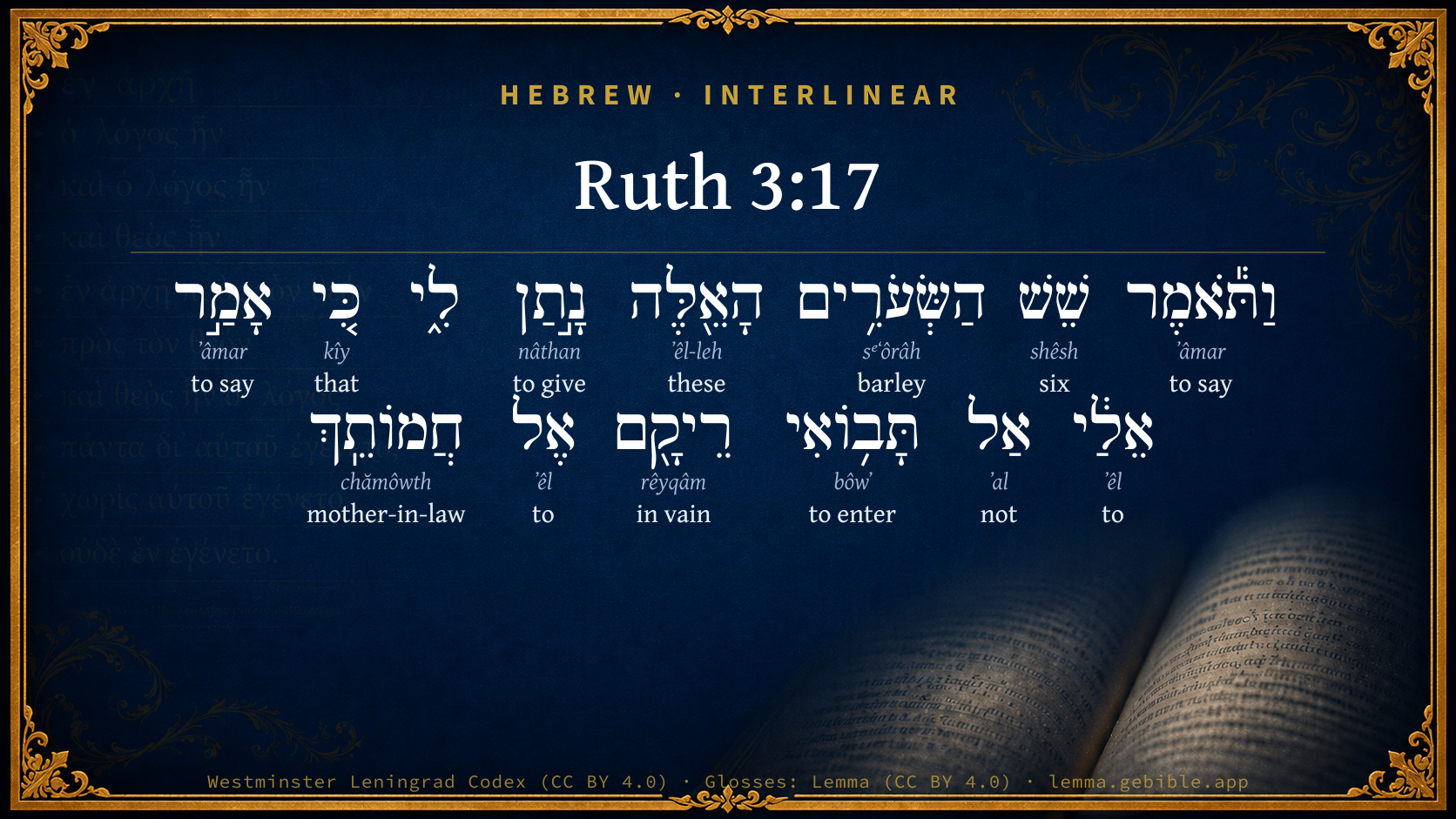
חֲמוֹתֵֽךְ
chămôwth
H2545
“mother-in-law · your”
Noun, Common, Feminine, Singular, Construct + Suffix, Personal, 2nd Person, Feminine, Singular
Part of Speech
Noun
Type
Common
Gender
Feminine
Number
Singular
State
Construct
Full BDB Definition

Origin: from H2524

TWOT: 674b

mother-in-law, husband's mother
  1. וַתֹּ֕אמֶר ʼâmar H559 “and · to say” Conjunction + Verb, Qal, Sequential Imperfect, 3rd Person, Feminine, Singular
  2. שֵׁשׁ shêsh H8337 “six” Adjective, Cardinal number, Feminine, Singular, Absolute
  3. הַשְּׂעֹרִ֥ים sᵉʻôrâh H8184 “the · barley” Particle, Definite Article + Noun, Common, Feminine, Plural, Absolute
  4. הָאֵ֖לֶּה ʼêl-leh H428 “the · these” Particle, Definite Article + Pronoun, Demonstrative, Common, Plural
  5. נָ֣תַן nâthan H5414 “to give” Verb, Qal, Perfect, 3rd Person, Masculine, Singular
  6. כִּ֚י kîy H3588 “that” Conjunction
  7. אָמַ֣ר ʼâmar H559 “to say” Verb, Qal, Perfect, 3rd Person, Masculine, Singular
  8. אֵלַ֔י ʼêl H413 “to · me” Preposition + Suffix, Personal, 1st Person, Common, Singular
  9. אַל ʼal H408 “not” Particle, Negative
  10. תָּב֥וֹאִי bôwʼ H935 “to enter” Verb, Qal, Jussive, 2nd Person, Feminine, Singular
  11. רֵיקָ֖ם rêyqâm H7387 “in vain” Adverb
  12. אֶל ʼêl H413 “to” Preposition

About this verse

These counts appear in no published source. They are computed here, from the morphology-tagged text and Lemma’s own curated glosses. What Lemma adds →

14
words
11
distinct lemmas
Historical
section

Notable vocabulary

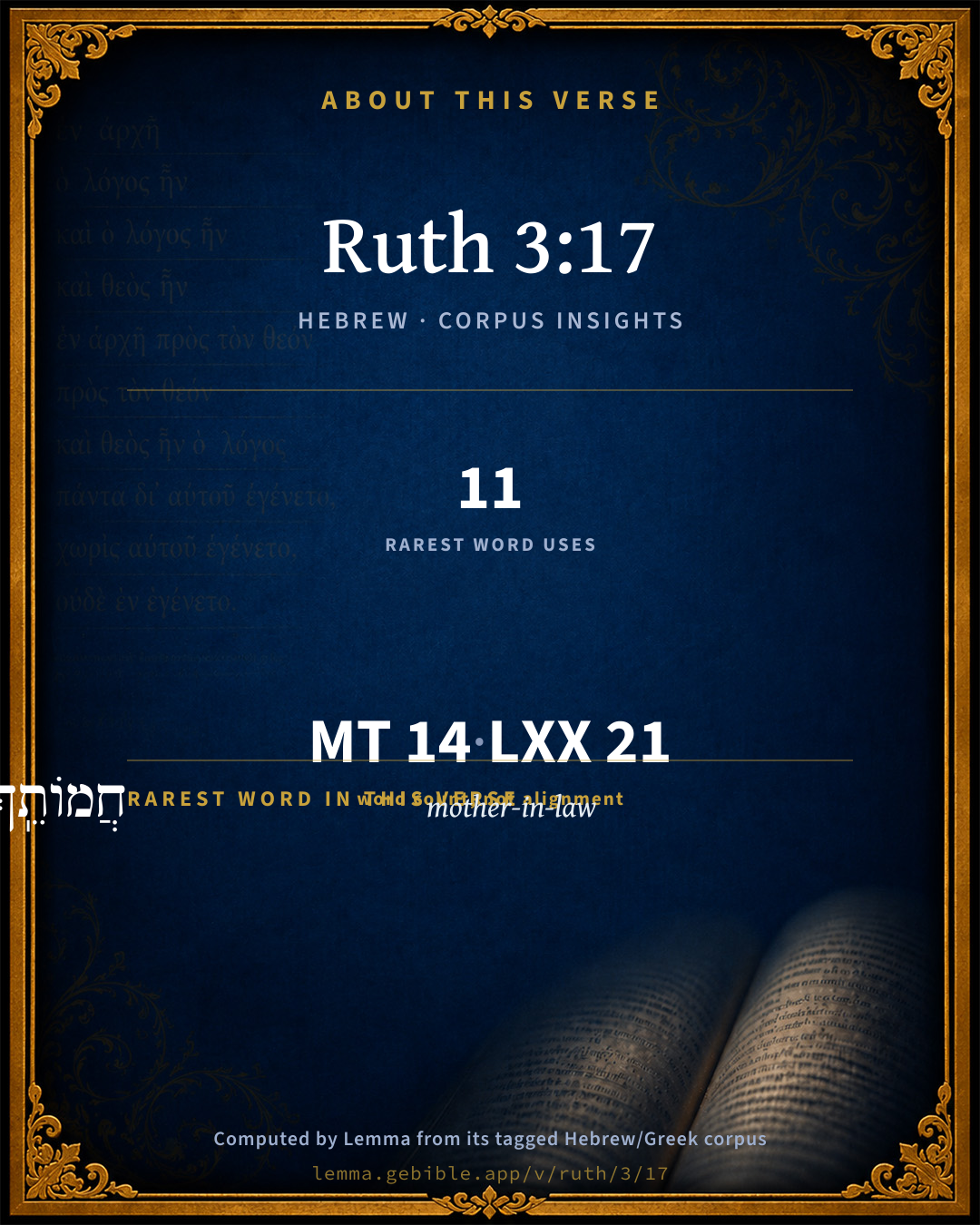
The rarest word here is חֲמוֹתֵֽךְ mother-in-law H2545 — appearing just 11 times in the whole Hebrew Bible.

Shared distinctive vocabulary

חֲמוֹתֵֽךְ mother-in-law H2545 occurs in 10 verses of the Hebrew Bible. Also found in:

Grammatical profile

  • 4 verbs
  • 2 nouns
  • 1 adjective
  • 1 pronoun
  • 3 prepositions
  • 1 conjunction
  • 1 adverb
  • 1 particle

Verb forms

  • וַתֹּ֕אמֶר Qal · Sequential Imperfect
  • נָ֣תַן Qal · Perfect
  • אָמַ֣ר Qal · Perfect
  • תָּב֥וֹאִי Qal · Jussive

Repetition

Words recur within this verse — often emphatic in Hebrew:

  • וַתֹּ֕אמֶר to say H559 ×2
  • אֵלַ֔י to H413 ×2

Hebrew & Septuagint length

In English translation the verse runs 19 words from the Hebrew and 24 from the Septuagint (LXX English) — closely comparable.

A rough comparison of the two English renderings, which tokenize alike — not a word-level alignment.

Word counts can differ between the Hebrew and the Greek without any difference in meaning — e.g. the Hebrew direct-object marker אֵת has no separate Greek word, and Greek often adds the article ὁ.

In the original languages it is 14 Hebrew tokens and 21 Greek tokens — but the two are counted differently (Hebrew bundles its prefixes and suffixes into one token; the Greek is in lemma form), so that isn’t a like-for-like length.

Hebrew and Greek witnesses Masoretic Hebrew ↔ Greek Septuagint

The same verse in the two great witnesses to the Old Testament, shown verse-for-verse.

These are two independent witnesses, not word-aligned to each other, and the Septuagint is shown in lemma (dictionary) form.

Hebrew Ruth 3:17 Masoretic · Westminster Leningrad Codex

וַתֹּ֕אמֶר שֵׁשׁ הַשְּׂעֹרִ֥ים הָאֵ֖לֶּה נָ֣תַן לִ֑י כִּ֚י אָמַ֣ר אֵלַ֔י אַל תָּב֥וֹאִי רֵיקָ֖ם אֶל חֲמוֹתֵֽךְ

She said, These six [measures] of barley gave he me; for he said, "Don't go empty to your mother-in-law."

World English Bible · Public Domain

Greek LXX Ruth 3:17 Septuagint · lemma form

καί εἶπον αὐτός ὁ ἕξ ὁ κριθή οὗτος δίδωμι ἐγώ ὅτι εἶπον πρός ἐγώ μή εἰςἔρχομαι κενός πρός ὁ πενθερά σύ

And she said to her, He gave me these six measures of barley, for he said to me, Go not empty to your mother-in-law.

LXX2012 (modern English Septuagint) · Public Domain

Hebrew: Westminster Leningrad Codex (CC BY 4.0). Greek: Septuagint (public domain); English from LXX2012 (modern English Septuagint) (Public Domain). How the Septuagint differs from the Hebrew →

Commentary

Notes on Ruth 3:17 from classic Christian and Jewish commentators (each source and its license shown beneath its notes). The classic Christian expositions comment on the surrounding passage and are grouped to its opening verse, so a note may address several verses; the Jewish commentaries on the Tanakh (Rashi and others) are per-verse, so they appear only where the commentator wrote on this verse.

Lemma curates 59 commentaries, every one of them public domain or Creative Commons licensed, each selected and text-cleaned for this edition rather than reprinted as found. About our sources →

Trapp's Complete Commentary

John Trapp

Rth 3:17 And she said, These six [measures] of barley gave he me; for he said to me, Go not empty unto thy mother in law.

Ver. 17. These six measures.] Love is liberal, it will not be hid: … quis enim celaverit ignem?

For he said to me.]

“ Dat bene, dat multum, qui dat cure munere vulture. ”

Go not empty.] This was to lay up treasure in heaven, to lend to the Lord, to lay hold upon eternal life. "A liberal man deviseth liberal things, and by liberal things he shall stand."

John Trapp, A Commentary or Exposition upon All the Books of the Old and New Testament (1647–1656) — public domain. Text from a community e-Sword module.

Jamieson, Fausset & Brown

Robert Jamieson, A. R. Fausset & David Brown

six measures of barley--Hebrew, "six seahs," a seah contained about two gallons and a half, six of which must have been rather a heavy load for a woman.

Next: Ruth Chapter 4

Jamieson, Fausset & Brown — Commentary Critical and Explanatory on the Whole Bible (1871) — public domain (CC PDM 1.0). Text via the HelloAO Bible API.

John Gill's Exposition

And she said, these six measures of barley gave he me,.... Which she laid down before her, which was a proof of his kindness to her, that she was acceptable to him, and had well sped; of these six measures, see Rut 3:15 which by some are allegorically interpreted of six blessings that should be bestowed upon her, as the spirit of wisdom, understanding, &c. as Isa 11:2 so Jarchi; or of six persons that should spring from her, as David, Daniel, and his companions, and the King Messiah, as the Targum:

for he said unto me, go not empty unto thy mother in law; which, as it expressed a regard to Naomi, and a compassionate concern for her support, so would give her assurance of the success Ruth met with, she would relate to her.

John Gill's Exposition of the Whole Bible (1746–1763) — public domain (CC PDM 1.0). Text via the HelloAO Bible API.

The Pulpit Commentary

And she said, These six measures of barley he gave to me; for he said, Thou must not go empty to thy mother-in-law. The C"tib omission of "to me" after "for he said" is most likely to be the original reading. A fastidious Rabbi would rather originate this insertion than the omission.

The present was, in one point of view, inconsiderable; but, in another point of view, it was a most suitable gift from one who desired indeed to show sympathy, gratitude, and kindness, but who did not wish, at that stage of the affair, to raise unconditioned expectation which might never be realized.

The Pulpit Commentary (1880–1919), ed. H.D.M. Spence-Jones & Joseph S. Exell — public domain. Text from a community e-Sword module.

Lesson kit

Teaching starters — assembled from the data on this page, not authored interpretation. Every prompt links to the verse data it draws on. Edit before teaching.

Ruth, in the Historical, opens this verse with 14 words (11 distinct Hebrew lemmas). Its most distinctive word is chămôwth (“mother-in-law”). A historical commentator’s framing appears above. Read the whole chapter for the surrounding context.

Discussion questions

  1. What does “mother-in-law” (chămôwth) contribute to the verse as a whole?
  2. Ruth 1:14 shares the word «mother-in-law» with this verse. How do the two illuminate each other?
  3. “to say” occurs 2× in this one verse. What is the effect of the repetition?
  4. These translations render this verse differently; the difference is in the English rendering, not the original. What questions does that raise?
  5. The verb «וַתֹּ֕אמֶר» is Qal Sequential Imperfect. How does its form color the action?
  6. Reading how Trapp's Complete Commentary and Jamieson, Fausset & Brown read this verse, where do the two commentators agree and where do they part?

Things to notice

Reading settings

Reading text

Shown beneath each verse's original-language words.

Old Testament
Old Testament edition

Read the OT as the Masoretic Hebrew (MT) or the Greek Septuagint (LXX).

English shown for the Greek Septuagint (in the Hebrew ↔ Greek comparison).

Comparing translations? Open the Compare panel on any verse page to stack up to four side by side.