
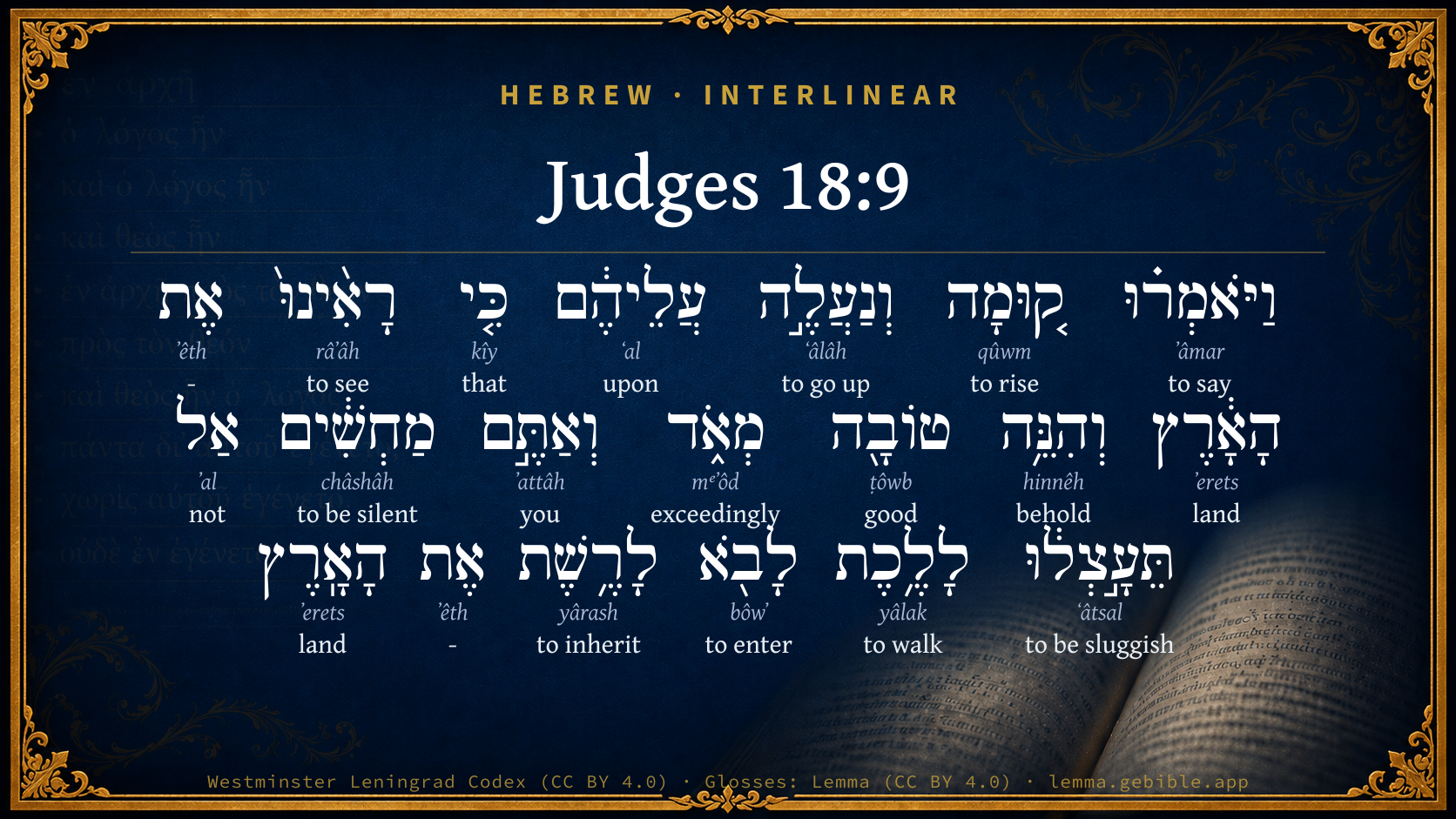
Judges 18:9

Hebrew (Westminster Leningrad Codex) Judges 18:9 appears in the Hebrew Old Testament. The text above is from the Westminster Leningrad Codex. Each word links to its Strong’s number, a concise gloss, and parsing drawn from the Open Scriptures Hebrew Bible morphology. Click any word for its full Brown-Driver-Briggs (BDB) entry.
Download image
Cite this verse

Judges 18:9 (World English Bible). Public Domain. Lemma interlinear Bible study tool, https://lemma.gebible.app/v/judges/18/9.

Show BibTeX & RIS
BibTeX
RIS
English Translation
They said, Arise, and let us go up against them; for we have seen the land, and, behold, it is very good: and are you still? don't be slothful to go and to enter in to possess the land.
World English Bible · Public Domain
Highlights
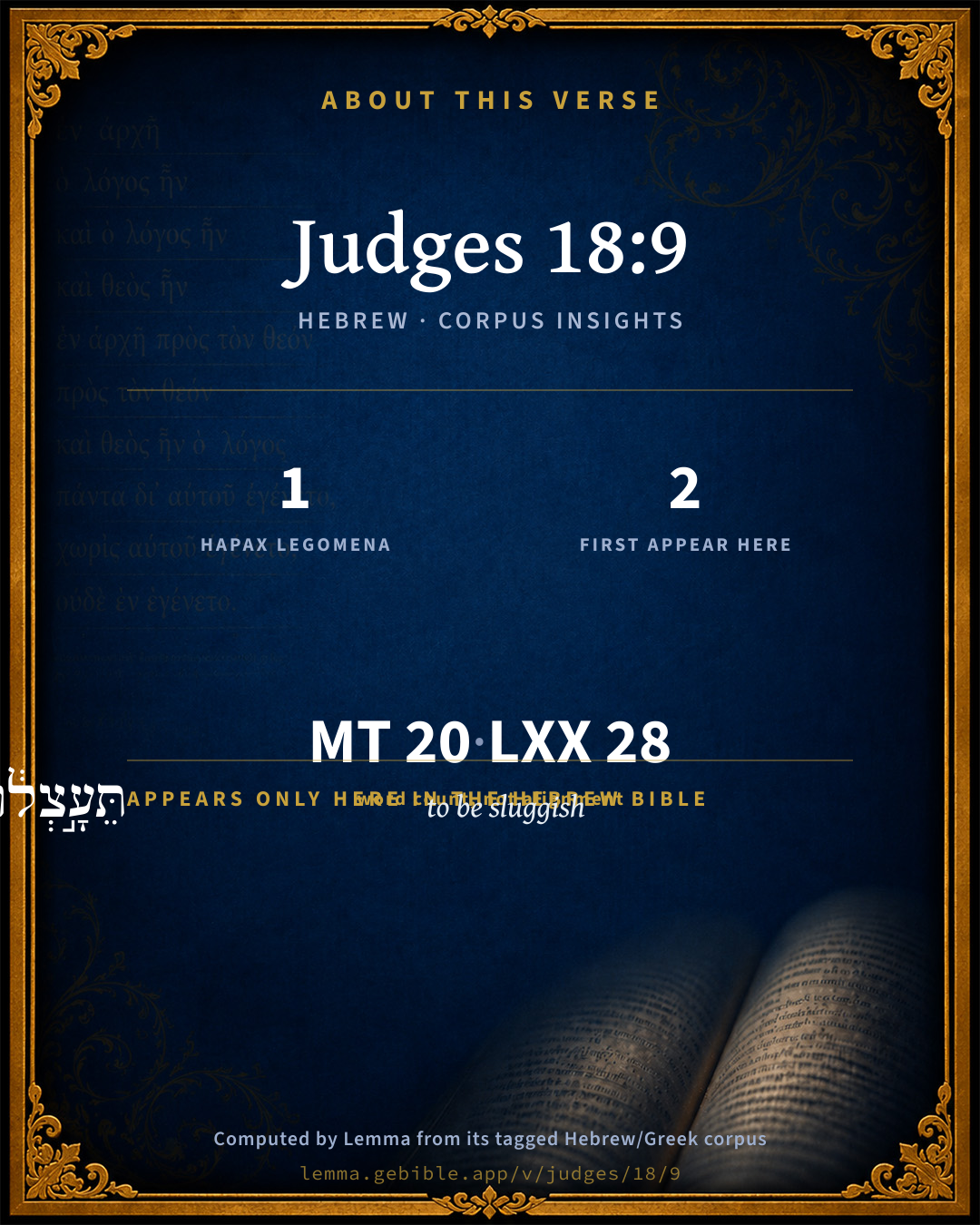
  • 1 hapax legomenon — only here in the Hebrew Bible
  • 2 first appearances in the Hebrew Bible
Full analysis ↓
Download a study sheet

One document with this verse’s original text, its word-by-word gloss line, the meaning frame, cross-references with their text, attributed commentary, and full source and license credits — printable, and it pastes into notes with its structure intact.

This verse Autodidact and up

Study sheet (.html) Plain text (.txt)

A passage Seminary Student

Up to 50 verses in one chapter. A passage sheet keeps up to 6 commentary sources and 12 cross-references per verse, in the order this page ranks them, and says so on the sheet whenever that leaves anything out. Ask for a single verse and you get the Autodidact verse sheet above.

Everything on this page stays free to read, with no account — the sheet is a download of what is already on screen, not access to it.

Want to remove ads? Support Godless Engineer
Compare translations 3

The same verse in 3 English versions, stacked beneath the original-language interlinear above. Click any original word for its lexicon entry.

Each is an independent rendering of the whole verse — the interlinear is not word-aligned to these translations.

Highlighted words mark where these versions differ — a whole-verse word diff, not a word-by-word alignment.

  • World English Bible Public Domain
    They said, Arise, and let us go up against them; for we have seen the land, and, behold, it is very good: and are you still? don't be slothful to go and to enter in to possess the land.
  • King James Version Public Domain
    And they said, Arise, that we may go up against them: for we have seen the land, and, behold, it is very good: and are ye still? be not slothful to go, and to enter to possess the land.
  • unfoldingWord Literal Text CC BY-SA 4.0
    And they said, “Arise, and let us go up against them! For we have seen the land, and behold, very good. And you being silent? May you not slacken yourselves to go to enter to possess the land!

unfoldingWord Literal Text — © unfoldingWord, licensed CC BY-SA 4.0. Word-aligned USFM3 via Door43 (git.door43.org/unfoldingWord/en_ult).

Versions to compare (up to 4)

3 of 4 selected

Show all 18 translations

Every available English version of this verse, each an independent rendering of the whole verse.

  • World English Bible Public Domain
    They said, Arise, and let us go up against them; for we have seen the land, and, behold, it is very good: and are you still? don't be slothful to go and to enter in to possess the land.
  • Berean Standard Bible Public Domain
    They answered, “Come on, let us go up against them, for we have seen the land, and it is very good. Why would you fail to act? Do not hesitate to go there and take possession of the land!
  • Majority Standard Bible Public Domain
    They answered, “Come on, let us go up against them, for we have seen the land, and it is very good. Why would you fail to act? Do not hesitate to go there and take possession of the land!
  • King James Version Public Domain
    And they said, Arise, that we may go up against them: for we have seen the land, and, behold, it is very good: and are ye still? be not slothful to go, and to enter to possess the land.
  • American Standard Version (1901) Public Domain
    And they said, Arise, and let us go up against them; for we have seen the land, and, behold, it is very good: and are ye still? be not slothful to go and to enter in to possess the land.
  • Revised Version (1885) Public Domain
    And they said, Arise, and let us go up against them: for we have seen the land, and, behold, it is very good: and are ye still? be not slofthful to go and to enter in to possess the land.
  • Geneva Bible (1599) Public Domain
    And they answered, Arise, that we may goe vp against them: for we haue seene the lande, and surely it is very good, and doe ye sit stil? be not slouthfull to goe and enter to possesse the lande:
  • Douay-Rheims (1899) Public Domain
    Arise, and let us go up to them: for we have seen the land which is exceeding rich and fruitful: neglect not, lose no time: let us go and possess it, there will be no difficulty.
  • Young's Literal Translation Public Domain
    And they say, `Rise, and we go up against them, for we have seen the land, and lo, very good; and ye are keeping silent! be not slothful to go -- to enter to possess the land.
  • Literal Standard Version CC BY-SA 4.0
    And they say, “Rise, and we go up against them, for we have seen the land, and behold—very good; and you are keeping silent! Do not be slothful to go—to enter to possess the land.
  • Unlocked Literal Bible CC BY-SA 4.0
    They said, “Come! Let us attack them! We have seen the land and it is very good. Are you doing nothing? Do not be slow to attack and conquer the land.
  • unfoldingWord Literal Text CC BY-SA 4.0
    And they said, “Arise, and let us go up against them! For we have seen the land, and behold, very good. And you being silent? May you not slacken yourselves to go to enter to possess the land!
  • Darby Bible Public Domain
    They said, "Arise, and let us go up against them; for we have seen the land, and behold, it is very fertile. And will you do nothing? Do not be slow to go, and enter in and possess the land.
  • World Messianic Bible Public Domain
    They said, “Arise, and let’s go up against them; for we have seen the land, and behold, it is very good. Do you stand still? Don’t be slothful to go and to enter in to possess the land.
  • Webster's Bible Public Domain
    And they said, Arise, that we may go up against them: for we have seen the land, and behold, it is very good: and are ye still? be not slothful to go, and to enter to possess the land.
  • Free Bible Version CC BY-SA 4.0
    “Come on, let's go and attack them!” the men interrupted. “We've surveyed the land, and it's excellent! Aren't you going to do something? Don't put off going there and occupying the land!
  • Bible in Basic English Public Domain
    And they said, Up! and let us go against Laish; for we have seen the land, and it is very good: why are you doing nothing? Do not be slow to go in and take the land for your heritage.
  • JPS Tanakh (1917) Public Domain
    And they said: 'Arise, and let us go up against them; for we have seen the land, and, behold, it is very good; and are ye still? be not slothful to go and to enter in to possess the land.

Literal Standard Version (2020), Covenant Press — licensed CC BY-SA 4.0. Text via the HelloAO Bible API (eBible.org). Unlocked Literal Bible (unfoldingWord) — licensed CC BY-SA 4.0. Text via the HelloAO Bible API (eBible.org). unfoldingWord Literal Text — © unfoldingWord, licensed CC BY-SA 4.0. Word-aligned USFM3 via Door43 (git.door43.org/unfoldingWord/en_ult). Free Bible Version, Dr. Jonathan Gallagher — licensed CC BY-SA 4.0. Text via the HelloAO Bible API (eBible.org).

Word by word

More ways to search: Search by grammar → Find every occurrence → Compare this word →

Practice this passage: Drill this verse → Learn its vocabulary →

תֵּעָ֣צְל֔וּ
ʻâtsal
H6101
“to be sluggish”
Verb, Niphal, Jussive, 2nd Person, Masculine, Plural
Part of Speech
Verb
Stem
Niphal
Form
Jussive
Person
2nd Person
Gender
Masculine
Number
Plural
Full BDB Definition

Origin: a primitive root

TWOT: 1672

(Niphal) to be sluggish
  1. וַיֹּאמְר֗וּ ʼâmar H559 “and · to say” Conjunction + Verb, Qal, Sequential Imperfect, 3rd Person, Masculine, Plural
  2. ק֚וּמָה qûwm H6965 “rise” Verb, Qal, Imperative, 2nd Person, Masculine, Singular + Suffix, h
  3. וְנַעֲלֶ֣ה ʻâlâh H5927 “and · to go up” Conjunction + Verb, Qal, Cohortative, 1st Person, Common, Plural
  4. עֲלֵיהֶ֔ם ʻal H5921 “upon · them” Preposition + Suffix, Personal, 3rd Person, Masculine, Plural
  5. כִּ֤י kîy H3588 “that” Conjunction
  6. רָאִ֨ינוּ֙ râʼâh H7200 “to see” Verb, Qal, Perfect, 1st Person, Common, Plural
  7. אֶת ʼêth H853 “-” Particle, Direct Object
  8. הָאָ֔רֶץ ʼerets H776 “the · land” Particle, Definite Article + Noun, Common, Both, Singular, Absolute
  9. וְהִנֵּ֥ה hinnêh H2009 “and · behold” Conjunction + Particle, Demonstrative
  10. טוֹבָ֖ה ṭôwb H2896 “good” Adjective, Adjective, Feminine, Singular, Absolute
  11. מְאֹ֑ד mᵉʼôd H3966 “exceedingly” Adverb
  12. וְאַתֶּ֣ם ʼattâh H859 “and · you” Conjunction + Pronoun, Personal, 2nd Person, Masculine, Plural
  13. מַחְשִׁ֔ים châshâh H2814 “being silent” Verb, Hiphil, Participle Active, Masculine, Plural, Absolute
  14. אַל ʼal H408 “not” Particle, Negative
  15. לָלֶ֥כֶת yâlak H3212 “to walk” Preposition + Verb, Qal, Infinitive Construct
  16. לָבֹ֖א bôwʼ H935 “to enter” Preposition + Verb, Qal, Infinitive Construct
  17. לָרֶ֥שֶׁת yârash H3423 “to inherit” Preposition + Verb, Qal, Infinitive Construct
  18. אֶת ʼêth H853 “-” Particle, Direct Object
  19. הָאָֽרֶץ ʼerets H776 “the · land” Particle, Definite Article + Noun, Common, Both, Singular, Absolute

About this verse

These counts appear in no published source. They are computed here, from the morphology-tagged text and Lemma’s own curated glosses. What Lemma adds →

20
words
18
distinct lemmas
Historical
section

Notable vocabulary

1 hapax legomenon — a word that appears only here in the entire Hebrew Bible:

  • תֵּעָ֣צְל֔וּ to be sluggish H6101

First appearance in Scripture

These words make their first canonical appearance in the Hebrew Bible here:

  • מַחְשִׁ֔ים to be silent H2814
  • תֵּעָ֣צְל֔וּ to be sluggish H6101

Shared distinctive vocabulary

מַחְשִׁ֔ים to be silent H2814 occurs in 16 verses of the Hebrew Bible. Also found in:

Grammatical profile

  • 9 verbs
  • 2 nouns
  • 1 adjective
  • 1 pronoun
  • 1 preposition
  • 1 conjunction
  • 1 adverb
  • 4 particles

Verb forms

  • וַיֹּאמְר֗וּ Qal · Sequential Imperfect
  • ק֚וּמָה Qal · Imperative
  • וְנַעֲלֶ֣ה Qal · Cohortative
  • רָאִ֨ינוּ֙ Qal · Perfect
  • מַחְשִׁ֔ים Hiphil · Participle Active
  • תֵּעָ֣צְל֔וּ Niphal · Jussive
  • לָלֶ֥כֶת Qal · Infinitive Construct
  • לָבֹ֖א Qal · Infinitive Construct
  • לָרֶ֥שֶׁת Qal · Infinitive Construct

Repetition

A word recurs within this verse — often emphatic in Hebrew:

  • הָאָ֔רֶץ land H776 ×2

Hebrew & Septuagint length

In English translation the verse runs 39 words from the Hebrew and 39 from the Septuagint (LXX English) — the same length.

A rough comparison of the two English renderings, which tokenize alike — not a word-level alignment.

Word counts can differ between the Hebrew and the Greek without any difference in meaning — e.g. the Hebrew direct-object marker אֵת has no separate Greek word, and Greek often adds the article ὁ.

In the original languages it is 20 Hebrew tokens and 28 Greek tokens — but the two are counted differently (Hebrew bundles its prefixes and suffixes into one token; the Greek is in lemma form), so that isn’t a like-for-like length.

Cross-references

11

Topical passages linked to Judges 18:9 in the Treasury of Scripture Knowledge — connected by theme and wording, ordered by reader-vote popularity; previews shown in the World English Bible.

  • Numbers 13:30 Caleb stilled the people before Moses, and said, Let us go up at once, and possess it; for we are well able to overcome it.
  • Joshua 2:23–24 Then the two men returned, and descended from the mountain, and passed over, and came to Joshua the son of Nun; and they told him all that had happened to them.
  • Joshua 18:3 Joshua said to the children of Israel, How long are you slack to go in to possess the land, which Yahweh, the God of your fathers, has given you?
  • John 6:27 Don't work for the food which perishes, but for the food which remains to eternal life, which the Son of Man will give to you. For God the Father has sealed him."
  • 1 Samuel 4:9 Be strong, and behave yourselves like men, O you Philistines, that you not be servants to the Hebrews, as they have been to you: quit yourselves like men, and fight.
  • 2 Samuel 10:12 Be of good courage, and let us play the man for our people, and for the cities of our God: and Yahweh do that which seems him good.
  • 1 Kings 22:3 The king of Israel said to his servants, "You know that Ramoth-gilead is ours, and we are still, and don't take it out of the hand of the king of Syria?"
  • 1 Kings 22:23 Now therefore, behold, Yahweh has put a lying spirit in the mouth of all these your prophets; and Yahweh has spoken evil concerning you.
  • Hebrews 6:11–12 We desire that each one of you may show the same diligence to the fullness of hope even to the end,
  • 2 Peter 1:10–11 Therefore, brothers, be more diligent to make your calling and election sure. For if you do these things, you will never stumble.
  • Numbers 14:7–9 and they spoke to all the congregation of the children of Israel, saying, The land, which we passed through to spy it out, is an exceeding good land.

Cross-references courtesy of OpenBible.info (CC BY 4.0).

Hebrew and Greek witnesses Masoretic Hebrew ↔ Greek Septuagint

The same verse in the two great witnesses to the Old Testament, shown verse-for-verse.

These are two independent witnesses, not word-aligned to each other, and the Septuagint is shown in lemma (dictionary) form.

Hebrew Judges 18:9 Masoretic · Westminster Leningrad Codex

וַיֹּאמְר֗וּ ק֚וּמָה וְנַעֲלֶ֣ה עֲלֵיהֶ֔ם כִּ֤י רָאִ֨ינוּ֙ אֶת הָאָ֔רֶץ וְהִנֵּ֥ה טוֹבָ֖ה מְאֹ֑ד וְאַתֶּ֣ם מַחְשִׁ֔ים אַל תֵּעָ֣צְל֔וּ לָלֶ֥כֶת לָבֹ֖א לָרֶ֥שֶׁת אֶת הָאָֽרֶץ

They said, Arise, and let us go up against them; for we have seen the land, and, behold, it is very good: and are you still? don't be slothful to go and to enter in to possess the land.

World English Bible · Public Domain

Greek LXX Judges 18:9 Septuagint · lemma form

καί εἶπον ἀναἵστημι καί ἀναβαίνω ἐπί αὐτός ὅτι ὁράω ὁ γῆ καί ἰδού ἀγαθός σφόδρα καί σύ ἡσυχάζω μή ὀκνέω ὁ πορεύομαι καί εἰςἔρχομαι ὁ κληρονομέω ὁ γῆ

And they said, Arise, and let us go up against them, for we have seen the land, and, behold, it is very good, yet you⌃ are still: delay not to go, and to enter in to possess the land.

LXX2012 (modern English Septuagint) · Public Domain

Hebrew: Westminster Leningrad Codex (CC BY 4.0). Greek: Septuagint (public domain); English from LXX2012 (modern English Septuagint) (Public Domain). How the Septuagint differs from the Hebrew →

Targum (Aramaic paraphrase)

1

The Targum is the ancient Jewish Aramaic paraphrase of the Hebrew Scriptures — an interpretive translation, not the Hebrew text itself. Onkelos (literal) and Pseudo-Jonathan (expansive) render the Torah, and Jonathan the Prophets. Coverage is partial: where no permissively-licensed English translation exists for a verse, only the Aramaic is shown. This is verse-level text, not a word-by-word alignment to the Hebrew.

  1. Targum Jonathan Prophets (Joshua–Malachi)
    וַאֲמַרוּ קוּמוּ וְנִיסַק עֲלֵיהוֹן אֲרֵי חֲזֵינָא יַת אַרְעָא וְהָא טָבָא לַחֲדָא וְאַתּוּן שַׁתְקִין לָא תִתְרַשְׁלוּן לְמֵיזַל לְמֵיעַל לְמֵירַת יַת אַרְעָא:

    (no public-domain English translation for this verse)

    Targum Jonathan — Aramaic: “Mikraot Gedolot” (public domain). English: “Sefaria Community Translation” (CC0 1.0 (public-domain dedication)); “London "Chaldee Paraphrase," 1871” (public domain). Text via Sefaria.

Commentary

Notes on Judges 18:9 from classic Christian and Jewish commentators (each source and its license shown beneath its notes). The classic Christian expositions comment on the surrounding passage and are grouped to its opening verse, so a note may address several verses; the Jewish commentaries on the Tanakh (Rashi and others) are per-verse, so they appear only where the commentator wrote on this verse.

Lemma curates 59 commentaries, every one of them public domain or Creative Commons licensed, each selected and text-cleaned for this edition rather than reprinted as found. About our sources →

Trapp's Complete Commentary

John Trapp

Jdg 18:9 And they said, Arise, that we may go up against them: for we have seen the land, and, behold, it [is] very good: and [are] ye still? be not slothful to go, [and] to enter to possess the land.

Ver. 9. Be not slothful to go, &c.] Thus do these spies notably and manfully encourage their contribules to set upon Laish, to secure a city. Captain Gam in like sort bespake our Henry V before the battle at Agincourt, If the French be so numerous, there will be enough to be killed, enough to be taken prisoners, and enough to run away. It proved accordingly, though the French were so confident of a victory, that they sent to King Henry, to know what ransom he would give. {a}

{a} Speed, 795.

John Trapp, A Commentary or Exposition upon All the Books of the Old and New Testament (1647–1656) — public domain. Text from a community e-Sword module.

Geneva Bible (1599)

Geneva Bible translators

Lose ye this good occasion through your slothfulness?

Geneva Bible (1599) marginal notes — public domain. Text via Bolls.life.

Adam Clarke's Commentary

Verse 9. Arise, c.] This is a very plain and nervous address full of good sense, and well adapted to the purpose. It seems to have produced an instantaneous effect.

Adam Clarke's Commentary on the Bible (1810–1826) — public domain. Text from a community e-Sword/MySword module.

Ellicott's Commentary for English Readers

(9) Behold, it is very good.—Comp. Num_14:7; Jos_2:23-24. The beauty of the site well bears out the description—“the rich and beautiful seclusion of that loveliest of the scenes of Palestine” (Stanley). It was by a similar statement that Anaxilaus of Rhegium persuaded the Messenians to seize Zankle (Pausan. 4:23, quoted by Cassel).

Are ye still?—1Ki_22:3; 2Ki_7:9.

A Bible Commentary for English Readers, edited by Charles John Ellicott (1878–1897) — public domain. Text from a community e-Sword module.

The Cambridge Bible for Schools and Colleges

gen. ed. J. J. S. Perowne

9, 10. The reply of the spies is overcharged, and the sentences out of logical order, probably owing to the combination of the two narratives. Moore thus separates the two: (a) Arise, and let us go up against them: for when ye come, ye shall come unto a people secure, and the land is large, for it is a place where there is no want of anything that is in the earth; (b) And they said, We have seen the land, and, behold, it is very good: and are ye still? be not slothful to go and to enter in to possess the land; God hath given it into your hand. A different arrangement is proposed by Budde, who further points out that we should expect the spies to mention the name of the place which they discovered and urged their clan to seize; accordingly he reads to Laish for against them in (a), and supplies the omission in (b). He distinguishes the sources as follows: (a) And they said, Arise and let us go up [to Laish]; for we have seen the land, and, behold, it is very good; a place where there is no want of any thing that is in the earth; (b) And they said, [Why] are ye still? be not slothful to go [to Laish] to possess the land, for [Jehovah] hath given it into your hand. When ye come, ye shall come … is large. Of the two, Budde’s arrangement seems preferable; but it is impossible to reconstruct the sources with any certainty.

and are ye still?] Cf. 1Ki_22:3. Budde’s correction, why for and, is an improvement.

The Cambridge Bible for Schools and Colleges (gen. ed. J. J. S. Perowne; Cambridge University Press, 1878–1918) — public domain. Text from a community e-Sword module.

John Gill's Exposition

And they said, arise, that me may go up against them,.... That is, prepare for war, and go up in an hostile manner against the present possessors of the land, not doubting of being masters of it easily:

for we have seen the land, and, behold, it is very good. Adrichomius (x) says it was very good pasture land, and fertile, abounding with fruits of all kinds; and the same is attested by Josephus (y):

and are ye still? can ye sit still, and be easy, and not bestir yourselves to go up and possess so good a country, of which an easy conquest may be made? or, affirmatively, "ye are still or silent" (z); ye make no answer to what we say, and seem careless and indifferent about the matter; or by way of exhortation, "be silent", either that the people may remain in their quiet, easy, careless state, and lest, on hearing designs against them, should prepare for their defence; or, as Abarbinel, lest any of the other tribes of Israel should hear of it, and go take it before them:

be not slothful to go, and to enter to possess the land; they suggest that there was scarce anything more to be done than to go and take possession, and that it would be altogether owing to their sloth and indolence if they did not.

(x) Ut supra. (Antiqu. l. 5. c. 3. sect. 1.) (y) Ut supra. (Antiqu. l. 5. c. 3. sect. 1.) (z) "vos autem desidetis", Tigurine version; "et vos quiescitis", Munster.

John Gill's Exposition of the Whole Bible (1746–1763) — public domain (CC PDM 1.0). Text via the HelloAO Bible API.

Haydock's Catholic Bible Commentary

There will, &c., is added to signify, that it will be necessary only to go to take possession. (Haydock)

George Leo Haydock (1774–1849), Haydock's Catholic Family Bible and Commentary, 1859 edition — public domain. Excludes Psalms (Douay-Rheims chapter numbering differs from Protestant) and Deuterocanonical books (Catholic canon only).

Matthew Poole's English Annotations

Are ye still, Heb. silent? Silence is oft put for stillness or cessation from action or motion, as Exo 14:14; Isa 62:1; Lam 2:18. For they do not accuse them for want of speaking, for that they did; but for want of doing, and putting their words and resolves into execution.

Matthew Poole's English Annotations on the Holy Bible (1683–1685) — public domain. Text from a community e-Sword/MySword module.

The Pulpit Commentary

To go, and to enter. The exact meaning is, Be not slothful to go (i.e. to go on your way from hence), so as to enter in and possess the land. This would be expressed by leaving out to before enter to go and enter.

The Pulpit Commentary (1880–1919), ed. H.D.M. Spence-Jones & Joseph S. Exell — public domain. Text from a community e-Sword module.

unfoldingWord translationNotes

Door43 World Missions Community

Are you doing nothing?

This rhetorical question is asked sarcastically and means that they should be doing the opposite. This question can be written as a statement. AT: "You should be acting now!" (See: Rhetorical Question and Double Negatives)

Do not be slow to attack

These two negative words "not" and "slow" together emphasize the positive idea to attack quickly. AT: "Hurry! Attack" (See: Double Negatives)

the land is wide

"the land is large." This is a description of the size of the land.

that does not lack anything in the land

The men use a hyperbole, an exaggeration, to emphasize that it is a very desirable place to live. AT: "where we will have everything there that we need" (See: Hyperbole and Generalization)

that does not lack anything

The two negative words together emphasize a positive idea. AT: "has everything" (See: Double Negatives)

translationWords

people group

God

earth

unfoldingWord translationNotes — © Distant Shores Media and the Door43 World Missions Community, licensed CC BY-SA 4.0. Source: git.door43.org/Door43/en_tn.

Rashi

Rabbi Shlomo Yitzchaki (Rashi)

You are apathetic Lazy.

Rashi on the Tanakh — English translations: “The Judaica Press complete Tanach with Rashi, translated by A. J. Rosenberg” (CC BY 4.0); “Pentateuch with Rashi's commentary by M. Rosenbaum and A.M. Silbermann, 1929-1934” (public domain); “The Metsudah Tanach series, Lakewood, N.J” (CC BY 4.0); and “The Book of Joshua, Metsudah Publications, 1997” (CC BY 4.0). Text via Sefaria.

Lesson kit

Teaching starters — assembled from the data on this page, not authored interpretation. Every prompt links to the verse data it draws on. Edit before teaching.

Judges, in the Historical, opens this verse with 20 words (18 distinct Hebrew lemmas). Its most distinctive word is ʻâtsal (“to be sluggish”). A historical commentator’s framing appears above. Read the whole chapter for the surrounding context.

Discussion questions

  1. What does “to be sluggish” (ʻâtsal) contribute to the verse as a whole?
  2. This verse holds 1 word here found nowhere else in the Hebrew Bible. What might the rare word draw attention to?
  3. 2 words here appear for the first time in Scripture. What is being introduced at this debut?
  4. 1 Kings 22:3 shares the word «to be silent» with this verse. How do the two illuminate each other?
  5. “land” occurs 2× in this one verse. What is the effect of the repetition?
  6. These translations render this verse differently. What is at stake in choosing one wording over another?
  7. The verb «וַיֹּאמְר֗וּ» is Qal Sequential Imperfect. How does its form color the action?
  8. Reading how Trapp's Complete Commentary and Geneva Bible (1599) read this verse, where do the two commentators agree and where do they part?

Things to notice

  • 1 word in this verse appears nowhere else in the Hebrew Bible.
  • 2 words make their first canonical appearance in Scripture here.
  • This verse counts 20 Hebrew ↔ 28 Greek words.
  • These translations choose different wording for 11 words in this verse.
  • “land” occurs 2× in this single verse.

Reading settings

Reading text

Shown beneath each verse's original-language words.

Old Testament
Old Testament edition

Read the OT as the Masoretic Hebrew (MT) or the Greek Septuagint (LXX).

English shown for the Greek Septuagint (in the Hebrew ↔ Greek comparison).

Comparing translations? Open the Compare panel on any verse page to stack up to four side by side.