
2 Kings 19:6

Hebrew (Westminster Leningrad Codex) 2 Kings 19:6 appears in the Hebrew Old Testament. The text above is from the Westminster Leningrad Codex. Each word links to its Strong’s number, a concise gloss, and parsing drawn from the Open Scriptures Hebrew Bible morphology. Click any word for its full Brown-Driver-Briggs (BDB) entry.
Download image
Cite this verse

2 Kings 19:6 (World English Bible). Public Domain. Lemma interlinear Bible study tool, https://lemma.gebible.app/v/2-kings/19/6.

Show BibTeX & RIS
BibTeX
RIS
English Translation
Isaiah said to them, Thus shall you tell your master, Thus says Yahweh, Don't be afraid of the words that you have heard, with which the servants of the king of Assyria have blasphemed me.
World English Bible · Public Domain
Download a study sheet

One document with this verse’s original text, its word-by-word gloss line, the meaning frame, cross-references with their text, attributed commentary, and full source and license credits — printable, and it pastes into notes with its structure intact.

This verse Autodidact and up

Study sheet (.html) Plain text (.txt)

A passage Seminary Student

Up to 50 verses in one chapter. A passage sheet keeps up to 6 commentary sources and 12 cross-references per verse, in the order this page ranks them, and says so on the sheet whenever that leaves anything out. Ask for a single verse and you get the Autodidact verse sheet above.

Everything on this page stays free to read, with no account — the sheet is a download of what is already on screen, not access to it.

Want to remove ads? Support Godless Engineer
Compare translations 3

The same verse in 3 English versions, stacked beneath the original-language interlinear above. Click any original word for its lexicon entry.

Each is an independent rendering of the whole verse — the interlinear is not word-aligned to these translations.

Highlighted words mark where these versions differ — a whole-verse word diff, not a word-by-word alignment.

  • World English Bible Public Domain
    Isaiah said to them, Thus shall you tell your master, Thus says Yahweh, Don't be afraid of the words that you have heard, with which the servants of the king of Assyria have blasphemed me.
  • King James Version Public Domain
    And Isaiah said unto them, Thus shall ye say to your master, Thus saith the LORD, Be not afraid of the words which thou hast heard, with which the servants of the king of Assyria have blasphemed me.
  • unfoldingWord Literal Text CC BY-SA 4.0
    and Isaiah said to them, “Thus you shall say to your master, ‘Thus says Yahweh, “Do not be afraid from the face of the words that you have heard, which the servants of the king of Assyria have blasphemed me.

unfoldingWord Literal Text — © unfoldingWord, licensed CC BY-SA 4.0. Word-aligned USFM3 via Door43 (git.door43.org/unfoldingWord/en_ult).

Versions to compare (up to 4)

3 of 4 selected

Show all 18 translations

Every available English version of this verse, each an independent rendering of the whole verse.

  • World English Bible Public Domain
    Isaiah said to them, Thus shall you tell your master, Thus says Yahweh, Don't be afraid of the words that you have heard, with which the servants of the king of Assyria have blasphemed me.
  • Berean Standard Bible Public Domain
    who replied, “Tell your master that this is what the LORD says: ‘Do not be afraid of the words you have heard, with which the servants of the king of Assyria have blasphemed Me.
  • Majority Standard Bible Public Domain
    who replied, “Tell your master that this is what the LORD says: ‘Do not be afraid of the words you have heard, with which the servants of the king of Assyria have blasphemed Me.
  • King James Version Public Domain
    And Isaiah said unto them, Thus shall ye say to your master, Thus saith the LORD, Be not afraid of the words which thou hast heard, with which the servants of the king of Assyria have blasphemed me.
  • American Standard Version (1901) Public Domain
    And Isaiah said unto them, Thus shall ye say to your master, Thus saith Jehovah, Be not afraid of the words that thou hast heard, wherewith the servants of the king of Assyria have blasphemed me.
  • Revised Version (1885) Public Domain
    And Isaiah said unto them, Thus shall ye say to your master, Thus saith the LORD, Be not afraid of the words that thou hast heard, wherewith the servants of the king of Assyria have blasphemed me.
  • Geneva Bible (1599) Public Domain
    And Isaiah said vnto them, So shall ye say to your master, Thus sayeth the Lord, Be not afraide of the words which thou hast heard, wherewith the seruants of the king of Asshur haue blasphemed me.
  • Douay-Rheims (1899) Public Domain
    And Isaias said to them: Thus shall you say to your master: Thus saith the Lord: Be not afraid for the words which thou hast heard, with which the servants of the king of the Assyrians have blasphemed me.
  • Young's Literal Translation Public Domain
    and Isaiah saith to them, `Thus do ye say unto your lord: Thus said Jehovah, Be not afraid because of the words that thou hast heard, with which the servants of the king of Asshur have reviled Me.
  • Literal Standard Version CC BY-SA 4.0
    and Isaiah says to them, “Thus you say to your lord, Thus said YHWH: Do not be afraid because of the words that you have heard, with which the servants of the king of Asshur have reviled Me.
  • Unlocked Literal Bible CC BY-SA 4.0
    and Isaiah said to them, “Say to your master: 'Yahweh says, “Do not be afraid of the words that you have heard, with which the servants of the king of Assyria have insulted me.
  • unfoldingWord Literal Text CC BY-SA 4.0
    and Isaiah said to them, “Thus you shall say to your master, ‘Thus says Yahweh, “Do not be afraid from the face of the words that you have heard, which the servants of the king of Assyria have blasphemed me.
  • Darby Bible Public Domain
    And Isaiah said to them, Thus shall ye say to your master: Thus saith Jehovah: Be not afraid of the words that thou hast heard, wherewith the servants of the king of Assyria have blasphemed me.
  • World Messianic Bible Public Domain
    Isaiah said to them, “Tell your master this: ‘The LORD says, “Don’t be afraid of the words that you have heard, with which the servants of the king of Assyria have blasphemed me.
  • Webster's Bible Public Domain
    And Isaiah said to them, Thus shall ye say to your master, Thus saith the LORD, Be not afraid of the words which thou hast heard, with which the servants of the king of Assyria have blasphemed me.
  • Free Bible Version CC BY-SA 4.0
    Isaiah replied to them, “Tell your master, This is what the Lord says: ‘Don't be frightened by the words that you have heard, the words used by the servants of the king of Assyria to blaspheme me.
  • Bible in Basic English Public Domain
    And Isaiah said to them, This is what you are to say to your master: The Lord says, Be not troubled by the words which the servants of the king of Assyria have said against me in your hearing.
  • JPS Tanakh (1917) Public Domain
    And Isaiah said unto them: 'Thus shall ye say to your master: Thus saith the LORD: Be not afraid of the words that thou hast heard, wherewith the servants of the king of Assyria have blasphemed Me.

Literal Standard Version (2020), Covenant Press — licensed CC BY-SA 4.0. Text via the HelloAO Bible API (eBible.org). Unlocked Literal Bible (unfoldingWord) — licensed CC BY-SA 4.0. Text via the HelloAO Bible API (eBible.org). unfoldingWord Literal Text — © unfoldingWord, licensed CC BY-SA 4.0. Word-aligned USFM3 via Door43 (git.door43.org/unfoldingWord/en_ult). Free Bible Version, Dr. Jonathan Gallagher — licensed CC BY-SA 4.0. Text via the HelloAO Bible API (eBible.org).

Word by word

More ways to search: Search by grammar → Find every occurrence → Compare this word →

Practice this passage: Drill this verse → Learn its vocabulary →

גִּדְּפ֛וּ
gâdaph
H1442
“to revile”
Verb, Piel, Perfect, 3rd Person, Common, Plural
Part of Speech
Verb
Stem
Piel
Form
Perfect
Person
3rd Person
Gender
Common
Number
Plural
Full BDB Definition

Origin: a primitive root

TWOT: 317

to revile men, blaspheme God - (Piel) - to revile (between men) - to blaspheme (God)
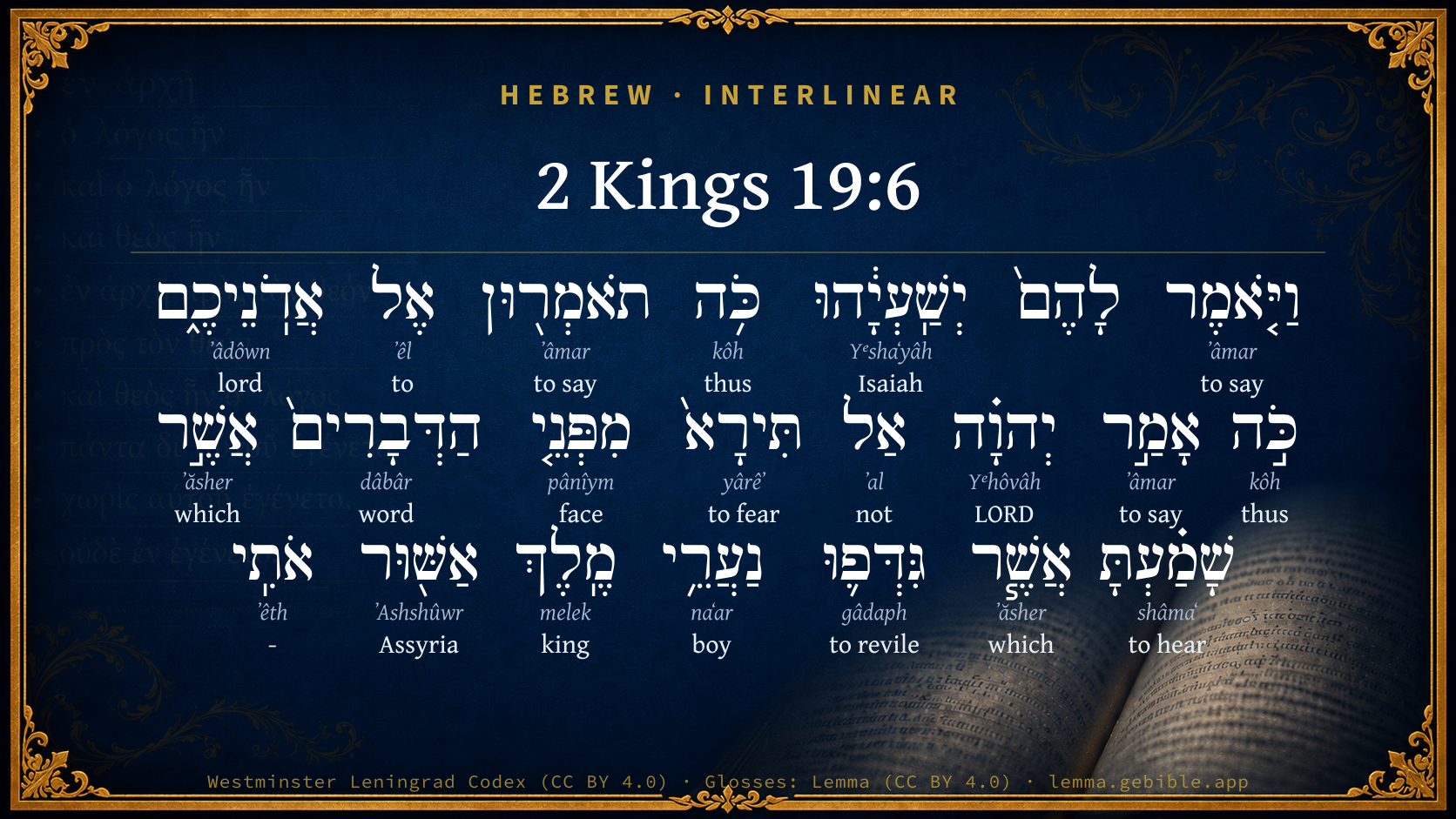
  1. וַיֹּ֤אמֶר ʼâmar H559 “and · to say” Conjunction + Verb, Qal, Sequential Imperfect, 3rd Person, Masculine, Singular
  2. יְשַֽׁעְיָ֔הוּ Yᵉshaʻyâh H3470 “Isaiah” Noun, Proper
  3. כֹּ֥ה kôh H3541 “thus” Adverb
  4. תֹאמְר֖וּן ʼâmar H559 “to say” Verb, Qal, Imperfect, 2nd Person, Masculine, Plural + Suffix, n
  5. אֶל ʼêl H413 “to” Preposition
  6. אֲדֹֽנֵיכֶ֑ם ʼâdôwn H113 “lords · your” Noun, Common, Masculine, Plural, Construct + Suffix, Personal, 2nd Person, Masculine, Plural
  7. כֹּ֣ה kôh H3541 “thus” Adverb
  8. אָמַ֣ר ʼâmar H559 “to say” Verb, Qal, Perfect, 3rd Person, Masculine, Singular
  9. יְהוָ֗ה Yᵉhôvâh H3068 “LORD” Noun, Proper
  10. אַל ʼal H408 “not” Particle, Negative
  11. תִּירָא֙ yârêʼ H3372 “to fear” Verb, Qal, Jussive, 2nd Person, Masculine, Singular
  12. מִפְּנֵ֤י pânîym H6440 “from · face(s) of” Preposition + Noun, Common, Both, Plural, Construct
  13. הַדְּבָרִים֙ dâbâr H1697 “the · words” Particle, Definite Article + Noun, Common, Masculine, Plural, Absolute
  14. אֲשֶׁ֣ר ʼăsher H834 “which” Particle, Relative
  15. שָׁמַ֗עְתָּ shâmaʻ H8085 “to hear” Verb, Qal, Perfect, 2nd Person, Masculine, Singular
  16. אֲשֶׁ֧ר ʼăsher H834 “which” Particle, Relative
  17. נַעֲרֵ֥י naʻar H5288 “boys of” Noun, Common, Masculine, Plural, Construct
  18. מֶֽלֶךְ melek H4428 “king of” Noun, Common, Masculine, Singular, Construct
  19. אַשּׁ֖וּר ʼAshshûwr H804 “Assyria” Noun, Proper
  20. אֹתִֽי ʼêth H853 “- · me” Particle, Direct Object + Suffix, Personal, 1st Person, Common, Singular

About this verse

These counts appear in no published source. They are computed here, from the morphology-tagged text and Lemma’s own curated glosses. What Lemma adds →

22
words
17
distinct lemmas
Historical
section

Notable vocabulary

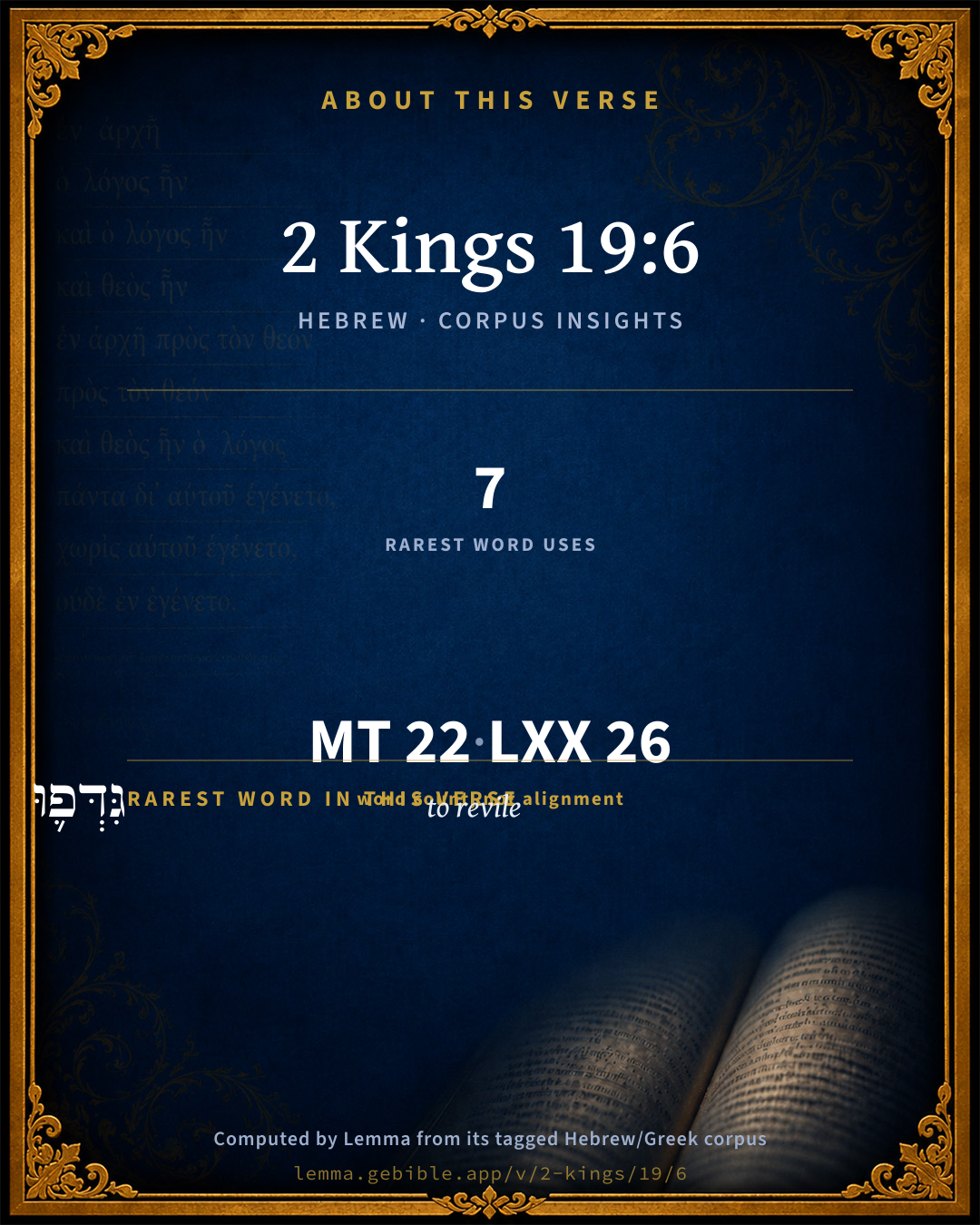
The rarest word here is גִּדְּפ֛וּ to revile H1442 — appearing just 7 times in the whole Hebrew Bible.

Shared distinctive vocabulary

גִּדְּפ֛וּ to revile H1442 occurs in 7 verses of the Hebrew Bible. Also found in:

Grammatical profile

  • 6 verbs
  • 8 nouns
  • 2 prepositions
  • 2 adverbs
  • 4 particles

Verb forms

  • וַיֹּ֤אמֶר Qal · Sequential Imperfect
  • תֹאמְר֖וּן Qal · Imperfect
  • אָמַ֣ר Qal · Perfect
  • תִּירָא֙ Qal · Jussive
  • שָׁמַ֗עְתָּ Qal · Perfect
  • גִּדְּפ֛וּ Piel · Perfect

Repetition

Words recur within this verse — often emphatic in Hebrew:

  • וַיֹּ֤אמֶר to say H559 ×3
  • כֹּ֥ה thus H3541 ×2
  • אֲשֶׁ֣ר which H834 ×2

Hebrew & Septuagint length

In English translation the verse runs 35 words from the Hebrew and 37 from the Septuagint (LXX English) — closely comparable.

A rough comparison of the two English renderings, which tokenize alike — not a word-level alignment.

Word counts can differ between the Hebrew and the Greek without any difference in meaning — e.g. the Hebrew direct-object marker אֵת has no separate Greek word, and Greek often adds the article ὁ.

In the original languages it is 22 Hebrew tokens and 26 Greek tokens — but the two are counted differently (Hebrew bundles its prefixes and suffixes into one token; the Greek is in lemma form), so that isn’t a like-for-like length.

Cross-references

19

Topical passages linked to 2 Kings 19:6 in the Treasury of Scripture Knowledge — connected by theme and wording, ordered by reader-vote popularity; previews shown in the World English Bible.

  • 2 Kings 18:17 The king of Assyria sent Tartan and Rabsaris and Rabshakeh from Lachish to king Hezekiah with a great army to Jerusalem. They went up and came to Jerusalem. When they were come up, they came and stood by the conduit of the upper pool, which is in the highway of the fuller's field.
  • 2 Kings 18:35 Who are they among all the gods of the countries, that have delivered their country out of my hand, that Yahweh should deliver Jerusalem out of my hand?
  • Isaiah 37:6–38 Isaiah said to them, Thus shall you tell your master, Thus says Yahweh, Don't be afraid of the words that you have heard, with which the servants of the king of Assyria have blasphemed me.
  • 2 Chronicles 20:15 and he said, Listen you, all Judah, and you inhabitants of Jerusalem, and you king Jehoshaphat: Thus says Yahweh to you, Don't be afraid you, neither be dismayed by reason of this great multitude; for the battle is not yours, but God's.
  • Exodus 14:13 Moses said to the people, "Don't be afraid. Stand still, and see the salvation of Yahweh, which he will work for you today: for the Egyptians whom you have seen today, you shall never see them again.
  • Leviticus 26:8 Five of you shall chase a hundred, and a hundred of you shall chase ten thousand; and your enemies shall fall before you by the sword.
  • Deuteronomy 20:1 When you go forth to battle against your enemies, and see horses, and chariots, [and] a people more than you, you shall not be afraid of them; for Yahweh your God is with you, who brought you up out of the land of Egypt.
  • Deuteronomy 20:3–4 and shall tell them, Hear, Israel, you draw near this day to battle against your enemies: don't let your heart faint; don't be afraid, nor tremble, neither be scared of them;
  • Joshua 11:6 Yahweh said to Joshua, Don't be afraid because of them; for tomorrow at this time will I deliver them up all slain before Israel: you shall hamstring their horses, and burn their chariots with fire.
  • 2 Kings 6:16 He answered, Don't be afraid; for those who are with us are more than those who are with them.
  • 2 Kings 18:30 neither let Hezekiah make you trust in Yahweh, saying, Yahweh will surely deliver us, and this city shall not be given into the hand of the king of Assyria.
  • 2 Chronicles 20:17 You shall not need to fight in this [battle]: set yourselves, stand you still, and see the salvation of Yahweh with you, O Judah and Jerusalem; don't be afraid, nor be dismayed: tomorrow go out against them: for Yahweh is with you.
  • Isaiah 41:10–14 Don't you be afraid, for I am with you; don't be dismayed, for I am your God; I will strengthen you; yes, I will help you; yes, I will uphold you with the right hand of my righteousness.
  • Isaiah 51:7 Listen to me, you who know righteousness, the people in whose heart is my law; don't you fear the reproach of men, neither be you dismayed at their insults.
  • Revelation 13:6 He opened his mouth for blasphemy against God, to blaspheme his name, and his dwelling, those who dwell in heaven.
  • 2 Kings 18:22–25 But if you tell me, We trust in Yahweh our God; isn't that he whose high places and whose altars Hezekiah has taken away, and has said to Judah and to Jerusalem, You shall worship before this altar in Jerusalem?
  • Psalms 74:18 Remember this, that the enemy has mocked you, Yahweh. Foolish people have blasphemed your name.
  • Psalms 74:23 Don't forget the voice of your adversaries. The tumult of those who rise up against you ascends continually.
  • Isaiah 51:12–13 I, even I, am he who comforts you: who are you, that you are afraid of man who shall die, and of the son of man who shall be made as grass;

Cross-references courtesy of OpenBible.info (CC BY 4.0).

Hebrew and Greek witnesses Masoretic Hebrew ↔ Greek Septuagint

The same verse in the two great witnesses to the Old Testament, shown verse-for-verse.

These are two independent witnesses, not word-aligned to each other, and the Septuagint is shown in lemma (dictionary) form.

Hebrew 2 Kings 19:6 Masoretic · Westminster Leningrad Codex

וַיֹּ֤אמֶר לָהֶם֙ יְשַֽׁעְיָ֔הוּ כֹּ֥ה תֹאמְר֖וּן אֶל אֲדֹֽנֵיכֶ֑ם כֹּ֣ה אָמַ֣ר יְהוָ֗ה אַל תִּירָא֙ מִפְּנֵ֤י הַדְּבָרִים֙ אֲשֶׁ֣ר שָׁמַ֗עְתָּ אֲשֶׁ֧ר גִּדְּפ֛וּ נַעֲרֵ֥י מֶֽלֶךְ אַשּׁ֖וּר אֹתִֽי

Isaiah said to them, Thus shall you tell your master, Thus says Yahweh, Don't be afraid of the words that you have heard, with which the servants of the king of Assyria have blasphemed me.

World English Bible · Public Domain

Greek LXX 2 Kings 19:6 Septuagint · lemma form

καί εἶπον αὐτός ησαιας ὅδε εἶπον πρός ὁ κύριος σύ ὅδε λέγω κύριος μή φοβέω ἀπό ὁ λόγος ὅς ἀκούω ὅς βλασφημέω ὁ παιδάριον βασιλεύς ἀσσύριος

And Esaias said to them, Thus shall you⌃ say to your master, Thus says the Lord, Be not afraid of the words which you have heard, wherewith the servants of the king of the Assyrians have blasphemed.

LXX2012 (modern English Septuagint) · Public Domain

On this verse, The Cambridge Bible for Schools and Colleges discusses the Septuagint’s reading. Read the note in Commentary ↓

Hebrew: Westminster Leningrad Codex (CC BY 4.0). Greek: Septuagint (public domain); English from LXX2012 (modern English Septuagint) (Public Domain). How the Septuagint differs from the Hebrew →

Targum (Aramaic paraphrase)

1

The Targum is the ancient Jewish Aramaic paraphrase of the Hebrew Scriptures — an interpretive translation, not the Hebrew text itself. Onkelos (literal) and Pseudo-Jonathan (expansive) render the Torah, and Jonathan the Prophets. Coverage is partial: where no permissively-licensed English translation exists for a verse, only the Aramaic is shown. This is verse-level text, not a word-by-word alignment to the Hebrew.

  1. Targum Jonathan Prophets (Joshua–Malachi)
    וַאֲמַר לְהוֹן יְשַׁעְיָהוּ כִּדְנַן תֵּימְרוּן לְרִבּוֹנְכוֹן כִּדְנַן אֲמַר יְיָ לָא תִדְחַל מִן קֳדָם פִּתְגָמַיָא דִשְׁמַעְתָּא דַחֲסִידוּ עוּלֵימֵי מַלְכָּא דְאַתּוּר קֳדָמָי:

    (no public-domain English translation for this verse)

    Targum Jonathan — Aramaic: “Mikraot Gedolot” (public domain). English: “Sefaria Community Translation” (CC0 1.0 (public-domain dedication)); “London "Chaldee Paraphrase," 1871” (public domain). Text via Sefaria.

Commentary

Notes on 2 Kings 19:6 from classic Christian and Jewish commentators (each source and its license shown beneath its notes). The classic Christian expositions comment on the surrounding passage and are grouped to its opening verse, so a note may address several verses; the Jewish commentaries on the Tanakh (Rashi and others) are per-verse, so they appear only where the commentator wrote on this verse.

Lemma curates 59 commentaries, every one of them public domain or Creative Commons licensed, each selected and text-cleaned for this edition rather than reprinted as found. About our sources →

Jamieson, Fausset & Brown

Robert Jamieson, A. R. Fausset & David Brown

COMFORTED BY ISAIAH. (Kg2 19:6-7)

Isaiah said . . . Be not afraid--The prophet's answer was most cheering, as it held out the prospect of a speedy deliverance from the invader. The blast, the rumor, the fall by the sword, contained a brief prediction that was soon fulfilled in all the three particulars--namely, the alarm that hastened his retreat, the destruction that overtook his army, and the violent death that suddenly ended his career.

Jamieson, Fausset & Brown — Commentary Critical and Explanatory on the Whole Bible (1871) — public domain (CC PDM 1.0). Text via the HelloAO Bible API.

Trapp's Complete Commentary

John Trapp

2Ki 19:6 And Isaiah said unto them, Thus shall ye say to your master, Thus saith the LORD, Be not afraid of the words which thou hast heard, with which the servants of the king of Assyria have blasphemed me.

Ver. 6. With which the servants.] Heb., The lads, younkers, or striplings: so they are called by way of contempt.

Have blasphemed me.] By railing upon thee, which is blasphemy in the second table; besides the deep dishonour they have done me, by matching me with their base born idols. {2Ki 18:35}

John Trapp, A Commentary or Exposition upon All the Books of the Old and New Testament (1647–1656) — public domain. Text from a community e-Sword module.

Ellicott's Commentary for English Readers

(6) The servants.—Or, attendants. The word is rather more special in sense than servant, denoting Apparently personal attendant. Delitzsch renders “squires.”. (Comp. 2Ki_4:12; 2Ki_5:20; 2Ki_8:4; Exo_33:11; Jdg_7:10; 2Sa_9:9; 1Ki_20:15.)

Blasphemed.—Not the same root as in 2Ki_19:3. (Psa_44:16; Isa_51:7; Num_15:30.)

A Bible Commentary for English Readers, edited by Charles John Ellicott (1878–1897) — public domain. Text from a community e-Sword module.

The Cambridge Bible for Schools and Colleges

gen. ed. J. J. S. Perowne

6. Be not afraid of the words which [R.V. that] thou hast heard, with which [R.V. wherewith] &c.] These slight changes make the rendering like that in Isaiah, where the Hebrew corresponds exactly.

God’s prophet sets down the threats and insults of Rab-shakeh as ‘words’ and no more. That there is a degree of contempt in the whole sentence is shewn in the words for ‘servants’ which is not the same as that so rendered in verse 6, but may be rendered ‘young men’ (the LXX has παιδάρια), not that Rab-shakeh and his comrades were young, but the words of Isaiah estimate their boasts and threatenings as ‘young men’s words’.

The Cambridge Bible for Schools and Colleges (gen. ed. J. J. S. Perowne; Cambridge University Press, 1878–1918) — public domain. Text from a community e-Sword module.

The Pulpit Commentary

And Isaiah said unto them, Thus shall ye say to your master. Isaiah seems to have been ready with a reply. The news of the words spoken by Rabshakeh had probably flown through the city, and reached him, and he had already laid the matter before God, and received God"s instructions concerning it. He was therefore able to return an answer at once. Thus saith the Lord, Be not afraid of the words which thou hast heard, with which the servants rather, lackeys ; the term used is not the common one for "servants," viz. ydeb, but a contemptuous one, yre "foot-boys," or "lackeysof the King of Assyria have blasphemed me.

The Pulpit Commentary (1880–1919), ed. H.D.M. Spence-Jones & Joseph S. Exell — public domain. Text from a community e-Sword module.

Lesson kit

Teaching starters — assembled from the data on this page, not authored interpretation. Every prompt links to the verse data it draws on. Edit before teaching.

2 Kings, in the Historical, opens this verse with 22 words (17 distinct Hebrew lemmas). Its most distinctive word is gâdaph (“to revile”). A historical commentator’s framing appears above. Read the whole chapter for the surrounding context.

Discussion questions

  1. What does “to revile” (gâdaph) contribute to the verse as a whole?
  2. Numbers 15:30 shares the word «to revile» with this verse. How do the two illuminate each other?
  3. “to say” occurs 3× in this one verse. What is the effect of the repetition?
  4. These translations render this verse differently; the difference is in the English rendering, not the original. What questions does that raise?
  5. The verb «וַיֹּ֤אמֶר» is Qal Sequential Imperfect. How does its form color the action?
  6. Reading how Jamieson, Fausset & Brown and Trapp's Complete Commentary read this verse, where do the two commentators agree and where do they part?

Things to notice

Reading settings

Reading text

Shown beneath each verse's original-language words.

Old Testament
Old Testament edition

Read the OT as the Masoretic Hebrew (MT) or the Greek Septuagint (LXX).

English shown for the Greek Septuagint (in the Hebrew ↔ Greek comparison).

Comparing translations? Open the Compare panel on any verse page to stack up to four side by side.