Leviticus 25:14

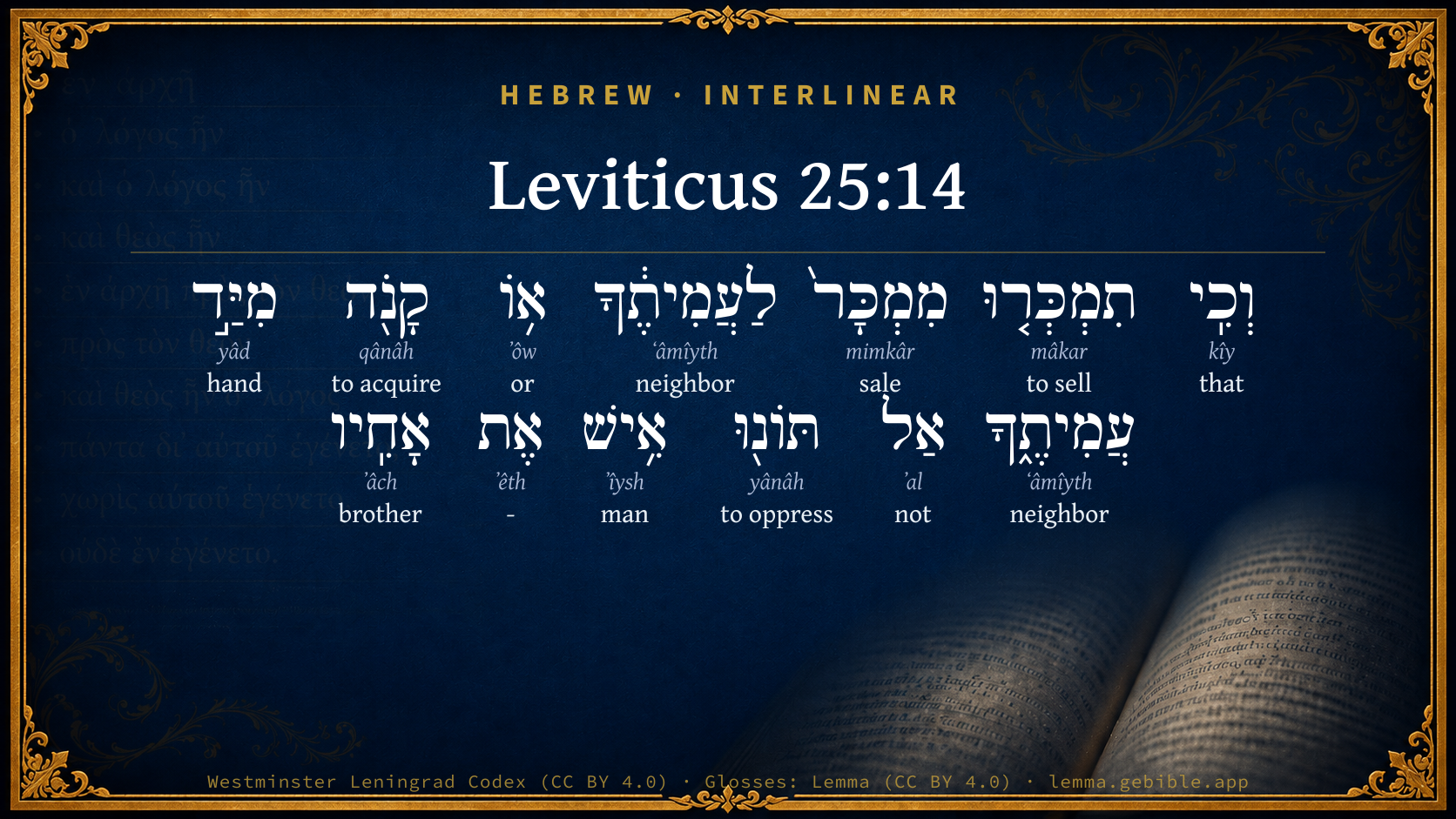
Hebrew (Westminster Leningrad Codex) Leviticus 25:14 appears in the Hebrew Old Testament. The text above is from the Westminster Leningrad Codex. Each word links to its Strong’s number, a concise gloss, and parsing drawn from the Open Scriptures Hebrew Bible morphology. Click any word for its full Brown-Driver-Briggs (BDB) entry.
Download image
Cite this verse

Leviticus 25:14 (World English Bible). Public Domain. Lemma interlinear Bible study tool, https://lemma.gebible.app/v/leviticus/25/14.

Show BibTeX & RIS
BibTeX
RIS
English Translation
"'If you sell anything to your neighbor, or buy from your neighbor, you shall not wrong one another.
World English Bible · Public Domain
Highlights
  • 1 first appearance in the Hebrew Bible
Full analysis ↓
Download a study sheet

One document with this verse’s original text, its word-by-word gloss line, the meaning frame, cross-references with their text, attributed commentary, and full source and license credits — printable, and it pastes into notes with its structure intact.

This verse Autodidact and up

Study sheet (.html) Plain text (.txt)

A passage Seminary Student

Up to 50 verses in one chapter. A passage sheet keeps up to 6 commentary sources and 12 cross-references per verse, in the order this page ranks them, and says so on the sheet whenever that leaves anything out. Ask for a single verse and you get the Autodidact verse sheet above.

Everything on this page stays free to read, with no account — the sheet is a download of what is already on screen, not access to it.

Want to remove ads? Support Godless Engineer
Compare translations 3

The same verse in 3 English versions, stacked beneath the original-language interlinear above. Click any original word for its lexicon entry.

Each is an independent rendering of the whole verse — the interlinear is not word-aligned to these translations.

Highlighted words mark where these versions differ — a whole-verse word diff, not a word-by-word alignment.

  • World English Bible Public Domain
    "'If you sell anything to your neighbor, or buy from your neighbor, you shall not wrong one another.
  • King James Version Public Domain
    And if thou sell ought unto thy neighbor, or buyest ought of thy neighbor's hand, ye shall not oppress one another:
  • unfoldingWord Literal Text CC BY-SA 4.0
    And when you sell something to your fellow or buy from the hand of your fellow, each you shall not oppress his brother.

unfoldingWord Literal Text — © unfoldingWord, licensed CC BY-SA 4.0. Word-aligned USFM3 via Door43 (git.door43.org/unfoldingWord/en_ult).

Versions to compare (up to 4)

3 of 4 selected

Show all 18 translations

Every available English version of this verse, each an independent rendering of the whole verse.

  • World English Bible Public Domain
    "'If you sell anything to your neighbor, or buy from your neighbor, you shall not wrong one another.
  • Berean Standard Bible Public Domain
    If you make a sale to your neighbor or a purchase from him, you must not take advantage of each other.
  • Majority Standard Bible Public Domain
    If you make a sale to your neighbor or a purchase from him, you must not take advantage of each other.
  • King James Version Public Domain
    And if thou sell ought unto thy neighbor, or buyest ought of thy neighbor's hand, ye shall not oppress one another:
  • American Standard Version (1901) Public Domain
    And if thou sell aught unto thy neighbor, or buy of thy neighbor's hand, ye shall not wrong one another.
  • Revised Version (1885) Public Domain
    And if thou sell aught unto thy neighbour, or buy of thy neighbour’s hand, ye shall not wrong one another:
  • Geneva Bible (1599) Public Domain
    And when thou sellest ought to thy neighbour, or byest at thy neighbours hande, ye shall not oppresse one another:
  • Douay-Rheims (1899) Public Domain
    When thou shalt sell any thing to thy neighbour, or shalt buy of him; grieve not thy brother: but thou shalt buy of him according to the number of years from the jubilee.
  • Young's Literal Translation Public Domain
    `And when thou sellest anything to thy fellow, or buyest from the hand of thy fellow, ye do not oppress one another;
  • Literal Standard Version CC BY-SA 4.0
    And when you sell anything to your fellow, or buy from the hand of your fellow, you do not oppress one another;
  • Unlocked Literal Bible CC BY-SA 4.0
    If you sell any land to your neighbor or buy any land from your neighbor, you must not cheat or wrong each other.
  • unfoldingWord Literal Text CC BY-SA 4.0
    And when you sell something to your fellow or buy from the hand of your fellow, each you shall not oppress his brother.
  • Darby Bible Public Domain
    And if ye sell ought unto your neighbour, or buy of your neighbour's hand, ye shall not overreach one another.
  • World Messianic Bible Public Domain
    “‘If you sell anything to your neighbor, or buy from your neighbor, you shall not wrong one another.
  • Webster's Bible Public Domain
    And if thou shalt sell aught to thy neighbor, or buy aught of thy neighbor's hand, ye shall not oppress one another:
  • Free Bible Version CC BY-SA 4.0
    If you sell land to your neighbor, or buy land from him, don't exploit one another.
  • Bible in Basic English Public Domain
    And in the business of trading goods for money, do no wrong to one another.
  • JPS Tanakh (1917) Public Domain
    And if thou sell aught unto thy neighbour, or buy of thy neighbour's hand, ye shall not wrong one another.

Literal Standard Version (2020), Covenant Press — licensed CC BY-SA 4.0. Text via the HelloAO Bible API (eBible.org). Unlocked Literal Bible (unfoldingWord) — licensed CC BY-SA 4.0. Text via the HelloAO Bible API (eBible.org). unfoldingWord Literal Text — © unfoldingWord, licensed CC BY-SA 4.0. Word-aligned USFM3 via Door43 (git.door43.org/unfoldingWord/en_ult). Free Bible Version, Dr. Jonathan Gallagher — licensed CC BY-SA 4.0. Text via the HelloAO Bible API (eBible.org).

Word by word

More ways to search: Search by grammar → Find every occurrence → Compare this word →

Practice this passage: Drill this verse → Learn its vocabulary →

מִמְכָּר֙
mimkâr
H4465
“sale”
Noun, Common, Masculine, Singular, Absolute
Part of Speech
Noun
Type
Common
Gender
Masculine
Number
Singular
State
Absolute
Full BDB Definition

Origin: from H4376

TWOT: 1194b

sale, ware, thing sold
  1. וְכִֽי kîy H3588 “and · that” Conjunction + Conjunction
  2. תִמְכְּר֤וּ mâkar H4376 “to sell” Verb, Qal, Imperfect, 2nd Person, Masculine, Plural
  3. לַעֲמִיתֶ֔ךָ ʻâmîyth H5997 “to/for · neighbor · your” Preposition + Noun, Common, Masculine, Singular, Construct + Suffix, Personal, 2nd Person, Masculine, Singular
  4. א֥וֹ ʼôw H176 “or” Conjunction
  5. קָנֹ֖ה qânâh H7069 “to acquire” Verb, Qal, Infinitive Absolute
  6. מִיַּ֣ד yâd H3027 “from · hand of” Preposition + Noun, Common, Both, Singular, Construct
  7. עֲמִיתֶ֑ךָ ʻâmîyth H5997 “neighbor · your” Noun, Common, Masculine, Singular, Construct + Suffix, Personal, 2nd Person, Masculine, Singular
  8. אַל ʼal H408 “not” Particle, Negative
  9. תּוֹנ֖וּ yânâh H3238 “to oppress” Verb, Hiphil, Jussive, 2nd Person, Masculine, Plural
  10. אִ֥ישׁ ʼîysh H376 “man” Noun, Common, Masculine, Singular, Absolute
  11. אֶת ʼêth H853 “-” Particle, Direct Object
  12. אָחִֽיו ʼâch H251 “brother · his” Noun, Common, Masculine, Singular, Construct + Suffix, Personal, 3rd Person, Masculine, Singular

About this verse

These counts appear in no published source. They are computed here, from the morphology-tagged text and Lemma’s own curated glosses. What Lemma adds →

13
words
12
distinct lemmas
Pentateuch
section

Notable vocabulary

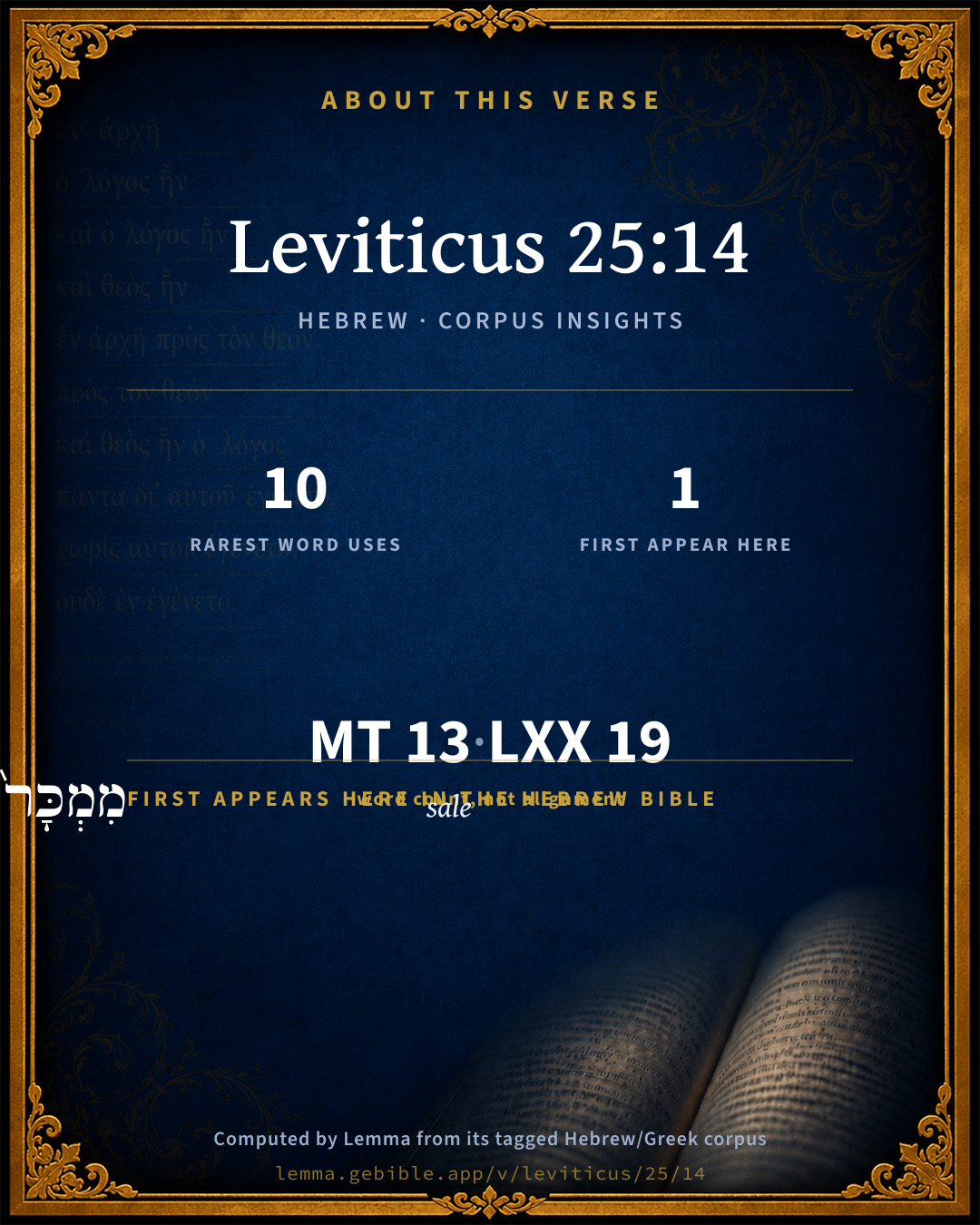
The rarest word here is מִמְכָּר֙ sale H4465 — appearing just 10 times in the whole Hebrew Bible.

First appearance in Scripture

This word makes its first canonical appearance in the Hebrew Bible here:

  • מִמְכָּר֙ sale H4465

Shared distinctive vocabulary

מִמְכָּר֙ sale H4465 occurs in 10 verses of the Hebrew Bible. Also found in:

Grammatical profile

  • 3 verbs
  • 6 nouns
  • 2 conjunctions
  • 2 particles

Verb forms

  • תִמְכְּר֤וּ Qal · Imperfect
  • קָנֹ֖ה Qal · Infinitive Absolute
  • תּוֹנ֖וּ Hiphil · Jussive

Repetition

A word recurs within this verse — often emphatic in Hebrew:

  • לַעֲמִיתֶ֔ךָ neighbor H5997 ×2

Hebrew & Septuagint length

In English translation the verse runs 18 words from the Hebrew and 25 from the Septuagint (LXX English) — closely comparable.

A rough comparison of the two English renderings, which tokenize alike — not a word-level alignment.

Word counts can differ between the Hebrew and the Greek without any difference in meaning — e.g. the Hebrew direct-object marker אֵת has no separate Greek word, and Greek often adds the article ὁ.

In the original languages it is 13 Hebrew tokens and 19 Greek tokens — but the two are counted differently (Hebrew bundles its prefixes and suffixes into one token; the Greek is in lemma form), so that isn’t a like-for-like length.

Cross-references

32

Topical passages linked to Leviticus 25:14 in the Treasury of Scripture Knowledge — connected by theme and wording, ordered by reader-vote popularity; previews shown in the World English Bible.

  • Leviticus 19:13 "'You shall not oppress your neighbor, nor rob him. The wages of a hired servant shall not remain with you all night until the morning.
  • Leviticus 25:17 You shall not wrong one another; but you shall fear your God: for I am Yahweh your God.
  • 1 Samuel 12:3–4 Here I am: witness against me before Yahweh, and before his anointed: whose ox have I taken? or whose donkey have I taken? or whom have I defrauded? whom have I oppressed? or of whose hand have I taken a ransom to blind my eyes therewith? and I will restore it you.
  • Isaiah 58:6 Isn't this the fast that I have chosen: to loose the bonds of wickedness, to undo the bands of the yoke, and to let the oppressed go free, and that you break every yoke?
  • Ezekiel 22:7 In you have they set light by father and mother; in the midst of you have they dealt by oppression with the foreigner; in you have they wronged the fatherless and the widow.
  • Ezekiel 22:12–13 In you have they taken bribes to shed blood; you have taken interest and increase, and you have greedily gained of your neighbors by oppression, and have forgotten me, says the Lord Yahweh.
  • Amos 5:11–12 Forasmuch therefore as you trample on the poor, And take taxes from him of wheat: You have built houses of hewn stone, But you will not dwell in them. You have planted pleasant vineyards, But you shall not drink their wine.
  • Amos 8:4–7 Hear this, you who desire to swallow up the needy, And cause the poor of the land to fail,
  • Micah 2:2–3 They covet fields, and seize them; And houses, and take them away: And they oppress a man and his house, Even a man and his heritage.
  • Micah 6:10–12 Are there yet treasures of wickedness in the house of the wicked, And a short ephah that is accursed?
  • James 5:1–5 Come now, you rich, weep and howl for your miseries that are coming on you.
  • Deuteronomy 16:19–20 You shall not wrest justice: you shall not respect persons; neither shall you take a bribe; for a bribe does blind the eyes of the wise, and pervert the words of the righteous.
  • Judges 4:3 The children of Israel cried to Yahweh: for he had nine hundred chariots of iron; and twenty years he mightily oppressed the children of Israel.
  • 2 Chronicles 16:10 Then Asa was angry with the seer, and put him in the prison-house; for he was in a rage with him because of this thing. Asa oppressed some of the people at the same time.
  • Nehemiah 9:36–37 Behold, we are servants this day, and as for the land that you gave to our fathers to eat the fruit of it and the good of it, behold, we are servants in it.
  • Psalms 10:18 To judge the fatherless and the oppressed, That man who is of the earth may terrify no more.
  • Proverbs 14:31 He who oppresses the poor shows contempt for his Maker, But he who is kind to the needy honors him.
  • Proverbs 21:13 Whoever stops his ears at the cry of the poor, He will also cry out, but shall not be heard.
  • Proverbs 22:16 Whoever oppresses the poor for his own increase and whoever gives to the rich, Both come to poverty.
  • Proverbs 28:3 A needy man who oppresses the poor Is like a driving rain which leaves no crops.
  • Proverbs 28:8 He who increases his wealth by excessive interest Gathers it for one who has pity on the poor.
  • Proverbs 28:16 A tyrannical ruler lacks judgment. One who hates ill-gotten gain will have long days.
  • Ecclesiastes 5:8 If you see the oppression of the poor, and the violent taking away of justice and righteousness in a district, don't marvel at the matter: for one official is eyed by a higher one; and there are officials over them.
  • Isaiah 1:17 Learn to do well. Seek justice, Relieve the oppressed, Judge the fatherless, Plead for the widow."
  • Isaiah 3:12–15 As for my people, children are their oppressors, And women rule over them. My people, those who lead you cause you to err, And destroy the way of your paths.
  • Isaiah 5:7 For the vineyard of Yahweh of Hosts is the house of Israel, And the men of Judah his pleasant plant: And he looked for justice, but, behold, oppression; For righteousness, but, behold, a cry of distress.
  • Isaiah 33:15 He who walks righteously, and speaks blamelessly; he who despises the gain of oppressions, who shakes his hands from taking a bribe, who stops his ears from hearing of blood, and shuts his eyes from looking on evil:
  • Jeremiah 22:17 But your eyes and your heart are not but for your covetousness, and for shedding innocent blood, and for oppression, and for violence, to do it.
  • Micah 7:3 Their hands are on that which is evil to do it diligently. The ruler and judge ask for a bribe; And the powerful man dictates the evil desire of his soul. Thus they conspire together.
  • Luke 3:14 Soldiers also asked him, saying, "What about us? What must we do?" He said to them, "Extort from no one by violence, neither accuse anyone wrongfully. Be content with your wages."
  • 1 Corinthians 6:8 No, but you yourselves do wrong, and defraud, and that against your brothers.
  • Job 20:19–20 For he has oppressed and forsaken the poor. He has violently taken away a house, and he shall not build it up.

Cross-references courtesy of OpenBible.info (CC BY 4.0).

Hebrew and Greek witnesses Masoretic Hebrew ↔ Greek Septuagint

The same verse in the two great witnesses to the Old Testament, shown verse-for-verse.

These are two independent witnesses, not word-aligned to each other, and the Septuagint is shown in lemma (dictionary) form.

Hebrew Leviticus 25:14 Masoretic · Westminster Leningrad Codex

וְכִֽי תִמְכְּר֤וּ מִמְכָּר֙ לַעֲמִיתֶ֔ךָ א֥וֹ קָנֹ֖ה מִיַּ֣ד עֲמִיתֶ֑ךָ אַל תּוֹנ֖וּ אִ֥ישׁ אֶת אָחִֽיו

"'If you sell anything to your neighbor, or buy from your neighbor, you shall not wrong one another.

World English Bible · Public Domain

Greek LXX Leviticus 25:14 Septuagint · lemma form

ἐάν δέ ἀποδίδωμι πρᾶσις ὁ πλησίον σύ ἐάν καί κτάομαι παρά ὁ πλησίον σύ μή θλίβω ἄνθρωπος ὁ πλησίον

And if you should sell a possession to your neighbor, or if you should buy of your neighbor, let not a man oppress his neighbor.

LXX2012 (modern English Septuagint) · Public Domain

Hebrew: Westminster Leningrad Codex (CC BY 4.0). Greek: Septuagint (public domain); English from LXX2012 (modern English Septuagint) (Public Domain). How the Septuagint differs from the Hebrew →

Targum (Aramaic paraphrase)

2

The Targum is the ancient Jewish Aramaic paraphrase of the Hebrew Scriptures — an interpretive translation, not the Hebrew text itself. Onkelos (literal) and Pseudo-Jonathan (expansive) render the Torah, and Jonathan the Prophets. Coverage is partial: where no permissively-licensed English translation exists for a verse, only the Aramaic is shown. This is verse-level text, not a word-by-word alignment to the Hebrew.

  1. Targum Onkelos Torah (Genesis–Deuteronomy)
    וַאֲרֵי תְזַבֵּן זְבִינִין לְחַבְרָךְ אוֹ תִזְבֵּן מִידָא דְחַבְרָךְ לָא תוֹנוּן גְבַר יָת אֲחוֹהִי

    (no public-domain English translation for this verse)

    Targum Onkelos — Aramaic: “Onkelos Genesis” (public domain); “Onkelos Exodus” (public domain); “Onkelos Leviticus” (public domain); “Onkelos Numbers” (public domain); “Onkelos Deuteronomy” (public domain). English: “Sefaria Community Translation” (CC0 1.0 (public-domain dedication)); “J.W. Etheridge. The Targums of Onkelos and Jonathan Ben Uzziel on the Pentateuch. London: Longmans, Green, 1862” (public domain). Text via Sefaria.

  2. Targum Pseudo-Jonathan Torah (Genesis–Deuteronomy)
    וַאֲרוּם תְּזַבְּנוּן זְבִינֵי לְחַבְרֵיכוֹן אוֹ תִזְבְּנוּן עִסְקָא דְמִיטַלְטְלָא מִן יַד חַבְרֵיכוֹן לֵית אַתּוּן רְשָׁאִין לְאוֹנַיָא גְבַר יַת חַבְרֵיהּ

    And when you sell sales to your neighbours, or you buy disposable (or moveable) goods from the hand of your neighbours, it is not allowable for a man to defraud his neighbour.

    Targum Pseudo-Jonathan — Aramaic: “Targum Jonathan on Genesis” (public domain); “Targum Jonathan on Exodus” (public domain); “Targum Jonathan on Leviticus” (public domain); “Targum Jonathan on Numbers” (public domain); “Targum Jonathan on Deuteronomy” (public domain). English: “The Targum of Jonathan ben Uzziel, trans. J. W. Etheridge, London, 1862” (public domain). Text via Sefaria.

Commentary

Notes on Leviticus 25:14 from classic Christian and Jewish commentators (each source and its license shown beneath its notes). The classic Christian expositions comment on the surrounding passage and are grouped to its opening verse, so a note may address several verses; the Jewish commentaries on the Tanakh (Rashi and others) are per-verse, so they appear only where the commentator wrote on this verse.

Lemma curates 59 commentaries, every one of them public domain or Creative Commons licensed, each selected and text-cleaned for this edition rather than reprinted as found. About our sources →

The Cambridge Bible for Schools and Colleges

gen. ed. J. J. S. Perowne

14. thou … ye] The variation in person indicates the combination of two sources.

thy neighbour] An unusual Heb. word (‘âmîth), occurring in the H section eleven times, 5:21 (bis), Lev_18:20, Lev_19:11; Lev_19:15; Lev_19:17, Lev_24:19, Lev_25:14 (bis), Lev_25:15; Lev_25:17; only once outside Lev., in Zec_13:7.

The Cambridge Bible for Schools and Colleges (gen. ed. J. J. S. Perowne; Cambridge University Press, 1878–1918) — public domain. Text from a community e-Sword module.

Trapp's Complete Commentary

John Trapp

Lev 25:14 And if thou sell ought unto thy neighbour, or buyest [ought] of thy neighbour’s hand, ye shall not oppress one another:

Ver. 14. Ye shall not oppress.] But proceed by that golden rule, "Whatever ye would that men should do to you, even so do ye to them."

John Trapp, A Commentary or Exposition upon All the Books of the Old and New Testament (1647–1656) — public domain. Text from a community e-Sword module.

Joseph Benson's Commentary

Lev 25:14. Ye shall not oppress — Neither the seller, by requiring more, nor the buyer, by taking the advantage from his brother’s necessities to give him less than the worth of it.

Joseph Benson's Commentary on the Old and New Testaments (1811–1818) — public domain. Text from a community e-Sword module.

Whedon's Commentary on the Bible

Daniel D. Whedon

RULES FOR THE SALE OF LAND, Lev_25:14-17.

14. If thou sell aught — This relates to real estate.

Ye shall not oppress — R.V., not wrong one another. The capitalist shall not make his brother’s necessity his opportunity to drive a sharp bargain and buy his field “for a song,” but he shall observe the following sliding scale in reference to the approach of the next jubilee.

Daniel D. Whedon (gen. ed.), Commentary on the Old and New Testaments (1874–1909) — public domain. Text from a community e-Sword module.

Geneva Bible (1599)

Geneva Bible translators

By deceit, or otherwise.

Geneva Bible (1599) marginal notes — public domain. Text via Bolls.life.

Adam Clarke's Commentary

Verse 14. Ye shall not oppress one another] Ye shall take no advantage of each other's ignorance either in buying or selling; for he that buys an article at less than it is worth, or sells one for more than it is worth, taking advantage in both cases of the ignorance of the vender or buyer, is no better than a thief, as he actually robs his neighbour of as much property as he has bought the article at below or sold it above its current value.

Adam Clarke's Commentary on the Bible (1810–1826) — public domain. Text from a community e-Sword/MySword module.

Ellicott's Commentary for English Readers

(14) Ye shall not oppress one another.—Better, ye shall not overreach any man his brother. Not only does the Law provide against the poor man losing his land for ever, but enjoins that in the temporary sales the buyer and seller are not to take undue advantage of each other’s circumstances. Hence it was enacted that if any one bought or sold anything for a sixth part more than its value the aggrieved party was entitled to have the excess returned to him, and if it amounted to more than a sixth part, the contract could be rescinded altogether. The fact that the phrase which is here translated “one another” in the Authorised Version is varied in the Hebrew in Lev_25:17, where it is likewise rendered “one another,” shows that it is not used in this idiomatic sense, but is designed to denote fellow-brethren, members of the same community, those who are related to each other by race and creed, as in Exo_32:27, Jer_31:34

A Bible Commentary for English Readers, edited by Charles John Ellicott (1878–1897) — public domain. Text from a community e-Sword module.

John Gill's Exposition

And if thou sell ought unto thy neighbour,.... Any estate or possession, house or land, at any time before the year of jubilee:

or buyest ought of thy neighbour's hand; of movable goods, as the Targum of Jonathan interprets it; and so other Jewish writers (z) restrain this to goods which are bought by hand, and delivered from hand to hand; and so they think that fields, and servants, which they say are like to fields, are excluded hereby; but it seems to refer to anything saleable, and chiefly to fields and vineyards, as the following verses show; wherefore Diodorus Siculus, as quoted by Grotius, must be mistaken, when he says, it was not counted lawful by the Jews to sell their inheritance, unless he means for ever, so indeed they could not:

ye shall not oppress one another; the buyer giving too little, or the seller requiring too much; no advantage was to be taken, either of the necessity of the one, or the ignorance of the other, but a fair bargain was to be made, and the full value given, neither too much nor too little. The Jews by "neighbour" understand an Israelite, and not a Gentile (a); not that there might be no buying and selling at all between Jews and Gentiles, or that the former might oppress and defraud the latter, though not an Israelite; but lands and inheritances might not be sold at all to Gentiles, only to Israelites.

(z) Maimon. & Bartenora in Misn. Bava Metziah, c. 4. sect. 9. (a) Jarchi in loc.

John Gill's Exposition of the Whole Bible (1746–1763) — public domain (CC PDM 1.0). Text via the HelloAO Bible API.

Albert Barnes' Notes on the Bible

Sell ought - i. e., any piece of ground.

Oppress one another - Rather, overreach one another. (Compare 1Sa 12:3-4).

Albert Barnes' Notes on the Bible (1834–1885) — public domain. Text from a community e-Sword/MySword module.

Haydock's Catholic Bible Commentary

Grieve. Hebrew, "deceive not." St. Chrysostom observes, that to engage another to sell us any thing for what we know is beneath its value, is theft. (Grotius, Jur. ii. 12.) The Rabbins also decide that, if an Israelite be defrauded a sixth part, restitution must be made, ver. 17. (Selden, Jur. vi. 6.)

George Leo Haydock (1774–1849), Haydock's Catholic Family Bible and Commentary, 1859 edition — public domain. Excludes Psalms (Douay-Rheims chapter numbering differs from Protestant) and Deuterocanonical books (Catholic canon only).

Matthew Poole's English Annotations

Neither the seller by requiring more, nor the buyer by taking the advantage from his brother’s necessities to give him less than the worth of it.

Matthew Poole's English Annotations on the Holy Bible (1683–1685) — public domain. Text from a community e-Sword/MySword module.

John Wesley's Explanatory Notes

Ye shall not oppress - Neither the seller by requiring more, nor the buyer by taking the advantage from his brother's necessities to give him less than the worth of it.

John Wesley, Explanatory Notes Upon the Whole Bible (1754–1765) — public domain. Text via the GEBible commentary corpus.

Rashi

Rabbi Shlomo Yitzchaki (Rashi)

‎'וכי תמכרו וגו‎‎‎‎ AND IF THOU SELL [OUGHT TO THY FELLOW… YE SHALL NOT OVERREACH ONE ANOTHER] — According to its plain sense the verse intimates what it literally means: (i. e. as translated above). But there is also a Midrashic interpretation: Whence can it be derived that if you sell anything you should sell it to your Israelite fellowman? From what Scripture states: “And if you sell —,לעמיתך sell it to one associated with you by nationality”. And whence can it be derived that if you intend to buy anything that you should buy it of your Israelite fellow? From what Scripture states “or if thou buy ought — מיד עמיתך, at the hand of one associated with thee, buy it” (Sifra, Behar, Section 3 1).

אל תונו YE SHALL NOT WRONG [ONE ANOTHER] — This refers to wronging in money matters (Sifra, Behar, Section 3 4).

Rashi on the Tanakh — English translations: “The Judaica Press complete Tanach with Rashi, translated by A. J. Rosenberg” (CC BY 4.0); “Pentateuch with Rashi's commentary by M. Rosenbaum and A.M. Silbermann, 1929-1934” (public domain); “The Metsudah Tanach series, Lakewood, N.J” (CC BY 4.0); and “The Book of Joshua, Metsudah Publications, 1997” (CC BY 4.0). Text via Sefaria.

Ramban (Nachmanides)

Rabbi Moshe ben Nachman (Ramban / Nachmanides)

YE SHALL NOT WRONG ONE ANOTHER. “This refers to overcharging in money matters.” 15. ACCORDING TO THE NUMBER OF YEARS AFTER THE JUBILEE THOU SHALT BUY OF THY NEIGHBOR. “The plain meaning of the verse as indicated by its context is that Scripture is admonishing here against overcharging [as mentioned in the preceding verse, and explains here in detail]: When you sell or buy land, ascertain how many years there are left till the Jubilee, and according to these years the vendor is to sell and the purchaser to buy, for in the end the purchaser must return him [the land] in the year of the Jubilee. Thus if there are but a few years [till the Jubilee] and he sells it at a high price, the purchaser has been wronged, and if there are many years so that the purchaser can eat many crops from it, he must buy it according to the [greater] time [remaining till the Jubilee]. It is referring to this that it is said, according to the number of years of the crops he shall sell unto thee, [meaning]: according to the number of years of crops which the land will remain in the hand of the purchaser, you shall sell it to him. Now our Rabbis have derived from here [the law] that one who sells his field has no right to redeem it before two years [after the date of the sale, for the verse states, according to the number of ‘years’ of the crops he shall sell, and the minimum number of the term ‘years’ is two], even if there were three crops in those two years. [However, although this interpretation of the Rabbis indicates that the verse in speaking of shnei means ‘two years’], it does not lose its literal meaning [i.e., ‘years of’], that is to say, he is to sell by the number of ‘years of’ crops, and not by years when the produce is smitten by blast, and the minimum number implied in ‘years’ is two.” Thus far is Rashi’s language.Now this is indeed the correct interpretation of the verse; however, our Rabbis have said that overcharge does not apply in [the sale of] land, for it is said: “Or buy of thy neighbor’s ‘hand’, and this refers to something which is transferred from ‘hand’ to ‘hand’” [i.e., movable goods or chattels]. But this verse according to the Rabbi [Rashi], both in its plain meaning and in its [Rabbinical] interpretation, speaks of [overcharging in the sale of] land! We must then perforce turn the verses away from their simple meaning, and say that each one stands independently [of the others]. Thus Scripture is stating: And if thou sell aught unto thy neighbor, or buy of thy neighbor’s hand, that is, something which is transferred from hand to hand, ye shall not wrong one another. Then He states further: “According to the number of years after the Jubilee thou shalt buy of him the crops, and according unto the number of years of the crops he shall sell them unto thee. According to the years you shall increase and reduce the price, for you will have to return it [i.e., the land] to him in the Jubilee.” All this is an admonition regarding the Jubilee, that they should keep it forever [but it is not intended as a law against overcharging in the sale of land, for in such a transaction the law of overcharge does not apply]. Then He said further, And ye shall not wrong one another, [referring to wronging] by words [i.e., offending].And it further seems to me logical that one who intentionally overcharges his fellowman, definitely transgresses a negative commandment, whether it be [in a sale of] chattels or land, for it is with reference to them that Scripture is saying, Ye shall not wrong one another. According to the number of years after the Jubilee, admonishing that one must buy and sell according to the years [after the Jubilee], and that no man shall wrong another. But our Rabbis laid down a new law regarding overcharge, namely, that [if the amount overcharged was] one-sixth of the total purchase price, [the sale is valid and that extra amount] must be paid back, but the sale is totally invalidated if the amount overcharged was more than one-sixth of the purchase-price. It is only from this law that land has been excluded, since [a person] foregoes an overcharge of even more than a sixth [of the purchase price] in the case of [the sale of land], just as one [is prepared to] forego in the case of chattels an overcharge of less than a sixth [of the purchase-price], although it is forbidden to overcharge intentionally by such [amounts], but people do not usually go back on their purchase on account of such a small overcharging. The Sages interpreted [Scripture to give a basis for this law] because the verse states, And if thou sell aught unto thy neighbor, or buy something which is transferred from hand to hand, ye shall not wrong one another. From this we learn that in the matter of overcharging there is a special law for chattels which does not apply to land, namely, the return of the money, [i.e., the cancellation of the entire sale if the amount overcharged was more than a sixth of the purchase price], but the negative commandment [forbidding overcharging] applies to all transactions. That is why He said, ‘v’chi thim’kru mimkar’ [“if ‘ye’ sell aught”], which is a plural expression, referring to one who sells land and to one who sells chattels; ‘o kanoh’ (or buys) of thy neighbor’s hand, referring to an individual, who sells chattels from hand to hand, and with reference to all of them He said ye shall not wrong. But since He singled out and specified chattels, [it indicates that] He gave concerning them an additional law regarding overcharging, namely the [right to] return the money [of the purchase-price and thereby cancel the sale]. This is a correct interpretation according to the expositions which our Rabbis have received on the allusions of the Torah.Perhaps all this is only a Scriptural support [for a Rabbinical enactment], for the negative commandment [ye shall not wrong one another] constitutes an admonition applying to both land and chattels [but does not refer at all to cancellation of the entire purchase], and [the right to return] the money the Rabbis received by tradition as applying to chattels and not to [transactions of] land, just as they have said that [land] is a possession that is worth any price. For all these [differing] standards of one-sixth [of the purchase-price, in which case the sale is valid and the amount overcharged must be returned], and more than one-sixth [in which case the entire sale may be cancelled] are based on people’s opinions [and since “land is worth any price” to most people, the Rabbis did not institute these laws of overcharging with respect to land]. And why should the Rabbis not exclude [transactions of] land from this law [of overcharging] just as they excluded from it wares bought from a householder? Thus they said: “[The law of overcharging] is taught only if one buys from a merchant, but if one buys from a private householder, the law of overcharging does not apply,” because private people are not in the habit of selling the possessions that they use [and hence if they do sell them, it is considered as if they had made a specific condition that the buyer cannot complain about the price]., in the name of the She’iltoth of Rav Achai Gaon.It is also possible to say that Scripture is warning that they [sellers and purchasers] should take cognizance of the number of years till the Jubilee, and according to them they should sell and buy, and no one should wrong another because of them by misleading him about the number [of years], or by deceiving him about the sale, so that he thinks that it is in perpetuity, and thus he leads him astray thereby. Instead, they must both know and inform one another of this number, since the sale is according to the number of years [remaining] until the Jubilee, for even in [transactions of] land the law of overcharging applies as regards size and number, even if the misleading referred to was less than one-sixth [of the size or the number], and all the more so in the case of chattels [one must be careful not to overcharge].

Ramban (Nachmanides) on the Tanakh — English translation: “Commentary on the Torah by Ramban (Nachmanides). Translated and annotated by Charles B. Chavel. New York, Shilo Pub. House, 1971-1976” (CC BY 4.0). Text via Sefaria.

Lesson kit

Teaching starters — assembled from the data on this page, not authored interpretation. Every prompt links to the verse data it draws on. Edit before teaching.

Leviticus, in the Pentateuch, opens this verse with 13 words (12 distinct Hebrew lemmas). Its most distinctive word is mimkâr (“sale”). A historical commentator’s framing appears above. Read the whole chapter for the surrounding context.

Discussion questions

  1. The word mimkâr carries the sense “sale.” How does it shape the verse?
  2. The word “sale” first appears here in Scripture. What is being introduced at this debut?
  3. Leviticus 25:25 shares the word «sale» with this verse. How do the two illuminate each other?
  4. “neighbor” occurs 2× in this one verse. What is the effect of the repetition?
  5. These translations render this verse differently. What is at stake in choosing one wording over another?
  6. The verb «תִמְכְּר֤וּ» is Qal Imperfect. How does its form color the action?
  7. Reading how The Cambridge Bible for Schools and Colleges and Trapp's Complete Commentary read this verse, where do the two commentators agree and where do they part?

Things to notice

Reading settings

Reading text

Shown beneath each verse's original-language words.

Old Testament
Old Testament edition

Read the OT as the Masoretic Hebrew (MT) or the Greek Septuagint (LXX).

English shown for the Greek Septuagint (in the Hebrew ↔ Greek comparison).

Comparing translations? Open the Compare panel on any verse page to stack up to four side by side.