Genesis 26:2

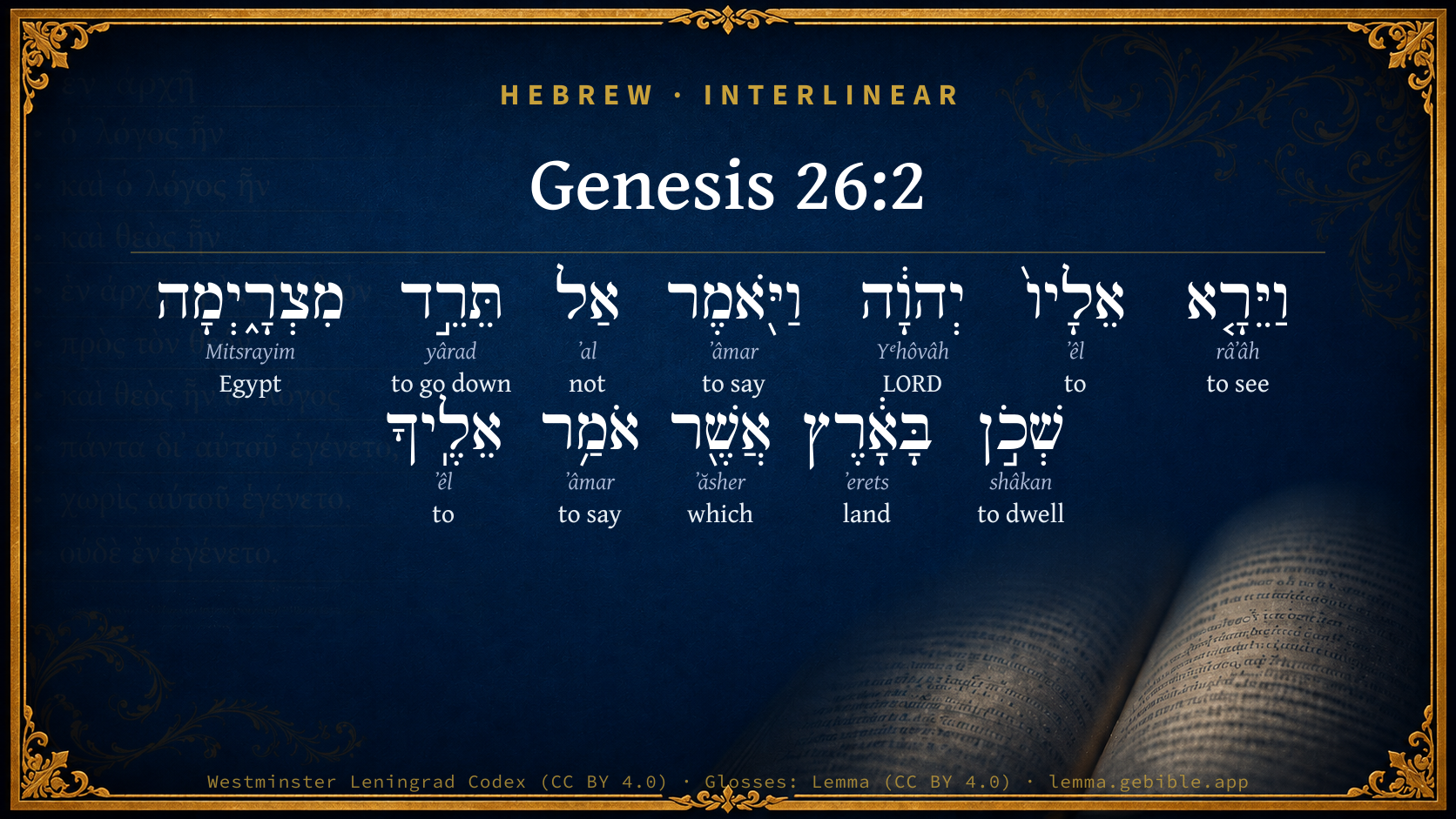
Hebrew (Westminster Leningrad Codex) Genesis 26:2 appears in the Hebrew Old Testament. The text above is from the Westminster Leningrad Codex. Each word links to its Strong’s number, a concise gloss, and parsing drawn from the Open Scriptures Hebrew Bible morphology. Click any word for its full Brown-Driver-Briggs (BDB) entry.
Download image
Cite this verse

Genesis 26:2 (World English Bible). Public Domain. Lemma interlinear Bible study tool, https://lemma.gebible.app/v/genesis/26/2.

Show BibTeX & RIS
BibTeX
RIS
English Translation
Yahweh appeared to him, and said, "Don't go down into Egypt. Dwell in the land which I will tell you of.
World English Bible · Public Domain
Download a study sheet

One document with this verse’s original text, its word-by-word gloss line, the meaning frame, cross-references with their text, attributed commentary, and full source and license credits — printable, and it pastes into notes with its structure intact.

This verse Autodidact and up

Study sheet (.html) Plain text (.txt)

A passage Seminary Student

Up to 50 verses in one chapter. A passage sheet keeps up to 6 commentary sources and 12 cross-references per verse, in the order this page ranks them, and says so on the sheet whenever that leaves anything out. Ask for a single verse and you get the Autodidact verse sheet above.

Everything on this page stays free to read, with no account — the sheet is a download of what is already on screen, not access to it.

Want to remove ads? Support Godless Engineer
Compare translations 3

The same verse in 3 English versions, stacked beneath the original-language interlinear above. Click any original word for its lexicon entry.

Each is an independent rendering of the whole verse — the interlinear is not word-aligned to these translations.

Highlighted words mark where these versions differ — a whole-verse word diff, not a word-by-word alignment.

  • World English Bible Public Domain
    Yahweh appeared to him, and said, "Don't go down into Egypt. Dwell in the land which I will tell you of.
  • King James Version Public Domain
    And the LORD appeared unto him, and said, Go not down into Egypt; dwell in the land which I shall tell thee of:
  • unfoldingWord Literal Text CC BY-SA 4.0
    Then Yahweh appeared to him and said, “Do not go down to Egypt; live in the land that I tell you.

unfoldingWord Literal Text — © unfoldingWord, licensed CC BY-SA 4.0. Word-aligned USFM3 via Door43 (git.door43.org/unfoldingWord/en_ult).

Versions to compare (up to 4)

3 of 4 selected

Show all 18 translations

Every available English version of this verse, each an independent rendering of the whole verse.

  • World English Bible Public Domain
    Yahweh appeared to him, and said, "Don't go down into Egypt. Dwell in the land which I will tell you of.
  • Berean Standard Bible Public Domain
    The LORD appeared to Isaac and said, “Do not go down to Egypt. Settle in the land where I tell you.
  • Majority Standard Bible Public Domain
    The LORD appeared to Isaac and said, “Do not go down to Egypt. Settle in the land where I tell you.
  • King James Version Public Domain
    And the LORD appeared unto him, and said, Go not down into Egypt; dwell in the land which I shall tell thee of:
  • American Standard Version (1901) Public Domain
    And Jehovah appeared unto him, and said, Go not down into Egypt. Dwell in the land which I shall tell thee of.
  • Revised Version (1885) Public Domain
    And the LORD appeared unto him, and said, Go not down into Egypt; dwell in the land which I shall tell thee of:
  • Geneva Bible (1599) Public Domain
    For the Lord appeared vnto him, and sayde, Goe not downe into Egypt, but abide in the land which I shall shewe vnto thee.
  • Douay-Rheims (1899) Public Domain
    And the Lord appeared to him and said: Go not down into Egypt, but stay in the land that I shall tell thee.
  • Young's Literal Translation Public Domain
    And Jehovah appeareth unto him, and saith, `Go not down towards Egypt, tabernacle in the land concerning which I speak unto thee,
  • Literal Standard Version CC BY-SA 4.0
    And YHWH appears to him and says, “Do not go down toward Egypt, dwell in the land concerning which I speak to you,
  • Unlocked Literal Bible CC BY-SA 4.0
    Now Yahweh appeared to him and said, “Do not go down to Egypt; live in the land that I tell you to live in.
  • unfoldingWord Literal Text CC BY-SA 4.0
    Then Yahweh appeared to him and said, “Do not go down to Egypt; live in the land that I tell you.
  • Darby Bible Public Domain
    And Jehovah appeared to him and said, Go not down to Egypt: dwell in the land that I shall tell thee of.
  • World Messianic Bible Public Domain
    The LORD appeared to him, and said, “Don’t go down into Egypt. Live in the land I will tell you about.
  • Webster's Bible Public Domain
    And the LORD appeared to him, and said, Go not down into Egypt: dwell in the land which I shall tell thee of.
  • Free Bible Version CC BY-SA 4.0
    The Lord appeared to Isaac and told him, “Don't go to Egypt—live in the country that I tell you to.
  • Bible in Basic English Public Domain
    And the Lord came to him in a vision and said, Do not go down to Egypt; keep in the land of which I will give you knowledge:
  • JPS Tanakh (1917) Public Domain
    And the LORD appeared unto him, and said: 'Go not down unto Egypt; dwell in the land which I shall tell thee of.

Literal Standard Version (2020), Covenant Press — licensed CC BY-SA 4.0. Text via the HelloAO Bible API (eBible.org). Unlocked Literal Bible (unfoldingWord) — licensed CC BY-SA 4.0. Text via the HelloAO Bible API (eBible.org). unfoldingWord Literal Text — © unfoldingWord, licensed CC BY-SA 4.0. Word-aligned USFM3 via Door43 (git.door43.org/unfoldingWord/en_ult). Free Bible Version, Dr. Jonathan Gallagher — licensed CC BY-SA 4.0. Text via the HelloAO Bible API (eBible.org).

Word by word

More ways to search: Search by grammar → Find every occurrence → Compare this word →

Practice this passage: Drill this verse → Learn its vocabulary →

שְׁכֹ֣ן
shâkan
H7931
“dwell”
Verb, Qal, Imperative, 2nd Person, Masculine, Singular
Part of Speech
Verb
Stem
Qal
Form
Imperative
Person
2nd Person
Gender
Masculine
Number
Singular
Full BDB Definition

Origin: a primitive root [apparently akin (by transmission) to H7901 through the idea of lodging]

TWOT: 2387

to settle down, abide, dwell, tabernacle, reside - (Qal) - to settle down to abide - to abide, dwell, reside - (Piel) - to make settle down, establish - to make or cause to dwell - (Hiphil) - to lay, place, set, establish, settle, fix - to cause to dwell or abide
  1. וַיֵּרָ֤א râʼâh H7200 “and · to see” Conjunction + Verb, Niphal, Sequential Imperfect, 3rd Person, Masculine, Singular
  2. אֵלָיו֙ ʼêl H413 “to · him” Preposition + Suffix, Personal, 3rd Person, Masculine, Singular
  3. יְהוָ֔ה Yᵉhôvâh H3068 “LORD” Noun, Proper
  4. וַיֹּ֖אמֶר ʼâmar H559 “and · to say” Conjunction + Verb, Qal, Sequential Imperfect, 3rd Person, Masculine, Singular
  5. אַל ʼal H408 “not” Particle, Negative
  6. תֵּרֵ֣ד yârad H3381 “to go down” Verb, Qal, Jussive, 2nd Person, Masculine, Singular
  7. מִצְרָ֑יְמָה Mitsrayim H4714 “Egypt · toward” Noun, Proper + Suffix, Demonstrative
  8. בָּאָ֔רֶץ ʼerets H776 “in/at the · land” Preposition, Determined + Noun, Common, Both, Singular, Absolute
  9. אֲשֶׁ֖ר ʼăsher H834 “which” Particle, Relative
  10. אֹמַ֥ר ʼâmar H559 “to say” Verb, Qal, Imperfect, 1st Person, Common, Singular
  11. אֵלֶֽיךָ ʼêl H413 “to · you” Preposition + Suffix, Personal, 2nd Person, Masculine, Singular

About this verse

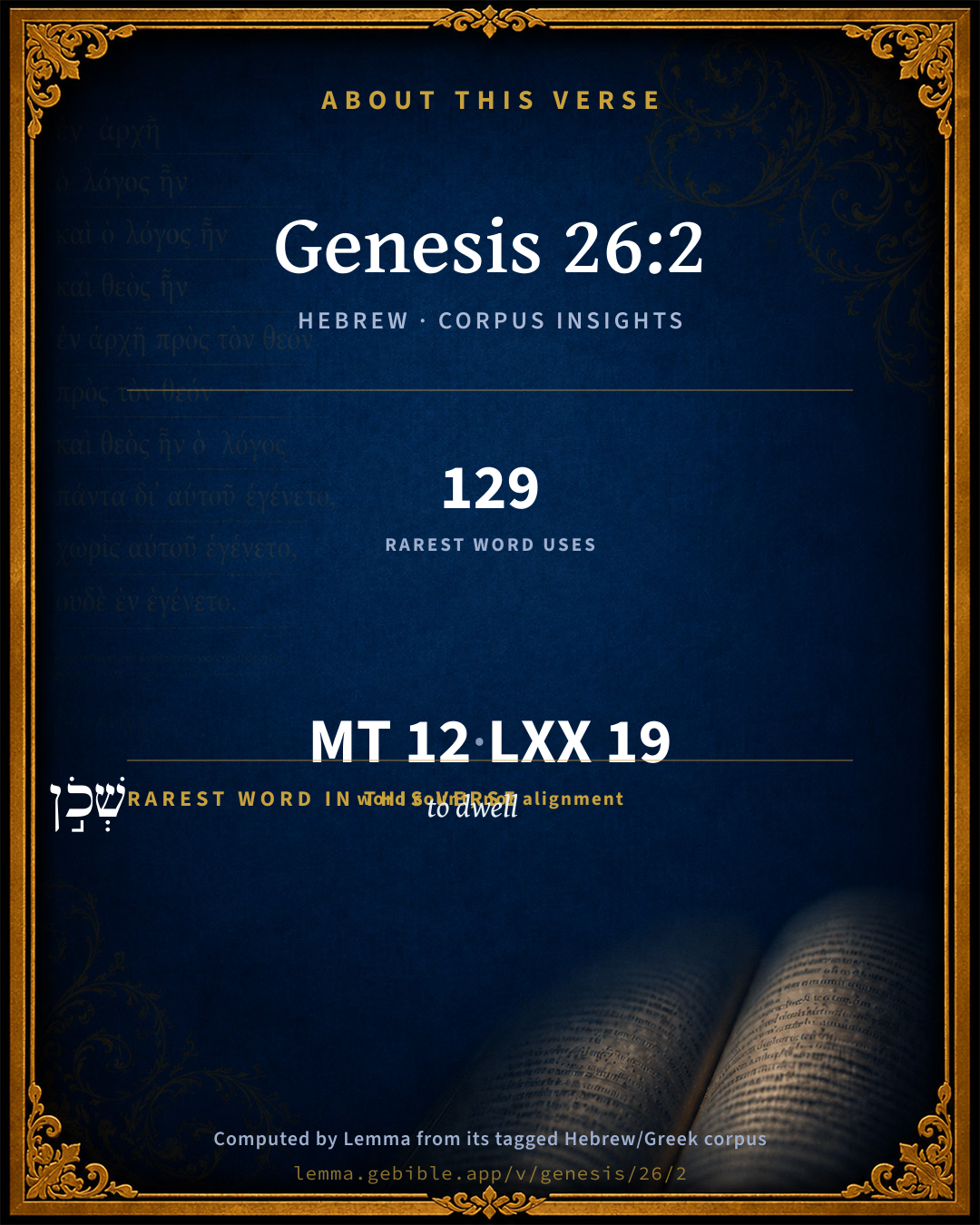
These counts appear in no published source. They are computed here, from the morphology-tagged text and Lemma’s own curated glosses. What Lemma adds →

12
words
10
distinct lemmas
Pentateuch
section

Grammatical profile

  • 5 verbs
  • 3 nouns
  • 2 prepositions
  • 2 particles

Verb forms

  • וַיֵּרָ֤א Niphal · Sequential Imperfect
  • וַיֹּ֖אמֶר Qal · Sequential Imperfect
  • תֵּרֵ֣ד Qal · Jussive
  • שְׁכֹ֣ן Qal · Imperative
  • אֹמַ֥ר Qal · Imperfect

Repetition

Words recur within this verse — often emphatic in Hebrew:

  • וַיֹּ֖אמֶר to say H559 ×2
  • אֵלָיו֙ to H413 ×2

Hebrew & Septuagint length

In English translation the verse runs 21 words from the Hebrew and 24 from the Septuagint (LXX English) — closely comparable.

A rough comparison of the two English renderings, which tokenize alike — not a word-level alignment.

Word counts can differ between the Hebrew and the Greek without any difference in meaning — e.g. the Hebrew direct-object marker אֵת has no separate Greek word, and Greek often adds the article ὁ.

In the original languages it is 12 Hebrew tokens and 19 Greek tokens — but the two are counted differently (Hebrew bundles its prefixes and suffixes into one token; the Greek is in lemma form), so that isn’t a like-for-like length.

Cross-references

6

Topical passages linked to Genesis 26:2 in the Treasury of Scripture Knowledge — connected by theme and wording, ordered by reader-vote popularity; previews shown in the World English Bible.

  • Genesis 12:7 Yahweh appeared to Abram, and said, "I will give this land to your seed." He built an altar there to Yahweh, who appeared to him.
  • Genesis 12:1 Now Yahweh said to Abram, "Get out of your country, and from your relatives, and from your father's house, to the land that I will show you.
  • Genesis 17:1 When Abram was ninety-nine years old, Yahweh appeared to Abram, and said to him, "I am God Almighty. Walk before me, and be blameless.
  • Genesis 18:1 Yahweh appeared to him by the oaks of Mamre, as he sat in the tent door in the heat of the day.
  • Psalms 37:3 Trust in Yahweh, and do good. Dwell in the land, and enjoy safe pasture.
  • Genesis 18:10–20 He said, "I will certainly return to you when the season comes round. Behold, Sarah your wife will have a son." Sarah heard in the tent door, which was behind him.

Cross-references courtesy of OpenBible.info (CC BY 4.0).

Hebrew and Greek witnesses Masoretic Hebrew ↔ Greek Septuagint

The same verse in the two great witnesses to the Old Testament, shown verse-for-verse.

These are two independent witnesses, not word-aligned to each other, and the Septuagint is shown in lemma (dictionary) form.

Hebrew Genesis 26:2 Masoretic · Westminster Leningrad Codex

וַיֵּרָ֤א אֵלָיו֙ יְהוָ֔ה וַיֹּ֖אמֶר אַל תֵּרֵ֣ד מִצְרָ֑יְמָה שְׁכֹ֣ן בָּאָ֔רֶץ אֲשֶׁ֖ר אֹמַ֥ר אֵלֶֽיךָ

Yahweh appeared to him, and said, "Don't go down into Egypt. Dwell in the land which I will tell you of.

World English Bible · Public Domain

Greek LXX Genesis 26:2 Septuagint · lemma form

ὁράω δέ αὐτός κύριος καί εἶπον μή καταβαίνω εἰς αἴγυπτος καταοἰκέω δέ ἐν ὁ γῆ ὅς ἄν σύ εἶπον

And the Lord appeared to him and said, Go not down to Egypt, but dwell in the land, which I shall tell you of.

LXX2012 (modern English Septuagint) · Public Domain

Hebrew: Westminster Leningrad Codex (CC BY 4.0). Greek: Septuagint (public domain); English from LXX2012 (modern English Septuagint) (Public Domain). How the Septuagint differs from the Hebrew →

Targum (Aramaic paraphrase)

2

The Targum is the ancient Jewish Aramaic paraphrase of the Hebrew Scriptures — an interpretive translation, not the Hebrew text itself. Onkelos (literal) and Pseudo-Jonathan (expansive) render the Torah, and Jonathan the Prophets. Coverage is partial: where no permissively-licensed English translation exists for a verse, only the Aramaic is shown. This is verse-level text, not a word-by-word alignment to the Hebrew.

  1. Targum Onkelos Torah (Genesis–Deuteronomy)
    וְאִתְגְּלִי לֵהּ יְיָ וַאֲמַר לָא תֵחוֹת לְמִצְרָיִם שְׁרֵי בְאַרְעָא דִּי אֵימַר לָךְ

    (no public-domain English translation for this verse)

    Targum Onkelos — Aramaic: “Onkelos Genesis” (public domain); “Onkelos Exodus” (public domain); “Onkelos Leviticus” (public domain); “Onkelos Numbers” (public domain); “Onkelos Deuteronomy” (public domain). English: “Sefaria Community Translation” (CC0 1.0 (public-domain dedication)); “J.W. Etheridge. The Targums of Onkelos and Jonathan Ben Uzziel on the Pentateuch. London: Longmans, Green, 1862” (public domain). Text via Sefaria.

  2. Targum Pseudo-Jonathan Torah (Genesis–Deuteronomy)
    וַהֲוָה בִּלְבָבֵיהּ דְיִצְחָק לְמֵיחוֹת לְמִצְרַיִם וְאִתְגְלֵי לֵיהּ יְיָ וַאֲמַר לָא תֵיחוּת לְמִצְרַיִם שְׁרֵי בְּאַרְעָא דְאֵימַר לָךְ

    It had been in Izhak's heart to go down to Mizraim; but the Lord appeared to him, and said, Go not down to Mizraim; dwell in the land as I have told thee;

    Targum Pseudo-Jonathan — Aramaic: “Targum Jonathan on Genesis” (public domain); “Targum Jonathan on Exodus” (public domain); “Targum Jonathan on Leviticus” (public domain); “Targum Jonathan on Numbers” (public domain); “Targum Jonathan on Deuteronomy” (public domain). English: “The Targum of Jonathan ben Uzziel, trans. J. W. Etheridge, London, 1862” (public domain). Text via Sefaria.

Commentary

Notes on Genesis 26:2 from classic Christian and Jewish commentators (each source and its license shown beneath its notes). The classic Christian expositions comment on the surrounding passage and are grouped to its opening verse, so a note may address several verses; the Jewish commentaries on the Tanakh (Rashi and others) are per-verse, so they appear only where the commentator wrote on this verse.

Lemma curates 59 commentaries, every one of them public domain or Creative Commons licensed, each selected and text-cleaned for this edition rather than reprinted as found. About our sources →

Trapp's Complete Commentary

John Trapp

Gen 26:2 And the LORD appeared unto him, and said, Go not down into Egypt; dwell in the land which I shall tell thee of:

Ver. 2. And the Lord appeared unto him.] God knows our souls, and our souls him, best in adversity. See Zec 13:9. This famine was to the Canaanites in the nature of a curse; to Isaac, of a cure. Hinc distinctio illa poenae in conferentem et nocentem, sive in suffocantem et promoventem; item in poenam vindictae et poenam cautelae, sire in condemnantem et corrigentem.

John Trapp, A Commentary or Exposition upon All the Books of the Old and New Testament (1647–1656) — public domain. Text from a community e-Sword module.

The Biblical Illustrator

Joseph S. Exell

Gen_26:2-5

Unto thee, and unto thy seed, I will give all these countries, and I will perform the oath which I sware unto Abraham thy father.

The covenant renewed to Isaac

I. IT WAS RENEWED TO HIM IN A TIME OF TRIAL. Divine help comes when all human efforts are exhausted.

II. IT WAS RENEWED TO HIM IN THE OLD TERMS, BUT RESTING ON NEW GROUNDS. Abraham was the beginning of the Church, and therefore God, in speaking to His servant whom He had called, rested upon His own Almightiness (Gen_17:1). But the Church had already commenced a history in the time of Jacob. There was a past to fall back upon. There was an example to stimulate and encourage. There was some one in whom the power of God was manifested, and who had proved the truth of His Word. Therefore to Isaac God rests His promises on the ground of his fathers obedience. Thus the Lord would teach Isaac that His attributes are on the side of the saints; that they possess Him only so far as they are obedient; that he must not regard the promised blessings as a matter of course, to be given irrespective of conduct, but rather as, by their very terms, demanding obedience; and that the greatness of his people could only arise from that piety and practical trust in God of which Abraham was such an illustrious example (Gen_26:5). But while obedience, as a general principle, was commended to Isaac, yet regard is had to duty as it is special and peculiar to the individual (Gen_26:2). (T. H. Leale.)

The renewed covenant

Two things are observable in this solemn renewal of the covenant with Isaac.

1. The good things promised. The sum of these blessings is the land of Canaan, a numerous progeny, and, what is greatest of all, the Messiah, in whom the nations should be blessed. On these precious promises Isaac is to live. God provided him with bread in the day of famine; but he lived not on bread only, but on the words which proceeded from the mouth of God.

2. Their being given for Abrahams sake. We are expressly informed in what manner this patriarch was accepted of God, namely, as believing on Him who justifieth the ungodly; and this accounts for the acceptance of his works. The most spiritual sacrifices being offered by a sinful creature, can no otherwise be acceptable to God than by Jesus Christ; for, as President Edwards justly remarks, It does not consist with the honour of the majesty of the king of heaven and earth to accept of any thing from a condemned malefactor, condemned by the justice of his own holy law, till that condemnation be removed. But a sinner being accepted as believing in Jesus, his works also are accepted for his sake, and become rewardable. It was in this way, and not of works, that Abrahams obedience was honoured with so great a reward. To this may be added that every degree of Divine respect to the obedience of the patriarchs was, in fact, no other than respect to the obedience of Christ, in whom they believed, and through whom their obedience, like ours, became acceptable. The light of the moon which is derived from its looking, as it were, on the face of the sun, is no other than the light of the sun itself reflected. (A. Fuller.)

Possession

Charles Dickens, in those younger days which he spent in the town of Rochester, used sometimes, in his country walks, to pass a large house standing in its own grounds, called Cads Hill Place. It was his boyish dream that some day he would be a rich man, and when he became so that he would buy that house and make it his home. Castles in the air of this kind are not uncommon, and nay readers have doubtless indulged in many of them. But what is uncommon is their fulfilment. In Dickens case it actually came to pass. He not only grew rich, as many do, but he dwelt in his latter years, and at length died, at Cads Hill Place. I refer to this well-known incident merely to illustrate the difference between the hope of possessing something and the actual possession of it. In Dickens case, indeed, the feeling could scarcely be called a hope. It was but a wild dream. Nervy, in the Book of Genesis, we have before us the case of men whose eyes, day by day, beheld a domain which they hoped would one day be their home; who not merely beheld it, but actually dwelt in it--only not as owners, but merely as guests; and whose hopes were built, not on boyish imaginations, but on the promise of an almighty and faithful God. And yet they never came into possession l Of Abraham we are told, in Heb_11:1-40., that he sojourned in the land of promise as in a strange country; and of all the patriarchs, that they died in faith --still trusting--yet not having received the promises. In what way, then, were the promises fulfilled? As the progenitors of a people, the patriarchs were to obtain the fulfilment in their descendants, hundreds of years after. As individuals, they obtained it, not on earth, but in heaven. They desired a better country, that is, an heavenly; and they got it--something far beyond their most exalted anticipations. (E. Stock.)

The Biblical Illustrator, edited by Joseph S. Exell (c. 1880s–1900s) — public domain. Text from a community e-Sword module.

Joseph Benson's Commentary

Gen 26:2. Go not down into Egypt — Whither, it is likely, Isaac had intended to go, it being a very fruitful country, and he being encouraged to go thither by his father’s example, on a similar occasion. No doubt God had wise reasons for prohibiting his going; but as he has not been pleased to acquaint us with them, to spend time in conjecturing what they were, would be giving ourselves trouble to no purpose.

Joseph Benson's Commentary on the Old and New Testaments (1811–1818) — public domain. Text from a community e-Sword module.

Tyndale Open Study Notes

Tyndale Open Resources

26:2-5 The Lord assured Isaac that the covenant promises (cp. 12:2-3; 15:5-8; 17:3-8; 22:15-18; 28:13-14) would pass to him because Abraham faithfully listened to God and obeyed all his requirements, commands, decrees, and instructions. These terms were later used in Deuteronomy to describe God’s full legal covenant with Israel. An Israelite reader would immediately think of the complete Torah when hearing these words and be prompted to obey God’s law as Abraham did, though Abraham had only a few commands from the Lord. Through these words, the text emphasizes that Abraham would have obeyed the later commands if he had had them, because he was an obedient servant of the Lord.

Tyndale Open Study Notes — © Tyndale Open Resources, licensed CC BY-SA 4.0. Text via the HelloAO Bible API.

Geneva Bible (1599)

Geneva Bible translators

God’s providence always watcheth to direct the ways of his children.

Geneva Bible (1599) marginal notes — public domain. Text via Bolls.life.

Adam Clarke's Commentary

Verse 2. Go not down into Egypt] As Abraham had taken refuge in that country, it is probable that Isaac was preparing to go thither also; and God, foreseeing that he would there meet with trials, &c., which might prove fatal to his peace or to his piety, warns him not to fulfil his intention.

Adam Clarke's Commentary on the Bible (1810–1826) — public domain. Text from a community e-Sword/MySword module.

John Calvin's Commentaries

2. And the Lord appeared unto him. I do not doubt but a reason is here given why Isaac rather went to the country of Gerar than to Egypt, which perhaps would have been more convenient for him; but Moses teaches that he was withheld by a heavenly oracle, so that a free choice was not left him. It may here be asked, why does the Lord prohibit Isaac from going to Egypt, whither he had suffered his father to go? Although Moses does not give the reason, yet we may be allowed to conjecture that the journey would have been more dangerous to the son. The Lord could indeed have endued the son also with the power of his Spirit, as he had done his father Abraham, so that the abundance and delicacies of Egypt should not have corrupted him by their allurements; but since he governs his faithful people with such moderation, that he does not correct all their faults at once, and render them entirely pure, he assists their infirmities, and anticipates, with suitable remedies, those evils by which they might be ensnared. Because, therefore, he knew that there was more infirmity in Isaac than there had been in Abraham, he was unwilling to expose him to danger; for he is faithful, and will not suffer his own people to be tempted beyond what they are able to bear. (1 Corinthians 10:13.) Now, as we must be persuaded, that however arduous and burdensome may be the temptations which alight upon us, the Divine help will never fail to renew our strength; so, on the other hand, we must beware lest we rashly rush into dangers; but each should be admonished by his own infirmity to proceed cautiously and with fear.

Dwell in the land. God commands him to settle in the promised land, yet with the understanding that he should dwell there as a stranger. The intimation was thus given, that the time had not yet arrived in which he should exercise dominion over it. God sustains indeed his mind with the hope of the promised inheritance, but requires this honor to be given to his word, that Isaac should remain inwardly at rest, in the midst of outward agitations; and truly we never lean upon a better support than when, disregarding the appearance of things present, we depend entirely upon the word of the Lord, and apprehend by faith that blessing which is not yet apparent. Moreover, he again inculcates the promise previously made, in order to render Isaac more prompt to obey; for so is the Lord wont to awaken his servants from their indolence, that they may fight valiantly for him, while he constantly affirms that their labor shall not he in vain; for although he requires from us a free and unreserved obedience, as a father does from his children, he yet so condescends to the weakness of our capacity, that he invites and encourages us by the prospect of reward.

John Calvin's Commentaries (1540-1563) — public domain. Text from the Calvin Translation Society English edition (1840s-50s) via the Christian Classics Ethereal Library (ccel.org). Calvin's coverage is partial (roughly two-thirds of the Bible); uncommented books and verses are honest gaps, never fabricated. The 19th-century editor's footnotes and remarks are omitted so the notes are faithfully Calvin's own voice.

Ellicott's Commentary for English Readers

(2) The Lord appeared unto him.—Only once besides does Jehovah manifest himself to Isaac (Gen_26:24), and sixty years had now passed since the revelations recorded in Genesis 22. Excepting to Abraham, it was only at rare and distant intervals that God spake to the patriarchs. The greater part of their lives was spent under the control of the same ordinary Providence as that which governs our actions now; but on special occasions God was pleased to confirm their faith in Him in a way not necessary now that we have had made known to us the whole counsel of God.

A Bible Commentary for English Readers, edited by Charles John Ellicott (1878–1897) — public domain. Text from a community e-Sword module.

The Cambridge Bible for Schools and Colleges

gen. ed. J. J. S. Perowne

2. appeared] The promises here made to Isaac are, for the most part, reiterated from Gen_12:2-3, Gen_15:5, Gen_17:6-8, Gen_22:15-18.

which I shall tell thee of] Cf. the similar phrase in Gen_12:1, Gen_22:2.

The Cambridge Bible for Schools and Colleges (gen. ed. J. J. S. Perowne; Cambridge University Press, 1878–1918) — public domain. Text from a community e-Sword module.

John Gill's Exposition

And the Lord appeared unto him,.... In a vision or dream, when he was at Gerar:

and said, go not down into Egypt; as his father had done in the like case, and where Isaac thought to have gone, and the rather, as that was a fruitful country; and so the Targum of Jonathan,"and it was in the heart of Isaac to go down into Egypt, and the Lord appeared unto him, &c.''and charged him not to go thither; partly to try his faith in him, and dependence on his providence for support in this time of famine, and partly lest he should think of continuing there, and be unmindful of the promise of the land of Canaan to Abraham's seed:

dwell in the land which I shall tell thee of; even the land of Canaan, which he was now about to give him on account of the promise of it to Abraham and his seed, and to renew it to him and to his seed.

John Gill's Exposition of the Whole Bible (1746–1763) — public domain (CC PDM 1.0). Text via the HelloAO Bible API.

Matthew Poole's English Annotations

To Egypt it seems Isaac intended to go, it being a very fruitful place, and being encouraged to do so by his father’s example upon the same occasion. But God saw good reasons to forbid Isaac to go thither, which it is needless to inquire, and not difficult to conjecture.

Matthew Poole's English Annotations on the Holy Bible (1683–1685) — public domain. Text from a community e-Sword/MySword module.

Whedon's Commentary on the Bible

Daniel D. Whedon

2. The Lord appeared — In a dream or vision of the night. Comp. Gen_26:24. “The last recorded vision was at the sacrifice of Isaac, more than sixty years before. These revelations were not so frequent as they seem to us, as we read one event rapidly after the other; but just sufficient to keep up the knowledge of God and the faith of the patriarchs in the line of the chosen people, and of the promised seed.” — Speaker’s Commentary.

Daniel D. Whedon (gen. ed.), Commentary on the Old and New Testaments (1874–1909) — public domain. Text from a community e-Sword module.

John Wesley's Explanatory Notes

The Lord said, go not down into Egypt. Sojourn in this land - There was a famine in Jacob's days, and God bid him go down into Egypt, chap. xlvi, 3, 4, a famine in Isaac's days, and God bid him not go down: a famine in Abraham's days, and God left him to his liberty, directing him neither way, which (considering that Egypt was always a place of trial to God's people) some ground upon the different characters of these three patriarchs. Abraham was a man of very intimate communion with God, and to him all places and conditions were alike; Isaac a very good man, but not cut out for hardship, therefore he is forbidden to go to Egypt; Jacob inured to difficulties, strong and patient, and therefore he must go down into Egypt, that the trial of his faith might be to praise, and honour, and glory. Thus God proportions his people's trials to their strength.

John Wesley, Explanatory Notes Upon the Whole Bible (1754–1765) — public domain. Text via the GEBible commentary corpus.

Scofield Reference Notes

C. I. Scofield

Go not down

Cf. (See Scofield "Gen 46:3").

The Scofield Reference Bible (1917 edition), notes by C. I. Scofield — public domain. Text from a community e-Sword module.

unfoldingWord translationNotes

Door43 World Missions Community

General Information:

Yahweh begins to speak to Isaac.

appeared to him

"appeared to Isaac"

Do not go down to Egypt

It was common to speak of leaving the promised land as "going down" to another place. (See: Idiom)

for to you and to your descendants, I will give all these lands

"for I will give all these lands to you and your descendants"

I will fulfill the oath that I swore to Abraham your father

"I will do what I promised Abraham your father I would do"

translationWords

Yahweh

Egypt

bless

descend

fulfill

oath

unfoldingWord translationNotes — © Distant Shores Media and the Door43 World Missions Community, licensed CC BY-SA 4.0. Source: git.door43.org/Door43/en_tn.

Rashi

Rabbi Shlomo Yitzchaki (Rashi)

אל תרד מצרימה GO NOT DOWN INTO EGYPT — Because he thought of going down to Egypt as his father had gone down in time of famine. He said to him, “Do not go down to Egypt for you are a burnt-offering without blemish and residence outside the Holy Land is not befitting you” (Genesis Rabbah 64:3).

Rashi on the Tanakh — English translations: “The Judaica Press complete Tanach with Rashi, translated by A. J. Rosenberg” (CC BY 4.0); “Pentateuch with Rashi's commentary by M. Rosenbaum and A.M. Silbermann, 1929-1934” (public domain); “The Metsudah Tanach series, Lakewood, N.J” (CC BY 4.0); and “The Book of Joshua, Metsudah Publications, 1997” (CC BY 4.0). Text via Sefaria.

Ramban (Nachmanides)

Rabbi Moshe ben Nachman (Ramban / Nachmanides)

DWELL IN THE LAND WHICH I SHALL TELL THEE OF. It is incomprehensible that G-d should tell Isaac at one time, Dwell in the land which I shall tell thee of, [and in the following verse continue], Sojourn in this land, [and in both cases be referring to the same land]. Instead, its explanation is as follows: “Go not down into Egypt, and dwell all your days in the land which I shall tell you from time to time. At the bidding of G-d you should move, and at the bidding of G-d you should encamp, and right now, sojourn in this land, the land of the Philistines, for unto thee and unto thy seed I will give it, even as it is written, Counted to the Canaanites are the five lords of the Philistines.” It is possible that [the event referred to in the beginning of the verse], And the Lord appeared unto him, and said … dwell in the land which I shall tell thee of, happened earlier so that before Isaac left his place it was said to him, “Go not down into Egypt; dwell in the land which I shall tell thee of when you will be there. Now dwell in this land, the land of Canaan, which will comprise many peoples and many lands, for I now command that you should not leave it forever for all these lands will I give to thy seed.” Following this command, Isaac journeyed from his place because of the famine to go into all the lands of Canaan, to dwell in the land which He would tell him. And when he came to Gerar, He said to him, “Dwell here.” It was not necessary however for Scripture to detail this for it is known that Isaac would not transgress the command of G-d., he left his place and went searching within the land of Canaan for a new home. When he finally reached Gerar he was told, Sojourn in this land. Thus Ramban explains that there was a lapse of [[illegible]] Verses 2 and 3. The original difficulty which Ramban mentions at the beginning of his comments on this verse is thus removed. A similar case of interpretation appears in the verse, Upon one of the mountains which I will tell thee of, as I mentioned there.

Ramban (Nachmanides) on the Tanakh — English translation: “Commentary on the Torah by Ramban (Nachmanides). Translated and annotated by Charles B. Chavel. New York, Shilo Pub. House, 1971-1976” (CC BY 4.0). Text via Sefaria.

Radak

Rabbi David Kimhi (Radak)

וירא, perhaps it had been part of Yitzchok’s plan to move all the way to Egypt as had done his father in similar circumstances, knowing that the food supply in Egypt was more abundant than that in any other country in the civilised world at the time. G’d appeared to him, meaning to dissuade him from carrying out such a plan, seeing that in the Land of the Philistines there was no famine at the time. In view of this, G’d said it would be better for him to reside there on a temporary basis than to move all the way south to Egypt. The Land of the Philistines is historically considered as part of the Land of Canaan as we have written in connection with 15,21 in reference to 15,18. G’d repeats this in verse 3 so that there could be no doubt about it [as some of us might have thought after considering that Avraham might have signed it away when he concluded his treaty with Avimelech at Beer Sheva. Ed.]

שכון בארץ אשר אמר אליך, in this verse the instruction is שכון, “make a permanent residence,” whereas in verse 3 the same instruction speaks of גור בארץ, “establish a temporary residence.” The commandment is reinforced that Yitzchok should not leave the Land of Canaan at that time or at any time in the future, the reason being

אשר אומר אליך, what I have said to your father is equally valid for you.

Radak on the Tanakh — English translations: “Sefaria Community Translation” (CC0 1.0 (public-domain dedication)); “Eliyahu Munk, HaChut Hameshulash” (CC BY 4.0); “Rabbi Mike Feuer, Jerusalem Anthology” (CC BY 4.0); and “R. David Kimhi on the first book of Psalms, Translated by R.G. Finch, London, 1919” (public domain). Text via Sefaria.

Lesson kit

Teaching starters — assembled from the data on this page, not authored interpretation. Every prompt links to the verse data it draws on. Edit before teaching.

Genesis, in the Pentateuch, opens this verse with 12 words (10 distinct Hebrew lemmas). Its most distinctive word is shâkan (“to dwell”). A historical commentator’s framing appears above. Read the whole chapter for the surrounding context.

Discussion questions

  1. How does “to dwell” (shâkan) shape what this verse is saying?
  2. Genesis 12:7 shares this passage’s theme. How do the two illuminate each other?
  3. “to say” occurs 2× in this one verse. What is the effect of the repetition?
  4. These translations render this verse differently; the difference is in the English rendering, not the original. What questions does that raise?
  5. The verb «וַיֵּרָ֤א» is Niphal Sequential Imperfect. How does its form color the action?
  6. Reading how Trapp's Complete Commentary and The Biblical Illustrator read this verse, where do the two commentators agree and where do they part?

Things to notice

Reading settings

Reading text

Shown beneath each verse's original-language words.

Old Testament
Old Testament edition

Read the OT as the Masoretic Hebrew (MT) or the Greek Septuagint (LXX).

English shown for the Greek Septuagint (in the Hebrew ↔ Greek comparison).

Comparing translations? Open the Compare panel on any verse page to stack up to four side by side.