

2 Kings 12:7

Hebrew (Westminster Leningrad Codex) 2 Kings 12:7 appears in the Hebrew Old Testament. The text above is from the Westminster Leningrad Codex. Each word links to its Strong’s number, a concise gloss, and parsing drawn from the Open Scriptures Hebrew Bible morphology. Click any word for its full Brown-Driver-Briggs (BDB) entry.
Download image
Cite this verse

2 Kings 12:7 (World English Bible). Public Domain. Lemma interlinear Bible study tool, https://lemma.gebible.app/v/2-kings/12/7.

Show BibTeX & RIS
BibTeX
RIS
English Translation
Then king Jehoash called for Jehoiada the priest, and for the [other] priests, and said to them, Why don't you repair the breaches of the house? now therefore take no [more] money from your acquaintance, but deliver it for the breaches of the house.
World English Bible · Public Domain
Download a study sheet

One document with this verse’s original text, its word-by-word gloss line, the meaning frame, cross-references with their text, attributed commentary, and full source and license credits — printable, and it pastes into notes with its structure intact.

This verse Autodidact and up

Study sheet (.html) Plain text (.txt)

A passage Seminary Student

Up to 50 verses in one chapter. A passage sheet keeps up to 6 commentary sources and 12 cross-references per verse, in the order this page ranks them, and says so on the sheet whenever that leaves anything out. Ask for a single verse and you get the Autodidact verse sheet above.

Everything on this page stays free to read, with no account — the sheet is a download of what is already on screen, not access to it.

Want to remove ads? Support Godless Engineer
Compare translations 3

The same verse in 3 English versions, stacked beneath the original-language interlinear above. Click any original word for its lexicon entry.

Each is an independent rendering of the whole verse — the interlinear is not word-aligned to these translations.

Highlighted words mark where these versions differ — a whole-verse word diff, not a word-by-word alignment.

  • World English Bible Public Domain
    Then king Jehoash called for Jehoiada the priest, and for the [other] priests, and said to them, Why don't you repair the breaches of the house? now therefore take no [more] money from your acquaintance, but deliver it for the breaches of the house.
  • King James Version Public Domain
    Then king Jehoash called for Jehoiada the priest, and the other priests, and said unto them, Why repair ye not the breaches of the house? now therefore receive no more money of your acquaintance, but deliver it for the breaches of the house.
  • unfoldingWord Literal Text CC BY-SA 4.0
    And King Joash called for Jehoiada the priest and for the priests, and he said to them, “Why are you not strengthening the damage of the house? And now, you shall not take silver from your acquaintances, but for the damage of the house you shall give it.”

unfoldingWord Literal Text — © unfoldingWord, licensed CC BY-SA 4.0. Word-aligned USFM3 via Door43 (git.door43.org/unfoldingWord/en_ult).

Versions to compare (up to 4)

3 of 4 selected

Show all 18 translations

Every available English version of this verse, each an independent rendering of the whole verse.

  • World English Bible Public Domain
    Then king Jehoash called for Jehoiada the priest, and for the [other] priests, and said to them, Why don't you repair the breaches of the house? now therefore take no [more] money from your acquaintance, but deliver it for the breaches of the house.
  • Berean Standard Bible Public Domain
    So King Joash called Jehoiada and the other priests and said, “Why have you not repaired the damage to the temple? Now, therefore, take no more money from your constituency, but hand it over for the repair of the temple.”
  • Majority Standard Bible Public Domain
    So King Joash called Jehoiada and the other priests and said, “Why have you not repaired the damage to the temple? Now, therefore, take no more money from your constituency, but hand it over for the repair of the temple.”
  • King James Version Public Domain
    Then king Jehoash called for Jehoiada the priest, and the other priests, and said unto them, Why repair ye not the breaches of the house? now therefore receive no more money of your acquaintance, but deliver it for the breaches of the house.
  • American Standard Version (1901) Public Domain
    Then king Jehoash called for Jehoiada the priest, and for the `other' priests, and said unto them, Why repair ye not the breaches of the house? now therefore take no `more' money from your acquaintance, but deliver it for the breaches of the house.
  • Revised Version (1885) Public Domain
    Then king Jehoash called for Jehoiada the priest, and for the other priests, and said unto them, Why repair ye not the breaches of the house? now therefore take no more money from your acquaintance, but deliver it for the breaches of the house.
  • Geneva Bible (1599) Public Domain
    Then King Iehoash called for Iehoiada the Priest, and the other Priestes, and sayd vnto them, Why repaire yee not the ruines of the Temple? nowe therefore receiue no more money of your acquaintance, except yee deliuer it to repaire the ruines of the Temple.
  • Douay-Rheims (1899) Public Domain
    And king Joas called Joiada the high priest and the priests, saying to them: Why do you not repair the temple? Take you therefore money no more according to your order, but restore it for the repairing of the temple.
  • Young's Literal Translation Public Domain
    and king Jehoash calleth to Jehoiada the priest, and to the priests, and saith unto them, `Wherefore are ye not strengthening the breach of the house? and now, receive no money from your acquaintances, but for the breach of the house give it.'
  • Literal Standard Version CC BY-SA 4.0
    and King Jehoash calls to Jehoiada the priest, and to the priests, and says to them, “Why are you not strengthening the breach of the house? And now, receive no money from your acquaintances, but give it for the breach of the house.”
  • Unlocked Literal Bible CC BY-SA 4.0
    Then King Joash called for Jehoiada the priest and for the other priests; he said to them, “Why have you not repaired anything in the temple? Now take no more money from your taxpayers, but take what has been collected for repairs of the temple and give it to those who can make the repairs.”
  • unfoldingWord Literal Text CC BY-SA 4.0
    And King Joash called for Jehoiada the priest and for the priests, and he said to them, “Why are you not strengthening the damage of the house? And now, you shall not take silver from your acquaintances, but for the damage of the house you shall give it.”
  • Darby Bible Public Domain
    Then king Jehoash called for Jehoiada the priest, and the priests, and said to them, Why have ye not repaired the breaches of the house? And now receive no money of your acquaintances, but give it for the breaches of the house.
  • World Messianic Bible Public Domain
    Then King Jehoash called for Jehoiada the priest, and for the other priests, and said to them, “Why aren’t you repairing the damage to the house? Now therefore take no more money from your treasurers, but deliver it for repair of the damage to the house.”
  • Webster's Bible Public Domain
    Then king Jehoash called for Jehoiada the priest, and the other priests, and said to them, Why repair ye not the breaches of the house? now therefore receive no more money of your acquaintance, but deliver it for the breaches of the house.
  • Free Bible Version CC BY-SA 4.0
    So King Joash called together Jehoiada and the other priests and asked, “Why haven't you repaired the damage in the Temple? Don't use any more money you're given for yourselves, instead hand it over to others to repair the Temple.”
  • Bible in Basic English Public Domain
    Then King Jehoash sent for Jehoiada the priest, and the other priests, and said to them, Why have you not made good what is damaged in the house? now take no more money from your neighbours, but give it for the building up of the house.
  • JPS Tanakh (1917) Public Domain
    (12-8) Then king Jehoash called for Jehoiada the priest, and for the other priests, and said unto them: 'Why repair ye not the breaches of the house? now therefore take no longer money from them that bestow it upon you, but deliver it for the breaches of the house.'

Literal Standard Version (2020), Covenant Press — licensed CC BY-SA 4.0. Text via the HelloAO Bible API (eBible.org). Unlocked Literal Bible (unfoldingWord) — licensed CC BY-SA 4.0. Text via the HelloAO Bible API (eBible.org). unfoldingWord Literal Text — © unfoldingWord, licensed CC BY-SA 4.0. Word-aligned USFM3 via Door43 (git.door43.org/unfoldingWord/en_ult). Free Bible Version, Dr. Jonathan Gallagher — licensed CC BY-SA 4.0. Text via the HelloAO Bible API (eBible.org).

Word by word

More ways to search: Search by grammar → Find every occurrence → Compare this word →

Practice this passage: Drill this verse → Learn its vocabulary →

מַכָּֽרֵיכֶ֔ם
makkâr
H4378
“friends · your”
Noun, Common, Masculine, Plural, Construct + Suffix, Personal, 2nd Person, Masculine, Plural
Part of Speech
Noun
Type
Common
Gender
Masculine
Number
Plural
State
Construct
Full BDB Definition

Origin: from H5234

TWOT: 1368f

acquaintance, friend
  1. וַיִּקְרָא֩ qârâʼ H7121 “and · to call” Conjunction + Verb, Qal, Sequential Imperfect, 3rd Person, Masculine, Singular
  2. הַמֶּ֨לֶךְ melek H4428 “the · king” Particle, Definite Article + Noun, Common, Masculine, Singular, Absolute
  3. יְהוֹאָ֜שׁ Yᵉhôwʼâsh H3060 “Jehoash” Noun, Proper
  4. לִיהוֹיָדָ֤ע Yᵉhôwyâdâʻ H3077 “to/for · Jehoiada” Preposition + Noun, Proper
  5. הַכֹּהֵן֙ kôhên H3548 “the · priest” Particle, Definite Article + Noun, Common, Masculine, Singular, Absolute
  6. וְלַכֹּ֣הֲנִ֔ים kôhên H3548 “and · to/for the · priests” Conjunction + Preposition, Determined + Noun, Common, Masculine, Plural, Absolute
  7. וַיֹּ֣אמֶר ʼâmar H559 “and · to say” Conjunction + Verb, Qal, Sequential Imperfect, 3rd Person, Masculine, Singular
  8. אֲלֵהֶ֔ם ʼêl H413 “to · them” Preposition + Suffix, Personal, 3rd Person, Masculine, Plural
  9. מַדּ֛וּעַ maddûwaʻ H4069 “why” Particle, Interrogative
  10. אֵינְכֶ֥ם ʼayin H369 “nothing · you” Particle, Negative + Suffix, Personal, 2nd Person, Masculine, Plural
  11. מְחַזְּקִ֖ים châzaq H2388 “strengthening” Verb, Piel, Participle Active, Masculine, Plural, Absolute
  12. אֶת ʼêth H853 “-” Particle, Direct Object
  13. בֶּ֣דֶק bedeq H919 “breach of” Noun, Common, Masculine, Singular, Construct
  14. הַבָּ֑יִת bayith H1004 “the · house” Particle, Definite Article + Noun, Common, Masculine, Singular, Absolute
  15. וְעַתָּ֗ה ʻattâh H6258 “and · now” Conjunction + Adverb
  16. אַל ʼal H408 “not” Particle, Negative
  17. תִּקְחוּ lâqach H3947 “to take” Verb, Qal, Jussive, 2nd Person, Masculine, Plural
  18. כֶ֨סֶף֙ keçeph H3701 “silver” Noun, Common, Masculine, Singular, Absolute
  19. מֵאֵ֣ת ʼêth H854 “from · with” Preposition + Preposition
  20. כִּֽי kîy H3588 “that” Conjunction
  21. לְבֶ֥דֶק bedeq H919 “to/for · breach of” Preposition + Noun, Common, Masculine, Singular, Construct
  22. הַבַּ֖יִת bayith H1004 “the · house” Particle, Definite Article + Noun, Common, Masculine, Singular, Absolute
  23. תִּתְּנֻֽהוּ nâthan H5414 “to give · him” Verb, Qal, Jussive, 2nd Person, Masculine, Plural + Suffix, Personal, 3rd Person, Masculine, Singular

About this verse

These counts appear in no published source. They are computed here, from the morphology-tagged text and Lemma’s own curated glosses. What Lemma adds →

24
words
21
distinct lemmas
Historical
section

Notable vocabulary

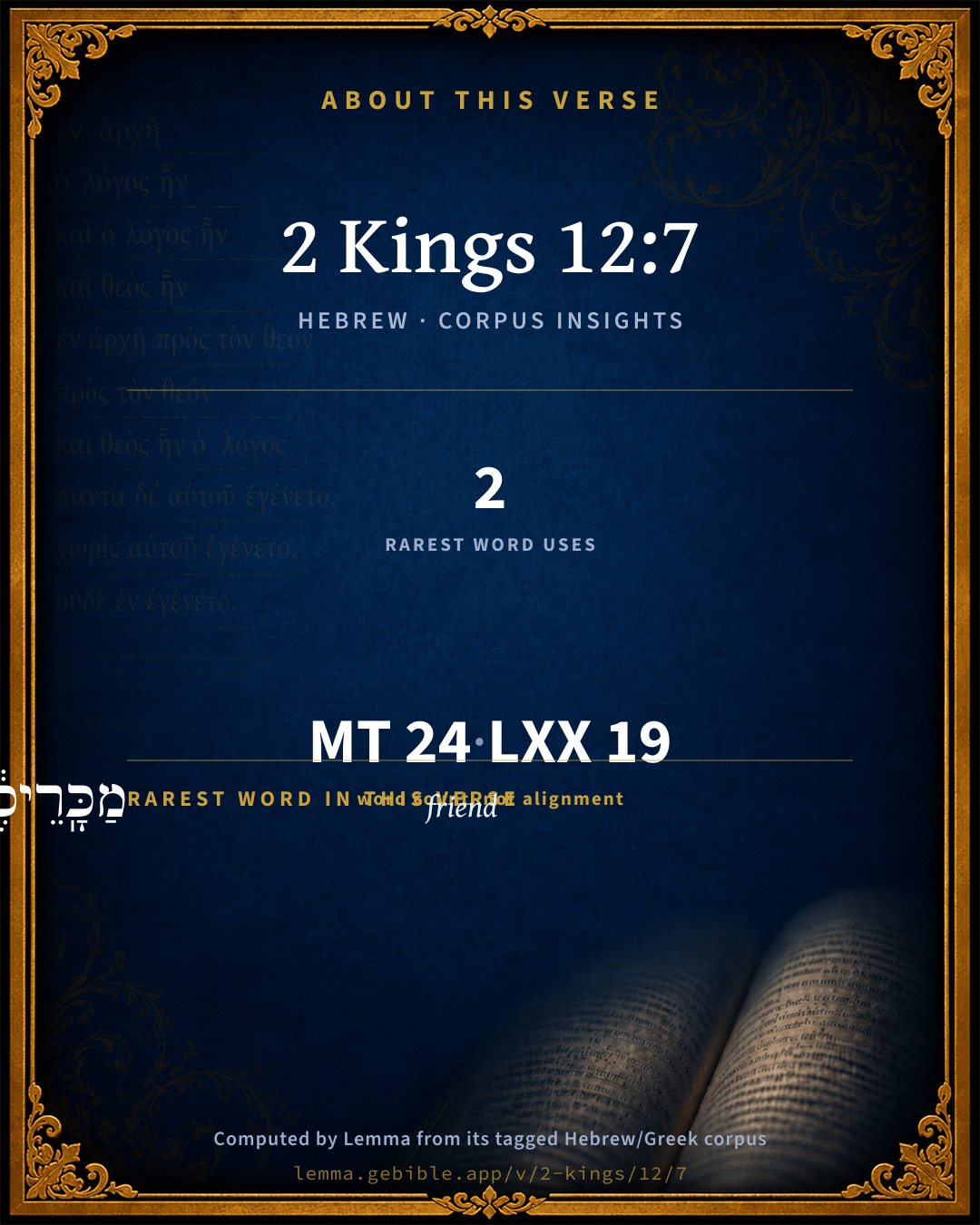
The rarest word here is מַכָּֽרֵיכֶ֔ם friend H4378 — appearing just 2 times in the whole Hebrew Bible.

Shared distinctive vocabulary

מַכָּֽרֵיכֶ֔ם friend H4378 occurs in 2 verses of the Hebrew Bible. Also found in:

Grammatical profile

  • 5 verbs
  • 11 nouns
  • 2 prepositions
  • 1 conjunction
  • 1 adverb
  • 4 particles

Verb forms

  • וַיִּקְרָא֩ Qal · Sequential Imperfect
  • וַיֹּ֣אמֶר Qal · Sequential Imperfect
  • מְחַזְּקִ֖ים Piel · Participle Active
  • תִּקְחוּ Qal · Jussive
  • תִּתְּנֻֽהוּ Qal · Jussive

Repetition

Words recur within this verse — often emphatic in Hebrew:

  • הַכֹּהֵן֙ priest H3548 ×2
  • בֶּ֣דֶק breach H919 ×2
  • הַבָּ֑יִת house H1004 ×2

Hebrew & Septuagint length

In English translation the verse runs 44 words from the Hebrew and 46 from the Septuagint (LXX English) — closely comparable.

A rough comparison of the two English renderings, which tokenize alike — not a word-level alignment.

Word counts can differ between the Hebrew and the Greek without any difference in meaning — e.g. the Hebrew direct-object marker אֵת has no separate Greek word, and Greek often adds the article ὁ.

In the original languages it is 24 Hebrew tokens and 19 Greek tokens — but the two are counted differently (Hebrew bundles its prefixes and suffixes into one token; the Greek is in lemma form), so that isn’t a like-for-like length.

Cross-references

6

Topical passages linked to 2 Kings 12:7 in the Treasury of Scripture Knowledge — connected by theme and wording, ordered by reader-vote popularity; previews shown in the World English Bible.

  • 2 Kings 11:4 In the seventh year Jehoiada sent and fetched the captains over hundreds of the Carites and of the guard, and brought them to him into the house of Yahweh; and he made a covenant with them, and took an oath of them in the house of Yahweh, and shown them the king's son.
  • 2 Kings 12:2 Jehoash did that which was right in the eyes of Yahweh all his days in which Jehoiada the priest instructed him.
  • 1 Chronicles 21:3 Joab said, Yahweh make his people a hundred times as many as they are: but, my lord the king, aren't they all my lord's servants? why does my lord require this thing? why will he be a cause of guilt to Israel?
  • 2 Chronicles 23:1 In the seventh year Jehoiada strengthened himself, and took the captains of hundreds, Azariah the son of Jeroham, and Ishmael the son of Jehohanan, and Azariah the son of Obed, and Maaseiah the son of Adaiah, and Elishaphat the son of Zichri, into covenant with him.
  • 2 Chronicles 24:5–14 He gathered together the priests and the Levites, and said to them, Go out to the cities of Judah, and gather of all Israel money to repair the house of your God from year to year; and see that you hasten the matter. However the Levites didn't hurry.
  • 2 Chronicles 24:16 They buried him in the city of David among the kings, because he had done good in Israel, and toward God and his house.

Cross-references courtesy of OpenBible.info (CC BY 4.0).

Hebrew and Greek witnesses Masoretic Hebrew ↔ Greek Septuagint

The same verse in the two great witnesses to the Old Testament, shown verse-for-verse.

These are two independent witnesses, not word-aligned to each other, and the Septuagint is shown in lemma (dictionary) form.

Hebrew 2 Kings 12:7 Masoretic · Westminster Leningrad Codex

וַיִּקְרָא֩ הַמֶּ֨לֶךְ יְהוֹאָ֜שׁ לִיהוֹיָדָ֤ע הַכֹּהֵן֙ וְלַכֹּ֣הֲנִ֔ים וַיֹּ֣אמֶר אֲלֵהֶ֔ם מַדּ֛וּעַ אֵינְכֶ֥ם מְחַזְּקִ֖ים אֶת בֶּ֣דֶק הַבָּ֑יִת וְעַתָּ֗ה אַל תִּקְחוּ כֶ֨סֶף֙ מֵאֵ֣ת מַכָּֽרֵיכֶ֔ם כִּֽי לְבֶ֥דֶק הַבַּ֖יִת תִּתְּנֻֽהוּ

Then king Jehoash called for Jehoiada the priest, and for the [other] priests, and said to them, Why don't you repair the breaches of the house? now therefore take no [more] money from your acquaintance, but deliver it for the breaches of the house.

World English Bible · Public Domain

Greek LXX 2 Kings 12:7 Septuagint · lemma form

καί γίγνομαι ἐν ὁ εἰκοστός καί τρίτος ἔτος ὁ βασιλεύς ιωας οὐ κραταιόω ὁ ἱερεύς ὁ βεδεκ ὁ οἶκος

And king Joas called Jodae the priest, and the other priests, and said to them, Why have you⌃ not repaired the breaches of the house? now then receive no more money from your sales, for you⌃ shall give it to repair the breaches of the house.

LXX2012 (modern English Septuagint) · Public Domain

Hebrew: Westminster Leningrad Codex (CC BY 4.0). Greek: Septuagint (public domain); English from LXX2012 (modern English Septuagint) (Public Domain). How the Septuagint differs from the Hebrew →

Targum (Aramaic paraphrase)

1

The Targum is the ancient Jewish Aramaic paraphrase of the Hebrew Scriptures — an interpretive translation, not the Hebrew text itself. Onkelos (literal) and Pseudo-Jonathan (expansive) render the Torah, and Jonathan the Prophets. Coverage is partial: where no permissively-licensed English translation exists for a verse, only the Aramaic is shown. This is verse-level text, not a word-by-word alignment to the Hebrew.

  1. Targum Jonathan Prophets (Joshua–Malachi)
    וַהֲוָה בִּשְׁנַת עַסְרִין וּתְלַת שְׁנִין לְמַלְכָּא יְהוֹאָשׁ לָא תַקִיפוּ כַהֲנַיָא יַת בִּדְקָא דְבֵיתָא:

    (no public-domain English translation for this verse)

    Targum Jonathan — Aramaic: “Mikraot Gedolot” (public domain). English: “Sefaria Community Translation” (CC0 1.0 (public-domain dedication)); “London "Chaldee Paraphrase," 1871” (public domain). Text via Sefaria.

Commentary

Notes on 2 Kings 12:7 from classic Christian and Jewish commentators (each source and its license shown beneath its notes). The classic Christian expositions comment on the surrounding passage and are grouped to its opening verse, so a note may address several verses; the Jewish commentaries on the Tanakh (Rashi and others) are per-verse, so they appear only where the commentator wrote on this verse.

Lemma curates 59 commentaries, every one of them public domain or Creative Commons licensed, each selected and text-cleaned for this edition rather than reprinted as found. About our sources →

Trapp's Complete Commentary

John Trapp

2Ki 12:7 Then king Jehoash called for Jehoiada the priest, and the [other] priests, and said unto them, Why repair ye not the breaches of the house? now therefore receive no [more] money of your acquaintance, but deliver it for the breaches of the house.

Ver. 7. Then king Jehoash called for Jehoiada.] It was wonder that he should need quickening; but he was grown very old, and his work was done in a manner. Howbeit Josephus saith that he excited Joash, and would be called for among the rest, whom haply he could not so well prevail with.

Why repair ye not the breaches of the house?] A temporary, then, we see may be the fore-horse in the team, the εργοδιωκτης, the ringleader of good exercises, and stir others up thereto, as Jehoash here did his best officers, and yet perish.

John Trapp, A Commentary or Exposition upon All the Books of the Old and New Testament (1647–1656) — public domain. Text from a community e-Sword module.

Geneva Bible (1599)

Geneva Bible translators

He taketh from them the ordering of the money, because of their negligence.

Geneva Bible (1599) marginal notes — public domain. Text via Bolls.life.

Jamieson, Fausset & Brown

Robert Jamieson, A. R. Fausset & David Brown

Why repair ye not the breaches of the house?--This mode of collection not proving so productive as was expected (the dilatoriness of the priests was the chief cause of the failure), a new arrangement was proposed. A chest was placed by the high priest at the entrance into the temple, into which the money given by the people for the repairs of the temple was to be put by the Levites who kept the door. The object of this chest was to make a separation between the money to be raised for the building from the other moneys destined for the general use of the priests, in the hope that the people would be more liberal in their contributions when it was known that their offerings would be devoted to the special purpose of making the necessary repairs. The duty of attending to this work was no longer to devolve on the priests, but to be undertaken by the king.

Jamieson, Fausset & Brown — Commentary Critical and Explanatory on the Whole Bible (1871) — public domain (CC PDM 1.0). Text via the HelloAO Bible API.

Ellicott's Commentary for English Readers

(7) Now therefore receive no more money.—The account of the whole transaction is not very clear, and commentators disagree upon the question of the degree of blame attaching to the priests for their neglect. It is evident, however, that the king now took the control of the funds and the work out of their hands. Probably the revenues of the sanctuary had been in a very languishing condition during the late reigns; and the priesthood had used whatever offerings they received for their own support. They would now very naturally be unwilling to appropriate any part of the revenues which they had come to regard as their own. to the work of repair. From the account in Chronicles it would not appear that any money was collected for the purpose of restoration before the king took the matter into his own hands. The idea of Thenins, that Joash wished to humble the pride of the priests by diminishing their revenues, is not contained in either narrative. But it is in itself likely that the moral tone of the whole order had degenerated in the late period of apostasy.

But deliver it for the breaches of the house.—Rather, For to the dilapidation of the house ye should give it; scil., and not apply it to any other purposes. The king’s words certainly seem to throw suspicion on the priests.

A Bible Commentary for English Readers, edited by Charles John Ellicott (1878–1897) — public domain. Text from a community e-Sword module.

The Cambridge Bible for Schools and Colleges

gen. ed. J. J. S. Perowne

7. Why repair ye not the breaches?] No answer is given to this question either here or in 2 Chronicles. There can be no doubt that with the decay of the house of the Lord, the decrease of the offerings had also taken place. The priests and Levites had perhaps found much difficulty in increasing the sums collected, and in apportioning what they received between their own maintenance and the restoration-fund. There seems to have been no blame attached to them by the king, and the explanation they offered, whatever it may have been, was so far satisfactory that the priests which kept the door of the house were placed in charge of the box that was provided for the offerings.

now therefore receive [R.V. take] no more money] The collection which had at first been ordered (2Ch_24:5) was now to cease. There was to be no going round to gather, but public offerings were to be made beside the altar when the worshippers came to Jerusalem. This seems to be the true principle, and calculated in all cases to stimulate bounty towards good works.

The Cambridge Bible for Schools and Colleges (gen. ed. J. J. S. Perowne; Cambridge University Press, 1878–1918) — public domain. Text from a community e-Sword module.

John Gill's Exposition

But Jehoiada the priest took a chest,.... By the commandment of the king, Ch2 24:8, to put the money collected into, to prevent any fraud, or suspicion of any:

and bored a hole in the lid of it; to drop the money into, by which means it could not be taken out without taking off the lid:

and set it beside the altar; the altar of burnt offering, in the court:

on the right side, as one cometh into the house of the Lord; that is, on the north; for the entrance into the temple was at the east: in Ch2 24:8, it is said to be set without at the gate of the house; which Dr. Lightfoot (k) thinks respects another time, and that either another chest was made, or the same that was first placed by the altar, in the court of the priests, and so in their hands, and the money not coming in apace, was removed without the court at the entrance of it, whither the people brought it readily:

and the priests that kept the door; the door of the outward court, the levites, the porters, or rather, as the Targum, the priests, the treasurers, who were appointed to this service in the room of the others dismissed; and so Kimchi and other Jewish commentators interpret this of the keepers of the vessels of the sanctuary, and not of the doors of it:

these put therein all the money that was brought into the house of the Lord; by the people from the several parts of the country, who, by proclamation, were required so to do, and very readily did, Ch2 24:9.

(k) Prospect of the Temple, ch. 30. p. 20, 22.

John Gill's Exposition of the Whole Bible (1746–1763) — public domain (CC PDM 1.0). Text via the HelloAO Bible API.

Matthew Poole's English Annotations

i.e. The money which you have already received.

Matthew Poole's English Annotations on the Holy Bible (1683–1685) — public domain. Text from a community e-Sword/MySword module.

The Pulpit Commentary

Then King Jehoash called for Jehoiada the priest. So, too, the writer of Chronicles. (2Ch_24:6) The king did not take the matter into his own hands, but consulted with the head of the priestly order on the best steps to take in order to expedite the repairs. He made no" charge," delivered no "rebuke." He did not "remove the administration of the funds from the hands of the delinquent order" (Stanley). On the contrary, he left it in their hands (vers. 9-11). Two changes only were made:

1. A public chest was set up conspicuously in the temple court, near the great altar, and the people were invited to bring their contributions to the temple, and hand them to the priests, who should straightway deposit them in the chest in the sight of the congregation.

2. The chest was opened from time to time, and the money counted, in the presence of the high priest and of a royal secretary. It was then delivered over to "the overseers of the house persons, probably, of the priestly order appointed by Jehoiada, (2Ki_11:18) who disbursed it to the carpenters and masons. (2Ki_12:11, 2Ki_12:12) The chest was a sort of tangible evidence to the people of the purpose to which their contributions would be applied, and naturally stimulated their giving. The presence of the king"s officer at the counting of the money, was equivalent, not really to an "audit" (Stanley), but to a publication of the accounts, and would prevent any suspension of the work, so long as it was clear that the money found in the chest had not been expended. Thus a new impetus was given to the movement. The measures taken completely answered. Contributions flowed in rapidly, and in a few years the whole work was accomplished. (2Ch_24:13, 2Ch_24:14) And the other priests, and said unto them, Why repair ye not the breaches of the house? This shows that no repairs were going on "in the twenty-third year of Joash, but not that none had been done previously. Now therefore receive no more money of your acceptance. This was a revocation of the order given in ver. 5, and necessarily put an end to the local collections, which that order required. But deliver it for the breaches of the house. If the priests were not to "receive the money," they could not "deliver" it. Obscurity is introduced by the desire for extreme brevity. In point of fact, they were to "receive" (ver. 9), but in a new way.

Vers. 7-16. The temple repairs a good purpose accomplished.

When so many years had elapsed without anything being done, Joash called the priests to account, and ordered them to take no more of the money of the people for themselves, but to repair the breaches of the house. A new start was made, and this time success was attained. We may ascribe the success to

I PRUDENT ARRANGEMENTS. Wise, business-like arrangements have much to do with the success of any undertaking. Those now entered into were under the superintendence of Jehoiada, and afforded:

1. Security against misappropriation. Jehoiada obtained a chest, and bored a hole in the lid of it. It was placed beside the altar, on the right side, and all the money that was brought was put therein. There could thus be no suspicion of any real-appropriation of the funds. Every worshipper had the certainty that what he gave would go for the purpose for which it was given.

2. A removal of temptation. The arrangement of the chest was an advantage to the priests as well as to the people. It no longer afforded any temptation to needy individuals among them to retain funds that were passing through their hands. It put the order, as a whole, above suspicion and reproach. It is well not to put needless temptations in any one"s way.

3. A convenience for giving. The chest, as it stood there beside the altar, was a permanent depository to which the contributions of the faithful could be brought. The people had not to seek out persons to receive their gifts. They knew, without asking, where to take them. Sound arrangements of this sort, inspiring confidence, minimizing temptations to negligence or dishonesty, and consulting the convenience of the offerers, were admirably adapted to promote the ends aimed at. The example may be attended to with profit in the financial management of churches, charities, missionary societies, etc.

II WILLING GIVERS. The fact that the work was taken partially out of the hands of the priests, and that the people had now security for their gifts being properly applied, had an immediate effect on the flow of contributions. We find:

1. Liberal gifts brought. It was not long, as we are told, before there was "much money" in the chest. People are seldom as willing to give for religion as they should be, but if a good cause is put before them, if they have the case properly presented, and if they feel secure as to the disposal of their gifts, it is wonderful often how freely liberality flows forth. We must not blame people for illiberality when their backwardness in giving arises from removable, and perhaps justifiable, causes.

2. A strict account kept. This is another feature in the business-like management of the funds which was now introduced, showing what great pains were taken to impress the minds of the people with confidence in the disposal of their money. When the chest was full, the king"s scribe and the high priest came up, opened the box, put the money in bags, and made a strict account of the sums. Strictness in pecuniary details may seem a minor matter, but it is really not so. The man who is honest in his pecuniary affairs is likely to be honest all through. Nothing shakes confidence so much as the suspicion of small unfaithfulnesses in money transactions. Instinctively we apply the principle, "He that is faithful in that which is least is faithful also in much: and he that is unjust in the least is unjust also in much. If therefore ye have not been faithful in the unrighteous mammon, who will commit to your trust the true riches?". (Luk_16:10, Luk_16:11)

III DILIGENT WORKERS. The money contributed by the people was applied to hire the services of workers to execute the needed repairs.

1. The workers were many. There were carpenters and builders, stonemasons and hewers, and part of the money was expended also on the purchase of materials. As in this temple-building so in the Christian Church, there is need not only for givers but for workers, and every variety of gift proves to be of service. Some can give who cannot work; others can work who cannot give; others can both give and work. There are needed those with mission talent the quarrymen and excavators; there are needed those who can educate, or hew and polish the stones when obtained; there are needed the organizers and builders those whose function it is to put the stones in their places, and build up the holy temple to the Lord.

2. The workers were diligent. They were set on as soon as funds were forthcoming to employ them, and they wrought with good heart till the work was finished. Labor in the kingdom of God should be diligent. The many workers did not work separately, but together, all of them helping one another; and similar combination and co-operation are necessary to overtake the work of Christ.

IV FAITHFUL OVERSEERS. Another step in the right direction, following up the previous precautions to inspire confidence, was the appointment of men to superintend the work who could be implicitly trusted. It is a noble testimony borne concerning these men who did the part of overseers in the work of the temple, that they did not need to be reckoned with, "for they dealt faithfully.

1. They were faithful in their oversight. They were men of probity and honor, who conscientiously looked after the men set under them, seeing that the work committed to their care was properly done. It is difficult to estimate the value, even in an economical respect, of the higher moral qualities of character. How much loss, suffering, disease, death, not to speak of minor annoyance, is inflicted on mankind through badly inspected, ill-done work? There is a sphere for faithfulness in the discharge of every kind of duty. Carlyle says of Louis XV, "His wide France, look at it from the fixed stars (them- selves not yet infinitude), is no wider than thy narrow brickfield, where thou, too, didst faithfully, or didst unfaithfully It is not thy works, which are all mortal, infinitely little, and the greatest no greater than the least, but only the spirit thou workest in that can have worth or continuance.

2. They were faithful in their money dealings. So perfectly faithful that it was not felt necessary to keep a strict reckoning with them as to their expenditure upon the workmen. No better tribute could be paid to their incorruptible integrity than the trust thus reposed in them. It was only a very high degree of integrity which would warrant it. As a rule, it is wise to keep account even with those whose integrity we do not dispute.

V RESPECT FOR RIGHTS. It is added that the revenues which properly belonged to the priests, the trespass money and sin money, were not touched for the purpose of the repairs. Neither was the money given for the restoration of the building applied, until the repairs were completed, to purchase new vessels for the sanctuary bowls of silver, snuffers, trumpets, etc. Probably in connection with the above arrangements for collecting the people"s money other steps were taken to put the priests" legitimate income, the tithe dues, etc., on a more satisfactory footing. A regard for justice is thus observable throughout the whole of these dealings. Right is the proper basis to take one"s stand on in works of reformation. J.O.

The Pulpit Commentary (1880–1919), ed. H.D.M. Spence-Jones & Joseph S. Exell — public domain. Text from a community e-Sword module.

Lesson kit

Teaching starters — assembled from the data on this page, not authored interpretation. Every prompt links to the verse data it draws on. Edit before teaching.

2 Kings, in the Historical, opens this verse with 24 words (21 distinct Hebrew lemmas). Its most distinctive word is makkâr (“friend”). A historical commentator’s framing appears above. Read the whole chapter for the surrounding context.

Discussion questions

  1. The word makkâr carries the sense “friend.” How does it shape the verse?
  2. 2 Kings 12:5 shares the word «friend» with this verse. How do the two illuminate each other?
  3. “priest” occurs 2× in this one verse. What is the effect of the repetition?
  4. The translations on this page render this verse differently — a whole-verse word diff, not a word-by-word alignment. What might account for the different wordings?
  5. The verb «וַיִּקְרָא֩» is Qal Sequential Imperfect. How does its form color the action?
  6. Reading how Trapp's Complete Commentary and Geneva Bible (1599) read this verse, where do the two commentators agree and where do they part?

Things to notice

Reading settings

Reading text

Shown beneath each verse's original-language words.

Old Testament
Old Testament edition

Read the OT as the Masoretic Hebrew (MT) or the Greek Septuagint (LXX).

English shown for the Greek Septuagint (in the Hebrew ↔ Greek comparison).

Comparing translations? Open the Compare panel on any verse page to stack up to four side by side.