Exodus 12:9

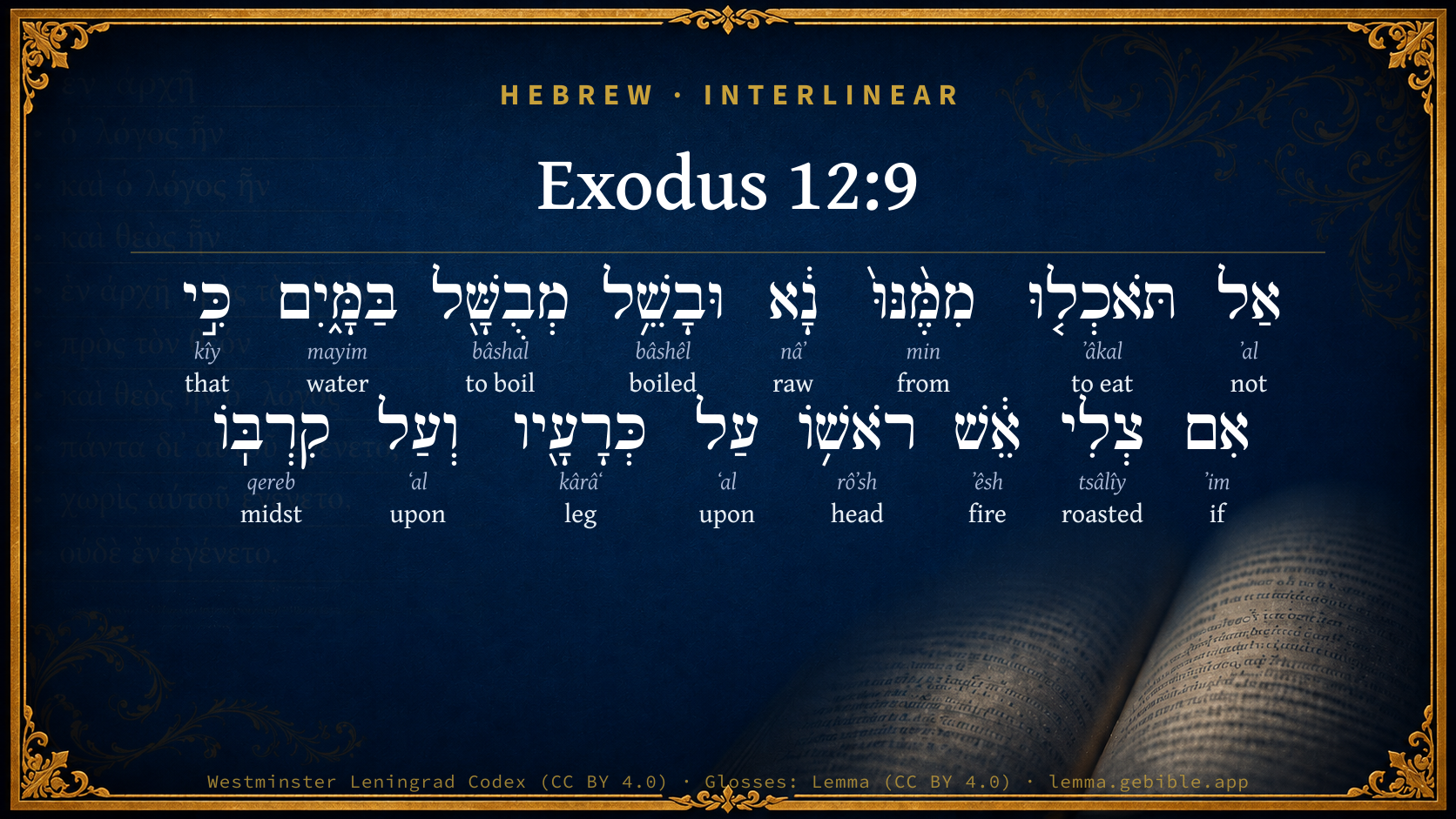
Hebrew (Westminster Leningrad Codex) Exodus 12:9 appears in the Hebrew Old Testament. The text above is from the Westminster Leningrad Codex. Each word links to its Strong’s number, a concise gloss, and parsing drawn from the Open Scriptures Hebrew Bible morphology. Click any word for its full Brown-Driver-Briggs (BDB) entry.
Download image
Cite this verse

Exodus 12:9 (World English Bible). Public Domain. Lemma interlinear Bible study tool, https://lemma.gebible.app/v/exodus/12/9.

Show BibTeX & RIS
BibTeX
RIS
English Translation
Don't eat it raw, nor boiled at all with water, but roasted with fire; with its head, its legs and its inner parts.
World English Bible · Public Domain
Highlights
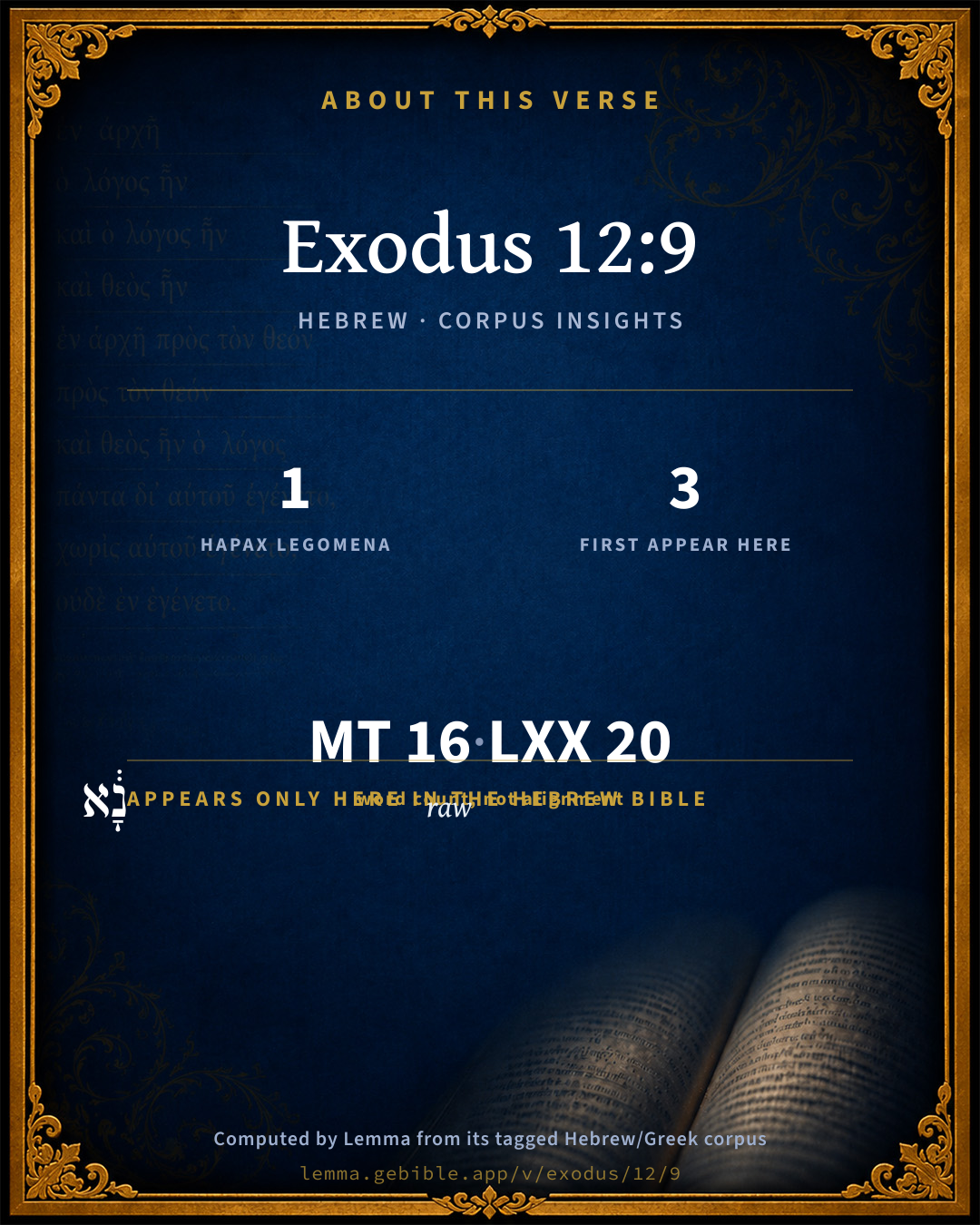
  • 1 hapax legomenon — only here in the Hebrew Bible
  • 3 first appearances in the Hebrew Bible
Full analysis ↓
Download a study sheet

One document with this verse’s original text, its word-by-word gloss line, the meaning frame, cross-references with their text, attributed commentary, and full source and license credits — printable, and it pastes into notes with its structure intact.

This verse Autodidact and up

Study sheet (.html) Plain text (.txt)

A passage Seminary Student

Up to 50 verses in one chapter. A passage sheet keeps up to 6 commentary sources and 12 cross-references per verse, in the order this page ranks them, and says so on the sheet whenever that leaves anything out. Ask for a single verse and you get the Autodidact verse sheet above.

Everything on this page stays free to read, with no account — the sheet is a download of what is already on screen, not access to it.

Want to remove ads? Support Godless Engineer
Compare translations 3

The same verse in 3 English versions, stacked beneath the original-language interlinear above. Click any original word for its lexicon entry.

Each is an independent rendering of the whole verse — the interlinear is not word-aligned to these translations.

Highlighted words mark where these versions differ — a whole-verse word diff, not a word-by-word alignment.

  • World English Bible Public Domain
    Don't eat it raw, nor boiled at all with water, but roasted with fire; with its head, its legs and its inner parts.
  • King James Version Public Domain
    Eat not of it raw, nor sodden at all with water, but roast with fire; his head with his legs, and with the purtenance thereof.
  • unfoldingWord Literal Text CC BY-SA 4.0
    You shall not eat from it raw or boiled from boiling in water. But instead, roasted of fire, its head with its legs and with its internal organs.

unfoldingWord Literal Text — © unfoldingWord, licensed CC BY-SA 4.0. Word-aligned USFM3 via Door43 (git.door43.org/unfoldingWord/en_ult).

Versions to compare (up to 4)

3 of 4 selected

Show all 18 translations

Every available English version of this verse, each an independent rendering of the whole verse.

  • World English Bible Public Domain
    Don't eat it raw, nor boiled at all with water, but roasted with fire; with its head, its legs and its inner parts.
  • Berean Standard Bible Public Domain
    Do not eat any of the meat raw or cooked in boiling water, but only roasted over the fire—its head and legs and inner parts.
  • Majority Standard Bible Public Domain
    Do not eat any of the meat raw or cooked in boiling water, but only roasted over the fire—its head and legs and inner parts.
  • King James Version Public Domain
    Eat not of it raw, nor sodden at all with water, but roast with fire; his head with his legs, and with the purtenance thereof.
  • American Standard Version (1901) Public Domain
    Eat not of it raw, nor boiled at all with water, but roast with fire; its head with its legs and with the inwards thereof.
  • Revised Version (1885) Public Domain
    Eat not of it raw, nor sodden at all with water, but roast with fire; its head with its legs and with the inwards thereof.
  • Geneva Bible (1599) Public Domain
    Eate not thereof rawe, boyled nor sodden in water, but rost with fire, both his head, his feete, and his purtenance.
  • Douay-Rheims (1899) Public Domain
    You shall not eat thereof any thing raw, nor boiled in water, but only roasted at the fire: you shall eat the head with the feet and entrails thereof.
  • Young's Literal Translation Public Domain
    ye do not eat of it raw, or boiled at all in water, but roast with fire, its head with its legs, and with its inwards;
  • Literal Standard Version CC BY-SA 4.0
    you do not eat of it raw, or boiled in water at all, but a roast with fire, its head with its legs, and with its innards;
  • Unlocked Literal Bible CC BY-SA 4.0
    Do not eat it raw or boiled in water. Instead, roast it over fire with its head, legs and inner parts.
  • unfoldingWord Literal Text CC BY-SA 4.0
    You shall not eat from it raw or boiled from boiling in water. But instead, roasted of fire, its head with its legs and with its internal organs.
  • Darby Bible Public Domain
    Ye shall eat none of it raw, nor boiled at all with water, but roast with fire; its head with its legs and with its in-wards.
  • World Messianic Bible Public Domain
    Don’t eat it raw, nor boiled at all with water, but roasted with fire; with its head, its legs and its inner parts.
  • Webster's Bible Public Domain
    Eat not of it raw, nor boiled at all with water, but roasted with fire; its head with its legs, and with its entrails.
  • Free Bible Version CC BY-SA 4.0
    You are not to eat the meat raw or boiled in water. All of it must be roasted over a fire, including the head, legs, and its insides.
  • Bible in Basic English Public Domain
    Do not take it uncooked or cooked with boiling water, but let it be cooked in the oven; its head with its legs and its inside parts.
  • JPS Tanakh (1917) Public Domain
    Eat not of it raw, nor sodden at all with water, but roast with fire; its head with its legs and with the inwards thereof.

Literal Standard Version (2020), Covenant Press — licensed CC BY-SA 4.0. Text via the HelloAO Bible API (eBible.org). Unlocked Literal Bible (unfoldingWord) — licensed CC BY-SA 4.0. Text via the HelloAO Bible API (eBible.org). unfoldingWord Literal Text — © unfoldingWord, licensed CC BY-SA 4.0. Word-aligned USFM3 via Door43 (git.door43.org/unfoldingWord/en_ult). Free Bible Version, Dr. Jonathan Gallagher — licensed CC BY-SA 4.0. Text via the HelloAO Bible API (eBible.org).

Word by word

More ways to search: Search by grammar → Find every occurrence → Compare this word →

Practice this passage: Drill this verse → Learn its vocabulary →

נָ֔א
nâʼ
H4995
“raw”
Particle, Exhortation
Part of Speech
Particle
Type
Exhortation
Full BDB Definition

Origin: apparently from H5106 in the sense of harshness from refusal

TWOT: 1358a

raw
  1. אַל ʼal H408 “not” Particle, Negative
  2. תֹּאכְל֤וּ ʼâkal H398 “to eat” Verb, Qal, Jussive, 2nd Person, Masculine, Plural
  3. מִמֶּ֨נּוּ֙ min H4480 “from · us” Preposition + Suffix, Personal, 1st Person, Common, Plural
  4. וּבָשֵׁ֥ל bâshêl H1311 “and · boiled” Conjunction + Adjective, Adjective, Masculine, Singular, Absolute
  5. מְבֻשָּׁ֖ל bâshal H1310 “boiled” Verb, Pual, Participle Passive, Masculine, Singular, Absolute
  6. בַּמָּ֑יִם mayim H4325 “in/at the · water(s)” Preposition, Determined + Noun, Common, Masculine, Plural, Absolute
  7. כִּ֣י kîy H3588 “that” Conjunction
  8. אִם ʼim H518 “if” Conjunction
  9. צְלִי tsâlîy H6748 “roasted of” Noun, Common, Masculine, Singular, Construct
  10. אֵ֔שׁ ʼêsh H784 “fire” Noun, Common, Both, Singular, Absolute
  11. רֹאשׁ֥וֹ rôʼsh H7218 “head · his” Noun, Common, Masculine, Singular, Construct + Suffix, Personal, 3rd Person, Masculine, Singular
  12. עַל ʻal H5921 “upon” Preposition
  13. כְּרָעָ֖יו kârâʻ H3767 “legs · his” Noun, Common, Both, Dual, Construct + Suffix, Personal, 3rd Person, Masculine, Singular
  14. וְעַל ʻal H5921 “and · upon” Conjunction + Preposition
  15. קִרְבּֽוֹ qereb H7130 “midst · his” Noun, Common, Masculine, Singular, Construct + Suffix, Personal, 3rd Person, Masculine, Singular

About this verse

These counts appear in no published source. They are computed here, from the morphology-tagged text and Lemma’s own curated glosses. What Lemma adds →

16
words
15
distinct lemmas
Pentateuch
section

Notable vocabulary

1 hapax legomenon — a word that appears only here in the entire Hebrew Bible:

First appearance in Scripture

These words make their first canonical appearance in the Hebrew Bible here:

  • נָ֔א raw H4995
  • וּבָשֵׁ֥ל boiled H1311
  • כְּרָעָ֖יו leg H3767

Shared distinctive vocabulary

וּבָשֵׁ֥ל boiled H1311 occurs in 2 verses of the Hebrew Bible. Also found in:

Grammatical profile

  • 2 verbs
  • 6 nouns
  • 1 adjective
  • 3 prepositions
  • 2 conjunctions
  • 2 particles

Verb forms

  • תֹּאכְל֤וּ Qal · Jussive
  • מְבֻשָּׁ֖ל Pual · Participle Passive

Repetition

A word recurs within this verse — often emphatic in Hebrew:

Hebrew & Septuagint length

In English translation the verse runs 23 words from the Hebrew and 24 from the Septuagint (LXX English) — closely comparable.

A rough comparison of the two English renderings, which tokenize alike — not a word-level alignment.

Word counts can differ between the Hebrew and the Greek without any difference in meaning — e.g. the Hebrew direct-object marker אֵת has no separate Greek word, and Greek often adds the article ὁ.

In the original languages it is 16 Hebrew tokens and 20 Greek tokens — but the two are counted differently (Hebrew bundles its prefixes and suffixes into one token; the Greek is in lemma form), so that isn’t a like-for-like length.

Cross-references

3

Topical passages linked to Exodus 12:9 in the Treasury of Scripture Knowledge — connected by theme and wording, ordered by reader-vote popularity; previews shown in the World English Bible.

  • Exodus 12:8 They shall eat the flesh in that night, roasted with fire, and unleavened bread. They shall eat it with bitter herbs.
  • Deuteronomy 16:7 You shall roast and eat it in the place which Yahweh your God shall choose: and you shall turn in the morning, and go to your tents.
  • Lamentations 1:13 From on high has he sent fire into my bones, and it prevails against them; He has spread a net for my feet, he has turned me back: He has made me desolate and faint all the day.

Cross-references courtesy of OpenBible.info (CC BY 4.0).

Hebrew and Greek witnesses Masoretic Hebrew ↔ Greek Septuagint

The same verse in the two great witnesses to the Old Testament, shown verse-for-verse.

These are two independent witnesses, not word-aligned to each other, and the Septuagint is shown in lemma (dictionary) form.

Hebrew Exodus 12:9 Masoretic · Westminster Leningrad Codex

אַל תֹּאכְל֤וּ מִמֶּ֨נּוּ֙ נָ֔א וּבָשֵׁ֥ל מְבֻשָּׁ֖ל בַּמָּ֑יִם כִּ֣י אִם צְלִי אֵ֔שׁ רֹאשׁ֥וֹ עַל כְּרָעָ֖יו וְעַל קִרְבּֽוֹ

Don't eat it raw, nor boiled at all with water, but roasted with fire; with its head, its legs and its inner parts.

World English Bible · Public Domain

Greek LXX Exodus 12:9 Septuagint · lemma form

οὐ ἐσθίω ἀπό αὐτός ὦμος οὐδέ ἕψω ἐν ὕδωρ ἀλλά ἤ ὀπτός πῦρ κεφαλή σύν ὁ πούς καί ὁ ἐνδόσθια

You⌃ shall not eat of it raw nor sodden in water, but only roast with fire, the head with the feet and the appurtenances.

LXX2012 (modern English Septuagint) · Public Domain

On this verse, Haydock's Catholic Bible Commentary discusses the Septuagint’s reading. Read the note in Commentary ↓

Hebrew: Westminster Leningrad Codex (CC BY 4.0). Greek: Septuagint (public domain); English from LXX2012 (modern English Septuagint) (Public Domain). How the Septuagint differs from the Hebrew →

Targum (Aramaic paraphrase)

2

The Targum is the ancient Jewish Aramaic paraphrase of the Hebrew Scriptures — an interpretive translation, not the Hebrew text itself. Onkelos (literal) and Pseudo-Jonathan (expansive) render the Torah, and Jonathan the Prophets. Coverage is partial: where no permissively-licensed English translation exists for a verse, only the Aramaic is shown. This is verse-level text, not a word-by-word alignment to the Hebrew.

  1. Targum Onkelos Torah (Genesis–Deuteronomy)
    לָא תֵיכְלוּן מִנֵהּ כַּד חַי וְאַף לָא בַשָׁלָא מְבֻשָׁל בְּמַיָא אֱלָהֵן טְוֵי נוּר רֵישֵׁיה עַל כְּרָעוֹהִי וְעַל גַוֵהּ:

    (no public-domain English translation for this verse)

    Targum Onkelos — Aramaic: “Onkelos Genesis” (public domain); “Onkelos Exodus” (public domain); “Onkelos Leviticus” (public domain); “Onkelos Numbers” (public domain); “Onkelos Deuteronomy” (public domain). English: “Sefaria Community Translation” (CC0 1.0 (public-domain dedication)); “J.W. Etheridge. The Targums of Onkelos and Jonathan Ben Uzziel on the Pentateuch. London: Longmans, Green, 1862” (public domain). Text via Sefaria.

  2. Targum Pseudo-Jonathan Torah (Genesis–Deuteronomy)
    לָא תֵיכְלוּן מִנֵיהּ כַּד חַי וְלָא כַּד בַּשְׁלָא בְּחַמְרָא וּמִשְׁחָא וְשַׁקְיָינֵי וְלָא מְבֻשָּׁל בְּמַיָא אֱלָהֵן טְוֵי נוּר עִם רֵישֵׁיהּ עִם רַגְלוֹי וְעִם גַּוֵּיהּ

    Eat not of it while living, neither boiled in wine, or oil, or other fluids, neither boiled in water, but roasted with fire, with its head, and its feet, and its inwards.

    Targum Pseudo-Jonathan — Aramaic: “Targum Jonathan on Genesis” (public domain); “Targum Jonathan on Exodus” (public domain); “Targum Jonathan on Leviticus” (public domain); “Targum Jonathan on Numbers” (public domain); “Targum Jonathan on Deuteronomy” (public domain). English: “The Targum of Jonathan ben Uzziel, trans. J. W. Etheridge, London, 1862” (public domain). Text via Sefaria.

Commentary

Notes on Exodus 12:9 from classic Christian and Jewish commentators (each source and its license shown beneath its notes). The classic Christian expositions comment on the surrounding passage and are grouped to its opening verse, so a note may address several verses; the Jewish commentaries on the Tanakh (Rashi and others) are per-verse, so they appear only where the commentator wrote on this verse.

Lemma curates 59 commentaries, every one of them public domain or Creative Commons licensed, each selected and text-cleaned for this edition rather than reprinted as found. About our sources →

Trapp's Complete Commentary

John Trapp

Exo 12:9 Eat not of it raw, nor sodden at all with water, but roast [with] fire; his head with his legs, and with the purtenance thereof.

Ver. 9. His head with his legs.] To let us see our need of whole Christ, and our most perfect communion with him.

John Trapp, A Commentary or Exposition upon All the Books of the Old and New Testament (1647–1656) — public domain. Text from a community e-Sword module.

Geneva Bible (1599)

Geneva Bible translators

That is, all that may be eaten.

Geneva Bible (1599) marginal notes — public domain. Text via Bolls.life.

Jamieson, Fausset & Brown

Robert Jamieson, A. R. Fausset & David Brown

Eat not of it raw--that is, with any blood remaining; a caveat against conformity to idolatrous practices. It was to be roasted whole, not a bone to be broken, and this pointed to Christ (Joh 19:36).

Jamieson, Fausset & Brown — Commentary Critical and Explanatory on the Whole Bible (1871) — public domain (CC PDM 1.0). Text via the HelloAO Bible API.

Adam Clarke's Commentary

Verse 9. With the purtenance thereof.] All the intestines, for these were abused by the heathens to purposes of divination; and when roasted in the manner here directed they could not be thus used. The command also implies that the lamb was to be roasted whole; neither the head or legs were to be separated, nor the intestines removed. I suppose that these last simply included the heart, lungs, liver, kidneys, &c., and not the intestinal canal.

Adam Clarke's Commentary on the Bible (1810–1826) — public domain. Text from a community e-Sword/MySword module.

Ellicott's Commentary for English Readers

(9) His head with his legs . . . —The lamb was to be roasted whole: “not a bone of it was to be broken” (Exo_12:46). Justin Martyr says that it was prepared for roasting by means of two wooden spits, one perpendicular and the other transverse, which extended it on a sort of cross, and made it aptly typify the Crucified One.

The purtenance thereof.—Heb., its inside. The entrails were taken out, carefully cleansed, and then replaced.

A Bible Commentary for English Readers, edited by Charles John Ellicott (1878–1897) — public domain. Text from a community e-Sword module.

The Cambridge Bible for Schools and Colleges

gen. ed. J. J. S. Perowne

9. Eat not of it raw] lest the blood should be eaten at the same time, against the standing prohibition, Lev_7:26 f., Exo_17:10-12, &c.

nor boiled at all with water] Sacrifices partaken of by the worshipper are elsewhere regularly represented as boiled: see (in P) Exo_29:31, Lev_6:28; Lev_8:31, Num_6:19; cf. also Exo 1Sa_2:15, Zec_14:21, and the ‘boiling-places’ in Ezekiel’s restored Temple, Eze_46:20; Eze_46:24 : there must thus be some reason for roasting being here so emphatically enjoined. What the reason was must remain matter of conjecture. Di. thinks that it was because in this case the fat (which might not be eaten, Lev_3:17; Lev_7:23-25, and had not, as in the case of the peace-offering, been removed previously, and burnt upon the altar, Lev_3:3-5; Lev_3:9-11; Lev_3:14-16) might drip down and be consumed in the fire. G. F. Moore, art. Sacrifice in EB. iv. 4187, thinks it a survival of archaic usage. ‘In the earliest times the carcase of the victim was probably roasted whole either over an open fire, or in a pit in the earth (as by the modern Samaritans), and the flesh sometimes eaten half raw or merely softened by fire. Deu_16:7 (see RVm.) prescribes that it shall be boiled, like other sacrifices partaken of by the worshipper. This, however, did not prevail; and P preserves the primitive custom.’

its head with, &c.] i.e. it is not to be divided (like the burnt-offering, for instance, Exo_29:17, Lev_1:8-9), but to be roasted whole (cf. v. 46).

The Cambridge Bible for Schools and Colleges (gen. ed. J. J. S. Perowne; Cambridge University Press, 1878–1918) — public domain. Text from a community e-Sword module.

John Gill's Exposition

Eat not of it raw,.... Not roasted enough; and so Jarchi says, that what is not sufficiently roasted, or is not thoroughly and down roasted, is in the Arabic language called (u), the word here used; and so Maimonides (w) says it signifies flesh, on which the fire begins to operate, and is roasted a little, but not enough for eating. And indeed there seems to be no necessity of a prohibition of eating the flesh quite raw: some (x) derive the word from a root which signifies to break, and suppose that this rule forbids the breaking or cutting it in pieces; that as it was to be roasted whole, and not a bone of it to be broken, so it was to be brought to table whole, and the whole to be eaten; but then it could not be eaten without being cut to pieces. Abarbinel (y) takes the word in the usual signification of it, "now", as if the sense was, ye shall not eat of it now, not before the evening of the fourteenth day; but whereas Moses had told them, Exo 12:6, that the lamb was to be kept up until the fourteenth day, it was needless to tell them that they should not eat it now or immediately; the first sense is best, and this shows that Christ, the antitype of this lamb, is not to be eaten in a carnal but spiritual manner, of which our Lord treats in Joh 6:31, nor sodden at all with water; the Targum of Jonathan is,"neither boiled in wine, nor in oil, nor in other liquor, nor boiled in water.''This, with respect to the antitype, shows, that Christ is not to be received in a cold lukewarm manner, and with indifference; and that nothing is to be mixed, added, and joined unto him, but he alone is to be regarded in the business of our acceptance, justification, and salvation:

but roast with fire; for the reasons before given: the manner of roasting it, according to the Jewish canons (z), was this, they bring a spit made of the wood of pomegranate, and thrust it into its mouth quite through it, and put the thighs and entrails within it; they do not roast the passover lamb on an iron spit, nor on an iron grate. Maimonides (a) is a little more particular and exact in his account; to the question, how do they roast it? he replies,"they transfix it through the middle of the mouth to its posteriors, with a wooden spit, and they hang it in the midst of a furnace, and the fire below:''so that it was not turned upon a spit, according to our manner of roasting, but was suspended on a hook, and roasted by the fire underneath, and so was a more exact figure of Christ suspended on the cross, and enduring the fire of divine wrath. And Justin Martyr (b) is still more particular, who was by birth a Samaritan, and was well versed in Jewish affairs; he, even in conversing with Trypho the Jew, who could have contradicted him had he said what was wrong, says, the lamb was roasted in the form of a cross; one spit, he says, went through from the lower parts to the head, and again another across the shoulders, to which the hands (or rather the legs) of the lamb were fastened and hung; and so was a very lively emblem of Christ crucified:

his head, with his legs, and with the purtenance thereof; or with its inwards (c), these were all to be roasted together, the whole lamb with all that belonged to it, with which the above canon of the Jews agrees.

(u) "cruda fuit caro", Golius, col. 2476. Semicocta, "cruda fuit caro", Castell. Lex. col. 2296. Vid. Hottinger. Smegma Oriental. p. 169, 170. (w) Hilchot Korban Pesach. c. 8. sect. 6. (x) Oleaster apud Rivet in loc. Gusset. Comment. Ebr. p. 487, 488; so some in Aben Ezra. (y) So Marinus Brixianus in Arca Noe. (z) Misn. Pesach. c. 7. sect. 1, 2. (a) Hilchot Korban Pesach. c. 8. sect. 10. (b) Dialog. cum Trypho Jud. p. 259. (c) "et cum interioribus ejus", Pagninus, Tigurine version, so Junius & Tremellius, Piscator.

John Gill's Exposition of the Whole Bible (1746–1763) — public domain (CC PDM 1.0). Text via the HelloAO Bible API.

Albert Barnes' Notes on the Bible

Raw - i. e. “half-cooked.”

Sodden ... with water - It was probably more common to seethe meat than to roast meat; hence, the regrets expressed by the Israelites for the seething pots of Egypt.

The purtenance thereof - or its intestines. This verse directs that the lamb should be roasted and placed on the table whole. No bone was to be broken (see Exo 12:46, and margin reference). The bowels were taken out, washed and then replaced. The Talmud prescribes the form of the oven of earthenware, in which the lamb was roasted, open above and below with a grating for the fire. Lambs and sheep are roasted whole in Persia, nearly in the same manner.

This entire consumption of the lamb constitutes one marked difference between the Passover and all other sacrifices, in which either a part or the whole was burned, and thus offered directly to God. The whole substance of the sacrificed lamb was to enter into the substance of the people, the blood only excepted, which was sprinkled as a propitiatory and sacrificial offering. Another point of subordinate importance is noticed. The lamb was slain and the blood sprinkled by the head of each family: no separate priesthood as yet existed in Israel; its functions belonged from the beginning to the father of the family: when the priesthood was instituted the slaying of the lamb still devolved on the heads of families, though the blood was sprinkled on the altar by the priests; an act which essentially belonged to their office. The typical character of this part of the transaction is clear. Our Lord was offered and His blood shed as an expiatory and propitiatory sacrifice, but His whole Humanity is transfused spiritually and effectually into His Church, an effect which is at once symbolized and assured in holy communion, the Christian Passover.

Albert Barnes' Notes on the Bible (1834–1885) — public domain. Text from a community e-Sword/MySword module.

Haydock's Catholic Bible Commentary

Raw. Some nations delighted in raw flesh, in the feasts of Bacchus, who hence received the title of Omadios. (Porphyrius, de Abstin. 3.) The Hebrew term na occurs no where else, and may perhaps signify half-roasted or boiled, semicoctum. It cannot be inferred from this prohibition, that the Hebrews commonly lived on such food. --- In water, as the other victims usually were. (1 Kings ii. 13; 2 Paralipomenon xxxv. 13.) --- You shall eat, is not in the original, nor in the Septuagint. We may supply it, however, or "you shall roast all, head," &c., but in eating, you shall avoid breaking any bone, as the Septuagint and Syriac express it, (ver. 10,) and as we read, ver. 46, and Numbers ix. 12. These were to be burnt, that they might not be profaned. (Calmet)

George Leo Haydock (1774–1849), Haydock's Catholic Family Bible and Commentary, 1859 edition — public domain. Excludes Psalms (Douay-Rheims chapter numbering differs from Protestant) and Deuterocanonical books (Catholic canon only).

Matthew Poole's English Annotations

Eat not of it raw, i.e. not thoroughly roasted, for such we also say is raw and so the Hebrew word נא is understood by the Jewish and other doctors. It signified that Christ should suffer, as well as save, to the uttermost, all that was done for our sins.

The purtenance; Heb. the inwards, which were to be taken and washed, and then to be roasted together with the rest. So do here except the fat, and caul, and kidneys which were reserved by God for himself, 2Ch 35:12,4. But that exception was not made till after this time, and it seems not certain that that exception extended to the paschal lamb. These and the heads and legs are here mentioned, not to exclude other parts, but because they are not commonly roasted; but God would have the whole lamb roasted and eaten, to signify that we must have either nothing of Christ, or the whole Christ, and all his benefits, hist Spirit to sanctify and rule us, as well as his blood to save us.

Matthew Poole's English Annotations on the Holy Bible (1683–1685) — public domain. Text from a community e-Sword/MySword module.

The Pulpit Commentary

Eat not of it raw. The injunction appears to moderns superfluous; but a wjmofagia, or eating of the raw flesh of victims sacrificed, seems to have been practised by several heathen nations in ancient times, more especially in the worship of Dionysus or Bacchus. Its head with its legs. The lamb was to be roasted whole according to some, as a symbol of the unity of Israel, and especially of the political unit which they were to become so soon as they quitted Egypt; but, as we learn from St. John, (Joh_19:36) still more to prefigure the unbroken body of Him whom the lamb especially represented, the true propitiation and atonement and deliverer of His people from the destroyer, our Lord Jesus Christ. The purtenance thereof. Rather, "the intestines thereof." The Jewish commentators say that the intestines were first taken out, washed, and cleansed, after which they were replaced, and the lamb roasted in a sort of oven.

The Pulpit Commentary (1880–1919), ed. H.D.M. Spence-Jones & Joseph S. Exell — public domain. Text from a community e-Sword module.

John Wesley's Explanatory Notes

Raw - Half roasted, but throughly drest.

John Wesley, Explanatory Notes Upon the Whole Bible (1754–1765) — public domain. Text via the GEBible commentary corpus.

unfoldingWord translationNotes

Door43 World Missions Community

Do not eat it raw

"Do not eat the lamb or goat uncooked"

You must not let any of it be left over until morning

This can be stated in active form. AT: "Do not leave any of it until the morning" (See: Active or Passive)

belt

This refers to a strip of leather or fabric for tying around the waist.

eat it hurriedly

"eat it quickly"

It is Yahweh's Passover

Here the word "it" refers to eating the animal on the tenth day of the month. AT: "This observance is Yahweh's Passover" (See: Assumed Knowledge and Implicit Information)

translationWords

staff

Passover

unfoldingWord translationNotes — © Distant Shores Media and the Door43 World Missions Community, licensed CC BY-SA 4.0. Source: git.door43.org/Door43/en_tn.

Rashi

Rabbi Shlomo Yitzchaki (Rashi)

אל תאכלו ממנו נא DO NOT EAT OF IT HALF-DONE — flesh that is not roasted as much as it should be is called נא in the Arabic language (cf. Pesachim 41a).

ובשל מבשל NOR SODDEN AT ALL — All this belongs to the prohibition, “Do not eat of it” (The text is, therefore, to be translated as above, and not: Do not eat of it half done, but boiled etc. The words אל תאכלו are to be supplied before בשל and כי אם צלי אש) (Pesachim 41b).

במים [BOILED] IN WATER — Whence may it be deduced that this prohibition extends to other liquids also? Because Scripture states here ובשל מבשל, “or boiled at all” (Pesachim 41a.).

כי אם צלי אש BUT ROAST WITH FIRE — Above (in the preceding verse) Scripture promulgates the law regarding this in the form of an affirmative command; here it adds to that a negative command: Do not eat of it … except roasted by fire. (Consequently one who eats of it in in any manner except roasted by fire is liable to the punishment laid down for transgressing a negative command as well as to that for the infringement of a positive command) (Pesachim 41b).

ראשו על כרעיו ITS HEAD WITH ITS LEGS — One roasts it all in one, with its head and with its legs and with its inward parts, and one places its entrails inside it after having rinsed them (Pesachim 74a). The expression על קרבו, is like the expression, (Exodus 6:26) “על צבאותם”, which is the same as בצבאותם, “with their hosts”, which means, “just as they are” (every one of the Israelites). So, too, this phrase means: they shall roast the flesh just as it is — all its flesh, whole.

Rashi on the Tanakh — English translations: “The Judaica Press complete Tanach with Rashi, translated by A. J. Rosenberg” (CC BY 4.0); “Pentateuch with Rashi's commentary by M. Rosenbaum and A.M. Silbermann, 1929-1934” (public domain); “The Metsudah Tanach series, Lakewood, N.J” (CC BY 4.0); and “The Book of Joshua, Metsudah Publications, 1997” (CC BY 4.0). Text via Sefaria.

Ramban (Nachmanides)

Rabbi Moshe ben Nachman (Ramban / Nachmanides)

EAT NOT OF IT RAW, NOR SODDEN AT ALL WITH WATER. This commandment applies for all generations [and not merely for the Passover at the time of the exodus], for all commandments here relate to the body of the Passover-offering and therefore apply for all times. But the commandments concerning those that eat thereof — such as your loins girded, etc., and the blood which is to be on the lintel — apply only to the Passover of Egypt. And so Scripture says concerning the second Passover-offering: They shall eat it with unleavened bread and bitter herbs; They shall leave none of it unto the morning, nor break a bone thereof; according to all the statute of the Passover they shall keep it. [The expression, according to all the statute, etc.], refers to the law of roasting with fire, and that it is not to be eaten either raw or sodden..

Ramban (Nachmanides) on the Tanakh — English translation: “Commentary on the Torah by Ramban (Nachmanides). Translated and annotated by Charles B. Chavel. New York, Shilo Pub. House, 1971-1976” (CC BY 4.0). Text via Sefaria.

Lesson kit

Teaching starters — assembled from the data on this page, not authored interpretation. Every prompt links to the verse data it draws on. Edit before teaching.

Exodus, in the Pentateuch, opens this verse with 16 words (15 distinct Hebrew lemmas). Its most distinctive word is nâʼ (“raw”). A historical commentator’s framing appears above. Read the whole chapter for the surrounding context.

Discussion questions

  1. What does “raw” (nâʼ) contribute to the verse as a whole?
  2. This verse holds 1 word here found nowhere else in the Hebrew Bible. What might the rare word draw attention to?
  3. 3 words here appear for the first time in Scripture. What is being introduced at this debut?
  4. Numbers 6:19 shares the word «boiled» with this verse. How do the two illuminate each other?
  5. “upon” occurs 2× in this one verse. What is the effect of the repetition?
  6. These translations render this verse differently. What is at stake in choosing one wording over another?
  7. The verb «תֹּאכְל֤וּ» is Qal Jussive. How does its form color the action?
  8. Reading how Trapp's Complete Commentary and Geneva Bible (1599) read this verse, where do the two commentators agree and where do they part?

Things to notice

  • 1 word in this verse appears nowhere else in the Hebrew Bible.
  • 3 words make their first canonical appearance in Scripture here.
  • This verse counts 16 Hebrew ↔ 20 Greek words.
  • These translations choose different wording for 16 words in this verse.
  • “upon” occurs 2× in this single verse.

Reading settings

Reading text

Shown beneath each verse's original-language words.

Old Testament
Old Testament edition

Read the OT as the Masoretic Hebrew (MT) or the Greek Septuagint (LXX).

English shown for the Greek Septuagint (in the Hebrew ↔ Greek comparison).

Comparing translations? Open the Compare panel on any verse page to stack up to four side by side.