1 Samuel 1:16

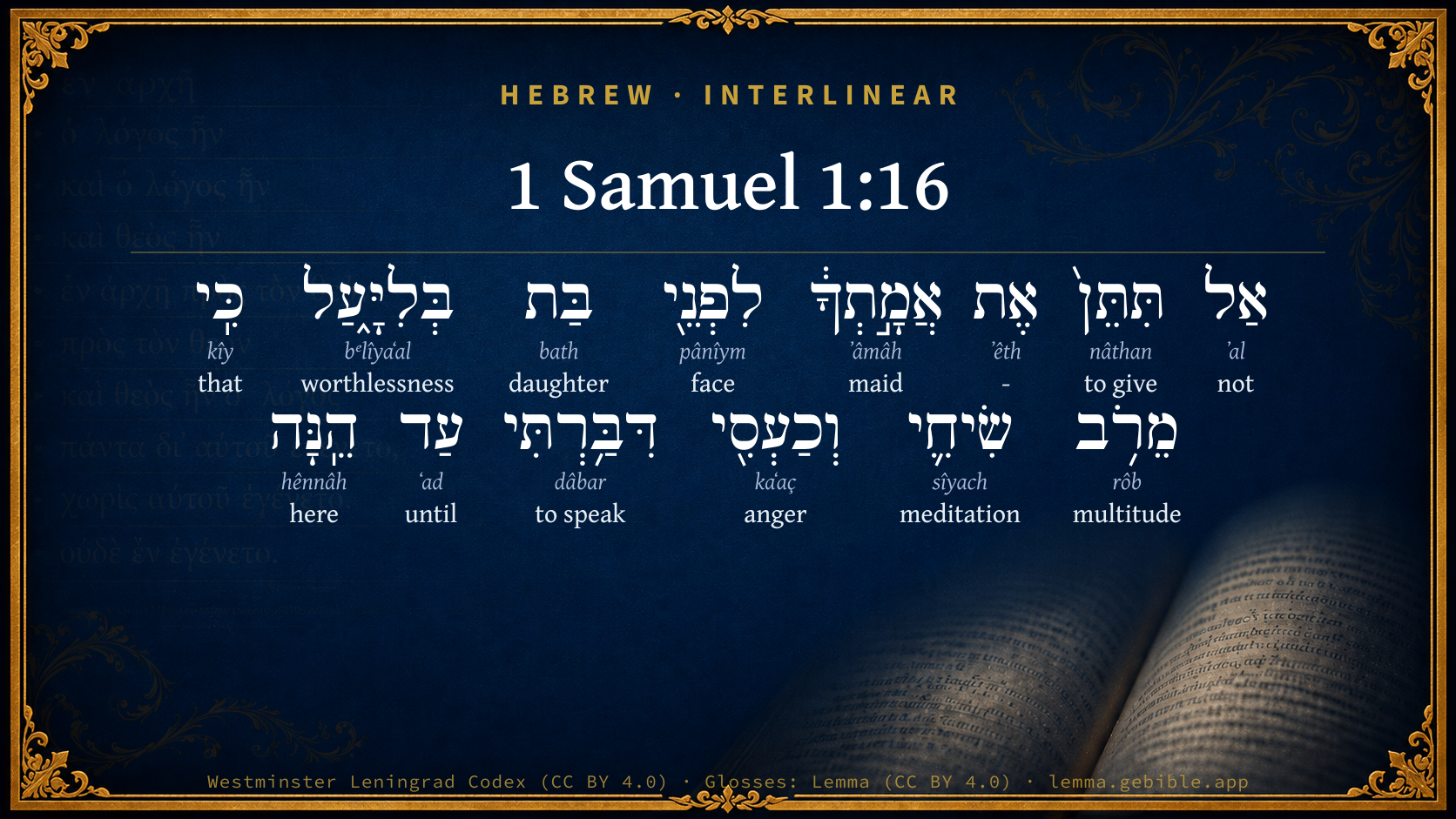
Hebrew (Westminster Leningrad Codex) 1 Samuel 1:16 appears in the Hebrew Old Testament. The text above is from the Westminster Leningrad Codex. Each word links to its Strong’s number, a concise gloss, and parsing drawn from the Open Scriptures Hebrew Bible morphology. Click any word for its full Brown-Driver-Briggs (BDB) entry.
Download image
Cite this verse

1 Samuel 1:16 (World English Bible). Public Domain. Lemma interlinear Bible study tool, https://lemma.gebible.app/v/1-samuel/1/16.

Show BibTeX & RIS
BibTeX
RIS
English Translation
Don't count your handmaid for a wicked woman; for out of the abundance of my complaint and my provocation have I spoken hitherto.
World English Bible · Public Domain
Highlights
  • 1 first appearance in the Hebrew Bible
Full analysis ↓
Download a study sheet

One document with this verse’s original text, its word-by-word gloss line, the meaning frame, cross-references with their text, attributed commentary, and full source and license credits — printable, and it pastes into notes with its structure intact.

This verse Autodidact and up

Study sheet (.html) Plain text (.txt)

A passage Seminary Student

Up to 50 verses in one chapter. A passage sheet keeps up to 6 commentary sources and 12 cross-references per verse, in the order this page ranks them, and says so on the sheet whenever that leaves anything out. Ask for a single verse and you get the Autodidact verse sheet above.

Everything on this page stays free to read, with no account — the sheet is a download of what is already on screen, not access to it.

Want to remove ads? Support Godless Engineer
Compare translations 3

The same verse in 3 English versions, stacked beneath the original-language interlinear above. Click any original word for its lexicon entry.

Each is an independent rendering of the whole verse — the interlinear is not word-aligned to these translations.

Highlighted words mark where these versions differ — a whole-verse word diff, not a word-by-word alignment.

  • World English Bible Public Domain
    Don't count your handmaid for a wicked woman; for out of the abundance of my complaint and my provocation have I spoken hitherto.
  • King James Version Public Domain
    Count not thine handmaid for a daughter of Belial: for out of the abundance of my complaint and grief have I spoken hitherto.
  • unfoldingWord Literal Text CC BY-SA 4.0
    Do not give your female servant to the face of a daughter of wickedness. For from the abundance of my complaint and my provocation I have been speaking until now.”

unfoldingWord Literal Text — © unfoldingWord, licensed CC BY-SA 4.0. Word-aligned USFM3 via Door43 (git.door43.org/unfoldingWord/en_ult).

Versions to compare (up to 4)

3 of 4 selected

Show all 18 translations

Every available English version of this verse, each an independent rendering of the whole verse.

  • World English Bible Public Domain
    Don't count your handmaid for a wicked woman; for out of the abundance of my complaint and my provocation have I spoken hitherto.
  • Berean Standard Bible Public Domain
    Do not take your servant for a wicked woman; for all this time I have been praying out of the depth of my anguish and grief.”
  • Majority Standard Bible Public Domain
    Do not take your servant for a wicked woman, for all this time I have been praying out of the depth of my anguish and grief.”
  • King James Version Public Domain
    Count not thine handmaid for a daughter of Belial: for out of the abundance of my complaint and grief have I spoken hitherto.
  • American Standard Version (1901) Public Domain
    Count not thy handmaid for a wicked woman; for out of the abundance of my complaint and my provocation have I spoken hitherto.
  • Revised Version (1885) Public Domain
    Count not thine handmaid for a daughter of Belial: for out of the abundance of my complaint and my provocation have I spoken hitherto.
  • Geneva Bible (1599) Public Domain
    Count not thine handmaide for a wicked woman: for of the abundance of my complaint and my griefe haue I spoken hitherto.
  • Douay-Rheims (1899) Public Domain
    Count not thy handmaid for one of the daughters of Belial: for out of the abundance of my sorrow and grief have I spoken till now.
  • Young's Literal Translation Public Domain
    put not thy handmaid before a daughter of worthlessness, for from the abundance of my meditation, and of my provocation, I have spoken hitherto.'
  • Literal Standard Version CC BY-SA 4.0
    do not put your handmaid before a daughter of worthlessness, for from the abundance of my meditation, and of my provocation, I have spoken until now.”
  • Unlocked Literal Bible CC BY-SA 4.0
    Do not consider your servant to be a shameless woman; I have been speaking out of the abundance of my great concern and provocation.”
  • unfoldingWord Literal Text CC BY-SA 4.0
    Do not give your female servant to the face of a daughter of wickedness. For from the abundance of my complaint and my provocation I have been speaking until now.”
  • Darby Bible Public Domain
    Take not thy handmaid for a daughter of Belial: for out of the abundance of my grief and provocation have I spoken hitherto.
  • World Messianic Bible Public Domain
    Don’t consider your servant a wicked woman; for I have been speaking out of the abundance of my complaint and my provocation.”
  • Webster's Bible Public Domain
    Count not thy handmaid for a daughter of Belial: for out of the abundance of my complaint and grief have I spoken hitherto.
  • Free Bible Version CC BY-SA 4.0
    Please don't think I'm a bad woman! I have been praying because of all my troubles and grief.”
  • Bible in Basic English Public Domain
    Do not take your servant to be a good-for-nothing woman: for my words have come from my stored-up sorrow and pain.
  • JPS Tanakh (1917) Public Domain
    Count not thy handmaid for a wicked woman: for out of the abundance of my complaint and my vexation have I spoken hitherto.'

Literal Standard Version (2020), Covenant Press — licensed CC BY-SA 4.0. Text via the HelloAO Bible API (eBible.org). Unlocked Literal Bible (unfoldingWord) — licensed CC BY-SA 4.0. Text via the HelloAO Bible API (eBible.org). unfoldingWord Literal Text — © unfoldingWord, licensed CC BY-SA 4.0. Word-aligned USFM3 via Door43 (git.door43.org/unfoldingWord/en_ult). Free Bible Version, Dr. Jonathan Gallagher — licensed CC BY-SA 4.0. Text via the HelloAO Bible API (eBible.org).

Word by word

More ways to search: Search by grammar → Find every occurrence → Compare this word →

Practice this passage: Drill this verse → Learn its vocabulary →

שִׂיחִ֛י
sîyach
H7879
“meditation · my”
Noun, Common, Masculine, Singular, Construct + Suffix, Personal, 1st Person, Common, Singular
Part of Speech
Noun
Type
Common
Gender
Masculine
Number
Singular
State
Construct
Full BDB Definition

Origin: from H7878

TWOT: 2255a

meditation, complaint, musing - plaint, complaint - following are dubious - musing - anxiety, trouble - talk
  1. אַל ʼal H408 “not” Particle, Negative
  2. תִּתֵּן֙ nâthan H5414 “to give” Verb, Qal, Jussive, 2nd Person, Masculine, Singular
  3. אֶת ʼêth H853 “-” Particle, Direct Object
  4. אֲמָ֣תְךָ֔ ʼâmâh H519 “maid · your” Noun, Common, Feminine, Singular, Construct + Suffix, Personal, 2nd Person, Masculine, Singular
  5. לִפְנֵ֖י pânîym H6440 “to/for · face(s) of” Preposition + Noun, Common, Both, Plural, Construct
  6. בַּת bath H1323 “daughter of” Noun, Common, Feminine, Singular, Construct
  7. בְּלִיָּ֑עַל bᵉlîyaʻal H1100 “worthlessness” Noun, Common, Masculine, Singular, Absolute
  8. כִּֽי kîy H3588 “that” Conjunction
  9. מֵרֹ֥ב rôb H7230 “from · multitude of” Preposition + Noun, Common, Both, Singular, Construct
  10. וְכַעְסִ֖י kaʻaç H3708 “and · anger · my” Conjunction + Noun, Common, Masculine, Singular, Construct + Suffix, Personal, 1st Person, Common, Singular
  11. דִּבַּ֥רְתִּי dâbar H1696 “to speak” Verb, Piel, Perfect, 1st Person, Common, Singular
  12. עַד ʻad H5704 “until” Preposition
  13. הֵֽנָּה hênnâh H2008 “here” Adverb

About this verse

These counts appear in no published source. They are computed here, from the morphology-tagged text and Lemma’s own curated glosses. What Lemma adds →

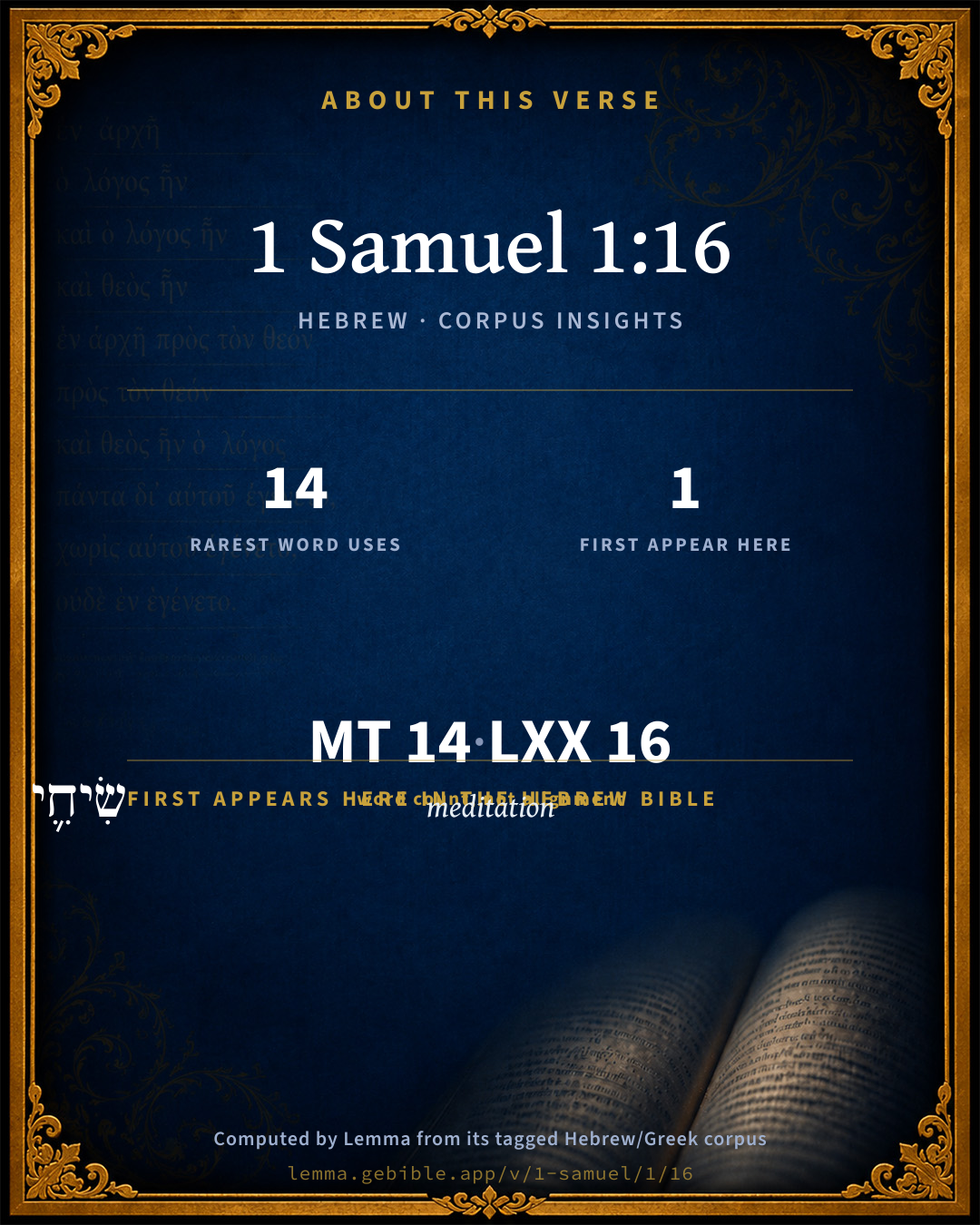
14
words
14
distinct lemmas
Historical
section

Notable vocabulary

The rarest word here is שִׂיחִ֛י meditation H7879 — appearing just 14 times in the whole Hebrew Bible.

First appearance in Scripture

This word makes its first canonical appearance in the Hebrew Bible here:

  • שִׂיחִ֛י meditation H7879

Shared distinctive vocabulary

שִׂיחִ֛י meditation H7879 occurs in 14 verses of the Hebrew Bible. Also found in:

Grammatical profile

  • 2 verbs
  • 7 nouns
  • 1 preposition
  • 1 conjunction
  • 1 adverb
  • 2 particles

Verb forms

  • תִּתֵּן֙ Qal · Jussive
  • דִּבַּ֥רְתִּי Piel · Perfect

Hebrew & Septuagint length

In English translation the verse runs 23 words from the Hebrew and 24 from the Septuagint (LXX English) — closely comparable.

A rough comparison of the two English renderings, which tokenize alike — not a word-level alignment.

Word counts can differ between the Hebrew and the Greek without any difference in meaning — e.g. the Hebrew direct-object marker אֵת has no separate Greek word, and Greek often adds the article ὁ.

In the original languages it is 14 Hebrew tokens and 16 Greek tokens — but the two are counted differently (Hebrew bundles its prefixes and suffixes into one token; the Greek is in lemma form), so that isn’t a like-for-like length.

Cross-references

7

Topical passages linked to 1 Samuel 1:16 in the Treasury of Scripture Knowledge — connected by theme and wording, ordered by reader-vote popularity; previews shown in the World English Bible.

  • 1 Samuel 2:12 Now the sons of Eli were base men; they didn't know Yahweh.
  • Job 6:2–3 "Oh that my anguish were weighed, And all my calamity laid in the balances!
  • Job 10:1–2 "My soul is weary of my life; I will give free course to my complaint. I will speak in the bitterness of my soul.
  • Matthew 12:34–35 You offspring of vipers, how can you, being evil, speak good things? For out of the abundance of the heart, the mouth speaks.
  • Deuteronomy 13:13 Certain base fellows are gone out from the midst of you, and have drawn away the inhabitants of their city, saying, Let us go and serve other gods, which you have not known;
  • 1 Samuel 10:27 But certain worthless fellows said, How shall this man save us? They despised him, and brought him no present. But he held his peace.
  • 1 Samuel 25:25 Please don't let my lord regard this worthless fellow, even Nabal; for as his name is, so is he; Nabal is his name, and folly is with him: but I your handmaid didn't see the young men of my lord, whom you did send.

Cross-references courtesy of OpenBible.info (CC BY 4.0).

Hebrew and Greek witnesses Masoretic Hebrew ↔ Greek Septuagint

The same verse in the two great witnesses to the Old Testament, shown verse-for-verse.

These are two independent witnesses, not word-aligned to each other, and the Septuagint is shown in lemma (dictionary) form.

Hebrew 1 Samuel 1:16 Masoretic · Westminster Leningrad Codex

אַל תִּתֵּן֙ אֶת אֲמָ֣תְךָ֔ לִפְנֵ֖י בַּת בְּלִיָּ֑עַל כִּֽי מֵרֹ֥ב שִׂיחִ֛י וְכַעְסִ֖י דִּבַּ֥רְתִּי עַד הֵֽנָּה

Don't count your handmaid for a wicked woman; for out of the abundance of my complaint and my provocation have I spoken hitherto.

World English Bible · Public Domain

Greek LXX 1 Samuel 1:16 Septuagint · lemma form

μή δίδωμι ὁ δούλη σύ εἰς θυγάτηρ λοιμός ὅτι ἐκ πλῆθος ἀδολεσχία ἐγώ ἐκτείνω ἕως νῦν

Count not your handmaid for a pestilent woman, for by reason of the abundance of my importunity I have continued my prayer until now.

LXX2012 (modern English Septuagint) · Public Domain

On this verse, Haydock's Catholic Bible Commentary discusses the Septuagint’s reading. Read the note in Commentary ↓

Hebrew: Westminster Leningrad Codex (CC BY 4.0). Greek: Septuagint (public domain); English from LXX2012 (modern English Septuagint) (Public Domain). How the Septuagint differs from the Hebrew →

Targum (Aramaic paraphrase)

1

The Targum is the ancient Jewish Aramaic paraphrase of the Hebrew Scriptures — an interpretive translation, not the Hebrew text itself. Onkelos (literal) and Pseudo-Jonathan (expansive) render the Torah, and Jonathan the Prophets. Coverage is partial: where no permissively-licensed English translation exists for a verse, only the Aramaic is shown. This is verse-level text, not a word-by-word alignment to the Hebrew.

  1. Targum Jonathan Prophets (Joshua–Malachi)
    לָא תַכְלִים יַת אַמְתָךְ קֳדָם בַּת רִשְׁעָא אֲרֵי מִסְגֵי אַקְנָיוּתִי וְאַרְגִיזוּתִי אוֹרְכִית בִּצְלוֹ עַד כְּעַן:

    (no public-domain English translation for this verse)

    Targum Jonathan — Aramaic: “Mikraot Gedolot” (public domain). English: “Sefaria Community Translation” (CC0 1.0 (public-domain dedication)); “London "Chaldee Paraphrase," 1871” (public domain). Text via Sefaria.

Commentary

Notes on 1 Samuel 1:16 from classic Christian and Jewish commentators (each source and its license shown beneath its notes). The classic Christian expositions comment on the surrounding passage and are grouped to its opening verse, so a note may address several verses; the Jewish commentaries on the Tanakh (Rashi and others) are per-verse, so they appear only where the commentator wrote on this verse.

Lemma curates 59 commentaries, every one of them public domain or Creative Commons licensed, each selected and text-cleaned for this edition rather than reprinted as found. About our sources →

Trapp's Complete Commentary

John Trapp

1Sa 1:16 Count not thine handmaid for a daughter of Belial: for out of the abundance of my complaint and grief have I spoken hitherto.

Ver. 16. Count not thine handmaid for a daughter of Belial.] That is, Of the devil, as all drunkards are confessedly. Behemoth lieth in the fens, {Job 40:21} which Gul. Parisiensis applieth to the devil dwelling in drunken hearts. See Luk 11:24. Oh that our carousers were persuaded, as Mohammed told his followers, that in every grape there dwelt a devil!

For out of the abundance of my complaint and grief.] Not of wine, or any other inebriating liquor, whereof the Italians, besides wine, have many sorts: the most delicious they blasphemously call Lachrymae Christi. If Hannah were drunk at all, it was with her own tears, which she, poor soul, had drunk in great abundance.

John Trapp, A Commentary or Exposition upon All the Books of the Old and New Testament (1647–1656) — public domain. Text from a community e-Sword module.

Joseph Benson's Commentary

1Sa 1:16. Count not thy handmaid for a daughter of Belial, &c. — A Scripture phrase for a wicked person. Thus, when we are unjustly censured, we should endeavour not only to clear ourselves, but to satisfy our brethren, by giving them a just and true account of what they misapprehended.

Joseph Benson's Commentary on the Old and New Testaments (1811–1818) — public domain. Text from a community e-Sword module.

Tyndale Open Study Notes

Tyndale Open Resources

1:16 wicked woman (Hebrew a daughter of Belial): An expression used to describe a worthless person. Belial (“worthlessness”) is later used as a name for Satan (2 Cor 6:15). In Hebrew, a son of or daughter of a quality is a person who exemplifies that quality.

Tyndale Open Study Notes — © Tyndale Open Resources, licensed CC BY-SA 4.0. Text via the HelloAO Bible API.

Geneva Bible (1599)

Geneva Bible translators

Hebrew, for a daughter of Belial.

Geneva Bible (1599) marginal notes — public domain. Text via Bolls.life.

Adam Clarke's Commentary

Verse 16. Count not thine handmaid for a daughter of Belial] אל תתן את אמתך לפני בת בליעל al titten eth amathecha liphney bath Beliyael; 'Put not thy handmaiden before the faces of a daughter of Belial." "If I am a drunkard, and strive by the most execrable hypocrisy (praying in the house of God) to cover my iniquity, then I am the chief of the daughters of Belial." Or, "Give not thy handmaid to reproach) before the faces of the daughters of Belial." Several of these probably attended there for the purposes of prostitution and gain; for it is said, 1Sa 2:22, that Eli's sons lay with the women at the door of the tabernacle, though this may refer to the women who kept the door.

Adam Clarke's Commentary on the Bible (1810–1826) — public domain. Text from a community e-Sword/MySword module.

The Cambridge Bible for Schools and Colleges

gen. ed. J. J. S. Perowne

16. a daughter of Belial] Rather, a worthless, or, wicked woman. Our translators have wrongly treated this word as a proper name in the historical books, but not elsewhere, though the alternative is generally given in the margin. It means worthlessness, and according to the usual Hebrew idiom a son or daughter of worthlessness signifies “a worthless man or woman,” and with positively bad sense, a lawless, ungodly, wicked person. If “naughty,” by which the word is rendered in Pro_6:12, had retained its archaic sense, it would be a fair equivalent. “Belial,” or more correctly “Beliar,” is used by St Paul in 2Co_6:15 as a name of Satan, the personification of all lawlessness and worthlessness. Milton naturally follows the E. V. in regarding Belial as the name of a spirit.

“Belial, than whom a spirit more lewd

Feel not from heaven, … to him no temple stood,

Or altar smoked, yet who more oft than he

In temples and at altars, when the priest

Turns atheist, as did Eli’s sons, who filled

With lust and violence the house of God.”

Paradise Lost, I. 490, ff.

grief] Lit. “provocation” (cp. 1Sa_1:6), or “vexation” as the consequence of provocation.

The Cambridge Bible for Schools and Colleges (gen. ed. J. J. S. Perowne; Cambridge University Press, 1878–1918) — public domain. Text from a community e-Sword module.

John Gill's Exposition

Count not thine handmaid for a daughter of Belial,.... A yokeless, a lawless, impudent, and abandoned creature; one of the most wicked, vilest, and most profligate wretches; as she must be to come drunk into the sanctuary of God; see Sa1 25:17. Drunkenness in man is au abominable crime, but much more in a woman. The Romans (a) forbad wine to women, and drunkenness in them was a capital crime, as adultery, or any other; and indeed a drunken woman is liable to all manner of sin:

for out of the abundance of my complaint and grief have I spoken hitherto; out of the abundance of the heart the mouth will speak, whether it is matter of trouble or of joy; the heart of Hannah was full of grief, and her mouth full of complaints, on which she long dwelt, in order to give vent thereunto, and ease herself.

(a) Plin. Nat. Hist. l. 14. c. 13.

John Gill's Exposition of the Whole Bible (1746–1763) — public domain (CC PDM 1.0). Text via the HelloAO Bible API.

Haydock's Catholic Bible Commentary

Belial; "without restraint;" abandoned. (Haydock) --- Septuagint, "pestiferous." --- Sorrow. Hebrew, "meditation;" (Calmet) what preys upon my spirits. (Haydock)

George Leo Haydock (1774–1849), Haydock's Catholic Family Bible and Commentary, 1859 edition — public domain. Excludes Psalms (Douay-Rheims chapter numbering differs from Protestant) and Deuterocanonical books (Catholic canon only).

Matthew Poole's English Annotations

For a daughter of Belial; for such a wicked monster, as a drunken woman is. The oppression of my spirits hath forced me to speak, and that so liberally at this time, for the case of my sinking heart.

Matthew Poole's English Annotations on the Holy Bible (1683–1685) — public domain. Text from a community e-Sword/MySword module.

Whedon's Commentary on the Bible

Daniel D. Whedon

16. A daughter of Belial — The Hebrew word בליעל, beliyaal, rendered as a proper name here and frequently elsewhere in the Old Testament, means worthlessness, lowness. Our translators have rendered it variously — wicked, (Deu_15:9;) evil, (Psa_41:8;) naughty, (Pro_6:12;) ungodly, (Pro_16:27;) and scholars are now generally agreed that it is nowhere to be taken as a proper name.

It should here be rendered, a daughter of worthlessness, that is, a low, worthless, licentious woman, such as were those whom Eli’s own sons corrupted. 1Sa_2:22. Hannah besought Eli not to class her among those wretched prostitutes.

Daniel D. Whedon (gen. ed.), Commentary on the Old and New Testaments (1874–1909) — public domain. Text from a community e-Sword module.

John Wesley's Explanatory Notes

Count not, &c. - Thus when we are unjustly censured, we should endeavour not only to clear ourselves, but to satisfy our brethren, by giving them a just and true account of that which they misapprehended.

John Wesley, Explanatory Notes Upon the Whole Bible (1754–1765) — public domain. Text via the GEBible commentary corpus.

Rashi

Rabbi Shlomo Yitzchaki (Rashi)

Do not deliver your maidservant. Because she had spoken harshly to him, she tried to appease him, so that he deliver her not, unprotected and disgraced, to her rival, the wicked woman.

For it is out of much grievance. That I have spoken harshly to you.

Grievance. In some instances, it [שִֹיחִי] is an expression of heartache. Another explanation of מֵרֹב שִֹיחִי, according to Targum, "because of much provocation and anger, I have prolonged my prayer until now."

And anger. My rival angers me.

Do not deliver. An expression of giving over, as in, "'Do not deliver me to the will of my tormentors."

Rashi on the Tanakh — English translations: “The Judaica Press complete Tanach with Rashi, translated by A. J. Rosenberg” (CC BY 4.0); “Pentateuch with Rashi's commentary by M. Rosenbaum and A.M. Silbermann, 1929-1934” (public domain); “The Metsudah Tanach series, Lakewood, N.J” (CC BY 4.0); and “The Book of Joshua, Metsudah Publications, 1997” (CC BY 4.0). Text via Sefaria.

Radak

Rabbi David Kimhi (Radak)

As (lit., before) an unbridled woman: Before the Lord, as an unbridled woman. Meaning to say, do not think that I would stand drunk like an evil woman in front of the Lord, may He be blessed. And Yonatan translated it [in the Targum] as, "Do not embarrass your maidservant before an evil woman." It appears from his words that she said, "unbridled woman," about Peninah, her rival. So she said to him, "Do not embarrass me in front of her, for she will rejoice at my misfortune, and she angers me." And the understanding of, "Do not place," is do not place me in this bad thing - do not embarrass me with it in front of this woman that is unbridled. And this explanation is correct.

For it is out of the greatness of my grievance and my anger: It is like its translation [in Targum Yonatan], "because of the abundance of my provocations and my anger did I prolong my prayer until now." Meaning to say, it is from the abundance that I have to speak before God [of] provocations that my rival provokes and angers me that I spoke in front of the Lord, may He be blessed, until now.

Radak on the Tanakh — English translations: “Sefaria Community Translation” (CC0 1.0 (public-domain dedication)); “Eliyahu Munk, HaChut Hameshulash” (CC BY 4.0); “Rabbi Mike Feuer, Jerusalem Anthology” (CC BY 4.0); and “R. David Kimhi on the first book of Psalms, Translated by R.G. Finch, London, 1919” (public domain). Text via Sefaria.

Lesson kit

Teaching starters — assembled from the data on this page, not authored interpretation. Every prompt links to the verse data it draws on. Edit before teaching.

1 Samuel, in the Historical, opens this verse with 14 words (14 distinct Hebrew lemmas). Its most distinctive word is sîyach (“meditation”). A historical commentator’s framing appears above. Read the whole chapter for the surrounding context.

Discussion questions

  1. The word sîyach carries the sense “meditation.” How does it shape the verse?
  2. The word “meditation” first appears here in Scripture. What is being introduced at this debut?
  3. 1 Kings 18:27 shares the word «meditation» with this verse. How do the two illuminate each other?
  4. These translations render this verse differently. What is at stake in choosing one wording over another?
  5. The verb «תִּתֵּן֙» is Qal Jussive. How does its form color the action?
  6. Reading how Trapp's Complete Commentary and Joseph Benson's Commentary read this verse, where do the two commentators agree and where do they part?

Things to notice

Reading settings

Reading text

Shown beneath each verse's original-language words.

Old Testament
Old Testament edition

Read the OT as the Masoretic Hebrew (MT) or the Greek Septuagint (LXX).

English shown for the Greek Septuagint (in the Hebrew ↔ Greek comparison).

Comparing translations? Open the Compare panel on any verse page to stack up to four side by side.