
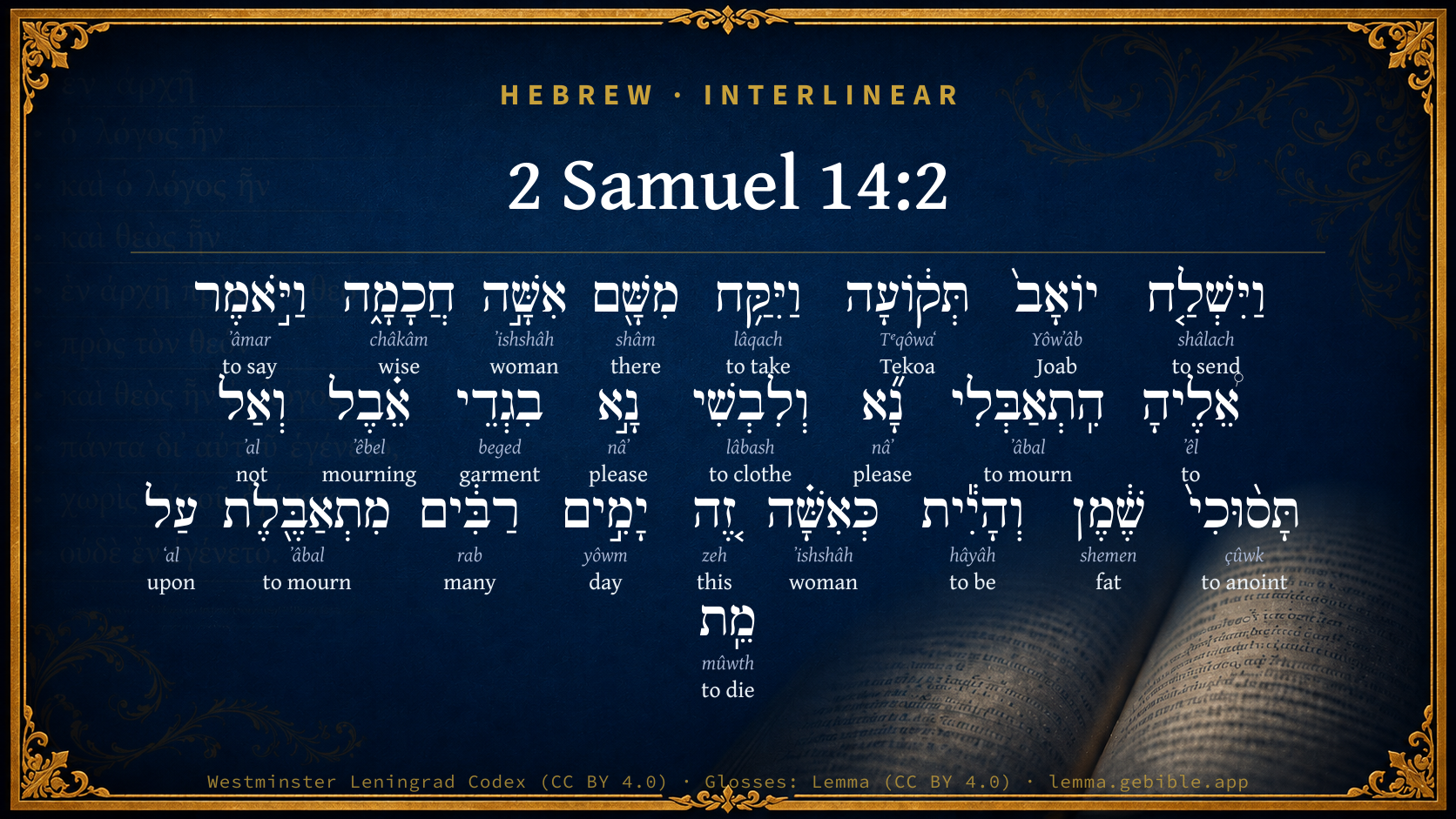
2 Samuel 14:2

Hebrew (Westminster Leningrad Codex) 2 Samuel 14:2 appears in the Hebrew Old Testament. The text above is from the Westminster Leningrad Codex. Each word links to its Strong’s number, a concise gloss, and parsing drawn from the Open Scriptures Hebrew Bible morphology. Click any word for its full Brown-Driver-Briggs (BDB) entry.
Download image
Cite this verse

2 Samuel 14:2 (World English Bible). Public Domain. Lemma interlinear Bible study tool, https://lemma.gebible.app/v/2-samuel/14/2.

Show BibTeX & RIS
BibTeX
RIS
English Translation
Joab sent to Tekoa, and fetched there a wise woman, and said to her, please act like a mourner, and put on mourning clothing, Please, and don't anoint yourself with oil, but be as a woman who has a long time mourned for the dead:
World English Bible · Public Domain
Highlights
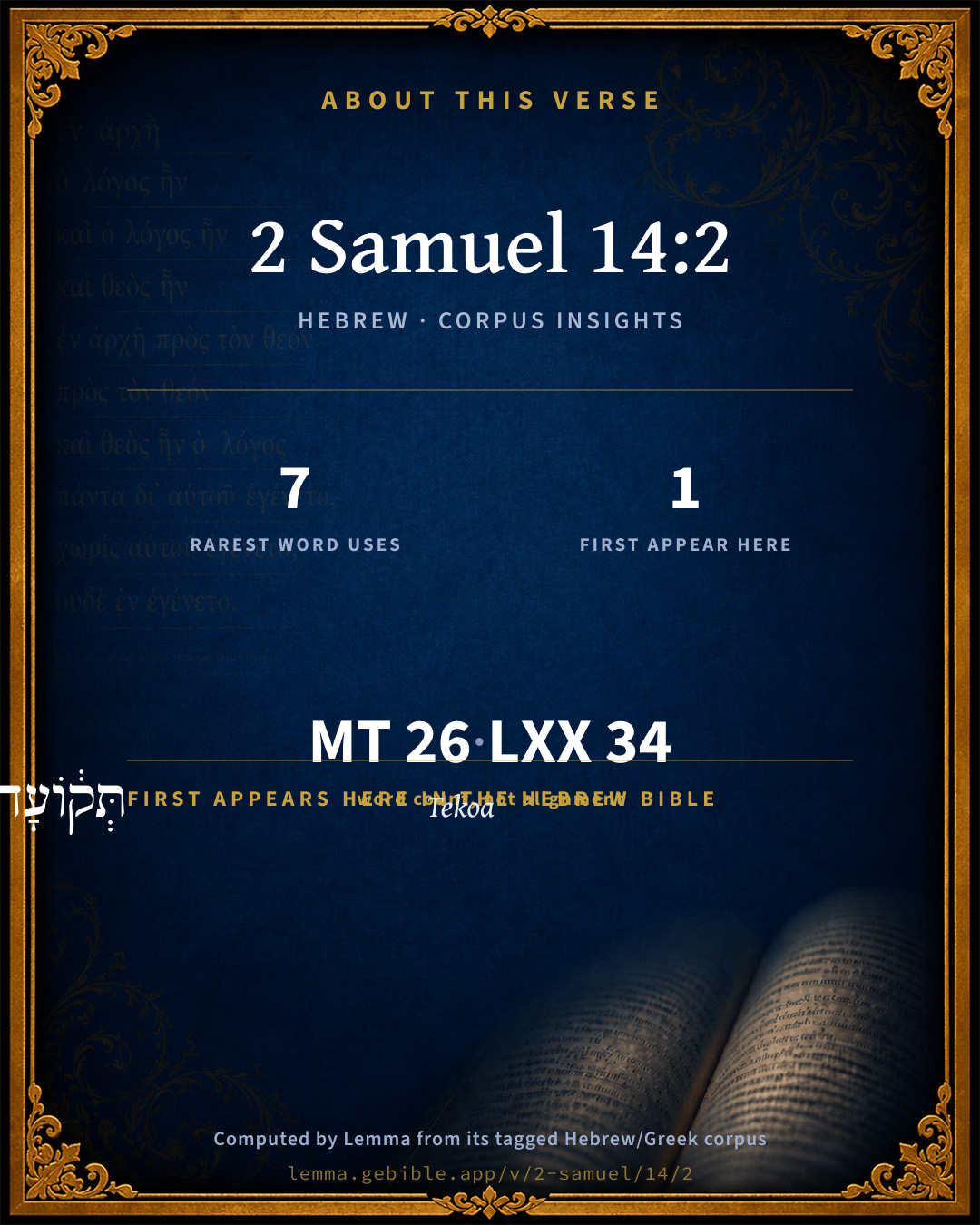
  • 1 first appearance in the Hebrew Bible
Full analysis ↓
Download a study sheet

One document with this verse’s original text, its word-by-word gloss line, the meaning frame, cross-references with their text, attributed commentary, and full source and license credits — printable, and it pastes into notes with its structure intact.

This verse Autodidact and up

Study sheet (.html) Plain text (.txt)

A passage Seminary Student

Up to 50 verses in one chapter. A passage sheet keeps up to 6 commentary sources and 12 cross-references per verse, in the order this page ranks them, and says so on the sheet whenever that leaves anything out. Ask for a single verse and you get the Autodidact verse sheet above.

Everything on this page stays free to read, with no account — the sheet is a download of what is already on screen, not access to it.

Want to remove ads? Support Godless Engineer
Compare translations 3

The same verse in 3 English versions, stacked beneath the original-language interlinear above. Click any original word for its lexicon entry.

Each is an independent rendering of the whole verse — the interlinear is not word-aligned to these translations.

Highlighted words mark where these versions differ — a whole-verse word diff, not a word-by-word alignment.

  • World English Bible Public Domain
    Joab sent to Tekoa, and fetched there a wise woman, and said to her, please act like a mourner, and put on mourning clothing, Please, and don't anoint yourself with oil, but be as a woman who has a long time mourned for the dead:
  • King James Version Public Domain
    And Joab sent to Tekoah, and fetched thence a wise woman, and said unto her, I pray thee, feign thyself to be a mourner, and put on now mourning apparel, and anoint not thyself with oil, but be as a woman that had a long time mourned for the dead:
  • unfoldingWord Literal Text CC BY-SA 4.0
    And Joab sent Tekoa, and he brought a wise woman from there. And he said to her, “Please mourn, and please put on clothes of mourning. And you shall not anoint oil, but you shall be like this woman mourning many days for one having died.

unfoldingWord Literal Text — © unfoldingWord, licensed CC BY-SA 4.0. Word-aligned USFM3 via Door43 (git.door43.org/unfoldingWord/en_ult).

Versions to compare (up to 4)

3 of 4 selected

Show all 18 translations

Every available English version of this verse, each an independent rendering of the whole verse.

  • World English Bible Public Domain
    Joab sent to Tekoa, and fetched there a wise woman, and said to her, please act like a mourner, and put on mourning clothing, Please, and don't anoint yourself with oil, but be as a woman who has a long time mourned for the dead:
  • Berean Standard Bible Public Domain
    So Joab sent to Tekoa to bring a wise woman from there. He told her, “Please pretend to be a mourner; put on clothes for mourning and do not anoint yourself with oil. Act like a woman who has mourned for the dead a long time.
  • Majority Standard Bible Public Domain
    So Joab sent to Tekoa to bring a wise woman from there. He told her, “Please pretend to be a mourner; put on clothes for mourning and do not anoint yourself with oil. Act like a woman who has mourned for the dead a long time.
  • King James Version Public Domain
    And Joab sent to Tekoah, and fetched thence a wise woman, and said unto her, I pray thee, feign thyself to be a mourner, and put on now mourning apparel, and anoint not thyself with oil, but be as a woman that had a long time mourned for the dead:
  • American Standard Version (1901) Public Domain
    And Joab sent to Tekoa, and fetched thence a wise woman, and said unto her, I pray thee, feign thyself to be a mourner, and put on mourning apparel, I pray thee, and anoint not thyself with oil, but be as a woman that hath a long time mourned for the dead:
  • Revised Version (1885) Public Domain
    And Joab sent to Tekoa, and fetched thence a wise woman, and said unto her, I pray thee, feign thyself to be a mourner, and put on mourning apparel, I pray thee, and anoint not thyself with oil, but be as a woman that had a long time mourned for the dead:
  • Geneva Bible (1599) Public Domain
    And Ioab sent to Tekoah, and brought thence a subtile woman, and sayd vnto her, I pray thee, fayne thy selfe to mourne, and nowe put on mourning apparel, and anoynt not thy selfe with oyle: but be as a woman that had now long time mourned for the dead.
  • Douay-Rheims (1899) Public Domain
    Sent to Thecua, and fetched from thence a wise woman: and said to her: Feign thyself to be a mourner, and put on mourning apparel, and be not anointed with oil, that thou mayest be as a woman that had a long time been mourning for one dead.
  • Young's Literal Translation Public Domain
    and Joab sendeth to Tekoah, and taketh thence a wise woman, and saith unto her, `Feign thyself a mourner, I pray thee, and put on, I pray thee, garments of mourning, and anoint not thyself with oil, and thou hast been as a woman these many days mourning for the dead,
  • Literal Standard Version CC BY-SA 4.0
    and Joab sends to Tekoah, and takes a wise woman from there, and says to her, “Please feign yourself a mourner, and now put on garments of mourning, and do not anoint yourself with oil, and you have been as a woman mourning for the dead [for] these many days,
  • Unlocked Literal Bible CC BY-SA 4.0
    So Joab sent word to Tekoa and had a wise woman brought to him. He said to her, “Please pretend you are a mourner and put on mourning clothes. Please do not anoint yourself with oil, but be like a woman who has mourned a long time for the dead.
  • unfoldingWord Literal Text CC BY-SA 4.0
    And Joab sent Tekoa, and he brought a wise woman from there. And he said to her, “Please mourn, and please put on clothes of mourning. And you shall not anoint oil, but you shall be like this woman mourning many days for one having died.
  • Darby Bible Public Domain
    And Joab sent to Tekoah, and fetched thence a wise woman, and said to her, I pray thee, feign thyself to be a mourner, and put on mourning garments, I pray, and anoint not thyself with oil, but be as a woman that hath a long time mourned for the dead;
  • World Messianic Bible Public Domain
    Joab sent to Tekoa and brought a wise woman from there, and said to her, “Please act like a mourner, and put on mourning clothing, please, and don’t anoint yourself with oil; but be as a woman who has mourned a long time for the dead.
  • Webster's Bible Public Domain
    And Joab sent to Tekoah, and brought thence a wise woman, and said to her, I pray thee, feign thyself to be a mourner, and put on now mourning apparel, and anoint not thyself with oil, but be as a woman that had a long time mourned for the dead:
  • Free Bible Version CC BY-SA 4.0
    So Joab sent a messenger to Tekoa to bring back a wise woman who lived there. He told her, “Pretend to be a mourner. Put on clothes for mourning, and don't use any scented oils. Be like a woman who has been in mourning for the dead a long time.
  • Bible in Basic English Public Domain
    And Joab sent to Tekoa and got from there a wise woman, and said to her, Now make yourself seem like one given up to grief, and put on the clothing of sorrow, not using any sweet oil for your body, but looking like one who for a long time has been weeping for the dead:
  • JPS Tanakh (1917) Public Domain
    And Joab sent to Tekoa, and fetched thence a wise woman, and said unto her: 'I pray thee, feign thyself to be a mourner, and put on mourning apparel, I pray thee, and anoint not thyself with oil, but be as a woman that had a long time mourned for the dead;

Literal Standard Version (2020), Covenant Press — licensed CC BY-SA 4.0. Text via the HelloAO Bible API (eBible.org). Unlocked Literal Bible (unfoldingWord) — licensed CC BY-SA 4.0. Text via the HelloAO Bible API (eBible.org). unfoldingWord Literal Text — © unfoldingWord, licensed CC BY-SA 4.0. Word-aligned USFM3 via Door43 (git.door43.org/unfoldingWord/en_ult). Free Bible Version, Dr. Jonathan Gallagher — licensed CC BY-SA 4.0. Text via the HelloAO Bible API (eBible.org).

Word by word

More ways to search: Search by grammar → Find every occurrence → Compare this word →

Practice this passage: Drill this verse → Learn its vocabulary →

תְּק֔וֹעָה
Tᵉqôwaʻ
H8620
“Tekoa · toward”
Noun, Proper + Suffix, Demonstrative
Part of Speech
Noun
Type
Proper
Full BDB Definition

Origin: a form of H8619

TWOT: None

Tekoa or Tekoah = "a stockade" - a Judaite, son of Ashur and grandson of Hezron (noun proper masculine) - a town in the hill country of Judah near Hebron built by king Rehoboam of Judah; birthplace of Amos (noun proper locative) - a wilderness area where king Jehoshaphat of Judah defeated the people of Moab, Ammon, and Mount Seir (noun proper locative)
  1. וַיִּשְׁלַ֤ח shâlach H7971 “and · to send” Conjunction + Verb, Qal, Sequential Imperfect, 3rd Person, Masculine, Singular
  2. יוֹאָב֙ Yôwʼâb H3097 “Joab” Noun, Proper
  3. וַיִּקַּ֥ח lâqach H3947 “and · to take” Conjunction + Verb, Qal, Sequential Imperfect, 3rd Person, Masculine, Singular
  4. מִשָּׁ֖ם shâm H8033 “from · there” Preposition + Adverb
  5. אִשָּׁ֣ה ʼishshâh H802 “woman” Noun, Common, Feminine, Singular, Absolute
  6. חֲכָמָ֑ה châkâm H2450 “wise” Adjective, Adjective, Feminine, Singular, Absolute
  7. וַיֹּ֣אמֶר ʼâmar H559 “and · to say” Conjunction + Verb, Qal, Sequential Imperfect, 3rd Person, Masculine, Singular
  8. אֵ֠לֶיהָ ʼêl H413 “to · her” Preposition + Suffix, Personal, 3rd Person, Feminine, Singular
  9. הִֽתְאַבְּלִי ʼâbal H56 “mourn” Verb, Hithpael, Imperative, 2nd Person, Feminine, Singular
  10. נָ֞א nâʼ H4994 “please” Particle, Exhortation
  11. וְלִבְשִׁי lâbash H3847 “and · clothe” Conjunction + Verb, Qal, Imperative, 2nd Person, Feminine, Singular
  12. נָ֣א nâʼ H4994 “please” Particle, Exhortation
  13. בִגְדֵי beged H899 “garments of” Noun, Common, Masculine, Plural, Construct
  14. אֵ֗בֶל ʼêbel H60 “mourning” Noun, Common, Masculine, Singular, Absolute
  15. וְאַל ʼal H408 “and · not” Conjunction + Particle, Negative
  16. תָּס֨וּכִי֙ çûwk H5480 “to anoint” Verb, Qal, Jussive, 2nd Person, Feminine, Singular
  17. שֶׁ֔מֶן shemen H8081 “fat” Noun, Common, Masculine, Singular, Absolute
  18. וְהָיִ֕ית hâyâh H1961 “and · to be” Conjunction + Verb, Qal, Sequential Perfect, 2nd Person, Feminine, Singular
  19. כְּאִשָּׁ֗ה ʼishshâh H802 “like/as · woman” Preposition + Noun, Common, Feminine, Singular, Absolute
  20. זֶ֚ה zeh H2088 “this” Pronoun, Demonstrative, Masculine, Singular
  21. יָמִ֣ים yôwm H3117 “days” Noun, Common, Masculine, Plural, Absolute
  22. רַבִּ֔ים rab H7227 “many” Adjective, Adjective, Masculine, Plural, Absolute
  23. מִתְאַבֶּ֖לֶת ʼâbal H56 “mourning” Verb, Hithpael, Participle Active, Feminine, Singular, Absolute
  24. עַל ʻal H5921 “upon” Preposition
  25. מֵֽת mûwth H4191 “dying” Verb, Qal, Participle Active, Masculine, Singular, Absolute

About this verse

These counts appear in no published source. They are computed here, from the morphology-tagged text and Lemma’s own curated glosses. What Lemma adds →

26
words
23
distinct lemmas
Historical
section

Notable vocabulary

The rarest word here is תְּק֔וֹעָה Tekoa H8620 — appearing just 7 times in the whole Hebrew Bible.

First appearance in Scripture

This word makes its first canonical appearance in the Hebrew Bible here:

  • תְּק֔וֹעָה Tekoa H8620

Shared distinctive vocabulary

תְּק֔וֹעָה Tekoa H8620 occurs in 7 verses of the Hebrew Bible. Also found in:

Grammatical profile

  • 9 verbs
  • 8 nouns
  • 2 adjectives
  • 1 pronoun
  • 2 prepositions
  • 1 adverb
  • 3 particles

Verb forms

  • וַיִּשְׁלַ֤ח Qal · Sequential Imperfect
  • וַיִּקַּ֥ח Qal · Sequential Imperfect
  • וַיֹּ֣אמֶר Qal · Sequential Imperfect
  • הִֽתְאַבְּלִי Hithpael · Imperative
  • וְלִבְשִׁי Qal · Imperative
  • תָּס֨וּכִי֙ Qal · Jussive
  • וְהָיִ֕ית Qal · Sequential Perfect
  • מִתְאַבֶּ֖לֶת Hithpael · Participle Active
  • מֵֽת Qal · Participle Active

Repetition

Words recur within this verse — often emphatic in Hebrew:

  • אִשָּׁ֣ה woman H802 ×2
  • הִֽתְאַבְּלִי to mourn H56 ×2
  • נָ֞א please H4994 ×2

Hebrew & Septuagint length

In English translation the verse runs 45 words from the Hebrew and 47 from the Septuagint (LXX English) — closely comparable.

A rough comparison of the two English renderings, which tokenize alike — not a word-level alignment.

Word counts can differ between the Hebrew and the Greek without any difference in meaning — e.g. the Hebrew direct-object marker אֵת has no separate Greek word, and Greek often adds the article ὁ.

In the original languages it is 26 Hebrew tokens and 34 Greek tokens — but the two are counted differently (Hebrew bundles its prefixes and suffixes into one token; the Greek is in lemma form), so that isn’t a like-for-like length.

Cross-references

12

Topical passages linked to 2 Samuel 14:2 in the Treasury of Scripture Knowledge — connected by theme and wording, ordered by reader-vote popularity; previews shown in the World English Bible.

  • 2 Chronicles 11:6 He built Bethlehem, and Etam, and Tekoa,
  • Ruth 3:3 Wash yourself therefore, and anoint you, and put your clothing on you, and get you down to the threshing floor, but don't make yourself known to the man, until he shall have done eating and drinking.
  • Amos 1:1 The words of Amos, who was among the herdsmen of Tekoa, which he saw concerning Israel in the days of Uzziah king of Judah, and in the days of Jeroboam the son of Joash king of Israel, two years before the earthquake.
  • 2 Samuel 12:20 Then David arose from the earth, and washed, and anointed himself, and changed his clothing; and he came into the house of Yahweh, and worshiped: then he came to his own house; and when he required, they set bread before him, and he ate.
  • 2 Chronicles 20:20 They rose early in the morning, and went forth into the wilderness of Tekoa: and as they went forth, Jehoshaphat stood and said, Hear me, Judah, and you inhabitants of Jerusalem: believe in Yahweh your God, so shall you be established; believe his prophets, so shall you prosper.
  • Nehemiah 3:5 Next to them the Tekoites repaired; but their nobles didn't put their necks to the work of their lord.
  • Jeremiah 6:1 Flee for safety, you children of Benjamin, out of the midst of Jerusalem, and blow the trumpet in Tekoa, and raise up a signal on Beth Haccherem; for evil looks forth from the north, and a great destruction.
  • 2 Samuel 11:26 When the wife of Uriah heard that Uriah her husband was dead, she made lamentation for her husband.
  • Nehemiah 3:27 After him the Tekoites repaired another portion, over against the great tower that stands out, and to the wall of Ophel.
  • Psalms 104:15 Wine that makes glad the heart of man, Oil to make his face to shine, And bread that strengthens man's heart.
  • Ecclesiastes 9:8 Let your garments be always white, and don't let your head lack oil.
  • Matthew 6:17 But you, when you fast, anoint your head, and wash your face;

Cross-references courtesy of OpenBible.info (CC BY 4.0).

Hebrew and Greek witnesses Masoretic Hebrew ↔ Greek Septuagint

The same verse in the two great witnesses to the Old Testament, shown verse-for-verse.

These are two independent witnesses, not word-aligned to each other, and the Septuagint is shown in lemma (dictionary) form.

Hebrew 2 Samuel 14:2 Masoretic · Westminster Leningrad Codex

וַיִּשְׁלַ֤ח יוֹאָב֙ תְּק֔וֹעָה וַיִּקַּ֥ח מִשָּׁ֖ם אִשָּׁ֣ה חֲכָמָ֑ה וַיֹּ֣אמֶר אֵ֠לֶיהָ הִֽתְאַבְּלִי נָ֞א וְלִבְשִׁי נָ֣א בִגְדֵי אֵ֗בֶל וְאַל תָּס֨וּכִי֙ שֶׁ֔מֶן וְהָיִ֕ית כְּאִשָּׁ֗ה זֶ֚ה יָמִ֣ים רַבִּ֔ים מִתְאַבֶּ֖לֶת עַל מֵֽת

Joab sent to Tekoa, and fetched there a wise woman, and said to her, please act like a mourner, and put on mourning clothing, Please, and don't anoint yourself with oil, but be as a woman who has a long time mourned for the dead:

World English Bible · Public Domain

Greek LXX 2 Samuel 14:2 Septuagint · lemma form

καί ἀποστέλλω ιωαβ εἰς θεκωε καί λαμβάνω ἐκεῖθεν γυνή σοφός καί εἶπον πρός αὐτός πενθέω δή καί ἐνδύω ἱμάτιον πενθικός καί μή ἀλείφω ἔλαιον καί εἰμί ὡς γυνή πενθέω ἐπί θνήσκω οὗτος ἡμέρα πολύς

And Joab sent to Thecoe, and took thence a cunning woman, and said to her, Mourn, I pray you, and put on mourning apparel, and anoint you not with oil, and you shall be as a woman mourning for one that is dead thus for many days.

LXX2012 (modern English Septuagint) · Public Domain

Hebrew: Westminster Leningrad Codex (CC BY 4.0). Greek: Septuagint (public domain); English from LXX2012 (modern English Septuagint) (Public Domain). How the Septuagint differs from the Hebrew →

Targum (Aramaic paraphrase)

1

The Targum is the ancient Jewish Aramaic paraphrase of the Hebrew Scriptures — an interpretive translation, not the Hebrew text itself. Onkelos (literal) and Pseudo-Jonathan (expansive) render the Torah, and Jonathan the Prophets. Coverage is partial: where no permissively-licensed English translation exists for a verse, only the Aramaic is shown. This is verse-level text, not a word-by-word alignment to the Hebrew.

  1. Targum Jonathan Prophets (Joshua–Malachi)
    וּשְׁלַח יוֹאָב לִתְקוֹעַ וּנְסֵיב מִתַּמָן אִתְּתָא חֲכִּמְתָּא וַאֲמַר לָהּ אִתְאַבְּלֵי כְעַן וּלְבוּשִׁי כְעַן לְבוּשֵׁי אֶבְלָא וְלָא תְשׁוּפִין מִשְׁחָא וּתְהֵא כְּאִתְּתָא דְנַן יוֹמִין סַגִיאִין מִתְאַבְּלָא עַל מֵיתָא:

    (no public-domain English translation for this verse)

    Targum Jonathan — Aramaic: “Mikraot Gedolot” (public domain). English: “Sefaria Community Translation” (CC0 1.0 (public-domain dedication)); “London "Chaldee Paraphrase," 1871” (public domain). Text via Sefaria.

Commentary

Notes on 2 Samuel 14:2 from classic Christian and Jewish commentators (each source and its license shown beneath its notes). The classic Christian expositions comment on the surrounding passage and are grouped to its opening verse, so a note may address several verses; the Jewish commentaries on the Tanakh (Rashi and others) are per-verse, so they appear only where the commentator wrote on this verse.

Lemma curates 59 commentaries, every one of them public domain or Creative Commons licensed, each selected and text-cleaned for this edition rather than reprinted as found. About our sources →

Trapp's Complete Commentary

John Trapp

2Sa 14:2 And Joab sent to Tekoah, and fetched thence a wise woman, and said unto her, I pray thee, feign thyself to be a mourner, and put on now mourning apparel, and anoint not thyself with oil, but be as a woman that had a long time mourned for the dead:

Ver. 2. And Joab sent to Tekoah.] A city of Judah, {2Ch 11:6} where the prophet Amos was born, or lived at least, {Amo 1:1} being the grandson of this wise woman, if the Rabbis may be believed.

And fetched thence a wise woman.] Witty and well-spoken.

Feign thyself to be a mourner.] And that many women can do very artificially. Plautus saith, but not truly,

“ Mulier nulla cordicitus dolet ex animo. ”

This woman might well be one of those who were usually hired to mourn at funerals.

John Trapp, A Commentary or Exposition upon All the Books of the Old and New Testament (1647–1656) — public domain. Text from a community e-Sword module.

Joseph Benson's Commentary

2Sa 14:2. Joab sent to Tekoah — A city in the tribe of Judah, about twelve miles south of Jerusalem. And fetched thence a wise woman — One whom he knew to be fit for such an undertaking, having good sense and a ready utterance; and said, I pray thee feign thyself to be a mourner — Who put on no ornaments, nor used any ointment, but appeared in a sordid, neglected condition. She was to assume this habit to heighten the idea of her distress, that her circumstances as a widow, her mournful tale, her dress, and her person, might make one united impression on the king, and secure his attention. She tells the king that she had buried her husband; that she had two sons that were the support and comfort of her widowed state; that they quarrelled, and fought, and one of them unhappily killed the other; that for her part, she was desirous to protect the man-slayer, for, as Rebekah argued concerning her two sons, Why should she be deprived of them both in one day? But though she, who was nearest of kin to the slain, was willing to let fall the demands of an avenger of blood, yet the other relations insisted upon it that the surviving brother should be put to death, according to the law; not out of affection either to justice or to the memory of the slain brother, but that, by destroying the heir, (which they did not conceal to be the thing they aimed at,) the inheritance might be theirs. The whole design of her speech was to frame a case similar to that of David, in order to convince him how much more reasonable it was to preserve Absalom. But there was great art in not making the similitude too plain and visible, lest the king should perceive the intention of the woman’s petition before she obtained a grant of pardon for her son. — Bishop Patrick.

Joseph Benson's Commentary on the Old and New Testaments (1811–1818) — public domain. Text from a community e-Sword module.

Tyndale Open Study Notes

Tyndale Open Resources

14:2 The woman with a reputation for great wisdom was summoned to carry out a delicate mission in the royal court (cp. 20:16).

Tyndale Open Study Notes — © Tyndale Open Resources, licensed CC BY-SA 4.0. Text via the HelloAO Bible API.

Geneva Bible (1599)

Geneva Bible translators

In token of mourning: for they used anointing to seem cheerful.

Or, wife.

Geneva Bible (1599) marginal notes — public domain. Text via Bolls.life.

Adam Clarke's Commentary

Verse 2. Joab sent to Tekoah] Tekoah, according to St. Jerome, was a little city in the tribe of Judah, about twelve miles from Jerusalem.

There are several circumstances relative to this woman and her case which deserve to be noticed:-

1. She was a widow, and therefore her condition of life was the better calculated to excite compassion.

2. She lived at some distance from Jerusalem, which rendered the case difficult to be readily inquired into; and consequently there was the less danger of detection.

3. She was advanced in years, as Josephus says, that her application might have the more weight.

4. She put on mourning, to heighten the idea of distress.

5. She framed a case similar to that in which David stood, in order to convince him of the reasonableness of sparing Absalom.

6. She did not make the similitude too plain and visible, lest the king should see her intention before she had obtained a grant of pardon. Thus her circumstances, her mournful tale, her widow's needs, her aged person, and her impressive manner, all combined to make one united impression on the king's heart. We need not wonder at her success. See Bishop Patrick.

Adam Clarke's Commentary on the Bible (1810–1826) — public domain. Text from a community e-Sword/MySword module.

Ellicott's Commentary for English Readers

(2) Tekoah.—A village on a high hill five miles south of Bethlehem, the home of the prophet Amos. It was also the native place of Ira, one of David’s thirty heroes (2Sa_23:26), and was near enough to Bethlehem, the home of Joab, for him to have had personal knowledge of this “wise woman.” There is no ground whatever for suspecting her of being a “witch,” or in any way disreputable.

The parable that follows was contrived by Joab, yet also required skill and address on the part of the woman. It is purposely made not too closely parallel to the case of Absalom, lest it should defeat its own object. In general it needs no comment.

A Bible Commentary for English Readers, edited by Charles John Ellicott (1878–1897) — public domain. Text from a community e-Sword module.

The Cambridge Bible for Schools and Colleges

gen. ed. J. J. S. Perowne

2. Tekoah] Situated on a lofty hill five miles south of Bethlehem. The name survives almost unaltered in the modern Tekûa. It was the native place of Ira, one of David’s Thirty Heroes (ch.2Sa_23:26): Rehoboam fortified it as a defence against invasions from the south (2Ch_11:6): but its chief claim to be remembered is as the home of the prophet Amos who was “among the herdmen of Tekoa” (Amo_1:1). The proximity of Tekoah to Bethlehem explains Joab’s acquaintance with this woman, whose shrewdness fitted her to act the part he wished. The term “wise woman” does not mean a witch, as the Speaker’s Comm. implies when it speaks of her “lawless profession.” Cp. ch. 2Sa_20:16.

feign thyself to be a mourner] Compare the similar ‘acted parable’ in 1Ki_20:35-43.

anoint not thyself] Cp. ch. 2Sa_12:20, note.

The Cambridge Bible for Schools and Colleges (gen. ed. J. J. S. Perowne; Cambridge University Press, 1878–1918) — public domain. Text from a community e-Sword module.

John Gill's Exposition

And Joab sent to Tekoah,.... Which Kimchi says was a city in the tribe of Asher, and others in the tribe of Benjamin, but it seems rather to be in the tribe, of Judah, Ch2 11:5; according Jerom (s), it was twelve miles from Jerusalem, though in another place (t) he says it was but nine; of this place was Amos, and some think (u) the woman after mentioned was his grandmother. It was proper to lay the scene of the affair to be proposed to the king at some distance, that it might not soon and easily be inquired into:

and fetched thence a wise woman; one much advanced in years, as Josephus says (w), whose years had taught her wisdom by experience; a woman of good sense, and of a good address, apt at expression and reply, and knew how to manage an affair committed to her; and among other things, perhaps, was famous for acting the part of a mourner at funerals, for which sometimes women were hired; however, she was one that was talked of for her wisdom and prudence, and Joab having heard of her, sent for her as one for his purpose. The Jews (x) say, that Tekoah was the first place in the land of Israel for oil, and because the inhabitants were much used to oil, wisdom was found among them:

and said unto her, I pray thee feign thyself to be a mourner; a woman of a sorrowful spirit, and in great distress, and show it by cries and tears:

and put on now mourning apparel; black clothes, such as mourners usually wore:

and anoint not thyself with oil; as used to be done in times of feasting and rejoicing, to make them look smooth, and gay, and cheerful, and of which there might be much use at Tekoah, if so famous for oil:

but be as a woman that had a long time mourned for the dead; her countenance pale and foul with weeping, her mourning clothes almost worn out, &c.

(s) Proem. in Amos, & Comment. in Jer. vi. 1. (t) De loc. Heb. in. voce "Elthei", fol. 91. B. (u) In Hieron. Trad. Heb. in 2 Reg. fol. 78. 1. (w) Antiqu. l. 7. c. 8. sect. 4. (x) T. Bab. Menachot, fol. 85. 2.

John Gill's Exposition of the Whole Bible (1746–1763) — public domain (CC PDM 1.0). Text via the HelloAO Bible API.

Albert Barnes' Notes on the Bible

Tekoah - In the south of Judah, six miles from Bethlehem, the modern Tekua. The rough, wild district was well suited for the lawless profession of the wise woman; it abounds in caves, as does the country near Endor.

Albert Barnes' Notes on the Bible (1834–1885) — public domain. Text from a community e-Sword/MySword module.

Haydock's Catholic Bible Commentary

Thecua, twelve miles south of Jerusalem. (St. Jerome) --- Joab causes this unknown woman to come from the country to conceal his design, (Calmet) hoping that Absalom would be his father’s successor. (Menochius)

George Leo Haydock (1774–1849), Haydock's Catholic Family Bible and Commentary, 1859 edition — public domain. Excludes Psalms (Douay-Rheims chapter numbering differs from Protestant) and Deuterocanonical books (Catholic canon only).

Matthew Poole's English Annotations

Tekoah; a city of Judah, 2Ch 11:5,6. One of Jerusalem was not convenient, lest the king might know the person, or search out the business. And besides, this woman seems to be of great eminency for her wisdom, as the following discourse manifests.

A wise woman, rather than a man, because women can more easily express their passions, and do sooner procure pity in their miseries, and an answer to their requests.

Anoint not thyself with oil; as they used to do when they were out of a mourning state. See Rth 3:3; Mat 6:17.

Matthew Poole's English Annotations on the Holy Bible (1683–1685) — public domain. Text from a community e-Sword/MySword module.

Whedon's Commentary on the Bible

Daniel D. Whedon

2. Tekoah — Twelve miles south of Jerusalem. Its ruins are still to be seen, and bear the name Tekua. “It lies on an elevated hill, not steep, but broad on the top, and covered with ruins to the extent of four or five acres. These consist chiefly in the foundations of houses built of squared stones, some of which are bevelled.… There are many cisterns excavated in the rocks, and not far off is a living spring, from which our Arabs brought us fine water.” — Robinson.

A wise woman — As her skilful appeals to David, and her language, so exquisite in beauty and pathos, abundantly show. Anoint not thyself — So as to appear shabbily, and not as one that has just put away mourning. Comp. 2Sa_12:20.

Daniel D. Whedon (gen. ed.), Commentary on the Old and New Testaments (1874–1909) — public domain. Text from a community e-Sword module.

The Pulpit Commentary

Tekoah. This town, famous as the birthplace of the Prophet Amos, lay upon the borders of the great wilderness southeast of Jerusalem. As it was only five miles to the south of Bethlehem, Joab"s birthplace, he had probably often heard tales of this woman"s intelligence; and, though he contrived the parable himself, yet it would need tact and adroitness on the woman"s part to give the tale with tragic effect, and answer the king"s questions with all the signs of genuine emotion. If her acting was bad, the king would see through the plot, and only by great skill would his heart be so moved as to three him to some such expression of feeling as would serve Joab"s purpose.

The Pulpit Commentary (1880–1919), ed. H.D.M. Spence-Jones & Joseph S. Exell — public domain. Text from a community e-Sword module.

John Wesley's Explanatory Notes

Anoint - As they used to do when they were out of a mourning state.

John Wesley, Explanatory Notes Upon the Whole Bible (1754–1765) — public domain. Text via the GEBible commentary corpus.

Rashi

Rabbi Shlomo Yitzchaki (Rashi)

Yoav sent to Tekuah. Our Rabbis said Because olive oil is found there, therefore wisdom is found there.

Rashi on the Tanakh — English translations: “The Judaica Press complete Tanach with Rashi, translated by A. J. Rosenberg” (CC BY 4.0); “Pentateuch with Rashi's commentary by M. Rosenbaum and A.M. Silbermann, 1929-1934” (public domain); “The Metsudah Tanach series, Lakewood, N.J” (CC BY 4.0); and “The Book of Joshua, Metsudah Publications, 1997” (CC BY 4.0). Text via Sefaria.

Lesson kit

Teaching starters — assembled from the data on this page, not authored interpretation. Every prompt links to the verse data it draws on. Edit before teaching.

2 Samuel, in the Historical, opens this verse with 26 words (23 distinct Hebrew lemmas). Its most distinctive word is Tᵉqôwaʻ (“Tekoa”). A historical commentator’s framing appears above. Read the whole chapter for the surrounding context.

Discussion questions

  1. The word Tᵉqôwaʻ carries the sense “Tekoa.” How does it shape the verse?
  2. The word “Tekoa” first appears here in Scripture. What is being introduced at this debut?
  3. 1 Chronicles 2:24 shares the word «Tekoa» with this verse. How do the two illuminate each other?
  4. “woman” occurs 2× in this one verse. What is the effect of the repetition?
  5. The translations on this page render this verse differently — a whole-verse word diff, not a word-by-word alignment. What might account for the different wordings?
  6. The verb «וַיִּשְׁלַ֤ח» is Qal Sequential Imperfect. How does its form color the action?
  7. Reading how Trapp's Complete Commentary and Joseph Benson's Commentary read this verse, where do the two commentators agree and where do they part?

Things to notice

Reading settings

Reading text

Shown beneath each verse's original-language words.

Old Testament
Old Testament edition

Read the OT as the Masoretic Hebrew (MT) or the Greek Septuagint (LXX).

English shown for the Greek Septuagint (in the Hebrew ↔ Greek comparison).

Comparing translations? Open the Compare panel on any verse page to stack up to four side by side.