
1 Samuel 4:20

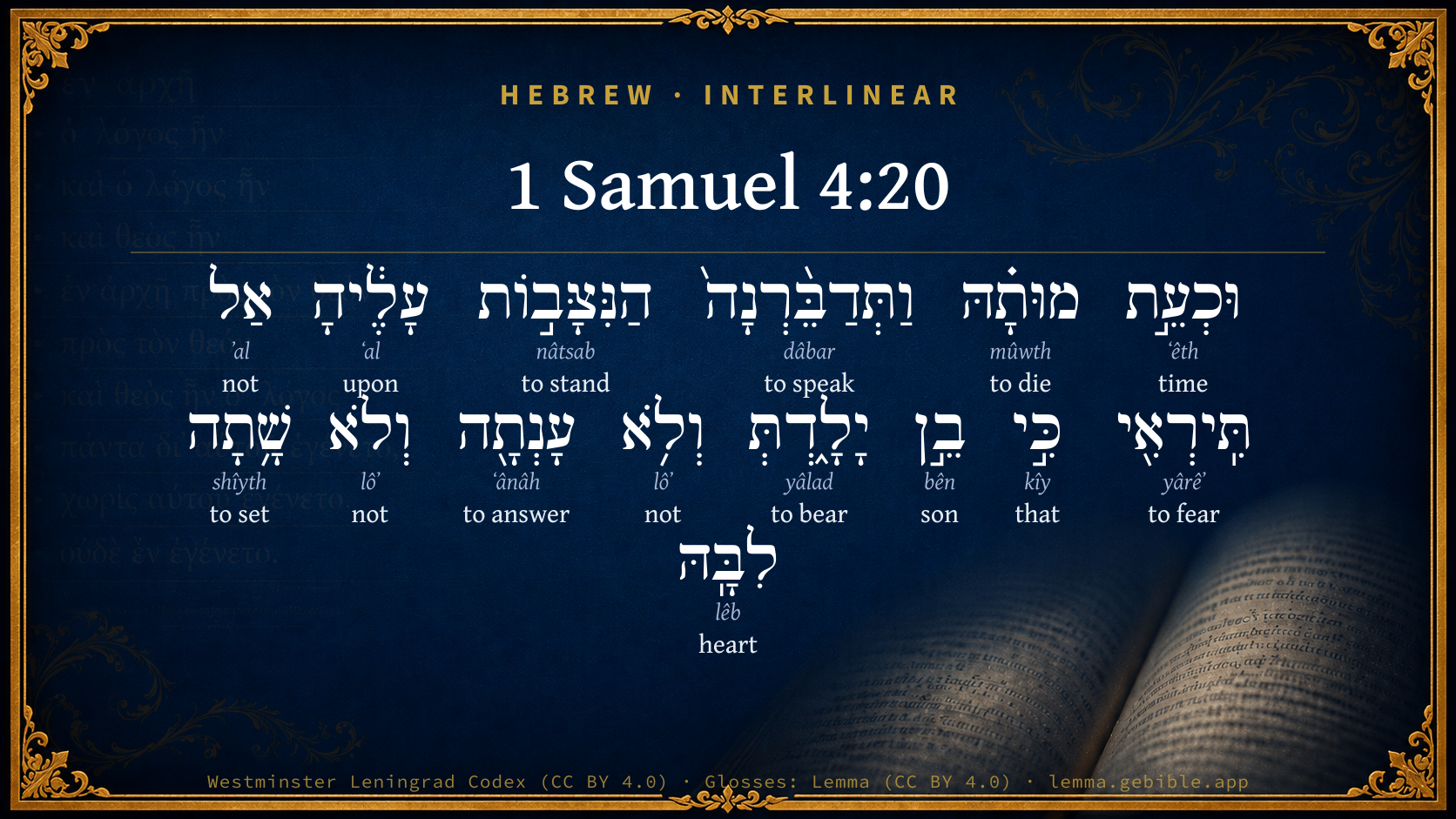
Hebrew (Westminster Leningrad Codex) 1 Samuel 4:20 appears in the Hebrew Old Testament. The text above is from the Westminster Leningrad Codex. Each word links to its Strong’s number, a concise gloss, and parsing drawn from the Open Scriptures Hebrew Bible morphology. Click any word for its full Brown-Driver-Briggs (BDB) entry.
Download image
Cite this verse

1 Samuel 4:20 (World English Bible). Public Domain. Lemma interlinear Bible study tool, https://lemma.gebible.app/v/1-samuel/4/20.

Show BibTeX & RIS
BibTeX
RIS
English Translation
About the time of her death the women who stood by her said to her, Don't be afraid; for you have brought forth a son. But she didn't answer, neither did she regard it.
World English Bible · Public Domain
Download a study sheet

One document with this verse’s original text, its word-by-word gloss line, the meaning frame, cross-references with their text, attributed commentary, and full source and license credits — printable, and it pastes into notes with its structure intact.

This verse Autodidact and up

Study sheet (.html) Plain text (.txt)

A passage Seminary Student

Up to 50 verses in one chapter. A passage sheet keeps up to 6 commentary sources and 12 cross-references per verse, in the order this page ranks them, and says so on the sheet whenever that leaves anything out. Ask for a single verse and you get the Autodidact verse sheet above.

Everything on this page stays free to read, with no account — the sheet is a download of what is already on screen, not access to it.

Want to remove ads? Support Godless Engineer
Compare translations 3

The same verse in 3 English versions, stacked beneath the original-language interlinear above. Click any original word for its lexicon entry.

Each is an independent rendering of the whole verse — the interlinear is not word-aligned to these translations.

Highlighted words mark where these versions differ — a whole-verse word diff, not a word-by-word alignment.

  • World English Bible Public Domain
    About the time of her death the women who stood by her said to her, Don't be afraid; for you have brought forth a son. But she didn't answer, neither did she regard it.
  • King James Version Public Domain
    And about the time of her death the women that stood by her said unto her, Fear not; for thou hast born a son. But she answered not, neither did she regard it.
  • unfoldingWord Literal Text CC BY-SA 4.0
    And about the time of her dying, then the ones standing over her said, “Do not fear, for you have borne a son.” But she did not answer, for she did not set her heart.

unfoldingWord Literal Text — © unfoldingWord, licensed CC BY-SA 4.0. Word-aligned USFM3 via Door43 (git.door43.org/unfoldingWord/en_ult).

Versions to compare (up to 4)

3 of 4 selected

Show all 18 translations

Every available English version of this verse, each an independent rendering of the whole verse.

  • World English Bible Public Domain
    About the time of her death the women who stood by her said to her, Don't be afraid; for you have brought forth a son. But she didn't answer, neither did she regard it.
  • Berean Standard Bible Public Domain
    As she was dying, the women attending to her said, “Do not be afraid, for you have given birth to a son!” But she did not respond or pay any heed.
  • Majority Standard Bible Public Domain
    As she was dying, the women attending to her said, “Do not be afraid, for you have given birth to a son!” But she did not respond or pay any heed.
  • King James Version Public Domain
    And about the time of her death the women that stood by her said unto her, Fear not; for thou hast born a son. But she answered not, neither did she regard it.
  • American Standard Version (1901) Public Domain
    And about the time of her death the women that stood by her said unto her, Fear not; for thou hast brought forth a son. But she answered not, neither did she regard it.
  • Revised Version (1885) Public Domain
    And about the time of her death the women that stood by her said unto her, Fear not; for thou hast brought forth a son. But she answered not, neither did she regard it.
  • Geneva Bible (1599) Public Domain
    And about the time of her death, the women that stoode about her, sayd vnto her, Feare not: for thou hast borne a sonne: but she answered not, nor regarded it.
  • Douay-Rheims (1899) Public Domain
    And when she was upon the point of death, they that stood about her said to her: Fear not, for thou hast borne a son. She answered them not, nor gave heed to them.
  • Young's Literal Translation Public Domain
    And at the time of her death, when the women who are standing by her say, `Fear not, for a son thou hast borne,' she hath not answered, nor set her heart `to it';
  • Literal Standard Version CC BY-SA 4.0
    And at the time of her death, the women who are standing by her say, “Do not fear, for you have borne a son,” she has not answered, nor set her heart [to it];
  • Unlocked Literal Bible CC BY-SA 4.0
    About the time of her death the women attending to her said, “Do not be afraid, for you have given birth to a son.” But she did not answer or take what they said to heart.
  • unfoldingWord Literal Text CC BY-SA 4.0
    And about the time of her dying, then the ones standing over her said, “Do not fear, for you have borne a son.” But she did not answer, for she did not set her heart.
  • Darby Bible Public Domain
    And as she was dying, the women that stood by her said, Fear not; for thou hast borne a son. But she did not answer, neither did she take it to heart.
  • World Messianic Bible Public Domain
    About the time of her death the women who stood by her said to her, “Don’t be afraid, for you have given birth to a son.” But she didn’t answer, neither did she regard it.
  • Webster's Bible Public Domain
    And about the time of her death, the women that stood by her said to her, Fear not; for thou hast borne a son. But she answered not, neither did she regard it.
  • Free Bible Version CC BY-SA 4.0
    Just before she died, the women caring for her said, “Don't give up—you have given birth to a son!” But she didn't answer or give any response.
  • Bible in Basic English Public Domain
    And when she was very near death the women who were with her said, Have no fear, for you have given birth to a son. But she made no answer and gave no attention to it.
  • JPS Tanakh (1917) Public Domain
    And about the time of her death the women that stood by her said unto her: 'Fear not; for thou hast brought forth a son.' But she answered not, neither did she regard it.

Literal Standard Version (2020), Covenant Press — licensed CC BY-SA 4.0. Text via the HelloAO Bible API (eBible.org). Unlocked Literal Bible (unfoldingWord) — licensed CC BY-SA 4.0. Text via the HelloAO Bible API (eBible.org). unfoldingWord Literal Text — © unfoldingWord, licensed CC BY-SA 4.0. Word-aligned USFM3 via Door43 (git.door43.org/unfoldingWord/en_ult). Free Bible Version, Dr. Jonathan Gallagher — licensed CC BY-SA 4.0. Text via the HelloAO Bible API (eBible.org).

Word by word

More ways to search: Search by grammar → Find every occurrence → Compare this word →

Practice this passage: Drill this verse → Learn its vocabulary →

הַנִּצָּב֣וֹת
nâtsab
H5324
“the · standing”
Particle, Definite Article + Verb, Niphal, Participle Active, Feminine, Plural, Absolute
Part of Speech
Particle + Verb
Stem
Niphal
Form
Participle Active
Gender
Feminine
Number
Plural
State
Absolute
Full BDB Definition

Origin: a primitive root

TWOT: 1398

to stand, take one's stand, stand upright, be set (over), establish - (Niphal) - to station oneself, take one's stand - to stand, be stationed - to stand, take an upright position - to be stationed, be appointed - deputy, prefect, appointed, deputed (substantive) - to stand firm - (Hiphil) - to station, set - to set up, erect - to cause to stand erect - to fix, establish - (Hophal) to be fixed, be determined, be stationary
  1. וּכְעֵ֣ת ʻêth H6256 “and · like/as · time of” Conjunction + Preposition + Noun, Common, Both, Singular, Construct
  2. מוּתָ֗הּ mûwth H4191 “to die · her” Verb, Qal, Infinitive Construct + Suffix, Personal, 3rd Person, Feminine, Singular
  3. וַתְּדַבֵּ֨רְנָה֙ dâbar H1696 “and · to speak” Conjunction + Verb, Piel, Sequential Imperfect, 3rd Person, Feminine, Plural
  4. עָלֶ֔יהָ ʻal H5921 “upon · her” Preposition + Suffix, Personal, 3rd Person, Feminine, Singular
  5. אַל ʼal H408 “not” Particle, Negative
  6. תִּֽירְאִ֖י yârêʼ H3372 “to fear” Verb, Qal, Jussive, 2nd Person, Feminine, Singular
  7. כִּ֣י kîy H3588 “that” Conjunction
  8. בֵ֣ן bên H1121 “son” Noun, Common, Masculine, Singular, Absolute
  9. יָלָ֑דְתְּ yâlad H3205 “to bear” Verb, Qal, Perfect, 2nd Person, Feminine, Singular
  10. וְלֹ֥א lôʼ H3808 “and · not” Conjunction + Particle, Negative
  11. עָנְתָ֖ה ʻânâh H6030 “to answer” Verb, Qal, Perfect, 3rd Person, Feminine, Singular
  12. וְלֹא lôʼ H3808 “and · not” Conjunction + Particle, Negative
  13. שָׁ֥תָה shîyth H7896 “to set” Verb, Qal, Perfect, 3rd Person, Feminine, Singular
  14. לִבָּֽהּ lêb H3820 “heart · her” Noun, Common, Masculine, Singular, Construct + Suffix, Personal, 3rd Person, Feminine, Singular

About this verse

These counts appear in no published source. They are computed here, from the morphology-tagged text and Lemma’s own curated glosses. What Lemma adds →

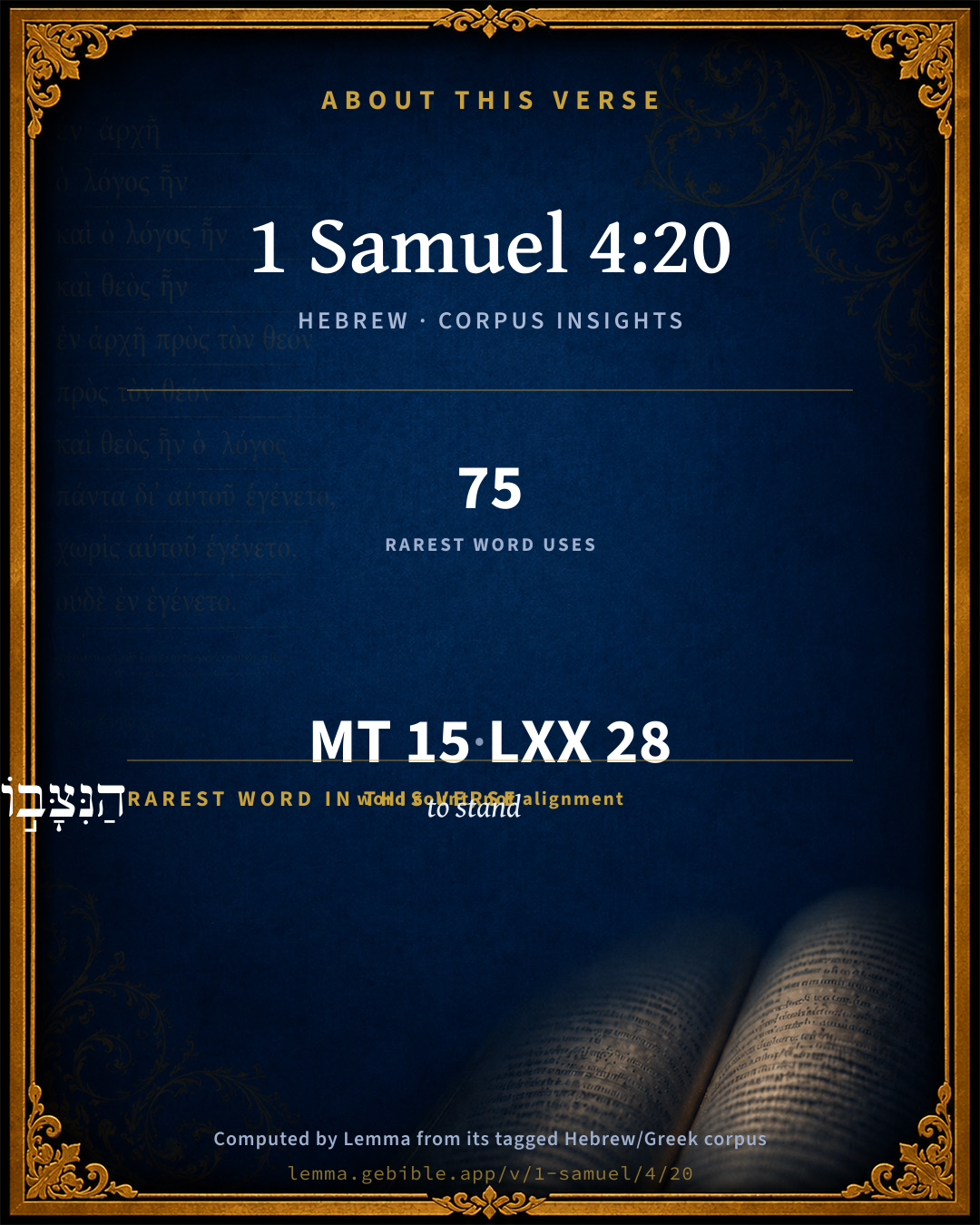
15
words
14
distinct lemmas
Historical
section

Grammatical profile

  • 7 verbs
  • 3 nouns
  • 1 preposition
  • 1 conjunction
  • 3 particles

Verb forms

  • מוּתָ֗הּ Qal · Infinitive Construct
  • וַתְּדַבֵּ֨רְנָה֙ Piel · Sequential Imperfect
  • הַנִּצָּב֣וֹת Niphal · Participle Active
  • תִּֽירְאִ֖י Qal · Jussive
  • יָלָ֑דְתְּ Qal · Perfect
  • עָנְתָ֖ה Qal · Perfect
  • שָׁ֥תָה Qal · Perfect

Repetition

A word recurs within this verse — often emphatic in Hebrew:

  • וְלֹ֥א not H3808 ×2

Hebrew & Septuagint length

In English translation the verse runs 34 words from the Hebrew and 40 from the Septuagint (LXX English) — closely comparable.

A rough comparison of the two English renderings, which tokenize alike — not a word-level alignment.

Word counts can differ between the Hebrew and the Greek without any difference in meaning — e.g. the Hebrew direct-object marker אֵת has no separate Greek word, and Greek often adds the article ὁ.

In the original languages it is 15 Hebrew tokens and 28 Greek tokens — but the two are counted differently (Hebrew bundles its prefixes and suffixes into one token; the Greek is in lemma form), so that isn’t a like-for-like length.

Cross-references

3

Topical passages linked to 1 Samuel 4:20 in the Treasury of Scripture Knowledge — connected by theme and wording, ordered by reader-vote popularity; previews shown in the World English Bible.

  • Genesis 35:17–18 It happened that, when she was in hard labor, that the midwife said to her, "Don't be afraid, for now you will have another son."
  • Psalms 77:2 In the day of my trouble I sought the Lord. My hand was stretched out in the night, and didn't get tired. My soul refused to be comforted.
  • John 16:21 A woman, when she gives birth, has sorrow, because her time has come. But when she has delivered the child, she doesn't remember the anguish any more, for the joy that a human being is born into the world.

Cross-references courtesy of OpenBible.info (CC BY 4.0).

Hebrew and Greek witnesses Masoretic Hebrew ↔ Greek Septuagint

The same verse in the two great witnesses to the Old Testament, shown verse-for-verse.

These are two independent witnesses, not word-aligned to each other, and the Septuagint is shown in lemma (dictionary) form.

Hebrew 1 Samuel 4:20 Masoretic · Westminster Leningrad Codex

וּכְעֵ֣ת מוּתָ֗הּ וַתְּדַבֵּ֨רְנָה֙ הַנִּצָּב֣וֹת עָלֶ֔יהָ אַל תִּֽירְאִ֖י כִּ֣י בֵ֣ן יָלָ֑דְתְּ וְלֹ֥א עָנְתָ֖ה וְלֹא שָׁ֥תָה לִבָּֽהּ

About the time of her death the women who stood by her said to her, Don't be afraid; for you have brought forth a son. But she didn't answer, neither did she regard it.

World English Bible · Public Domain

Greek LXX 1 Samuel 4:20 Septuagint · lemma form

καί ἐν ὁ καιρός αὐτός ἀποθνήσκω καί εἶπον αὐτός ὁ γυνή ὁ παραἵστημι αὐτός μή φοβέω ὅτι υἱός τίκτω καί οὐ ἀποκρίνω καί οὐ νοέω ὁ καρδία αὐτός

And in her time she was at the point of death; and the women that stood by her, said to her, Fear not, for you have born a son: but she answered not, and her heart did not regard it.

LXX2012 (modern English Septuagint) · Public Domain

Hebrew: Westminster Leningrad Codex (CC BY 4.0). Greek: Septuagint (public domain); English from LXX2012 (modern English Septuagint) (Public Domain). How the Septuagint differs from the Hebrew →

Targum (Aramaic paraphrase)

1

The Targum is the ancient Jewish Aramaic paraphrase of the Hebrew Scriptures — an interpretive translation, not the Hebrew text itself. Onkelos (literal) and Pseudo-Jonathan (expansive) render the Torah, and Jonathan the Prophets. Coverage is partial: where no permissively-licensed English translation exists for a verse, only the Aramaic is shown. This is verse-level text, not a word-by-word alignment to the Hebrew.

  1. Targum Jonathan Prophets (Joshua–Malachi)
    וּכְעִידַן מוּתָה וּמַלִילוּ נְשַׁיָא דְקַיְמָן עִלַוָה לָא תִדְחֲלִין אֲרֵי בַּר דְכַר יְלִידַת וְלָא אֲתִיבַת וְלָא שַׁוִיאַת עַל לִבָּהּ:

    (no public-domain English translation for this verse)

    Targum Jonathan — Aramaic: “Mikraot Gedolot” (public domain). English: “Sefaria Community Translation” (CC0 1.0 (public-domain dedication)); “London "Chaldee Paraphrase," 1871” (public domain). Text via Sefaria.

Commentary

Notes on 1 Samuel 4:20 from classic Christian and Jewish commentators (each source and its license shown beneath its notes). The classic Christian expositions comment on the surrounding passage and are grouped to its opening verse, so a note may address several verses; the Jewish commentaries on the Tanakh (Rashi and others) are per-verse, so they appear only where the commentator wrote on this verse.

Lemma curates 59 commentaries, every one of them public domain or Creative Commons licensed, each selected and text-cleaned for this edition rather than reprinted as found. About our sources →

Trapp's Complete Commentary

John Trapp

1Sa 4:20 And about the time of her death the women that stood by her said unto her, Fear not; for thou hast born a son. But she answered not, neither did she regard [it].

Ver. 20. Neither did she regard it.] {See Trapp on "1Sa 4:19"}

John Trapp, A Commentary or Exposition upon All the Books of the Old and New Testament (1647–1656) — public domain. Text from a community e-Sword module.

Joseph Benson's Commentary

1Sa 4:20. Fear not — Indeed, the sorrows of her travail would have been forgotten, for joy that a child was born into the world. But what is that joy to one that feels herself dying? None but spiritual joy will stand us instead then. Death admits not the relish of any earthly joy: it is then all flat and tasteless. What is it to one that is lamenting the loss of the ark? What can give us pleasure, if we want God’s word and ordinances? Especially if we want the comfort of his gracious presence, and the light of his countenance?

Joseph Benson's Commentary on the Old and New Testaments (1811–1818) — public domain. Text from a community e-Sword module.

Tyndale Open Study Notes

Tyndale Open Resources

4:20-21 The name Ichabod contains the Hebrew word kabod (glory; see Exod 24:15-17). A similar word is used to describe Eli in 1 Sam 4:18 (Hebrew kabed, “heavy”). The disappearance of the Ark parallels the demise of Eli’s house. Although the Israelites experienced a stunning loss of divine glory and protection (cp. Ezek 8–10; Luke 19:41-44; 21:20-24), God’s glorious presence would subsequently return to his people (1 Sam 6:1-21; cp. Ezek 43:1-8).

Tyndale Open Study Notes — © Tyndale Open Resources, licensed CC BY-SA 4.0. Text via the HelloAO Bible API.

Adam Clarke's Commentary

Verse 20. But she answered not] She paid no attention to what the women had said concerning her having borne a son; that information she regarded not.

Adam Clarke's Commentary on the Bible (1810–1826) — public domain. Text from a community e-Sword/MySword module.

The Cambridge Bible for Schools and Colleges

gen. ed. J. J. S. Perowne

20. Fear not] Cp. Gen_35:16-19. But the attempt to comfort her was vain. The loss of the Ark so absorbed her mind, that even a mother’s greatest joy (Joh_16:21) could not rouse her.

The Cambridge Bible for Schools and Colleges (gen. ed. J. J. S. Perowne; Cambridge University Press, 1878–1918) — public domain. Text from a community e-Sword module.

John Gill's Exposition

And about the time of her death,.... Which quickly came on after she was brought to bed:

the women that stood by her; who were called to her labour, and assisted at it:

said unto her, fear not, for thou hast born a son; perceiving that she was very low spirited, endeavoured to cheer and comfort her, by observing to her that the worst was over; and besides she had brought forth a man child, which was usually matter of joy to a family, and particularly to the woman that bears it, which causes her to forget the sorrows and pains she has gone through in bearing it, Joh 16:21 but she answered not, neither did she regard it; said not one word in answer to them, nor was the least affected with joy and pleasure at what they related to her; being not only a dying woman, on the borders of another world, and so had no relish for temporal enjoyments, but also overcome with grief with what had happened, not only to her family, but more especially to the ark of God.

John Gill's Exposition of the Whole Bible (1746–1763) — public domain (CC PDM 1.0). Text via the HelloAO Bible API.

Haydock's Catholic Bible Commentary

CHAPTER IV.

George Leo Haydock (1774–1849), Haydock's Catholic Family Bible and Commentary, 1859 edition — public domain. Excludes Psalms (Douay-Rheims chapter numbering differs from Protestant) and Deuterocanonical books (Catholic canon only).

Matthew Poole's English Annotations

Being overwhelmed with sorrow, and so uncapable of comfort.

Matthew Poole's English Annotations on the Holy Bible (1683–1685) — public domain. Text from a community e-Sword/MySword module.

John Wesley's Explanatory Notes

Fear not - Indeed the sorrows of her travail would have been forgotten, for joy that a child was born into the world. But what is that joy to one that feels herself dying? None but spiritual joy will stand us in stead then. Death admits not the relish of any earthly joy: it is then all flat and tasteless. What is it to one that is lamenting the loss of the ark? What can give us pleasure, if we want God's word and ordinances? Especially if we want the comfort of his gracious presence, and the light of his countenance?

John Wesley, Explanatory Notes Upon the Whole Bible (1754–1765) — public domain. Text via the GEBible commentary corpus.

Lesson kit

Teaching starters — assembled from the data on this page, not authored interpretation. Every prompt links to the verse data it draws on. Edit before teaching.

1 Samuel, in the Historical, opens this verse with 15 words (14 distinct Hebrew lemmas). Its most distinctive word is nâtsab (“to stand”). A historical commentator’s framing appears above. Read the whole chapter for the surrounding context.

Discussion questions

  1. How does “to stand” (nâtsab) shape what this verse is saying?
  2. Genesis 35:17–18 shares this passage’s theme. How do the two illuminate each other?
  3. “not” occurs 2× in this one verse. What is the effect of the repetition?
  4. These translations render this verse differently; the difference is in the English rendering, not the original. What questions does that raise?
  5. The verb «מוּתָ֗הּ» is Qal Infinitive Construct. How does its form color the action?
  6. Reading how Trapp's Complete Commentary and Joseph Benson's Commentary read this verse, where do the two commentators agree and where do they part?

Things to notice

Reading settings

Reading text

Shown beneath each verse's original-language words.

Old Testament
Old Testament edition

Read the OT as the Masoretic Hebrew (MT) or the Greek Septuagint (LXX).

English shown for the Greek Septuagint (in the Hebrew ↔ Greek comparison).

Comparing translations? Open the Compare panel on any verse page to stack up to four side by side.