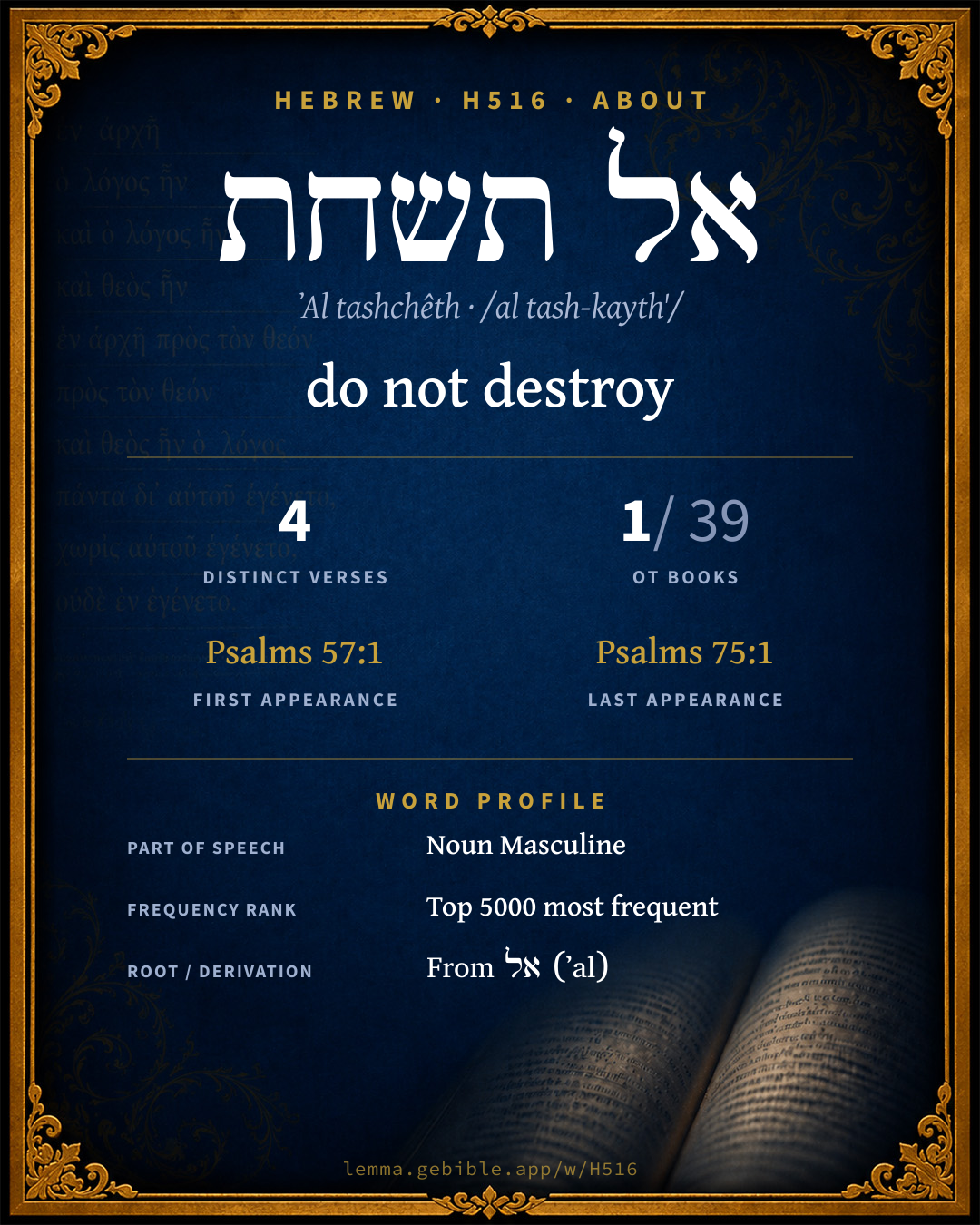
אַל תַּשְׁחֵת
do not destroy
‘do not destroy’ is one of 2 main senses fuller range ↓
Full lexicon entry — Brown-Driver-Briggs (BDB)
From Brown-Driver-Briggs (BDB)
Where this word appears
Grammar key — what these labels mean
Part of speech
- Particle
- A short function word — article, negation, interrogative, the sign of the direct object, and the like.
- Verb
- An action or state-of-being word.
Stem
- Hiphil
- The causative active stem (“he caused / brought about”). Here: ‘spoil’
Form
- Imperfect
- An incomplete, ongoing, or future action (“he will / would write”).
- Jussive
- A third- or second-person volitional form expressing wish or command (“let him write”).
Person
- 2nd Person
- The one addressed (“you”).
Gender
- Masculine
- Grammatically masculine.
Number
- Singular
- One.
Grammatical forms
- Particle, Negative 4 times (50%)
- Verb, Hiphil, Imperfect, 2nd Person, Masculine, Singular 3 times (38%)
- Verb, Hiphil, Jussive, 2nd Person, Masculine, Singular 1 time (13%)
Parsed forms decoded from the imported morphology (morphhb / Westminster Leningrad Codex — WLC text public domain, morphhb tagging CC BY 4.0), counted across 8 parsed occurrences — not distinct verses.
Every verse where H516 appears — 4 distinct verses across 1 book. Click any verse to open its interlinear word-by-word view. Verse text shown in the World English Bible for context — . Each verse’s Hebrew form is shown with its reference; the English is not keyword-highlighted, since the data carries no word-level English alignment. Use “Compare translations” on any verse to read it across multiple English versions. This concordance covers the Hebrew Bible; Septuagint (Greek Old Testament) occurrences are not indexed here.
Psalms 4 verses
- Psalms 57:1 אַל תַּ֭שְׁחֵת ptcl neg Hiphil juss 2ms Be merciful to me, God, be merciful to me, For my soul takes refuge in you. Yes, in the shadow of your wings, I will take refuge, Until disaster has passed.
- Psalms 58:1 אַל תַּשְׁחֵ֗ת ptcl neg Hiphil impf 2ms Do you indeed speak righteousness, silent ones? Do you judge blamelessly, you sons of men?
- Psalms 59:1 אַל תַּשְׁחֵת֮ ptcl neg Hiphil impf 2ms Deliver me from my enemies, my God. Set me on high from those who rise up against me.
- Psalms 75:1 אַל תַּשְׁחֵ֑ת ptcl neg Hiphil impf 2ms We give thanks to you, God, We give thanks, for your Name is near. Men tell about your wondrous works.
About this entry
At a glance — auto-summarized from this page’s data, not written by a person. Every figure links to its source below. This summary describes the numbers; it doesn’t interpret them.
אל תשחת — transliterated ʼAl tashchêth — is a Hebrew noun carrying the sense “do not destroy.” A scarce word — 4 verses in all of the Hebrew Bible. More than three-quarters of its appearances fall in Psalms. Debuting at Psalms 57:1, it then recurs through the corpus. It is not a single-sense word — see its full sense range. See the sense tree, 4-verse concordance, and the renderings breakdown below.
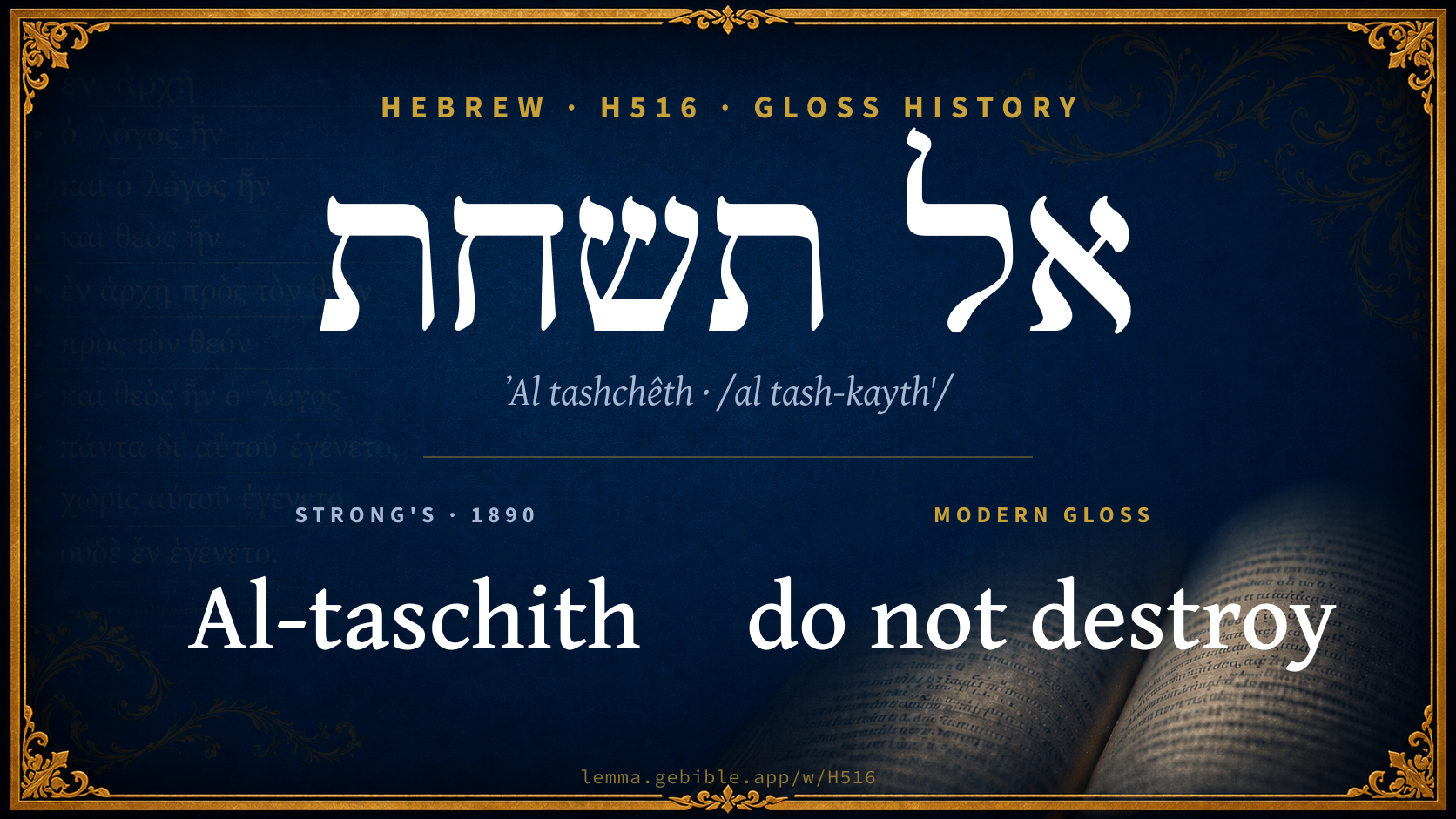
Gloss history
Strong's 1890 vs modern scholarship
About this word
Strong's H516 catalogs a Hebrew word from the Hebrew Old Testament.
These counts are not copied from any lexicon or concordance. They are computed here, from the morphology-tagged Hebrew Old Testament. What Lemma adds →
- 4
- distinct verses
- The word appears in 4 distinct verses.
- 1 / 39
- OT books
- The word appears in 1 of 39 Old Testament books.
- #2,625
- by frequency
- Top 5000 most frequent Hebrew words (rank 2,625 of 8,640 Hebrew words by occurrence).
View all 4 occurrences in the concordance →
Most concentrated in
- Psalms 4 verses 100%
By section of the Old Testament
By traditional corpus
Conventional, traditional groupings — biblical authorship is debated, so this is a traditional corpus grouping, not an authorship claim. Each share is this word’s portion of its verses in that division of the Hebrew canon. Each figure is a share of the word’s 4 distinct verses.
- Writings (Ketuvim) 4 verses · 100%
How translations render this word
Counts come from each version’s own published word-to-Strong’s tagging or interlinear alignment — an approximate guide to how each version renders this word, not a word-level alignment the data otherwise carries. Because each total is that version’s own tagged count, the per-version totals vary from one another and need not match the appearance or distinct-verse counts above. These counts may also differ from a printed concordance because Lemma counts each distinctly tagged rendering and does not collapse phrase taggings into a single head-word total. This is a fixed set of word-tagged versions (KJV, ASV, BSB, ULT) and does not change with the reading translation you choose elsewhere. Each version’s license is shown beside its name below (and on Sources).
- King James Version: Altaschith 4×
- Berean Standard Bible: Do not destroy 4×, Tune of 2×
King James Version Public Domain
Renders H516 across 4 tagged occurrences — most commonly:
Berean Standard Bible Public Domain
Renders H516 across 6 tagged occurrences — most commonly:
8 senses and sub-senses in the full BDB
Hebrew verbs can shift meaning by stem (binyan): Qal is the basic action, Niphal is often passive or reflexive, Piel often intensifies or makes it factitive, and Hiphil is typically causative. The senses below are grouped under the stem BDB assigns to each. This entry also uses Hophal (the passive of Hiphil).
What do BDB’s symbols mean?
BDB uses these scholarly abbreviations:
| Symbol | Meaning |
|---|---|
| 𝔊 | the Septuagint (the ancient Greek translation, LXX) |
| 𝔙 | the Vulgate (the Latin translation) |
| 𝔖 | the Syriac version (the Peshitta) |
| 𝔗 | the Targum (the Aramaic translation) |
| ψ | the Psalms |
| √ | root (the underlying root or stem) |
| ‖ | parallel passage (a synonymous or contrasted parallel) |
| † | the dagger: every passage where the word occurs is cited |
The 8 senses and sub-senses the full Brown-Driver-Briggs lexicon distinguishes for this word, in lexicon order (not ranked by frequency), with BDB’s own verbatim wording and sub-sense lettering. Shown in Hebrew script with BDB’s own scholarly abbreviations. The condensed entry is in the Lexicon Entry tab. See also the Forms in the corpus table below.
Niphal
- be marred, spoiled, Pf. 3 ms. נִשְׁחַת, of waistcloth Je 13:7, vessel 18:4; be injured, or even (hyperb.) ruined, Impf. 3 fs. תִּשָּׁחֵת Ex 8:20 (J) of land (מִפְּנֵי הֶעָרֹב); be corrupted, corrupt, in morals and rel., of earth, Pf. 3 fs. נִשְׁחָ֑תָה Gn 6:12 (P), Impf. 3 fs. וַתִּשּׁ׳ לִפְנֵי הָא׳ v 11 (P); so Pt. fpl. as adj. נִשְׁחָתוֹת Ez 20:44. e.g. Jeremiah 13:7
Piel
- Pf. 3 ms. שִׁחֵת Ex 32:7 +, sf. שִׁחֶתְךָ Ho 13:9; 2 ms. שִׁחַתָּ Is 14:20 +, etc.; Imv. mpl. שַׁחֵ֑תוּ Je 5:10; Inf. cstr. שַׁחֵת Gn 13:10 +, etc.;— e.g. Exodus 32:7
- 1. spoil, ruin, acc. of eye Ex 21:26 (E), vineyard Je 12:10 (fig.), branches Na 2:3 (fig.), also = destroy, acc. pers. 2 S 1:14; 14:11 (acc. om.), Ez 5:16; 20:17, כָּל־בָּשָׂר Gn 6:17; 9:15 (P), city, fortress, etc., Gn 13:10; 19:13, 29 (all J); 2 S 24:16; Je 5:10 (acc. om.) 48:18; Ez 26:4; 43:3; La 2:5, ruin temple v 6, nation Ho 11:9; 13:9 (read perhaps שִׁחַתִּךָ Oort Now), land 2 K 19:12 (Hiph. in ‖ Is 37:12), Ju 6:5 Jos 22:33 (P), Ez 22:30; 30:11, earth Gn 9:11 (P); c. ל obj. (ל 3 b), city 1 S 23:11, pers. Nu 32:15 (P); c. acc. רַחֲמָיו Am 1:11, destroyed (stifled) his compassion (or, RSK 28 al., the bonds of kinship, v. רַחֲמִים), בְּרִית Mal 2:8, i.e. violate it, v. especially וְשׁ׳ אַרְצָה (sc. semen) Gn 38:9 (J) he spoiled (it) upon the ground, made it ineffective, = waste words Pr 23:8. e.g. Exodus 21:26
- 2. pervert, corrupt, acc. wisdom Ez 28:17, abs. = deal corruptly, חֶעֱמִיקוּ שִׁחֵתוּ Ho 9:9 (cf. [עָמֹק], p. 770b; but We Now read שַׁחְתּוֹ, √ שׁוח), Ex 32:7 (JE), Dt 9:12, so שׁ׳ לוֹ 32:5. e.g. Ezekiel 28:17
Hiphil
- Pf. 3 ms. הִשְׁחִית Gn 6:12 +; 1 s. וְהִשְׁחַתִּ֫י Je 51:20, etc.; Impf. 3 ms. יַשְׁחִית Dn 8:24 +, יַשְׁחִת Mal 3:11 +, וַיַּשְׁחֵת 1 Ch 20:1; 2 fs. וַתַּשְׁחִתִי Ez 16:47, 2 mpl. תַּשְׁחִתוּן Dt 4:16; 31:29; Imv. ms. sf. הַשְׁחִיתָהּ 2 K 18:25 = Is 36:10; Inf. abs. הַשְׁחֵת Dt 31:29; cstr. הַשְׁחִית 1 S 26:15 +, etc.; Pt. מַשְׁחִית Gn 19:14 +, etc.;— e.g. Genesis 6:12
- 1. spoil, ruin, acc. crop Ju 6:4; Mal 3:11, trees Dt 20:19, 20; Je 11:19 (fig.), vessels 2 Ch 36:19, houses 34:11, palaces Je 6:5, cf. Is 65:8; Lv 19:27 (H), Ru 4:6; הִשׁ׳ דַּיָּם Je 49:9 thieves damage as much as they want; acc. pers. = ruin, destroy, 1 S 26:9, 15 Ju 20:21, 25 (+ אַ֫רְצָה), v 35, 42; 2 K 13:23; 2 Ch 24:23 (+ מִן separ.), + 12 times, + (acc. pers. om.) Is 51:13 + 4 times, acc. בֵּית דָּוִד 2 Ch 21:7, abs. Is 11:9 = 65:25; also ruin one (by words) Pr 11:9; acc. עַם 2 S 24:16; Dt 9:26; land 1 S 6:5; Je 36:29; Dn 11:17 (v. Dr); city wall 2 S 20:15 (Ew Th here denom. from שַׁחַת they were making a pit; מְהַשְּׁבִים were devising), La 2:8, cities and nations Gn 18:28(×2) (J, acc. om.), 19:13, 14 (J), Is 37:12 (Pi. in ‖ 2 K 19:12), 36:10(×2) = 2 K 18:25(×2) + 11 times + (Israel personif.) Dt 4:31; 10:10; 2 K 8:19, pride of Judah Je 13:9, earth Je 51:1; abs. c. adv. acc. Dn 8:24 (v. Dr; Bev conj. יְשׂחֵחַ or יָשִׂיחַ utter monstrous things), cf. 1 Ch 21:12; Pt. as adj., of lion Je 2:30, angel 1 Ch 21:15; = destroyer Ex 12:23 (J), Je 22:7; Is 54:16, מ׳ גּוֹיִם Je 4:7, רוּח מ׳ 51:1; sg. coll. (הַמּ׳ Ges§ 126 i; the destroying band, cf. Dr Bu Now) 1 S 13:17; 14:15 (spoilers, ravagers); fig. for snare, trap, Je 5:26. e.g. Judges 6:4
- 2. pervert, corrupt, morally, acc. דֶּרֶךְ Gn 6:12 (P; v. דֶּרֶךְ 6), נַפְשׁוֹ Pr 6:32, cf. Zp 3:7; Ez 23:11 (מִן comp.); הִשׁ׳ הִתְעִיבוּ עֲלִילָה ψ 14:1 = 53:2; הַשְׁהֵת תַּשְׁח׳ (+ vb. of particular act) Dt 4:16; 31:29; declar. = act corruptly, Is 1:4; Dt 4:25 (+ vb. of act), 2 Ch 27:2, + מִן comp. Ju 2:19; Ez 16:47; Pt. as subst. Je 6:28, אִישׁ מַשׁ׳ Pr 28:24 (18:9 v. infra).—אַל־תַּשְׁחֵת destroy not (catchword of old song or melody?) in ψ-titles: †57:1; 58:1; 59:1; 75:1. e.g. Genesis 6:12
Hophal
- Pt. מָשְׁחָת spoiled, ruined, of a spring, מָקוֹר Pr 25:26 (‖ מַעְיָן נִרְפָּשׂ); as subst. Mal 1:14 sacrificing a spoiled thing. e.g. Proverbs 25:26
Senses from the full Brown-Driver-Briggs lexicon (Brown, Driver, Briggs; Oxford 1906 — public domain), digitized via Sefaria, supplemented by the OpenScriptures HebrewLexicon (CC BY 4.0). Full attribution on Sources.
Word origin
vb. go to ruin (?), only der. spec. (NH Hiph. = BH, Ecclus. שחיתה 30:11 corrupt act; Arabic سَحَتَ extirpate; Ethiopic ሰሐጠ: injure, violate; TelAm. šaḫâtu is fall (especially of city), be prostrate (? of land), perhaps Canaanism (v. WklTelAm. Vocab.), Assyrian poss. šêtu, flee, escape (cf. אבד); Old Aramaic (Zinj.) שחת destroy Lzb374, Aramaic שְׁחַת, ܫܰܚܶܛ (assim. of ܬ), mutilate;—very improb. Gerber179 denom. from שַׁחַת);—
— Brown-Driver-Briggs (Oxford 1906, public domain), digitized via Sefaria, supplemented by the OpenScriptures HebrewLexicon (CC BY 4.0). See Sources.
Derived from אל (ʼal) (H408) — not.
Forms in the corpus
The 5 distinct written forms H516 takes in the Hebrew Bible, most frequent first — each parse links to that stem’s occurrences in the concordance. Hebrew forms include their vowel points and cantillation, so a single lemma takes many written forms.
| Form | Parsing | Example | Uses |
|---|---|---|---|
| אַל | Particle, Negative | Psalms 57:1 | 4 |
| תַּ֭שְׁחֵת | Verb, Hiphil, Jussive, 2nd Person, Masculine, Singular | Psalms 57:1 | 1 |
| תַּשְׁחֵ֑ת | Verb, Hiphil, Imperfect, 2nd Person, Masculine, Singular | Psalms 75:1 | 1 |
| תַּשְׁחֵ֗ת | Verb, Hiphil, Imperfect, 2nd Person, Masculine, Singular | Psalms 58:1 | 1 |
| תַּשְׁחֵת֮ | Verb, Hiphil, Imperfect, 2nd Person, Masculine, Singular | Psalms 59:1 | 1 |
Same root — word family
Other BDB entries built from the same root as H516, grouped by Strong’s listed origin. These share a root / origin per the lexicon — not necessarily a shared meaning. Each links to that word’s own entry.
Derives from
Shares the same root
Compare all same-root words → Showing 4 of 6 — not the complete family. They share a root, not necessarily a meaning.
Septuagint verse parallels
This word appears in 4 verses that also exist in the Greek Old Testament (Septuagint), out of the 4 Hebrew verses it occurs in. You can read those verses in Greek by switching the Old Testament edition to the Septuagint.
Read these verses in the Septuagint
This is a verse-level parallel only — the same verses exist in both the Hebrew and Greek Old Testaments. No word-level Hebrew↔Greek correspondence is claimed: the data carries no such alignment, so no Greek word is shown as this Hebrew word’s translation. Coverage is not total — the Septuagint omits the deuterocanon and renumbers the Psalms, so some Hebrew verses have no direct Greek parallel.