
Exodus 8:29

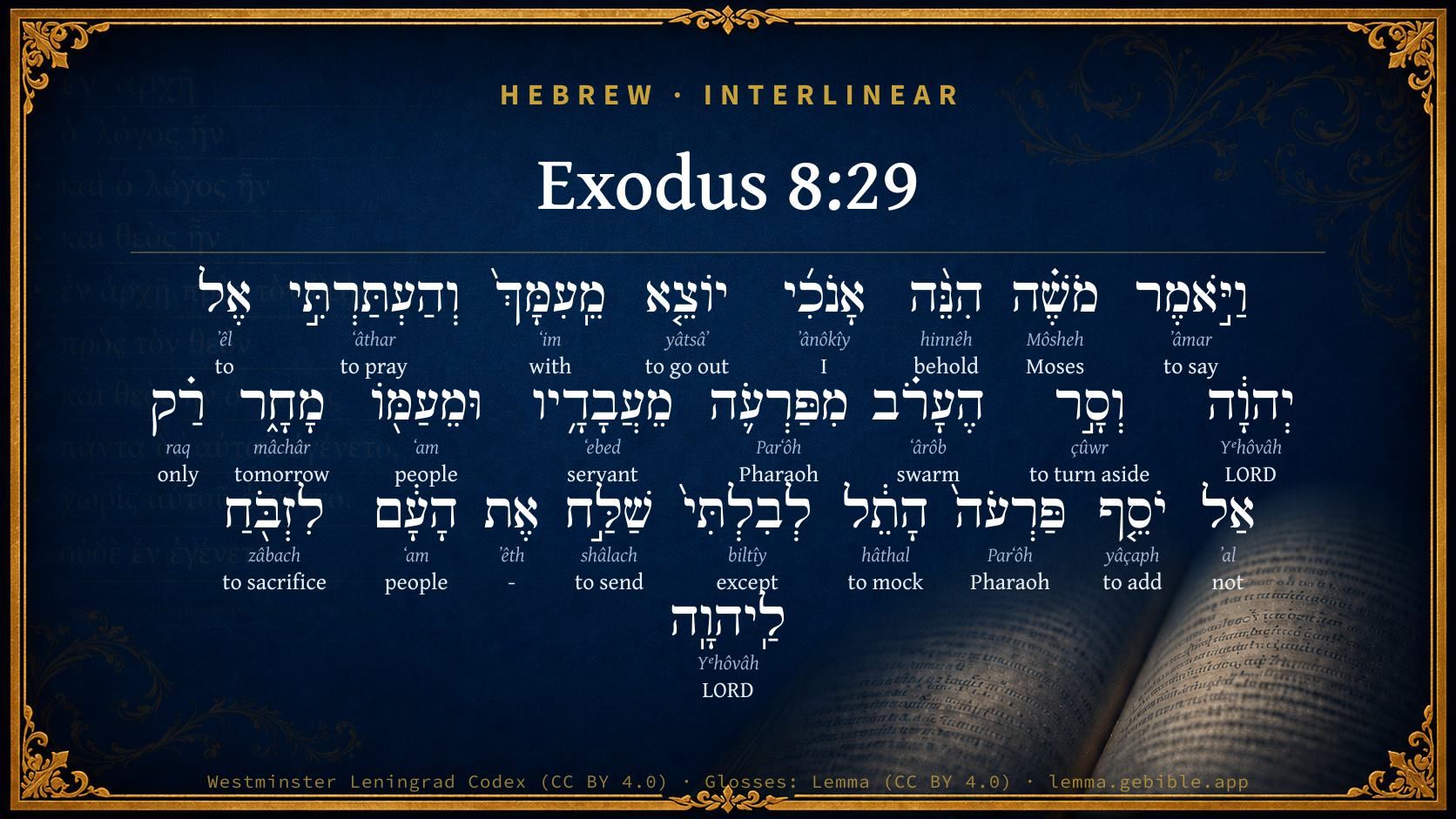
Hebrew (Westminster Leningrad Codex) Exodus 8:29 appears in the Hebrew Old Testament. The text above is from the Westminster Leningrad Codex. Each word links to its Strong’s number, a concise gloss, and parsing drawn from the Open Scriptures Hebrew Bible morphology. Click any word for its full Brown-Driver-Briggs (BDB) entry.
Download image
Cite this verse

Exodus 8:29 (World English Bible). Public Domain. Lemma interlinear Bible study tool, https://lemma.gebible.app/v/exodus/8/29.

Show BibTeX & RIS
BibTeX
RIS
English Translation
Moses said, "Behold, I go out from you, and I will pray to Yahweh that the swarms of flies may depart from Pharaoh, from his servants, and from his people, tomorrow; only don't let Pharaoh deal deceitfully any more in not letting the people go to sacrifice to Yahweh."
World English Bible · Public Domain
Download a study sheet

One document with this verse’s original text, its word-by-word gloss line, the meaning frame, cross-references with their text, attributed commentary, and full source and license credits — printable, and it pastes into notes with its structure intact.

This verse Autodidact and up

Study sheet (.html) Plain text (.txt)

A passage Seminary Student

Up to 50 verses in one chapter. A passage sheet keeps up to 6 commentary sources and 12 cross-references per verse, in the order this page ranks them, and says so on the sheet whenever that leaves anything out. Ask for a single verse and you get the Autodidact verse sheet above.

Everything on this page stays free to read, with no account — the sheet is a download of what is already on screen, not access to it.

Want to remove ads? Support Godless Engineer
Compare translations 3

The same verse in 3 English versions, stacked beneath the original-language interlinear above. Click any original word for its lexicon entry.

Each is an independent rendering of the whole verse — the interlinear is not word-aligned to these translations.

Highlighted words mark where these versions differ — a whole-verse word diff, not a word-by-word alignment.

  • World English Bible Public Domain
    Moses said, "Behold, I go out from you, and I will pray to Yahweh that the swarms of flies may depart from Pharaoh, from his servants, and from his people, tomorrow; only don't let Pharaoh deal deceitfully any more in not letting the people go to sacrifice to Yahweh."
  • King James Version Public Domain
    And Moses said, Behold, I go out from thee, and I will entreat the LORD that the swarms of flies may depart from Pharaoh, from his servants, and from his people, to morrow: but let not Pharaoh deal deceitfully any more in not letting the people go to sacrifice to the LORD.
  • unfoldingWord Literal Text CC BY-SA 4.0
    And Moses said, “Behold, I am about to go out from with you. And I shall pray to Yahweh, and he will withdraw the swarm from Pharaoh, from his servants, and from his people tomorrow. Only may Pharaoh not continue to deceive in order to fail to let the people go to sacrifice to Yahweh.”

unfoldingWord Literal Text — © unfoldingWord, licensed CC BY-SA 4.0. Word-aligned USFM3 via Door43 (git.door43.org/unfoldingWord/en_ult).

Versions to compare (up to 4)

3 of 4 selected

Show all 18 translations

Every available English version of this verse, each an independent rendering of the whole verse.

  • World English Bible Public Domain
    Moses said, "Behold, I go out from you, and I will pray to Yahweh that the swarms of flies may depart from Pharaoh, from his servants, and from his people, tomorrow; only don't let Pharaoh deal deceitfully any more in not letting the people go to sacrifice to Yahweh."
  • Berean Standard Bible Public Domain
    “As soon as I leave you,” Moses said, “I will pray to the LORD, so that tomorrow the swarms of flies will depart from Pharaoh and his officials and his people. But Pharaoh must not act deceitfully again by refusing to let the people go and sacrifice to the LORD.”
  • Majority Standard Bible Public Domain
    “As soon as I leave you,” Moses said, “I will pray to the LORD, so that tomorrow the swarms of flies will depart from Pharaoh and his officials and his people. But Pharaoh must not act deceitfully again by refusing to let the people go and sacrifice to the LORD.”
  • King James Version Public Domain
    And Moses said, Behold, I go out from thee, and I will entreat the LORD that the swarms of flies may depart from Pharaoh, from his servants, and from his people, to morrow: but let not Pharaoh deal deceitfully any more in not letting the people go to sacrifice to the LORD.
  • American Standard Version (1901) Public Domain
    And Moses said, Behold, I go out from thee, and I will entreat Jehovah that the swarms of flies may depart from Pharaoh, from his servants, and from his people, to-morrow: only let not Pharaoh deal deceitfully any more in not letting the people go to sacrifice to Jehovah.
  • Revised Version (1885) Public Domain
    And Moses said, Behold, I go out from thee, and I will entreat the LORD that the swarms of flies may depart from Pharaoh, from his servants, and from his people, tomorrow: only let not Pharaoh deal deceitfully any more in not letting the people go to sacrifice to the LORD.
  • Geneva Bible (1599) Public Domain
    And Moses said, Behold, I will go out from thee, and pray vnto the Lord, that the swarmes of flies may depart from Pharaoh, from his seruants, and from his people to morowe: but let Pharaoh from hencefoorth deceiue no more, in not suffering the people to sacrifice vnto the Lord.
  • Douay-Rheims (1899) Public Domain
    And Moses said: I will go out from thee, and will pray to the Lord: and the flies shall depart from Pharao, and from his servants, and from his people tomorrow: but do not deceive any more, in not letting the people go to sacrifice to the Lord.
  • Young's Literal Translation Public Domain
    and Moses saith, `Lo, I am going out from thee, and have made supplication unto Jehovah, and the beetle hath turned aside from Pharaoh, from his servants, and from his people -- to-morrow, only let not Pharaoh add to deceive -- in not sending the people away to sacrifice to Jehovah.'
  • Literal Standard Version CC BY-SA 4.0
    and Moses says, “Behold, I am going out from you, and have made supplication to YHWH, and tomorrow the beetle has turned aside from Pharaoh, from his servants, and from his people; only, do not let Pharaoh add to deceive in not sending the people away to sacrifice to YHWH.”
  • Unlocked Literal Bible CC BY-SA 4.0
    Moses said, “As soon as I go out from you, I will pray to Yahweh that the swarms of flies may leave you, Pharaoh, and your servants and people tomorrow. But you must not deal deceitfully any more by not letting our people go to sacrifice to Yahweh.”
  • unfoldingWord Literal Text CC BY-SA 4.0
    And Moses said, “Behold, I am about to go out from with you. And I shall pray to Yahweh, and he will withdraw the swarm from Pharaoh, from his servants, and from his people tomorrow. Only may Pharaoh not continue to deceive in order to fail to let the people go to sacrifice to Yahweh.”
  • Darby Bible Public Domain
    And Moses said, Behold, I go out from thee, and will intreat Jehovah; and the dog-flies will depart from Pharaoh, from his bondmen, and from his people, to-morrow; only let not Pharaoh deal deceitfully any more in not letting the people go to sacrifice to Jehovah.
  • World Messianic Bible Public Domain
    Moses said, “Behold, I am going out from you. I will pray to the LORD that the swarms of flies may depart from Pharaoh, from his servants, and from his people, tomorrow; only don’t let Pharaoh deal deceitfully any more in not letting the people go to sacrifice to the LORD.”
  • Webster's Bible Public Domain
    And Moses said, Behold, I go out from thee, and I will entreat the LORD that the swarms of flies may depart from Pharaoh, from his servants, and from his people, to-morrow: but let not Pharaoh deal deceitfully any more, in not letting the people go to sacrifice to the LORD.
  • Free Bible Version CC BY-SA 4.0
    “As soon as I leave you, I will pray to the Lord,” Moses replied, “and tomorrow the flies will leave Pharaoh and his officials and his people. But Pharaoh should be sure not to be deceitful again and refuse to let the people go and offer sacrifices to the Lord.”
  • Bible in Basic English Public Domain
    And Moses said, When I go out from you I will make prayer to the Lord that the cloud of flies may go away from Pharaoh and from his people and from his servants tomorrow: only let Pharaoh no longer by deceit keep back the people from making their offering to the Lord.
  • JPS Tanakh (1917) Public Domain
    (8-25) And Moses said: 'Behold, I go out from thee, and I will entreat the LORD that the swarms of flies may depart from Pharaoh, from his servants, and from his people, tomorrow; only let not Pharaoh deal deceitfully any more in not letting the people go to sacrifice to the LORD.'

Literal Standard Version (2020), Covenant Press — licensed CC BY-SA 4.0. Text via the HelloAO Bible API (eBible.org). Unlocked Literal Bible (unfoldingWord) — licensed CC BY-SA 4.0. Text via the HelloAO Bible API (eBible.org). unfoldingWord Literal Text — © unfoldingWord, licensed CC BY-SA 4.0. Word-aligned USFM3 via Door43 (git.door43.org/unfoldingWord/en_ult). Free Bible Version, Dr. Jonathan Gallagher — licensed CC BY-SA 4.0. Text via the HelloAO Bible API (eBible.org).

Word by word

More ways to search: Search by grammar → Find every occurrence → Compare this word →

Practice this passage: Drill this verse → Learn its vocabulary →

הֶעָרֹ֗ב
ʻârôb
H6157
“the · swarm”
Particle, Definite Article + Noun, Common, Masculine, Singular, Absolute
Part of Speech
Particle + Noun
Type
Common
Gender
Masculine
Number
Singular
State
Absolute
Full BDB Definition

Origin: from H6148

TWOT: 1685c

swarm - probable meaning from 'mixture' and 'incessant or involved motion'
  1. וַיֹּ֣אמֶר ʼâmar H559 “and · to say” Conjunction + Verb, Qal, Sequential Imperfect, 3rd Person, Masculine, Singular
  2. מֹשֶׁ֗ה Môsheh H4872 “Moses” Noun, Proper
  3. הִנֵּ֨ה hinnêh H2009 “behold” Particle, Demonstrative
  4. אָנֹכִ֜י ʼânôkîy H595 “I” Pronoun, Personal, 1st Person, Common, Singular
  5. יוֹצֵ֤א yâtsâʼ H3318 “going out” Verb, Qal, Participle Active, Masculine, Singular, Absolute
  6. מֵֽעִמָּךְ֙ ʻim H5973 “from · with · you” Preposition + Preposition + Suffix, Personal, 2nd Person, Feminine, Singular
  7. וְהַעְתַּרְתִּ֣י ʻâthar H6279 “and · to pray” Conjunction + Verb, Hiphil, Sequential Perfect, 1st Person, Common, Singular
  8. אֶל ʼêl H413 “to” Preposition
  9. יְהוָ֔ה Yᵉhôvâh H3068 “LORD” Noun, Proper
  10. וְסָ֣ר çûwr H5493 “and · to turn aside” Conjunction + Verb, Qal, Sequential Perfect, 3rd Person, Masculine, Singular
  11. מִפַּרְעֹ֛ה Parʻôh H6547 “from · Pharaoh” Preposition + Noun, Proper
  12. מֵעֲבָדָ֥יו ʻebed H5650 “from · servants · his” Preposition + Noun, Common, Masculine, Plural, Construct + Suffix, Personal, 3rd Person, Masculine, Singular
  13. וּמֵעַמּ֖וֹ ʻam H5971 “and · from · people · his” Conjunction + Preposition + Noun, Common, Masculine, Singular, Construct + Suffix, Personal, 3rd Person, Masculine, Singular
  14. מָחָ֑ר mâchâr H4279 “tomorrow” Noun, Common, Masculine, Singular, Absolute
  15. רַ֗ק raq H7535 “only” Particle, Accusative
  16. אַל ʼal H408 “not” Particle, Negative
  17. יֹסֵ֤ף yâçaph H3254 “to add” Verb, Hiphil, Jussive, 3rd Person, Masculine, Singular
  18. פַּרְעֹה֙ Parʻôh H6547 “Pharaoh” Noun, Proper
  19. הָתֵ֔ל hâthal H2048 “to mock” Verb, Hiphil, Infinitive Construct
  20. לְבִלְתִּי֙ biltîy H1115 “to/for · except” Preposition + Conjunction
  21. שַׁלַּ֣ח shâlach H7971 “to send” Verb, Piel, Infinitive Construct
  22. אֶת ʼêth H853 “-” Particle, Direct Object
  23. הָעָ֔ם ʻam H5971 “the · people” Particle, Definite Article + Noun, Common, Masculine, Singular, Absolute
  24. לִזְבֹּ֖חַ zâbach H2076 “to sacrifice” Preposition + Verb, Qal, Infinitive Construct
  25. לַֽיהוָֽה Yᵉhôvâh H3068 “to/for · LORD” Preposition + Noun, Proper

About this verse

These counts appear in no published source. They are computed here, from the morphology-tagged text and Lemma’s own curated glosses. What Lemma adds →

26
words
23
distinct lemmas
Pentateuch
section

Notable vocabulary

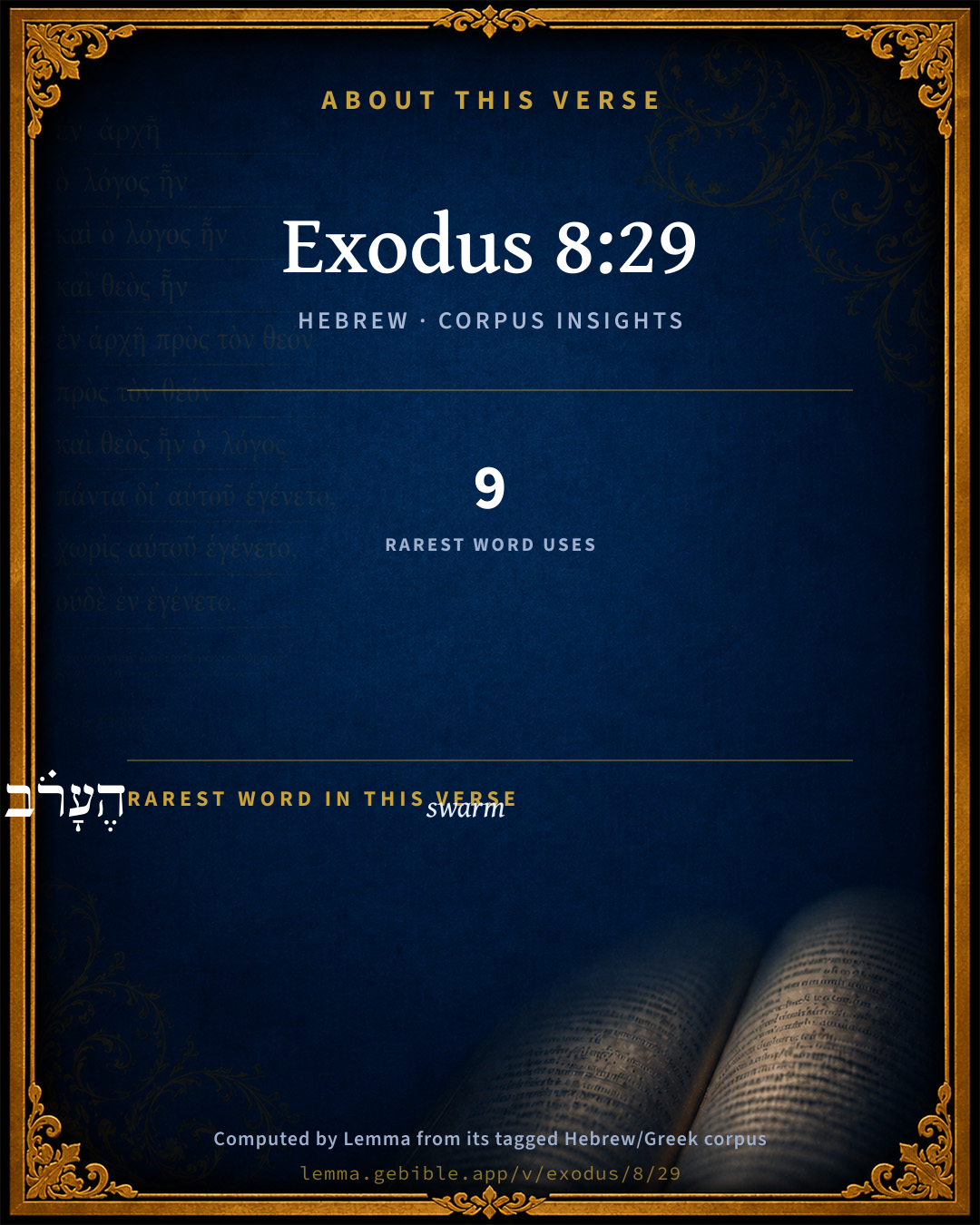
The rarest word here is הֶעָרֹ֗ב swarm H6157 — appearing just 9 times in the whole Hebrew Bible.

Shared distinctive vocabulary

הֶעָרֹ֗ב swarm H6157 occurs in 7 verses of the Hebrew Bible. Also found in:

Grammatical profile

  • 8 verbs
  • 10 nouns
  • 1 pronoun
  • 2 prepositions
  • 1 conjunction
  • 4 particles

Verb forms

  • וַיֹּ֣אמֶר Qal · Sequential Imperfect
  • יוֹצֵ֤א Qal · Participle Active
  • וְהַעְתַּרְתִּ֣י Hiphil · Sequential Perfect
  • וְסָ֣ר Qal · Sequential Perfect
  • יֹסֵ֤ף Hiphil · Jussive
  • הָתֵ֔ל Hiphil · Infinitive Construct
  • שַׁלַּ֣ח Piel · Infinitive Construct
  • לִזְבֹּ֖חַ Qal · Infinitive Construct

Repetition

Words recur within this verse — often emphatic in Hebrew:

  • יְהוָ֔ה LORD H3068 ×2
  • מִפַּרְעֹ֛ה Pharaoh H6547 ×2
  • וּמֵעַמּ֖וֹ people H5971 ×2

Hebrew & Septuagint length

In English translation the verse runs 49 words from the Hebrew and 48 from the Septuagint (LXX English) — closely comparable.

A rough comparison of the two English renderings, which tokenize alike — not a word-level alignment.

Word counts can differ between the Hebrew and the Greek without any difference in meaning — e.g. the Hebrew direct-object marker אֵת has no separate Greek word, and Greek often adds the article ὁ.

Cross-references

7

Topical passages linked to Exodus 8:29 in the Treasury of Scripture Knowledge — connected by theme and wording, ordered by reader-vote popularity; previews shown in the World English Bible.

  • Exodus 8:15 But when Pharaoh saw that there was a respite, he hardened his heart, and didn't listen to them, as Yahweh had spoken.
  • Exodus 8:8 Then Pharaoh called for Moses and Aaron, and said, "Entreat Yahweh, that he take away the frogs from me, and from my people; and I will let the people go, that they may sacrifice to Yahweh."
  • Jeremiah 42:20–21 For you have dealt deceitfully against your own souls; for you sent me to Yahweh your God, saying, Pray for us to Yahweh our God; and according to all that Yahweh our God shall say, so declare to us, and we will do it:
  • Psalms 66:3 Tell God, "How awesome are your deeds! Through the greatness of your power, your enemies submit themselves to you.
  • Psalms 78:34–37 When he killed them, then they inquired after him. They returned and sought God earnestly.
  • Acts 5:3–4 But Peter said, "Ananias, why has Satan filled your heart to lie to the Holy Spirit, and to keep back part of the price of the land?
  • Galatians 6:7 Don't be deceived. God is not mocked, for whatever a man sows, that will he also reap.

Cross-references courtesy of OpenBible.info (CC BY 4.0).

Hebrew and Greek witnesses Masoretic Hebrew ↔ Greek Septuagint

The same verse in the two great witnesses to the Old Testament, shown verse-for-verse.

These are two independent witnesses, not word-aligned to each other, and the Septuagint is shown in lemma (dictionary) form.

Hebrew Exodus 8:29 Masoretic · Westminster Leningrad Codex

וַיֹּ֣אמֶר מֹשֶׁ֗ה הִנֵּ֨ה אָנֹכִ֜י יוֹצֵ֤א מֵֽעִמָּךְ֙ וְהַעְתַּרְתִּ֣י אֶל יְהוָ֔ה וְסָ֣ר הֶעָרֹ֗ב מִפַּרְעֹ֛ה מֵעֲבָדָ֥יו וּמֵעַמּ֖וֹ מָחָ֑ר רַ֗ק אַל יֹסֵ֤ף פַּרְעֹה֙ הָתֵ֔ל לְבִלְתִּי֙ שַׁלַּ֣ח אֶת הָעָ֔ם לִזְבֹּ֖חַ לַֽיהוָֽה

Moses said, "Behold, I go out from you, and I will pray to Yahweh that the swarms of flies may depart from Pharaoh, from his servants, and from his people, tomorrow; only don't let Pharaoh deal deceitfully any more in not letting the people go to sacrifice to Yahweh."

World English Bible · Public Domain

Greek LXX Exodus 8:29 Septuagint · lemma form
And Moses said, I then will go forth from you and pray to God, and the dog-fly shall depart both from your servants, and from your people to-morrow. Do not you, Pharao, deceive again, so as not to send the people away to do sacrifice to the Lord.

LXX2012 (modern English Septuagint) · Public Domain

Hebrew: Westminster Leningrad Codex (CC BY 4.0). Greek: Septuagint (public domain); English from LXX2012 (modern English Septuagint) (Public Domain). How the Septuagint differs from the Hebrew →

Commentary

Notes on Exodus 8:29 from classic Christian and Jewish commentators (each source and its license shown beneath its notes). The classic Christian expositions comment on the surrounding passage and are grouped to its opening verse, so a note may address several verses; the Jewish commentaries on the Tanakh (Rashi and others) are per-verse, so they appear only where the commentator wrote on this verse.

Lemma curates 59 commentaries, every one of them public domain or Creative Commons licensed, each selected and text-cleaned for this edition rather than reprinted as found. About our sources →

Trapp's Complete Commentary

John Trapp

Exo 8:29 And Moses said, Behold, I go out from thee, and I will intreat the LORD that the swarms [of flies] may depart from Pharaoh, from his servants, and from his people, to morrow: but let not Pharaoh deal deceitfully any more in not letting the people go to sacrifice to the LORD.

Ver. 29. Deal deceitfully any more.] Some are so slippery, there is no believing of them. Egesippus saith of Pilate, that he was vir nequam, et parvifaciens mendacium, a naughty man, and one that made no conscience of a lie. No more did Pharaoh.

John Trapp, A Commentary or Exposition upon All the Books of the Old and New Testament (1647–1656) — public domain. Text from a community e-Sword module.

Tyndale Open Study Notes

Tyndale Open Resources

8:29-30 I will pray: Moses was learning the role of intercessor that would be so much a part of his life in future years (see, e.g., 32:11-13, 30-32; Num 14:13-19). It must have been increasingly tempting to let the Egyptians continue to experience the results of their king’s stubbornness, but Moses was willing to plead with God not to leave them in a permanent state of grief and distress.

Tyndale Open Study Notes — © Tyndale Open Resources, licensed CC BY-SA 4.0. Text via the HelloAO Bible API.

Geneva Bible (1599)

Geneva Bible translators

He could not judge his heart, but yet he charged him to do this unfeignedly.

Geneva Bible (1599) marginal notes — public domain. Text via Bolls.life.

Ellicott's Commentary for English Readers

(29) And Moses said, Behold . . . I will in-treat the Lord.—Moses accepted Pharaoh’s second promise, and took no special exception to its condition —“only ye shall not go very far away.” He had distinctly stated his own demand, which was for “a three days’ journey into the wilderness” (Exo_5:3; Exo_8:27). It was for Pharaoh to settle with himself whether he considered that distance “very far” or not. As he made no clear objection to the distance, Moses was bound to suppose that he allowed it.

Let not Pharaoh deal deceitfully any more. God’s servants must rebuke even kings when they openly break the moral law (1Sa_13:13; 1Sa_15:16-23; 2Sa_12:7-12; 1Ki_21:20-22; Mat_14:4. &c.). Pharaoh had promised unconditionally to let the people go if the frogs were removed (Exo_8:8), and had. then flagrantly broken his word. Moses was right to rebuke his “deceit.”

A Bible Commentary for English Readers, edited by Charles John Ellicott (1878–1897) — public domain. Text from a community e-Sword module.

The Cambridge Bible for Schools and Colleges

gen. ed. J. J. S. Perowne

29. to-morrow] Cf. v. 10; and on v. 23.

deal deceitfully] properly, mock (1Ki_18:27), so as to deceive (Gen_31:7, Jdg_16:10; Jdg_16:13; Jdg_16:15).

any more] as in v. 15, after the promise of v. 8.

The Cambridge Bible for Schools and Colleges (gen. ed. J. J. S. Perowne; Cambridge University Press, 1878–1918) — public domain. Text from a community e-Sword module.

John Gill's Exposition

And Moses went out from Pharaoh, and entreated the Lord. He did as he promised he would, and prayed to the Lord to remove the flies from Pharaoh and his people.

And Moses went out from Pharaoh, and entreated the Lord. He did as he promised he would, and prayed to the Lord to remove the flies from Pharaoh and his people.

Exodus 8:31

exo 8:31

exo 8:31

exo 8:31And the Lord did according to the word of Moses,.... Did as he entreated him to do, as follows:

and he removed the swarms of flies from Pharaoh, from his servants, and from his people; by what means is not said, whether by destroying them at once, as the frogs, or by driving them away with a wind, as the locusts afterwards:

there remained not one; the meaning is not, not one swarm of flies, but not one fly, there was not one left; which looks as if it was in the latter way that they were removed, since, if in the former, they would have remained, though dead, as the frogs did, for a little while.

John Gill's Exposition of the Whole Bible (1746–1763) — public domain (CC PDM 1.0). Text via the HelloAO Bible API.

The Pulpit Commentary

To-morrow. As Pharaoh had fixed the "morrow" for the departure of the second plague (ver. 10), so Moses now announces a similar date for the departure of the fourth. He adds a remonstrance against any further deceit or tergiversation, which Pharaoh must have felt to be well deserved.

The duty of God"s servants to rebuke the great of the earth.

not Pharaoh deal deceitfully any more." Deceit is despicable in the meanest of men. How much more in a king! Subterfuge, tricks, lies, are said to be the refuge of the weak, the only resource whereby they can meet and defend themselves against the violence and oppressiveness of the strong. What need has a king of them? A king drags his honour in the dust when he forfeits his word, and does more to lower the dignity of kings in general than fifty rebels or revolutionists. Our own "King Charles the Martyr" has lost half the sympathy which he would otherwise have obtained, by his lamentable want of straightforwardness and steadfastness. And when kings err, in this or any other way, it is the duty of those who have the opportunity, to rebuke them. Elijah rebuked Ahab; Azariah, son of Oded, rebuked Asa; Eliezer, Jehoshaphat; Azarlah the high priest, Uzziah; John Baptist, Herod Antipas. Jesus himself spoke of Herod as "that fox," The great are very apt to urge that whoever says a word in their dispraise is "speaking evil of dignities"(Jud_1:8), and so offending against the law of God. But the examples cited show that "dignities" have no claim to exemption from the rebukes and reproofs of God"s servants. Dignities ought to be above needing rebuke. They ought to set an example of virtue and highmindedness, and, above all, of regard for their word, when once they have pledged it. What might be forgiven in inferior men, cannot be Pardoned in them. "Be wise, O ye kings; be instructed, ye judges of the earth." "A city set on a hill cannot be hid."

The Pulpit Commentary (1880–1919), ed. H.D.M. Spence-Jones & Joseph S. Exell — public domain. Text from a community e-Sword module.

Lesson kit

Teaching starters — assembled from the data on this page, not authored interpretation. Every prompt links to the verse data it draws on. Edit before teaching.

Exodus, in the Pentateuch, opens this verse with 26 words (23 distinct Hebrew lemmas). Its most distinctive word is ʻârôb (“swarm”). A historical commentator’s framing appears above. Read the whole chapter for the surrounding context.

Discussion questions

  1. The word ʻârôb carries the sense “swarm.” How does it shape the verse?
  2. How does Exodus 8:21, which shares the word «swarm», read alongside this verse?
  3. What does the repetition of “LORD” (2× in this one verse) do in this verse?
  4. These translations render this verse differently. What is at stake in choosing one wording over another?
  5. «וַיֹּ֣אמֶר» is a Qal Sequential Imperfect verb. How does that grammatical form shape the action described?
  6. Compare how Trapp's Complete Commentary and Tyndale Open Study Notes read this verse. Where do they agree or differ?

Things to notice

Reading settings

Reading text

Shown beneath each verse's original-language words.

Old Testament
Old Testament edition

Read the OT as the Masoretic Hebrew (MT) or the Greek Septuagint (LXX).

English shown for the Greek Septuagint (in the Hebrew ↔ Greek comparison).

Comparing translations? Open the Compare panel on any verse page to stack up to four side by side.