
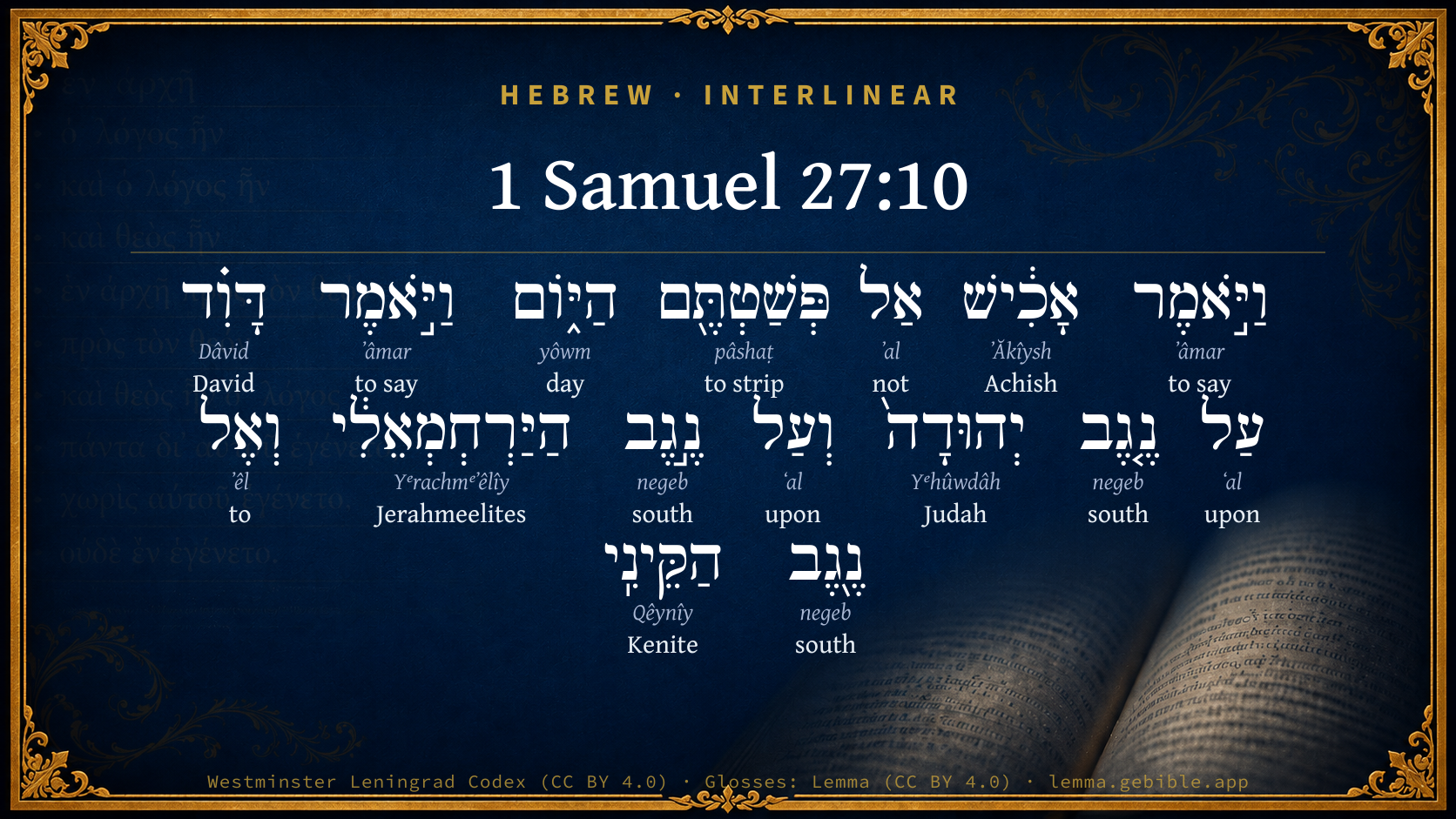
1 Samuel 27:10

Hebrew (Westminster Leningrad Codex) 1 Samuel 27:10 appears in the Hebrew Old Testament. The text above is from the Westminster Leningrad Codex. Each word links to its Strong’s number, a concise gloss, and parsing drawn from the Open Scriptures Hebrew Bible morphology. Click any word for its full Brown-Driver-Briggs (BDB) entry.
Download image
Cite this verse

1 Samuel 27:10 (World English Bible). Public Domain. Lemma interlinear Bible study tool, https://lemma.gebible.app/v/1-samuel/27/10.

Show BibTeX & RIS
BibTeX
RIS
English Translation
Achish said, Against whom have you made a raid today? David said, Against the South of Judah, and against the South of the Jerahmeelites, and against the South of the Kenites.
World English Bible · Public Domain
Highlights
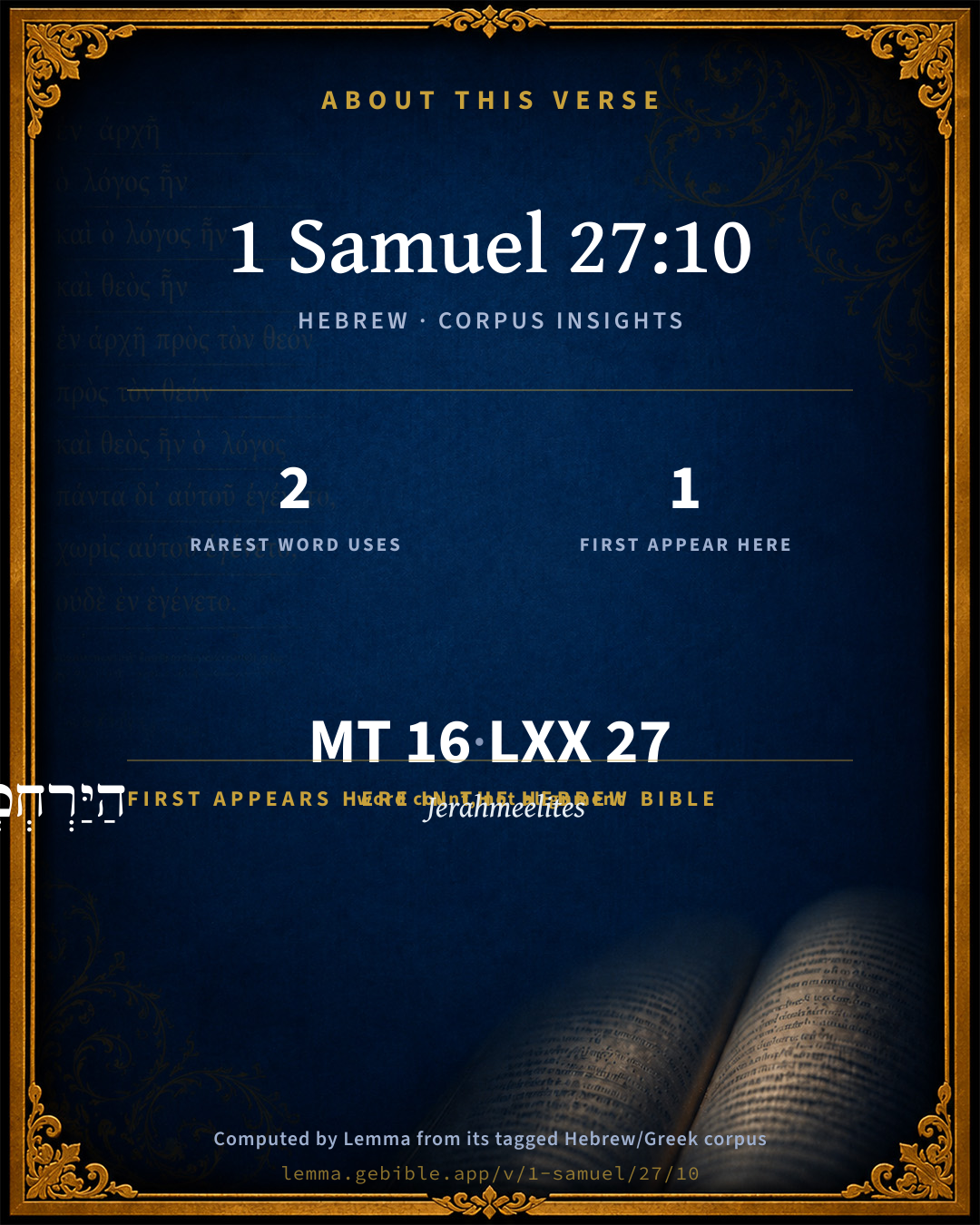
  • 1 first appearance in the Hebrew Bible
Full analysis ↓
Download a study sheet

One document with this verse’s original text, its word-by-word gloss line, the meaning frame, cross-references with their text, attributed commentary, and full source and license credits — printable, and it pastes into notes with its structure intact.

This verse Autodidact and up

Study sheet (.html) Plain text (.txt)

A passage Seminary Student

Up to 50 verses in one chapter. A passage sheet keeps up to 6 commentary sources and 12 cross-references per verse, in the order this page ranks them, and says so on the sheet whenever that leaves anything out. Ask for a single verse and you get the Autodidact verse sheet above.

Everything on this page stays free to read, with no account — the sheet is a download of what is already on screen, not access to it.

Want to remove ads? Support Godless Engineer
Compare translations 3

The same verse in 3 English versions, stacked beneath the original-language interlinear above. Click any original word for its lexicon entry.

Each is an independent rendering of the whole verse — the interlinear is not word-aligned to these translations.

Highlighted words mark where these versions differ — a whole-verse word diff, not a word-by-word alignment.

  • World English Bible Public Domain
    Achish said, Against whom have you made a raid today? David said, Against the South of Judah, and against the South of the Jerahmeelites, and against the South of the Kenites.
  • King James Version Public Domain
    And Achish said, Whither have ye made a road to day? And David said, Against the south of Judah, and against the south of the Jerahmeelites, and against the south of the Kenites.
  • unfoldingWord Literal Text CC BY-SA 4.0
    And Achish said, “Have you not raided today?” And David said, “Against the Negeb of Judah” or “against the Negeb of the Jerahmeelite” or “against the Negeb of the Kenite.”

unfoldingWord Literal Text — © unfoldingWord, licensed CC BY-SA 4.0. Word-aligned USFM3 via Door43 (git.door43.org/unfoldingWord/en_ult).

Versions to compare (up to 4)

3 of 4 selected

Show all 18 translations

Every available English version of this verse, each an independent rendering of the whole verse.

  • World English Bible Public Domain
    Achish said, Against whom have you made a raid today? David said, Against the South of Judah, and against the South of the Jerahmeelites, and against the South of the Kenites.
  • Berean Standard Bible Public Domain
    who would ask him, “What have you raided today?” And David would reply, “The Negev of Judah,” or “The Negev of Jerahmeel,” or “The Negev of the Kenites.”
  • Majority Standard Bible Public Domain
    who would ask him, “What have you raided today?” And David would reply, “The Negev of Judah,” or “The Negev of Jerahmeel,” or “The Negev of the Kenites.”
  • King James Version Public Domain
    And Achish said, Whither have ye made a road to day? And David said, Against the south of Judah, and against the south of the Jerahmeelites, and against the south of the Kenites.
  • American Standard Version (1901) Public Domain
    And Achish said, Against whom have ye made a raid to-day? And David said, Against the South of Judah, and against the South of the Jerahmeelites, and against the South of the Kenites.
  • Revised Version (1885) Public Domain
    And Achish said, Whither have ye made a raid today? And David said, Against the South of Judah, and against the South of the Jerahmeelites, and against the South of the Kenites.
  • Geneva Bible (1599) Public Domain
    And Achish said, Where haue ye bene a rouing this day? And Dauid answered, Against the South of Iudah, and against the South of the Ierahmeelites, and against the South of ye Kenites.
  • Douay-Rheims (1899) Public Domain
    And Achis said to him: Whom hast thou gone against to day? David answered: Against the south of Juda, and against the south of Jerameel, and against the south of Ceni.
  • Young's Literal Translation Public Domain
    And Achish saith, `Whither have ye pushed to-day?' and David saith, `Against the south of Judah, and against the south of the Jerahmeelite, and unto the south of the Kenite.'
  • Literal Standard Version CC BY-SA 4.0
    And Achish says, “To where have you pushed today?” And David says, “Against the south of Judah, and against the south of the Jerahmeelite, and to the south of the Kenite.”
  • Unlocked Literal Bible CC BY-SA 4.0
    Achish would say, “Against whom have you made a raid today?” David would answer, “Against the south of Judah,” or “Against the south of the Jerahmeelites,” or “Against the south of the Kenites.”
  • unfoldingWord Literal Text CC BY-SA 4.0
    And Achish said, “Have you not raided today?” And David said, “Against the Negeb of Judah” or “against the Negeb of the Jerahmeelite” or “against the Negeb of the Kenite.”
  • Darby Bible Public Domain
    So Achish said, Have ye not made a raid to-day? And David said, Against the south of Judah, and against the south of the Jerahmeelites, and against the south of the Kenites.
  • World Messianic Bible Public Domain
    Achish said, “Against whom have you made a raid today?” David said, “Against the South of Judah, against the South of the Jerahmeelites, and against the South of the Kenites.”
  • Webster's Bible Public Domain
    And Achish said, Whither have ye made a road to-day? And David said, Against the south of Judah, and against the south of the Jerahmeelites, and against the south of the Kenites.
  • Free Bible Version CC BY-SA 4.0
    When Achish asked him, “Where have you been raiding today?” David would reply, “In the desert of Judah,” or “the desert of Jerahmeel,” or “the desert of the Kenites.”
  • Bible in Basic English Public Domain
    And every time Achish said, Where have you been fighting today? David said, Against the South of Judah and the South of the Jerahmeelites and the South of the Kenites.
  • JPS Tanakh (1917) Public Domain
    And Achish said: 'Whither have ye made a raid to-day?' And David said: 'Against the South of Judah, and against the South of the Jerahmeelites, and against the South of the Kenites.'

Literal Standard Version (2020), Covenant Press — licensed CC BY-SA 4.0. Text via the HelloAO Bible API (eBible.org). Unlocked Literal Bible (unfoldingWord) — licensed CC BY-SA 4.0. Text via the HelloAO Bible API (eBible.org). unfoldingWord Literal Text — © unfoldingWord, licensed CC BY-SA 4.0. Word-aligned USFM3 via Door43 (git.door43.org/unfoldingWord/en_ult). Free Bible Version, Dr. Jonathan Gallagher — licensed CC BY-SA 4.0. Text via the HelloAO Bible API (eBible.org).

Word by word

More ways to search: Search by grammar → Find every occurrence → Compare this word →

Practice this passage: Drill this verse → Learn its vocabulary →

הַיַּרְחְמְאֵלִ֔י
Yᵉrachmᵉʼêlîy
H3397
“the · Jerahmeelites”
Particle, Definite Article + Noun, Gentilic, Masculine, Singular, Absolute
Part of Speech
Particle + Noun
Type
Gentilic
Gender
Masculine
Number
Singular
State
Absolute
Full BDB Definition

Origin: patronymically from H3396

TWOT: None

Jerahmeelites = see Jerahmeel " may God have pity" - the descendants of Jerahmeel, the great grandson of Judah
  1. וַיֹּ֣אמֶר ʼâmar H559 “and · to say” Conjunction + Verb, Qal, Sequential Imperfect, 3rd Person, Masculine, Singular
  2. אָכִ֔ישׁ ʼĂkîysh H397 “Achish” Noun, Proper
  3. אַל ʼal H408 “not” Particle, Negative
  4. פְּשַׁטְתֶּ֖ם pâshaṭ H6584 “to strip” Verb, Qal, Perfect, 2nd Person, Masculine, Plural
  5. הַיּ֑וֹם yôwm H3117 “the · day” Particle, Definite Article + Noun, Common, Masculine, Singular, Absolute
  6. וַיֹּ֣אמֶר ʼâmar H559 “and · to say” Conjunction + Verb, Qal, Sequential Imperfect, 3rd Person, Masculine, Singular
  7. דָּוִ֗ד Dâvid H1732 “David” Noun, Proper
  8. עַל ʻal H5921 “upon” Preposition
  9. נֶ֤גֶב negeb H5045 “south of” Noun, Common, Masculine, Singular, Construct
  10. יְהוּדָה֙ Yᵉhûwdâh H3063 “Judah” Noun, Proper
  11. וְעַל ʻal H5921 “and · upon” Conjunction + Preposition
  12. נֶ֣גֶב negeb H5045 “south of” Noun, Common, Masculine, Singular, Construct
  13. וְאֶל ʼêl H413 “and · to” Conjunction + Preposition
  14. נֶ֖גֶב negeb H5045 “south of” Noun, Common, Masculine, Singular, Construct
  15. הַקֵּינִֽי Qêynîy H7017 “the · Kenite” Particle, Definite Article + Noun, Gentilic, Masculine, Singular, Absolute

About this verse

These counts appear in no published source. They are computed here, from the morphology-tagged text and Lemma’s own curated glosses. What Lemma adds →

16
words
12
distinct lemmas
Historical
section

Notable vocabulary

The rarest word here is הַיַּרְחְמְאֵלִ֔י Jerahmeelites H3397 — appearing just 2 times in the whole Hebrew Bible.

First appearance in Scripture

This word makes its first canonical appearance in the Hebrew Bible here:

  • הַיַּרְחְמְאֵלִ֔י Jerahmeelites H3397

Shared distinctive vocabulary

הַיַּרְחְמְאֵלִ֔י Jerahmeelites H3397 occurs in 2 verses of the Hebrew Bible. Also found in:

Grammatical profile

  • 3 verbs
  • 9 nouns
  • 3 prepositions
  • 1 particle

Verb forms

  • וַיֹּ֣אמֶר Qal · Sequential Imperfect
  • פְּשַׁטְתֶּ֖ם Qal · Perfect
  • וַיֹּ֣אמֶר Qal · Sequential Imperfect

Repetition

Words recur within this verse — often emphatic in Hebrew:

  • נֶ֤גֶב south H5045 ×3
  • וַיֹּ֣אמֶר to say H559 ×2
  • עַל upon H5921 ×2

Hebrew & Septuagint length

In English translation the verse runs 31 words from the Hebrew and 36 from the Septuagint (LXX English) — closely comparable.

A rough comparison of the two English renderings, which tokenize alike — not a word-level alignment.

Word counts can differ between the Hebrew and the Greek without any difference in meaning — e.g. the Hebrew direct-object marker אֵת has no separate Greek word, and Greek often adds the article ὁ.

In the original languages it is 16 Hebrew tokens and 27 Greek tokens — but the two are counted differently (Hebrew bundles its prefixes and suffixes into one token; the Greek is in lemma form), so that isn’t a like-for-like length.

Cross-references

19

Topical passages linked to 1 Samuel 27:10 in the Treasury of Scripture Knowledge — connected by theme and wording, ordered by reader-vote popularity; previews shown in the World English Bible.

  • Judges 1:16 The children of the Kenite, Moses' brother-in-law, went up out of the city of palm trees with the children of Judah into the wilderness of Judah, which is in the south of Arad; and they went and lived with the people.
  • 1 Chronicles 2:9 The sons also of Hezron, who were born to him: Jerahmeel, and Ram, and Chelubai.
  • 1 Chronicles 2:25 The sons of Jerahmeel the firstborn of Hezron were Ram the firstborn, and Bunah, and Oren, and Ozem, Ahijah.
  • Judges 4:11 Now Heber the Kenite had separated himself from the Kenites, even from the children of Hobab the brother-in-law of Moses, and had pitched his tent as far as the oak in Zaanannim, which is by Kedesh.
  • 1 Samuel 30:29 and to those who were in Racal, and to those who were in the cities of the Jerahmeelites, and to those who were in the cities of the Kenites,
  • Galatians 2:11–13 But when Peter came to Antioch, I resisted him to the face, because he stood condemned.
  • Genesis 27:19–20 Jacob said to his father, "I am Esau your firstborn. I have done what you asked me to do. Please arise, sit and eat of my venison, that your soul may bless me."
  • Genesis 27:24 He said, "Are you really my son Esau?" He said, "I am."
  • Numbers 24:21 He looked at the Kenite, and took up his parable, and said, Strong is your dwelling-place, Your nest is set in the rock.
  • Joshua 2:4–6 The woman took the two men, and hid them; and she said, Yes, the men came to me, but I didn't know whence they were:
  • Judges 5:24 Blessed above women shall Jael be, The wife of Heber the Kenite; Blessed shall she be above women in the tent.
  • 1 Samuel 15:6 Saul said to the Kenites, Go, depart, get you down from among the Amalekites, lest I destroy you with them; for you shown kindness to all the children of Israel, when they came up out of Egypt. So the Kenites departed from among the Amalekites.
  • 1 Samuel 21:2 David said to Ahimelech the priest, The king has commanded me a business, and has said to me, Let no man know anything of the business about which I send you, and what I have commanded you: and I have appointed the young men to such and such a place.
  • 1 Samuel 23:27 But there came a messenger to Saul, saying, Haste you, and come; for the Philistines have made a raid on the land.
  • 2 Samuel 17:20 Absalom's servants came to the woman to the house; and they said, Where are Ahimaaz and Jonathan? The woman said to them, They have gone over the brook of water. When they had sought and could not find them, they returned to Jerusalem.
  • Psalms 119:29 Keep me from the way of deceit. Grant me your law graciously!
  • Psalms 119:163 I hate and abhor falsehood. I love your law.
  • Proverbs 29:25 The fear of man proves to be a snare, But whoever puts his trust in Yahweh is kept safe.
  • Ephesians 4:25 Therefore, putting away falsehood, speak truth each one with his neighbor. For we are members one of another.

Cross-references courtesy of OpenBible.info (CC BY 4.0).

Hebrew and Greek witnesses Masoretic Hebrew ↔ Greek Septuagint

The same verse in the two great witnesses to the Old Testament, shown verse-for-verse.

These are two independent witnesses, not word-aligned to each other, and the Septuagint is shown in lemma (dictionary) form.

Hebrew 1 Samuel 27:10 Masoretic · Westminster Leningrad Codex

וַיֹּ֣אמֶר אָכִ֔ישׁ אַל פְּשַׁטְתֶּ֖ם הַיּ֑וֹם וַיֹּ֣אמֶר דָּוִ֗ד עַל נֶ֤גֶב יְהוּדָה֙ וְעַל נֶ֣גֶב הַיַּרְחְמְאֵלִ֔י וְאֶל נֶ֖גֶב הַקֵּינִֽי

Achish said, Against whom have you made a raid today? David said, Against the South of Judah, and against the South of the Jerahmeelites, and against the South of the Kenites.

World English Bible · Public Domain

Greek LXX 1 Samuel 27:10 Septuagint · lemma form

καί εἶπον αγχους πρός δαυίδ ἐπί τίς ἐπιτίθημι σήμερον καί εἶπον δαυίδ πρός αγχους κατά νότος ὁ ἰουδαία καί κατά νότος ιεσμεγα καί κατά νότος ὁ κενεζι

And Anchus said to David, On whom have you⌃ made an attack today? And David said to Anchus, On the south of Judea, and on the south of Jesmega, and on the south of the Kenezite.

LXX2012 (modern English Septuagint) · Public Domain

Hebrew: Westminster Leningrad Codex (CC BY 4.0). Greek: Septuagint (public domain); English from LXX2012 (modern English Septuagint) (Public Domain). How the Septuagint differs from the Hebrew →

Targum (Aramaic paraphrase)

1

The Targum is the ancient Jewish Aramaic paraphrase of the Hebrew Scriptures — an interpretive translation, not the Hebrew text itself. Onkelos (literal) and Pseudo-Jonathan (expansive) render the Torah, and Jonathan the Prophets. Coverage is partial: where no permissively-licensed English translation exists for a verse, only the Aramaic is shown. This is verse-level text, not a word-by-word alignment to the Hebrew.

  1. Targum Jonathan Prophets (Joshua–Malachi)
    וַאֲמַר אָכִישׁ לְאָן אִתְנְגַדְתּוּן יוֹמָא דֵין וַאֲמַר דָוִד עַל דָרוֹם יְהוּדָה וְעַל דָרוֹם יְרַחְמְאֵלָה וּלְדָרוֹם שַׁלְמָאָה:

    (no public-domain English translation for this verse)

    Targum Jonathan — Aramaic: “Mikraot Gedolot” (public domain). English: “Sefaria Community Translation” (CC0 1.0 (public-domain dedication)); “London "Chaldee Paraphrase," 1871” (public domain). Text via Sefaria.

Commentary

Notes on 1 Samuel 27:10 from classic Christian and Jewish commentators (each source and its license shown beneath its notes). The classic Christian expositions comment on the surrounding passage and are grouped to its opening verse, so a note may address several verses; the Jewish commentaries on the Tanakh (Rashi and others) are per-verse, so they appear only where the commentator wrote on this verse.

Lemma curates 59 commentaries, every one of them public domain or Creative Commons licensed, each selected and text-cleaned for this edition rather than reprinted as found. About our sources →

Trapp's Complete Commentary

John Trapp

1Sa 27:10 And Achish said, Whither have ye made a road to day? And David said, Against the south of Judah, and against the south of the Jerahmeelites, and against the south of the Kenites.

Ver. 10. Whither have ye made a road?] Or, Whether have ye made, &c.

Against the south of Judah.] This was either a flat lie, or a foul equivocation, much misbecoming such a man’s mouth. The infirmities of God’s children never appear but in their tentations. David knew that

“ Nihil est vigilantius aure tyranni. ” - Juvenal.

But that should not have made him thus to lie and dissemble: as the Priscillianists did of old, and the Jesuits do still, with their detestable equivocations, and mental reservations, which they teach and defend ad consolationem afflictorum Catholicorum (their own words) et omnium piorum instructionem, for the comfort of poor afflicted Catholics, and the instruction of all godly persons. {a} That subtle answer of Tarlton, bishop of Winchester, is well known, Edwardum occidere nolito timere bonum est. David had chosen the way of truth, {Psa 119:30} and yet otherwhiles he deviated.

{a} Garnes. Blackwell.

John Trapp, A Commentary or Exposition upon All the Books of the Old and New Testament (1647–1656) — public domain. Text from a community e-Sword module.

Joseph Benson's Commentary

1Sa 27:10. David said, Against the south of Judah, &c. — David expressed himself thus ambiguously that Achish might suppose he had assaulted the land of Judah; whereas he had only fallen upon those people who bordered on that land. His words, therefore, though not directly false, (all those people actually dwelling on the south of Judah,) yet being ambiguous, and intended to convey an erroneous idea, were very contrary to that simplicity which became David, both as a prince and as an eminent professor of the true religion. The fidelity of Achish to him, and the confidence he put in him, aggravates his sin in thus deceiving him; which David seems peculiarly to reflect on when he prays, “Remove from me the way of lying.”

Joseph Benson's Commentary on the Old and New Testaments (1811–1818) — public domain. Text from a community e-Sword module.

Tyndale Open Study Notes

Tyndale Open Resources

27:10 David misled Achish by claiming his attacks were against his own people of Judah and two other related groups. The text does not commend David for lying to the foreign king, but neither does it condemn him. • The Jerahmeelites were a Semitic tribe in southern Judah (1 Chr 2:9, 25-27, 33, 42). • Kenites: Moses’ father-in-law was a Kenite (Judg 1:16; 4:11; see also study note on 1 Sam 15:6).

Tyndale Open Study Notes — © Tyndale Open Resources, licensed CC BY-SA 4.0. Text via the HelloAO Bible API.

Geneva Bible (1599)

Geneva Bible translators

Or, against whom.

Which were a family of the tribe of Judah, 1 Chron. 2:9.

Geneva Bible (1599) marginal notes — public domain. Text via Bolls.life.

Jamieson, Fausset & Brown

Robert Jamieson, A. R. Fausset & David Brown

Achish said, Whither have ye made a road to-day?--that is, raid, a hostile excursion for seizing cattle and other booty.

David said, Against the south of Judah, and against the south of the Jerahmeelites--Jerahmeel was the great-grandson of Judah, and his posterity occupied the southern portion of that tribal domain.

the south of the Kenites--the posterity of Jethro, who occupied the south of Judah (Jdg 1:16; Num 24:21). The deceit practised upon his royal host and the indiscriminate slaughter committed, lest any one should escape to tell the tale, exhibit an unfavorable view of this part of David's history.

Next: 1 Samuel Chapter 28

Jamieson, Fausset & Brown — Commentary Critical and Explanatory on the Whole Bible (1871) — public domain (CC PDM 1.0). Text via the HelloAO Bible API.

Adam Clarke's Commentary

Verse 10. Whither have ye made a road today?] He had probably been in the habit of making predatory excursions. This seems to be implied in the question of Achish.

Adam Clarke's Commentary on the Bible (1810–1826) — public domain. Text from a community e-Sword/MySword module.

Ellicott's Commentary for English Readers

(10) And David said, Against the south of Judah.—The answer of David to his sovereign lord, the King of Gath—for he was now, to all intents and purposes, a vassal prince of Achish—was simply a falsehood. He had been engaged in distant forays against the old Bedaween enemies of Israel, far away in the desert which stretched to the frontier of Egypt; and from these nomads—rich in cattle and in other property, which they had obtained by years of successful plunder—he seems to have gained much booty, a share of which he brought to his “suzerain,” Achish. But David represents that the cattle and apparel had been captured from his own countrymen, whose territory he was harrying. “The Jerahmeelites were descendants of Jerahmeel, the firstborn of Hezron (1Ch_2:9; 1Ch_2:25-26), and therefore one of the three large families of Judah who sprang from Hezron.”—Keil, They dwelt, it is believed, on the southern frontier of the tribe of Judah. The Kenites were a race living in friendship with and under the protection of Judah.

A Bible Commentary for English Readers, edited by Charles John Ellicott (1878–1897) — public domain. Text from a community e-Sword module.

The Cambridge Bible for Schools and Colleges

gen. ed. J. J. S. Perowne

10. Whither] The Heb. word does not mean whither, and must be emended. It is best to follow the Sept. and Vulg. in reading “against whom.”

have ye made a road] The same word as that translated “invaded” in 1Sa_27:8. “Road” means a plundering excursion or raid, from A.-S. râd, a riding. Compare the compound in-road. “Him hee named, who at that time was absent, making roades upon the Lacedemonians.” Sidney’s Arcadia.

the Jerahmeelites] Descendants of Jerahmeel the son of Hezron (1Ch_2:9; 1Ch_2:25), who were settled on the southern frontier of Judah, apparently as an independent tribe. Cp. 1Sa_30:29.

the Kenites] Who were in alliance with the Israelites. See on 1Sa_15:6.

The Cambridge Bible for Schools and Colleges (gen. ed. J. J. S. Perowne; Cambridge University Press, 1878–1918) — public domain. Text from a community e-Sword module.

John Gill's Exposition

And Achish said, whither have ye made a road today?.... Or whither had they rushed in, or poured in and spread themselves? or where had they made their excursion to fetch in the prey and booty they now brought?

and David said, against the south of Judah; he meant against some people that lay to the south of the land of Judah, without it; but expressed himself so, that Achish might think he meant the southern parts of Judah within the country; which, though not a downright lie, was an equivocation, and made with a design to deceive; and was by no means agreeably to the character of David, nor to be defended nor imitated:

and against the south of the Jerahmeelites; these were the descendants of Jerahmeel, the son of Hezron, the grandson of Judah, and so inhabited in the tribe of Judah, and very probably in the southern part of it, Ch1 2:9,

and against the south of the Kenites; the posterity of Jethro; these, at least some of them, at the first seating of the children of Israel in the land of Canaan, went with the children of Judah into the wilderness of Judah, which lieth in the south of Arad, Jdg 1:16.

John Gill's Exposition of the Whole Bible (1746–1763) — public domain (CC PDM 1.0). Text via the HelloAO Bible API.

Albert Barnes' Notes on the Bible

The Jerahmeelites - i. e. the descendants of Jerahmeel, the son of Hezron, the son of Perez, the son of Judah (marginal references). They were therefore a portion of the “south of Judah.”

The Kenites - See Num 24:21 note; Num 4:11; and for their near neighborhood to Amalek, see 1Sa 15:6.

Albert Barnes' Notes on the Bible (1834–1885) — public domain. Text from a community e-Sword/MySword module.

Haydock's Catholic Bible Commentary

Jerameel, the son of Esron, inhabited the most southern part of Juda. --- Ceni, or the Cinites, descendants of Jethro, (Calmet) who dwelt at Arad and the environs. The words of David might signify that he attacked these people of Israel, as Achis understood him; or that he made inroads upon those who dwelt to the south of them, which was really the case. (Haydock) --- At his return, he passed by Siceleg, where he left the spoil, carrying some of the choicest things, as a present, to Achis. (Menochius) --- But he suffered none of the human race to be carried away captive, lest any of them might disclose the true state of affairs to the king, who might have apprehended that the injured nations would make an attack upon his dominions. (Salien)

George Leo Haydock (1774–1849), Haydock's Catholic Family Bible and Commentary, 1859 edition — public domain. Excludes Psalms (Douay-Rheims chapter numbering differs from Protestant) and Deuterocanonical books (Catholic canon only).

Matthew Poole's English Annotations

Against the south of Judah: these and the following words are ambiguous; for they may be understood, either of the southern parts from Judah, &c., which he would have Achish understand; or of another country lying southward from Judah, &c., which David meant, and which was the truth. So though it was not a downright lie; yet it was an equivocation, with an intention to deceive, which is the formality of a lie, and was contrary to that simplicity which became David, both as a prince, and as an eminent professor of the true religion.

And against, for that is against; for in the following words he particularly expresseth what part of the south of Judah he went against, even that which was inhabited by the Jerahmeelites, and by the Kenites.

The Jerahmeelites; the posterity of Hezron, a family of Judah, 1Ch 2:9,25. The

Kenites; the posterity of Jethro, which chose to dwell in the south of Judah, Jdg 1:16. See Num 24:21.

Matthew Poole's English Annotations on the Holy Bible (1683–1685) — public domain. Text from a community e-Sword/MySword module.

Whedon's Commentary on the Bible

Daniel D. Whedon

10. Jerahmeelites — The family of Jerahmeel, the son of Hezron, and descendant of Judah. 1Ch_2:9; 1Ch_2:25.

Kenites — See note on 1Sa_15:6. In making this reply to Achish, David uttered a deliberate lie, for which no apology can be offered.

Daniel D. Whedon (gen. ed.), Commentary on the Old and New Testaments (1874–1909) — public domain. Text from a community e-Sword module.

John Wesley's Explanatory Notes

David - These and the following words are ambiguous, and contrary to that simplicity which became David, both as a prince, and as an eminent professor of the true religion. The fidelity of Achish to him, and the confidence he put in him, aggravates his sin in thus deceiving him, which David seems penitently to reflect on, when he prays, Remove from me the way of lying.

John Wesley, Explanatory Notes Upon the Whole Bible (1754–1765) — public domain. Text via the GEBible commentary corpus.

Keil & Delitzsch

C. F. Keil & F. Delitzsch

Achish said, "Ye have not made an invasion to-day, have ye?" אל, like μὴ, is an interrogative sense; the ה has dropped out: vid., Ewald, 324, b. David replied, "Against the south of Judah, and the south of the Jerahmeelites, and into the south of the Kenites," sc., we have made an incursion. This reply shows that the Geshurites, Gerzites, and Amalekites dwelt close to the southern boundary of Judah, so that David was able to represent the march against these tribes to Achish as a march against the south of Judah, to make him believe that he had been making an attack upon the southern territory of Judah and its dependencies. The Negeb of Judah is the land between the mountains of Judah and the desert of Arabia (see at Jos 15:21). The Jerahmeelites are the descendants of Jerahmeel, the first-born of Hezron (Ch1 2:9, Ch1 2:25-26), and therefore one of the three large families of Judah who sprang from Hezron. They probably dwelt on the southern frontier of the tribe of Judah (vid., Sa1 30:29). The Kenites were protgs of Judah (see at Sa1 15:6, and Jdg 1:16). In Sa1 27:11 the writer introduces the remark, that in his raid David left neither man nor woman of his enemies alive, to take them to Gath, because he thought "they might report against us, and say, Thus hath David done." There ought to be a major point under דּוד עשׂה, as the following clause does not contain the words of the slaughtered enemies, but is a clause appended by the historian himself, to the effect that David continued to act in that manner as long as he dwelt in the land of the Philistines. משׁפּט, the mode of procedure; lit. the right which he exercised (see Sa1 8:9).

Keil & Delitzsch — Biblical Commentary on the Old Testament (1861–1891) — public domain (CC PDM 1.0). Text via the HelloAO Bible API. (Old Testament only.)

unfoldingWord translationNotes

Door43 World Missions Community

Achish

the king of Gath (See: How to Translate Names)

Jerahmeelites

a clan from the tribe of Judah (See: How to Translate Names)

Kenites

a people group who lived in the land of Midian (See: How to Translate Names)

translationWords

David

unfoldingWord translationNotes — © Distant Shores Media and the Door43 World Missions Community, licensed CC BY-SA 4.0. Source: git.door43.org/Door43/en_tn.

Rashi

Rabbi Shlomo Yitzchaki (Rashi)

Where did you raid. The 'ל' is interchangeable with a 'נ' [so the word אֶל=אָן which means 'where'], as in "he prepared a large chamber [נִשְׁכָּה]," in the Book of Ezra, meaning the equivalent of לִשְׁכָּה [=chamber].

Rashi on the Tanakh — English translations: “The Judaica Press complete Tanach with Rashi, translated by A. J. Rosenberg” (CC BY 4.0); “Pentateuch with Rashi's commentary by M. Rosenbaum and A.M. Silbermann, 1929-1934” (public domain); “The Metsudah Tanach series, Lakewood, N.J” (CC BY 4.0); and “The Book of Joshua, Metsudah Publications, 1997” (CC BY 4.0). Text via Sefaria.

Lesson kit

Teaching starters — assembled from the data on this page, not authored interpretation. Every prompt links to the verse data it draws on. Edit before teaching.

1 Samuel, in the Historical, opens this verse with 16 words (12 distinct Hebrew lemmas). Its most distinctive word is Yᵉrachmᵉʼêlîy (“Jerahmeelites”). A historical commentator’s framing appears above. Read the whole chapter for the surrounding context.

Discussion questions

  1. How does “Jerahmeelites” (Yᵉrachmᵉʼêlîy) shape what this verse is saying?
  2. The word “Jerahmeelites” first appears here in Scripture. What is being introduced at this debut?
  3. 1 Samuel 30:29 shares the word «Jerahmeelites» with this verse. How do the two illuminate each other?
  4. “south” occurs 3× in this one verse. What is the effect of the repetition?
  5. These translations render this verse differently. What is at stake in choosing one wording over another?
  6. The verb «וַיֹּ֣אמֶר» is Qal Sequential Imperfect. How does its form color the action?
  7. Reading how Trapp's Complete Commentary and Joseph Benson's Commentary read this verse, where do the two commentators agree and where do they part?

Things to notice

Reading settings

Reading text

Shown beneath each verse's original-language words.

Old Testament
Old Testament edition

Read the OT as the Masoretic Hebrew (MT) or the Greek Septuagint (LXX).

English shown for the Greek Septuagint (in the Hebrew ↔ Greek comparison).

Comparing translations? Open the Compare panel on any verse page to stack up to four side by side.