Judges 19:20

Hebrew (Westminster Leningrad Codex) Judges 19:20 appears in the Hebrew Old Testament. The text above is from the Westminster Leningrad Codex. Each word links to its Strong’s number, a concise gloss, and parsing drawn from the Open Scriptures Hebrew Bible morphology. Click any word for its full Brown-Driver-Briggs (BDB) entry.
Download image
Cite this verse

Judges 19:20 (World English Bible). Public Domain. Lemma interlinear Bible study tool, https://lemma.gebible.app/v/judges/19/20.

Show BibTeX & RIS
BibTeX
RIS
English Translation
The old man said, Peace be to you; howsoever let all your wants lie on me; only don't lodge in the street.
World English Bible · Public Domain
Download a study sheet

One document with this verse’s original text, its word-by-word gloss line, the meaning frame, cross-references with their text, attributed commentary, and full source and license credits — printable, and it pastes into notes with its structure intact.

This verse Autodidact and up

Study sheet (.html) Plain text (.txt)

A passage Seminary Student

Up to 50 verses in one chapter. A passage sheet keeps up to 6 commentary sources and 12 cross-references per verse, in the order this page ranks them, and says so on the sheet whenever that leaves anything out. Ask for a single verse and you get the Autodidact verse sheet above.

Everything on this page stays free to read, with no account — the sheet is a download of what is already on screen, not access to it.

Want to remove ads? Support Godless Engineer
Compare translations 3

The same verse in 3 English versions, stacked beneath the original-language interlinear above. Click any original word for its lexicon entry.

Each is an independent rendering of the whole verse — the interlinear is not word-aligned to these translations.

Highlighted words mark where these versions differ — a whole-verse word diff, not a word-by-word alignment.

  • World English Bible Public Domain
    The old man said, Peace be to you; howsoever let all your wants lie on me; only don't lodge in the street.
  • King James Version Public Domain
    And the old man said, Peace be with thee; howsoever let all thy wants lie upon me; only lodge not in the street.
  • unfoldingWord Literal Text CC BY-SA 4.0
    But the old man said, “Peace to you! Surely all of your need upon me. Surely you must not lodge in the open area.”

unfoldingWord Literal Text — © unfoldingWord, licensed CC BY-SA 4.0. Word-aligned USFM3 via Door43 (git.door43.org/unfoldingWord/en_ult).

Versions to compare (up to 4)

3 of 4 selected

Show all 18 translations

Every available English version of this verse, each an independent rendering of the whole verse.

  • World English Bible Public Domain
    The old man said, Peace be to you; howsoever let all your wants lie on me; only don't lodge in the street.
  • Berean Standard Bible Public Domain
    “Peace to you,” said the old man. “Let me supply everything you need. Only do not spend the night in the square.”
  • Majority Standard Bible Public Domain
    “Peace to you,” said the old man. “Let me supply everything you need. Only do not spend the night in the square.”
  • King James Version Public Domain
    And the old man said, Peace be with thee; howsoever let all thy wants lie upon me; only lodge not in the street.
  • American Standard Version (1901) Public Domain
    And the old man said, Peace be unto thee; howsoever let all thy wants lie upon me; only lodge not in the street.
  • Revised Version (1885) Public Domain
    And the old man said, Peace be unto thee; howsoever let all thy wants lie upon me; only lodge not in the street.
  • Geneva Bible (1599) Public Domain
    And the olde man sayde, Peace bee with thee: as for all that thou lackest, shalt thou finde with me: onely abide not in the streete al night.
  • Douay-Rheims (1899) Public Domain
    And the old man answered him: Peace be with thee: I will furnish all things that are necessary: only I beseech thee, stay not in the street.
  • Young's Literal Translation Public Domain
    And the old man saith, `Peace to thee; only, all thy lack `is' on me, only in the broad place lodge not.'
  • Literal Standard Version CC BY-SA 4.0
    And the old man says, “Peace to you; only, all your lack [is] on me, but do not lodge in the broad place.”
  • Unlocked Literal Bible CC BY-SA 4.0
    The old man greeted them, “Peace be with you! I will take care of all your needs. Only do not spend the night in the square.”
  • unfoldingWord Literal Text CC BY-SA 4.0
    But the old man said, “Peace to you! Surely all of your need upon me. Surely you must not lodge in the open area.”
  • Darby Bible Public Domain
    And the old man said, "Peace be to you; I will care for all your wants; only, do not spend the night in the square."
  • World Messianic Bible Public Domain
    The old man said, “Peace be to you! Just let me supply all your needs, but don’t sleep in the street.”
  • Webster's Bible Public Domain
    And the old man said, Peace be with thee; however, let all thy wants lie upon me; only lodge not in the street.
  • Free Bible Version CC BY-SA 4.0
    “You are welcome to stay with me,” the man replied. “I can let you have everything you need. Just don't spend the night here in the square.”
  • Bible in Basic English Public Domain
    And the old man said, Peace be with you; let all your needs be my care; only do not take your rest in the street.
  • JPS Tanakh (1917) Public Domain
    And the old man said: 'Peace be unto thee; howsoever let all thy wants lie upon me; only lodge not in the broad place.'

Literal Standard Version (2020), Covenant Press — licensed CC BY-SA 4.0. Text via the HelloAO Bible API (eBible.org). Unlocked Literal Bible (unfoldingWord) — licensed CC BY-SA 4.0. Text via the HelloAO Bible API (eBible.org). unfoldingWord Literal Text — © unfoldingWord, licensed CC BY-SA 4.0. Word-aligned USFM3 via Door43 (git.door43.org/unfoldingWord/en_ult). Free Bible Version, Dr. Jonathan Gallagher — licensed CC BY-SA 4.0. Text via the HelloAO Bible API (eBible.org).

Word by word

More ways to search: Search by grammar → Find every occurrence → Compare this word →

Practice this passage: Drill this verse → Learn its vocabulary →

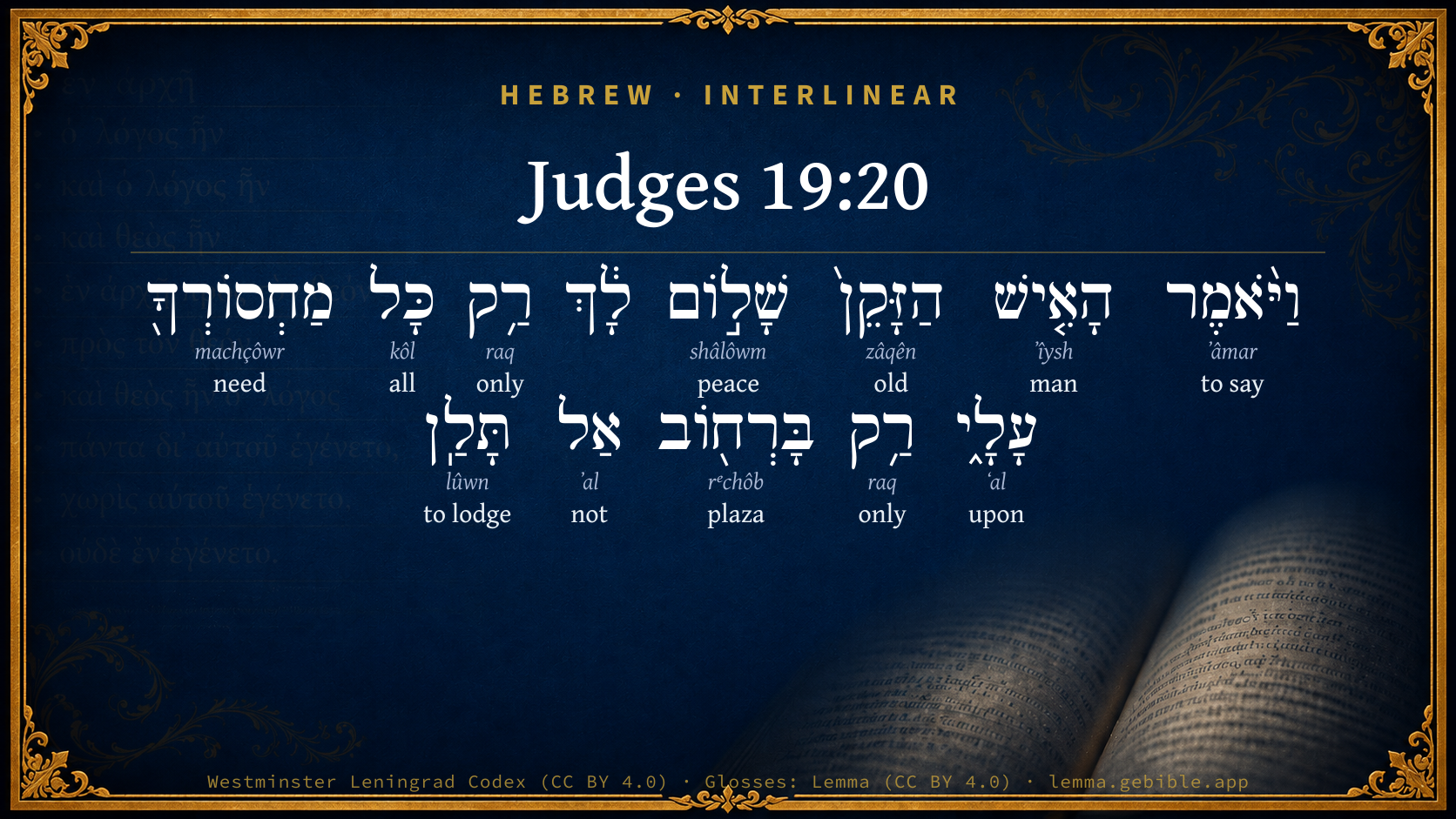
מַחְסוֹרְךָ֖
machçôwr
H4270
“need · your”
Noun, Common, Masculine, Singular, Construct + Suffix, Personal, 2nd Person, Masculine, Singular
Part of Speech
Noun
Type
Common
Gender
Masculine
Number
Singular
State
Construct
Full BDB Definition

Origin: from H2637

TWOT: 705e

need, poverty, thing needed - need, thing needed - lack, want - need, poverty
  1. וַיֹּ֨אמֶר ʼâmar H559 “and · to say” Conjunction + Verb, Qal, Sequential Imperfect, 3rd Person, Masculine, Singular
  2. הָאִ֤ישׁ ʼîysh H376 “the · man” Particle, Definite Article + Noun, Common, Masculine, Singular, Absolute
  3. הַזָּקֵן֙ zâqên H2205 “the · old” Particle, Definite Article + Adjective, Adjective, Masculine, Singular, Absolute
  4. שָׁל֣וֹם shâlôwm H7965 “peace” Noun, Common, Masculine, Singular, Absolute
  5. רַ֥ק raq H7535 “only” Particle, Accusative
  6. כָּל kôl H3605 “all of” Noun, Common, Masculine, Singular, Construct
  7. עָלָ֑י ʻal H5921 “upon · me” Preposition + Suffix, Personal, 1st Person, Common, Singular
  8. רַ֥ק raq H7535 “only” Particle, Accusative
  9. בָּרְח֖וֹב rᵉchôb H7339 “in/at the · plaza” Preposition, Determined + Noun, Common, Feminine, Singular, Absolute
  10. אַל ʼal H408 “not” Particle, Negative
  11. תָּלַֽן lûwn H3885 “to lodge” Verb, Qal, Jussive, 2nd Person, Masculine, Singular

About this verse

These counts appear in no published source. They are computed here, from the morphology-tagged text and Lemma’s own curated glosses. What Lemma adds →

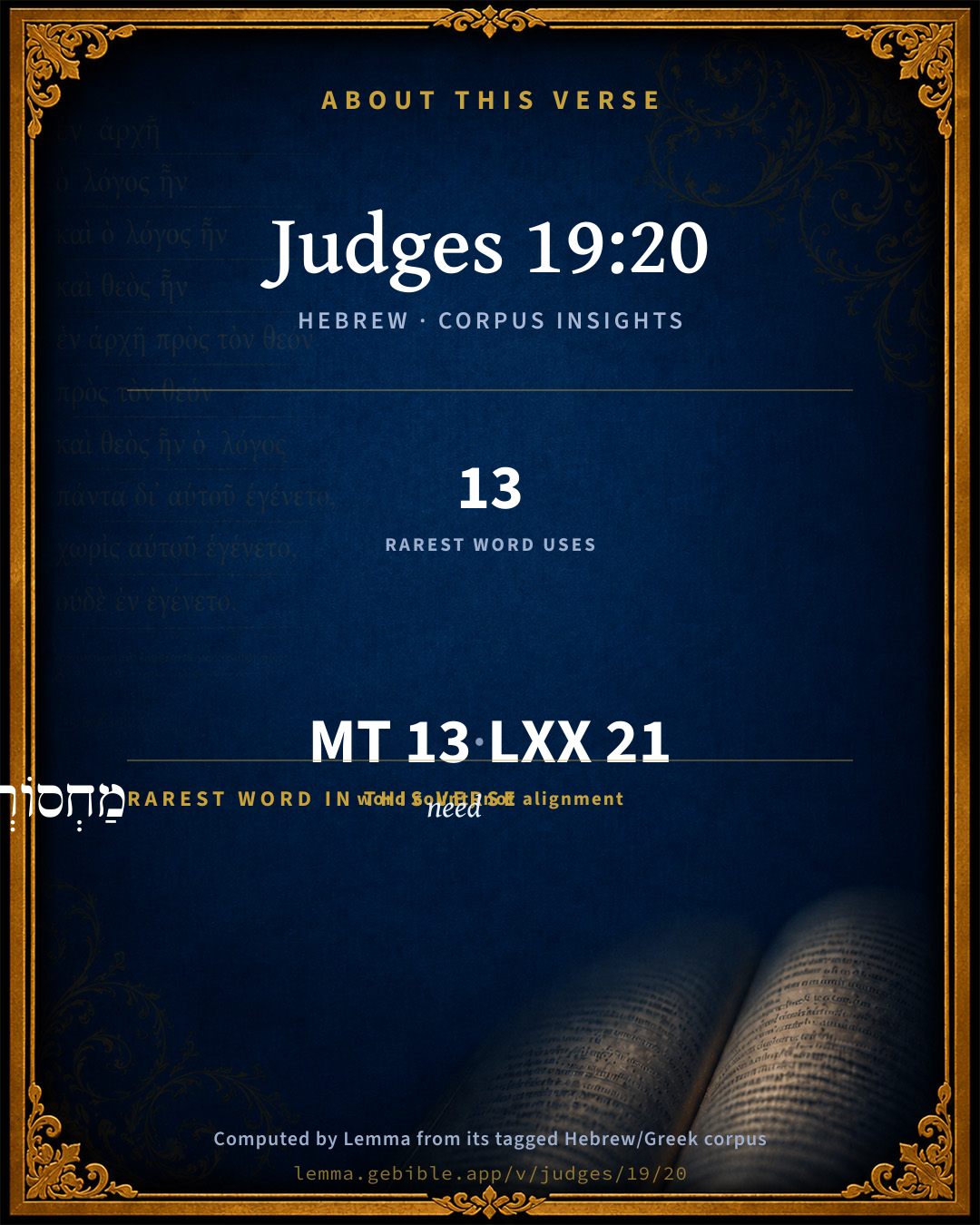
13
words
11
distinct lemmas
Historical
section

Notable vocabulary

The rarest word here is מַחְסוֹרְךָ֖ need H4270 — appearing just 13 times in the whole Hebrew Bible.

Shared distinctive vocabulary

מַחְסוֹרְךָ֖ need H4270 occurs in 13 verses of the Hebrew Bible. Also found in:

Grammatical profile

  • 2 verbs
  • 5 nouns
  • 1 adjective
  • 2 prepositions
  • 3 particles

Verb forms

  • וַיֹּ֨אמֶר Qal · Sequential Imperfect
  • תָּלַֽן Qal · Jussive

Repetition

A word recurs within this verse — often emphatic in Hebrew:

  • רַ֥ק only H7535 ×2

Hebrew & Septuagint length

In English translation the verse runs 22 words from the Hebrew and 27 from the Septuagint (LXX English) — closely comparable.

A rough comparison of the two English renderings, which tokenize alike — not a word-level alignment.

Word counts can differ between the Hebrew and the Greek without any difference in meaning — e.g. the Hebrew direct-object marker אֵת has no separate Greek word, and Greek often adds the article ὁ.

In the original languages it is 13 Hebrew tokens and 21 Greek tokens — but the two are counted differently (Hebrew bundles its prefixes and suffixes into one token; the Greek is in lemma form), so that isn’t a like-for-like length.

Cross-references

15

Topical passages linked to Judges 19:20 in the Treasury of Scripture Knowledge — connected by theme and wording, ordered by reader-vote popularity; previews shown in the World English Bible.

  • Judges 6:23 Yahweh said to him, Peace be to you; don't be afraid: you shall not die.
  • Genesis 19:2–3 and he said, "See now, my lords, please turn aside into your servant's house, stay all night, wash your feet, and you will rise up early, and go on your way." They said, "No, but we will stay in the street all night."
  • Genesis 24:31–33 He said, "Come in, you blessed of Yahweh. Why do you stand outside? For I have prepared the house, and room for the camels."
  • Genesis 43:23–24 He said, "Peace be to you. Don't be afraid. Your God, and the God of your father, has given you treasure in your sacks. I received your money." He brought Simeon out to them.
  • 1 Samuel 25:6 and thus shall you tell him who lives [in prosperity], Peace be to you, and peace be to your house, and peace be to all that you have.
  • 1 Chronicles 12:18 Then the Spirit came on Amasai, who was chief of the thirty, [and he said], "We are yours, David, and on your side, you son of Jesse: peace, peace be to you, and peace be to your helpers; for your God helps you." Then David received them, and made them captains of the band.
  • Luke 10:5–6 Into whatever house you enter, first say, 'Peace be to this house.'
  • John 14:27 Peace I leave with you. My peace I give to you; not as the world gives, give I to you. Don't let your heart be troubled, neither let it be fearful.
  • Romans 12:13 contributing to the needs of the saints; given to hospitality.
  • 1 Corinthians 1:3 Grace to you and peace from God our Father and the Lord Jesus Christ.
  • Galatians 6:6 But let him who is taught in the word share all good things with him who teaches.
  • Hebrews 13:2 Don't forget to show hospitality to strangers, for in doing so, some have entertained angels without knowing it.
  • James 2:15–16 And if a brother or sister is naked and in lack of daily food,
  • 1 Peter 4:9 Be hospitable one to another without grumbling.
  • 1 John 3:18 My little children, let's not love in word only, neither with the tongue only, but in deed and truth.

Cross-references courtesy of OpenBible.info (CC BY 4.0).

Hebrew and Greek witnesses Masoretic Hebrew ↔ Greek Septuagint

The same verse in the two great witnesses to the Old Testament, shown verse-for-verse.

These are two independent witnesses, not word-aligned to each other, and the Septuagint is shown in lemma (dictionary) form.

Hebrew Judges 19:20 Masoretic · Westminster Leningrad Codex

וַיֹּ֨אמֶר הָאִ֤ישׁ הַזָּקֵן֙ שָׁל֣וֹם לָ֔ךְ רַ֥ק כָּל מַחְסוֹרְךָ֖ עָלָ֑י רַ֥ק בָּרְח֖וֹב אַל תָּלַֽן

The old man said, Peace be to you; howsoever let all your wants lie on me; only don't lodge in the street.

World English Bible · Public Domain

Greek LXX Judges 19:20 Septuagint · lemma form

καί εἶπον ὁ ἀνήρ ὁ πρεσβύτης εἰρήνη σύ πλήν πᾶς ὑστέρημα σύ ἐπί ἐγώ πλήν ἐν ὁ πλατύς οὐ μή αὐλίζω

And the old man said, Peace be to you; only be every lack of your upon me, only do you by no means lodge in the street.

LXX2012 (modern English Septuagint) · Public Domain

Hebrew: Westminster Leningrad Codex (CC BY 4.0). Greek: Septuagint (public domain); English from LXX2012 (modern English Septuagint) (Public Domain). How the Septuagint differs from the Hebrew →

Targum (Aramaic paraphrase)

1

The Targum is the ancient Jewish Aramaic paraphrase of the Hebrew Scriptures — an interpretive translation, not the Hebrew text itself. Onkelos (literal) and Pseudo-Jonathan (expansive) render the Torah, and Jonathan the Prophets. Coverage is partial: where no permissively-licensed English translation exists for a verse, only the Aramaic is shown. This is verse-level text, not a word-by-word alignment to the Hebrew.

  1. Targum Jonathan Prophets (Joshua–Malachi)
    וַאֲמַר גַבְרָא סָבָא שְׁלָם לָךְ לְחוֹד כָּל חוֹסְרָנָךְ עָלַי לְחוֹד בִּרְחוֹבָא לָא תְבִית:

    (no public-domain English translation for this verse)

    Targum Jonathan — Aramaic: “Mikraot Gedolot” (public domain). English: “Sefaria Community Translation” (CC0 1.0 (public-domain dedication)); “London "Chaldee Paraphrase," 1871” (public domain). Text via Sefaria.

Commentary

Notes on Judges 19:20 from classic Christian and Jewish commentators (each source and its license shown beneath its notes). The classic Christian expositions comment on the surrounding passage and are grouped to its opening verse, so a note may address several verses; the Jewish commentaries on the Tanakh (Rashi and others) are per-verse, so they appear only where the commentator wrote on this verse.

Lemma curates 59 commentaries, every one of them public domain or Creative Commons licensed, each selected and text-cleaned for this edition rather than reprinted as found. About our sources →

Trapp's Complete Commentary

John Trapp

Jdg 19:20 And the old man said, Peace [be] with thee; howsoever [let] all thy wants [lie] upon me; only lodge not in the street.

Ver. 20. Only lodge not in the street.] He maketh it his suit to the Levite that he may lodge him, &c. This is to pursue hospitality. This good old man was a sojourner there himself; and, as she said, Non iguara mali, &c., he could the more pity and provide for strangers. Queen Elizabeth’s speech to the children of Christ’s Hospital as she rode through Fleet Street, was, "We are orphans all: let me enjoy your prayers, and ye shall be sure of mine assistance." {a}

{a} England’s Elizeb.

John Trapp, A Commentary or Exposition upon All the Books of the Old and New Testament (1647–1656) — public domain. Text from a community e-Sword module.

Joseph Benson's Commentary

Jdg 19:20-21. Let all thy wants lie upon me — It matters not whether thou wantest nothing or every thing; I will take care to supply all thy wants. They washed their feet — As they used to do to travellers in those hot countries.

Joseph Benson's Commentary on the Old and New Testaments (1811–1818) — public domain. Text from a community e-Sword module.

Geneva Bible (1599)

Geneva Bible translators

Or, be of good comfort.

Geneva Bible (1599) marginal notes — public domain. Text via Bolls.life.

Jamieson, Fausset & Brown

Robert Jamieson, A. R. Fausset & David Brown

only lodge not in the street--As this is no rare or singular circumstance in the East, the probability is that the old man's earnest dissuasive from such a procedure arose from his acquaintance with the infamous practices of the place.

Jamieson, Fausset & Brown — Commentary Critical and Explanatory on the Whole Bible (1871) — public domain (CC PDM 1.0). Text via the HelloAO Bible API.

Adam Clarke's Commentary

Verse 20. All thy wants lie upon me] Here was genuine hospitality: "Keep your bread and wine for yourselves, and your straw and provender for your asses; you may need them before you finish your journey; I will supply all your wants for this night, therefore do not lodge in the street."

Adam Clarke's Commentary on the Bible (1810–1826) — public domain. Text from a community e-Sword/MySword module.

Ellicott's Commentary for English Readers

(20) Peace be with thee.—The words are not here a greeting, but an assurance of help.

Only lodge not in the street.—Gen_19:2.

A Bible Commentary for English Readers, edited by Charles John Ellicott (1878–1897) — public domain. Text from a community e-Sword module.

John Gill's Exposition

And the old man said, peace be with you,.... All happiness attend thee, particularly ease and tranquillity of mind, let nothing disturb or distress thee:

howsoever, let all thy wants lie upon me; signifying, that if he had neither bread nor wine for himself, his wife, and his servant, nor any litter nor provender for his asses, he was welcome to all from him; and whatever his wants were, he would supply them, which was nobly and generously said:

only lodge not in the street: that I cannot bear to think of, as if he should say; for a stranger, an Israelite, one of my own country, a good man, a Levite going to the house of God, to take up a lodging in the streets, let it not be said.

John Gill's Exposition of the Whole Bible (1746–1763) — public domain (CC PDM 1.0). Text via the HelloAO Bible API.

Haydock's Catholic Bible Commentary

I will. Hebrew, "all thy wants be upon me." I will furnish all that may be requisite. In this wicked city, there was at least, one generous soul, like Lot in Sodom, Genesis xviii., and xix.

George Leo Haydock (1774–1849), Haydock's Catholic Family Bible and Commentary, 1859 edition — public domain. Excludes Psalms (Douay-Rheims chapter numbering differs from Protestant) and Deuterocanonical books (Catholic canon only).

Matthew Poole's English Annotations

It matters not whether thou wantest nothing or every thing, I will take care to supply all thy wants.

Matthew Poole's English Annotations on the Holy Bible (1683–1685) — public domain. Text from a community e-Sword/MySword module.

The Pulpit Commentary

They washed their feet. See Gen_18:4 Gen_19:2 1Ti_5:10, etc.

The Pulpit Commentary (1880–1919), ed. H.D.M. Spence-Jones & Joseph S. Exell — public domain. Text from a community e-Sword module.

John Wesley's Explanatory Notes

Let all, &c. - It matters not whether thou wantest nothing or everything, I will take care to supply all thy wants.

John Wesley, Explanatory Notes Upon the Whole Bible (1754–1765) — public domain. Text via the GEBible commentary corpus.

unfoldingWord translationNotes

Door43 World Missions Community

Only do not

"Do not." The word "only" is used here to emphasize what he did not want the Levite to do.

square

This refers to the city square. See how you translated this Judges 19:17.

brought the Levite into his house

This means that he invited the Levite to spend the night in his house. Also, by inviting the Levite he was inviting the man's concubine and servant as well. AT: "invited the Levite and his servants to stay in his house" (See: Idiom and Synecdoche)

translationWords

peace

Levi

donkey

unfoldingWord translationNotes — © Distant Shores Media and the Door43 World Missions Community, licensed CC BY-SA 4.0. Source: git.door43.org/Door43/en_tn.

Lesson kit

Teaching starters — assembled from the data on this page, not authored interpretation. Every prompt links to the verse data it draws on. Edit before teaching.

Judges, in the Historical, opens this verse with 13 words (11 distinct Hebrew lemmas). Its most distinctive word is machçôwr (“need”). A historical commentator’s framing appears above. Read the whole chapter for the surrounding context.

Discussion questions

  1. The word machçôwr carries the sense “need.” How does it shape the verse?
  2. Deuteronomy 15:8 shares the word «need» with this verse. How do the two illuminate each other?
  3. “only” occurs 2× in this one verse. What is the effect of the repetition?
  4. These translations render this verse differently. What is at stake in choosing one wording over another?
  5. The verb «וַיֹּ֨אמֶר» is Qal Sequential Imperfect. How does its form color the action?
  6. Reading how Trapp's Complete Commentary and Joseph Benson's Commentary read this verse, where do the two commentators agree and where do they part?

Things to notice

Reading settings

Reading text

Shown beneath each verse's original-language words.

Old Testament
Old Testament edition

Read the OT as the Masoretic Hebrew (MT) or the Greek Septuagint (LXX).

English shown for the Greek Septuagint (in the Hebrew ↔ Greek comparison).

Comparing translations? Open the Compare panel on any verse page to stack up to four side by side.