
Proverbs 12:28

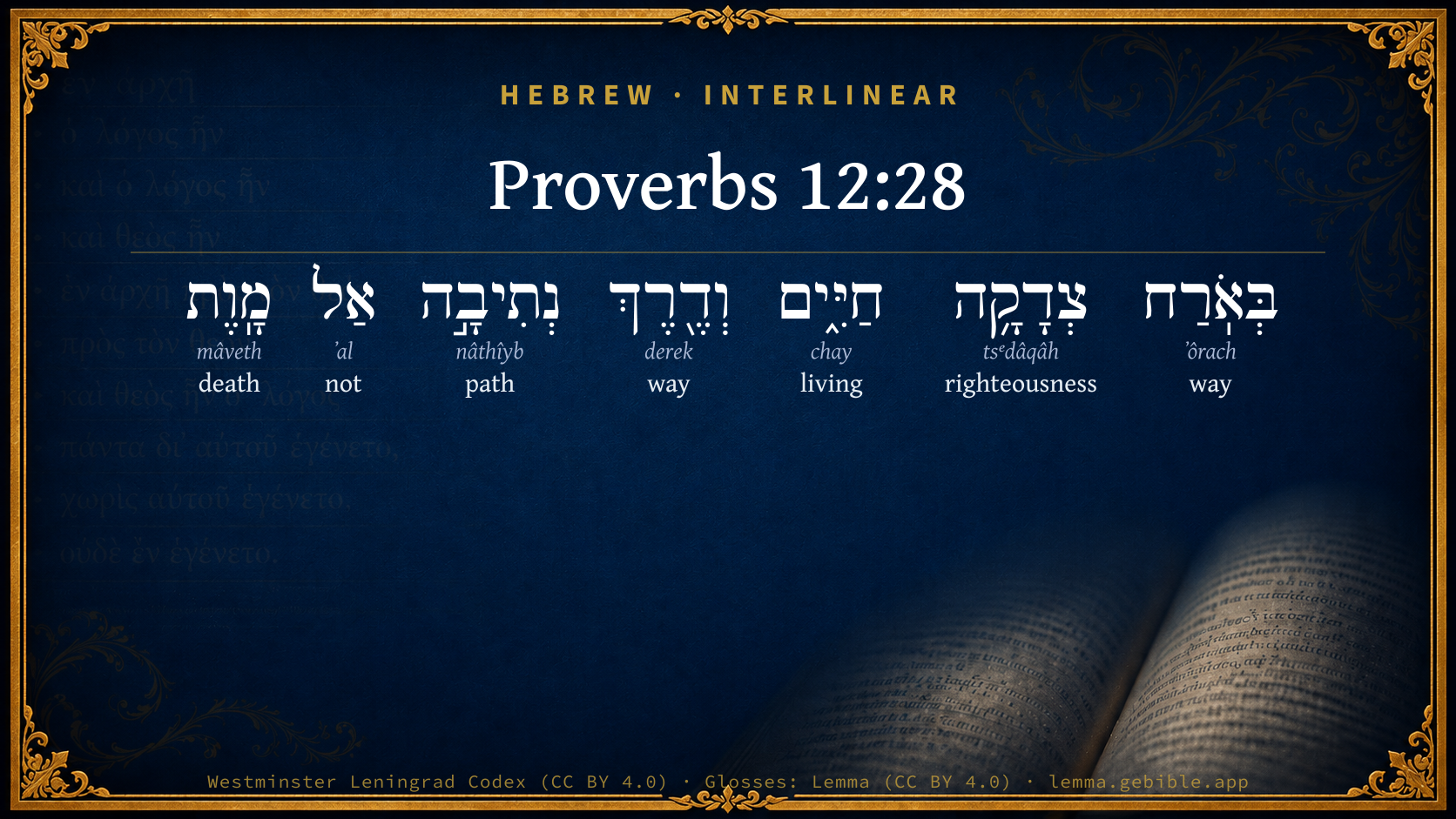
Hebrew (Westminster Leningrad Codex) Proverbs 12:28 appears in the Hebrew Old Testament. The text above is from the Westminster Leningrad Codex. Each word links to its Strong’s number, a concise gloss, and parsing drawn from the Open Scriptures Hebrew Bible morphology. Click any word for its full Brown-Driver-Briggs (BDB) entry.
Download image
Cite this verse

Proverbs 12:28 (World English Bible). Public Domain. Lemma interlinear Bible study tool, https://lemma.gebible.app/v/proverbs/12/28.

Show BibTeX & RIS
BibTeX
RIS
English Translation
In the way of righteousness is life; In its path there is no death.
World English Bible · Public Domain
Download a study sheet

One document with this verse’s original text, its word-by-word gloss line, the meaning frame, cross-references with their text, attributed commentary, and full source and license credits — printable, and it pastes into notes with its structure intact.

This verse Autodidact and up

Study sheet (.html) Plain text (.txt)

A passage Seminary Student

Up to 50 verses in one chapter. A passage sheet keeps up to 6 commentary sources and 12 cross-references per verse, in the order this page ranks them, and says so on the sheet whenever that leaves anything out. Ask for a single verse and you get the Autodidact verse sheet above.

Everything on this page stays free to read, with no account — the sheet is a download of what is already on screen, not access to it.

Want to remove ads? Support Godless Engineer
Compare translations 3

The same verse in 3 English versions, stacked beneath the original-language interlinear above. Click any original word for its lexicon entry.

Each is an independent rendering of the whole verse — the interlinear is not word-aligned to these translations.

Highlighted words mark where these versions differ — a whole-verse word diff, not a word-by-word alignment.

  • World English Bible Public Domain
    In the way of righteousness is life; In its path there is no death.
  • King James Version Public Domain
    In the way of righteousness is life: and in the pathway thereof there is no death.
  • unfoldingWord Literal Text CC BY-SA 4.0
    In the path of righteousness life, and the way of the beaten path no death.

unfoldingWord Literal Text — © unfoldingWord, licensed CC BY-SA 4.0. Word-aligned USFM3 via Door43 (git.door43.org/unfoldingWord/en_ult).

Versions to compare (up to 4)

3 of 4 selected

Show all 18 translations

Every available English version of this verse, each an independent rendering of the whole verse.

  • World English Bible Public Domain
    In the way of righteousness is life; In its path there is no death.
  • Berean Standard Bible Public Domain
    There is life in the path of righteousness, but another path leads to death.
  • Majority Standard Bible Public Domain
    There is life in the path of righteousness, but another path leads to death.
  • King James Version Public Domain
    In the way of righteousness is life: and in the pathway thereof there is no death.
  • American Standard Version (1901) Public Domain
    In the way of righteousness is life; And in the pathway thereof there is no death.
  • Revised Version (1885) Public Domain
    In the way of righteousness is life; and in the pathway thereof there is no death.
  • Geneva Bible (1599) Public Domain
    Life is in the way of righteousnesse, and in that path way there is no death.
  • Douay-Rheims (1899) Public Domain
    In the path of justice is life: but the by-way leadeth to death.
  • Young's Literal Translation Public Domain
    In the path of righteousness `is' life, And in the way of `that' path `is' no death!
  • Literal Standard Version CC BY-SA 4.0
    In the path of righteousness [is] life, || And in the way of [that] path [is] no death!
  • Unlocked Literal Bible CC BY-SA 4.0
    Those who walk in the right way find life and in its path there is no death.
  • unfoldingWord Literal Text CC BY-SA 4.0
    In the path of righteousness life, and the way of the beaten path no death.
  • Darby Bible Public Domain
    In the path of righteousness is life, and in the pathway thereof there is no death.
  • World Messianic Bible Public Domain
    In the way of righteousness is life; in its path there is no death.
  • Webster's Bible Public Domain
    In the way of righteousness is life; and in the path of it there is no death.
  • Free Bible Version CC BY-SA 4.0
    The path of right leads to life, it doesn't lead to death.
  • Bible in Basic English Public Domain
    In the road of righteousness is life, but the way of the evil-doer goes to death.
  • JPS Tanakh (1917) Public Domain
    In the way of righteousness is life, and in the pathway thereof there is no death.

Literal Standard Version (2020), Covenant Press — licensed CC BY-SA 4.0. Text via the HelloAO Bible API (eBible.org). Unlocked Literal Bible (unfoldingWord) — licensed CC BY-SA 4.0. Text via the HelloAO Bible API (eBible.org). unfoldingWord Literal Text — © unfoldingWord, licensed CC BY-SA 4.0. Word-aligned USFM3 via Door43 (git.door43.org/unfoldingWord/en_ult). Free Bible Version, Dr. Jonathan Gallagher — licensed CC BY-SA 4.0. Text via the HelloAO Bible API (eBible.org).

Word by word

More ways to search: Search by grammar → Find every occurrence → Compare this word →

Practice this passage: Drill this verse → Learn its vocabulary →

About this verse

These counts appear in no published source. They are computed here, from the morphology-tagged text and Lemma’s own curated glosses. What Lemma adds →

7
words
7
distinct lemmas
Wisdom
section

Shared distinctive vocabulary

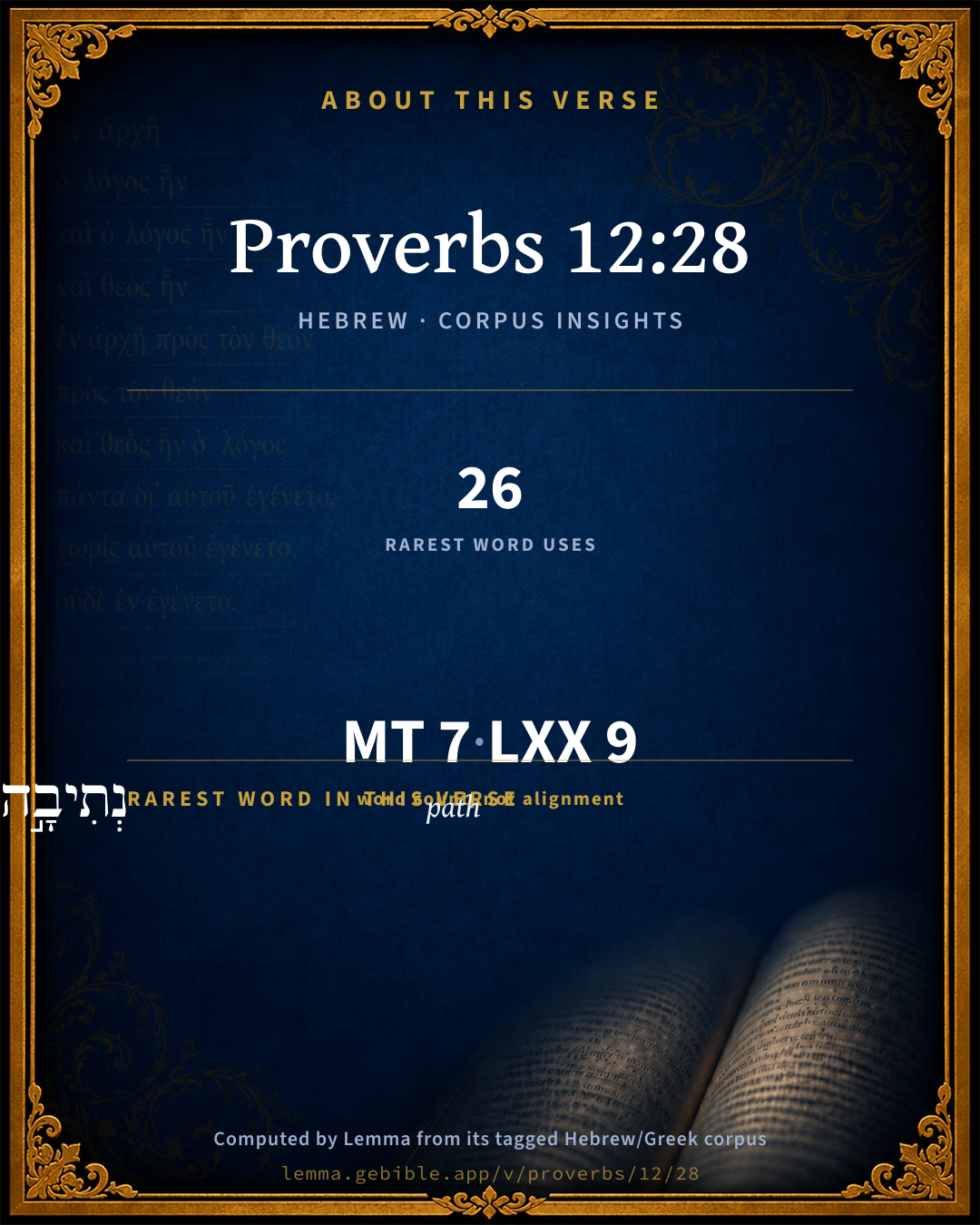
נְתִיבָ֣ה path H5410 occurs in 26 verses of the Hebrew Bible. Also found in:

Grammatical profile

  • 6 nouns
  • 1 particle

Hebrew & Septuagint length

In English translation the verse runs 14 words from the Hebrew and 18 from the Septuagint (LXX English) — closely comparable.

A rough comparison of the two English renderings, which tokenize alike — not a word-level alignment.

Word counts can differ between the Hebrew and the Greek without any difference in meaning — e.g. the Hebrew direct-object marker אֵת has no separate Greek word, and Greek often adds the article ὁ.

In the original languages it is 7 Hebrew tokens and 9 Greek tokens — but the two are counted differently (Hebrew bundles its prefixes and suffixes into one token; the Greek is in lemma form), so that isn’t a like-for-like length.

Cross-references

13

Topical passages linked to Proverbs 12:28 in the Treasury of Scripture Knowledge — connected by theme and wording, ordered by reader-vote popularity; previews shown in the World English Bible.

  • 3 John 1:11 Beloved, don't imitate that which is evil, but that which is good. He who does good is of God. He who does evil hasn't seen God.
  • Romans 5:21 that as sin reigned in death, even so might grace reign through righteousness to eternal life through Jesus Christ our Lord.
  • Ezekiel 18:20–24 The soul who sins, he shall die: the son shall not bear the iniquity of the father, neither shall the father bear the iniquity of the son; the righteousness of the righteous shall be on him, and the wickedness of the wicked shall be on him.
  • Proverbs 11:19 He who is truly righteous gets life. He who pursues evil gets death.
  • Titus 2:11–12 For the grace of God has appeared, bringing salvation to all men,
  • Deuteronomy 30:15 Behold, I have set before you this day life and good, and death and evil;
  • Proverbs 8:35 For whoever finds me, finds life, And will obtain favor from Yahweh.
  • Proverbs 10:16 The labor of the righteous leads to life. The increase of the wicked leads to sin.
  • Ezekiel 18:9 has walked in my statutes, and has kept my ordinances, to deal truly; he is just, he shall surely live, says the Lord Yahweh.
  • 1 John 2:29 If you know that he is righteous, you know that everyone who practices righteousness is born of him.
  • 1 John 3:7 Little children, let no one lead you astray. He who does righteousness is righteous, even as he is righteous.
  • Romans 6:22–23 But now, being made free from sin, and having become servants of God, you have your fruit of sanctification, and the result of eternal life.
  • Proverbs 9:11 For by me your days will be multiplied. The years of your life will be increased.

Cross-references courtesy of OpenBible.info (CC BY 4.0).

Hebrew and Greek witnesses Masoretic Hebrew ↔ Greek Septuagint

The same verse in the two great witnesses to the Old Testament, shown verse-for-verse.

These are two independent witnesses, not word-aligned to each other, and the Septuagint is shown in lemma (dictionary) form.

Hebrew Proverbs 12:28 Masoretic · Westminster Leningrad Codex

בְּאֹֽרַח צְדָקָ֥ה חַיִּ֑ים וְדֶ֖רֶךְ נְתִיבָ֣ה אַל מָֽוֶת

In the way of righteousness is life; In its path there is no death.

World English Bible · Public Domain

Greek LXX Proverbs 12:28 Septuagint · lemma form

ἐν ὁδός δικαιοσύνη ζωή ὁδός δέ μνησίκακος εἰς θάνατος

In the ways of righteousness is life; but the ways of those that remember injuries lead to death.

LXX2012 (modern English Septuagint) · Public Domain

On this verse, The Cambridge Bible for Schools and Colleges discusses the Septuagint’s reading. Read the note in Commentary ↓

Hebrew: Westminster Leningrad Codex (CC BY 4.0). Greek: Septuagint (public domain); English from LXX2012 (modern English Septuagint) (Public Domain). How the Septuagint differs from the Hebrew →

Commentary

Notes on Proverbs 12:28 from classic Christian and Jewish commentators (each source and its license shown beneath its notes). The classic Christian expositions comment on the surrounding passage and are grouped to its opening verse, so a note may address several verses; the Jewish commentaries on the Tanakh (Rashi and others) are per-verse, so they appear only where the commentator wrote on this verse.

Lemma curates 59 commentaries, every one of them public domain or Creative Commons licensed, each selected and text-cleaned for this edition rather than reprinted as found. About our sources →

Trapp's Complete Commentary

John Trapp

Pro 12:28 In the way of righteousness [is] life; and [in] the pathway [thereof there is] no death.

Ver. 28. In the way of righteousness is life.] And life, in any sense, is a sweet mercy, a precious indulgence. Life natural is but a little spot of time between two eternities, before and after, but it is of great consequence (for ex hoc momento pendet aeternitas), and given us for this purpose, that glory may be begun in grace, and we have a further and further entrance into the kingdom of heaven here, as Peter saith, 2Pe 1:11.

And in the path thereof there is no death.] Christ hath unstinged the first death, and made it of a punishment, a benefit; of a postern to let out temporal life, a street door to let in eternal life. {a} Surely the bitterness of this death is past to the righteous; there is no gall in it (as the Hebrew word there signifies); nay, there is honey in it, as once there was in the corpse of Samson’s dead lion. And for the second death, there is no danger; for they shall pass from the jaws of death to the joys of heaven. Yea, though hell had closed her mouth upon a child of God, it could as little hold him as the whale could Jonah; it must, perforce, regurgitate, and render up such a morsel.

{a} Mors ianua vitae, porta coeli. - Bern.

John Trapp, A Commentary or Exposition upon All the Books of the Old and New Testament (1647–1656) — public domain. Text from a community e-Sword module.

The Biblical Illustrator

Joseph S. Exell

Pro_12:28

In the way of righteousness is life.

Life in the way of righteousness

There are many ways which men are found to pursue in order to the attainment of happiness. One pursues the way of worldly pleasure; another is fascinated by the splendour and magnificence and show of the world; another seeks happiness in the business of life. These ways are false ways and disappointing ways. There is a way which is neither delusive nor disappointing. It is the way of holiness, the way of conformity to Gods mind and will. The righteous walk in this way. But who are the righteous? They who are interested by faith in the Redeemers righteousness for justification and acceptance before God. They are distinguished by the integrity of their principles and a conscientious endeavour to discharge every duty they owe their fellow-men. They are careful to avoid all known sin, and desire to live in the practice of all known duty. They are not satisfied with present attainments in religin, but seek to grow in grace as well as knowledge. They are animated by the constraining love of Jesus. They live in the exercise of communion with God in prayer and praise. And the text declares that those who walk in holy obedience to the revealed will of God, and are filled with the fruits of righteousness, have received a new nature, and are animated by a new life. The existence of the life of grace in the soul will be manifested by its corresponding effects in the walk and conversation. In the way of righteousness is the life of consolation and joy. Gods smile is on the righteous in all their goings. Great are the privileges of the righteous, which must be felt, but cannot be adequately described. The new life, kindled by the Spirit of God, shall never be extinguished. It shall survive every shock of opposition and trial, and shall triumph over the combined rage of earth and hell. In the pathway thereof there is no death. The righteous must die, as well as the unrighteous; there is no peculiarity of exemption in their case from the stroke of the last enemy. But to the believer in Jesus death is unspeakable gain. Then are we in the number of the righteous? (C. Rawlings, B.A.)

The way of religion recommended as

I. A straight, plain, easy way. Gods commands (the rule we are to walk by) are all holy, just, and good. Religion has right, reason, and equity on its side.

II. As a safe, pleasant comfortable way.

1. There is not only life at the end, but there is life in the way; all true comfort and satisfaction. The favour of God, which is better than life; the Spirit, who is life.

2. There is not only life in it, but so as that in it there is no death, none of that sorrow of the world which works death, and is an allay to our present joy and life. There is no end to that life that is in the way of righteousness. Here there is life, but there is death too. In the way of righteousness there is life and no death--life and immortality. (Matthew Henry.)

.

The Biblical Illustrator, edited by Joseph S. Exell (c. 1880s–1900s) — public domain. Text from a community e-Sword module.

Joseph Benson's Commentary

Pro 12:28. In the way of righteousness is life, &c. — The practice of righteousness, though it expose a man to some dangers and inconveniences in the world, through the corruption of mankind, and the malice of the devil, yet it will certainly lead a man to life and happiness; whereas the end of all the wicked is death and destruction.

Joseph Benson's Commentary on the Old and New Testaments (1811–1818) — public domain. Text from a community e-Sword module.

The Preacher's Complete Homiletical Commentary

Joseph S. Exell (gen. ed.)

CRITICAL NOTES.—

Pro_12:28. No death, literally “no-death,” i.e., “immortality.”

MAIN HOMILETICS OF Pro_12:28

I. There is a way of righteousness in the world.

1. This fact is universally recognised. Men regard each other as moral and responsible beings. The doctrine of necessity will not do for every-day life. In all positions and conditions, man is met with the assumption that there is a “way of righteousness,” and his fellow-men deal with him accordingly. Man could not be held accountable for his actions if a right way of life did not exist, in which it was possible for him to walk.

2. This fact is confirmed by conscience. Bad actions are followed by remorse, and good deeds bring gladness to the soul. If there were no way of righteousness, how could this be the case?

3. It is revealed to us by God. The Bible sets forth two paths, in one of which man must walk, it foretells a day in which God will judge men, and will hold them guilty who have refused to walk in the way of righteousness after it has been made known to them. Where there is no way of righteousness there can be no transgression, and, consequently, no penalty.

II. The way of life implies—

1. A beginning. All ways or paths have a starting-point, all methods or plans of life date from some point of time.

2. An object in view. If men walk in a certain road it is presumed that they have some purpose in view.

3. An end or goal. So the way of righteousness. Its beginning is “repentance towards God and faith in our Lord Jesus Christ;” the object at which it aims by “patient continuance in well-doing” is “glory, and honour, and immortality;” its end is “eternal life” (Act_20:21; Rom_2:7), for “in the pathway thereof is no death, or immortality” (On this subject see also homiletics on chap. Pro_4:18).

OUTLINES AND SUGGESTIVE COMMENTS

From life being said to be in the way of righteousness, I should urge the lesson that the deeds of the hand have a reflex influence upon the state of the heart. There is life in spiritual-mindedness, and it serves to aliment this life to walk in the way of obedience.—Chalmers.

And life, in any sense, is a sweet mercy, a precious indulgence. Life natural is but a little spot of time between the two eternities, before and after, but it is of great consequence, and given us for this purpose, that glory may be begun in grace, and we have a further and further entrance into the kingdom of heaven here, as Peter saith (2Pe_1:2). Christ hath unstinged the first death, and made of a postern to let out eternal life, a street-door to let in eternal life. Surely the bitterness of this death is past to the righteous; there is no gall in it; nay, there is honey in it, as once there was in the corpse of Samson’s dead lion. And for the second death there is no danger, for they shall pass from the jaws of death to the joys of heaven. Yea, though hell had closed her mouth upon a child of God, it would as little hold him as the whale could Jonah; it must, perforce, regurgitate such a morsel.—Trapp.

“Righteousness” which is the very path of the righteous man, is itself eternal life. All men have a “way,” and this implies that all men have an “end.” The Psalmist had before announced (Psa_1:6) that “the way of the ungodly shall perish;” that is, not only shall they not reach their end, but their very way shall die down and perish. They shall cease to take an interest in it. But this passage goes deeper. It says the path of righteousness is life itself, and then, contrasting them with the wicked, it says, “their way is a path,” i.e., it leads somewhere; and then implies that all other ways are “a death!” These are striking truths. Immortality is a path. It travels the ages. It begins among believers. It is itself its destiny. Impenitence is “a death.” It travels nowhere. The very mind of the impenitent can announce no terminus for his way-worn tread.—Miller.

NOTE.—It will be seen from the foregoing remarks that Miller translates the latter clause of this verse, “The way is a path, not a death.”

HOMILY ON THE ENTIRE CHAPTER

On the true wisdom of the children of God as it ought to appear

(1) In the home, under the forms of good discipline, diligence, and contentment;

(2) In the State, or in the intercourse of citizens, under the forms of truthfulness, justice, and unfeigned benevolence (Pro_12:12-22); in the Church, or in the religious life, as a progressive knowledge of God, a diligent devotion to prayer, and striving after eternal life (Pro_12:23-28).—Lange’s Commentary.

The Preacher's Complete Homiletical Commentary (gen. ed. Joseph S. Exell; Funk & Wagnalls, c. 1892) — public domain (pre-1929). A full-Bible homiletical/sermon-outline anthology covering 65 of 66 books (2 John is absent from the source module). Text from a community e-Sword module.

Matthew Henry's Commentary

The way of religion is here recommended to us, 1. As a straight, plain, easy way; it is the way of righteousness. God's commands (the rule we are to walk by) are all holy, just, and good. Religion has right reason and equity on its side; it is a path-way, a way which God has cast up for us (Isa 35:8); it is a highway, the king's highway, the King of kings' highway, a way which is tracked before us by all the saints, the good old way, full of the footsteps of the flock. 2. As a safe, pleasant, comfortable way. (1.) There is not only life at the end, but there is life in the way; all true comfort and satisfaction. The favour of God, which is better than life; the Spirit, who is life. (2.) There is not only life in it, but so as that in it there is no death, none of that sorrow of the world which works death and is an allay to our present joy and life. There is no end of that life that is in the way of righteousness. Here there is life, but there is death too. In the way of righteousness there is life, and no death, life and immortality.

Matthew Henry's Commentary on the Whole Bible (1708–1710) — public domain (CC PDM 1.0). Text via the HelloAO Bible API.

Jamieson, Fausset & Brown

Robert Jamieson, A. R. Fausset & David Brown

(Compare Pro 8:8, Pro 8:20, &c.). A sentiment often stated; here first affirmatively, then negatively.

Next: Proverbs Chapter 13

Jamieson, Fausset & Brown — Commentary Critical and Explanatory on the Whole Bible (1871) — public domain (CC PDM 1.0). Text via the HelloAO Bible API.

Adam Clarke's Commentary

Verse 28. In the way of righteousness is life] חיים chaiyim, lives; life temporal, and life eternal.

And in the pathway thereof there is no death.] Not only do the general precepts and promises of God lead to life eternal, and promote life temporal; but every duty, every act of faith, patience of hope, and labour of love, though requiring much self-abasement, self-denial, and often an extension of corporal strength, all lead to life. For in every case, in every particular, "the path of duty is the way of safety." The latter clause is only a repetition of the sense of the former.

Adam Clarke's Commentary on the Bible (1810–1826) — public domain. Text from a community e-Sword/MySword module.

Ellicott's Commentary for English Readers

(28) In the way of righteousness is life.—Comp. above on Pro_10:2, “Righteousness delivereth from death.”

A Bible Commentary for English Readers, edited by Charles John Ellicott (1878–1897) — public domain. Text from a community e-Sword module.

The Cambridge Bible for Schools and Colleges

gen. ed. J. J. S. Perowne

28. no death] The rendering to death, i.e. the pathway (sc. common and well-trodden, or, of evil men) leadeth to death, is supported by LXX. εἰς θάνατον, and Vulg. ducit ad mortem.

The Cambridge Bible for Schools and Colleges (gen. ed. J. J. S. Perowne; Cambridge University Press, 1878–1918) — public domain. Text from a community e-Sword module.

John Gill's Exposition

In the way of righteousness is life,.... The life of the soul, or spiritual life, as Aben Ezra; and eternal life, as Gersom. One that is in the true way of righteousness is one that is instilled by the righteousness of Christ, which justification is the justification of life: such an one is made alive, and reckons himself alive in a law sense; and enjoys true spiritual peace and comfort, arising from the love and favour of God, and acceptance with him, in which he sees his interest, and in which is life; and this righteousness, by which he is justified before God, entitles him to eternal life; to which the path of holiness, he is directed and enabled to walk in, leads; though it is a narrow way, and a strait gate, Mat 7:14. Christ, and righteousness and holiness in and by him, are the way, the truth, and the life, or the true way to eternal life; and all in this way now live spiritually, and shall live eternally, Joh 14:6;

and in the pathway thereof there is no death; no condemnation to them that are in Christ, the way, and are justified by his righteousness; the law's sentence of death shall not be executed on them, though it passed upon them in Adam; spiritual death shall not again prevail over those who are passed from death to life; nor shall they be hurt at the second death; they shall never die that death, it shall have no power over them; life and immortality are the sure effects of being in the way of righteousness. The Targum renders it, "the way of the perverse": and the Septuagint version, "of those that remember evil": and the Syriac and Arabic versions, "the way of angry men is unto death": and so the Vulgate Latin version,

"the out of the way path leads to death:''

and so some Hebrew copies read, instead of "no death, unto death"; but the most read as we do, and which the Jewish commentators follow.

Next: Proverbs Chapter 13

John Gill's Exposition of the Whole Bible (1746–1763) — public domain (CC PDM 1.0). Text via the HelloAO Bible API.

Haydock's Catholic Bible Commentary

Bye-way. Of vice. Hebrew, "and a way which leadeth to death," or "its paths conduct to death." (Calmet)

George Leo Haydock (1774–1849), Haydock's Catholic Family Bible and Commentary, 1859 edition — public domain. Excludes Psalms (Douay-Rheims chapter numbering differs from Protestant) and Deuterocanonical books (Catholic canon only).

Matthew Poole's English Annotations

The practice of justice and godliness, though it expose a man to some dangers and inconveniences in the world, yet it will certainly lead him to life and happiness, whereas the end of all wicked courses is death and destruction.

Matthew Poole's English Annotations on the Holy Bible (1683–1685) — public domain. Text from a community e-Sword/MySword module.

Whedon's Commentary on the Bible

Daniel D. Whedon

28. Way of righteousness is life — Plural, lives; life temporal and life eternal.

Pathway thereof… is no death — Better. A devious way leadeth to death. The original denotes a crooked, winding path, of uncertain, if not of positively evil, termination. The later critics think our Authorized Version has mistaken the sense.

Daniel D. Whedon (gen. ed.), Commentary on the Old and New Testaments (1874–1909) — public domain. Text from a community e-Sword module.

The Pulpit Commentary

In the way of righteousness is life. (comp. Pro_10:2) For the promise of temporal prosperity which the Jew saw in such passages as these we substitute a better hope. And in the pathway thereof of righteousnessthere is no death. Many combine the two words thus: "no death," i.e. immortality; but examples of such combination are not forthcoming, and the anomaly is not necessitated by the failure of the usual rendering to afford an adequate sense. The Greek and Latin versions are noteworthy. Septuagint, "The ways of the revengeful (mnhsikakwn ) are unto (la, not la) death." St. Chrysostom refers ("Hom. 16 in Ephesians") to this rendering: "He here speaks of vindictiveness; for on the spur of the moment he allows the sufferer to act in order to cheek the aggressor; but further to bear a grudge he permits not; because the act then is no longer one of passion, nor of boiling rage, but of malice premeditated. Now, God forgives those who may be carried away, perhaps upon a sense of outrage, and rush out to resent it. Hence he says, "eye for eye;" and yet again "The ways of the revengeful lead to death." Vulgate, "A devious path leads to death a path, that is, which turns aside from the right direction, a life and conversation which are alien from justice and piety. But both the Septuagint and the Vulgate have missed the right meaning of the words in question; derek nethibah, "pathway." Many see in this verse a plain evidence that the writer believed in the immortality of the soul. We have reason to suppose that such was his faith, but it cannot be proved from this passage, though we may consider that he was guided to speak in terms to which later knowledge would affix a deeper interpretation. (see Pro_14:32, and note there) It is Jesus Christ "who hath brought life and immortality (afyarsian ) to light through the gospel". (2Ti_1:10) Writers in Solomon"s time could speak only darkly about this sublime and comforting hope, though later, as in the Book of Wisdom and throughout most of the Apocryphal books, it formed a common topic, and was used as a reason for patience and resignation.

Righteousness and life.

I THE ASSOCIATION OF RIGHTEOUSNESS AND LIFE. It is something to have two such great ideas brought into close juxtaposition. Their very proximity is a revelation. They mutually illumine one another. We know more of righteousness when we see its bearing on life, and we have a better understanding of life when we recognize its dependence on righteousness. There is thus a relationship of ideas to be recognized here over and above the separate forms of the ideas themselves. The limitation of the subject is also instructive. We do not see to what else righteousness may be related. It may or it may not bring happiness, wealth, and success. What it is related to is distinct from all these ends, and greater than any of them viz. life.

II THE FORM OF RIGHTEOUSNESS THAT IS CONNECTED WITH LIFE. This is the path of righteousness. It is not righteousness regarded as an abstract idea, or viewed only as a law. It is not an external garment of righteousness, nor an internal principle of righteousness. It does not consist in one or more isolated deeds of righteousness. On the contrary, what is here presented to us is a view of a continuous course of righteous action. It may not be the highest path of holiness, but it is at least a right path. The traveller may stumble upon it, loiter by the way, even forget himself at times, and sleep. Yet, on the whole, this is the course he pursues. He is trying to do the right thing in his daily experience.

III THE INFLUENCE OF RIGHTEOUSNESS UPON LIFE. The path is life.

1. It is the path of a living soul. No one can continuously pursue a right course unless he has the spiritual life in him. Dead souls may be galvanized into momentary spasms of goodness by an electrifying example or the shock of a great authority. But the path of righteousness can only be trodden by those who have within them the soul energy to follow it.

2. It is the path that quickens life. It is not like the deadly tracts of sin, those ways of wickedness that head down into the fatal swamps of soul death. This path runs over bracing mountain heights.

3. It is the path that leads to life. There is a fuller life beyond, not yet reached; and righteousness is the way to it. Every attainment in holiness is accompanied by a deepening of the soul life. The way of God leads to eternal life. The gospel of Christ does not set aside this Old Testament principle, but it gives the new righteousness of a new life.

IV THE FATAL RESULT OF LEAVING RIGHTEOUSNESS. "A devious way leadeth to death.

1. The way of evil is devious. It is not only an alternative; it is a departure from the normal course. He who is in it is where he ought not to be. Then this way is no direct high road; it is a wandering bypath.

2. The deviousness of the way is fatal to the traveller upon it. The higher way is made for the good purpose of leading to She city of life. The devious way is not purposely made; it is a lawless beaten track, which runs out into the wilderness. It must be dangerous to follow such a course. To pursue it to the end is to court soul destruction.

The straight road and the bypath.

I RECTITUDE MAY BE COMPARED TO A STRAIGHT ROAD. It has a definite beginning, a clearly marked course, a happy termination.

II ALL IMMORALITY AND IRRELIGION MAY BE COMPARED TO BYPATHS. See Bunyan"s Bypath Meadow in "Pilgrim"s Progress.

III LIFE AND DEATH ARE THE TWO GREAT TERMINI All the more impressive because we know not what they contain of blissful or of dread meaning: "Behold, I set before you life and death!" is the constant cry of wisdom, of every true teacher, of the unchanging gospel. J.

The one way of life.

"All that a man hath will he give for his life;" but of what worth is life to many men? What does it mean to them but work and sleep and indulgence? Of how many is it true that they "are dead while they live"! But "in the way of righteousness there is life, and in the pathway thereof is no death.

I THE WAY OF RIGHTEOUSNESS THE ONE PATH OF LIFE. It is the one and only path; for the paths of sin are those of spiritual death. In them the human traveller is separated from God, from all excellency of character, from all true and lasting joy: and what is this but death in everything except the name? It is not the true, the real life of man. But righteousness in the full, broad sense in which the word is here employed, includes:

1. Devotion; the spirit of reverence, the act of prayer, the approach of our human spirit to God, and our habitual walking with him and worship of him.

2. Virtue; the practice of truthfulness, temperance, purity, integrity; the exercise of self-restraint, the discharge of the duties which we owe to our fellow men, respecting ourselves and honouring them.

3. Service; the endeavour, in a spirit of loving kindness, to raise, to succour, to guide, to bless, all whom we can reach and influence.

4. Joy; i.e. not mere excitement or gratification, which may expire at any moment, and may leave a sting or a stain behind, but rather that honourable and pure elation of spirit which springs from conscious rectitude, which is the consequence of our being in harmony with all that is around us, and with him who is above us, which lasts through the changes of circumstances, which "through all time abides" which "satisfies and sanctifies the soul." This is life; this is life indeed; this is worth callling life; and this is in the way of righteousness.

II ITS IMMUNITY FROM DEATH. "In the pathway," etc.

1. No death during mortal life; so long as we walk in the light of Divine truth there is no fear of our stumbling into error and falling into the condition of spiritual death; our life in God and with him will be steadily maintained.

2. No real death at the end of that life; for though we must pass through "the portal we call death," yet "it is not death to die," when the termination of mortal existence is the starting-point of the celestial life; when the being unclothed of the earthly tenement means the "being clothed upon with our house which is from heaven," when "absence from the body" means "presence with the Lord.

3. Fulness and enlargement of life forever; for our hope and confident expectation is that, along whatever paths our God may lead us in the heavenly spheres, the way we shall take will be one that will be ever disclosing greater grandeurs, ever opening new sources of joy, ever unfolding new secrets, and making life mean more and more to our rejoicing spirits as the years and ages pass. C.

The Pulpit Commentary (1880–1919), ed. H.D.M. Spence-Jones & Joseph S. Exell — public domain. Text from a community e-Sword module.

Keil & Delitzsch

C. F. Keil & F. Delitzsch

28 In the path of righteousness is life,

And the way of its path is immortality.

All the old versions to the Venet. give אל־ instead of אל־, and are therefore under the necessity of extracting from ודּרך נתיבה a meaning corresponding to this, εἰς θάνατον, in which they are followed by Hitzig: "a devious way leadeth to death." But נתיב (נתיבה) signifies step, and generally way and street (vid., at Pro 1:15), not "devious way," which is expressed, Jdg 5:6, by ארחות עקלקלות. And that אל is anywhere punctuated thus in the sense of אל is previously improbable, because the Babylonian system of punctuation distinguishes the negative אל with a short Pathach, and the prepositional אל (Arab. ilâ) with a short Chirek, from each other (vid., Pinsker, Einl. p. xxii.f.); the punctuation Sa2 18:16; Jer 51:3, gives no support to the opinion that here אל is vocalized thus in the sense of אל, and it is not to be thus corrected. Nothing is more natural than that the Chokma in its constant contrast between life and death makes a beginning of expressing the idea of the ἀθανασία, which Aquila erroneously read from the אל־מות, Ps. 48:15. It has been objected that for the formation of such negative substantives and noun-adjectives לא (e.g., לא־אל, לא־עם) and not אל is used; but that אל also may be in close connection with a noun, Sa2 1:13 shows. There אל־טל is equivalent to אל יהי טל, according to which it may also be explained in the passage before us, with Luther and all the older interpreters, who accepted אל in its negative signification: and on (the בּ governing) the way ... is no death. The negative אל frequently stands as an intensifying of the objective לא; but why should the Chokma, which has already shown itself bold in the coining of new words, not apply itself to the formation of the idea of immortality?: the idol name אליל is the result of a much greater linguistic boldness. It is certain that אל is here not equivalent to אל; the Masora is therefore right in affirming that נתיבה is written with He raphatum pro mappicato (vid., Kimchi, Michlol 31a, and in the Lex.), cf. Sa1 20:20, vid., Bttcher, 418. Thus: the way of their step is immortality, or much rather, since דּרך is not a fixed idea, but also denotes the going to a distance (i.e., the journey), the behaviour, the proceeding, the walk, etc.: the walking (the stepping over and passing through) of their way is immortality. Rich in synonyms of the way, the Hebrew style delights in connecting them with picturesque expressions; but דּרך always means the way in general, which divides into ארחות or נתיבות (Job 6:18; Jer 18:5), and consists of such (Isa 3:16). The distich is synonymous: on the path of righteousness (accentuate בארח צדקה) is life meeting him who walks in it, and giving itself to him as a possession, and the walking in its path is immortality (cf. Pro 3:17; Pro 10:28); so that to go in it and to be immortal, i.e., to be delivered from death, to be exalted above it, is one and the same thing. If we compare with this, Sa1 14:32, it is obvious that the Chokma begins (vid., Psychol. p. 410) to break through the limits of this present life, and to announce a life beyond the reach of death.

Keil & Delitzsch — Biblical Commentary on the Old Testament (1861–1891) — public domain (CC PDM 1.0). Text via the HelloAO Bible API. (Old Testament only.)

Bridges on Proverbs

Charles Bridges

Righteousness is here crowned with "life and immortality."†1 So clearly did the wise man see beyond this dying world; and catch the sun-beams of glory "brought to light by the Gospel!" (2Ti 1:10 .) The way of righteousness is the way of God’s salvation (Joh 14:6 ), in which his children come to him; the way of his commandments, in which they love to walk with him. (Isa 35:8 .) In this way is present life (Pro 8:35 ; Pro 10:16 ), "a passage from death unto life" eternal. (Joh 5:24 .) Enjoying the sense of God’s love; confiding in his unspeakable, satisfying friendship; consecrating ourselves in spiritual devotedness to his service; anticipating the fullness of his eternal joy — this is life indeed for eternity.†2 For where the life of grace is possessed, the life of glory is secured. It is "hid with Christ in God" (Col 3:3 ); so that — "Because I live, ye shall live also." (Joh 14:19 .)

In this pathway there is no death. (Joh 8:51 ; Joh 11:25 .) The curse of the first death hath passed away. (Rom 5:21 .) The power of "the second death cannot hurt." (Rev 2:11 ; Rev 20:6 .) "The body is dead because of sin." (Rom 8:10 ; Rom 5:12 .) Yet it "sleeps," rather than dies, under the care of Jesus. (Act 7:60 . 1Th 4:14 .) "Surely the bitterness of death is passed." Now, "O death! where is thy sting?" (1Co 15:55 .) Sheathed in the body of Jesus.

And is not this cheering privilege, this glorious hope, an infinite recompense for all the crosses of the way? Contrast the ways of sin, full of death (Rom 8:6 . Eph 2:1 . 1Ti 5:6 ), ending in death eternal. (Mat 7:13 . Rom 6:21 .) Then wonder at the multitudes "loving death." (Pro 8:36 .) Pity, pray for them, "pull them out of the fire." (Jud 1:23 .) Adore the riches of that Sovereign grace, which has brought you to righteousness, to life, to salvation.

Footnotes:

†1 ’In the path of righteousness is life; yea — the highway is immortality.’ — MSS. Translation of Proverbs, by the late Dr. Good. See also Schultens.

†2 ’Those who seek after righteousness preserve, and increase in themselves the spiritual life of God’s grace, and the presence of his Spirit, and so attain to life everlasting.’ — Diodati.

Charles Bridges, An Exposition of the Book of Proverbs (1846) — public domain. Text from a community e-Sword module.

Kretzmann's Popular Commentary

Paul E. Kretzmann

v. 28. In the way of righteousness is life, it leads to the possession and enjoyment of true life; and in the pathway thereof there is no death, no misfortune of any kind, for it is only the devious way that leads to destruction.

Paul E. Kretzmann, Popular Commentary of the Bible (1921–1924) — public domain. Text from a community e-Sword module.

Rashi

Rabbi Shlomo Yitzchaki (Rashi)

In the road of charity is life, and [on] the way of its path of charity.

there is no death He will not die.

Rashi on the Tanakh — English translations: “The Judaica Press complete Tanach with Rashi, translated by A. J. Rosenberg” (CC BY 4.0); “Pentateuch with Rashi's commentary by M. Rosenbaum and A.M. Silbermann, 1929-1934” (public domain); “The Metsudah Tanach series, Lakewood, N.J” (CC BY 4.0); and “The Book of Joshua, Metsudah Publications, 1997” (CC BY 4.0). Text via Sefaria.

Lesson kit

Teaching starters — assembled from the data on this page, not authored interpretation. Every prompt links to the verse data it draws on. Edit before teaching.

Proverbs, in the Wisdom, opens this verse with 7 words (7 distinct Hebrew lemmas). Its most distinctive word is nâthîyb (“path”). A historical commentator’s framing appears above. Read the whole chapter for the surrounding context.

Discussion questions

  1. How does “path” (nâthîyb) shape what this verse is saying?
  2. Judges 5:6 shares the word «path» with this verse. How do the two illuminate each other?
  3. These translations render this verse differently; the difference is in the English rendering, not the original. What questions does that raise?
  4. Reading how Trapp's Complete Commentary and The Biblical Illustrator read this verse, where do the two commentators agree and where do they part?

Things to notice

Reading settings

Reading text

Shown beneath each verse's original-language words.

Old Testament
Old Testament edition

Read the OT as the Masoretic Hebrew (MT) or the Greek Septuagint (LXX).

English shown for the Greek Septuagint (in the Hebrew ↔ Greek comparison).

Comparing translations? Open the Compare panel on any verse page to stack up to four side by side.