
Joshua 22:19

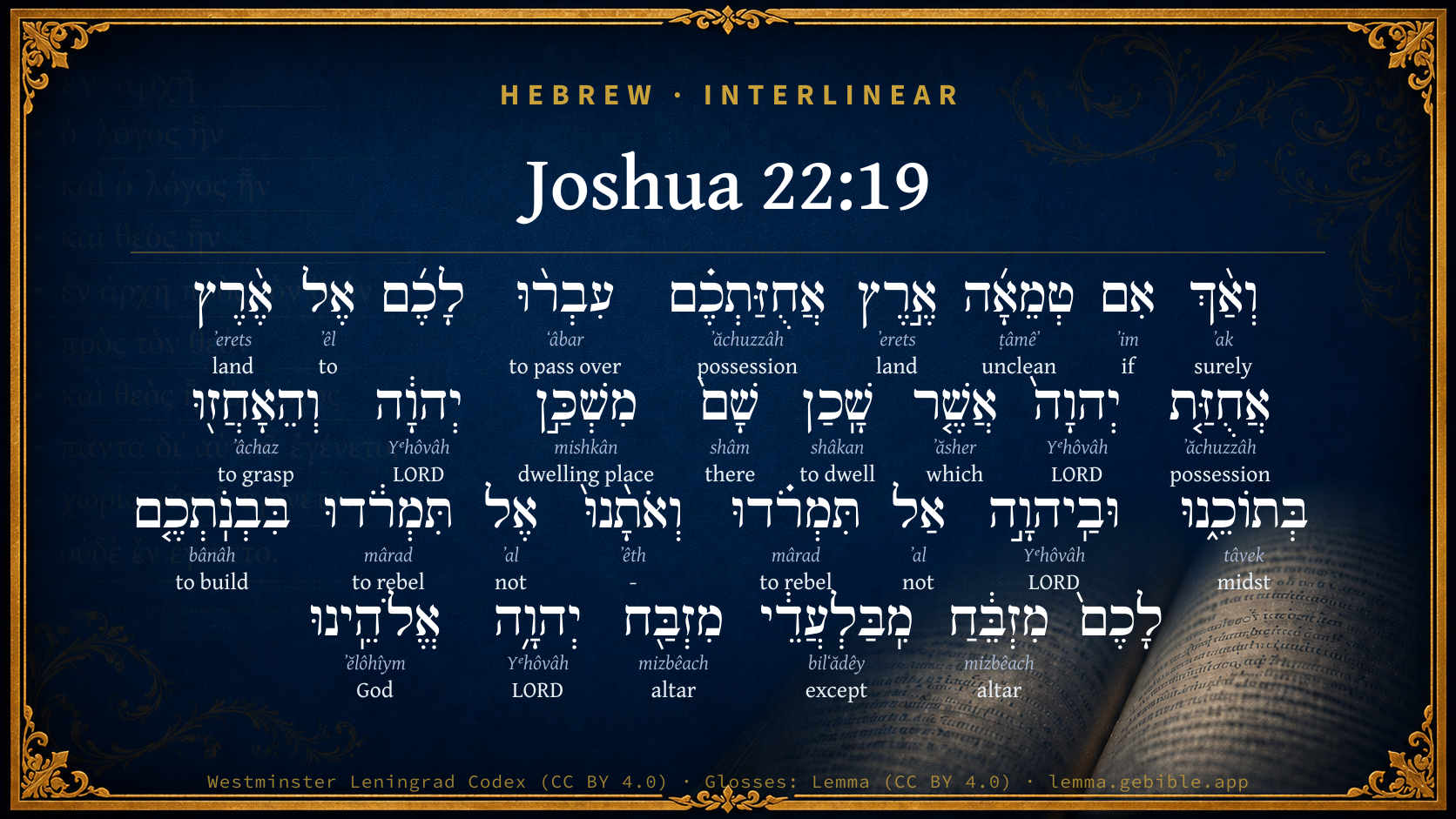
Hebrew (Westminster Leningrad Codex) Joshua 22:19 appears in the Hebrew Old Testament. The text above is from the Westminster Leningrad Codex. Each word links to its Strong’s number, a concise gloss, and parsing drawn from the Open Scriptures Hebrew Bible morphology. Click any word for its full Brown-Driver-Briggs (BDB) entry.
Download image
Cite this verse

Joshua 22:19 (World English Bible). Public Domain. Lemma interlinear Bible study tool, https://lemma.gebible.app/v/joshua/22/19.

Show BibTeX & RIS
BibTeX
RIS
English Translation
However, if the land of your possession be unclean, then pass over to the land of the possession of Yahweh, in which Yahweh's tent dwells, and take possession among us: but don't rebel against Yahweh, nor rebel against us, in building you an altar besides the altar of Yahweh our God.
World English Bible · Public Domain
Download a study sheet

One document with this verse’s original text, its word-by-word gloss line, the meaning frame, cross-references with their text, attributed commentary, and full source and license credits — printable, and it pastes into notes with its structure intact.

This verse Autodidact and up

Study sheet (.html) Plain text (.txt)

A passage Seminary Student

Up to 50 verses in one chapter. A passage sheet keeps up to 6 commentary sources and 12 cross-references per verse, in the order this page ranks them, and says so on the sheet whenever that leaves anything out. Ask for a single verse and you get the Autodidact verse sheet above.

Everything on this page stays free to read, with no account — the sheet is a download of what is already on screen, not access to it.

Want to remove ads? Support Godless Engineer
Compare translations 3

The same verse in 3 English versions, stacked beneath the original-language interlinear above. Click any original word for its lexicon entry.

Each is an independent rendering of the whole verse — the interlinear is not word-aligned to these translations.

Highlighted words mark where these versions differ — a whole-verse word diff, not a word-by-word alignment.

  • World English Bible Public Domain
    However, if the land of your possession be unclean, then pass over to the land of the possession of Yahweh, in which Yahweh's tent dwells, and take possession among us: but don't rebel against Yahweh, nor rebel against us, in building you an altar besides the altar of Yahweh our God.
  • King James Version Public Domain
    Notwithstanding, if the land of your possession be unclean, then pass ye over unto the land of the possession of the LORD, wherein the LORD's tabernacle dwelleth, and take possession among us: but rebel not against the LORD, nor rebel against us, in building you an altar beside the altar of the LORD our God.
  • unfoldingWord Literal Text CC BY-SA 4.0
    And indeed, if the land of your possession unclean, cross over for yourselves into the land of the possession of Yahweh, where the dwelling of Yahweh dwells there, and possess in the midst of us. But against Yahweh do not rebel, and against us do not rebel, by your building an altar for yourselves apart from the altar of Yahweh our God.

unfoldingWord Literal Text — © unfoldingWord, licensed CC BY-SA 4.0. Word-aligned USFM3 via Door43 (git.door43.org/unfoldingWord/en_ult).

Versions to compare (up to 4)

3 of 4 selected

Show all 18 translations

Every available English version of this verse, each an independent rendering of the whole verse.

  • World English Bible Public Domain
    However, if the land of your possession be unclean, then pass over to the land of the possession of Yahweh, in which Yahweh's tent dwells, and take possession among us: but don't rebel against Yahweh, nor rebel against us, in building you an altar besides the altar of Yahweh our God.
  • Berean Standard Bible Public Domain
    If indeed the land of your inheritance is unclean, then cross over to the land of the LORD’s possession, where the LORD’s tabernacle stands, and take possession of it among us. But do not rebel against the LORD or against us by building for yourselves an altar other than the altar of the LORD our God.
  • Majority Standard Bible Public Domain
    If indeed the land of your inheritance is unclean, then cross over to the land of the LORD’s possession, where the LORD’s tabernacle stands, and take possession of it among us. But do not rebel against the LORD or against us by building for yourselves an altar other than the altar of the LORD our God.
  • King James Version Public Domain
    Notwithstanding, if the land of your possession be unclean, then pass ye over unto the land of the possession of the LORD, wherein the LORD's tabernacle dwelleth, and take possession among us: but rebel not against the LORD, nor rebel against us, in building you an altar beside the altar of the LORD our God.
  • American Standard Version (1901) Public Domain
    Howbeit, if the land of your possession be unclean, then pass ye over unto the land of the possession of Jehovah, wherein Jehovah's tabernacle dwelleth, and take possession among us: but rebel not against Jehovah, nor rebel against us, in building you an altar besides the altar of Jehovah our God.
  • Revised Version (1885) Public Domain
    Howbeit, if the land of your possession be unclean, then pass ye over unto the land of the possession of the LORD, wherein the LORD’S tabernacle dwelleth, and take possession among us: but rebel not against the LORD, nor rebel against us, in building you an altar besides the altar of the LORD our God.
  • Geneva Bible (1599) Public Domain
    Notwithstanding if the land of your possession be vncleane, come ye ouer vnto the land of the possession of the Lord, wherein the Lordes Tabernacle dwelleth, and take possession among vs: but rebell not against the Lord, nor rebell not against vs in building you an altar, beside the altar of the Lord our God.
  • Douay-Rheims (1899) Public Domain
    But if you think the land of your possession to be unclean, pass over to the land wherein is the tabernacle of the Lord, and dwell among us: only depart not from the Lord, and from our society, by building an altar beside the altar of the Lord our God.
  • Young's Literal Translation Public Domain
    `And surely, if the land of your possession is unclean, pass over for you unto the land of the possession of Jehovah, where the tabernacle of Jehovah hath tabernacled, and have possession in our midst; and against Jehovah rebel not, and against us rebel not, by your building for you an altar, besides the altar of Jehovah our God.
  • Literal Standard Version CC BY-SA 4.0
    And surely, if the land of your possession is unclean, pass over for yourselves to the land of the possession of YHWH, where the Dwelling Place of YHWH has dwelt, and have possession in our midst; and do not rebel against YHWH, and do not rebel against us, by your building an altar for yourselves, besides the altar of our God YHWH.
  • Unlocked Literal Bible CC BY-SA 4.0
    If the land that you possess is defiled, then you should pass over into the land where Yahweh's tabernacle stands and take for yourselves a possession among us. Only do not rebel against Yahweh, nor rebel against us by building an altar for yourselves other than the altar of Yahweh our God.
  • unfoldingWord Literal Text CC BY-SA 4.0
    And indeed, if the land of your possession unclean, cross over for yourselves into the land of the possession of Yahweh, where the dwelling of Yahweh dwells there, and possess in the midst of us. But against Yahweh do not rebel, and against us do not rebel, by your building an altar for yourselves apart from the altar of Yahweh our God.
  • Darby Bible Public Domain
    Notwithstanding, if the land of your possession is unclean, come over into the land of the possession of Jehovah, where Jehovah's tabernacle dwelleth, and take possession amongst us; but rebel not against Jehovah, and rebel not against us, in building for yourselves an altar besides the altar of Jehovah our God.
  • World Messianic Bible Public Domain
    However, if the land of your possession is unclean, then pass over to the land of the possession of the LORD, in which the LORD’s tabernacle dwells, and take possession among us; but don’t rebel against the LORD, nor rebel against us, in building an altar other than the LORD our God’s altar.
  • Webster's Bible Public Domain
    Not withstanding, if the land of your possession is unclean, then pass ye over to the land of the possession of the LORD, in which the LORD'S tabernacle dwelleth, and take possession among us: but rebel not against the LORD, nor rebel against us, in building you an altar besides the altar of the LORD our God.
  • Free Bible Version CC BY-SA 4.0
    But if you think your land is tainted then come over to the land of the Lord where the Tabernacle of the Lord is located and share some of our land with us. Just don't rebel against the Lord, or against us, by building for yourselves an altar other than the altar of the Lord our God.
  • Bible in Basic English Public Domain
    But if the land you now have is unclean, come over into the Lord's land where his House is, and take up your heritage among us: but do not be false to the Lord and to us by building yourselves an altar in addition to the altar of the Lord our God.
  • JPS Tanakh (1917) Public Domain
    Howbeit, if the land of your possession be unclean, then pass ye over unto the land of the possession of the LORD, wherein the LORD'S tabernacle dwelleth, and take possession among us; but rebel not against the LORD, nor rebel against us, in building you an altar besides the altar of the LORD our God.

Literal Standard Version (2020), Covenant Press — licensed CC BY-SA 4.0. Text via the HelloAO Bible API (eBible.org). Unlocked Literal Bible (unfoldingWord) — licensed CC BY-SA 4.0. Text via the HelloAO Bible API (eBible.org). unfoldingWord Literal Text — © unfoldingWord, licensed CC BY-SA 4.0. Word-aligned USFM3 via Door43 (git.door43.org/unfoldingWord/en_ult). Free Bible Version, Dr. Jonathan Gallagher — licensed CC BY-SA 4.0. Text via the HelloAO Bible API (eBible.org).

Word by word

More ways to search: Search by grammar → Find every occurrence → Compare this word →

Practice this passage: Drill this verse → Learn its vocabulary →

מִֽבַּלְעֲדֵ֔י
bilʻădêy
H1107
“from · except”
Preposition + Preposition
Part of Speech
Preposition + Preposition
Full BDB Definition

Origin: constructive pl. from H1077 and H5703

TWOT: 246h

apart from, except, without, besides
  1. וְאַ֨ךְ ʼak H389 “and · surely” Conjunction + Adverb
  2. אִם ʼim H518 “if” Conjunction
  3. טְמֵאָ֜ה ṭâmêʼ H2931 “unclean” Adjective, Adjective, Feminine, Singular, Absolute
  4. אֶ֣רֶץ ʼerets H776 “land of” Noun, Common, Both, Singular, Construct
  5. אֲחֻזַּתְכֶ֗ם ʼăchuzzâh H272 “possession · your” Noun, Common, Feminine, Singular, Construct + Suffix, Personal, 2nd Person, Masculine, Plural
  6. עִבְר֨וּ ʻâbar H5674 “pass over” Verb, Qal, Imperative, 2nd Person, Masculine, Plural
  7. אֶל ʼêl H413 “to” Preposition
  8. אֶ֨רֶץ ʼerets H776 “land of” Noun, Common, Both, Singular, Construct
  9. אֲחֻזַּ֤ת ʼăchuzzâh H272 “possession of” Noun, Common, Feminine, Singular, Construct
  10. יְהוָה֙ Yᵉhôvâh H3068 “LORD” Noun, Proper
  11. אֲשֶׁ֤ר ʼăsher H834 “which” Particle, Relative
  12. שָֽׁכַן shâkan H7931 “to dwell” Verb, Qal, Perfect, 3rd Person, Masculine, Singular
  13. שָׁם֙ shâm H8033 “there” Adverb
  14. מִשְׁכַּ֣ן mishkân H4908 “dwelling place of” Noun, Common, Masculine, Singular, Construct
  15. יְהוָ֔ה Yᵉhôvâh H3068 “LORD” Noun, Proper
  16. וְהֵאָחֲז֖וּ ʼâchaz H270 “and · grasp” Conjunction + Verb, Niphal, Imperative, 2nd Person, Masculine, Plural
  17. בְּתוֹכֵ֑נוּ tâvek H8432 “in/at · midst · our” Preposition + Noun, Common, Masculine, Singular, Construct + Suffix, Personal, 1st Person, Common, Plural
  18. וּבַֽיהוָ֣ה Yᵉhôvâh H3068 “and · in/at · LORD” Conjunction + Preposition + Noun, Proper
  19. אַל ʼal H408 “not” Particle, Negative
  20. תִּמְרֹ֗דוּ mârad H4775 “to rebel” Verb, Qal, Jussive, 2nd Person, Masculine, Plural
  21. וְאֹתָ֨נוּ֙ ʼêth H853 “and · - · us” Conjunction + Particle, Direct Object + Suffix, Personal, 1st Person, Common, Plural
  22. אֶל ʼal H408 “not” Preposition
  23. תִּמְרֹ֔דוּ mârad H4775 “to rebel” Verb, Qal, Jussive, 2nd Person, Masculine, Plural
  24. בִּבְנֹֽתְכֶ֤ם bânâh H1129 “in/at · to build · you” Preposition + Verb, Qal, Infinitive Construct + Suffix, Personal, 2nd Person, Masculine, Plural
  25. מִזְבֵּ֔חַ mizbêach H4196 “altar” Noun, Common, Masculine, Singular, Absolute
  26. מִזְבַּ֖ח mizbêach H4196 “altar of” Noun, Common, Masculine, Singular, Construct
  27. יְהוָ֥ה Yᵉhôvâh H3068 “LORD” Noun, Proper
  28. אֱלֹהֵֽינוּ ʼĕlôhîym H430 “God(s) · our” Noun, Common, Masculine, Plural, Construct + Suffix, Personal, 1st Person, Common, Plural

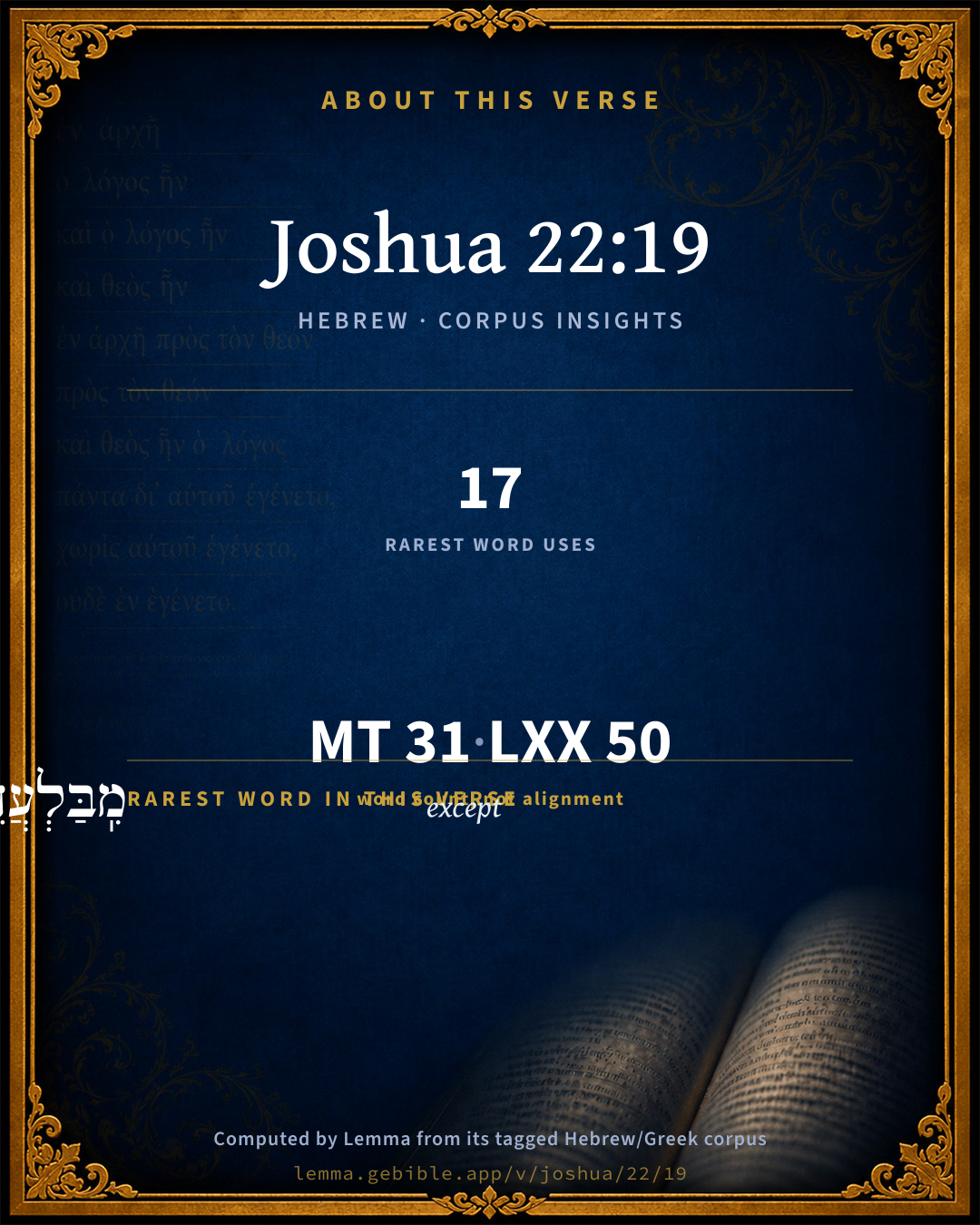
About this verse

These counts appear in no published source. They are computed here, from the morphology-tagged text and Lemma’s own curated glosses. What Lemma adds →

31
words
21
distinct lemmas
Historical
section

Notable vocabulary

The rarest word here is מִֽבַּלְעֲדֵ֔י except H1107 — appearing just 17 times in the whole Hebrew Bible.

Shared distinctive vocabulary

מִֽבַּלְעֲדֵ֔י except H1107 occurs in 16 verses of the Hebrew Bible. Also found in:

Grammatical profile

  • 6 verbs
  • 13 nouns
  • 1 adjective
  • 5 prepositions
  • 1 conjunction
  • 2 adverbs
  • 3 particles

Verb forms

  • עִבְר֨וּ Qal · Imperative
  • שָֽׁכַן Qal · Perfect
  • וְהֵאָחֲז֖וּ Niphal · Imperative
  • תִּמְרֹ֗דוּ Qal · Jussive
  • תִּמְרֹ֔דוּ Qal · Jussive
  • בִּבְנֹֽתְכֶ֤ם Qal · Infinitive Construct

Repetition

Words recur within this verse — often emphatic in Hebrew:

  • יְהוָה֙ LORD H3068 ×4
  • אֶ֣רֶץ land H776 ×2
  • אֲחֻזַּתְכֶ֗ם possession H272 ×2
  • תִּמְרֹ֗דוּ to rebel H4775 ×2
  • מִזְבֵּ֔חַ altar H4196 ×2
  • אַל not H408 ×2

Hebrew & Septuagint length

In English translation the verse runs 51 words from the Hebrew and 66 from the Septuagint (LXX English) — closely comparable.

A rough comparison of the two English renderings, which tokenize alike — not a word-level alignment.

Word counts can differ between the Hebrew and the Greek without any difference in meaning — e.g. the Hebrew direct-object marker אֵת has no separate Greek word, and Greek often adds the article ὁ.

In the original languages it is 31 Hebrew tokens and 50 Greek tokens — but the two are counted differently (Hebrew bundles its prefixes and suffixes into one token; the Greek is in lemma form), so that isn’t a like-for-like length.

Cross-references

10

Topical passages linked to Joshua 22:19 in the Treasury of Scripture Knowledge — connected by theme and wording, ordered by reader-vote popularity; previews shown in the World English Bible.

  • Joshua 18:1 The whole congregation of the children of Israel assembled themselves together at Shiloh, and set up the tent of meeting there: and the land was subdued before them.
  • Exodus 15:17 You shall bring them in, and plant them in the mountain of your inheritance, The place, Yahweh, which you have made for yourself to dwell in; The sanctuary, Lord, which your hands have established.
  • Leviticus 17:8–9 "You shall say to them, 'Any man there is of the house of Israel, or of the strangers who live as foreigners among them, who offers a burnt offering or sacrifice,
  • Leviticus 18:25–28 The land was defiled: therefore I punished its iniquity, and the land vomitted out her inhabitants.
  • Deuteronomy 12:5–6 But to the place which Yahweh your God shall choose out of all your tribes, to put his name there, even to his habitation shall you seek, and there you shall come;
  • 2 Chronicles 11:13 The priests and the Levites who were in all Israel resorted to him out of all their border.
  • 2 Chronicles 11:16–17 After them, out of all the tribes of Israel, such as set their hearts to seek Yahweh, the God of Israel, came to Jerusalem to sacrifice to Yahweh, the God of their fathers.
  • Amos 7:17 Therefore thus says Yahweh: 'Your wife shall be a prostitute in the city, and your sons and your daughters shall fall by the sword, and your land shall be divided by line; and you yourself shall die in a land that is unclean, and Israel shall surely be led away captive out of his land.'"
  • Acts 10:14–15 But Peter said, "Not so, Lord; for I have never eaten anything that is common or unclean."
  • Acts 11:8–9 But I said, 'Not so, Lord, for nothing unholy or unclean has ever entered into my mouth.'

Cross-references courtesy of OpenBible.info (CC BY 4.0).

Hebrew and Greek witnesses Masoretic Hebrew ↔ Greek Septuagint

The same verse in the two great witnesses to the Old Testament, shown verse-for-verse.

These are two independent witnesses, not word-aligned to each other, and the Septuagint is shown in lemma (dictionary) form.

Hebrew Joshua 22:19 Masoretic · Westminster Leningrad Codex

וְאַ֨ךְ אִם טְמֵאָ֜ה אֶ֣רֶץ אֲחֻזַּתְכֶ֗ם עִבְר֨וּ לָכֶ֜ם אֶל אֶ֨רֶץ אֲחֻזַּ֤ת יְהוָה֙ אֲשֶׁ֤ר שָֽׁכַן שָׁם֙ מִשְׁכַּ֣ן יְהוָ֔ה וְהֵאָחֲז֖וּ בְּתוֹכֵ֑נוּ וּבַֽיהוָ֣ה אַל תִּמְרֹ֗דוּ וְאֹתָ֨נוּ֙ אֶל תִּמְרֹ֔דוּ בִּבְנֹֽתְכֶ֤ם לָכֶם֙ מִזְבֵּ֔חַ מִֽבַּלְעֲדֵ֔י מִזְבַּ֖ח יְהוָ֥ה אֱלֹהֵֽינוּ

However, if the land of your possession be unclean, then pass over to the land of the possession of Yahweh, in which Yahweh's tent dwells, and take possession among us: but don't rebel against Yahweh, nor rebel against us, in building you an altar besides the altar of Yahweh our God.

World English Bible · Public Domain

Greek LXX Joshua 22:19 Septuagint · lemma form

καί νῦν εἰ μικρός σύ ὁ γῆ ὁ κατάσχεσις σύ διαβαίνω εἰς ὁ γῆ ὁ κατάσχεσις κύριος οὗ κατασκηνόω ἐκεῖ ὁ σκηνή κύριος καί κατακληρονομέω ἐν ἐγώ καί μή ἀποστάτης ἀπό θεός γίγνομαι καί μή ἀποἵστημι ἀπό κύριος διά ὁ οἰκοδομέω σύ βωμός ἔξω ὁ θυσιαστήριον κύριος ὁ θεός ἐγώ

And now if the land of your possession be too little, cross over to the land of the possession of the Lord, where the tabernacle of the Lord dwells, and receive you⌃ an inheritance among us; and do not become apostates from God, neither do you⌃ apostatize from the Lord, because of your having built an altar apart from the altar of the Lord our God.

LXX2012 (modern English Septuagint) · Public Domain

Hebrew: Westminster Leningrad Codex (CC BY 4.0). Greek: Septuagint (public domain); English from LXX2012 (modern English Septuagint) (Public Domain). How the Septuagint differs from the Hebrew →

Targum (Aramaic paraphrase)

1

The Targum is the ancient Jewish Aramaic paraphrase of the Hebrew Scriptures — an interpretive translation, not the Hebrew text itself. Onkelos (literal) and Pseudo-Jonathan (expansive) render the Torah, and Jonathan the Prophets. Coverage is partial: where no permissively-licensed English translation exists for a verse, only the Aramaic is shown. This is verse-level text, not a word-by-word alignment to the Hebrew.

  1. Targum Jonathan Prophets (Joshua–Malachi)
    וּבְרַם אִם מְסָאֲבָא אֲרַע אַחְסַנְתְּכוֹן עֲבָרוּ לְכוֹן לַאֲרַע אַחְסַנַת עַמָא דַייָ דִי שְׁרָא תַמָן מַשְׁכְּנָא דַייָ וְאַחֲסִינוּ בֵּינָנָא וּבְמֵימְרָא דַייָ לָא תִמְרְדוּן וּבָנָא לָא תִמְרְדוּן בְּמִבְנֵיכוֹן לְכוֹן מַדְבְּחָא בַּר מִמַדְבְּחָא דַייָ אֱלָהָנָא:

    (no public-domain English translation for this verse)

    Targum Jonathan — Aramaic: “Mikraot Gedolot” (public domain). English: “Sefaria Community Translation” (CC0 1.0 (public-domain dedication)); “London "Chaldee Paraphrase," 1871” (public domain). Text via Sefaria.

Commentary

Notes on Joshua 22:19 from classic Christian and Jewish commentators (each source and its license shown beneath its notes). The classic Christian expositions comment on the surrounding passage and are grouped to its opening verse, so a note may address several verses; the Jewish commentaries on the Tanakh (Rashi and others) are per-verse, so they appear only where the commentator wrote on this verse.

Lemma curates 59 commentaries, every one of them public domain or Creative Commons licensed, each selected and text-cleaned for this edition rather than reprinted as found. About our sources →

Trapp's Complete Commentary

John Trapp

Jos 22:19 Notwithstanding, if the land of your possession [be] unclean, [then] pass ye over unto the land of the possession of the LORD, wherein the LORD’S tabernacle dwelleth, and take possession among us: but rebel not against the LORD, nor rebel against us, in building you an altar beside the altar of the LORD our God.

Ver. 19. Be unclean.] In your opinion at least; for to the pure all things are pure: and God may be enjoyed in one place as well as another. {1Ti 2:3}

And take possession among us.] Though we have room little enough, yet better bear an inconvenience than a mischief: better we be distressed than God dishonoured, and the public hazarded to God’s hot and heavy displeasure.

John Trapp, A Commentary or Exposition upon All the Books of the Old and New Testament (1647–1656) — public domain. Text from a community e-Sword module.

Joseph Benson's Commentary

Jos 22:19. If the land of your possession be unclean — If you apprehend it to be so, and that it is not regarded by God for want of the tabernacle and altar there, but is like heathen lands; if you now repent of your former choice in preferring the worldly commodities of that country before the advantage of God’s presence, and more frequent opportunities of his service; pass ye over, and take possession among us — We will readily resign part of our possessions to you for the prevention of this sin and mischief. Thus Phinehas manifests his piety, disinterestedness, and benevolent intentions: “he even,” as Dr. Dodd observes, “himself seeks out some plausible pretence for the step against which he inveighs. He supposes that the Israelites beyond the river may have thought their land would be defiled, that it would not be a holy land, consecrated to God, and under his protection, unless they beheld there some token of his presence, some sacred edifice, which might publicly signify that the Lord was their God.” Rebel not against the Lord, nor against us — For as all the tribes were united in one body politic, and made one commonwealth, and one church; and each tribe was subject to the laws and commands of the whole society, and of the chief ruler or rulers thereof; so its disobedience to their just commands was properly rebellion against them. The tribes appear here to have been possessed of a wonderful zeal for God and the common good, inasmuch as they were willing and desirous rather to put themselves to straits, and give up some of their own land to their brethren, than see them deviate into schism, and revolt against God.

Joseph Benson's Commentary on the Old and New Testaments (1811–1818) — public domain. Text from a community e-Sword module.

Tyndale Open Study Notes

Tyndale Open Resources

22:19 Being defiled was not necessarily the result of rebellion or a moral lapse, but it did prevent persons or groups from participating in regular worship activities, including the offering of sacrifices. If the eastern tribes had defiled the land itself, the Israelites could not offer sacrifices to the Lord within it. This concern provides evidence that the eastern tribes had built their altar on the western bank of the Jordan. • The land west of the Jordan was considered the Lord’s land. The delegation from the western tribes made a very generous offer, inviting the eastern tribes to share their land. This demonstrated their commitment to national unity in faithfulness to God.

Tyndale Open Study Notes — © Tyndale Open Resources, licensed CC BY-SA 4.0. Text via the HelloAO Bible API.

Geneva Bible (1599)

Geneva Bible translators

In your judgment.

To use any other service than God hath appointed, is to rebel against God, 1 Sam. 15:23.

Geneva Bible (1599) marginal notes — public domain. Text via Bolls.life.

Adam Clarke's Commentary

Verse 19. If the land of your possessions be unclean] The generous mind of Phinehas led him to form this excuse for them. If ye suppose that this land is impure, as not having been originally included in the covenant, and ye think that ye cannot expect the blessing of God unless ye have an altar, sacrifices, &c., then pass ye over unto the land of the possession of the Lord, wherein the Lord's tabernacle dwelleth, the only legitimate place where sacrifices and offerings can be made. We will divide this land with you, and rather straiten ourselves than that you should conceive yourselves to be under any necessity of erecting a new altar besides the altar of the Lord our God.

Adam Clarke's Commentary on the Bible (1810–1826) — public domain. Text from a community e-Sword/MySword module.

Ellicott's Commentary for English Readers

(19) If the land of your possession be unclean.—This suggests that they might have built the altar in it to sanctify it. But it would hardly be intelligible unless the altar was, as we supposed, on the eastern side.

A Bible Commentary for English Readers, edited by Charles John Ellicott (1878–1897) — public domain. Text from a community e-Sword module.

The Cambridge Bible for Schools and Colleges

gen. ed. J. J. S. Perowne

19. if the land of your possession be unclean] i. e. without an altar to the Lord, and in the midst of many heathen dwelling amongst them.

the land of the possession of the Lord] the land of your possession. Observe the antithesis.

The Cambridge Bible for Schools and Colleges (gen. ed. J. J. S. Perowne; Cambridge University Press, 1878–1918) — public domain. Text from a community e-Sword module.

John Gill's Exposition

Did not Achan the son of Zerah,.... One that descended from Zerah the son of Judah, Jos 7:18,

commit a trespass in the accursed thing; in taking what was devoted to sacred uses:

and wrath fell on all the congregation of Israel? and which was what was feared now; and this instance is brought to show that such fears were not groundless:

and that man perished not alone in his iniquity: which seems to confirm the notion of those who think that his children suffered with him; though it may be observed, that it was through his sin that thirty six men were slain by the men of Ai, Jos 7:5.

John Gill's Exposition of the Whole Bible (1746–1763) — public domain (CC PDM 1.0). Text via the HelloAO Bible API.

Albert Barnes' Notes on the Bible

Unclean - i. e. unholy because the sanctuary was not in it, but on the other side of Jordan.

Albert Barnes' Notes on the Bible (1834–1885) — public domain. Text from a community e-Sword/MySword module.

Haydock's Catholic Bible Commentary

Unclean, as being destitute of the ark, &c. The Israelites had the greatest veneration for the land which God had chosen for their habitation. Naaman loaded two mules with some of the earth. We cannot help admiring the zeal and the disinterestedness of Phinees. He proposes to abandon some of the possessions on the other side of the Jordan, rather than that his brethren should forsake God, or offend him.

George Leo Haydock (1774–1849), Haydock's Catholic Family Bible and Commentary, 1859 edition — public domain. Excludes Psalms (Douay-Rheims chapter numbering differs from Protestant) and Deuterocanonical books (Catholic canon only).

Matthew Poole's English Annotations

If the land of your possession be clean; if you apprehend it to be so for want of the tabernacle and altar there, as the following words imply; if you now repent of your former choice in preferring the worldly commodities of that country before the advantage of God’s presence and favour, and more frequent opportunities of his service.

Take possession among us; we will readily resign part of our possessions to you for the prevention of this sin and mischief; wherein they show great zeal for God’s honour, and great pity and charity to their brethren.

Nor rebel against us; for all the tribes were united in one body politic, and made one commonwealth, and one church; and each tribe was subject to the laws and commands of the whole society, and of the chief ruler or rulers thereof; so its disobedience to their just commands was properly rebellion against them.

Matthew Poole's English Annotations on the Holy Bible (1683–1685) — public domain. Text from a community e-Sword/MySword module.

Whedon's Commentary on the Bible

Daniel D. Whedon

19. If the land of your possession be unclean — Not consecrated by the presence of the tabernacle and altar. “If ye think that God has not received your land into the same favour as ours, because he seems to dwell with us, and it is for that reason that ye are about to establish a worship of your own, change your abode and come over to us.” — Masius.

Daniel D. Whedon (gen. ed.), Commentary on the Old and New Testaments (1874–1909) — public domain. Text from a community e-Sword module.

The Pulpit Commentary

If the land of your possession be unclean. Rather, be defiled, either by the idolatrous nations around, or by being cut off from the worship of the true God at Shiloh. The only satisfactory explanation of this somewhat difficult passage which has yet been given is that of Masius, who explains it of a possible belief on the part of the two and a half tribes, that they were cut off by Jordan into another land, a land which had no title to the promises and privileges of Israel, no share in the worship of the one true God at Shiloh. If they entertained such an idea, then, however unfounded their conviction, it were better far to abandon the land, how suited to their circumstances soever it might be, and come across the Jordan, and dwell in the midst of their brethren, and under the protection of the tabernacle of the Lord. Beside. That is, separate from, suggesting the idea of an exclusion of those who committed such an act from the worship of the Lord.

The Pulpit Commentary (1880–1919), ed. H.D.M. Spence-Jones & Joseph S. Exell — public domain. Text from a community e-Sword module.

John Wesley's Explanatory Notes

Be unclean - If you apprehend it to be so for want of the tabernacle and altar there; as the following words imply: if you now repent of your former choice in preferring the worldly commodities of that country before the advantage of God's presence, and more frequent opportunities of his service. Among us - We will readily resign part of our possessions to you for the prevention of this sin and mischief. Against us - For all the tribes were united in one body politick, and made one commonwealth, and one church; and each tribe was subject to the laws and commands of the whole society, and of the chief ruler or rulers thereof; so its disobedience to their just commands was properly rebellion against them.

John Wesley, Explanatory Notes Upon the Whole Bible (1754–1765) — public domain. Text via the GEBible commentary corpus.

Keil & Delitzsch

C. F. Keil & F. Delitzsch

"And truly," the speaker continued, "if the land of your possession should be unclean," sc., so that you think it necessary to have an altar in the neighbourhood to expiate your sins and wipe away your uncleanness, "pass over into the land of Jehovah's possession, where His dwelling-place stands, and settle in the midst of us ('settle,' as in Gen 34:10); but do not rebel against Jehovah nor against us, by building an altar beside the (one) altar of Jehovah our God." מרד is construed first of all with בּ, and then with the accusative; the only other place in which the latter occurs is Job. Jos 24:13.

Keil & Delitzsch — Biblical Commentary on the Old Testament (1861–1891) — public domain (CC PDM 1.0). Text via the HelloAO Bible API. (Old Testament only.)

unfoldingWord translationNotes

Door43 World Missions Community

Achan ... Zerah

names of men (See: How to Translate Names)

Did not Achan son of Zerah break faith in the matter of those things that had been reserved for God? Did not wrath fall on all the people of Israel?

These questions are used to remind the people of the punishment for past sins. These questions can be written as statements. AT: "Achan son of Zerah sinned by taking things that had been reserved for God. And because of that God punished all the people of Israel!" (See: Rhetorical Question)

translationWords

possess

defile

Yahweh

tabernacle

rebel

altar

wrath

perish

iniquity

unfoldingWord translationNotes — © Distant Shores Media and the Door43 World Missions Community, licensed CC BY-SA 4.0. Source: git.door43.org/Door43/en_tn.

Rashi

Rabbi Shlomo Yitzchaki (Rashi)

If the land of Your posession is impure. Since the Holy blessed is He, did not choose to rest His Presence there.

Do not rebel against us.—וְאוֹתָנוּ אַל תִּמְרדוּ This is the same as—וּבָּנוּ אַל תִּמְרדוּ

Rashi on the Tanakh — English translations: “The Judaica Press complete Tanach with Rashi, translated by A. J. Rosenberg” (CC BY 4.0); “Pentateuch with Rashi's commentary by M. Rosenbaum and A.M. Silbermann, 1929-1934” (public domain); “The Metsudah Tanach series, Lakewood, N.J” (CC BY 4.0); and “The Book of Joshua, Metsudah Publications, 1997” (CC BY 4.0). Text via Sefaria.

Lesson kit

Teaching starters — assembled from the data on this page, not authored interpretation. Every prompt links to the verse data it draws on. Edit before teaching.

Joshua, in the Historical, opens this verse with 31 words (21 distinct Hebrew lemmas). Its most distinctive word is bilʻădêy (“except”). A historical commentator’s framing appears above. Read the whole chapter for the surrounding context.

Discussion questions

  1. What does “except” (bilʻădêy) contribute to the verse as a whole?
  2. Genesis 14:24 shares the word «except» with this verse. How do the two illuminate each other?
  3. “LORD” occurs 4× in this one verse. What is the effect of the repetition?
  4. These translations render this verse differently. What is at stake in choosing one wording over another?
  5. The verb «עִבְר֨וּ» is Qal Imperative. How does its form color the action?
  6. Reading how Trapp's Complete Commentary and Joseph Benson's Commentary read this verse, where do the two commentators agree and where do they part?

Things to notice

Reading settings

Reading text

Shown beneath each verse's original-language words.

Old Testament
Old Testament edition

Read the OT as the Masoretic Hebrew (MT) or the Greek Septuagint (LXX).

English shown for the Greek Septuagint (in the Hebrew ↔ Greek comparison).

Comparing translations? Open the Compare panel on any verse page to stack up to four side by side.