2 Kings 4:3

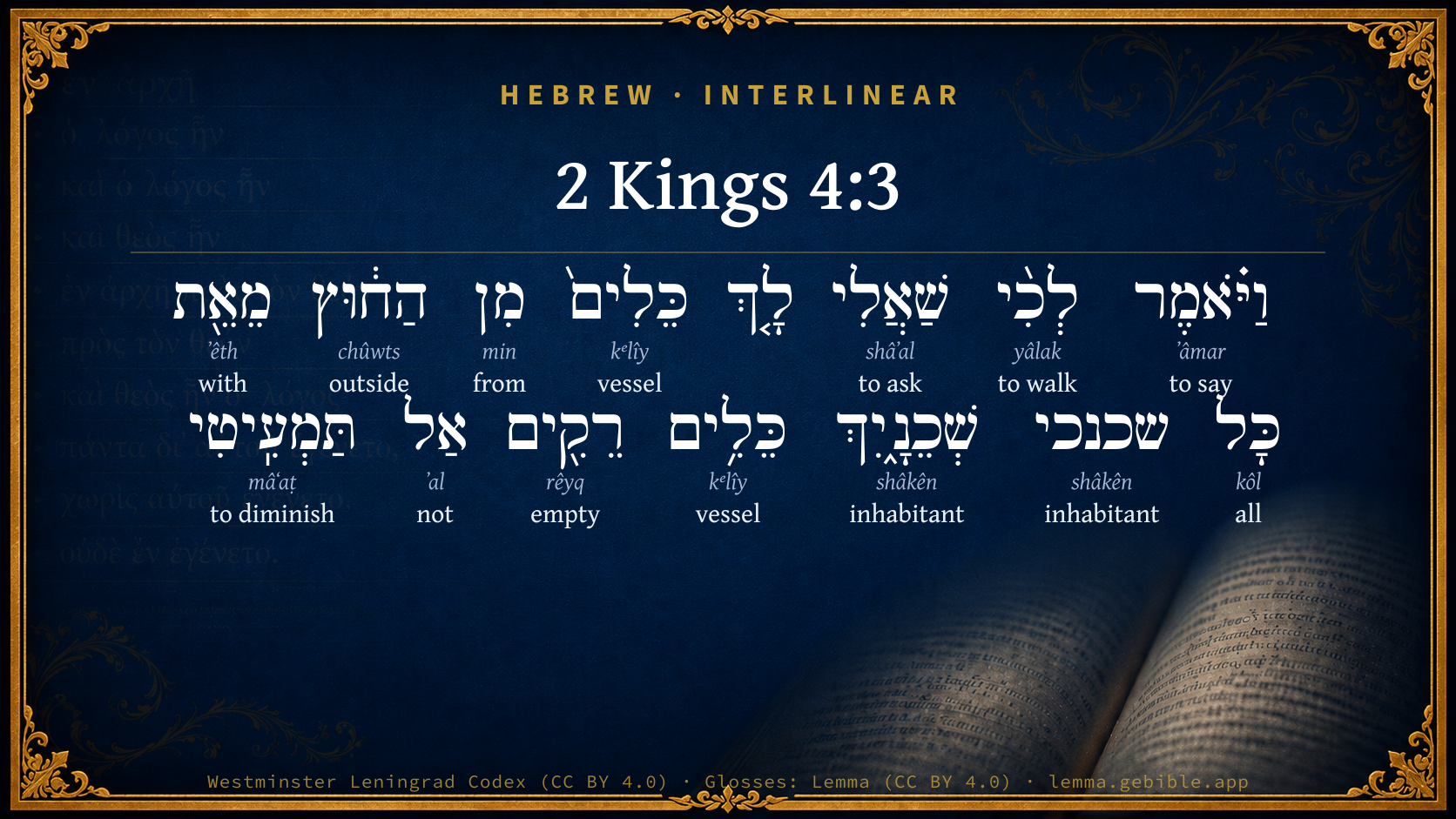
Hebrew (Westminster Leningrad Codex) 2 Kings 4:3 appears in the Hebrew Old Testament. The text above is from the Westminster Leningrad Codex. Each word links to its Strong’s number, a concise gloss, and parsing drawn from the Open Scriptures Hebrew Bible morphology. Click any word for its full Brown-Driver-Briggs (BDB) entry.
Download image
Cite this verse

2 Kings 4:3 (World English Bible). Public Domain. Lemma interlinear Bible study tool, https://lemma.gebible.app/v/2-kings/4/3.

Show BibTeX & RIS
BibTeX
RIS
English Translation
Then he said, Go, borrow you vessels abroad of all your neighbors, even empty vessels; borrow not a few.
World English Bible · Public Domain
Download a study sheet

One document with this verse’s original text, its word-by-word gloss line, the meaning frame, cross-references with their text, attributed commentary, and full source and license credits — printable, and it pastes into notes with its structure intact.

This verse Autodidact and up

Study sheet (.html) Plain text (.txt)

A passage Seminary Student

Up to 50 verses in one chapter. A passage sheet keeps up to 6 commentary sources and 12 cross-references per verse, in the order this page ranks them, and says so on the sheet whenever that leaves anything out. Ask for a single verse and you get the Autodidact verse sheet above.

Everything on this page stays free to read, with no account — the sheet is a download of what is already on screen, not access to it.

Want to remove ads? Support Godless Engineer
Compare translations 3

The same verse in 3 English versions, stacked beneath the original-language interlinear above. Click any original word for its lexicon entry.

Each is an independent rendering of the whole verse — the interlinear is not word-aligned to these translations.

Highlighted words mark where these versions differ — a whole-verse word diff, not a word-by-word alignment.

  • World English Bible Public Domain
    Then he said, Go, borrow you vessels abroad of all your neighbors, even empty vessels; borrow not a few.
  • King James Version Public Domain
    Then he said, Go, borrow thee vessels abroad of all thy neighbors, even empty vessels; borrow not a few.
  • unfoldingWord Literal Text CC BY-SA 4.0
    And he said, “Go, ask for yourself vessels from outside, from all of your neighbors, empty vessels. Do not get few.

unfoldingWord Literal Text — © unfoldingWord, licensed CC BY-SA 4.0. Word-aligned USFM3 via Door43 (git.door43.org/unfoldingWord/en_ult).

Versions to compare (up to 4)

3 of 4 selected

Show all 18 translations

Every available English version of this verse, each an independent rendering of the whole verse.

  • World English Bible Public Domain
    Then he said, Go, borrow you vessels abroad of all your neighbors, even empty vessels; borrow not a few.
  • Berean Standard Bible Public Domain
    “Go,” said Elisha, “borrow jars, even empty ones, from all your neighbors. Do not gather just a few.
  • Majority Standard Bible Public Domain
    “Go,” said Elisha, “borrow empty jars from all your neighbors. Do not gather just a few.
  • King James Version Public Domain
    Then he said, Go, borrow thee vessels abroad of all thy neighbors, even empty vessels; borrow not a few.
  • American Standard Version (1901) Public Domain
    Then he said, Go, borrow thee vessels abroad of all thy neighbors, even empty vessels; borrow not a few.
  • Revised Version (1885) Public Domain
    Then he said, Go, borrow thee vessels abroad of all thy neighbours, even empty vessels; borrow not a few.
  • Geneva Bible (1599) Public Domain
    And he sayde, Goe, and borowe thee vessels abroad of all thy neighbours, emptie vessels, and spare not.
  • Douay-Rheims (1899) Public Domain
    And he said to her: Go, borrow of all thy neighbours empty vessels not a few.
  • Young's Literal Translation Public Domain
    And he saith, `Go, ask for thee vessels from without, from all thy neighbours -- empty vessels -- let `them' not be few;
  • Literal Standard Version CC BY-SA 4.0
    And he says, “Go, ask [for] vessels for yourself from outside, from all your neighbors—empty vessels—let [them] not be few;
  • Unlocked Literal Bible CC BY-SA 4.0
    Then Elisha said, “Go out to borrow jars from your neighbors, empty jars. Borrow as many as possible.
  • unfoldingWord Literal Text CC BY-SA 4.0
    And he said, “Go, ask for yourself vessels from outside, from all of your neighbors, empty vessels. Do not get few.
  • Darby Bible Public Domain
    And he said, Go, borrow for thyself vessels abroad from all thy neighbours, empty vessels; let it not be few;
  • World Messianic Bible Public Domain
    Then he said, “Go, borrow empty containers from all your neighbors. Don’t borrow just a few containers.
  • Webster's Bible Public Domain
    Then he said, Go, borrow thee vessels abroad of all thy neighbors, even empty vessels; borrow not a few.
  • Free Bible Version CC BY-SA 4.0
    “Go and borrow empty jars from your neighbors—as many as possible, not just a few,” Elisha told her.
  • Bible in Basic English Public Domain
    Then he said, Go out to all your neighbours and get vessels, a very great number of them.
  • JPS Tanakh (1917) Public Domain
    Then he said: 'Go, borrow thee vessels abroad of all thy neighbours, even empty vessels; borrow not a few.

Literal Standard Version (2020), Covenant Press — licensed CC BY-SA 4.0. Text via the HelloAO Bible API (eBible.org). Unlocked Literal Bible (unfoldingWord) — licensed CC BY-SA 4.0. Text via the HelloAO Bible API (eBible.org). unfoldingWord Literal Text — © unfoldingWord, licensed CC BY-SA 4.0. Word-aligned USFM3 via Door43 (git.door43.org/unfoldingWord/en_ult). Free Bible Version, Dr. Jonathan Gallagher — licensed CC BY-SA 4.0. Text via the HelloAO Bible API (eBible.org).

Word by word

More ways to search: Search by grammar → Find every occurrence → Compare this word →

Practice this passage: Drill this verse → Learn its vocabulary →

רֵקִ֖ים
rêyq
H7386
“empty”
Adjective, Adjective, Masculine, Plural, Absolute
Part of Speech
Adjective
Type
Adjective
Gender
Masculine
Number
Plural
State
Absolute
Full BDB Definition

Origin: from H7324

TWOT: 2161a

empty, vain - empty (of vessels) - empty, idle, worthless (ethically)
  1. וַיֹּ֗אמֶר ʼâmar H559 “and · to say” Conjunction + Verb, Qal, Sequential Imperfect, 3rd Person, Masculine, Singular
  2. לְכִ֨י yâlak H3212 “walk” Verb, Qal, Imperative, 2nd Person, Feminine, Singular
  3. שַׁאֲלִי shâʼal H7592 “ask” Verb, Qal, Imperative, 2nd Person, Feminine, Singular
  4. כֵּלִים֙ kᵉlîy H3627 “vessels” Noun, Common, Masculine, Plural, Absolute
  5. מִן min H4480 “from” Preposition
  6. הַח֔וּץ chûwts H2351 “the · outside” Particle, Definite Article + Noun, Common, Masculine, Singular, Absolute
  7. מֵאֵ֖ת ʼêth H854 “from · with” Preposition + Preposition
  8. כָּל kôl H3605 “all of” Noun, Common, Masculine, Singular, Construct
  9. שכנכי shâkên H7934 “inhabitant · your” Adjective, Adjective, Masculine, Plural, Construct + Suffix, Personal, 2nd Person, Feminine, Singular
  10. שְׁכֵנָ֑יִךְ shâkên H7934 “inhabitant · your” Adjective, Adjective, Masculine, Plural, Construct + Suffix, Personal, 2nd Person, Feminine, Singular
  11. כֵּלִ֥ים kᵉlîy H3627 “vessels” Noun, Common, Masculine, Plural, Absolute
  12. אַל ʼal H408 “not” Particle, Negative
  13. תַּמְעִֽיטִי mâʻaṭ H4591 “to diminish” Verb, Hiphil, Jussive, 2nd Person, Feminine, Singular

About this verse

These counts appear in no published source. They are computed here, from the morphology-tagged text and Lemma’s own curated glosses. What Lemma adds →

15
words
12
distinct lemmas
Historical
section

Notable vocabulary

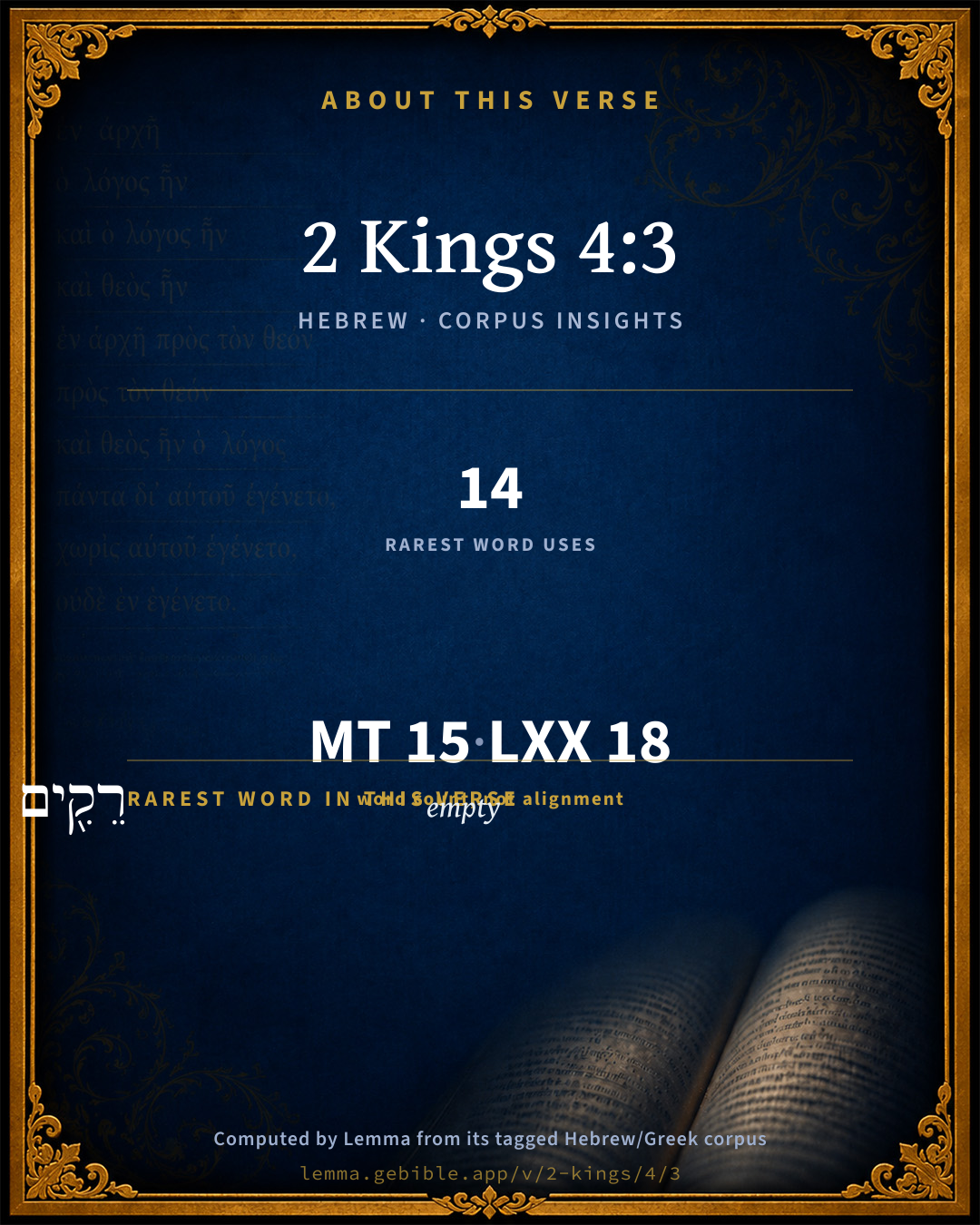
The rarest word here is רֵקִ֖ים empty H7386 — appearing just 14 times in the whole Hebrew Bible.

Shared distinctive vocabulary

רֵקִ֖ים empty H7386 occurs in 14 verses of the Hebrew Bible. Also found in:

Grammatical profile

  • 4 verbs
  • 4 nouns
  • 3 adjectives
  • 3 prepositions
  • 1 particle

Verb forms

  • וַיֹּ֗אמֶר Qal · Sequential Imperfect
  • לְכִ֨י Qal · Imperative
  • שַׁאֲלִי Qal · Imperative
  • תַּמְעִֽיטִי Hiphil · Jussive

Repetition

Words recur within this verse — often emphatic in Hebrew:

  • כֵּלִים֙ vessel H3627 ×2
  • שכנכי inhabitant H7934 ×2

Hebrew & Septuagint length

In English translation the verse runs 19 words from the Hebrew and 22 from the Septuagint (LXX English) — closely comparable.

A rough comparison of the two English renderings, which tokenize alike — not a word-level alignment.

Word counts can differ between the Hebrew and the Greek without any difference in meaning — e.g. the Hebrew direct-object marker אֵת has no separate Greek word, and Greek often adds the article ὁ.

In the original languages it is 15 Hebrew tokens and 18 Greek tokens — but the two are counted differently (Hebrew bundles its prefixes and suffixes into one token; the Greek is in lemma form), so that isn’t a like-for-like length.

Cross-references

5

Topical passages linked to 2 Kings 4:3 in the Treasury of Scripture Knowledge — connected by theme and wording, ordered by reader-vote popularity; previews shown in the World English Bible.

  • John 2:7 Jesus said to them, "Fill the water pots with water." They filled them up to the brim.
  • Psalms 81:10 I am Yahweh, your God, Who brought you up out of the land of Egypt. Open your mouth wide, and I will fill it.
  • John 16:24 Until now, you have asked nothing in my name. Ask, and you will receive, that your joy may be made full.
  • 2 Kings 3:16 He said, Thus says Yahweh, Make this valley full of trenches.
  • 2 Kings 13:18–19 He said, Take the arrows; and he took them. He said to the king of Israel, Smite on the ground; and he struck thrice, and stayed.

Cross-references courtesy of OpenBible.info (CC BY 4.0).

Hebrew and Greek witnesses Masoretic Hebrew ↔ Greek Septuagint

The same verse in the two great witnesses to the Old Testament, shown verse-for-verse.

These are two independent witnesses, not word-aligned to each other, and the Septuagint is shown in lemma (dictionary) form.

Hebrew 2 Kings 4:3 Masoretic · Westminster Leningrad Codex

וַיֹּ֗אמֶר לְכִ֨י שַׁאֲלִי לָ֤ךְ כֵּלִים֙ מִן הַח֔וּץ מֵאֵ֖ת כָּל שכנכי שְׁכֵנָ֑יִךְ כֵּלִ֥ים רֵקִ֖ים אַל תַּמְעִֽיטִי

Then he said, Go, borrow you vessels abroad of all your neighbors, even empty vessels; borrow not a few.

World English Bible · Public Domain

Greek LXX 2 Kings 4:3 Septuagint · lemma form

καί εἶπον πρός αὐτός δεῦρο αἰτέω σεαυτοῦ σκεῦος ἔξωθεν παρά πᾶς ὁ γείτων σύ σκεῦος κενός μή ὀλιγόω

And he said to her, Go, borrow for yourself vessels without of all your neighbors, even empty vessels; borrow not a few.

LXX2012 (modern English Septuagint) · Public Domain

Hebrew: Westminster Leningrad Codex (CC BY 4.0). Greek: Septuagint (public domain); English from LXX2012 (modern English Septuagint) (Public Domain). How the Septuagint differs from the Hebrew →

Targum (Aramaic paraphrase)

1

The Targum is the ancient Jewish Aramaic paraphrase of the Hebrew Scriptures — an interpretive translation, not the Hebrew text itself. Onkelos (literal) and Pseudo-Jonathan (expansive) render the Torah, and Jonathan the Prophets. Coverage is partial: where no permissively-licensed English translation exists for a verse, only the Aramaic is shown. This is verse-level text, not a word-by-word alignment to the Hebrew.

  1. Targum Jonathan Prophets (Joshua–Malachi)
    וַאֲמַר אֱזִילִי שְׁאִילִי לִיךְ מָנִין מִן בָּרָא מִן כָּל שְׁבַבַיְכִי מָנִין רֵיקָנִין לָא תַזְעִירִין:

    (no public-domain English translation for this verse)

    Targum Jonathan — Aramaic: “Mikraot Gedolot” (public domain). English: “Sefaria Community Translation” (CC0 1.0 (public-domain dedication)); “London "Chaldee Paraphrase," 1871” (public domain). Text via Sefaria.

Commentary

Notes on 2 Kings 4:3 from classic Christian and Jewish commentators (each source and its license shown beneath its notes). The classic Christian expositions comment on the surrounding passage and are grouped to its opening verse, so a note may address several verses; the Jewish commentaries on the Tanakh (Rashi and others) are per-verse, so they appear only where the commentator wrote on this verse.

Lemma curates 59 commentaries, every one of them public domain or Creative Commons licensed, each selected and text-cleaned for this edition rather than reprinted as found. About our sources →

Trapp's Complete Commentary

John Trapp

2Ki 4:3 Then he said, Go, borrow thee vessels abroad of all thy neighbours, [even] empty vessels; borrow not a few.

Ver. 3. Even empty vessels.] They must be empty hearts, saith Bernard; empty of self, and all ungodly lusts, which God will fill with the oil of grace: Intus existens prohibet alienum, else that precious liquor would be spilt upon the ground.

Borrow not a few.] Ne paucifices. Let not men be constrained in their own heart; there is enough in God.

John Trapp, A Commentary or Exposition upon All the Books of the Old and New Testament (1647–1656) — public domain. Text from a community e-Sword module.

The Biblical Illustrator

Joseph S. Exell

2Ki_4:3

Empty vessels: borrow not a few.

The filling of empty vessels

The best of men may die in poverty. Here is the widow of a prophet left in destitution. We must not hastily censure those who leave their families unprovided for. Circumstances may render it impossible to do more than supply the pressing wants of the hour. This sorrowing widow went to God in her trouble, but through the mediation of the prophet. So we should go to Christ. It is well to tell friends, but never fail to tell Rim who is the best friend. God was pleased to ordain by His servant a way of escape for the poor woman. It is the rule of Gods providence that His children should cry to Him in the day of trouble, and that He should be gracious to them and deliver them. Yet the Lord allowed His handmaid to be very sorely pressed. The Lord does not promise to rescue us in our time, or to save us from waiting; wherefore I say to you whose turn seems to come last, be strong to wait. Waiting in faith is a high form of worship, which in some respects excels the adoration of the shining ones above. But the way in which this woman was delivered was one which proved and exercised her faith.

I. In reference to the grace that is in Christ Jesus. All the miracle required was empty vessels. Full vessels were of no use. Righteous self is a greater hindrance than sinful self. All our Saviour wants of us is our need of being saved, and our acceptance of His salvation. The oil flowed as long as any empty vessel could be brought. How many empty souls are there here? Christ will continue to save sinners just as long as there are needy sinners to save.

II. In reference to answers to prayer. My conviction is that we do not pray enough; that is, do not ask enough of God. Borrow empty vessels--note the next word, borrow not a few. It was needful to urge her to large things. You and I have more to do with the measurement of our mercies than we think. Some have never brought their sins and prevalent temptations to God. Why carry your sin, your need, your care? These cares are all different sets of empty vessels for the grace of God to fill. We ought to treat others as if they were empty vessels for us to use, so as to glorify God in their salvation. (C. H. Spurgeon.)

God wants our emptiness

Do you see that beautiful tree in the orchard loaded with fruit? It is a pear tree. From top to bottom it is covered with fruit. Some boughs are ready to break with the luscious burden. As I listen to the creaking boughs, I can hear the tree speak. It says. Baskets, baskets, baskets, bring baskets. Now, then, who has a basket? I have got one, says yonder friend, but it is of no use, for there is nothing in it. Bring it here, man; that is the very kind of basket the tree wants. A person over there says, Oh, I have a basket, a splendid basket. It is just the thing. It is full from top to bottom. You may keep your basket to yourself. It is of no use to my loaded tree . . . What is wanted by the Lord Jesus is an empty soul to receive out of the fulness God has treasured up in Him. (C. H. Spurgeon.)

The Biblical Illustrator, edited by Joseph S. Exell (c. 1880s–1900s) — public domain. Text from a community e-Sword module.

Ellicott's Commentary for English Readers

(3) Abroad.—Literally, from the outside (of the house); out of doors.

Borrow not a few.—See margin. Do not scant, or stint, namely, to borrow.

A Bible Commentary for English Readers, edited by Charles John Ellicott (1878–1897) — public domain. Text from a community e-Sword module.

The Cambridge Bible for Schools and Colleges

gen. ed. J. J. S. Perowne

3. borrow thee vessels] Another sign of indigence. But the command to borrow many gave promise of the coming help.

The Cambridge Bible for Schools and Colleges (gen. ed. J. J. S. Perowne; Cambridge University Press, 1878–1918) — public domain. Text from a community e-Sword module.

John Gill's Exposition

Then he said, go, borrow thee vessels abroad of all thy neighbours,.... For he perceived that she had none:

even empty vessels; which they might more readily lend her:

borrow not a few; but as many as she could get; the prophet, under a divine impulse, was directed to say this to her, foreseeing, by a spirit of prophecy, that a large quantity of oil would be given her.

John Gill's Exposition of the Whole Bible (1746–1763) — public domain (CC PDM 1.0). Text via the HelloAO Bible API.

The Pulpit Commentary

Then he said, Go, borrow thee vessels abroad of all thy neighbors, even empty vessels; borrow not a few. God stints not in his. (Isa_55:1) When he offers them, men should take advantage of the offer largely, in the same spirit in which it is made (see below,. (2Ki_13:19)

The Pulpit Commentary (1880–1919), ed. H.D.M. Spence-Jones & Joseph S. Exell — public domain. Text from a community e-Sword module.

unfoldingWord translationNotes

Door43 World Missions Community

you must go inside

This means to go inside their house. The full meaning of this statement can be made explicit. AT: "you must go inside your house" (See: Assumed Knowledge and Implicit Information)

translationWords

neighbor

unfoldingWord translationNotes — © Distant Shores Media and the Door43 World Missions Community, licensed CC BY-SA 4.0. Source: git.door43.org/Door43/en_tn.

Lesson kit

Teaching starters — assembled from the data on this page, not authored interpretation. Every prompt links to the verse data it draws on. Edit before teaching.

2 Kings, in the Historical, opens this verse with 15 words (12 distinct Hebrew lemmas). Its most distinctive word is rêyq (“empty”). A historical commentator’s framing appears above. Read the whole chapter for the surrounding context.

Discussion questions

  1. How does “empty” (rêyq) shape what this verse is saying?
  2. How does Genesis 37:24, which shares the word «empty», read alongside this verse?
  3. What does the repetition of “vessel” (2× in this one verse) do in this verse?
  4. These translations render this verse differently; the difference is in the English rendering, not the original. What questions does that raise?
  5. «וַיֹּ֗אמֶר» is a Qal Sequential Imperfect verb. How does that grammatical form shape the action described?
  6. Compare how Trapp's Complete Commentary and The Biblical Illustrator read this verse. Where do they agree or differ?

Things to notice

Reading settings

Reading text

Shown beneath each verse's original-language words.

Old Testament
Old Testament edition

Read the OT as the Masoretic Hebrew (MT) or the Greek Septuagint (LXX).

English shown for the Greek Septuagint (in the Hebrew ↔ Greek comparison).

Comparing translations? Open the Compare panel on any verse page to stack up to four side by side.