
Numbers 16:15

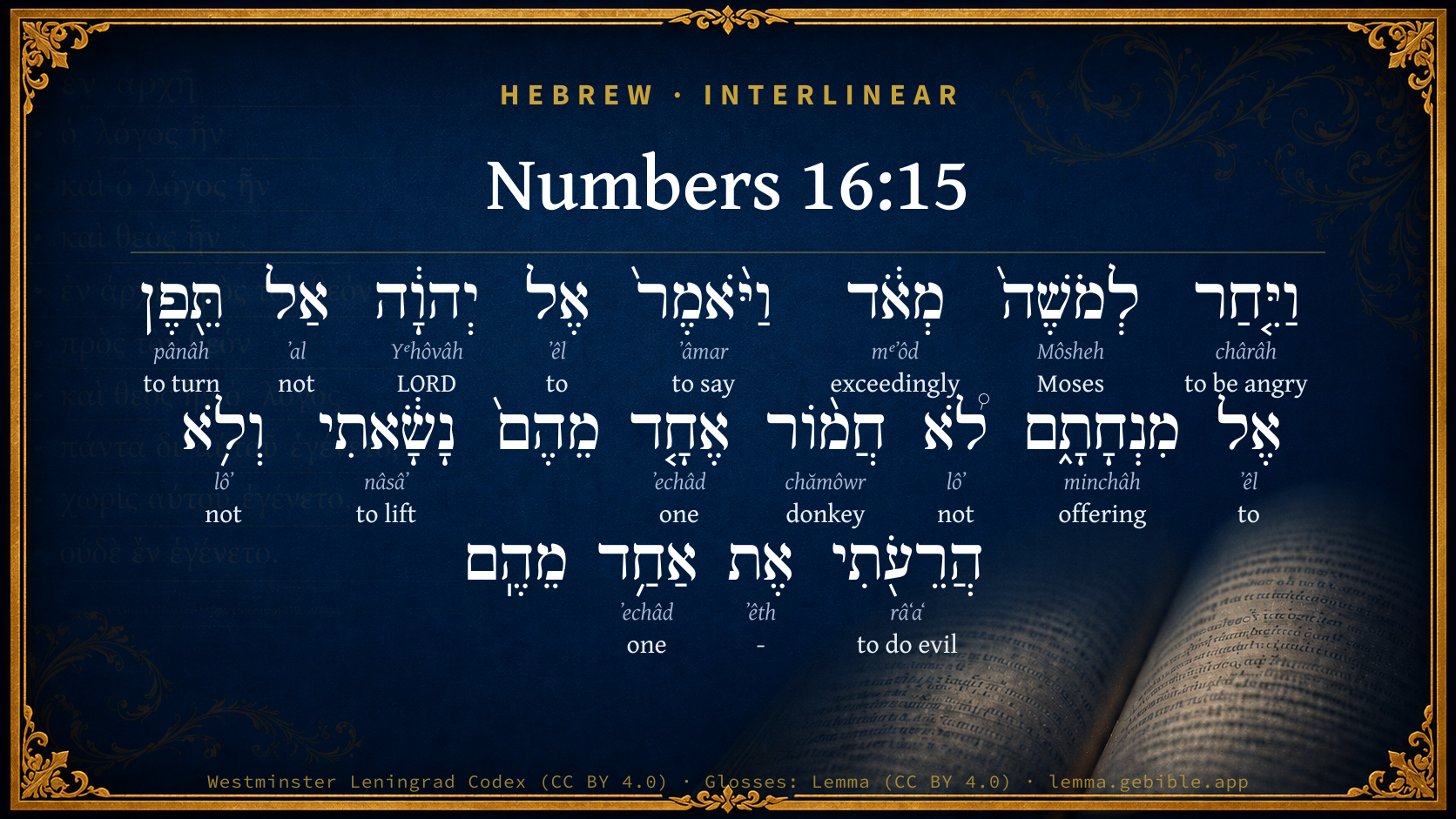
Hebrew (Westminster Leningrad Codex) Numbers 16:15 appears in the Hebrew Old Testament. The text above is from the Westminster Leningrad Codex. Each word links to its Strong’s number, a concise gloss, and parsing drawn from the Open Scriptures Hebrew Bible morphology. Click any word for its full Brown-Driver-Briggs (BDB) entry.
Download image
Cite this verse

Numbers 16:15 (World English Bible). Public Domain. Lemma interlinear Bible study tool, https://lemma.gebible.app/v/numbers/16/15.

Show BibTeX & RIS
BibTeX
RIS
English Translation
Moses was very angry, and said to Yahweh, "Don't respect their offering: I have not taken one donkey from them, neither have I hurt one of them."
World English Bible · Public Domain
Download a study sheet

One document with this verse’s original text, its word-by-word gloss line, the meaning frame, cross-references with their text, attributed commentary, and full source and license credits — printable, and it pastes into notes with its structure intact.

This verse Autodidact and up

Study sheet (.html) Plain text (.txt)

A passage Seminary Student

Up to 50 verses in one chapter. A passage sheet keeps up to 6 commentary sources and 12 cross-references per verse, in the order this page ranks them, and says so on the sheet whenever that leaves anything out. Ask for a single verse and you get the Autodidact verse sheet above.

Everything on this page stays free to read, with no account — the sheet is a download of what is already on screen, not access to it.

Want to remove ads? Support Godless Engineer
Compare translations 3

The same verse in 3 English versions, stacked beneath the original-language interlinear above. Click any original word for its lexicon entry.

Each is an independent rendering of the whole verse — the interlinear is not word-aligned to these translations.

Highlighted words mark where these versions differ — a whole-verse word diff, not a word-by-word alignment.

  • World English Bible Public Domain
    Moses was very angry, and said to Yahweh, "Don't respect their offering: I have not taken one donkey from them, neither have I hurt one of them."
  • King James Version Public Domain
    And Moses was very wroth, and said unto the LORD, Respect not thou their offering: I have not taken one ass from them, neither have I hurt one of them.
  • unfoldingWord Literal Text CC BY-SA 4.0
    And it burned exceedingly for Moses, and he said to Yahweh, “Do not turn to their grain offering. I have not lifted up one donkey from them. And I have not done evil to one from them.”

unfoldingWord Literal Text — © unfoldingWord, licensed CC BY-SA 4.0. Word-aligned USFM3 via Door43 (git.door43.org/unfoldingWord/en_ult).

Versions to compare (up to 4)

3 of 4 selected

Show all 18 translations

Every available English version of this verse, each an independent rendering of the whole verse.

  • World English Bible Public Domain
    Moses was very angry, and said to Yahweh, "Don't respect their offering: I have not taken one donkey from them, neither have I hurt one of them."
  • Berean Standard Bible Public Domain
    Then Moses became very angry and said to the LORD, “Do not regard their offering. I have not taken one donkey from them or mistreated a single one of them.”
  • Majority Standard Bible Public Domain
    Then Moses became very angry and said to the LORD, “Do not regard their offering. I have not taken one donkey from them or mistreated a single one of them.”
  • King James Version Public Domain
    And Moses was very wroth, and said unto the LORD, Respect not thou their offering: I have not taken one ass from them, neither have I hurt one of them.
  • American Standard Version (1901) Public Domain
    And Moses was very wroth, and said unto Jehovah, Respect not thou their offering: I have not taken one ass from them, neither have I hurt one of them.
  • Revised Version (1885) Public Domain
    And Moses was very wroth, and said unto the LORD, Respect not thou their offering: I have not taken one ass from them, neither have I hurt one of them.
  • Geneva Bible (1599) Public Domain
    Then Moses waxed verie angry, and saide vnto the Lord, Looke not vnto their offring: I haue not taken so much as an asse from them, neither haue I hurt any of them.
  • Douay-Rheims (1899) Public Domain
    Moses therefore being very angry, raid to the Lord: Respect not their sacrifices: thou knowest that I have not taken of them so much as a young ass at any time, nor have injured any of them.
  • Young's Literal Translation Public Domain
    And it is very displeasing to Moses, and he saith unto Jehovah, `Turn not Thou unto their present; not one ass from them have I taken, nor have I afflicted one of them.'
  • Literal Standard Version CC BY-SA 4.0
    And it is very displeasing to Moses, and he says to YHWH, “Do not turn to their present; I have not taken one donkey from them, nor have I afflicted one of them.”
  • Unlocked Literal Bible CC BY-SA 4.0
    Moses was very angry and said to Yahweh, “Do not respect their offering. I have not taken one donkey from them, and I have not harmed any of them.”
  • unfoldingWord Literal Text CC BY-SA 4.0
    And it burned exceedingly for Moses, and he said to Yahweh, “Do not turn to their grain offering. I have not lifted up one donkey from them. And I have not done evil to one from them.”
  • Darby Bible Public Domain
    Then Moses was very wroth, and said to Jehovah, Have no regard to their oblation: not one ass have I taken from them, neither have I hurt one of them.
  • World Messianic Bible Public Domain
    Moses was very angry, and said to the LORD, “Don’t respect their offering. I have not taken one donkey from them, neither have I hurt one of them.”
  • Webster's Bible Public Domain
    And Moses was very wroth, and said to the LORD, Respect not thou their offering: I have not taken one ass from them, neither have I hurt one of them.
  • Free Bible Version CC BY-SA 4.0
    Moses got really angry and said to the Lord, “Don't accept their offerings. I have never taken even a donkey from them or treated any of them badly.”
  • Bible in Basic English Public Domain
    Then Moses was very angry, and said to the Lord, Give no attention to their offering: not one of their asses have I taken, or done wrong to any of them.
  • JPS Tanakh (1917) Public Domain
    And Moses was very wroth, and said unto the LORD: 'Respect not Thou their offering; I have not taken one ass from them, neither have I hurt one of them.'

Literal Standard Version (2020), Covenant Press — licensed CC BY-SA 4.0. Text via the HelloAO Bible API (eBible.org). Unlocked Literal Bible (unfoldingWord) — licensed CC BY-SA 4.0. Text via the HelloAO Bible API (eBible.org). unfoldingWord Literal Text — © unfoldingWord, licensed CC BY-SA 4.0. Word-aligned USFM3 via Door43 (git.door43.org/unfoldingWord/en_ult). Free Bible Version, Dr. Jonathan Gallagher — licensed CC BY-SA 4.0. Text via the HelloAO Bible API (eBible.org).

Word by word

More ways to search: Search by grammar → Find every occurrence → Compare this word →

Practice this passage: Drill this verse → Learn its vocabulary →

וַיִּ֤חַר
chârâh
H2734
“and · to be angry”
Conjunction + Verb, Qal, Sequential Imperfect, 3rd Person, Masculine, Singular
Part of Speech
Conjunction + Verb
Stem
Qal
Form
Sequential Imperfect
Person
3rd Person
Gender
Masculine
Number
Singular
Full BDB Definition

Origin: a primitive root [compare H2787 ]

TWOT: 736

to be hot, furious, burn, become angry, be kindled - (Qal) to burn, kindle (anger) - (Niphal) to be angry with, be incensed - (Hiphil) to burn, kindle - (Hithpael) to heat oneself in vexation
  1. לְמֹשֶׁה֙ Môsheh H4872 “to/for · Moses” Preposition + Noun, Proper
  2. מְאֹ֔ד mᵉʼôd H3966 “exceedingly” Adverb
  3. וַיֹּ֨אמֶר֙ ʼâmar H559 “and · to say” Conjunction + Verb, Qal, Sequential Imperfect, 3rd Person, Masculine, Singular
  4. אֶל ʼêl H413 “to” Preposition
  5. יְהוָ֔ה Yᵉhôvâh H3068 “LORD” Noun, Proper
  6. אַל ʼal H408 “not” Particle, Negative
  7. תֵּ֖פֶן pânâh H6437 “to turn” Verb, Qal, Jussive, 2nd Person, Masculine, Singular
  8. אֶל ʼêl H413 “to” Preposition
  9. מִנְחָתָ֑ם minchâh H4503 “offering · their” Noun, Common, Feminine, Singular, Construct + Suffix, Personal, 3rd Person, Masculine, Plural
  10. לֹ֠א lôʼ H3808 “not” Particle, Negative
  11. חֲמ֨וֹר chămôwr H2543 “donkey” Noun, Common, Both, Singular, Absolute
  12. אֶחָ֤ד ʼechâd H259 “one” Adjective, Cardinal number, Masculine, Singular, Absolute
  13. נָשָׂ֔אתִי nâsâʼ H5375 “to lift” Verb, Qal, Perfect, 1st Person, Common, Singular
  14. וְלֹ֥א lôʼ H3808 “and · not” Conjunction + Particle, Negative
  15. הֲרֵעֹ֖תִי râʻaʻ H7489 “to do evil” Verb, Hiphil, Perfect, 1st Person, Common, Singular
  16. אֶת ʼêth H853 “-” Particle, Direct Object
  17. אַחַ֥ד ʼechâd H259 “one” Adjective, Cardinal number, Masculine, Singular, Absolute

About this verse

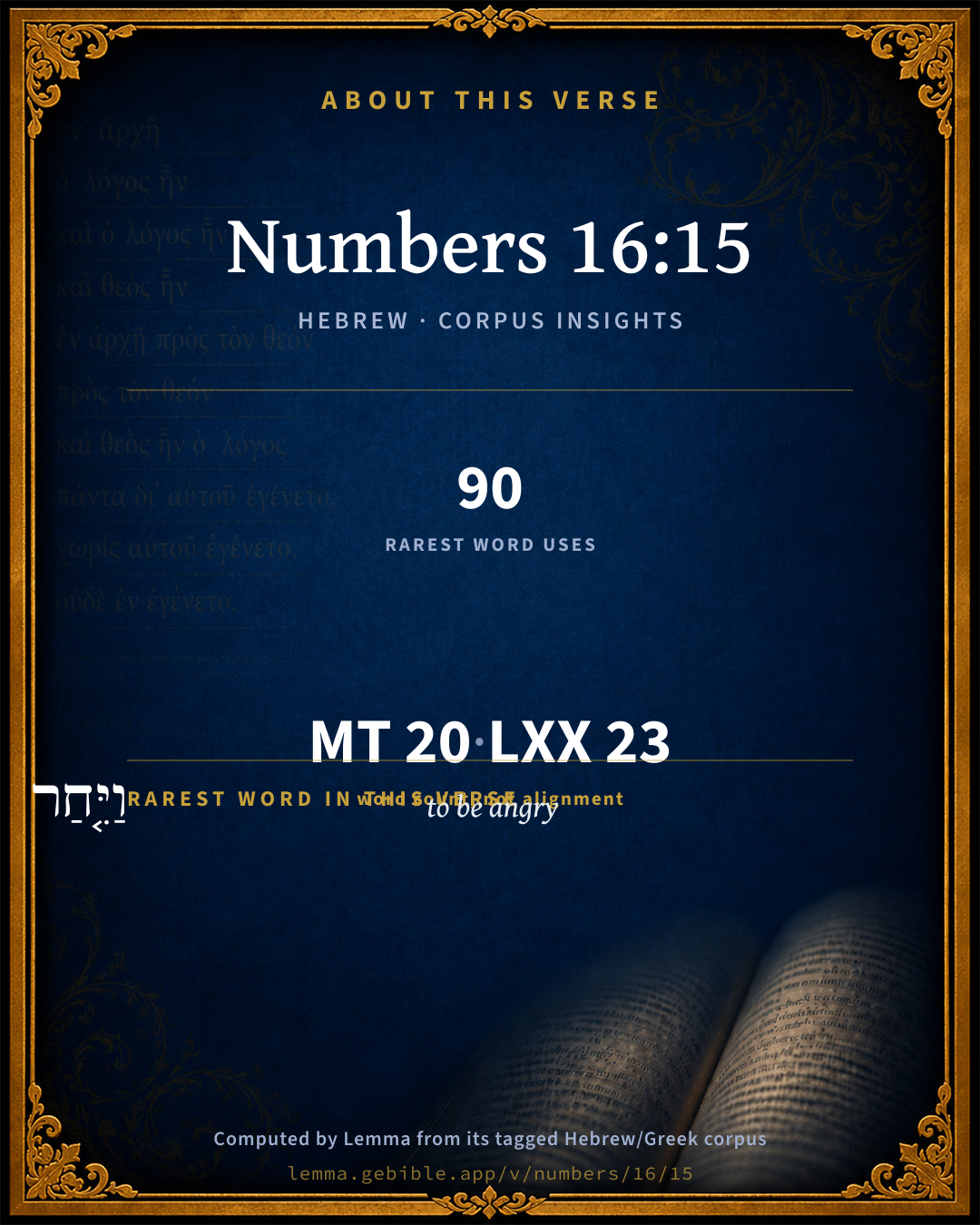
These counts appear in no published source. They are computed here, from the morphology-tagged text and Lemma’s own curated glosses. What Lemma adds →

20
words
15
distinct lemmas
Pentateuch
section

Grammatical profile

  • 5 verbs
  • 4 nouns
  • 2 adjectives
  • 4 prepositions
  • 1 adverb
  • 4 particles

Verb forms

  • וַיִּ֤חַר Qal · Sequential Imperfect
  • וַיֹּ֨אמֶר֙ Qal · Sequential Imperfect
  • תֵּ֖פֶן Qal · Jussive
  • נָשָׂ֔אתִי Qal · Perfect
  • הֲרֵעֹ֖תִי Hiphil · Perfect

Repetition

Words recur within this verse — often emphatic in Hebrew:

  • אֶחָ֤ד one H259 ×2
  • אֶל to H413 ×2
  • לֹ֠א not H3808 ×2

Hebrew & Septuagint length

In English translation the verse runs 27 words from the Hebrew and 38 from the Septuagint (LXX English) — the Septuagint runs noticeably longer here. See the side-by-side →

A rough comparison of the two English renderings, which tokenize alike — not a word-level alignment.

Word counts can differ between the Hebrew and the Greek without any difference in meaning — e.g. the Hebrew direct-object marker אֵת has no separate Greek word, and Greek often adds the article ὁ.

In the original languages it is 20 Hebrew tokens and 23 Greek tokens — but the two are counted differently (Hebrew bundles its prefixes and suffixes into one token; the Greek is in lemma form), so that isn’t a like-for-like length.

Cross-references

15

Topical passages linked to Numbers 16:15 in the Treasury of Scripture Knowledge — connected by theme and wording, ordered by reader-vote popularity; previews shown in the World English Bible.

  • Genesis 4:4–5 Abel also brought some of the firstborn of his flock and of the fat of it. Yahweh respected Abel and his offering,
  • 2 Corinthians 7:2 Open your hearts to us. We wronged no one. We corrupted no one. We took advantage of no one.
  • Exodus 32:19 It happened, as soon as he came near to the camp, that he saw the calf and the dancing: and Moses' anger grew hot, and he threw the tablets out of his hands, and broke them beneath the mountain.
  • Numbers 12:3 Now the man Moses was very humble, above all the men who were on the surface of the earth.
  • Numbers 16:6–7 This do: take you censers, Korah, and all his company;
  • 1 Samuel 12:3–4 Here I am: witness against me before Yahweh, and before his anointed: whose ox have I taken? or whose donkey have I taken? or whom have I defrauded? whom have I oppressed? or of whose hand have I taken a ransom to blind my eyes therewith? and I will restore it you.
  • Isaiah 1:10–15 Hear the word of Yahweh, you rulers of Sodom! Listen to the law of our God, you people of Gomorrah!
  • Matthew 5:22 But I tell you, that everyone who is angry with his brother without a cause shall be in danger of the judgment; and whoever shall say to his brother, 'Raca!' shall be in danger of the council; and whoever shall say, 'You fool!' shall be in danger of the fire of Gehenna.
  • Mark 3:5 When he had looked around at them with anger, being grieved at the hardening of their hearts, he said to the man, "Stretch out your hand." He stretched it out, and his hand was restored as healthy as the other.
  • Acts 20:33–34 I coveted no one's silver, or gold, or clothing.
  • 1 Corinthians 9:15 But I have used none of these things, and I don't write these things that it may be done so in my case; for I would rather die, than that anyone should make my boasting void.
  • 2 Corinthians 1:12 For our boasting is this: the testimony of our conscience, that in holiness and sincerity of God, not in fleshly wisdom but in the grace of God we behaved ourselves in the world, and more abundantly toward you.
  • 2 Corinthians 12:14–17 Behold, this is the third time I am ready to come to you, and I will not be a burden to you; for I seek not your possessions, but you. For the children ought not to save up for the parents, but the parents for the children.
  • 1 Thessalonians 2:10 You are witnesses with God, how holy, righteously, and blamelessly we behaved ourselves toward you who believe.
  • Ephesians 4:26 "Be angry, and don't sin." Don't let the sun go down on your wrath,

Cross-references courtesy of OpenBible.info (CC BY 4.0).

Hebrew and Greek witnesses Masoretic Hebrew ↔ Greek Septuagint

The same verse in the two great witnesses to the Old Testament, shown verse-for-verse.

Here the Septuagint runs noticeably longer than the Hebrew — LXX2012 (modern English Septuagint) 38 words vs World English Bible 27. A rough length comparison of the two English translations, not a word-level alignment — read both below.

These are two independent witnesses, not word-aligned to each other, and the Septuagint is shown in lemma (dictionary) form.

Hebrew Numbers 16:15 Masoretic · Westminster Leningrad Codex

וַיִּ֤חַר לְמֹשֶׁה֙ מְאֹ֔ד וַיֹּ֨אמֶר֙ אֶל יְהוָ֔ה אַל תֵּ֖פֶן אֶל מִנְחָתָ֑ם לֹ֠א חֲמ֨וֹר אֶחָ֤ד מֵהֶם֙ נָשָׂ֔אתִי וְלֹ֥א הֲרֵעֹ֖תִי אֶת אַחַ֥ד מֵהֶֽם

Moses was very angry, and said to Yahweh, "Don't respect their offering: I have not taken one donkey from them, neither have I hurt one of them."

World English Bible · Public Domain

Greek LXX Numbers 16:15 Septuagint · lemma form

καί βαρυθυμέω μωυσῆς σφόδρα καί εἶπον πρός κύριος μή προἔχω εἰς ὁ θυσία αὐτός οὐ ἐπιθύμημα οὐδείς αὐτός λαμβάνω οὐδέ κακόω οὐδείς αὐτός

And Moses was exceeding indignant, and said to the Lord, Do you take no heed to their sacrifice: I have not taken away the desire of any one of them, neither have I hurt any one of them.

LXX2012 (modern English Septuagint) · Public Domain

On this verse, Haydock's Catholic Bible Commentary discusses the Septuagint’s reading. Read the note in Commentary ↓

Hebrew: Westminster Leningrad Codex (CC BY 4.0). Greek: Septuagint (public domain); English from LXX2012 (modern English Septuagint) (Public Domain). How the Septuagint differs from the Hebrew →

Targum (Aramaic paraphrase)

2

The Targum is the ancient Jewish Aramaic paraphrase of the Hebrew Scriptures — an interpretive translation, not the Hebrew text itself. Onkelos (literal) and Pseudo-Jonathan (expansive) render the Torah, and Jonathan the Prophets. Coverage is partial: where no permissively-licensed English translation exists for a verse, only the Aramaic is shown. This is verse-level text, not a word-by-word alignment to the Hebrew.

  1. Targum Onkelos Torah (Genesis–Deuteronomy)
    וּתְקֵף לְמשֶׁה לַחֲדָא וַאֲמַר קֳדָם יְיָ לָא תְקַבֵּל בְּרַעֲוָא קוּרְבַּנְהוֹן לָא חֲמָרָא דְחַד מִנְהוֹן שְׁחָרִית וְלָא אַבְאֵישִׁית יַת חָד מִנְהוֹן

    (no public-domain English translation for this verse)

    Targum Onkelos — Aramaic: “Onkelos Genesis” (public domain); “Onkelos Exodus” (public domain); “Onkelos Leviticus” (public domain); “Onkelos Numbers” (public domain); “Onkelos Deuteronomy” (public domain). English: “Sefaria Community Translation” (CC0 1.0 (public-domain dedication)); “J.W. Etheridge. The Targums of Onkelos and Jonathan Ben Uzziel on the Pentateuch. London: Longmans, Green, 1862” (public domain). Text via Sefaria.

  2. Targum Pseudo-Jonathan Torah (Genesis–Deuteronomy)
    וּתְקֵיף לְמשֶׁה לַחֲדָא וַאֲמַר קֳדָם יְיָ בְּבָעוּ מִינָךְ לָא תִסְתַּכֵּל לְדוֹרוֹן דִידְהוֹן דְלָא חַמְרָא דְחַד מִנְהוֹן שְׁחָרִית וְלָא אַבְאָשִׁית לְחַד מִנְהוֹן

    And Mosheh was very wroth, and said before the Lord: I beseech thee, look not upon their offering, the portion of their hands; for not an ass have I taken from one of them, nor to any of them done an injury,

    Targum Pseudo-Jonathan — Aramaic: “Targum Jonathan on Genesis” (public domain); “Targum Jonathan on Exodus” (public domain); “Targum Jonathan on Leviticus” (public domain); “Targum Jonathan on Numbers” (public domain); “Targum Jonathan on Deuteronomy” (public domain). English: “The Targum of Jonathan ben Uzziel, trans. J. W. Etheridge, London, 1862” (public domain). Text via Sefaria.

Commentary

Notes on Numbers 16:15 from classic Christian and Jewish commentators (each source and its license shown beneath its notes). The classic Christian expositions comment on the surrounding passage and are grouped to its opening verse, so a note may address several verses; the Jewish commentaries on the Tanakh (Rashi and others) are per-verse, so they appear only where the commentator wrote on this verse.

Lemma curates 59 commentaries, every one of them public domain or Creative Commons licensed, each selected and text-cleaned for this edition rather than reprinted as found. About our sources →

Trapp's Complete Commentary

John Trapp

Num 16:15 And Moses was very wroth, and said unto the LORD, Respect not thou their offering: I have not taken one ass from them, neither have I hurt one of them.

Ver. 15. And Moses was very wroth.] Or, Very sore grieved. He might have said, as one once did, Felix essem si non imperitassem, Happy had I been if I had never been in place of authority. Egypt is said by Seneca to have been loquax et ingeniosa in contumeliam praefectorum provincia, in qua qui vitaverit culpam non effugit infamiam, A province apt to find fault with, and to speak hardly of their rulers, though never so innocent. These rebels had haply learned those Egyptian manners, by living so long amongst them.

I have not taken one ass from them.] Moses was not of them that follow the administration of justice as a trade only, with an unquenchable and unconscionable desire of gain. This is but robbery with authority, and justifies the common resemblance of the courts of justice to the bush, where to while the sheep flees for defence in weather, he is sure to lose part of his fleece.

John Trapp, A Commentary or Exposition upon All the Books of the Old and New Testament (1647–1656) — public domain. Text from a community e-Sword module.

Joseph Benson's Commentary

Num 16:15. Respect not their offering — Accept not their incense which they are now going to offer, but show some eminent dislike of it. He calls it their offering, though it was offered by Korah and his companions, because it was offered in the name and by the consent of all the conspirators, for the decision of the present controversy between them and Moses. I have not hurt one of them — I have never injured them, nor used my power to defraud or oppress them, as I might have done; I have done them many good offices, but no hurt; therefore their crime is without any cause or provocation.

Joseph Benson's Commentary on the Old and New Testaments (1811–1818) — public domain. Text from a community e-Sword module.

Tyndale Open Study Notes

Tyndale Open Resources

16:15 Do not accept their grain offerings! Cp. Ps 109:7; Prov 28:9.

Tyndale Open Study Notes — © Tyndale Open Resources, licensed CC BY-SA 4.0. Text via the HelloAO Bible API.

Jamieson, Fausset & Brown

Robert Jamieson, A. R. Fausset & David Brown

Moses was very wroth--Though the meekest of all men [Num 12:3], he could not restrain his indignation at these unjust and groundless charges; and the highly excited state of his feeling was evinced by the utterance of a brief exclamation in the mixed form of a prayer and an impassioned assertion of his integrity. (Compare Sa1 12:3).

and said unto the Lord, Respect not thou their offering--He calls it their offering, because, though it was to be offered by Korah and his Levitical associates, it was the united appeal of all the mutineers for deciding the contested claims of Moses and Aaron.

Jamieson, Fausset & Brown — Commentary Critical and Explanatory on the Whole Bible (1871) — public domain (CC PDM 1.0). Text via the HelloAO Bible API.

Adam Clarke's Commentary

Verse 15. Respect not thou their offering] There was no danger of this: they wished to set up a priesthood and a sacrifical system of their own; and God never has blessed, and never can bless, any scheme of salvation which is not of his own appointment. Man is ever supposing that he can mend his Maker's work, or that he can make one of his own that will do in its place.

Adam Clarke's Commentary on the Bible (1810–1826) — public domain. Text from a community e-Sword/MySword module.

Ellicott's Commentary for English Readers

(15) I have not taken one ass from them . . . —In answer to the accusation preferred against him in Num_16:13, Moses vindicates himself from the charge of oppression or extortion.

A Bible Commentary for English Readers, edited by Charles John Ellicott (1878–1897) — public domain. Text from a community e-Sword module.

The Cambridge Bible for Schools and Colleges

gen. ed. J. J. S. Perowne

15. their offering] This refers, apparently, ‘to the sacrifice which every Israelite might offer for his household and may be compared with Gen_4:4 f.… The writer is not thinking of any special priesthood, but simply takes it for granted that Yahwè, whose favour was always sought by sacrifice, will not accept the offering of rebels against just authority’ (Addis).

The Cambridge Bible for Schools and Colleges (gen. ed. J. J. S. Perowne; Cambridge University Press, 1878–1918) — public domain. Text from a community e-Sword module.

John Gill's Exposition

And Moses was very wroth,.... Or "it heated Moses exceedingly" (p); made him very angry, caused him to burn with wrath against them; even the speech they made, the words they uttered, not so much on account of their ill usage of him, as for the dishonour cast upon the Lord:

and said unto the Lord, respect not thou their offering; their "Minchah", the word is commonly used for the meat or bread offering. Aben Ezra observes, that Dathan and Abiram were great men, and had offered such kind of offerings before this fact; and therefore Moses desires that the Lord would have no respect to any they had offered, but have respect to him, who had never injured any of them. Jarchi gives it as the sense of some, that whereas these men had a part in the daily sacrifices of the congregation (with which a meat offering always went), the request is, that it might not be received with acceptance by the Lord; but he himself thinks it is to be understood of the offering of incense they were to offer on the morrow; and Moses desires that God would show his disapprobation of it, and which is the common interpretation. The Targums of Jonathan and Jerusalem render it, "their gift":

I have not taken one ass from them; either by force, or as a bribe, or by way of gratuity for any service done them; the sense is, that he had not taken from them the least thing in the world, anything of the meanest worth and value, on any consideration. Aben Ezra interprets the word "take", of taking and laying any burden upon an ass of theirs; so far was he from laying any burdens on them, and using them in a cruel and tyrannical manner, as they suggested, that he never laid the least burden on any ass of theirs, and much less on them:

neither have I hurt any of them; never did any injury to the person or property of anyone of them, but, on the contrary, had done them many good offices.

(p) "et excanduit Mosi valde", Drusius.

John Gill's Exposition of the Whole Bible (1746–1763) — public domain (CC PDM 1.0). Text via the HelloAO Bible API.

Haydock's Catholic Bible Commentary

Very angry. This anger was a zeal against sin; and an indignation at the affront offered to God; like that which the same holy prophet conceived upon the sight of the golden calf, Exodus xxxii. 19. (Challoner) --- Respect not. Hebrew, "thou wilt not have regard for their sacrifices," as long as they continue in these sentiments of pride and of rebellion. (Haydock) --- Thou knowest. Hebrew, "I have not," &c. --- Ass. This expression is proverbial, 1 Kings xii. 3. The Samaritan and Septuagint read, chamod, "any thing desirable," instead of chamor "an ass." (Calmet)

George Leo Haydock (1774–1849), Haydock's Catholic Family Bible and Commentary, 1859 edition — public domain. Excludes Psalms (Douay-Rheims chapter numbering differs from Protestant) and Deuterocanonical books (Catholic canon only).

Matthew Poole's English Annotations

Moses was very wroth, not so much for his own sake, for he had learnt to bear indignities, Num 12, as for God’s sake, who was highly dishonoured, blasphemed, and provoked by these speeches and carriages, in which case he ought to be angry, as Christ was, Mar 3:5.

Respect not thou their offering, i.e. accept not their incense which they are now going to offer, but show some eminent dislike of it. He calls it their offering, though it was offered by Korah and his companions, because it was offered in the name and by the consent of all the conspirators, for the decision of the present controversy between them and Moses.

Not one ass, i.e. not any thing of the smallest value, as an ass was; see 1Sa 12:3 neither have I injured them, nor used my power to defraud or oppress them, as I might have done; but, which is here implied, I have done them many good offices, but no hurt; therefore their crime is inexcusable, because without any cause or provocation on my part.

Matthew Poole's English Annotations on the Holy Bible (1683–1685) — public domain. Text from a community e-Sword/MySword module.

Whedon's Commentary on the Bible

Daniel D. Whedon

15. Moses was very wroth — Anger in the interest of truth and justice is a holy emotion which dwells in the bosom of God and of his Son. Psa_7:11; Mar_3:5, note.

Respect not — Accept not their offered incense.

Gen_4:4.

Not taken one ass — No tribute had been exacted such as kings lay upon their subjects. Their rebellion is entirely without justification.

Daniel D. Whedon (gen. ed.), Commentary on the Old and New Testaments (1874–1909) — public domain. Text from a community e-Sword module.

The Pulpit Commentary

And Moses was very wroth. The bitter taunts of the Reubenites had just enough semblance of truth in them to make them very hard to bear, and especially the imputation of low personal ambition; but it is impossible to say that Moses did not err through anger. Respect not thou their offering. Cf. Gen_4:4. It is not quite clear what offering Moses meant, since they do not seem to have wished to offer incense. Probably it was equivalent to saying, Do not thou accept them when they approach thee; for such approach was always by sacrifice. (cf. Psa_109:7) I have not taken one ass from them. Cf. 1Sa_12:3. The ass was the least valuable of the ordinary live stock of those days. (cf. Exo_20:17) The Septuagint has here ouk epiyumhma oudeno , which is apparently an intentional paraphrase with a reference to the tenth commandment (ouk epiyumhseiv k.t.l.). Neither have I hurt one of them. As absolute ruler he might have made himself very burdensome to all, and very terrible to his personal enemies. Compare Samuel"s description of the Eastern autocrat. (1Sa_8:11-17)

The Pulpit Commentary (1880–1919), ed. H.D.M. Spence-Jones & Joseph S. Exell — public domain. Text from a community e-Sword module.

John Wesley's Explanatory Notes

Respect not their offering - Accept not their incense which they are now going to offer, but shew some eminent dislike of it. He calls it their offering, though it was offered by Korah and his companions, because it was offered in the name and by the consent of all the conspirators, for the decision of the present controversy between them and Moses. I have not hurt one of them - I have never injured them, nor used my power to defraud or oppress them, as I might have done; I have done them many good offices, but no hurt: therefore their crime is without any cause or provocation.

John Wesley, Explanatory Notes Upon the Whole Bible (1754–1765) — public domain. Text via the GEBible commentary corpus.

Keil & Delitzsch

C. F. Keil & F. Delitzsch

Moses was so disturbed by these scornful reproaches, that he entreated the Lord, with an assertion of his own unselfishness, not to have respect to their gift, i.e., not to accept the sacrifice which they should bring (cf. Gen 4:4). "I have not taken one ass from them, nor done harm to one of them," i.e., I have not treated them as a ruler, who demands tribute of his subjects, and oppresses them (cf. Sa1 12:3).

Keil & Delitzsch — Biblical Commentary on the Old Testament (1861–1891) — public domain (CC PDM 1.0). Text via the HelloAO Bible API. (Old Testament only.)

unfoldingWord translationNotes

Door43 World Missions Community

I have not taken one donkey from them

One donkey here represents anything that a person my take from someone else. AT: "I have not taken anything from them, not even one donkey" (See: Synecdoche)

censer

a container in which to burn incense

translationWords

anger

sacrifice

donkey

incense

unfoldingWord translationNotes — © Distant Shores Media and the Door43 World Missions Community, licensed CC BY-SA 4.0. Source: git.door43.org/Door43/en_tn.

Rashi

Rabbi Shlomo Yitzchaki (Rashi)

ויחר למשה מאד AND MOSES WAS VERY DISTRESSED — i.e. he was very much grieved.

אל תפן אל מנחתם TURN NOT THOU TO THEIR OBLATION — According to its plain sense the meaning is: “In respect to the frankincense which they will offer before Thee tomorrow, I beg of Thee do not turn (pay regard) to them”. The Midrashic explanation is: He said, “I know that they have a portion in the continual offerings of the community; let not even this their portion be accepted favourably before Thee — let the fire leave it alone and not consume it” (Midrash Tanchuma, Korach 7).

לא חמור אחד מהם נשאתי means, I have not taken the ass of any one of them; — even when I went from Midian to Egypt and placed my wife and my sons on the ass (Exodus 4:20), and I surely ought afterwards to have taken the price of that ass from their money, yet I took it only from my own (Midrash Tanchuma, Korach 7). The translation given by Onkelos of the word נשאתי is שחרית: in the Aramaic language a forced levy made by the king is so called, viz., שחרור (cf. Rashi on Bava Batra 47a. The translation of Onkelos therefore is: I did not press into my service the ass of any one of them).

Rashi on the Tanakh — English translations: “The Judaica Press complete Tanach with Rashi, translated by A. J. Rosenberg” (CC BY 4.0); “Pentateuch with Rashi's commentary by M. Rosenbaum and A.M. Silbermann, 1929-1934” (public domain); “The Metsudah Tanach series, Lakewood, N.J” (CC BY 4.0); and “The Book of Joshua, Metsudah Publications, 1997” (CC BY 4.0). Text via Sefaria.

Ramban (Nachmanides)

Rabbi Moshe ben Nachman (Ramban / Nachmanides)

RESPECT NOT THOU ‘MINCHATHAM’ (THEIR OFFERING). “According to its plain sense [the meaning of ‘their offering’ is] ‘the incense which they will offer up before You tomorrow — do not turn to it.’ The Midrashic explanation is that Moses said: ‘I know that they have a portion in the Daily Whole-offerings of the congregation; let not [their part in it] be accepted before You favorably.’” This is Rashi’s language. But it does not seem to me to be correct that it is referring to the incense, because it was with reference to Dathan and Abiram that Moses said this, because he became angered by their words, and they were not amongst the company who gathered together to burn the incense. But the plain meaning [of the verse] is that because these people wanted the priesthood, to be able to perform the service of the offerings, Moses said: “Respect not Thou their offering, meaning: respect not the offering which they want to bring before You, nor the prayer which they will pray unto You,” for all offerings, including prayer, are called minchah (offering) in Scripture. Onkelos also rendered [minchatham] as kurbanhon (their offering), meaning “anything that they will offer before You.”

I HAVE NOT TAKEN ONE ASS FROM THEM. The meaning thereof is that Moses said: “What lordship am I exercising over them, for I have never taken from them even one ass to do my work, as is the manner of kings and princes?” For this is the manner of the kingdom, as it is written, and he will take your asses, and put them to his work., 8:16. This is the meaning of Onkelos’ rendition: [“I have not taken one ass from them] sh’chorith (as a levy),” for [in Aramaic] the king’s levy is called shichvur. Thus Moses mentioned the smallest incident amongst the laws of royalty, and then he said, Neither have I hurt one of them by appointing him to my chariot, Verse 12. or to do my work, as is befitting for a king, or by perverting his judgment [in a lawsuit] or by treating him with disrespect, for [the phrase “hurting” in neither have I ‘hurt’ one of them] includes all kinds of injustice.

Ramban (Nachmanides) on the Tanakh — English translation: “Commentary on the Torah by Ramban (Nachmanides). Translated and annotated by Charles B. Chavel. New York, Shilo Pub. House, 1971-1976” (CC BY 4.0). Text via Sefaria.

Lesson kit

Teaching starters — assembled from the data on this page, not authored interpretation. Every prompt links to the verse data it draws on. Edit before teaching.

Numbers, in the Pentateuch, opens this verse with 20 words (15 distinct Hebrew lemmas). Its most distinctive word is chârâh (“to be angry”). The Greek Septuagint runs longer here. A historical commentator’s framing appears above. Read the whole chapter for the surrounding context.

Discussion questions

  1. How does “to be angry” (chârâh) shape what this verse is saying?
  2. How does Genesis 4:4–5, which shares this passage’s theme, read alongside this verse?
  3. What does the repetition of “one” (2× in this one verse) do in this verse?
  4. The Septuagint runs longer here than the Hebrew. What might account for the difference?
  5. These translations render this verse differently. What is at stake in choosing one wording over another?
  6. «וַיִּ֤חַר» is a Qal Sequential Imperfect verb. How does that grammatical form shape the action described?
  7. Compare how Trapp's Complete Commentary and Joseph Benson's Commentary read this verse. Where do they agree or differ?

Things to notice

Reading settings

Reading text

Shown beneath each verse's original-language words.

Old Testament
Old Testament edition

Read the OT as the Masoretic Hebrew (MT) or the Greek Septuagint (LXX).

English shown for the Greek Septuagint (in the Hebrew ↔ Greek comparison).

Comparing translations? Open the Compare panel on any verse page to stack up to four side by side.