
Exodus 19:15

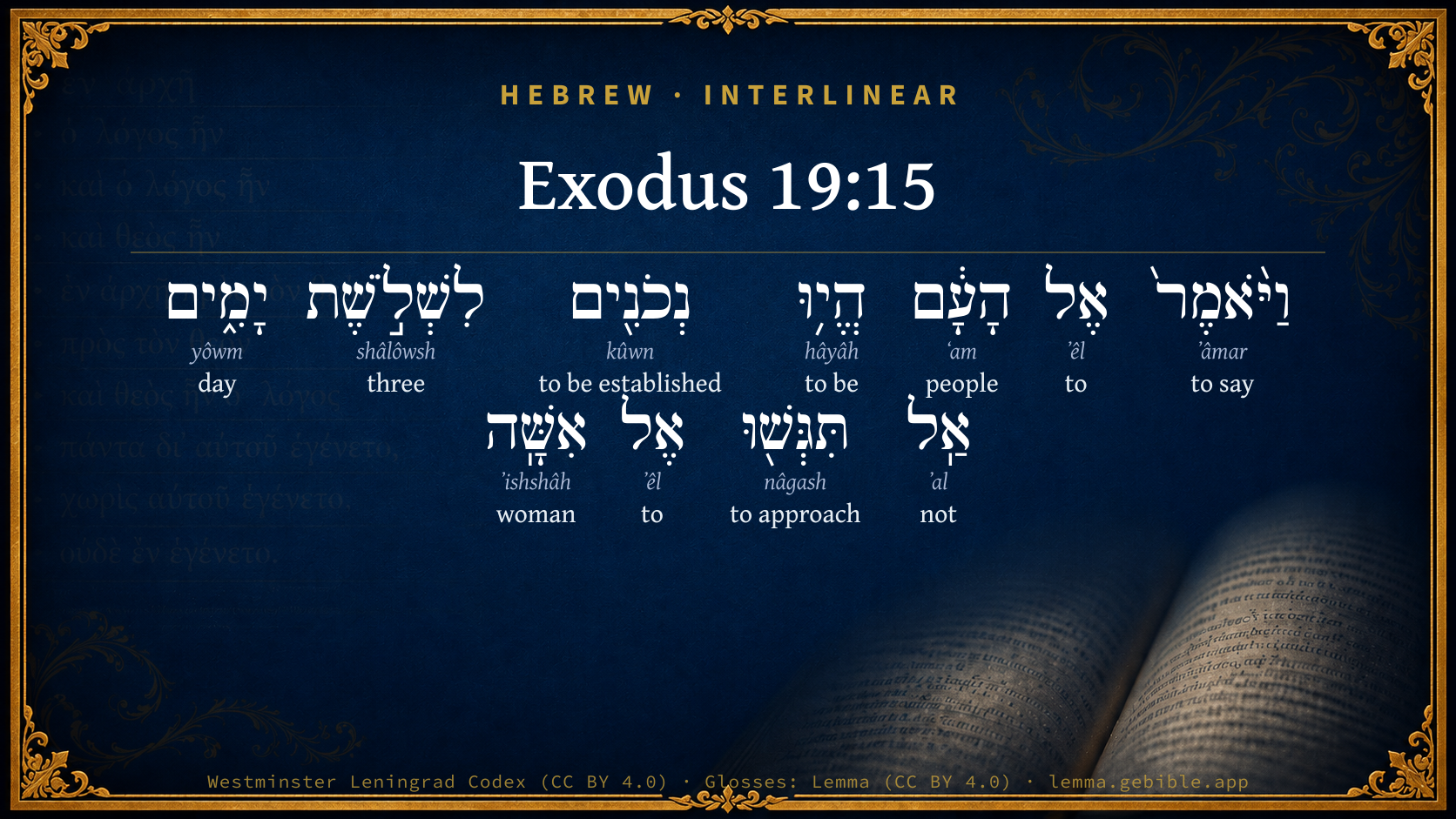
Hebrew (Westminster Leningrad Codex) Exodus 19:15 appears in the Hebrew Old Testament. The text above is from the Westminster Leningrad Codex. Each word links to its Strong’s number, a concise gloss, and parsing drawn from the Open Scriptures Hebrew Bible morphology. Click any word for its full Brown-Driver-Briggs (BDB) entry.
Download image
Cite this verse

Exodus 19:15 (World English Bible). Public Domain. Lemma interlinear Bible study tool, https://lemma.gebible.app/v/exodus/19/15.

Show BibTeX & RIS
BibTeX
RIS
English Translation
He said to the people, "Be ready by the third day. Don't have sexual relations with a woman."
World English Bible · Public Domain
Download a study sheet

One document with this verse’s original text, its word-by-word gloss line, the meaning frame, cross-references with their text, attributed commentary, and full source and license credits — printable, and it pastes into notes with its structure intact.

This verse Autodidact and up

Study sheet (.html) Plain text (.txt)

A passage Seminary Student

Up to 50 verses in one chapter. A passage sheet keeps up to 6 commentary sources and 12 cross-references per verse, in the order this page ranks them, and says so on the sheet whenever that leaves anything out. Ask for a single verse and you get the Autodidact verse sheet above.

Everything on this page stays free to read, with no account — the sheet is a download of what is already on screen, not access to it.

Want to remove ads? Support Godless Engineer
Compare translations 3

The same verse in 3 English versions, stacked beneath the original-language interlinear above. Click any original word for its lexicon entry.

Each is an independent rendering of the whole verse — the interlinear is not word-aligned to these translations.

Highlighted words mark where these versions differ — a whole-verse word diff, not a word-by-word alignment.

  • World English Bible Public Domain
    He said to the people, "Be ready by the third day. Don't have sexual relations with a woman."
  • King James Version Public Domain
    And he said unto the people, Be ready against the third day: come not at your wives.
  • unfoldingWord Literal Text CC BY-SA 4.0
    And he said to the people, “Be prepared by the third day; you shall not come near to a woman.”

unfoldingWord Literal Text — © unfoldingWord, licensed CC BY-SA 4.0. Word-aligned USFM3 via Door43 (git.door43.org/unfoldingWord/en_ult).

Versions to compare (up to 4)

3 of 4 selected

Show all 18 translations

Every available English version of this verse, each an independent rendering of the whole verse.

  • World English Bible Public Domain
    He said to the people, "Be ready by the third day. Don't have sexual relations with a woman."
  • Berean Standard Bible Public Domain
    “Be prepared for the third day,” he said to the people. “Do not draw near to a woman.”
  • Majority Standard Bible Public Domain
    “Be prepared for the third day,” he said to the people. “Do not draw near to a woman.”
  • King James Version Public Domain
    And he said unto the people, Be ready against the third day: come not at your wives.
  • American Standard Version (1901) Public Domain
    And he said unto the people, Be ready against the third day: come not near a woman.
  • Revised Version (1885) Public Domain
    And he said unto the people, Be ready against the third day: come not near a woman.
  • Geneva Bible (1599) Public Domain
    And he said vnto the people, Be ready on the third day, and come not at your wiues.
  • Douay-Rheims (1899) Public Domain
    He said to them: Be ready against the third day, and come not near your wives.
  • Young's Literal Translation Public Domain
    and he saith unto the people, `Be ye prepared for the third day, come not nigh unto a woman.'
  • Literal Standard Version CC BY-SA 4.0
    and he says to the people, “Be prepared for the third day, do not come near to a woman.”
  • Unlocked Literal Bible CC BY-SA 4.0
    He said to the people, “Be ready on the third day; do not go near your wives.”
  • unfoldingWord Literal Text CC BY-SA 4.0
    And he said to the people, “Be prepared by the third day; you shall not come near to a woman.”
  • Darby Bible Public Domain
    And he said to the people, Be ready for the third day; do not come near [your] wives.
  • World Messianic Bible Public Domain
    He said to the people, “Be ready by the third day. Don’t have sexual relations with a woman.”
  • Webster's Bible Public Domain
    And he said to the people, Be ready against the third day: come not at your wives.
  • Free Bible Version CC BY-SA 4.0
    He instructed the people, “Get ready for the third day, and don't be intimate with a woman.”
  • Bible in Basic English Public Domain
    And he said to the people, Be ready by the third day: do not come near a woman.
  • JPS Tanakh (1917) Public Domain
    And he said unto the people: 'Be ready against the third day; come not near a woman.'

Literal Standard Version (2020), Covenant Press — licensed CC BY-SA 4.0. Text via the HelloAO Bible API (eBible.org). Unlocked Literal Bible (unfoldingWord) — licensed CC BY-SA 4.0. Text via the HelloAO Bible API (eBible.org). unfoldingWord Literal Text — © unfoldingWord, licensed CC BY-SA 4.0. Word-aligned USFM3 via Door43 (git.door43.org/unfoldingWord/en_ult). Free Bible Version, Dr. Jonathan Gallagher — licensed CC BY-SA 4.0. Text via the HelloAO Bible API (eBible.org).

Word by word

More ways to search: Search by grammar → Find every occurrence → Compare this word →

Practice this passage: Drill this verse → Learn its vocabulary →

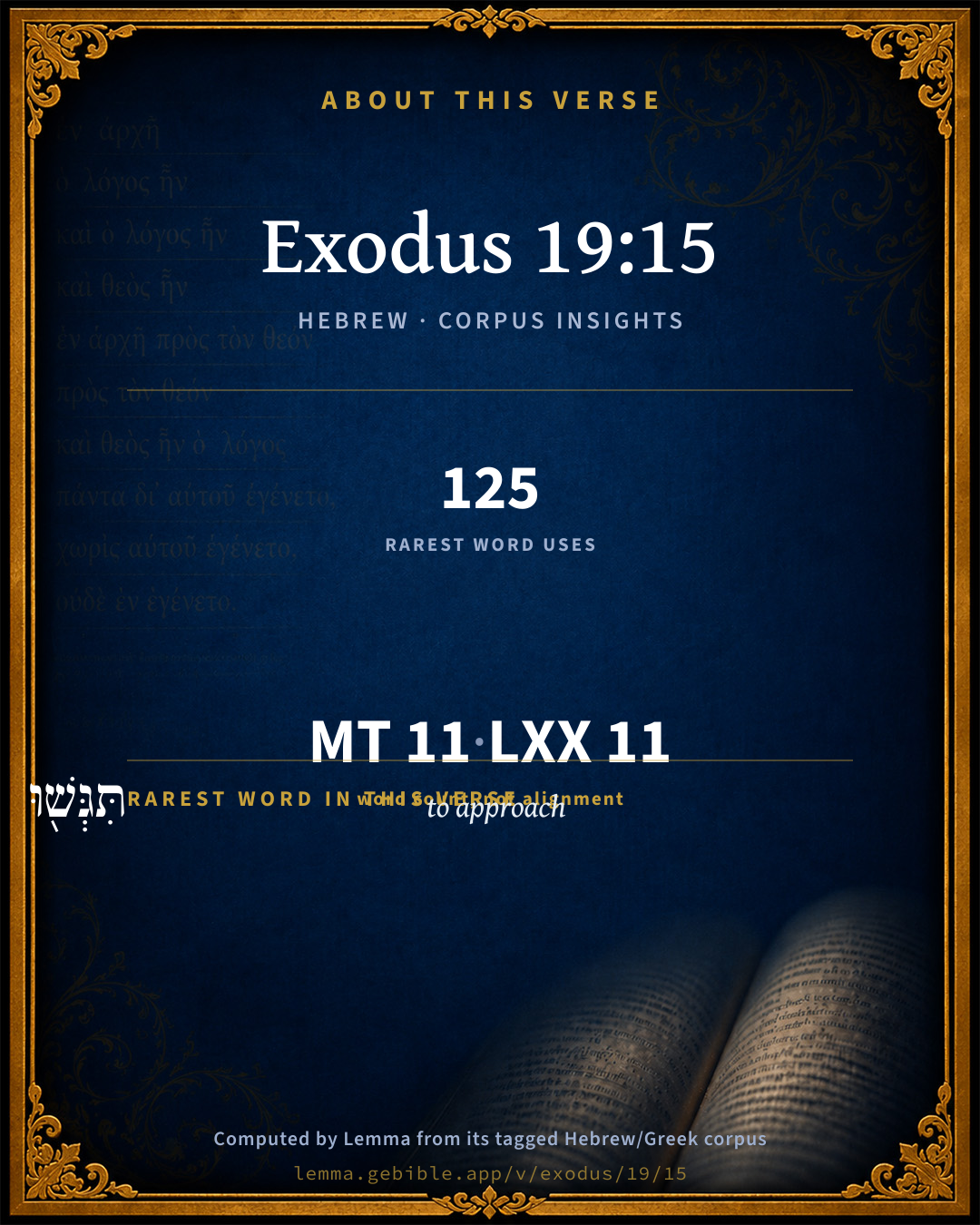
תִּגְּשׁ֖וּ
nâgash
H5066
“to approach”
Verb, Qal, Jussive, 2nd Person, Masculine, Plural
Part of Speech
Verb
Stem
Qal
Form
Jussive
Person
2nd Person
Gender
Masculine
Number
Plural
Full BDB Definition

Origin: a primitive root

TWOT: 1297

to draw near, approach - (Qal) to draw or come near - of humans - of sexual intercourse - of inanimate subject - to approach one another - (Niphal) to draw near - (Hiphil) to cause to approach, bring near, bring - (Hophal) to be brought near - (Hithpael) to draw near
  1. וַיֹּ֨אמֶר֙ ʼâmar H559 “and · to say” Conjunction + Verb, Qal, Sequential Imperfect, 3rd Person, Masculine, Singular
  2. אֶל ʼêl H413 “to” Preposition
  3. הָעָ֔ם ʻam H5971 “the · people” Particle, Definite Article + Noun, Common, Masculine, Singular, Absolute
  4. הֱי֥וּ hâyâh H1961 “be” Verb, Qal, Imperative, 2nd Person, Masculine, Plural
  5. נְכֹנִ֖ים kûwn H3559 “being established” Verb, Niphal, Participle Active, Masculine, Plural, Absolute
  6. לִשְׁלֹ֣שֶׁת shâlôwsh H7969 “to/for · three” Preposition + Adjective, Cardinal number, Masculine, Singular, Construct
  7. יָמִ֑ים yôwm H3117 “days” Noun, Common, Masculine, Plural, Absolute
  8. אַֽל ʼal H408 “not” Particle, Negative
  9. אֶל ʼêl H413 “to” Preposition
  10. אִשָּֽׁה ʼishshâh H802 “woman” Noun, Common, Feminine, Singular, Absolute

About this verse

These counts appear in no published source. They are computed here, from the morphology-tagged text and Lemma’s own curated glosses. What Lemma adds →

11
words
10
distinct lemmas
Pentateuch
section

Grammatical profile

  • 4 verbs
  • 3 nouns
  • 1 adjective
  • 2 prepositions
  • 1 particle

Verb forms

  • וַיֹּ֨אמֶר֙ Qal · Sequential Imperfect
  • הֱי֥וּ Qal · Imperative
  • נְכֹנִ֖ים Niphal · Participle Active
  • תִּגְּשׁ֖וּ Qal · Jussive

Repetition

A word recurs within this verse — often emphatic in Hebrew:

  • אֶל to H413 ×2

Hebrew & Septuagint length

In English translation the verse runs 18 words from the Hebrew and 17 from the Septuagint (LXX English) — closely comparable.

A rough comparison of the two English renderings, which tokenize alike — not a word-level alignment.

Word counts can differ between the Hebrew and the Greek without any difference in meaning — e.g. the Hebrew direct-object marker אֵת has no separate Greek word, and Greek often adds the article ὁ.

In the original languages it is 11 Hebrew tokens and 11 Greek tokens — but the two are counted differently (Hebrew bundles its prefixes and suffixes into one token; the Greek is in lemma form), so that isn’t a like-for-like length.

Cross-references

13

Topical passages linked to Exodus 19:15 in the Treasury of Scripture Knowledge — connected by theme and wording, ordered by reader-vote popularity; previews shown in the World English Bible.

  • Exodus 19:11 and be ready against the third day; for on the third day Yahweh will come down in the sight of all the people on Mount Sinai.
  • 1 Samuel 21:4–5 The priest answered David, and said, There is no common bread under my hand, but there is holy bread; if only the young men have kept themselves from women.
  • 1 Corinthians 7:5 Don't deprive one another, unless it is by consent for a season, that you may give yourselves to fasting and prayer, and may be together again, that Satan doesn't tempt you because of your lack of self-control.
  • Joel 2:16 Gather the people. Sanctify the assembly. Assemble the elders. Gather the children, and those who suck the breasts. Let the bridegroom go forth from his room, And the bride out of her chamber.
  • Exodus 19:16 It happened on the third day, when it was morning, that there were thunders and lightnings, and a thick cloud on the mountain, and the sound of an exceedingly loud trumpet; and all the people who were in the camp trembled.
  • Amos 4:12 "Therefore thus will I do to you, Israel; Because I will do this to you, Prepare to meet your God, Israel.
  • Zechariah 6:3 in the third chariot white horses; and in the fourth chariot dappled horses, all of them powerful.
  • Zechariah 7:3 and to speak to the priests of the house of Yahweh of Hosts, and to the prophets, saying, "Should I weep in the fifth month, separating myself, as I have done these so many years?"
  • Malachi 3:2 "But who can endure the day of his coming? And who will stand when he appears? For he is like a refiner's fire, and like launderer's soap;
  • Matthew 3:10–12 "Even now the axe lies at the root of the trees. Therefore, every tree that doesn't bring forth good fruit is cut down, and cast into the fire.
  • Matthew 24:44 Therefore also be ready, for in an hour that you don't expect, the Son of Man will come.
  • 2 Peter 3:11–12 Therefore since all these things are thus to be destroyed, what manner of persons ought you to be in holy living and godliness,
  • Zechariah 12:12–14 The land will mourn, every family apart; the family of the house of David apart, and their wives apart; the family of the house of Nathan apart, and their wives apart;

Cross-references courtesy of OpenBible.info (CC BY 4.0).

Hebrew and Greek witnesses Masoretic Hebrew ↔ Greek Septuagint

The same verse in the two great witnesses to the Old Testament, shown verse-for-verse.

These are two independent witnesses, not word-aligned to each other, and the Septuagint is shown in lemma (dictionary) form.

Hebrew Exodus 19:15 Masoretic · Westminster Leningrad Codex

וַיֹּ֨אמֶר֙ אֶל הָעָ֔ם הֱי֥וּ נְכֹנִ֖ים לִשְׁלֹ֣שֶׁת יָמִ֑ים אַֽל תִּגְּשׁ֖וּ אֶל אִשָּֽׁה

He said to the people, "Be ready by the third day. Don't have sexual relations with a woman."

World English Bible · Public Domain

Greek LXX Exodus 19:15 Septuagint · lemma form

καί εἶπον ὁ λαός γίγνομαι ἕτοιμος τρεῖς ἡμέρα μή προςἔρχομαι γυνή

And he said to the people, Be ready: for three days come not near to a woman.

LXX2012 (modern English Septuagint) · Public Domain

Hebrew: Westminster Leningrad Codex (CC BY 4.0). Greek: Septuagint (public domain); English from LXX2012 (modern English Septuagint) (Public Domain). How the Septuagint differs from the Hebrew →

Targum (Aramaic paraphrase)

2

The Targum is the ancient Jewish Aramaic paraphrase of the Hebrew Scriptures — an interpretive translation, not the Hebrew text itself. Onkelos (literal) and Pseudo-Jonathan (expansive) render the Torah, and Jonathan the Prophets. Coverage is partial: where no permissively-licensed English translation exists for a verse, only the Aramaic is shown. This is verse-level text, not a word-by-word alignment to the Hebrew.

  1. Targum Onkelos Torah (Genesis–Deuteronomy)
    וַאֲמַר לְעַמָא הֱווֹ זְמִינִין לִתְלָתָא יוֹמִין לָא תִקְרְבוּן לְצַד אִתְּתָא:

    (no public-domain English translation for this verse)

    Targum Onkelos — Aramaic: “Onkelos Genesis” (public domain); “Onkelos Exodus” (public domain); “Onkelos Leviticus” (public domain); “Onkelos Numbers” (public domain); “Onkelos Deuteronomy” (public domain). English: “Sefaria Community Translation” (CC0 1.0 (public-domain dedication)); “J.W. Etheridge. The Targums of Onkelos and Jonathan Ben Uzziel on the Pentateuch. London: Longmans, Green, 1862” (public domain). Text via Sefaria.

  2. Targum Pseudo-Jonathan Torah (Genesis–Deuteronomy)
    וַאֲמַר לְעַמָּא הֲווֹ זְמִינִין לִתְלָתֵי יוֹמִין לָא תִקְרְבוּן לְתַשְׁמִישׁ דְעָרִיס

    And he said to the people, Be ready for the third day; abstain from the marriage-bed.

    Targum Pseudo-Jonathan — Aramaic: “Targum Jonathan on Genesis” (public domain); “Targum Jonathan on Exodus” (public domain); “Targum Jonathan on Leviticus” (public domain); “Targum Jonathan on Numbers” (public domain); “Targum Jonathan on Deuteronomy” (public domain). English: “The Targum of Jonathan ben Uzziel, trans. J. W. Etheridge, London, 1862” (public domain). Text via Sefaria.

Commentary

Notes on Exodus 19:15 from classic Christian and Jewish commentators (each source and its license shown beneath its notes). The classic Christian expositions comment on the surrounding passage and are grouped to its opening verse, so a note may address several verses; the Jewish commentaries on the Tanakh (Rashi and others) are per-verse, so they appear only where the commentator wrote on this verse.

Lemma curates 59 commentaries, every one of them public domain or Creative Commons licensed, each selected and text-cleaned for this edition rather than reprinted as found. About our sources →

Trapp's Complete Commentary

John Trapp

Exo 19:15 And he said unto the people, Be ready against the third day: come not at [your] wives.

Ver. 15. Be ready against the third day.] If the word of a command expected such readiness, what shall the word of promise? &c.

Come not at your wives.] For the legal uncleanness that was in it, {Lev 15:18 1Sa 21:4} figuring the filth of original sin.

John Trapp, A Commentary or Exposition upon All the Books of the Old and New Testament (1647–1656) — public domain. Text from a community e-Sword module.

Geneva Bible (1599)

Geneva Bible translators

But give yourselves to prayer and abstinence, that you may at this time attend only upon the Lord, 1 Cor. 7:5.

Geneva Bible (1599) marginal notes — public domain. Text via Bolls.life.

Ellicott's Commentary for English Readers

(15) Come not at your wives.—Comp. 1Sa_21:4-5 :1Co_7:5. It was the general sentiment of antiquity that a ceremonial uncleanness attached even to the chastest sexual connection. (Herod. I. 189, ii. 64; Hesiod. Op. et D., 11. 733-4: Tibull, Carni. ii. 1, 11. 11, 12; Porphyr., De Abstinentia, 4:7.) The Levitical law took the same view (Lev_15:18), as did the Indian law (Menu, v. 63), the Persian (Zendavesta, quoted by Bähr, Symbolik, vol. ii., p. 466), and the Mahometan (Koran, iv. 5).

A Bible Commentary for English Readers, edited by Charles John Ellicott (1878–1897) — public domain. Text from a community e-Sword module.

John Gill's Exposition

And he said unto the people, be ready against the third day,.... The third day from thence, the sixth of the month Sivan, against which day they were to prepare themselves, by washing their garments, and all other outward acts of sanctification and purity they were directed to, that they might be ready for the service of that day, to hear and receive the law from God himself: Aben Ezra has this note on the passage,"perhaps not a man slept that night, that he might hear the voice of the Lord in the morning, as was the way or custom of the high priest on the day of atonement;''that is, not to sleep the night before:

come not at your wives; or, "do not draw nigh to a woman" (q), to lie with her; meaning not with a strange woman, or one that was not his wife, for that was not lawful at any time; nor with a menstruous woman who was unclean, and so forbidden, but with a man's own wife: what was lawful must now be abstained from, for the greater sanctification and solemnity of the service of this day, see Co1 7:5, so Chaeremoh (r) the stoic says of the Egyptian priests, that when the time is at hand that they are to perform some very sacred and solemn service, they spend several days in preparing for it; sometimes two and forty, sometimes more, sometimes less, but never under seven; when they abstain from all animals, and from all kind of herbs and pulse, and especially from venereal conversation with women; and to this latter Juvenal (s) the poet has respect.

(q) Sept. "to a woman", Ainsworth. (r) Apud Porphyr, de Abstinentia, l. 4. sect. 7. Vid Clement. Alexand Stromat. l. 1. p. 306. (s) "Ille petit veniam quoties non abstinet uxor, "Concubitu, sacris observandisque diebus". Juvenal, Satyr 6.

John Gill's Exposition of the Whole Bible (1746–1763) — public domain (CC PDM 1.0). Text via the HelloAO Bible API.

Haydock's Catholic Bible Commentary

Wives. St. Paul recommends continence when people have to pray, 1 Corinthians vii. On the pagan temple of Epidaurus, this inscription was placed, "Let those be chaste who enter here." (Clement of Alexandria, strom. 5.)

George Leo Haydock (1774–1849), Haydock's Catholic Family Bible and Commentary, 1859 edition — public domain. Excludes Psalms (Douay-Rheims chapter numbering differs from Protestant) and Deuterocanonical books (Catholic canon only).

Matthew Poole's English Annotations

Abstain from the use of the marriage-bed, partly because your wives may haply have their uncleanness upon them, though unknown to themselves, at least to you, whereby you may be legally defiled; see Lev 15:18; and partly that your minds may be abstracted from all sensual delights, and wholly employed about this great and holy work and service. There is a like command 1Co 7:5; but both this and that do indifferently concern both ministers and people, and are limited to a certain time, and therefore are very impertinently alleged for the perpetual celibacy of ministers. See also 1Sa 21:5.

Matthew Poole's English Annotations on the Holy Bible (1683–1685) — public domain. Text from a community e-Sword/MySword module.

The Pulpit Commentary

Come not at your wives. Compare 1Sa_21:4, 1Sa_21:5; 1Co_7:5. A similar obligation lay on the Egyptian priests (Porphyr. De Abstin. 4:7); and the idea which underlies it was widespread in the ancient world (See Heb 1:198; Hesiod. Op. et Di. 733-4; Tibul. Carm. 2:1; 51:11, 12.) The subject is well treated, from a Christian point of view, by Pope Gregory the First, in his answers to S. Augustine"s questions (Bode, Hist. Eccl. 2.).

The Pulpit Commentary (1880–1919), ed. H.D.M. Spence-Jones & Joseph S. Exell — public domain. Text from a community e-Sword module.

Rashi

Rabbi Shlomo Yitzchaki (Rashi)

היו נכנים לשלשת ימים means be ready by the end of three days, that is, by the fourth day — for Moses added a day of his own accord to the time appointed by God. This is the opinion of Rabbi José. But according to the opinion of him who says that the Ten Commandments were given on the sixth of the month Moses did not add anything, and the words לשלשת ימים do not signify after three days but mean the same as ליום השלישי (v. 11), i. e. by three days (cf. Shabbat 86b-87a).

אל תגשו אל אשה DO NOT GO NEAR A WOMAN during the whole of these three days, this was in order that the women may immerse themselves on the third day and be pure to receive the Torah. If they have relations within the three days, the woman could [involuntarily] expel semen after her immersion and become unclean again. After three days have elapsed, however, the semen has already become putrid and is no longer capable of fertilization, so it is pure from contaminating the woman who expels it. (cf. Shabbat 86a)

Rashi on the Tanakh — English translations: “The Judaica Press complete Tanach with Rashi, translated by A. J. Rosenberg” (CC BY 4.0); “Pentateuch with Rashi's commentary by M. Rosenbaum and A.M. Silbermann, 1929-1934” (public domain); “The Metsudah Tanach series, Lakewood, N.J” (CC BY 4.0); and “The Book of Joshua, Metsudah Publications, 1997” (CC BY 4.0). Text via Sefaria.

Lesson kit

Teaching starters — assembled from the data on this page, not authored interpretation. Every prompt links to the verse data it draws on. Edit before teaching.

Exodus, in the Pentateuch, opens this verse with 11 words (10 distinct Hebrew lemmas). Its most distinctive word is nâgash (“to approach”). A historical commentator’s framing appears above. Read the whole chapter for the surrounding context.

Discussion questions

  1. The word nâgash carries the sense “to approach.” How does it shape the verse?
  2. Exodus 19:11 shares this passage’s theme. How do the two illuminate each other?
  3. “to” occurs 2× in this one verse. What is the effect of the repetition?
  4. The translations on this page render this verse differently — a whole-verse word diff, not a word-by-word alignment. What might account for the different wordings?
  5. The verb «וַיֹּ֨אמֶר֙» is Qal Sequential Imperfect. How does its form color the action?
  6. Reading how Trapp's Complete Commentary and Geneva Bible (1599) read this verse, where do the two commentators agree and where do they part?

Things to notice

Reading settings

Reading text

Shown beneath each verse's original-language words.

Old Testament
Old Testament edition

Read the OT as the Masoretic Hebrew (MT) or the Greek Septuagint (LXX).

English shown for the Greek Septuagint (in the Hebrew ↔ Greek comparison).

Comparing translations? Open the Compare panel on any verse page to stack up to four side by side.