
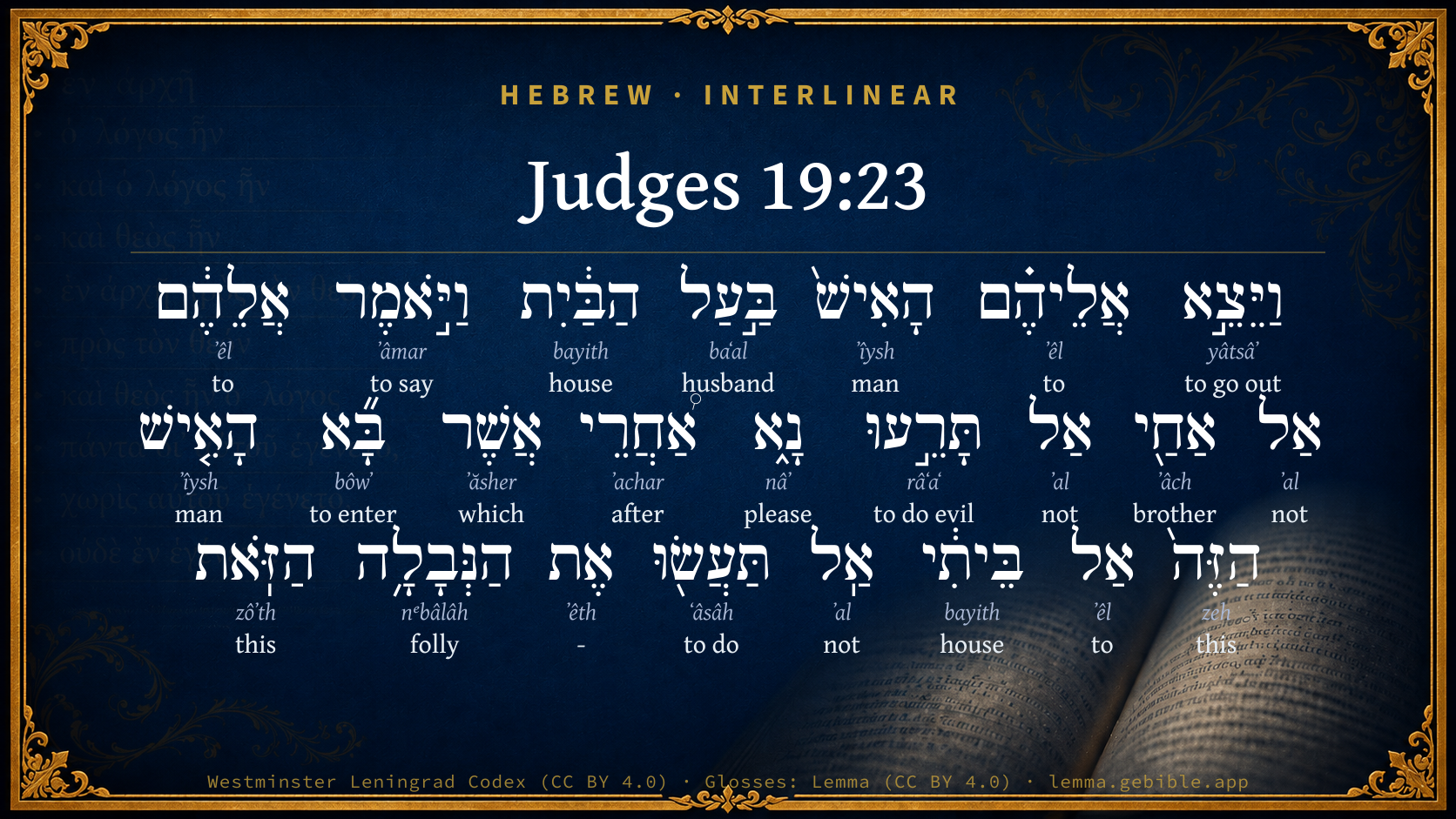
Judges 19:23

Hebrew (Westminster Leningrad Codex) Judges 19:23 appears in the Hebrew Old Testament. The text above is from the Westminster Leningrad Codex. Each word links to its Strong’s number, a concise gloss, and parsing drawn from the Open Scriptures Hebrew Bible morphology. Click any word for its full Brown-Driver-Briggs (BDB) entry.
Download image
Cite this verse

Judges 19:23 (World English Bible). Public Domain. Lemma interlinear Bible study tool, https://lemma.gebible.app/v/judges/19/23.

Show BibTeX & RIS
BibTeX
RIS
English Translation
The man, the master of the house, went out to them, and said to them, No, my brothers, please don't act so wickedly; seeing that this man is come into my house, don't do this folly.
World English Bible · Public Domain
Download a study sheet

One document with this verse’s original text, its word-by-word gloss line, the meaning frame, cross-references with their text, attributed commentary, and full source and license credits — printable, and it pastes into notes with its structure intact.

This verse Autodidact and up

Study sheet (.html) Plain text (.txt)

A passage Seminary Student

Up to 50 verses in one chapter. A passage sheet keeps up to 6 commentary sources and 12 cross-references per verse, in the order this page ranks them, and says so on the sheet whenever that leaves anything out. Ask for a single verse and you get the Autodidact verse sheet above.

Everything on this page stays free to read, with no account — the sheet is a download of what is already on screen, not access to it.

Want to remove ads? Support Godless Engineer
Compare translations 3

The same verse in 3 English versions, stacked beneath the original-language interlinear above. Click any original word for its lexicon entry.

Each is an independent rendering of the whole verse — the interlinear is not word-aligned to these translations.

Highlighted words mark where these versions differ — a whole-verse word diff, not a word-by-word alignment.

  • World English Bible Public Domain
    The man, the master of the house, went out to them, and said to them, No, my brothers, please don't act so wickedly; seeing that this man is come into my house, don't do this folly.
  • King James Version Public Domain
    And the man, the master of the house, went out unto them, and said unto them, Nay, my brethren, nay, I pray you, do not so wickedly; seeing that this man is come into mine house, do not this folly.
  • unfoldingWord Literal Text CC BY-SA 4.0
    But the man, the master of the house, went out to them and said to them, “No, my brothers, please do not act wickedly! After that this man has come into my house, you must not do this outrage!

unfoldingWord Literal Text — © unfoldingWord, licensed CC BY-SA 4.0. Word-aligned USFM3 via Door43 (git.door43.org/unfoldingWord/en_ult).

Versions to compare (up to 4)

3 of 4 selected

Show all 18 translations

Every available English version of this verse, each an independent rendering of the whole verse.

  • World English Bible Public Domain
    The man, the master of the house, went out to them, and said to them, No, my brothers, please don't act so wickedly; seeing that this man is come into my house, don't do this folly.
  • Berean Standard Bible Public Domain
    The owner of the house went out and said to them, “No, my brothers, do not do this wicked thing! After all, this man is a guest in my house. Do not commit this outrage.
  • Majority Standard Bible Public Domain
    The owner of the house went out and said to them, “No, my brothers, do not do this wicked thing! After all, this man is a guest in my house. Do not commit this outrage.
  • King James Version Public Domain
    And the man, the master of the house, went out unto them, and said unto them, Nay, my brethren, nay, I pray you, do not so wickedly; seeing that this man is come into mine house, do not this folly.
  • American Standard Version (1901) Public Domain
    And the man, the master of the house, went out unto them, and said unto them, Nay, my brethren, I pray you, do not so wickedly; seeing that this man is come into my house, do not this folly.
  • Revised Version (1885) Public Domain
    And the man, the master of the house, went out unto them, and said unto them, Nay, my brethren, I pray you, do not so wickedly; seeing that this man is come into mine house, do not this folly.
  • Geneva Bible (1599) Public Domain
    And this man the master of ye house went out vnto the, and said vnto them, Nay my brethre, do not so wickedly, I pray you: seeing that this man is come into mine house, do not this villenie.
  • Douay-Rheims (1899) Public Domain
    And the old man went out to them, and said: Do not so, my brethren, do not so wickedly: because this man is come into my lodging, and cease I pray you from this folly.
  • Young's Literal Translation Public Domain
    And the man, the master of the house, goeth out unto them, and saith unto them, `Nay, my brethren, do not evil, I pray you, after that this man hath come in unto my house, do not this folly;
  • Literal Standard Version CC BY-SA 4.0
    And the man, the master of the house, goes out to them and says to them, “No, my brothers, please do not do evil after that this man has come into my house; do not do this folly;
  • Unlocked Literal Bible CC BY-SA 4.0
    The man, the master of the house, went out to them and said to them, “No, my brothers, please do not do this evil thing! Since this man is a guest in my house, do not do this wicked thing!
  • unfoldingWord Literal Text CC BY-SA 4.0
    But the man, the master of the house, went out to them and said to them, “No, my brothers, please do not act wickedly! After that this man has come into my house, you must not do this outrage!
  • Darby Bible Public Domain
    And the man, the master of the house, went out to them and said to them, "No, my brethren, do not act so wickedly; seeing that this man has come into my house, do not do this vile thing.
  • World Messianic Bible Public Domain
    The man, the master of the house, went out to them, and said to them, “No, my brothers, please don’t act so wickedly; since this man has come into my house, don’t do this folly.
  • Webster's Bible Public Domain
    And the man, the master of the house, went out to them, and said to them, Nay, my brethren, nay, I pray you, do not so wickedly; seeing that this man is come into my house, do not this folly.
  • Free Bible Version CC BY-SA 4.0
    The man who owned the house went outside and told them, “My brothers, don't act in such an evil way! This man is a guest in my house. Don't do something so disgusting!
  • Bible in Basic English Public Domain
    So the man, the master of the house, went out to them, and said, No, my brothers, do not this evil thing; this man has come into my house, and you are not to do him this wrong.
  • JPS Tanakh (1917) Public Domain
    And the man, the master of the house, went out unto them, and said unto them: 'Nay, my brethren, I pray you, do not so wickedly; seeing that this man is come into my house, do not this wanton deed.

Literal Standard Version (2020), Covenant Press — licensed CC BY-SA 4.0. Text via the HelloAO Bible API (eBible.org). Unlocked Literal Bible (unfoldingWord) — licensed CC BY-SA 4.0. Text via the HelloAO Bible API (eBible.org). unfoldingWord Literal Text — © unfoldingWord, licensed CC BY-SA 4.0. Word-aligned USFM3 via Door43 (git.door43.org/unfoldingWord/en_ult). Free Bible Version, Dr. Jonathan Gallagher — licensed CC BY-SA 4.0. Text via the HelloAO Bible API (eBible.org).

Word by word

More ways to search: Search by grammar → Find every occurrence → Compare this word →

Practice this passage: Drill this verse → Learn its vocabulary →

הַנְּבָלָ֥ה
nᵉbâlâh
H5039
“the · folly”
Particle, Definite Article + Noun, Common, Feminine, Singular, Absolute
Part of Speech
Particle + Noun
Type
Common
Gender
Feminine
Number
Singular
State
Absolute
Full BDB Definition

Origin: from H5036

TWOT: 1285b

senselessness, folly - disgraceful folly - of immorality, profane actions - disgrace, contumely disgrace
  1. וַיֵּצֵ֣א yâtsâʼ H3318 “and · to go out” Conjunction + Verb, Qal, Sequential Imperfect, 3rd Person, Masculine, Singular
  2. אֲלֵיהֶ֗ם ʼêl H413 “to · them” Preposition + Suffix, Personal, 3rd Person, Masculine, Plural
  3. הָאִישׁ֙ ʼîysh H376 “the · man” Particle, Definite Article + Noun, Common, Masculine, Singular, Absolute
  4. בַּ֣עַל baʻal H1167 “husband of” Noun, Common, Masculine, Singular, Construct
  5. הַבַּ֔יִת bayith H1004 “the · house” Particle, Definite Article + Noun, Common, Masculine, Singular, Absolute
  6. וַיֹּ֣אמֶר ʼâmar H559 “and · to say” Conjunction + Verb, Qal, Sequential Imperfect, 3rd Person, Masculine, Singular
  7. אֲלֵהֶ֔ם ʼêl H413 “to · them” Preposition + Suffix, Personal, 3rd Person, Masculine, Plural
  8. אַל ʼal H408 “not” Particle, Negative
  9. אַחַ֖י ʼâch H251 “brothers · my” Noun, Common, Masculine, Plural, Construct + Suffix, Personal, 1st Person, Common, Singular
  10. אַל ʼal H408 “not” Particle, Negative
  11. תָּרֵ֣עוּ râʻaʻ H7489 “to do evil” Verb, Hiphil, Jussive, 2nd Person, Masculine, Plural
  12. נָ֑א nâʼ H4994 “please” Particle, Exhortation
  13. אַ֠חֲרֵי ʼachar H310 “after” Preposition
  14. אֲשֶׁר ʼăsher H834 “which” Particle, Relative
  15. בָּ֞א bôwʼ H935 “to enter” Verb, Qal, Perfect, 3rd Person, Masculine, Singular
  16. הָאִ֤ישׁ ʼîysh H376 “the · man” Particle, Definite Article + Noun, Common, Masculine, Singular, Absolute
  17. הַזֶּה֙ zeh H2088 “the · this” Particle, Definite Article + Pronoun, Demonstrative, Masculine, Singular
  18. אַל ʼêl H413 “to” Particle, Negative
  19. בֵּיתִ֔י bayith H1004 “house · my” Noun, Common, Masculine, Singular, Construct + Suffix, Personal, 1st Person, Common, Singular
  20. אַֽל ʼal H408 “not” Particle, Negative
  21. תַּעֲשׂ֖וּ ʻâsâh H6213 “to do” Verb, Qal, Jussive, 2nd Person, Masculine, Plural
  22. אֶת ʼêth H853 “-” Particle, Direct Object
  23. הַזֹּֽאת zôʼth H2063 “the · this” Particle, Definite Article + Pronoun, Demonstrative, Feminine, Singular

About this verse

These counts appear in no published source. They are computed here, from the morphology-tagged text and Lemma’s own curated glosses. What Lemma adds →

24
words
18
distinct lemmas
Historical
section

Notable vocabulary

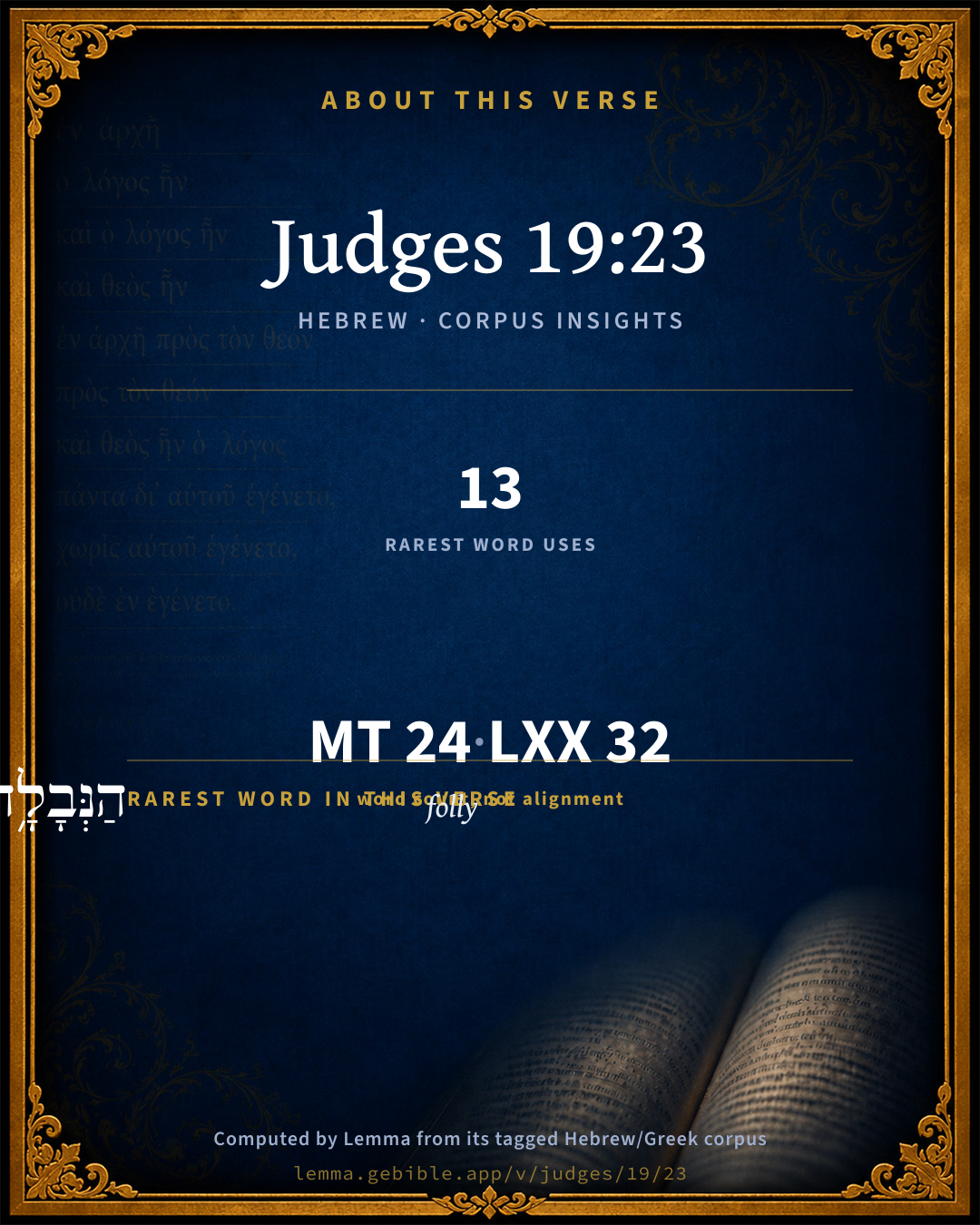
The rarest word here is הַנְּבָלָ֥ה folly H5039 — appearing just 13 times in the whole Hebrew Bible.

Shared distinctive vocabulary

הַנְּבָלָ֥ה folly H5039 occurs in 13 verses of the Hebrew Bible. Also found in:

Grammatical profile

  • 5 verbs
  • 7 nouns
  • 2 pronouns
  • 3 prepositions
  • 7 particles

Verb forms

  • וַיֵּצֵ֣א Qal · Sequential Imperfect
  • וַיֹּ֣אמֶר Qal · Sequential Imperfect
  • תָּרֵ֣עוּ Hiphil · Jussive
  • בָּ֞א Qal · Perfect
  • תַּעֲשׂ֖וּ Qal · Jussive

Repetition

Words recur within this verse — often emphatic in Hebrew:

  • הָאִישׁ֙ man H376 ×2
  • הַבַּ֔יִת house H1004 ×2
  • אֲלֵיהֶ֗ם to H413 ×3
  • אַל not H408 ×3

Hebrew & Septuagint length

In English translation the verse runs 36 words from the Hebrew and 34 from the Septuagint (LXX English) — closely comparable.

A rough comparison of the two English renderings, which tokenize alike — not a word-level alignment.

Word counts can differ between the Hebrew and the Greek without any difference in meaning — e.g. the Hebrew direct-object marker אֵת has no separate Greek word, and Greek often adds the article ὁ.

In the original languages it is 24 Hebrew tokens and 32 Greek tokens — but the two are counted differently (Hebrew bundles its prefixes and suffixes into one token; the Greek is in lemma form), so that isn’t a like-for-like length.

Cross-references

6

Topical passages linked to Judges 19:23 in the Treasury of Scripture Knowledge — connected by theme and wording, ordered by reader-vote popularity; previews shown in the World English Bible.

  • Genesis 34:7 The sons of Jacob came in from the field when they heard it. The men were grieved, and they were very angry, because he had done folly in Israel in lying with Jacob's daughter; which thing ought not to be done.
  • Judges 20:6 I took my concubine, and cut her in pieces, and sent her throughout all the country of the inheritance of Israel; for they have committed lewdness and folly in Israel.
  • 2 Samuel 13:12 She answered him, No, my brother, do not force me; for no such thing ought to be done in Israel. Don't you do this folly.
  • Genesis 19:6–7 Lot went out to them to the door, and shut the door after him.
  • Deuteronomy 22:21 then they shall bring out the young lady to the door of her father's house, and the men of her city shall stone her to death with stones, because she has done folly in Israel, to play the prostitute in her father's house: so shall you put away the evil from the midst of you.
  • Joshua 7:15 It shall be, that he who is taken with the devoted thing shall be burnt with fire, he and all that he has; because he has transgressed the covenant of Yahweh, and because he has done folly in Israel.

Cross-references courtesy of OpenBible.info (CC BY 4.0).

Hebrew and Greek witnesses Masoretic Hebrew ↔ Greek Septuagint

The same verse in the two great witnesses to the Old Testament, shown verse-for-verse.

These are two independent witnesses, not word-aligned to each other, and the Septuagint is shown in lemma (dictionary) form.

Hebrew Judges 19:23 Masoretic · Westminster Leningrad Codex

וַיֵּצֵ֣א אֲלֵיהֶ֗ם הָאִישׁ֙ בַּ֣עַל הַבַּ֔יִת וַיֹּ֣אמֶר אֲלֵהֶ֔ם אַל אַחַ֖י אַל תָּרֵ֣עוּ נָ֑א אַ֠חֲרֵי אֲשֶׁר בָּ֞א הָאִ֤ישׁ הַזֶּה֙ אַל בֵּיתִ֔י אַֽל תַּעֲשׂ֖וּ אֶת הַנְּבָלָ֥ה הַזֹּֽאת

The man, the master of the house, went out to them, and said to them, No, my brothers, please don't act so wickedly; seeing that this man is come into my house, don't do this folly.

World English Bible · Public Domain

Greek LXX Judges 19:23 Septuagint · lemma form

καί ἐκἔρχομαι πρός αὐτός ὁ ἀνήρ ὁ κύριος ὁ οἶκος καί εἶπον μή ἀδελφός μή κακοποιέω δή μετά ὁ εἰςἔρχομαι ὁ ἀνήρ οὗτος εἰς ὁ οἰκία ἐγώ μή ποιέω ὁ ἀφροσύνη οὗτος

And the master of the house came out to them, and said, Nay, brethren, do not you⌃ wrong, I pray you, after this man has come into my house; do not you⌃ this folly.

LXX2012 (modern English Septuagint) · Public Domain

Hebrew: Westminster Leningrad Codex (CC BY 4.0). Greek: Septuagint (public domain); English from LXX2012 (modern English Septuagint) (Public Domain). How the Septuagint differs from the Hebrew →

Targum (Aramaic paraphrase)

1

The Targum is the ancient Jewish Aramaic paraphrase of the Hebrew Scriptures — an interpretive translation, not the Hebrew text itself. Onkelos (literal) and Pseudo-Jonathan (expansive) render the Torah, and Jonathan the Prophets. Coverage is partial: where no permissively-licensed English translation exists for a verse, only the Aramaic is shown. This is verse-level text, not a word-by-word alignment to the Hebrew.

  1. Targum Jonathan Prophets (Joshua–Malachi)
    וּנְפַק לְוַתְהוֹן גַבְרָא מָרֵיהּ דְבֵיתָא וַאֲמַר לְהוֹן בְּבָעוּ אֲחַי לָא תַבְאֲשׁוּן כְּעַן בָּתַר דְעַל גַבְרָא הָדֵין לְבֵיתִי לָא תַעְבְּדוּן יַת קְלָנָא הָדֵין:

    (no public-domain English translation for this verse)

    Targum Jonathan — Aramaic: “Mikraot Gedolot” (public domain). English: “Sefaria Community Translation” (CC0 1.0 (public-domain dedication)); “London "Chaldee Paraphrase," 1871” (public domain). Text via Sefaria.

Commentary

Notes on Judges 19:23 from classic Christian and Jewish commentators (each source and its license shown beneath its notes). The classic Christian expositions comment on the surrounding passage and are grouped to its opening verse, so a note may address several verses; the Jewish commentaries on the Tanakh (Rashi and others) are per-verse, so they appear only where the commentator wrote on this verse.

Lemma curates 59 commentaries, every one of them public domain or Creative Commons licensed, each selected and text-cleaned for this edition rather than reprinted as found. About our sources →

Trapp's Complete Commentary

John Trapp

Jdg 19:23 And the man, the master of the house, went out unto them, and said unto them, Nay, my brethren, [nay], I pray you, do not [so] wickedly; seeing that this man is come into mine house, do not this folly.

Ver. 23. Nay, my brethren.] Brethren they were by race and place: but these were unworthy of this compellation, as having put off the man, and become dogs, and worse, {Deu 23:18 2Ti 3:8} scalded {a} in their own grease. {Rom 1:27}

{a} εξεκαυθησαν.

John Trapp, A Commentary or Exposition upon All the Books of the Old and New Testament (1647–1656) — public domain. Text from a community e-Sword module.

Ellicott's Commentary for English Readers

(23) Do not this folly.—It is from no deficiency of moral indignation that the word “folly” (nebalah) is used. Sometimes when crime is too dark and deadly for ordinary reproach the feelings are more deeply expressed by using a milder word, which is instantly corrected and intensified by the hearer himself. (See Gen_34:7; Deu_22:21.) Thus Virgil merely gives the epithet “unpraised” (“illaudati Busiridis aras”) to the cannibal tyrant, which serves even better than a stronger word. (Comp. “Shall I praise you for these things? I praise you not” 1Co_11:17-22.) (See the author’s Brief Greek Syntax, p. 199.) This figure of speech takes the various form of antiphasis, litotes, meiosis, &c.

A Bible Commentary for English Readers, edited by Charles John Ellicott (1878–1897) — public domain. Text from a community e-Sword module.

The Cambridge Bible for Schools and Colleges

gen. ed. J. J. S. Perowne

23. Nay, my brethren … wickedly] Similarly Gen_19:7.

do not … folly] This translation is only a makeshift. The Hebr. nebâlâh means much more than folly; it implies moral insensibility, repudiation of the claims of morality and religion, particularly, in this phrase, an outrage against the laws of nature, Jdg_20:6; Jdg_20:10, Gen_34:7, Deu_22:21, 2Sa_13:12. In Jos_7:15 the phrase is used of Achan’s iniquity.

The Cambridge Bible for Schools and Colleges (gen. ed. J. J. S. Perowne; Cambridge University Press, 1878–1918) — public domain. Text from a community e-Sword module.

John Gill's Exposition

And the man, the master of the house, went out unto them,.... Opened the door, and went out to converse with them, and talked them after this manner:

and said unto them, nay, my brethren, nay, I pray you, do not so wickedly; it is plain he understood them in such sense, that they meant not bare knowledge of the man, as who he was, &c. but to commit wickedness the most abominable; so great, that it cannot be well said how great it is; and to dissuade from it, he uses the most tender language, and the most earnest entreaties:

seeing this man is come into my house, do not this folly; he argues from the law of hospitality, which ought not to be infringed; a man being obliged to protect a stranger under his roof; and from the nature of the crime, which was folly, stupidity, and what was abominable to the last degree.

John Gill's Exposition of the Whole Bible (1746–1763) — public domain (CC PDM 1.0). Text via the HelloAO Bible API.

Albert Barnes' Notes on the Bible

This man is come into mine house - He appeals to the sacred rights of hospitality, just as Lot did Gen 19:8. Both cases betray painfully the low place in the social scale occupied by woman in the old world, from which it is one of the glories of Christianity to have raised her.

Albert Barnes' Notes on the Bible (1834–1885) — public domain. Text from a community e-Sword/MySword module.

Matthew Poole's English Annotations

This man is come into mine house, and therefore I am obliged to protect him by the laws of hospitality. Compare Gen 19:17,8.

Matthew Poole's English Annotations on the Holy Bible (1683–1685) — public domain. Text from a community e-Sword/MySword module.

The Pulpit Commentary

He pleads the sanctity of hospitality.

The Pulpit Commentary (1880–1919), ed. H.D.M. Spence-Jones & Joseph S. Exell — public domain. Text from a community e-Sword module.

John Wesley's Explanatory Notes

Into my house - And therefore I am obliged to protect him by the laws of hospitality.

John Wesley, Explanatory Notes Upon the Whole Bible (1754–1765) — public domain. Text via the GEBible commentary corpus.

Lesson kit

Teaching starters — assembled from the data on this page, not authored interpretation. Every prompt links to the verse data it draws on. Edit before teaching.

Judges, in the Historical, opens this verse with 24 words (18 distinct Hebrew lemmas). Its most distinctive word is nᵉbâlâh (“folly”). A historical commentator’s framing appears above. Read the whole chapter for the surrounding context.

Discussion questions

  1. How does “folly” (nᵉbâlâh) shape what this verse is saying?
  2. How does Genesis 34:7, which shares the word «folly», read alongside this verse?
  3. What does the repetition of “man” (2× in this one verse) do in this verse?
  4. These translations render this verse differently; the difference is in the English rendering, not the original. What questions does that raise?
  5. «וַיֵּצֵ֣א» is a Qal Sequential Imperfect verb. How does that grammatical form shape the action described?
  6. Compare how Trapp's Complete Commentary and Ellicott's Commentary for English Readers read this verse. Where do they agree or differ?

Things to notice

Reading settings

Reading text

Shown beneath each verse's original-language words.

Old Testament
Old Testament edition

Read the OT as the Masoretic Hebrew (MT) or the Greek Septuagint (LXX).

English shown for the Greek Septuagint (in the Hebrew ↔ Greek comparison).

Comparing translations? Open the Compare panel on any verse page to stack up to four side by side.