
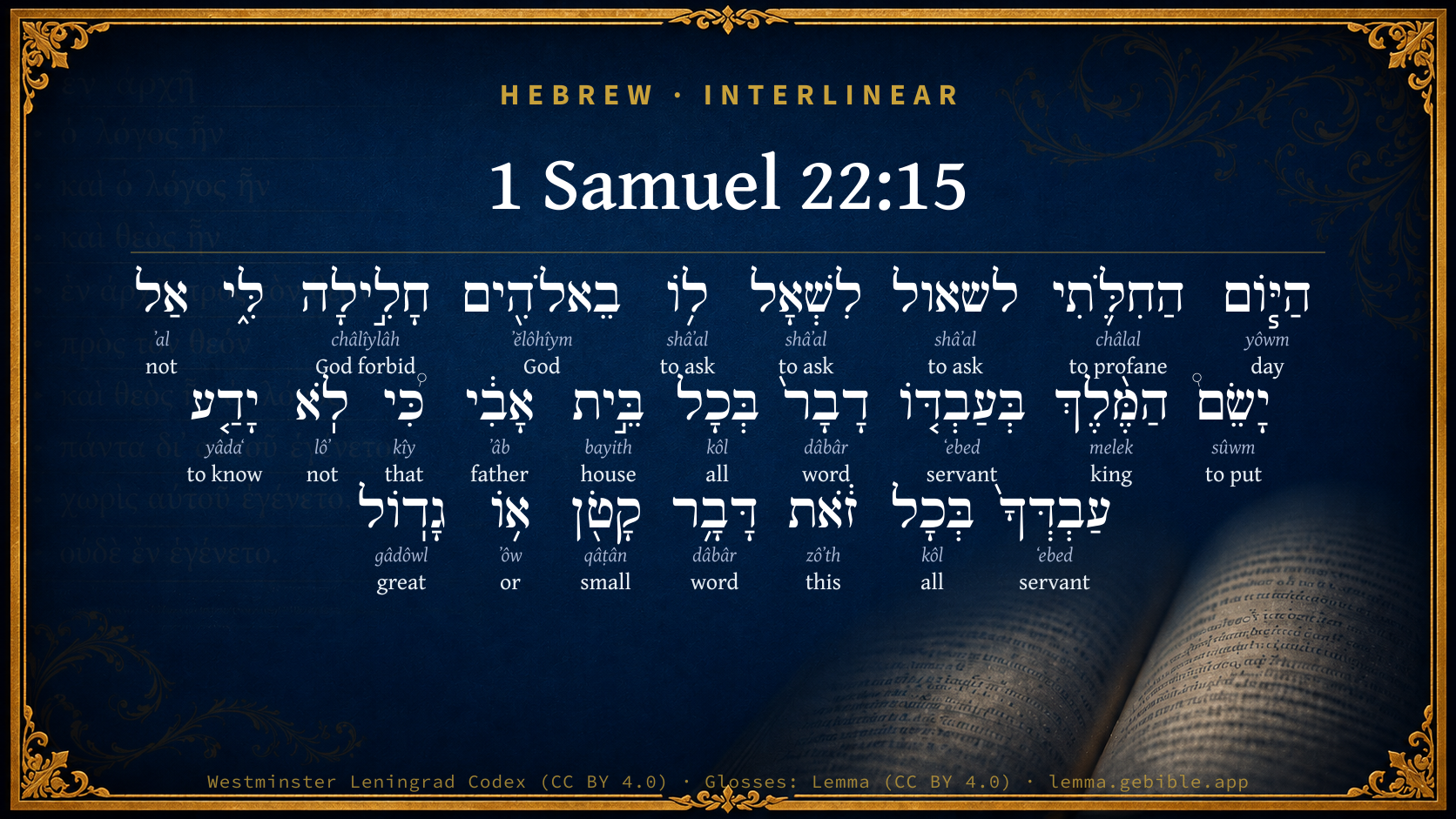
1 Samuel 22:15

Hebrew (Westminster Leningrad Codex) 1 Samuel 22:15 appears in the Hebrew Old Testament. The text above is from the Westminster Leningrad Codex. Each word links to its Strong’s number, a concise gloss, and parsing drawn from the Open Scriptures Hebrew Bible morphology. Click any word for its full Brown-Driver-Briggs (BDB) entry.
Download image
Cite this verse

1 Samuel 22:15 (World English Bible). Public Domain. Lemma interlinear Bible study tool, https://lemma.gebible.app/v/1-samuel/22/15.

Show BibTeX & RIS
BibTeX
RIS
English Translation
Have I today begun to inquire of God for him? be it far from me: don't let the king impute anything to his servant, nor to all the house of my father; for your servant knows nothing of all this, less or more.
World English Bible · Public Domain
Download a study sheet

One document with this verse’s original text, its word-by-word gloss line, the meaning frame, cross-references with their text, attributed commentary, and full source and license credits — printable, and it pastes into notes with its structure intact.

This verse Autodidact and up

Study sheet (.html) Plain text (.txt)

A passage Seminary Student

Up to 50 verses in one chapter. A passage sheet keeps up to 6 commentary sources and 12 cross-references per verse, in the order this page ranks them, and says so on the sheet whenever that leaves anything out. Ask for a single verse and you get the Autodidact verse sheet above.

Everything on this page stays free to read, with no account — the sheet is a download of what is already on screen, not access to it.

Want to remove ads? Support Godless Engineer
Compare translations 3

The same verse in 3 English versions, stacked beneath the original-language interlinear above. Click any original word for its lexicon entry.

Each is an independent rendering of the whole verse — the interlinear is not word-aligned to these translations.

Highlighted words mark where these versions differ — a whole-verse word diff, not a word-by-word alignment.

  • World English Bible Public Domain
    Have I today begun to inquire of God for him? be it far from me: don't let the king impute anything to his servant, nor to all the house of my father; for your servant knows nothing of all this, less or more.
  • King James Version Public Domain
    Did I then begin to inquire of God for him? be it far from me: let not the king impute any thing unto his servant, nor to all the house of my father: for thy servant knew nothing of all this, less or more.
  • unfoldingWord Literal Text CC BY-SA 4.0
    Did I begin to inquire of God for him today? Profane to me! May the king not set a word against his servant, against all of the house of my father. For your servant does not know about any of this matter, small or great.”

unfoldingWord Literal Text — © unfoldingWord, licensed CC BY-SA 4.0. Word-aligned USFM3 via Door43 (git.door43.org/unfoldingWord/en_ult).

Versions to compare (up to 4)

3 of 4 selected

Show all 18 translations

Every available English version of this verse, each an independent rendering of the whole verse.

  • World English Bible Public Domain
    Have I today begun to inquire of God for him? be it far from me: don't let the king impute anything to his servant, nor to all the house of my father; for your servant knows nothing of all this, less or more.
  • Berean Standard Bible Public Domain
    Was that day the first time I inquired of God for him? Far be it from me! Let not the king accuse your servant or any of my father’s household, for your servant knew nothing of this whole affair—not in part or in whole.”
  • Majority Standard Bible Public Domain
    Was that day the first time I inquired of God for him? Far be it from me! Let not the king accuse your servant or any of my father’s household, for your servant knew nothing of this whole affair—not in part or in whole.”
  • King James Version Public Domain
    Did I then begin to inquire of God for him? be it far from me: let not the king impute any thing unto his servant, nor to all the house of my father: for thy servant knew nothing of all this, less or more.
  • American Standard Version (1901) Public Domain
    Have I to-day begun to inquire of God for him? be it far from me: let not the king impute anything unto his servant, nor to all the house of my father; for thy servant knoweth nothing of all this, less or more.
  • Revised Version (1885) Public Domain
    Have I today begun to inquire of God for him? be it far from me: let not the king impute any thing unto his servant, nor to all the house of my father: for thy servant knoweth nothing of all this, less or more.
  • Geneva Bible (1599) Public Domain
    Haue I this day first begun to aske counsell of God for him? be it farre from mee, let not the King impute any thing vnto his seruant, nor to all the house of my father: for thy seruant knew nothing of all this, lesse nor more.
  • Douay-Rheims (1899) Public Domain
    Did I begin to day to consult the Lord for him? far be this from me: let not the king suspect such a thing against his servant, or any one in all my father's house: for thy servant knew nothing of this matter, either little or great.
  • Young's Literal Translation Public Domain
    To-day have I begun to ask for him at God? far be it from me! let not the king lay anything against his servant, against any of the house of my father, for thy servant hath known nothing of all this, less or more.'
  • Literal Standard Version CC BY-SA 4.0
    Today have I begun to inquire of God for him? Far be it from me! Do not let the king lay anything against his servant, against any of the house of my father, for your servant has known nothing of all this, little or much.”
  • Unlocked Literal Bible CC BY-SA 4.0
    Is today the first time I have prayed to God to help him? Far be it from me! Do not let the king impute anything to his servant or to all the house of my father. For your servant knows nothing of this whole matter.”
  • unfoldingWord Literal Text CC BY-SA 4.0
    Did I begin to inquire of God for him today? Profane to me! May the king not set a word against his servant, against all of the house of my father. For your servant does not know about any of this matter, small or great.”
  • Darby Bible Public Domain
    Was it to-day that I began to inquire of God for him? be it far from me: let not the king charge anything to his servant, [nor] to all the house of my father; for thy servant knew nothing of all this, less or more.
  • World Messianic Bible Public Domain
    Have I today begun to inquire of God for him? Be it far from me! Don’t let the king impute anything to his servant, nor to all the house of my father; for your servant knew nothing of all this, less or more.”
  • Webster's Bible Public Domain
    Did I then begin to inquire of God for him? be it far from me. Let not the king impute any thing to his servant, nor to all the house of my father: for thy servant knew nothing of all this, less or more.
  • Free Bible Version CC BY-SA 4.0
    “And was that day the first time he asked advice from God on his behalf? Of course not! The king should not accuse me your servant or any of my family, for I didn't know anything about any of this.”
  • Bible in Basic English Public Domain
    Is this the first time I have got directions from God for him? Far be the thought! let the king make no such statement against his servant or my father's family, for your servant has no knowledge, great or small, of this thing.
  • JPS Tanakh (1917) Public Domain
    Have I to-day begun to inquire of God for him? be it far from me; let not the king impute any thing unto his servant, nor to all the house of my father; for thy servant knoweth nothing of all this, less or more.'

Literal Standard Version (2020), Covenant Press — licensed CC BY-SA 4.0. Text via the HelloAO Bible API (eBible.org). Unlocked Literal Bible (unfoldingWord) — licensed CC BY-SA 4.0. Text via the HelloAO Bible API (eBible.org). unfoldingWord Literal Text — © unfoldingWord, licensed CC BY-SA 4.0. Word-aligned USFM3 via Door43 (git.door43.org/unfoldingWord/en_ult). Free Bible Version, Dr. Jonathan Gallagher — licensed CC BY-SA 4.0. Text via the HelloAO Bible API (eBible.org).

Word by word

More ways to search: Search by grammar → Find every occurrence → Compare this word →

Practice this passage: Drill this verse → Learn its vocabulary →

חָלִ֣ילָה
châlîylâh
H2486
“God forbid”
Particle, Interjection + Suffix, h
Part of Speech
Particle
Type
Interjection
Full BDB Definition

Origin: a directive from H2490

TWOT: 661c

far be it (from me), God forbid that, let it not be
  1. הַיּ֧וֹם yôwm H3117 “the · day” Particle, Definite Article + Noun, Common, Masculine, Singular, Absolute
  2. הַחִלֹּ֛תִי châlal H2490 “to profane” Verb, Hiphil, Perfect, 1st Person, Common, Singular
  3. לשאול shâʼal H7592 “to ask” Preposition + Verb, Qal, Infinitive Construct
  4. לִשְׁאָל shâʼal H7592 “to ask” Preposition + Verb, Qal, Infinitive Construct
  5. ל֥וֹ shâʼal H7592 “to/for · him” Preposition + Suffix, Personal, 3rd Person, Masculine, Singular
  6. בֵאלֹהִ֖ים ʼĕlôhîym H430 “in/at · God(s)” Preposition + Noun, Common, Masculine, Plural, Absolute
  7. אַל ʼal H408 “not” Particle, Negative
  8. יָשֵׂם֩ sûwm H7760 “to put” Verb, Qal, Jussive, 3rd Person, Masculine, Singular
  9. הַמֶּ֨לֶךְ melek H4428 “the · king” Particle, Definite Article + Noun, Common, Masculine, Singular, Absolute
  10. בְּעַבְדּ֤וֹ ʻebed H5650 “in/at · servant · his” Preposition + Noun, Common, Masculine, Singular, Construct + Suffix, Personal, 3rd Person, Masculine, Singular
  11. דָבָר֙ dâbâr H1697 “word” Noun, Common, Masculine, Singular, Absolute
  12. בְּכָל kôl H3605 “in/at · all of” Preposition + Noun, Common, Masculine, Singular, Construct
  13. בֵּ֣ית bayith H1004 “house of” Noun, Common, Masculine, Singular, Construct
  14. אָבִ֔י ʼâb H1 “father · my” Noun, Common, Masculine, Singular, Construct + Suffix, Personal, 1st Person, Common, Singular
  15. כִּ֠י kîy H3588 “that” Conjunction
  16. לֹֽא lôʼ H3808 “not” Particle, Negative
  17. יָדַ֤ע yâdaʻ H3045 “to know” Verb, Qal, Perfect, 3rd Person, Masculine, Singular
  18. עַבְדְּךָ֙ ʻebed H5650 “servant · your” Noun, Common, Masculine, Singular, Construct + Suffix, Personal, 2nd Person, Masculine, Singular
  19. בְּכָל kôl H3605 “in/at · all of” Preposition + Noun, Common, Masculine, Singular, Construct
  20. זֹ֔את zôʼth H2063 “this” Pronoun, Demonstrative, Feminine, Singular
  21. דָּבָ֥ר dâbâr H1697 “word” Noun, Common, Masculine, Singular, Absolute
  22. קָטֹ֖ן qâṭân H6996 “small” Adjective, Adjective, Masculine, Singular, Absolute
  23. א֥וֹ ʼôw H176 “or” Conjunction
  24. גָדֽוֹל gâdôwl H1419 “great” Adjective, Adjective, Masculine, Singular, Absolute

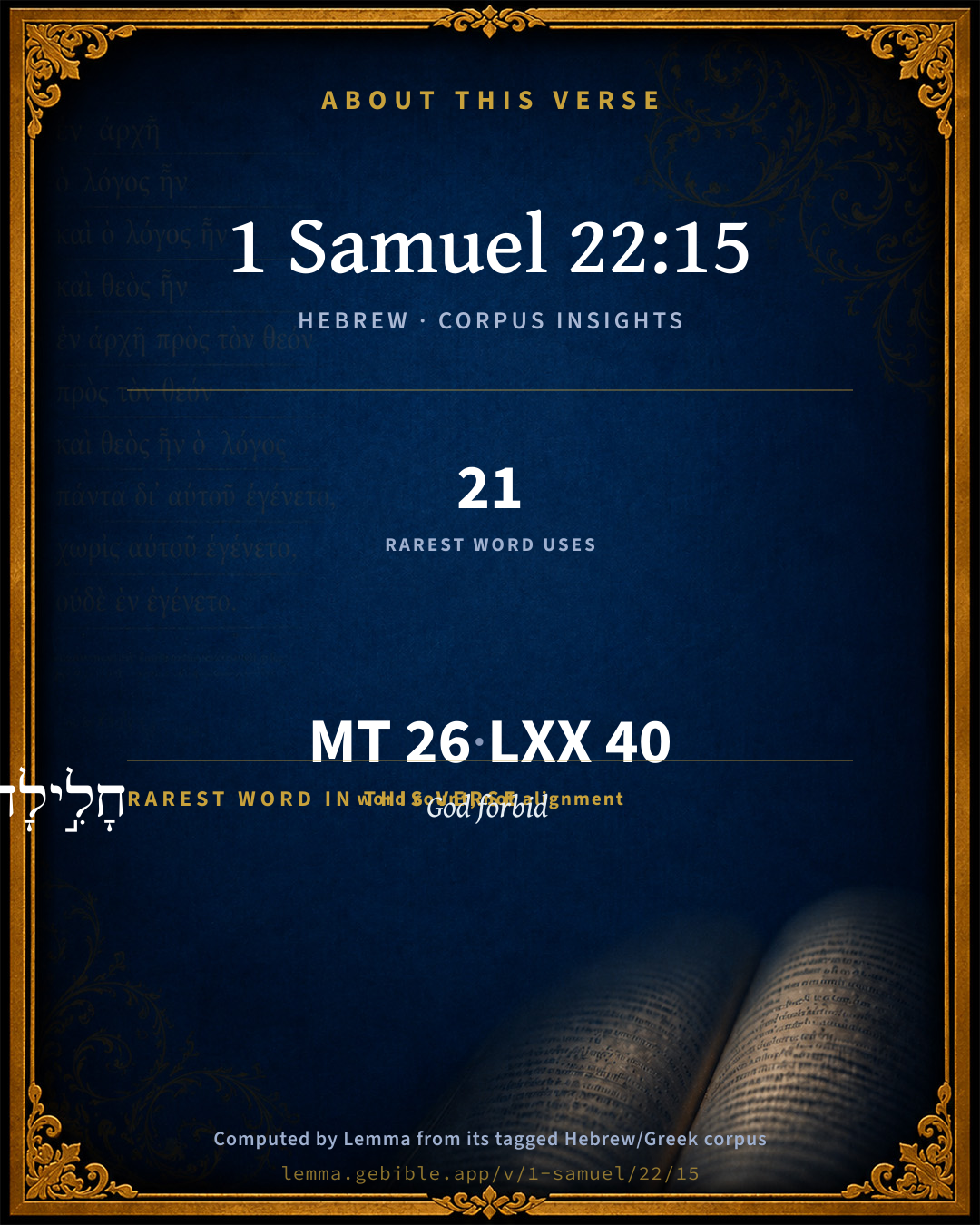
About this verse

These counts appear in no published source. They are computed here, from the morphology-tagged text and Lemma’s own curated glosses. What Lemma adds →

26
words
20
distinct lemmas
Historical
section

Notable vocabulary

The rarest word here is חָלִ֣ילָה God forbid H2486 — appearing just 21 times in the whole Hebrew Bible.

Shared distinctive vocabulary

חָלִ֣ילָה God forbid H2486 occurs in 19 verses of the Hebrew Bible. Also found in:

Grammatical profile

  • 5 verbs
  • 11 nouns
  • 2 adjectives
  • 1 pronoun
  • 2 prepositions
  • 2 conjunctions
  • 3 particles

Verb forms

  • הַחִלֹּ֛תִי Hiphil · Perfect
  • לשאול Qal · Infinitive Construct
  • לִשְׁאָל Qal · Infinitive Construct
  • יָשֵׂם֩ Qal · Jussive
  • יָדַ֤ע Qal · Perfect

Repetition

Words recur within this verse — often emphatic in Hebrew:

  • לשאול to ask H7592 ×3
  • בְּעַבְדּ֤וֹ servant H5650 ×2
  • דָבָר֙ word H1697 ×2
  • בְּכָל all H3605 ×2

Hebrew & Septuagint length

In English translation the verse runs 43 words from the Hebrew and 44 from the Septuagint (LXX English) — closely comparable.

A rough comparison of the two English renderings, which tokenize alike — not a word-level alignment.

Word counts can differ between the Hebrew and the Greek without any difference in meaning — e.g. the Hebrew direct-object marker אֵת has no separate Greek word, and Greek often adds the article ὁ.

In the original languages it is 26 Hebrew tokens and 40 Greek tokens — but the two are counted differently (Hebrew bundles its prefixes and suffixes into one token; the Greek is in lemma form), so that isn’t a like-for-like length.

Cross-references

5

Topical passages linked to 1 Samuel 22:15 in the Treasury of Scripture Knowledge — connected by theme and wording, ordered by reader-vote popularity; previews shown in the World English Bible.

  • 1 Samuel 25:36 Abigail came to Nabal; and, behold, he held a feast in his house, like the feast of a king; and Nabal's heart was merry within him, for he was very drunken: therefore she told him nothing, less or more, until the morning light.
  • 1 Peter 3:16–17 having a good conscience; that, while you are spoken against as evildoers, they may be disappointed who curse your good manner of life in Christ.
  • Genesis 20:5–6 Didn't he tell me, 'She is my sister?' She, even she herself said, 'He is my brother.' In the integrity of my heart and the innocence of my hands have I done this."
  • 2 Samuel 15:11 With Absalom went two hundred men out of Jerusalem, who were invited, and went in their simplicity; and they didn't know anything.
  • 2 Corinthians 1:12 For our boasting is this: the testimony of our conscience, that in holiness and sincerity of God, not in fleshly wisdom but in the grace of God we behaved ourselves in the world, and more abundantly toward you.

Cross-references courtesy of OpenBible.info (CC BY 4.0).

Hebrew and Greek witnesses Masoretic Hebrew ↔ Greek Septuagint

The same verse in the two great witnesses to the Old Testament, shown verse-for-verse.

These are two independent witnesses, not word-aligned to each other, and the Septuagint is shown in lemma (dictionary) form.

Hebrew 1 Samuel 22:15 Masoretic · Westminster Leningrad Codex

הַיּ֧וֹם הַחִלֹּ֛תִי לשאול לִשְׁאָל ל֥וֹ בֵאלֹהִ֖ים חָלִ֣ילָה לִּ֑י אַל יָשֵׂם֩ הַמֶּ֨לֶךְ בְּעַבְדּ֤וֹ דָבָר֙ בְּכָל בֵּ֣ית אָבִ֔י כִּ֠י לֹֽא יָדַ֤ע עַבְדְּךָ֙ בְּכָל זֹ֔את דָּבָ֥ר קָטֹ֖ן א֥וֹ גָדֽוֹל

Have I today begun to inquire of God for him? be it far from me: don't let the king impute anything to his servant, nor to all the house of my father; for your servant knows nothing of all this, less or more.

World English Bible · Public Domain

Greek LXX 1 Samuel 22:15 Septuagint · lemma form

ἤ σήμερον ἄρχω ἐρωτάω αὐτός διά ὁ θεός μηδαμῶς μή δίδωμι ὁ βασιλεύς κατά ὁ δοῦλος αὐτός λόγος καί ἐπί ὅλος ὁ οἶκος ὁ πατήρ ἐγώ ὅτι οὐ εἶδος ὁ δοῦλος ὁ σός ἐν πᾶς οὗτος ῥῆμα μικρός ἤ μέγας

Have I begun today to enquire of God for him? By no means: let not the king bring a charge against his servant, and against the whole of my father's house; for your servant knew not in all these matters anything great or small.

LXX2012 (modern English Septuagint) · Public Domain

Hebrew: Westminster Leningrad Codex (CC BY 4.0). Greek: Septuagint (public domain); English from LXX2012 (modern English Septuagint) (Public Domain). How the Septuagint differs from the Hebrew →

Targum (Aramaic paraphrase)

1

The Targum is the ancient Jewish Aramaic paraphrase of the Hebrew Scriptures — an interpretive translation, not the Hebrew text itself. Onkelos (literal) and Pseudo-Jonathan (expansive) render the Torah, and Jonathan the Prophets. Coverage is partial: where no permissively-licensed English translation exists for a verse, only the Aramaic is shown. This is verse-level text, not a word-by-word alignment to the Hebrew.

  1. Targum Jonathan Prophets (Joshua–Malachi)
    יוֹמָא דֵין שְׁרִיתִי לְמִשְׁאַל לֵיהּ בְּמֵימְרָא דַייָ חַס לִי לָא יְשַׁוֵי מַלְכָּא בְּעַבְדֵיהּ פִּתְגָמָא בְּכָל בֵּית אַבָּא אֲרֵי לָא יְדַע עַבְדָךְ בְּכָל דָא פִּתְגַם זְעֵיר אוֹ רַב:

    (no public-domain English translation for this verse)

    Targum Jonathan — Aramaic: “Mikraot Gedolot” (public domain). English: “Sefaria Community Translation” (CC0 1.0 (public-domain dedication)); “London "Chaldee Paraphrase," 1871” (public domain). Text via Sefaria.

Commentary

Notes on 1 Samuel 22:15 from classic Christian and Jewish commentators (each source and its license shown beneath its notes). The classic Christian expositions comment on the surrounding passage and are grouped to its opening verse, so a note may address several verses; the Jewish commentaries on the Tanakh (Rashi and others) are per-verse, so they appear only where the commentator wrote on this verse.

Lemma curates 59 commentaries, every one of them public domain or Creative Commons licensed, each selected and text-cleaned for this edition rather than reprinted as found. About our sources →

Trapp's Complete Commentary

John Trapp

1Sa 22:15 Did I then begin to enquire of God for him? be it far from me: let not the king impute [any] thing unto his servant, [nor] to all the house of my father: for thy servant knew nothing of all this, less or more.

Ver. 15. Be it far from me,] viz., To have any band in a treacherous conspiracy against my sovereign. As for sedition, said Latimer, for aught that I know, methinks I should not need Christ, if I may so say: I do so abhor the very thoughts of it.

John Trapp, A Commentary or Exposition upon All the Books of the Old and New Testament (1647–1656) — public domain. Text from a community e-Sword module.

Joseph Benson's Commentary

1Sa 22:15. Did I then begin to inquire of God for him? — These words do not necessarily imply that Ahimelech had inquired of God for David. Doeg indeed charged him with doing it, but as the sacred historian has made no mention of any such thing, it is probable that he charged him falsely and maliciously, and with a view to heighten the king’s resentment against the priests. Ahimelech’s words may be very naturally so interpreted, as Dr. Dodd has observed, as to imply an absolute denial of the charge. “Did I then begin to inquire of God for him? Be it far from me. I never did it before, nor did I begin to do it now.” The verb החל, hechel, (from חלל, chelel,) which we render begin, is frequently a mere expletive, denoting not the first beginning of an action, but the action itself, as begun and finished. “This vindication was honest and sufficient; but what was the effect of it? A resolution worthy the tyrant that made it.” — Chandler. Thy servant knew nothing of all this — Of any design against thee.

Joseph Benson's Commentary on the Old and New Testaments (1811–1818) — public domain. Text from a community e-Sword module.

Geneva Bible (1599)

Geneva Bible translators

Have I not at other times also, when he had great affairs, consulted with the Lord for him?

Geneva Bible (1599) marginal notes — public domain. Text via Bolls.life.

Adam Clarke's Commentary

Verse 15. Did I then begin to inquire of God] He probably means that his inquiring now for David was no new thing, having often done so before, and without ever being informed it was either wrong in itself, or displeasing to the king. Nor is it likely that Ahimelech knew of any disagreement between Saul and David. He knew him to be the king's son-in-law, and he treated him as such.

Adam Clarke's Commentary on the Bible (1810–1826) — public domain. Text from a community e-Sword/MySword module.

Ellicott's Commentary for English Readers

(15) Did I then begin to enquire?—The English translation of the Hebrew here would imply that David had on many previous occasions received through him (the high priest) Divine directions from the Urim and Thummim. “Did I that day begin to enquire?” Abarbanel gives an alternative rendering: “That was the first day that I enquired of God for him, and I did not know that it was displeasing to thee.” Another rendering is: “Did I enquire?” in a negative sense, suggesting the reply “No, I did not.” On the whole, the alternative rendering suggested by Abarbanel, quoted in Lange, is the best: “That was the first day, &c.” And the reason why Ahimelech allowed the sacred Urim to be consulted was that he supposed David was come (as he represented) on a mission direct from King Saul. Surely, thought the blameless high priest, I never supposed my king would have been wroth with me for that.

If we render as in the English Version, which has the support of many scholars and versions, the only possible explanation of the words, “Did I that day begin to enquire?” is to suppose that David had been in the habit of consulting the Urim on special occasions for the king. The king, when there was a king in Israel, it is nearly certain, alone had this right. The Talmud teaching here is most definite; and it is a point in which the Talmud tradition may be looked on as authoritative. “The Rabbis have taught—How were the Urim and Thummim oracularly consulted? The king or the chief of the legislative administration, who alone had the privilege of consulting the Urim, stood facing the priest, and the priest was facing the Shekinah and the ‘Shem-hammephorash,’ the ineffable name deposited with the Urim within the breastplate.”—Treatise Yoma, fol. 73, cols. 1, 2.

A Bible Commentary for English Readers, edited by Charles John Ellicott (1878–1897) — public domain. Text from a community e-Sword module.

The Cambridge Bible for Schools and Colleges

gen. ed. J. J. S. Perowne

15. Did I then begin] That day did I begin, &c.? The stress is upon these words. Ahimelech pleads that there was no harm in doing as he had often done before.

be it far from me] To plot against the king.

knew nothing of all this] Was in no way a party to the alleged conspiracy.

The Cambridge Bible for Schools and Colleges (gen. ed. J. J. S. Perowne; Cambridge University Press, 1878–1918) — public domain. Text from a community e-Sword module.

John Gill's Exposition

Did I then begin to inquire of God for him?.... Was this the first time of inquiring of God for him? no; I have done this many a time, when he has been going upon the king's business, engaging in war with his enemies; he has then consulted the Lord by me, and I have inquired of the Lord for him, as I now did; and which I did as innocently, and as much for the king's service, as ever I did any. Kimchi observes it may be read without the interrogation, "that day I began to inquire of God for him"; it was the first time I ever did, and I did not know it would have been grievous to thee, or have given thee any disturbance or uneasiness. I did not know that he fled from thee, or was not in thy service, and upon thy business; had I known it, I would never have done it, and as it is the first time it shall be the last:

be it far from me; from doing such a thing, had I known it to be disagreeable to thee, or how David stood with thee:

let not the king impute any thing unto his servant, nor to all the house of my father; charge me or them with the crime of treason, or conspiracy against him, or with aiding:, assisting, and abetting traitors and conspirators:

for thy servant knew nothing of all this, less or more; was entirely ignorant of this affair; which plain, honest, account of things, one might have thought, would have been satisfying to Saul; but it seems it was not by what follows.

John Gill's Exposition of the Whole Bible (1746–1763) — public domain (CC PDM 1.0). Text via the HelloAO Bible API.

Albert Barnes' Notes on the Bible

Did I then begin ... - Some lay the stress upon the word “begin,” as though Ahimelech’s justification was that he had often before inquired of the Lord for David when employed on the king’s affairs. But it is much better to understand the words as Ahimelech’s solemn denial of having inquired of the Lord for David, a duty which he owed to Saul alone as king of Israel. The force of the word “begin” lies in this, that it would have been his first act of allegiance to David and defection from Saul. This he strenuously repudiates, and adds, “thy servant knew nothing of all this” conspiracy between Jonathan and David of which Saul speaks: he had acted quite innocently.

Albert Barnes' Notes on the Bible (1834–1885) — public domain. Text from a community e-Sword/MySword module.

Haydock's Catholic Bible Commentary

CHAPTER XXII.

For him? We might read without an interrogation, "I have to-day begun...." (Chaldean) never suspecting that it would be disagreeable to the king. (Calmet) --- His character and his declarations, led me to conclude quite the contrary, so that I cannot lawfully be accused of any conspiracy. (Haydock)

George Leo Haydock (1774–1849), Haydock's Catholic Family Bible and Commentary, 1859 edition — public domain. Excludes Psalms (Douay-Rheims chapter numbering differs from Protestant) and Deuterocanonical books (Catholic canon only).

Matthew Poole's English Annotations

Any thing, or, this thing, to wit, which thou now chargest me with, that I should assist David in any evil design against thee.

Thy servant knew nothing of all this; or, of thy suspicion concerning him. For as for Saul’s attempts upon David, well might Ahimelech impute them wholly to the violence of Saul’s passion and disease, seeing even Jonathan did so, as may be gathered from 1Sa 20:2.

Matthew Poole's English Annotations on the Holy Bible (1683–1685) — public domain. Text from a community e-Sword/MySword module.

Whedon's Commentary on the Bible

Daniel D. Whedon

15. Did I then begin to inquire — It was not the first time I inquired for David respecting important enterprises; I had often done the same thing before: nor in doing this did I ever suspect myself of treason against the king.

Daniel D. Whedon (gen. ed.), Commentary on the Old and New Testaments (1874–1909) — public domain. Text from a community e-Sword module.

John Wesley's Explanatory Notes

Knew nothing of all this - Of any design against thee.

John Wesley, Explanatory Notes Upon the Whole Bible (1754–1765) — public domain. Text via the GEBible commentary corpus.

Rashi

Rabbi Shlomo Yitzchaki (Rashi)

Did I begin today to inquire. This is in the form of a question, meaning, it is already a long time that the concern of the community is his, for they appointed him as the one who leads [the Bnei] Yisroel to and [from battle], and ever since then, I inquire of God on his behalf.

Far be it from me. To have done this thing with the intent of rebellion or treason.

Rashi on the Tanakh — English translations: “The Judaica Press complete Tanach with Rashi, translated by A. J. Rosenberg” (CC BY 4.0); “Pentateuch with Rashi's commentary by M. Rosenbaum and A.M. Silbermann, 1929-1934” (public domain); “The Metsudah Tanach series, Lakewood, N.J” (CC BY 4.0); and “The Book of Joshua, Metsudah Publications, 1997” (CC BY 4.0). Text via Sefaria.

Lesson kit

Teaching starters — assembled from the data on this page, not authored interpretation. Every prompt links to the verse data it draws on. Edit before teaching.

1 Samuel, in the Historical, opens this verse with 26 words (20 distinct Hebrew lemmas). Its most distinctive word is châlîylâh (“God forbid”). A historical commentator’s framing appears above. Read the whole chapter for the surrounding context.

Discussion questions

  1. How does “God forbid” (châlîylâh) shape what this verse is saying?
  2. Genesis 18:25 shares the word «God forbid» with this verse. How do the two illuminate each other?
  3. “to ask” occurs 3× in this one verse. What is the effect of the repetition?
  4. The translations on this page render this verse differently — a whole-verse word diff, not a word-by-word alignment. What might account for the different wordings?
  5. The verb «הַחִלֹּ֛תִי» is Hiphil Perfect. How does its form color the action?
  6. Reading how Trapp's Complete Commentary and Joseph Benson's Commentary read this verse, where do the two commentators agree and where do they part?

Things to notice

Reading settings

Reading text

Shown beneath each verse's original-language words.

Old Testament
Old Testament edition

Read the OT as the Masoretic Hebrew (MT) or the Greek Septuagint (LXX).

English shown for the Greek Septuagint (in the Hebrew ↔ Greek comparison).

Comparing translations? Open the Compare panel on any verse page to stack up to four side by side.