Genesis 50:21

Hebrew (Westminster Leningrad Codex) Genesis 50:21 appears in the Hebrew Old Testament. The text above is from the Westminster Leningrad Codex. Each word links to its Strong’s number, a concise gloss, and parsing drawn from the Open Scriptures Hebrew Bible morphology. Click any word for its full Brown-Driver-Briggs (BDB) entry.
Download image
Cite this verse

Genesis 50:21 (World English Bible). Public Domain. Lemma interlinear Bible study tool, https://lemma.gebible.app/v/genesis/50/21.

Show BibTeX & RIS
BibTeX
RIS
English Translation
Now therefore don't be afraid. I will nourish you and your little ones." He comforted them, and spoke kindly to them.
World English Bible · Public Domain
Download a study sheet

One document with this verse’s original text, its word-by-word gloss line, the meaning frame, cross-references with their text, attributed commentary, and full source and license credits — printable, and it pastes into notes with its structure intact.

This verse Autodidact and up

Study sheet (.html) Plain text (.txt)

A passage Seminary Student

Up to 50 verses in one chapter. A passage sheet keeps up to 6 commentary sources and 12 cross-references per verse, in the order this page ranks them, and says so on the sheet whenever that leaves anything out. Ask for a single verse and you get the Autodidact verse sheet above.

Everything on this page stays free to read, with no account — the sheet is a download of what is already on screen, not access to it.

Want to remove ads? Support Godless Engineer
Compare translations 3

The same verse in 3 English versions, stacked beneath the original-language interlinear above. Click any original word for its lexicon entry.

Each is an independent rendering of the whole verse — the interlinear is not word-aligned to these translations.

Highlighted words mark where these versions differ — a whole-verse word diff, not a word-by-word alignment.

  • World English Bible Public Domain
    Now therefore don't be afraid. I will nourish you and your little ones." He comforted them, and spoke kindly to them.
  • King James Version Public Domain
    Now therefore fear ye not: I will nourish you, and your little ones. And he comforted them, and spake kindly unto them.
  • unfoldingWord Literal Text CC BY-SA 4.0
    So now, do not be afraid. I will support you and your little ones.” So he comforted them, and he spoke to their heart. Joseph’s Death in Egypt 50:22-26

unfoldingWord Literal Text — © unfoldingWord, licensed CC BY-SA 4.0. Word-aligned USFM3 via Door43 (git.door43.org/unfoldingWord/en_ult).

Versions to compare (up to 4)

3 of 4 selected

Show all 18 translations

Every available English version of this verse, each an independent rendering of the whole verse.

  • World English Bible Public Domain
    Now therefore don't be afraid. I will nourish you and your little ones." He comforted them, and spoke kindly to them.
  • Berean Standard Bible Public Domain
    Therefore do not be afraid. I will provide for you and your little ones.” So Joseph reassured his brothers and spoke kindly to them.
  • Majority Standard Bible Public Domain
    Therefore do not be afraid. I will provide for you and your little ones.” So Joseph reassured his brothers and spoke kindly to them.
  • King James Version Public Domain
    Now therefore fear ye not: I will nourish you, and your little ones. And he comforted them, and spake kindly unto them.
  • American Standard Version (1901) Public Domain
    Now therefore fear ye not: I will nourish you, and your little ones. And he comforted them, and spake kindly unto them.
  • Revised Version (1885) Public Domain
    Now therefore fear ye not: I will nourish you, and your little ones. And he comforted them, and spake kindly unto them.
  • Geneva Bible (1599) Public Domain
    Feare not nowe therefore, I will nourish you, and your children: and hee comforted them, and spake kindly vnto them.
  • Douay-Rheims (1899) Public Domain
    Fear not: I will feed you and your children. And he comforted them, and spoke gently and mildly.
  • Young's Literal Translation Public Domain
    and now, fear not: I do nourish you and your infants;' and he comforteth them, and speaketh unto their heart.
  • Literal Standard Version CC BY-SA 4.0
    and now, do not fear: I nourish you and your infants”; and he comforts them, and speaks to their heart.
  • Unlocked Literal Bible CC BY-SA 4.0
    So now do not be afraid. I will provide for you and your little children.” He comforted them in this way and spoke kindly to their hearts.
  • unfoldingWord Literal Text CC BY-SA 4.0
    So now, do not be afraid. I will support you and your little ones.” So he comforted them, and he spoke to their heart. Joseph’s Death in Egypt 50:22-26
  • Darby Bible Public Domain
    And now, fear not: I will maintain you and your little ones. And he comforted them, and spoke consolingly to them.
  • World Messianic Bible Public Domain
    Now therefore don’t be afraid. I will provide for you and your little ones.” He comforted them, and spoke kindly to them.
  • Webster's Bible Public Domain
    Now therefore fear ye not: I will nourish you, and your little ones. And he comforted them, and spoke kindly to them.
  • Free Bible Version CC BY-SA 4.0
    So don't worry. I'll go on taking care of you and your children.” Speaking kindly like this he calmed them down.
  • Bible in Basic English Public Domain
    So now, have no fear: for I will take care of you and your little ones. So he gave them comfort with kind words.
  • JPS Tanakh (1917) Public Domain
    Now therefore fear ye not; I will sustain you, and your little ones.' And he comforted them, and spoke kindly unto them.

Literal Standard Version (2020), Covenant Press — licensed CC BY-SA 4.0. Text via the HelloAO Bible API (eBible.org). Unlocked Literal Bible (unfoldingWord) — licensed CC BY-SA 4.0. Text via the HelloAO Bible API (eBible.org). unfoldingWord Literal Text — © unfoldingWord, licensed CC BY-SA 4.0. Word-aligned USFM3 via Door43 (git.door43.org/unfoldingWord/en_ult). Free Bible Version, Dr. Jonathan Gallagher — licensed CC BY-SA 4.0. Text via the HelloAO Bible API (eBible.org).

Word by word

More ways to search: Search by grammar → Find every occurrence → Compare this word →

Practice this passage: Drill this verse → Learn its vocabulary →

אֲכַלְכֵּ֥ל
kûwl
H3557
“to contain”
Verb, Pilpel, Imperfect, 1st Person, Common, Singular
Part of Speech
Verb
Stem
Pilpel
Form
Imperfect
Person
1st Person
Gender
Common
Number
Singular
Full BDB Definition

Origin: a primitive root

TWOT: 962

to seize, contain, measure - (Qal) to measure, calculate - (Pilpel) to sustain, maintain, contain - to sustain, support, nourish - to contain, hold in, restrain - to support, endure - (Polpal) to be supplied - (Hiphil) to contain, hold, hold in, endure - to contain - to sustain, endure
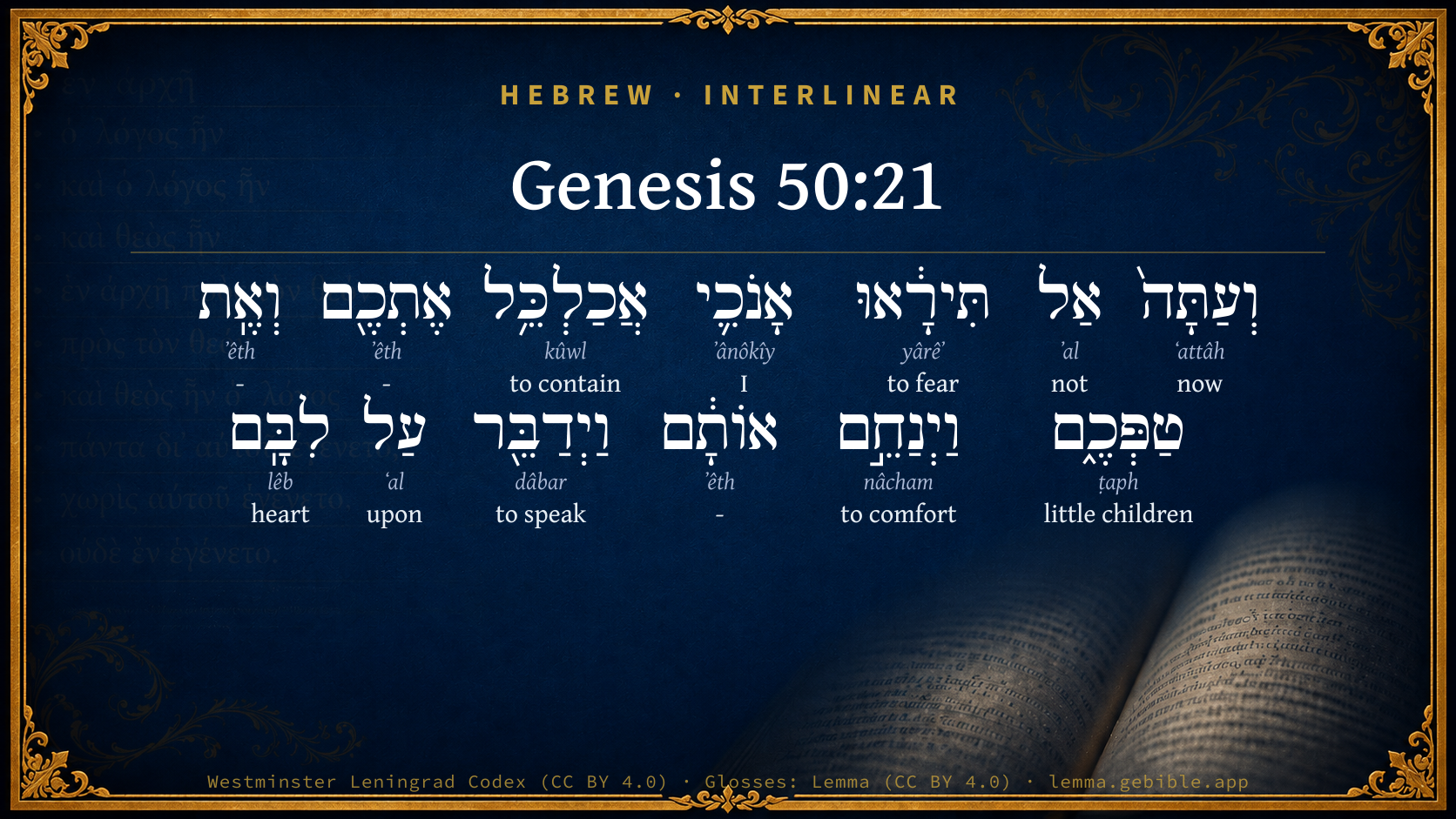
  1. וְעַתָּה֙ ʻattâh H6258 “and · now” Conjunction + Adverb
  2. אַל ʼal H408 “not” Particle, Negative
  3. תִּירָ֔אוּ yârêʼ H3372 “to fear” Verb, Qal, Jussive, 2nd Person, Masculine, Plural
  4. אָנֹכִ֛י ʼânôkîy H595 “I” Pronoun, Personal, 1st Person, Common, Singular
  5. אֶתְכֶ֖ם ʼêth H853 “- · you” Particle, Direct Object + Suffix, Personal, 2nd Person, Masculine, Plural
  6. וְאֶֽת ʼêth H853 “and · -” Conjunction + Particle, Direct Object
  7. טַפְּכֶ֑ם ṭaph H2945 “little children · your” Noun, Common, Masculine, Singular, Construct + Suffix, Personal, 2nd Person, Masculine, Plural
  8. וַיְנַחֵ֣ם nâcham H5162 “and · to comfort” Conjunction + Verb, Piel, Sequential Imperfect, 3rd Person, Masculine, Singular
  9. אוֹתָ֔ם ʼêth H853 “- · them” Particle, Direct Object + Suffix, Personal, 3rd Person, Masculine, Plural
  10. וַיְדַבֵּ֖ר dâbar H1696 “and · to speak” Conjunction + Verb, Piel, Sequential Imperfect, 3rd Person, Masculine, Singular
  11. עַל ʻal H5921 “upon” Preposition
  12. לִבָּֽם lêb H3820 “heart · their” Noun, Common, Masculine, Singular, Construct + Suffix, Personal, 3rd Person, Masculine, Plural

About this verse

These counts appear in no published source. They are computed here, from the morphology-tagged text and Lemma’s own curated glosses. What Lemma adds →

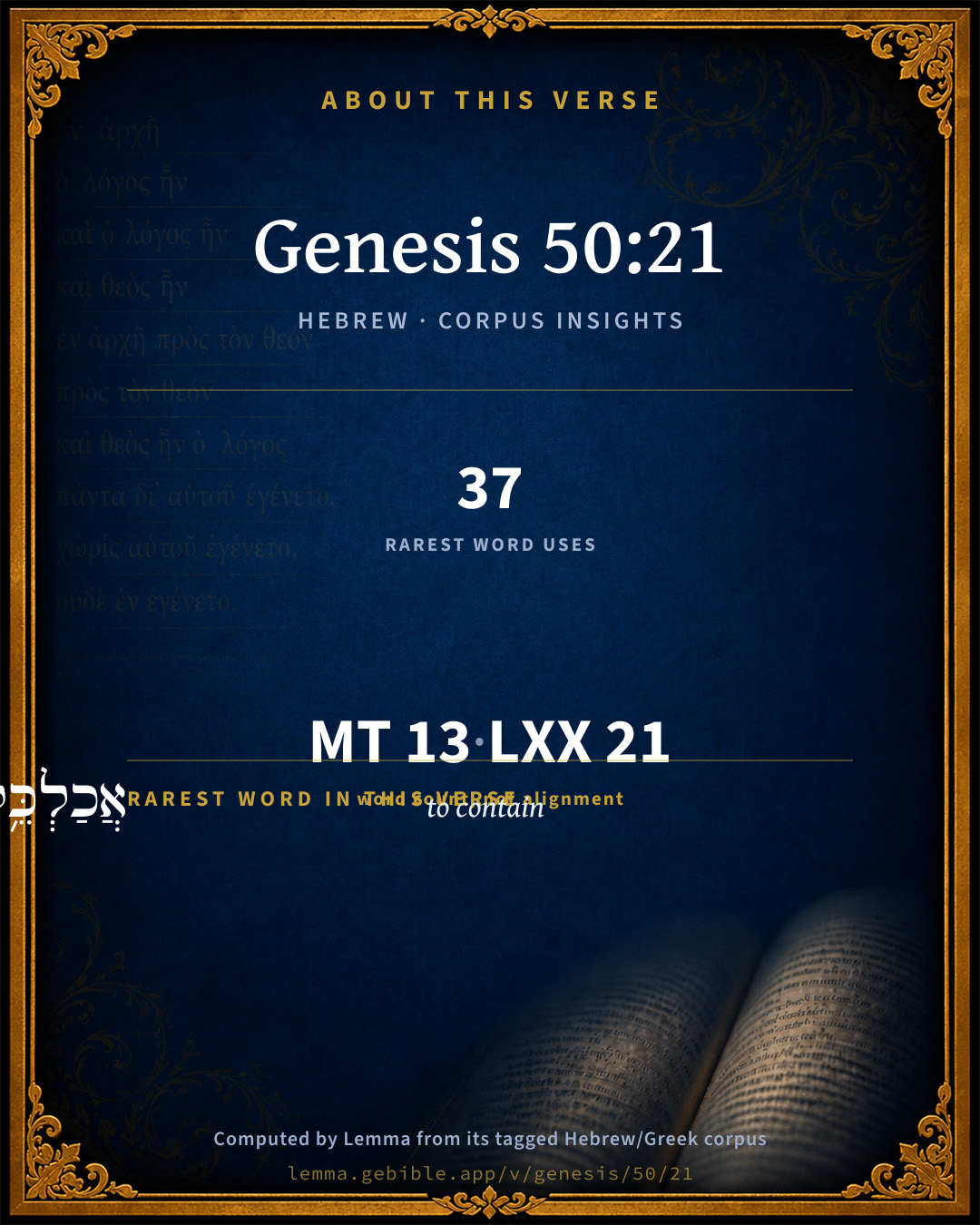
13
words
11
distinct lemmas
Pentateuch
section

Shared distinctive vocabulary

אֲכַלְכֵּ֥ל to contain H3557 occurs in 36 verses of the Hebrew Bible. Also found in:

Grammatical profile

  • 4 verbs
  • 2 nouns
  • 1 pronoun
  • 1 preposition
  • 1 adverb
  • 4 particles

Verb forms

  • תִּירָ֔אוּ Qal · Jussive
  • אֲכַלְכֵּ֥ל Pilpel · Imperfect
  • וַיְנַחֵ֣ם Piel · Sequential Imperfect
  • וַיְדַבֵּ֖ר Piel · Sequential Imperfect

Hebrew & Septuagint length

In English translation the verse runs 21 words from the Hebrew and 23 from the Septuagint (LXX English) — closely comparable.

A rough comparison of the two English renderings, which tokenize alike — not a word-level alignment.

Word counts can differ between the Hebrew and the Greek without any difference in meaning — e.g. the Hebrew direct-object marker אֵת has no separate Greek word, and Greek often adds the article ὁ.

In the original languages it is 13 Hebrew tokens and 21 Greek tokens — but the two are counted differently (Hebrew bundles its prefixes and suffixes into one token; the Greek is in lemma form), so that isn’t a like-for-like length.

Cross-references

8

Topical passages linked to Genesis 50:21 in the Treasury of Scripture Knowledge — connected by theme and wording, ordered by reader-vote popularity; previews shown in the World English Bible.

  • Genesis 47:12 Joseph nourished his father, his brothers, and all of his father's household, with bread, according to their families.
  • 1 Peter 3:9 not rendering evil for evil, or reviling for reviling; but instead blessing; knowing that to this were you called, that you may inherit a blessing.
  • Genesis 45:10–11 You shall dwell in the land of Goshen, and you will be near to me, you, your children, your children's children, your flocks, your herds, and all that you have.
  • Isaiah 40:2 Speak comfortably to Jerusalem; and cry to her, that her warfare is accomplished, that her iniquity is pardoned, that she has received of Yahweh's hand double for all her sins.
  • Matthew 5:44 But I tell you, love your enemies, bless those who curse you, do good to those who hate you, and pray for those who mistreat you and persecute you,
  • Matthew 6:14 "For if you forgive men their trespasses, your heavenly Father will also forgive you.
  • Romans 12:20–21 Therefore "If your enemy is hungry, feed him. If he is thirsty, give him a drink. For in doing so, you will heap coals of fire on his head."
  • 1 Thessalonians 5:15 See that no one returns evil for evil to anyone, but always follow after that which is good, for one another, and for all.

Cross-references courtesy of OpenBible.info (CC BY 4.0).

Hebrew and Greek witnesses Masoretic Hebrew ↔ Greek Septuagint

The same verse in the two great witnesses to the Old Testament, shown verse-for-verse.

These are two independent witnesses, not word-aligned to each other, and the Septuagint is shown in lemma (dictionary) form.

Hebrew Genesis 50:21 Masoretic · Westminster Leningrad Codex

וְעַתָּה֙ אַל תִּירָ֔אוּ אָנֹכִ֛י אֲכַלְכֵּ֥ל אֶתְכֶ֖ם וְאֶֽת טַפְּכֶ֑ם וַיְנַחֵ֣ם אוֹתָ֔ם וַיְדַבֵּ֖ר עַל לִבָּֽם

Now therefore don't be afraid. I will nourish you and your little ones." He comforted them, and spoke kindly to them.

World English Bible · Public Domain

Greek LXX Genesis 50:21 Septuagint · lemma form

καί εἶπον αὐτός μή φοβέω ἐγώ διατρέφω σύ καί ὁ οἰκία σύ καί παρακαλέω αὐτός καί λαλέω αὐτός εἰς ὁ καρδία

And he said to them, Fear not, I will maintain you, and your families: and he comforted them, and spoke kindly to them.

LXX2012 (modern English Septuagint) · Public Domain

On this verse, Ellicott's Commentary for English Readers discusses the Septuagint’s reading. Read the note in Commentary ↓

Hebrew: Westminster Leningrad Codex (CC BY 4.0). Greek: Septuagint (public domain); English from LXX2012 (modern English Septuagint) (Public Domain). How the Septuagint differs from the Hebrew →

Targum (Aramaic paraphrase)

2

The Targum is the ancient Jewish Aramaic paraphrase of the Hebrew Scriptures — an interpretive translation, not the Hebrew text itself. Onkelos (literal) and Pseudo-Jonathan (expansive) render the Torah, and Jonathan the Prophets. Coverage is partial: where no permissively-licensed English translation exists for a verse, only the Aramaic is shown. This is verse-level text, not a word-by-word alignment to the Hebrew.

  1. Targum Onkelos Torah (Genesis–Deuteronomy)
    וּכְעַן לָא תִדַחֲלוּן אֲנָא אֵזוּן יָתְכוֹן וְיָת טַפְלְכוֹן וְנַחֵם יָתְהוֹן וּמַלֵּיל תַּנְחוּמִין עַל לִבְּהוֹן

    (no public-domain English translation for this verse)

    Targum Onkelos — Aramaic: “Onkelos Genesis” (public domain); “Onkelos Exodus” (public domain); “Onkelos Leviticus” (public domain); “Onkelos Numbers” (public domain); “Onkelos Deuteronomy” (public domain). English: “Sefaria Community Translation” (CC0 1.0 (public-domain dedication)); “J.W. Etheridge. The Targums of Onkelos and Jonathan Ben Uzziel on the Pentateuch. London: Longmans, Green, 1862” (public domain). Text via Sefaria.

  2. Targum Pseudo-Jonathan Torah (Genesis–Deuteronomy)
    וּכְדוֹן לָא תִידַחֲלִין אָנָא אֵיזוּן יַתְכוֹן וְיַת טַפְלְכוֹן וְנָחִים יַתְהוֹן וּמַלֵל תַּנְחוּמִין עַל לִבְּהוֹן

    And now fear not; I will sustain you and your little ones. And he comforted them, and spake consolation to their heart.

    Targum Pseudo-Jonathan — Aramaic: “Targum Jonathan on Genesis” (public domain); “Targum Jonathan on Exodus” (public domain); “Targum Jonathan on Leviticus” (public domain); “Targum Jonathan on Numbers” (public domain); “Targum Jonathan on Deuteronomy” (public domain). English: “The Targum of Jonathan ben Uzziel, trans. J. W. Etheridge, London, 1862” (public domain). Text via Sefaria.

Commentary

Notes on Genesis 50:21 from classic Christian and Jewish commentators (each source and its license shown beneath its notes). The classic Christian expositions comment on the surrounding passage and are grouped to its opening verse, so a note may address several verses; the Jewish commentaries on the Tanakh (Rashi and others) are per-verse, so they appear only where the commentator wrote on this verse.

Lemma curates 59 commentaries, every one of them public domain or Creative Commons licensed, each selected and text-cleaned for this edition rather than reprinted as found. About our sources →

Trapp's Complete Commentary

John Trapp

Gen 50:21 Now therefore fear ye not: I will nourish you, and your little ones. And he comforted them, and spake kindly unto them.

Ver. 21. I will nourish you.] To requite your kindness, that consulted to starve me in the waterless pit. This was a noble way of revenging; this was heroical, and fit for Christian imitation. "If thine enemy hunger, feed him." {Rom 12:20}

John Trapp, A Commentary or Exposition upon All the Books of the Old and New Testament (1647–1656) — public domain. Text from a community e-Sword module.

The Biblical Illustrator

Joseph S. Exell

Gen_50:21

He comforted them, and spake kindly unto them

Josephs last forgiveness of his brethren:

I.

THEIR NEED OF FORGIVENESS.

II. THE PLEA ON WHICH THEY URGE IT (Gen_50:16-18).

1. The dying request of their father.

2. Their own free confession of guilt.

3. Their fathers influence with God.

4. Their willingness to utterly abase themselves.

III. THE COMPLETENESS OF THEIR FORGIVENESS.

1. He speaks words of peace.

2. He will not presume to put himself judicially in the place of God.

(1) As an instrument of vengeance.

(2) As presuming to change does not join forgetfulness. You forgive only so far as you forget. (F. W. Robertson, M. A.)

The Biblical Illustrator, edited by Joseph S. Exell (c. 1880s–1900s) — public domain. Text from a community e-Sword module.

Geneva Bible (1599)

Geneva Bible translators

Hebrew, to their heart.

Geneva Bible (1599) marginal notes — public domain. Text via Bolls.life.

John Calvin's Commentaries

21. I will nourish you. It was a token of a solid and not a feigned reconciliation, not only to abstain from malice and injury, but also to “overcome evil with good,” as Paul teaches, (Romans 12:21:) and truly, he who fails in his duty, when he possesses the power of giving help, and when the occasion demands his assistance, shows, by this very course, that he is not forgetful of injury. This requires to be the more diligently observed, because, commonly, the greater part weakly conclude that they forgive offenses if they do not retaliate them; as if indeed we were not taking revenge when we withdraw our hands from giving help. You would assist your brother if you thought him worthy: he implores your aid in necessity; you desert him because he has done you some unkindness; what hinders you from helping him but hatred? Therefore, we shall then only prove our minds to be free from malevolence, when we follow with kindness those enemies by whom we have been ill treated. Joseph is said to have spoken “to the heart of his brethren,” because, by addressing them with suavity and kindness, he removed all their scruples; as we have before seen, that Shechem spoke to the heart of Dinah, when he attempted to console her with allurements, in order that, forgetting the dishonor he had done her, she might consent to marry him.

John Calvin's Commentaries (1540-1563) — public domain. Text from the Calvin Translation Society English edition (1840s-50s) via the Christian Classics Ethereal Library (ccel.org). Calvin's coverage is partial (roughly two-thirds of the Bible); uncommented books and verses are honest gaps, never fabricated. The 19th-century editor's footnotes and remarks are omitted so the notes are faithfully Calvin's own voice.

Ellicott's Commentary for English Readers

(21) Your little ones.—Heb., your “tafs” rendered in the LXX., “your households,” and in the Syriac, “your families,” your dependents—its usual translation in that Version.

A Bible Commentary for English Readers, edited by Charles John Ellicott (1878–1897) — public domain. Text from a community e-Sword module.

The Cambridge Bible for Schools and Colleges

gen. ed. J. J. S. Perowne

21. nourish you] Cf. Gen_45:11, Gen_47:12.

kindly] Heb. to their heart. So LXX: cf. Gen_34:3. The Latin gives the sense blande ac leniter.

The Cambridge Bible for Schools and Colleges (gen. ed. J. J. S. Perowne; Cambridge University Press, 1878–1918) — public domain. Text from a community e-Sword module.

John Gill's Exposition

And Joseph dwelt in Egypt, he, and his father's house,.... Comfortably, quietly, and in great prosperity, not only he, but his brethren and their families, as long as he lived:

and Joseph lived one hundred and ten years; and all but seventeen of them in Egypt, for at that age it was when he was brought thither: thirteen years he lived in Potiphar's house, and in prison, for he was thirty years of age when he was brought to Pharaoh, and stood before him, and fourscore years he lived in the greatest honour and prosperity that a man could well wish for.

John Gill's Exposition of the Whole Bible (1746–1763) — public domain (CC PDM 1.0). Text via the HelloAO Bible API.

Matthew Poole's English Annotations

I will nourish you; expect not only a free pardon from me, but all the kindness of a loving brother.

Matthew Poole's English Annotations on the Holy Bible (1683–1685) — public domain. Text from a community e-Sword/MySword module.

Whedon's Commentary on the Bible

Daniel D. Whedon

21. Spake kindly unto them — Hebrews, spake to their heart, as in the margin; a beautiful form of speech, which it would have been well to retain in translation.

Daniel D. Whedon (gen. ed.), Commentary on the Old and New Testaments (1874–1909) — public domain. Text from a community e-Sword module.

The Pulpit Commentary

Now therefore (literally, and now) fear ye not: I will nourish you, and your little ones. Thus he repeats and confirms the promise which he had originally made to them when he invited them to come to Egypt. (Gen_45:11, Gen_45:18, Gen_45:19) And he comforted them, and spake kindly unto them literally, to their hearts (cf. Gen_34:3)

The Pulpit Commentary (1880–1919), ed. H.D.M. Spence-Jones & Joseph S. Exell — public domain. Text from a community e-Sword module.

John Wesley's Explanatory Notes

Fear not, I will nourish you - See what an excellent spirit Joseph was of, and learn of him to render good for evil. He did not tell them they were upon their good behaviour, and he would be kind to them if he saw they carried themselves well: no, he would not thus hold them in suspence, nor seem jealous of them, though they had been suspicious of him. He comforted them, and, to banish all their fears, he spake kindly to them. Those we love and forgive we must not only do well for, but speak kindly to.

John Wesley, Explanatory Notes Upon the Whole Bible (1754–1765) — public domain. Text via the GEBible commentary corpus.

Rashi

Rabbi Shlomo Yitzchaki (Rashi)

וידבר אל לבם means HE SPOKE words that found ready entrance INTO THEIR HEART: Before you came down hither people spread rumours about me that I was born a slave; through you it became public that I am a free-man by birth. If I were to kill you what would people say? “He saw a party of fine young men and he prided himself on his relationship with them, saying “These are my brothers”, but afterwards he killed them. Have you ever heard of a man killing his brothers?!” (Genesis Rabbah 100:9) Another interpretation is: He said to them, “Ten lights could not extinguish one light; how, then, can one light extinguish ten lights?” (Megillah 16b).

Rashi on the Tanakh — English translations: “The Judaica Press complete Tanach with Rashi, translated by A. J. Rosenberg” (CC BY 4.0); “Pentateuch with Rashi's commentary by M. Rosenbaum and A.M. Silbermann, 1929-1934” (public domain); “The Metsudah Tanach series, Lakewood, N.J” (CC BY 4.0); and “The Book of Joshua, Metsudah Publications, 1997” (CC BY 4.0). Text via Sefaria.

Lesson kit

Teaching starters — assembled from the data on this page, not authored interpretation. Every prompt links to the verse data it draws on. Edit before teaching.

Genesis, in the Pentateuch, opens this verse with 13 words (11 distinct Hebrew lemmas). Its most distinctive word is kûwl (“to contain”). A historical commentator’s framing appears above. Read the whole chapter for the surrounding context.

Discussion questions

  1. The word kûwl carries the sense “to contain.” How does it shape the verse?
  2. Genesis 45:11 shares the word «to contain» with this verse. How do the two illuminate each other?
  3. These translations render this verse differently. What is at stake in choosing one wording over another?
  4. The verb «תִּירָ֔אוּ» is Qal Jussive. How does its form color the action?
  5. Reading how Trapp's Complete Commentary and The Biblical Illustrator read this verse, where do the two commentators agree and where do they part?

Things to notice

Reading settings

Reading text

Shown beneath each verse's original-language words.

Old Testament
Old Testament edition

Read the OT as the Masoretic Hebrew (MT) or the Greek Septuagint (LXX).

English shown for the Greek Septuagint (in the Hebrew ↔ Greek comparison).

Comparing translations? Open the Compare panel on any verse page to stack up to four side by side.