
2 Kings 18:26

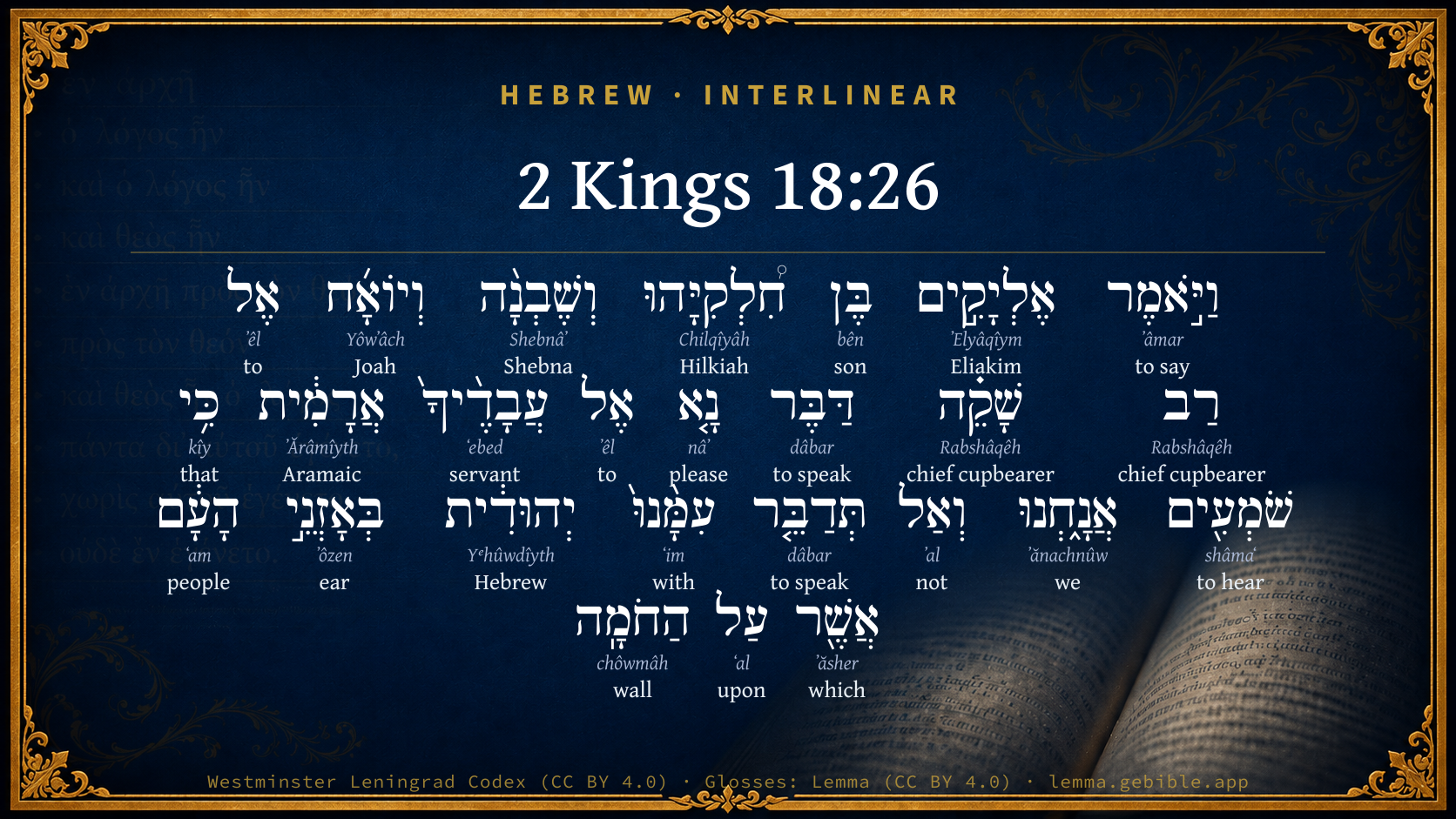
Hebrew (Westminster Leningrad Codex) 2 Kings 18:26 appears in the Hebrew Old Testament. The text above is from the Westminster Leningrad Codex. Each word links to its Strong’s number, a concise gloss, and parsing drawn from the Open Scriptures Hebrew Bible morphology. Click any word for its full Brown-Driver-Briggs (BDB) entry.
Download image
Cite this verse

2 Kings 18:26 (World English Bible). Public Domain. Lemma interlinear Bible study tool, https://lemma.gebible.app/v/2-kings/18/26.

Show BibTeX & RIS
BibTeX
RIS
English Translation
Then said Eliakim the son of Hilkiah, and Shebnah, and Joah, to Rabshakeh, Please speak to your servants in the Syrian language; for we understand it: and don't speak with us in the Jews' language, in the ears of the people who are on the wall.
World English Bible · Public Domain
Highlights
  • 2 first appearances in the Hebrew Bible
Full analysis ↓
Download a study sheet

One document with this verse’s original text, its word-by-word gloss line, the meaning frame, cross-references with their text, attributed commentary, and full source and license credits — printable, and it pastes into notes with its structure intact.

This verse Autodidact and up

Study sheet (.html) Plain text (.txt)

A passage Seminary Student

Up to 50 verses in one chapter. A passage sheet keeps up to 6 commentary sources and 12 cross-references per verse, in the order this page ranks them, and says so on the sheet whenever that leaves anything out. Ask for a single verse and you get the Autodidact verse sheet above.

Everything on this page stays free to read, with no account — the sheet is a download of what is already on screen, not access to it.

Want to remove ads? Support Godless Engineer
Compare translations 3

The same verse in 3 English versions, stacked beneath the original-language interlinear above. Click any original word for its lexicon entry.

Each is an independent rendering of the whole verse — the interlinear is not word-aligned to these translations.

Highlighted words mark where these versions differ — a whole-verse word diff, not a word-by-word alignment.

  • World English Bible Public Domain
    Then said Eliakim the son of Hilkiah, and Shebnah, and Joah, to Rabshakeh, Please speak to your servants in the Syrian language; for we understand it: and don't speak with us in the Jews' language, in the ears of the people who are on the wall.
  • King James Version Public Domain
    Then said Eliakim the son of Hilkiah, and Shebna, and Joah, unto Rabshakeh, Speak, I pray thee, to thy servants in the Syrian language; for we understand it: and talk not with us in the Jews' language in the ears of the people that are on the wall.
  • unfoldingWord Literal Text CC BY-SA 4.0
    And Eliakim, the son of Hilkiah, with Shebnah and Joah, said to the Rabshakeh, “Please speak to your servants in Aramaic, for we are understanding. But do not speak with us in Judean in the ears of the people who on the wall.”

unfoldingWord Literal Text — © unfoldingWord, licensed CC BY-SA 4.0. Word-aligned USFM3 via Door43 (git.door43.org/unfoldingWord/en_ult).

Versions to compare (up to 4)

3 of 4 selected

Show all 18 translations

Every available English version of this verse, each an independent rendering of the whole verse.

  • World English Bible Public Domain
    Then said Eliakim the son of Hilkiah, and Shebnah, and Joah, to Rabshakeh, Please speak to your servants in the Syrian language; for we understand it: and don't speak with us in the Jews' language, in the ears of the people who are on the wall.
  • Berean Standard Bible Public Domain
    Then Eliakim son of Hilkiah, along with Shebnah and Joah, said to the Rabshakeh, “Please speak to your servants in Aramaic, since we understand it. Do not speak with us in Hebrew in the hearing of the people on the wall.”
  • Majority Standard Bible Public Domain
    Then Eliakim son of Hilkiah, along with Shebnah and Joah, said to the Rabshakeh, “Please speak to your servants in Aramaic, since we understand it. Do not speak with us in Hebrew in the hearing of the people on the wall.”
  • King James Version Public Domain
    Then said Eliakim the son of Hilkiah, and Shebna, and Joah, unto Rabshakeh, Speak, I pray thee, to thy servants in the Syrian language; for we understand it: and talk not with us in the Jews' language in the ears of the people that are on the wall.
  • American Standard Version (1901) Public Domain
    Then said Eliakim the son of Hilkiah, and Shebnah, and Joah, unto Rabshakeh, Speak, I pray thee, to thy servants in the Syrian language; for we understand it: and speak not with us in the Jews' language, in the ears of the people that are on the wall.
  • Revised Version (1885) Public Domain
    Then said Eliakim the son of Hilkiah, and Shebnah, and Joah, unto Rabshakeh, Speak, I pray thee, to thy servants in the Syrian language; for we understand it: and speak not with us in the Jews’ language, in the ears of the people that are on the wall.
  • Geneva Bible (1599) Public Domain
    Then Eliakim the sonne of Hilkiah, and Shebnah, and Ioah said vnto Rabshakeh, Speake I pray thee, to thy seruants in the Aramites language, for we vnderstand it, and talke not with vs in the Iewes tongue, in the audience of the people that are on the wall.
  • Douay-Rheims (1899) Public Domain
    Then Eliacim the son of Helcias, and Sobna, and Joahe said to Rabsaces: We pray thee speak to us thy servants in Syriac: for we understand that tongue: and speak not to us in the Jews' language, in the hearing of the people that are upon the wall.
  • Young's Literal Translation Public Domain
    And Eliakim son of Hilkiah saith -- and Shebna, and Joah -- to the chief of the butlers, `Speak, we pray thee, unto thy servants `in' Aramaean, for we are understanding, and do not speak with us `in' Jewish, in the ears of the people who `are' on the wall.'
  • Literal Standard Version CC BY-SA 4.0
    And Eliakim son of Hilkiah says—and Shebna and Joah—to the chief of the butlers, “Please speak to your servants [in] Aramaic, for we are understanding, but do not speak with us [in] Jewish, in the ears of the people who [are] on the wall.”
  • Unlocked Literal Bible CC BY-SA 4.0
    Then Eliakim son of Hilkiah, and Shebnah, and Joah said to the chief commander, “Please speak to your servants in the Aramaic language, for we understand it. Do not speak with us in the language of Judah in the ears of the people who are on the wall.”
  • unfoldingWord Literal Text CC BY-SA 4.0
    And Eliakim, the son of Hilkiah, with Shebnah and Joah, said to the Rabshakeh, “Please speak to your servants in Aramaic, for we are understanding. But do not speak with us in Judean in the ears of the people who on the wall.”
  • Darby Bible Public Domain
    And Eliakim the son of Hilkijah, and Shebnah and Joah said to Rab-shakeh, Speak, we pray thee, to thy servants in Syriac, for we understand it, and talk not with us in the Jewish [language] in the ears of the people that are on the wall.
  • World Messianic Bible Public Domain
    Then Eliakim the son of Hilkiah, Shebnah, and Joah, said to Rabshakeh, “Please speak to your servants in the Syrian language, for we understand it. Don’t speak with us in the Jews’ language, in the hearing of the people who are on the wall.”
  • Webster's Bible Public Domain
    Then said Eliakim the son of Hilkiah, and Shebna and Joah, to Rab-shakeh, Speak, I pray thee, to thy servants in the Syrian language; for we understand it: and talk not with us in the Jews language in the ears of the people that are on the wall.
  • Free Bible Version CC BY-SA 4.0
    Eliakim, son of Hilkiah, together with Shebnah and Joah, said to the army general, “Please speak to us, your servants, in Aramaic, for we understand it. Don't speak to us in Hebrew while the people on the wall are listening.”
  • Bible in Basic English Public Domain
    Then Eliakim, the son of Hilkiah, and Shebna and Joah said to the Rab-shakeh, Will you kindly make use of the Aramaean language in talking to your servants, for we are used to it, and do not make use of the Jews' language in the hearing of the people on the wall.
  • JPS Tanakh (1917) Public Domain
    Then said Eliakim the son of Hilkiah, and Shebnah, and Joah, unto Rab-shakeh: 'Speak, I pray thee, to thy servants in the Aramean language; for we understand it; and speak not with us in the Jews' language, in the ears of the people that are on the wall.'

Literal Standard Version (2020), Covenant Press — licensed CC BY-SA 4.0. Text via the HelloAO Bible API (eBible.org). Unlocked Literal Bible (unfoldingWord) — licensed CC BY-SA 4.0. Text via the HelloAO Bible API (eBible.org). unfoldingWord Literal Text — © unfoldingWord, licensed CC BY-SA 4.0. Word-aligned USFM3 via Door43 (git.door43.org/unfoldingWord/en_ult). Free Bible Version, Dr. Jonathan Gallagher — licensed CC BY-SA 4.0. Text via the HelloAO Bible API (eBible.org).

Word by word

More ways to search: Search by grammar → Find every occurrence → Compare this word →

Practice this passage: Drill this verse → Learn its vocabulary →

אֲרָמִ֔ית
ʼĂrâmîyth
H762
“Aramaic”
Noun, Gentilic, Feminine, Singular, Absolute
Part of Speech
Noun
Type
Gentilic
Gender
Feminine
Number
Singular
State
Absolute
Full BDB Definition

Origin: feminine of H761

TWOT: None

Aramaic = "language" - the language of Aram, Aramaic
  1. וַיֹּ֣אמֶר ʼâmar H559 “and · to say” Conjunction + Verb, Qal, Sequential Imperfect, 3rd Person, Masculine, Singular
  2. אֶלְיָקִ֣ים ʼElyâqîym H471 “Eliakim” Noun, Proper
  3. בֶּן bên H1121 “son of” Noun, Common, Masculine, Singular, Construct
  4. חִ֠לְקִיָּהוּ Chilqîyâh H2518 “Hilkiah” Noun, Proper
  5. וְשֶׁבְנָ֨ה Shebnâʼ H7644 “and · Shebna” Conjunction + Noun, Proper
  6. וְיוֹאָ֜ח Yôwʼâch H3098 “and · Joah” Conjunction + Noun, Proper
  7. אֶל ʼêl H413 “to” Preposition
  8. רַב Rabshâqêh H7262 “chief cupbearer of” Noun, Common, Masculine, Singular, Construct
  9. שָׁקֵ֗ה Rabshâqêh H7262 “chief cupbearer” Noun, Proper
  10. דַּבֶּר dâbar H1696 “speak” Verb, Piel, Imperative, 2nd Person, Masculine, Singular
  11. נָ֤א nâʼ H4994 “please” Particle, Exhortation
  12. אֶל ʼêl H413 “to” Preposition
  13. עֲבָדֶ֨יךָ֙ ʻebed H5650 “servants · your” Noun, Common, Masculine, Plural, Construct + Suffix, Personal, 2nd Person, Masculine, Singular
  14. כִּ֥י kîy H3588 “that” Conjunction
  15. שֹׁמְעִ֖ים shâmaʻ H8085 “hearing” Verb, Qal, Participle Active, Masculine, Plural, Absolute
  16. אֲנָ֑חְנוּ ʼănachnûw H587 “we” Pronoun, Personal, 1st Person, Common, Plural
  17. וְאַל ʼal H408 “and · not” Conjunction + Particle, Negative
  18. תְּדַבֵּ֤ר dâbar H1696 “to speak” Verb, Piel, Jussive, 2nd Person, Masculine, Singular
  19. עִמָּ֨נוּ֙ ʻim H5973 “with · us” Preposition + Suffix, Personal, 1st Person, Common, Plural
  20. יְהוּדִ֔ית Yᵉhûwdîyth H3066 “Hebrew” Noun, Gentilic, Feminine, Singular, Absolute
  21. בְּאָזְנֵ֣י ʼôzen H241 “in/at · ears of” Preposition + Noun, Common, Feminine, Dual, Construct
  22. הָעָ֔ם ʻam H5971 “the · people” Particle, Definite Article + Noun, Common, Masculine, Singular, Absolute
  23. אֲשֶׁ֖ר ʼăsher H834 “which” Particle, Relative
  24. עַל ʻal H5921 “upon” Preposition
  25. הַחֹמָֽה chôwmâh H2346 “the · wall” Particle, Definite Article + Noun, Common, Feminine, Singular, Absolute

About this verse

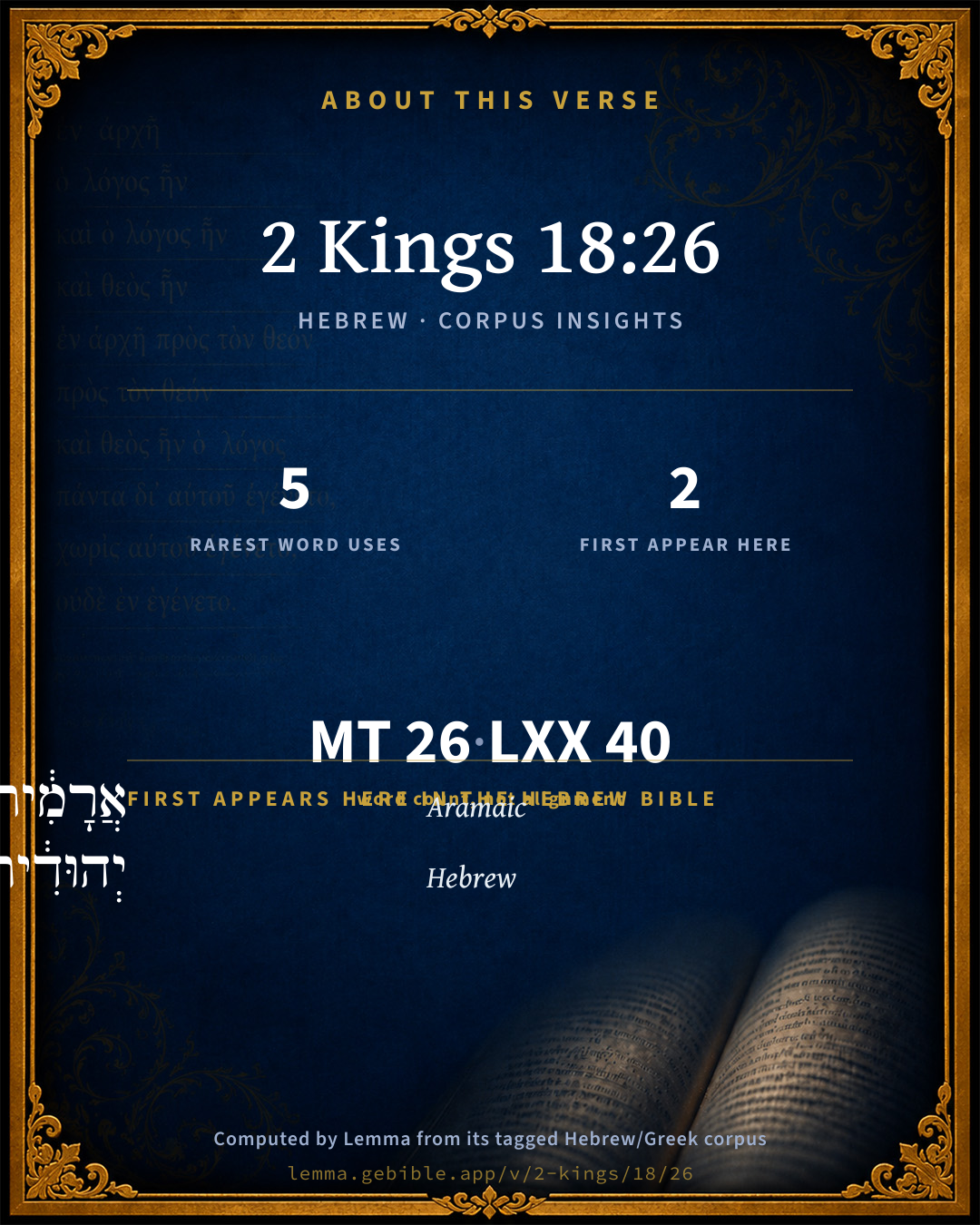
These counts appear in no published source. They are computed here, from the morphology-tagged text and Lemma’s own curated glosses. What Lemma adds →

26
words
23
distinct lemmas
Historical
section

Notable vocabulary

The rarest word here is אֲרָמִ֔ית Aramaic H762 — appearing just 5 times in the whole Hebrew Bible.

First appearance in Scripture

These words make their first canonical appearance in the Hebrew Bible here:

  • אֲרָמִ֔ית Aramaic H762
  • יְהוּדִ֔ית Hebrew H3066

Shared distinctive vocabulary

אֲרָמִ֔ית Aramaic H762 occurs in 4 verses of the Hebrew Bible. Also found in:

Grammatical profile

  • 4 verbs
  • 13 nouns
  • 1 pronoun
  • 4 prepositions
  • 1 conjunction
  • 3 particles

Verb forms

  • וַיֹּ֣אמֶר Qal · Sequential Imperfect
  • דַּבֶּר Piel · Imperative
  • שֹׁמְעִ֖ים Qal · Participle Active
  • תְּדַבֵּ֤ר Piel · Jussive

Repetition

Words recur within this verse — often emphatic in Hebrew:

  • רַב chief cupbearer H7262 ×2
  • דַּבֶּר to speak H1696 ×2
  • אֶל to H413 ×2

Hebrew & Septuagint length

In English translation the verse runs 46 words from the Hebrew and 51 from the Septuagint (LXX English) — closely comparable.

A rough comparison of the two English renderings, which tokenize alike — not a word-level alignment.

Word counts can differ between the Hebrew and the Greek without any difference in meaning — e.g. the Hebrew direct-object marker אֵת has no separate Greek word, and Greek often adds the article ὁ.

In the original languages it is 26 Hebrew tokens and 40 Greek tokens — but the two are counted differently (Hebrew bundles its prefixes and suffixes into one token; the Greek is in lemma form), so that isn’t a like-for-like length.

Cross-references

4

Topical passages linked to 2 Kings 18:26 in the Treasury of Scripture Knowledge — connected by theme and wording, ordered by reader-vote popularity; previews shown in the World English Bible.

  • Ezra 4:7 In the days of Artaxerxes wrote Bishlam, Mithredath, Tabeel, and the rest of his companions, to Artaxerxes king of Persia; and the writing of the letter was written in the Syrian [character], and set forth in the Syrian [language].
  • Daniel 2:4 Then spoke the Chaldeans to the king in the Syrian language, O king, live forever: tell your servants the dream, and we will show the interpretation.
  • Isaiah 36:11–12 Then said Eliakim and Shebna and Joah to Rabshakeh, Please speak, to your servants in the Syrian language; for we understand it: and don't speak to us in the Jews' language, in the ears of the people who are on the wall.
  • 2 Kings 18:18 When they had called to the king, there came out to them Eliakim the son of Hilkiah, who was over the household, and Shebnah the scribe, and Joah the son of Asaph the recorder.

Cross-references courtesy of OpenBible.info (CC BY 4.0).

Hebrew and Greek witnesses Masoretic Hebrew ↔ Greek Septuagint

The same verse in the two great witnesses to the Old Testament, shown verse-for-verse.

These are two independent witnesses, not word-aligned to each other, and the Septuagint is shown in lemma (dictionary) form.

Hebrew 2 Kings 18:26 Masoretic · Westminster Leningrad Codex

וַיֹּ֣אמֶר אֶלְיָקִ֣ים בֶּן חִ֠לְקִיָּהוּ וְשֶׁבְנָ֨ה וְיוֹאָ֜ח אֶל רַב שָׁקֵ֗ה דַּבֶּר נָ֤א אֶל עֲבָדֶ֨יךָ֙ אֲרָמִ֔ית כִּ֥י שֹׁמְעִ֖ים אֲנָ֑חְנוּ וְאַל תְּדַבֵּ֤ר עִמָּ֨נוּ֙ יְהוּדִ֔ית בְּאָזְנֵ֣י הָעָ֔ם אֲשֶׁ֖ר עַל הַחֹמָֽה

Then said Eliakim the son of Hilkiah, and Shebnah, and Joah, to Rabshakeh, Please speak to your servants in the Syrian language; for we understand it: and don't speak with us in the Jews' language, in the ears of the people who are on the wall.

World English Bible · Public Domain

Greek LXX 2 Kings 18:26 Septuagint · lemma form

καί εἶπον ελιακιμ υἱός χελκιας καί σομνας καί ιωας πρός ραψακης λαλέω δή πρός ὁ παῖς σύ συριστί ὅτι ἀκούω ἐγώ καί οὐ λαλέω μετά ἐγώ ἰουδαϊστί καί ἵνα τίς λαλέω ἐν ὁ οὖς ὁ λαός ὁ ἐπί ὁ τεῖχος

And Heliakim the son of Chelkias, and Somnas, and Joas, said to Rapsakes, Speak now to your servants in the Syrian language, for we understand it; and speak not with us in the Jewish language: and why do you speak in the ears of the people that are on the wall?

LXX2012 (modern English Septuagint) · Public Domain

Hebrew: Westminster Leningrad Codex (CC BY 4.0). Greek: Septuagint (public domain); English from LXX2012 (modern English Septuagint) (Public Domain). How the Septuagint differs from the Hebrew →

Targum (Aramaic paraphrase)

1

The Targum is the ancient Jewish Aramaic paraphrase of the Hebrew Scriptures — an interpretive translation, not the Hebrew text itself. Onkelos (literal) and Pseudo-Jonathan (expansive) render the Torah, and Jonathan the Prophets. Coverage is partial: where no permissively-licensed English translation exists for a verse, only the Aramaic is shown. This is verse-level text, not a word-by-word alignment to the Hebrew.

  1. Targum Jonathan Prophets (Joshua–Malachi)
    וַאֲמַר אֶלְיָקִים בַּר חִלְקִיָה וְשֶׁבְנָה וְיוֹאָח לְרַבְשָׁקֵה מַלֵל כְּעַן עִם עַבְדָךְ אֲרָמִית אֲרֵי שָׁמְעִין אֲנַחֲנָא וְלָא תְמַלֵיל עִמָנָא יְהוּדִית קֳדָם עַמָא דְעַל שׁוּרָא:

    (no public-domain English translation for this verse)

    Targum Jonathan — Aramaic: “Mikraot Gedolot” (public domain). English: “Sefaria Community Translation” (CC0 1.0 (public-domain dedication)); “London "Chaldee Paraphrase," 1871” (public domain). Text via Sefaria.

Commentary

Notes on 2 Kings 18:26 from classic Christian and Jewish commentators (each source and its license shown beneath its notes). The classic Christian expositions comment on the surrounding passage and are grouped to its opening verse, so a note may address several verses; the Jewish commentaries on the Tanakh (Rashi and others) are per-verse, so they appear only where the commentator wrote on this verse.

Lemma curates 59 commentaries, every one of them public domain or Creative Commons licensed, each selected and text-cleaned for this edition rather than reprinted as found. About our sources →

Trapp's Complete Commentary

John Trapp

2Ki 18:26 Then said Eliakim the son of Hilkiah, and Shebna, and Joah, unto Rabshakeh, Speak, I pray thee, to thy servants in the Syrian language; for we understand [it]: and talk not with us in the Jews’ language in the ears of the people that [are] on the wall.

Ver. 26. Speak, I pray thee, … in the Syrian language.] This was no wise motion: but they were frightened; and some think it was wicked Shebna rather than good Eliakim that made it, purposely to provoke Rabshakeh to rail the more, and to lay open that whereby the people might be moved to yield up the city.

John Trapp, A Commentary or Exposition upon All the Books of the Old and New Testament (1647–1656) — public domain. Text from a community e-Sword module.

Joseph Benson's Commentary

2Ki 18:26. Speak, I pray thee, to thy servants in the Syrian language — It is probable Eliakim perceived the people to be terrified with his big words, and therefore requested him, in the name of the other commissioners sent to treat with him, to speak no longer in the Jews’ language, but in his own: for he was sent, not to treat with the people, but with them, who understood the Syrian tongue very well. In the ears of the people that are upon the wall — Upon which these officers stood; not being willing to put themselves into the power of such a barbarous and perfidious enemy by going out of the city.

Joseph Benson's Commentary on the Old and New Testaments (1811–1818) — public domain. Text from a community e-Sword module.

Tyndale Open Study Notes

Tyndale Open Resources

18:26 Hezekiah’s representatives wanted the Assyrian delegation to speak . . . in Aramaic, the language of diplomacy, so that the people who were listening would not understand and be discouraged or frightened.

Tyndale Open Study Notes — © Tyndale Open Resources, licensed CC BY-SA 4.0. Text via the HelloAO Bible API.

Geneva Bible (1599)

Geneva Bible translators

Or, Syrians.

Geneva Bible (1599) marginal notes — public domain. Text via Bolls.life.

Adam Clarke's Commentary

Verse 26. Talk not with us in the Jews' language] The object of this blasphemous caitiff was to stir up the people to sedition, that the city and the king might be delivered into his hand.

Adam Clarke's Commentary on the Bible (1810–1826) — public domain. Text from a community e-Sword/MySword module.

Ellicott's Commentary for English Readers

(26) Speak, I pray thee . . . in the Syrian language.—HezeMah’s ministers naturally dread the effect of Rab-shakeh’s arguments and assertions upon the garrison of the city. The people, many of whom had always been accustomed to worship at the high places, might very well doubt whether there were not some truth in the allegation that Jehovah was incensed at their removal.

In the Syrian language.—In Aramaic; which was at that time the language of diplomacy and commerce in the countries of Western Asia, as is proved by the bilingual contract-tablets (in Aramaic and Assyrian) discovered at Nineveh.

In the Jews’ language.—In Jewish; an expression only found in Neh_13:24 besides the present narrative. The word “Jew” (Yehûdî), from which it is derived, itself occurs only in the later Biblical books; but contemporary Assyrian usage (mât Ya-u-di or Ya-u-du, “Judah;” Ya-u-da-a-a, “the Jews”) is in favour of the supposition that the people of the Southern kingdom were even then called Yehûdim, and their language “Jewish” (Yehûdîth). The spoken dialect probably differed considerably from other varieties of Hebrew, though not enough to make it unintelligible to other Hebrew-speaking peoples, such as the northern Israelites and the Moabites and Edomites.

A Bible Commentary for English Readers, edited by Charles John Ellicott (1878–1897) — public domain. Text from a community e-Sword module.

The Cambridge Bible for Schools and Colleges

gen. ed. J. J. S. Perowne

26–37. Further insolence of Rab-shakeh. He addresses the people that stand on the wall. Despair of hezekiah’s ministers (2Ch_32:13-19; Isa_35:1-2)

26. Speak, I pray thee … in the Syrian language] The language intended is more properly named, as in the margin of R.V. ‘Aramæan’ This was the language of Mesopotamia and Babylon. It was of the same family as Hebrew, but yet not commonly understood by the people of Judæa. The court officials would of necessity have to speak it for the purposes of political intercourse. ‘Syriac’ is a later dialect of Aramæan. For ‘talk not’ R.V. has speak not. The original word is the same as in the previous clause. By their request Eliakim and his companions at once put themselves at Rabshakeh’s mercy, and he shewed them none. ‘Lewd men are the worse for admonitions. Rab-shakeh had not so strained his throat to corrupt the citizens of Jerusalem, had it not been for the humble obtestation of Eliakim. Now he rears up his voice and holds up his sides, and roars out his double blasphemies’ (Bp Hall).

the people that are on the wall] There had gathered a crowd around Hezekiah’s ministers to hear the issue of the conference, and these from their previous sufferings in the siege would be ready enough to put a favourable construction on Rab-shakeh’s argument. The Chronicler (2Ch_32:11) represents him as employing the powerful argument to starving men ‘Doth not Hezekiah persuade you to give yourselves over to die by famine and by thirst’? This is the fearful extremity which is so coarsely alluded to in the words of the next verse. That such food had been used by persons reduced to extremity in a siege, see above chap. 2Ki_6:25 and the note there.

The Cambridge Bible for Schools and Colleges (gen. ed. J. J. S. Perowne; Cambridge University Press, 1878–1918) — public domain. Text from a community e-Sword module.

Albert Barnes' Notes on the Bible

The Syrian language - i. e., Aramaic; probably the dialect of Damascus, a Semitic language nearly akin to their own, but suffciently different to be unintelligible to ordinary Jews

The people that are on the wall - The conference must have been held immediately outside the wall for the words of the speakers to have been audible.

Albert Barnes' Notes on the Bible (1834–1885) — public domain. Text from a community e-Sword/MySword module.

Haydock's Catholic Bible Commentary

Syriac, or Chaldean language, which was spoken at the Assyrian court, 1 Esdras iv. 7., and Daniel ii. 4. Rabsaces was acquainted with both the languages; as the Jews say he was an apostate, which they infer from this passage, and from the legates tearing their clothes when they heard him blaspheme; as t hey pretend this was only done when blasphemy came from the mouth of an Israelite. (Grotius) --- But these reasons are very weak. (Calmet) --- The like was practised when any thing terrifying was heard, ver. 37. (Haydock) --- The reasons why the legates desire Rabsaces not to speak in a language which the common soldiers understood, was to prevent them from shewing their indignation by shooting at him, or out of fear, lest they should be induced to cause some sedition. (Menochius)

George Leo Haydock (1774–1849), Haydock's Catholic Family Bible and Commentary, 1859 edition — public domain. Excludes Psalms (Douay-Rheims chapter numbering differs from Protestant) and Deuterocanonical books (Catholic canon only).

Matthew Poole's English Annotations

Upon which these officers stood; not being willing to put themselves into the power of such a barbarous and perfidious enemy, by going out of the city.

Matthew Poole's English Annotations on the Holy Bible (1683–1685) — public domain. Text from a community e-Sword/MySword module.

Whedon's Commentary on the Bible

Daniel D. Whedon

26. Speak… in the Syrian language — The Jewish officers thus interrupted Rab-shakeh in the midst of his address. Such words as those of 2Ki_18:25 are, alas! too true, and have support, whether Assyria fully comprehends it or not, in oracles which Jehovah’s own prophets have uttered. For a representative of Assyria to speak of them in the Jews’ language in the ears of the people may easily occasion murmurings and rebellion. The Syrian language, more properly the Aramaic, (ארמית,) seems at this time to have been commonly understood in Syria, Assyria, and Babylonia. Its close affinity with the Hebrew would enable those who spoke one of these languages as their vernacular easily to acquire the use of the other; but the mass of the people would be familiar only with the tongue in which they were born.

On the wall — So it appears that this interview was held near the walls of the city, and within hearing of the soldiers stationed thereon.

Daniel D. Whedon (gen. ed.), Commentary on the Old and New Testaments (1874–1909) — public domain. Text from a community e-Sword module.

The Pulpit Commentary

Then said Eliakim the son of Hilkiah, and Shebna, and Joah, unto Rabshakeh, Speak, I pray thee, to thy servants in the Syrian language; literally, in the Aramaic language. Hebrew, Aramaic, and Assyrian were three cognate languages, closely allied, and very similar both in their grammatical forms and in their vocabularies, but still sufficiently different to be distinct languages, which were only intelligible to those who had learnt them. Rabshakeh had addressed the Jewish officials in Hebrew, probably as the language which they would best understand, if it were not even the only one that they would understand; not with the express "object of influencing the common people," as Bahr supposes. But the Jewish officials feared that the words uttered were influencing them. They proposed, therefore, that the further negotiations should be conducted in Aramaic, a tongue which they understood, and one which they supposed that Rabshakeh, as he knew Hebrew, would also know. Aramaic was spoken in most of the tract that lay between Assyria and Palestine, in Syria and Damascus certainly, in Upper Mesopotamia, along the line of the Euphrates, and perhaps as far as the Khabour river. For we understand it. It is not likely that the Jews of this time generally understood Aramaic; but high officials of the court, who might have to deal with embassies and negotiate treaties, found it necessary to understand it, just as such persons in our own country have to know French. And talk not with us in the Jews" language in the ears of the people that are on the wall. Besides the sentinels and other soldiers, there would probably be many idlers upon the wall, attracted by the unwonted spectacle of an ambassadorial cortege, and anxious to pick up intelligence. The loud voices of Orientals would be heard to a considerable distance.

The Pulpit Commentary (1880–1919), ed. H.D.M. Spence-Jones & Joseph S. Exell — public domain. Text from a community e-Sword module.

unfoldingWord translationNotes

Door43 World Missions Community

Eliakim ... Hilkiah ... Shebnah ... Joah

Translate the names of these men as in 2 Kings 18:18. (See: How to Translate Names)

in the ears of the people who are on the wall

"In the ears" is metonymy for being able to listen. AT: "because the people standing on the city wall will hear it and be afraid" (See: Metonymy)

Has my master sent me to your master and to you to speak these words? Has he not sent me to the men who sit on the wall, who will have to eat their own dung and drink their own urine with you?

He asks these questions assuming the listeners know the answers to emphasize their intention to destroy and humiliate the leaders and people of Jerusalem. AT: "My master sent me not only to you and your master, but also to speak to the people in this city, who will suffer with you when they have to eat their own dung and drink their own urine to survive." (See: Rhetorical Question)

translationWords

Eliakim

Aram

dung

unfoldingWord translationNotes — © Distant Shores Media and the Door43 World Missions Community, licensed CC BY-SA 4.0. Source: git.door43.org/Door43/en_tn.

Rashi

Rabbi Shlomo Yitzchaki (Rashi)

For we understand it. We are residents of the palace, and understand Aramaic and other languages. But do not speak Hebrew to us, which all the people understand, and we do not want them to hear.

Rashi on the Tanakh — English translations: “The Judaica Press complete Tanach with Rashi, translated by A. J. Rosenberg” (CC BY 4.0); “Pentateuch with Rashi's commentary by M. Rosenbaum and A.M. Silbermann, 1929-1934” (public domain); “The Metsudah Tanach series, Lakewood, N.J” (CC BY 4.0); and “The Book of Joshua, Metsudah Publications, 1997” (CC BY 4.0). Text via Sefaria.

Lesson kit

Teaching starters — assembled from the data on this page, not authored interpretation. Every prompt links to the verse data it draws on. Edit before teaching.

2 Kings, in the Historical, opens this verse with 26 words (23 distinct Hebrew lemmas). Its most distinctive word is ʼĂrâmîyth (“Aramaic”). A historical commentator’s framing appears above. Read the whole chapter for the surrounding context.

Discussion questions

  1. What does “Aramaic” (ʼĂrâmîyth) contribute to the verse as a whole?
  2. 2 words make their first appearance in Scripture here. What does this debut establish?
  3. How does Ezra 4:7, which shares the word «Aramaic», read alongside this verse?
  4. What does the repetition of “chief cupbearer” (2× in this one verse) do in this verse?
  5. The translations on this page render this verse differently — a whole-verse word diff, not a word-by-word alignment. What might account for the different wordings?
  6. «וַיֹּ֣אמֶר» is a Qal Sequential Imperfect verb. How does that grammatical form shape the action described?
  7. Compare how Trapp's Complete Commentary and Joseph Benson's Commentary read this verse. Where do they agree or differ?

Things to notice

Reading settings

Reading text

Shown beneath each verse's original-language words.

Old Testament
Old Testament edition

Read the OT as the Masoretic Hebrew (MT) or the Greek Septuagint (LXX).

English shown for the Greek Septuagint (in the Hebrew ↔ Greek comparison).

Comparing translations? Open the Compare panel on any verse page to stack up to four side by side.