
1 Samuel 12:20

Hebrew (Westminster Leningrad Codex) 1 Samuel 12:20 appears in the Hebrew Old Testament. The text above is from the Westminster Leningrad Codex. Each word links to its Strong’s number, a concise gloss, and parsing drawn from the Open Scriptures Hebrew Bible morphology. Click any word for its full Brown-Driver-Briggs (BDB) entry.
Download image
Cite this verse

1 Samuel 12:20 (World English Bible). Public Domain. Lemma interlinear Bible study tool, https://lemma.gebible.app/v/1-samuel/12/20.

Show BibTeX & RIS
BibTeX
RIS
English Translation
Samuel said to the people, "Don't be afraid; you have indeed done all this evil; yet don't turn aside from following Yahweh, but serve Yahweh with all your heart:
World English Bible · Public Domain
Download a study sheet

One document with this verse’s original text, its word-by-word gloss line, the meaning frame, cross-references with their text, attributed commentary, and full source and license credits — printable, and it pastes into notes with its structure intact.

This verse Autodidact and up

Study sheet (.html) Plain text (.txt)

A passage Seminary Student

Up to 50 verses in one chapter. A passage sheet keeps up to 6 commentary sources and 12 cross-references per verse, in the order this page ranks them, and says so on the sheet whenever that leaves anything out. Ask for a single verse and you get the Autodidact verse sheet above.

Everything on this page stays free to read, with no account — the sheet is a download of what is already on screen, not access to it.

Want to remove ads? Support Godless Engineer
Compare translations 3

The same verse in 3 English versions, stacked beneath the original-language interlinear above. Click any original word for its lexicon entry.

Each is an independent rendering of the whole verse — the interlinear is not word-aligned to these translations.

Highlighted words mark where these versions differ — a whole-verse word diff, not a word-by-word alignment.

  • World English Bible Public Domain
    Samuel said to the people, "Don't be afraid; you have indeed done all this evil; yet don't turn aside from following Yahweh, but serve Yahweh with all your heart:
  • King James Version Public Domain
    And Samuel said unto the people, Fear not: ye have done all this wickedness: yet turn not aside from following the LORD, but serve the LORD with all your heart;
  • unfoldingWord Literal Text CC BY-SA 4.0
    And Samuel said to the people, “Do not fear. You, you have done all of this evil, but do not turn aside from after Yahweh, but serve Yahweh with all of your heart.

unfoldingWord Literal Text — © unfoldingWord, licensed CC BY-SA 4.0. Word-aligned USFM3 via Door43 (git.door43.org/unfoldingWord/en_ult).

Versions to compare (up to 4)

3 of 4 selected

Show all 18 translations

Every available English version of this verse, each an independent rendering of the whole verse.

  • World English Bible Public Domain
    Samuel said to the people, "Don't be afraid; you have indeed done all this evil; yet don't turn aside from following Yahweh, but serve Yahweh with all your heart:
  • Berean Standard Bible Public Domain
    “Do not be afraid,” Samuel replied. “Even though you have committed all this evil, do not turn aside from following the LORD, but serve the LORD with all your heart.
  • Majority Standard Bible Public Domain
    “Do not be afraid,” Samuel replied. “Even though you have committed all this evil, do not turn aside from following the LORD, but serve the LORD with all your heart.
  • King James Version Public Domain
    And Samuel said unto the people, Fear not: ye have done all this wickedness: yet turn not aside from following the LORD, but serve the LORD with all your heart;
  • American Standard Version (1901) Public Domain
    And Samuel said unto the people, Fear not; ye have indeed done all this evil; yet turn not aside from following Jehovah, but serve Jehovah with all your heart:
  • Revised Version (1885) Public Domain
    And Samuel said unto the people, Fear not: ye have indeed done all this evil: yet turn not aside from following the LORD, but serve the LORD with all your heart;
  • Geneva Bible (1599) Public Domain
    And Samuel said vnto the people, Feare not. (ye haue indeede done all this wickednesse, yet depart not from following the Lord, but serue the Lord with all your heart,
  • Douay-Rheims (1899) Public Domain
    And Samuel said to the people: Fear not, you have done all this evil: but yet depart not from following the Lord, but serve the Lord with all your heart.
  • Young's Literal Translation Public Domain
    And Samuel saith unto the people, `Fear not; ye have done all this evil; only, turn not aside from after Jehovah -- and ye have served Jehovah with all your heart,
  • Literal Standard Version CC BY-SA 4.0
    And Samuel says to the people, “Do not fear; you have done all this evil; only, do not turn aside from after YHWH—and you have served YHWH with all your heart,
  • Unlocked Literal Bible CC BY-SA 4.0
    Samuel replied, “Do not be afraid. You have done all this evil, but do not turn away from Yahweh, but serve Yahweh with all your heart.
  • unfoldingWord Literal Text CC BY-SA 4.0
    And Samuel said to the people, “Do not fear. You, you have done all of this evil, but do not turn aside from after Yahweh, but serve Yahweh with all of your heart.
  • Darby Bible Public Domain
    And Samuel said to the people, Fear not: *ye* have done all this wickedness; yet turn not aside from following Jehovah, and serve Jehovah with all your heart;
  • World Messianic Bible Public Domain
    Samuel said to the people, “Don’t be afraid. You have indeed done all this evil; yet don’t turn away from following the LORD, but serve the LORD with all your heart.
  • Webster's Bible Public Domain
    And Samuel said to the people, Fear not: ye have done all this wickedness: yet turn not aside from following the LORD, but serve the LORD with all your heart;
  • Free Bible Version CC BY-SA 4.0
    “Don't be afraid,” Samuel replied. “Even though you have indeed done all these evil things, don't give up following the Lord, but dedicate yourselves completely to worshiping him.
  • Bible in Basic English Public Domain
    Then Samuel said to the people, Have no fear: truly you have done evil, but do not be turned away from the Lord; be his servants with all your heart;
  • JPS Tanakh (1917) Public Domain
    And Samuel said unto the people: 'Fear not; ye have indeed done all this evil; yet turn not aside from following the LORD, but serve the LORD with all your heart;

Literal Standard Version (2020), Covenant Press — licensed CC BY-SA 4.0. Text via the HelloAO Bible API (eBible.org). Unlocked Literal Bible (unfoldingWord) — licensed CC BY-SA 4.0. Text via the HelloAO Bible API (eBible.org). unfoldingWord Literal Text — © unfoldingWord, licensed CC BY-SA 4.0. Word-aligned USFM3 via Door43 (git.door43.org/unfoldingWord/en_ult). Free Bible Version, Dr. Jonathan Gallagher — licensed CC BY-SA 4.0. Text via the HelloAO Bible API (eBible.org).

Word by word

More ways to search: Search by grammar → Find every occurrence → Compare this word →

Practice this passage: Drill this verse → Learn its vocabulary →

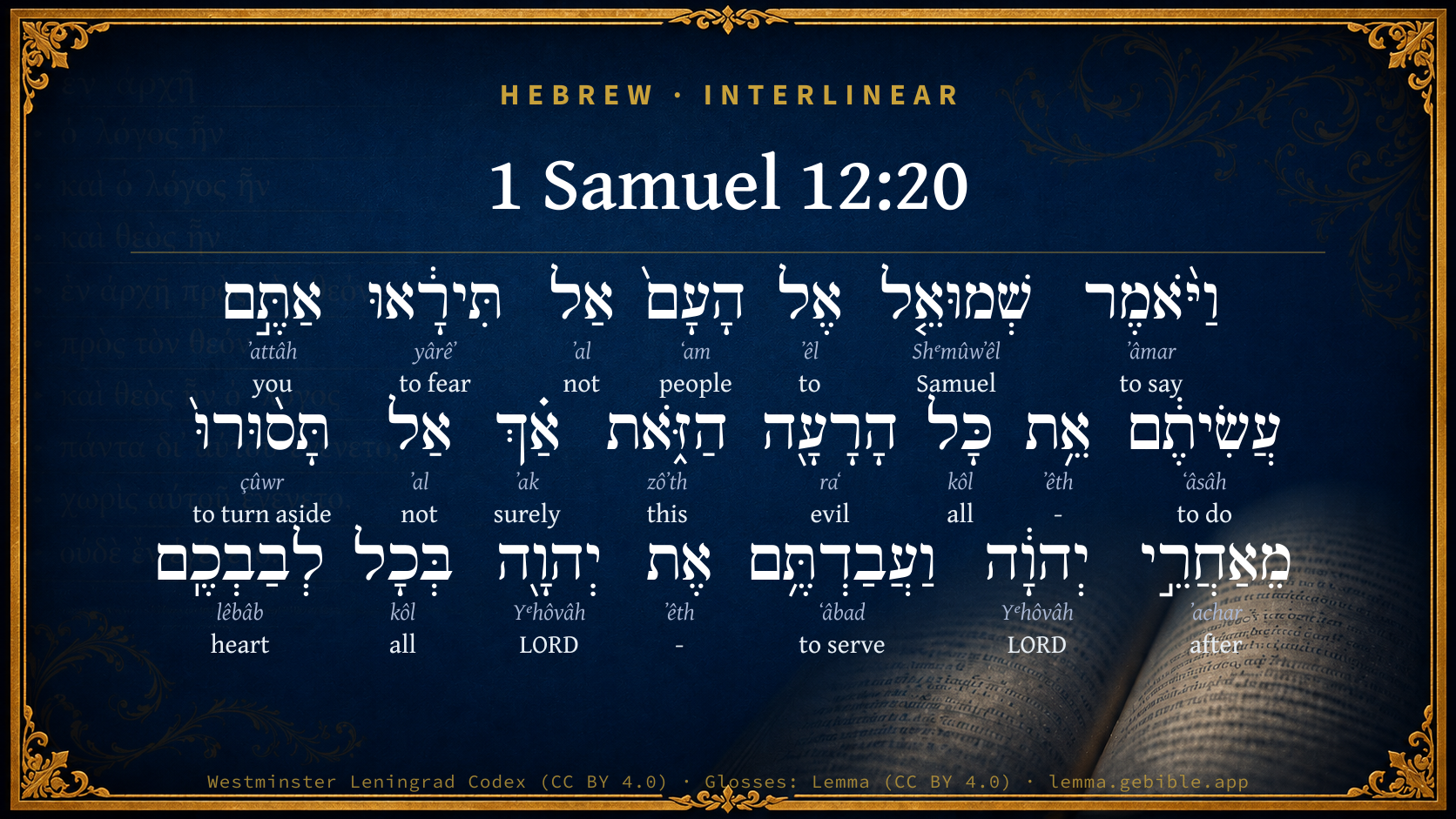
שְׁמוּאֵ֤ל
Shᵉmûwʼêl
H8050
“Samuel”
Noun, Proper
Part of Speech
Noun
Type
Proper
Full BDB Definition

Origin: from the pass part of H8085 and H410

TWOT: None

Samuel = "his name is El" - son of Elkanah by his wife Hannah and judge or prophet of Israel during the days of Saul and David - son Ammihud and the prince of the tribe of Simeon who was chosen to divide the land of Canaan between the tribes. Spelled 'Shemuel' - son of Tola and grandson of Issachar. Spelled 'Shemuel'
  1. וַיֹּ֨אמֶר ʼâmar H559 “and · to say” Conjunction + Verb, Qal, Sequential Imperfect, 3rd Person, Masculine, Singular
  2. אֶל ʼêl H413 “to” Preposition
  3. הָעָם֙ ʻam H5971 “the · people” Particle, Definite Article + Noun, Common, Masculine, Singular, Absolute
  4. אַל ʼal H408 “not” Particle, Negative
  5. תִּירָ֔אוּ yârêʼ H3372 “to fear” Verb, Qal, Jussive, 2nd Person, Masculine, Plural
  6. אַתֶּ֣ם ʼattâh H859 “you” Pronoun, Personal, 2nd Person, Masculine, Plural
  7. עֲשִׂיתֶ֔ם ʻâsâh H6213 “to do” Verb, Qal, Perfect, 2nd Person, Masculine, Plural
  8. אֵ֥ת ʼêth H853 “-” Particle, Direct Object
  9. כָּל kôl H3605 “all of” Noun, Common, Masculine, Singular, Construct
  10. הָרָעָ֖ה raʻ H7451 “the · evil” Particle, Definite Article + Noun, Common, Feminine, Singular, Absolute
  11. הַזֹּ֑את zôʼth H2063 “the · this” Particle, Definite Article + Pronoun, Demonstrative, Feminine, Singular
  12. אַ֗ךְ ʼak H389 “surely” Particle, Accusative
  13. אַל ʼal H408 “not” Particle, Negative
  14. תָּס֨וּרוּ֙ çûwr H5493 “to turn aside” Verb, Qal, Jussive, 2nd Person, Masculine, Plural
  15. מֵאַחֲרֵ֣י ʼachar H310 “from · after” Preposition + Preposition
  16. יְהוָ֔ה Yᵉhôvâh H3068 “LORD” Noun, Proper
  17. וַעֲבַדְתֶּ֥ם ʻâbad H5647 “and · to serve” Conjunction + Verb, Qal, Sequential Perfect, 2nd Person, Masculine, Plural
  18. אֶת ʼêth H853 “-” Particle, Direct Object
  19. יְהוָ֖ה Yᵉhôvâh H3068 “LORD” Noun, Proper
  20. בְּכָל kôl H3605 “in/at · all of” Preposition + Noun, Common, Masculine, Singular, Construct
  21. לְבַבְכֶֽם lêbâb H3824 “heart · your” Noun, Common, Masculine, Singular, Construct + Suffix, Personal, 2nd Person, Masculine, Plural

About this verse

These counts appear in no published source. They are computed here, from the morphology-tagged text and Lemma’s own curated glosses. What Lemma adds →

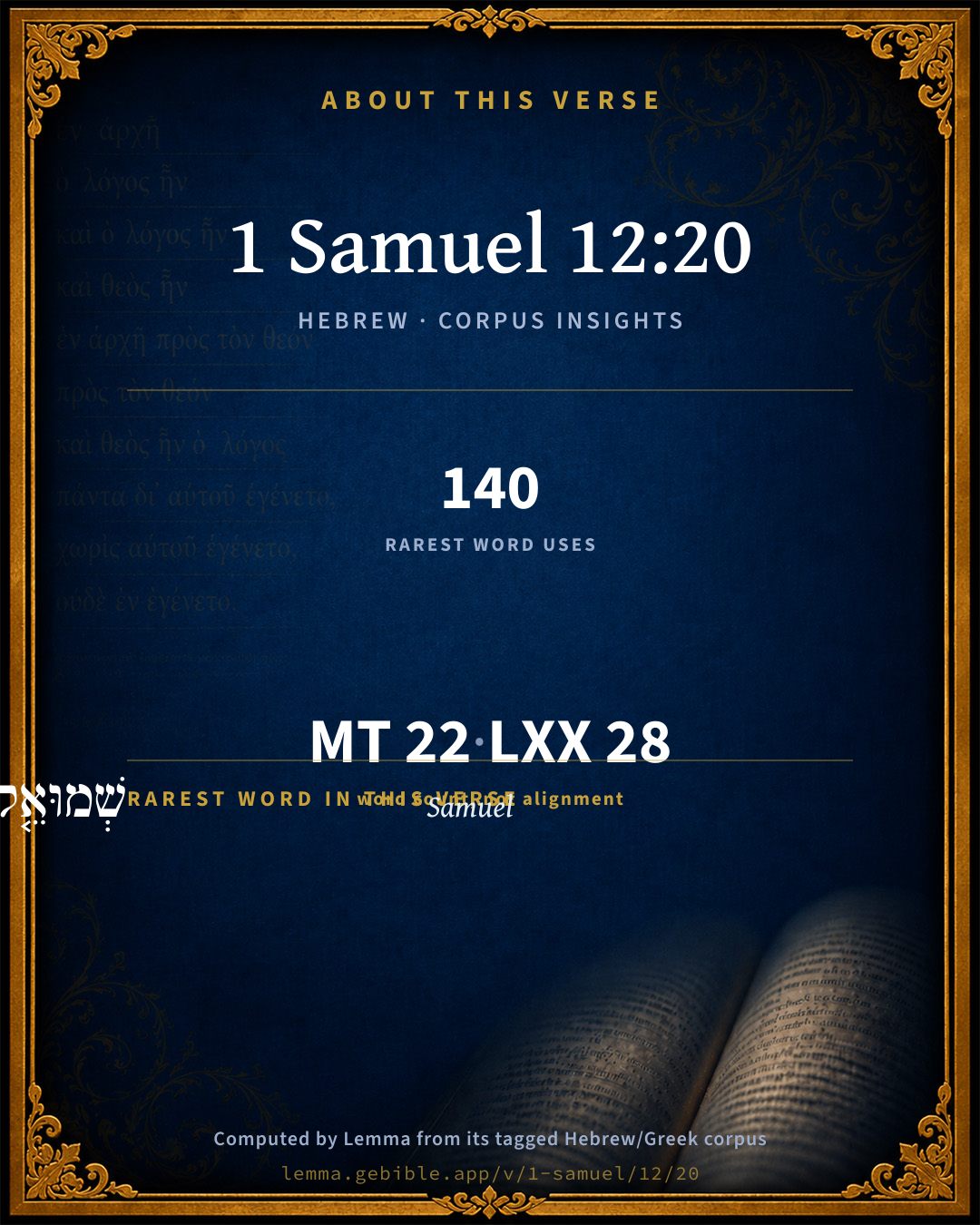
22
words
18
distinct lemmas
Historical
section

Grammatical profile

  • 5 verbs
  • 8 nouns
  • 2 pronouns
  • 2 prepositions
  • 5 particles

Verb forms

  • וַיֹּ֨אמֶר Qal · Sequential Imperfect
  • תִּירָ֔אוּ Qal · Jussive
  • עֲשִׂיתֶ֔ם Qal · Perfect
  • תָּס֨וּרוּ֙ Qal · Jussive
  • וַעֲבַדְתֶּ֥ם Qal · Sequential Perfect

Repetition

Words recur within this verse — often emphatic in Hebrew:

  • כָּל all H3605 ×2
  • יְהוָ֔ה LORD H3068 ×2
  • אַל not H408 ×2

Hebrew & Septuagint length

In English translation the verse runs 29 words from the Hebrew and 30 from the Septuagint (LXX English) — closely comparable.

A rough comparison of the two English renderings, which tokenize alike — not a word-level alignment.

Word counts can differ between the Hebrew and the Greek without any difference in meaning — e.g. the Hebrew direct-object marker אֵת has no separate Greek word, and Greek often adds the article ὁ.

In the original languages it is 22 Hebrew tokens and 28 Greek tokens — but the two are counted differently (Hebrew bundles its prefixes and suffixes into one token; the Greek is in lemma form), so that isn’t a like-for-like length.

Cross-references

9

Topical passages linked to 1 Samuel 12:20 in the Treasury of Scripture Knowledge — connected by theme and wording, ordered by reader-vote popularity; previews shown in the World English Bible.

  • Deuteronomy 11:16 Take heed to yourselves, lest your heart be deceived, and you turn aside, and serve other gods, and worship them;
  • Joshua 23:6 Therefore be you very courageous to keep and to do all that is written in the book of the law of Moses, that you not turn aside from it to the right hand or to the left;
  • Psalms 101:3 I will set no vile thing before my eyes. I hate the deeds of faithless men. They will not cling to me.
  • Psalms 125:5 But as for those who turn aside to their crooked ways, Yahweh will lead them away with the workers of iniquity. Peace be on Israel.
  • Exodus 20:19–20 They said to Moses, "Speak with us yourself, and we will listen; but don't let God speak with us, lest we die."
  • Deuteronomy 31:29 For I know that after my death you will utterly corrupt yourselves, and turn aside from the way which I have commanded you; and evil will happen to you in the latter days; because you will do that which is evil in the sight of Yahweh, to provoke him to anger through the work of your hands.
  • Jeremiah 3:1 They say, If a man put away his wife, and she go from him, and become another man's, will he return to her again? Won't that land be greatly polluted? But you have played the prostitute with many lovers; yet return again to me, says Yahweh.
  • 1 Peter 3:16 having a good conscience; that, while you are spoken against as evildoers, they may be disappointed who curse your good manner of life in Christ.
  • Psalms 40:4 Blessed is the man who makes Yahweh his trust, And doesn't respect the proud, nor such as turn aside to lies.

Cross-references courtesy of OpenBible.info (CC BY 4.0).

Hebrew and Greek witnesses Masoretic Hebrew ↔ Greek Septuagint

The same verse in the two great witnesses to the Old Testament, shown verse-for-verse.

These are two independent witnesses, not word-aligned to each other, and the Septuagint is shown in lemma (dictionary) form.

Hebrew 1 Samuel 12:20 Masoretic · Westminster Leningrad Codex

וַיֹּ֨אמֶר שְׁמוּאֵ֤ל אֶל הָעָם֙ אַל תִּירָ֔אוּ אַתֶּ֣ם עֲשִׂיתֶ֔ם אֵ֥ת כָּל הָרָעָ֖ה הַזֹּ֑את אַ֗ךְ אַל תָּס֨וּרוּ֙ מֵאַחֲרֵ֣י יְהוָ֔ה וַעֲבַדְתֶּ֥ם אֶת יְהוָ֖ה בְּכָל לְבַבְכֶֽם

Samuel said to the people, "Don't be afraid; you have indeed done all this evil; yet don't turn aside from following Yahweh, but serve Yahweh with all your heart:

World English Bible · Public Domain

Greek LXX 1 Samuel 12:20 Septuagint · lemma form

καί εἶπον σαμουηλ πρός ὁ λαός μή φοβέω σύ ποιέω ὁ πᾶς κακία οὗτος πλήν μή ἐκκλίνω ἀπό ὄπισθε κύριος καί δουλεύω ὁ κύριος ἐν ὅλος καρδία σύ

And Samuel said to the people, Fear not: you⌃ have indeed wrought all this iniquity; only turn not from following the Lord, and serve the Lord with all your heart.

LXX2012 (modern English Septuagint) · Public Domain

Hebrew: Westminster Leningrad Codex (CC BY 4.0). Greek: Septuagint (public domain); English from LXX2012 (modern English Septuagint) (Public Domain). How the Septuagint differs from the Hebrew →

Targum (Aramaic paraphrase)

1

The Targum is the ancient Jewish Aramaic paraphrase of the Hebrew Scriptures — an interpretive translation, not the Hebrew text itself. Onkelos (literal) and Pseudo-Jonathan (expansive) render the Torah, and Jonathan the Prophets. Coverage is partial: where no permissively-licensed English translation exists for a verse, only the Aramaic is shown. This is verse-level text, not a word-by-word alignment to the Hebrew.

  1. Targum Jonathan Prophets (Joshua–Malachi)
    וַאֲמַר שְׁמוּאֵל לְעַמָא לָא תִדְחֲלוּן אַתּוּן גְרַמְתּוּן יַת כָּל בִּישְׁתָּא הָדָא בְּרַם לָא תִסְטוּן מִבָּתַר פּוּלְחָנָא דַייָ וְתִפְלְחוּן קֳדָם יְיָ בְּכָל לִבְּכוֹן:

    (no public-domain English translation for this verse)

    Targum Jonathan — Aramaic: “Mikraot Gedolot” (public domain). English: “Sefaria Community Translation” (CC0 1.0 (public-domain dedication)); “London "Chaldee Paraphrase," 1871” (public domain). Text via Sefaria.

Commentary

Notes on 1 Samuel 12:20 from classic Christian and Jewish commentators (each source and its license shown beneath its notes). The classic Christian expositions comment on the surrounding passage and are grouped to its opening verse, so a note may address several verses; the Jewish commentaries on the Tanakh (Rashi and others) are per-verse, so they appear only where the commentator wrote on this verse.

Lemma curates 59 commentaries, every one of them public domain or Creative Commons licensed, each selected and text-cleaned for this edition rather than reprinted as found. About our sources →

Trapp's Complete Commentary

John Trapp

1Sa 12:20 And Samuel said unto the people, Fear not: ye have done all this wickedness: yet turn not aside from following the LORD, but serve the LORD with all your heart;

Ver. 20. Fear not,] i.e., Despair not, cast not away your confidence: they that go down into this pit cannot hope for God’s truth. {Isa 38:18} It is a kind of taking away the Almighty, to limit his boundless mercy; despair is a high point of atheism.

Yet turn not aside.] As the devil, that old manslayer, would have it, tempting you first to presume, and then to despair: "whom resist steadfast in the faith."

John Trapp, A Commentary or Exposition upon All the Books of the Old and New Testament (1647–1656) — public domain. Text from a community e-Sword module.

The Biblical Illustrator

Joseph S. Exell

1Sa_12:20-22

And Samuel said unto the people, Fear not.

Danger or despondency

It is, I believe, no very unusual thing, however unwilling we may be to avow it, for persons to give way to a kind of despair, when they are called on to repent of their sins. They say to themselves, It is too late now: it is no use pretending to keep the commandments, after so many years of transgression. And what is very remarkable, men change all at once into this method of excusing themselves, from one the very contrary to it, in which they have spent all their lives. We know too well, most of us, by experience, how common a thing it is to break Gods plain commandments, and yet to keep ones conscience tolerably quiet, with the hope of repenting one day or another. At last we get ashamed and tired of dreaming of amendment, and promising it vainly to ourselves; we know by experience what the end will be if we again resolve and put off our resolutions: our consciences also have insensibly become hardened, and have lost all horror of sin as it is in itself: and in this state of mind it is no hard matter for the Evil Spirit to pervert our minds in a way exactly opposite to the former. Hitherto we have gone on, quieting ourselves every day with the notion that we might and would repent tomorrow; but now He keeps whispering to our disordered spirits, What if it should be too late for you to repent at all? Against such a snare as this it would seem that Samuel is guarding the children of Israel. They were to beware of that sullen fear which would make it impossible for them to repent; they were not to doubt that, wicked as they had been, and irremediable as their wickedness might be in some respects, still their best and only true wisdom lay in following the Lord for the future with all their heart. The great wickedness which the Israelites had done was this, that having been especially chosen and set apart by Almighty God to be His own people, and having so gone on for many years, receiving from Him peculiar and distinguishing favours, they were dissatisfied with their own condition, and rather wished themselves, as said the Prophet Ezekiel, like the Heathen, the families of the countries, if not directly to serve wood and stone, yet to take liberties of one sort and another, very inconsistent with the pure and holy character of a people redeemed and marked as they were to be Gods own. This was their sin; most dangerous to themselves, and most affronting to the Almighty: so that we need not wonder at the severity of Samuels reproof, nor at the awful warning which God sent them from Heaven. It was a voice from above, most mercifully sent, to warn them what would come of it if they went on in the way which they had begun, and how much worse and more ungodly the temper in which they were acting than they had themselves imagined. Too often have we taken a perverse pleasure in slighting and undervaluing our own privileges. Surely in this way we have most of us too much to answer for, and our Lord might most justly and reasonably cast us off. But He has not done so; therefore, in any case we must not cast ourselves away. We may not, we must not, go in any kind of sin, under pretence of its being too late to cure ourselves of that ill habit at least.

1. To be a little more particular. The cases in which people are most apt to give themselves up are generally such as these following. First, when after having gone on religiously and blamelessly for many years, perhaps through the whole of youth and early manhood, the Devil prevails against any man, and he gives way to temptation, slight or strong, and knowingly commits any kind of deadly sin. The same Evil Spirit, who has so far had his own way with him, will presently try to make him think the case desperate. Thus, at first, through a feeling of despair, and afterwards through a sense of thorough incurable bad habit, men knowingly throw away their only remaining chance of repentance, and with it, of course, their only remaining chance of salvation. One of the sins in which this sad and fatal process may be seen most distinctly is the inordinate love of strong drink. And if it is so in drunkenness, much more in those sins, which in mans sentence as well as Gods bring an irrecoverable stain on those who are guilty of them: such as unchastity, falsehood, dishonesty. One might well imagine that the Prophet Jeremiah was thinking on these two sorts of deadly sin--the unchaste and the deceitful--when he wrote that most fearful of all sentences, Can the Ethiopian change his skin, or the leopard his spots? Then may ye do good who are accustomed to do evil; as much as to say, With men this is impossible, but not with God: for with God all things are possible. On the other hand, it is well for all, even the worst, to be sure there is hope so far, as that no one holy desire or good purpose, no one prayer or sigh of sincere repentance through Faith in Christ Jesus our Lord, can ever fall to the ground useless and vain. Hitherto I have spoken of great and notorious sins; practices which naturally startle the consciences of all men, such as unchastity, drunkenness, dishonesty: and I have shown what danger we are in of becoming hardened in these by a kind of despair, as if, having been long bad, we must of course go on and be worse.

2. A word must now be added on another way of going wrong, somewhat in the same kind, that is, by mere lightness of temper and shallowness of principle: when men, for instance, continue in the custom of profane swearing, or of dissolute wanton talk, or of backbiting and slandering, or of lying in common conversation. These persons are in one thing unlike the sinful Jewish people as described in Samuel; they are far from acknowledging that in their way of going on they are adding a great evil to their former sins: they look upon their ill words, as I just now said, one by one, not as making up a sum of mischief; they do not consider that such sinful habits are, as it were, a smothered, inward fire, gradually consuming the whole body.

3. There is another class who are especially apt to encourage themselves in sinning again by the very remembrance which ought most to daunt and humble them;--the remembrance that they have sinned much and often before:--I mean those who sin mostly in the way of omission; the habitual scorner of the Church and Sacraments of God. They say to themselves and sometimes to others, It, is so very hard to recollect what for so many years we have allowed to slip out of our minds; and they fancy to themselves in some indistinct way that a little act of kindness or of devotion will go further, and tell for more, in their case, than in the case of one to whom such acts are familiar; making the great unpleasantness of the duty, which is an effect of their own sinful neglect, an excuse for their imperfect performance of it. Now the example of the Israelites and the Prophet in the text shows how all these and other like cases are to be treated. They must be spoken to very plainly, as Samuel spoke to those Jews: though full of all kindness towards them, he neither spared them at first, in reproving them plainly for their apostasy. It is true, he said, you have indeed done all this great wickedness; I cannot, I must not flatter you; your case is very bad; you have need to humble yourselves deeply before your God; but this one thing you must do; you must turn your attention earnestly from the Past to the Future; you must live in fear and trembling and watchfulness, that you add no more to your sad and heavy account: Ye have done all this great wickedness, yet turn not aside from following the Lord, but serve the Lord with all your heart. This one sentence of the grave and mild Prophet may convey to us the meaning of the whole Scripture of God. Your past sins, He tells you, are at least as bad as you imagine them: but they are done, and you cannot undo them; very likely you may forever have to bear the mark and stain of them; yet despair not; the worst consequence may yet, by Gods mercy, be averted; only lay hold in earnest of that Cross by which hitherto you have held so slightly: fear always, but not with such slavish, ungodly fear, as shall hinder you from doing your very best; preserve a holy obstinacy in following Christ for the future. (Plain sermons by contributors to the Tracts for the Times. )

The Biblical Illustrator, edited by Joseph S. Exell (c. 1880s–1900s) — public domain. Text from a community e-Sword module.

Geneva Bible (1599)

Geneva Bible translators

He showeth that there is no sin so great, but it shall be forgiven, if the sinner turn again to God.

Geneva Bible (1599) marginal notes — public domain. Text via Bolls.life.

Adam Clarke's Commentary

Verse 20. Ye have done all this wickedness] That is, although ye have done all this wickedness: what was past God would pass by, provided they would be obedient in future.

Adam Clarke's Commentary on the Bible (1810–1826) — public domain. Text from a community e-Sword/MySword module.

Ellicott's Commentary for English Readers

(20) Fear not: ye have done all this wickedness.—A very great and precious evangelical truth is contained in these comforting words of the great and good seer. They show how deeply this eminent servant of the Most High had entered into the Eternal thought. No sin or course of sin was too great to be repented of. Afar off these true ministers of the Lord saw, though, perhaps, “in a glass’ darkly,” the Lamb of God, whose blood cleanseth from all sin. Isaiah often pressed home the same truth to the sinning Israel of his own day in such terms as, “Though your sins be as scarlet, they shall be white as snow;” and Samuel’s words—bidding the people, in spite of the guilty past, yet press on, following the Lord and serving Him with all the heart—were taken up by Samuel’s prophet-successors, and repeated in coming ages again and again in such moving exhortations as, “O Israel, return unto the Lord thy God” (Hos_14:1). They were re-echoed by men like Paul, who, with stirring loving words, bade their hearers, forgetting all the things that were behind, their past guilt and failure, press on still fearlessly for the real prize of life.

A Bible Commentary for English Readers, edited by Charles John Ellicott (1878–1897) — public domain. Text from a community e-Sword module.

John Gill's Exposition

And Samuel said unto the people, fear not,.... Being destroyed by the tempest:

ye have done all this wickedness; in asking a king; that is, though they were guilty of so heinous a sin, yet there were grace and mercy with God, and they should not despair of it, so be it that they did not depart from him, but cordially served him; the Targum is,"ye have been the cause of all this evil;''the storm of thunder and rain; and though they had, he would not have them despond or indulge slavish fear:

yet turn not aside from following the Lord; the worship of the Lord, as the Targum; provided they did not depart from the Lord, and forsake his worship, word, and ordinances, they need not fear utter ruin and destruction, though they had been guilty of this sin:

but serve the Lord with all your heart; if their service of God was kept up, and was hearty and sincere, they might still expect things would go well with them.

John Gill's Exposition of the Whole Bible (1746–1763) — public domain (CC PDM 1.0). Text via the HelloAO Bible API.

Haydock's Catholic Bible Commentary

Following, as that would imply despair. To come boldly before him would argue presumption. Therefore, St. Mary Magdalene keeps at the feet of Jesus Christ. (Worthington)

George Leo Haydock (1774–1849), Haydock's Catholic Family Bible and Commentary, 1859 edition — public domain. Excludes Psalms (Douay-Rheims chapter numbering differs from Protestant) and Deuterocanonical books (Catholic canon only).

Matthew Poole's English Annotations

Fear not, to wit, with a servile and desponding fear, as if there were no hope left for you.

Matthew Poole's English Annotations on the Holy Bible (1683–1685) — public domain. Text from a community e-Sword/MySword module.

Whedon's Commentary on the Bible

Daniel D. Whedon

20. Fear not — Do not yield yourselves to inordinate terror, for even after all your rebellions, if now ye serve him with all your heart, he will be found plenteous in mercy.

Daniel D. Whedon (gen. ed.), Commentary on the Old and New Testaments (1874–1909) — public domain. Text from a community e-Sword module.

The Pulpit Commentary

Ye have done all this wickedness. The ye is emphatic, and to give its force we should translate, "Ye have indeed done all this evil." From following Jehovah. See on ver. 15.

The Pulpit Commentary (1880–1919), ed. H.D.M. Spence-Jones & Joseph S. Exell — public domain. Text from a community e-Sword module.

John Wesley's Explanatory Notes

Fear not - With a desponding fear, as if there were no hope left for you.

John Wesley, Explanatory Notes Upon the Whole Bible (1754–1765) — public domain. Text via the GEBible commentary corpus.

Keil & Delitzsch

C. F. Keil & F. Delitzsch

Samuel thereupon announced to them first of all, that the Lord would not forsake His people for His great name's sake, if they would only serve Him with uprightness. In order, however, to give no encouragement to any false trust in the covenant faithfulness of the Lord, after the comforting words, "Fear not," he told them again very decidedly that they had done wrong, but that now they were not to turn away from the Lord, but to serve Him with all their heart, and not go after vain idols. To strengthen this admonition, he repeats the תּסוּרוּ לא in Sa1 12:21, with the explanation, that in turning from the Lord they would fall away to idols, which could not bring them either help or deliverance. To the כּי after תּסוּרוּ the same verb must be supplied from the context: "Do not turn aside (from the Lord), for (ye turn aside) after that which is vain." התּהוּ, the vain, worthless thing, signifies the false gods. This will explain the construction with a plural: "which do not profit and do not save, because they are emptiness" (tohu), i.e., worthless beings (elilim, Lev 19:4; cf. Isa 44:9 and Jer 16:19).

Keil & Delitzsch — Biblical Commentary on the Old Testament (1861–1891) — public domain (CC PDM 1.0). Text via the HelloAO Bible API. (Old Testament only.)

Lesson kit

Teaching starters — assembled from the data on this page, not authored interpretation. Every prompt links to the verse data it draws on. Edit before teaching.

1 Samuel, in the Historical, opens this verse with 22 words (18 distinct Hebrew lemmas). Its most distinctive word is Shᵉmûwʼêl (“Samuel”). A historical commentator’s framing appears above. Read the whole chapter for the surrounding context.

Discussion questions

  1. How does “Samuel” (Shᵉmûwʼêl) shape what this verse is saying?
  2. How does Deuteronomy 11:16, which shares this passage’s theme, read alongside this verse?
  3. What does the repetition of “all” (2× in this one verse) do in this verse?
  4. The translations on this page render this verse differently — a whole-verse word diff, not a word-by-word alignment. What might account for the different wordings?
  5. «וַיֹּ֨אמֶר» is a Qal Sequential Imperfect verb. How does that grammatical form shape the action described?
  6. Compare how Trapp's Complete Commentary and The Biblical Illustrator read this verse. Where do they agree or differ?

Things to notice

Reading settings

Reading text

Shown beneath each verse's original-language words.

Old Testament
Old Testament edition

Read the OT as the Masoretic Hebrew (MT) or the Greek Septuagint (LXX).

English shown for the Greek Septuagint (in the Hebrew ↔ Greek comparison).

Comparing translations? Open the Compare panel on any verse page to stack up to four side by side.