
Genesis 22:12

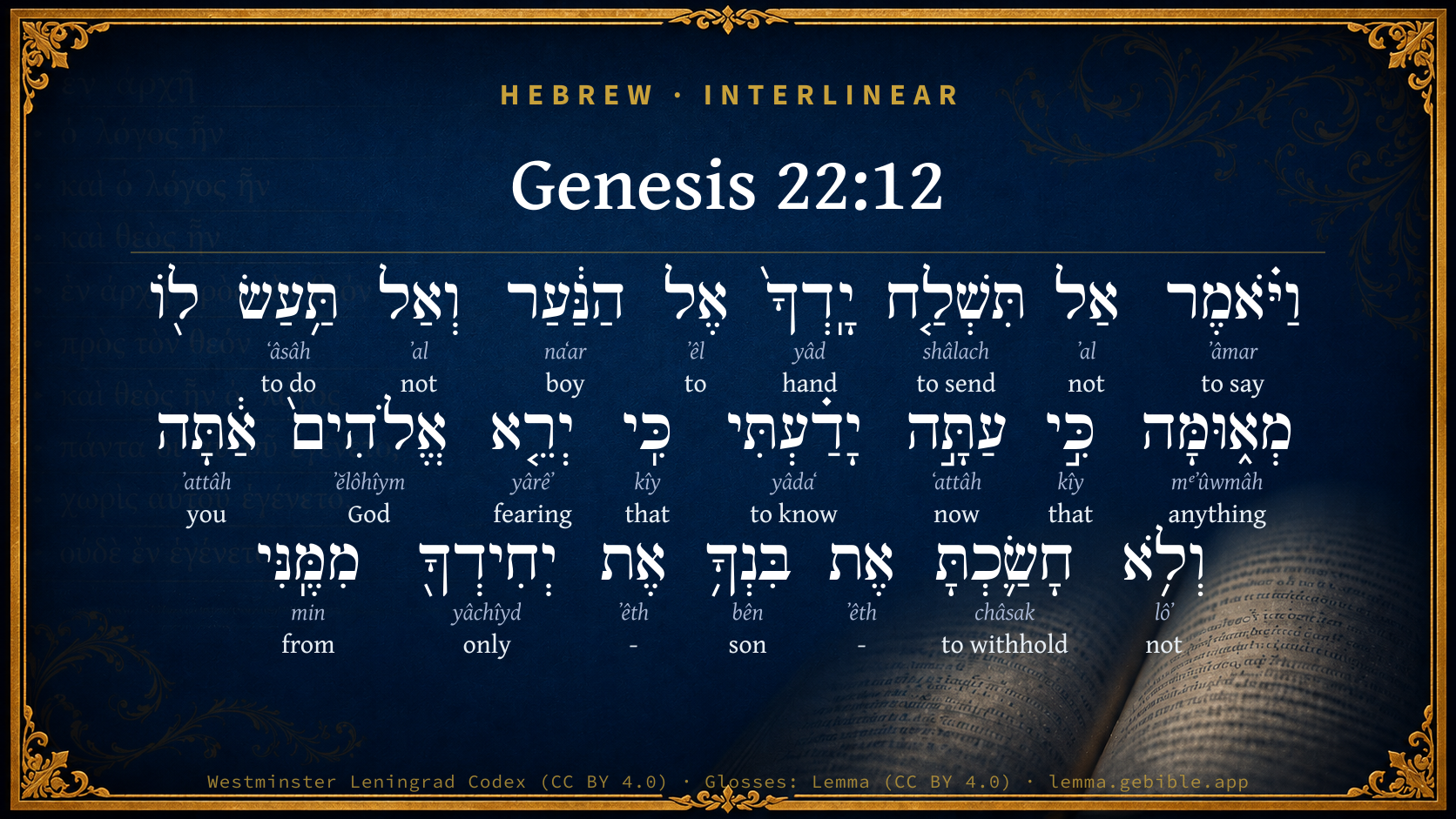
Hebrew (Westminster Leningrad Codex) Genesis 22:12 appears in the Hebrew Old Testament. The text above is from the Westminster Leningrad Codex. Each word links to its Strong’s number, a concise gloss, and parsing drawn from the Open Scriptures Hebrew Bible morphology. Click any word for its full Brown-Driver-Briggs (BDB) entry.
Download image
Cite this verse

Genesis 22:12 (World English Bible). Public Domain. Lemma interlinear Bible study tool, https://lemma.gebible.app/v/genesis/22/12.

Show BibTeX & RIS
BibTeX
RIS
English Translation
He said, "Don't lay your hand on the boy, neither do anything to him. For now I know that you fear God, seeing you have not withheld your son, your only son, from me."
World English Bible · Public Domain
Highlights
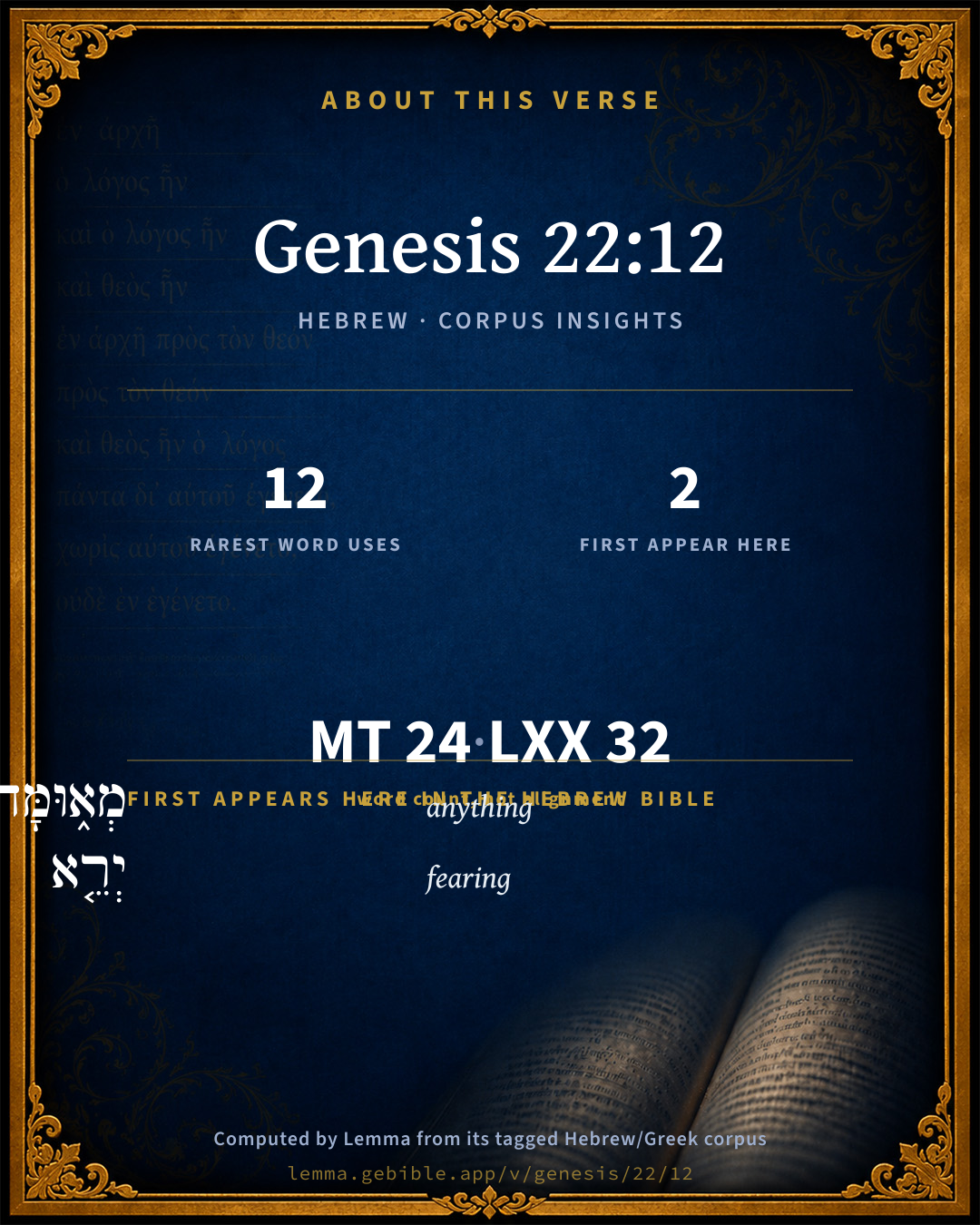
  • 2 first appearances in the Hebrew Bible
Full analysis ↓
Download a study sheet

One document with this verse’s original text, its word-by-word gloss line, the meaning frame, cross-references with their text, attributed commentary, and full source and license credits — printable, and it pastes into notes with its structure intact.

This verse Autodidact and up

Study sheet (.html) Plain text (.txt)

A passage Seminary Student

Up to 50 verses in one chapter. A passage sheet keeps up to 6 commentary sources and 12 cross-references per verse, in the order this page ranks them, and says so on the sheet whenever that leaves anything out. Ask for a single verse and you get the Autodidact verse sheet above.

Everything on this page stays free to read, with no account — the sheet is a download of what is already on screen, not access to it.

Want to remove ads? Support Godless Engineer
Compare translations 3

The same verse in 3 English versions, stacked beneath the original-language interlinear above. Click any original word for its lexicon entry.

Each is an independent rendering of the whole verse — the interlinear is not word-aligned to these translations.

Highlighted words mark where these versions differ — a whole-verse word diff, not a word-by-word alignment.

  • World English Bible Public Domain
    He said, "Don't lay your hand on the boy, neither do anything to him. For now I know that you fear God, seeing you have not withheld your son, your only son, from me."
  • King James Version Public Domain
    And he said, Lay not thine hand upon the lad, neither do thou any thing unto him: for now I know that thou fearest God, seeing thou hast not withheld thy son, thine only son from me.
  • unfoldingWord Literal Text CC BY-SA 4.0
    Then he said, “Do not reach out your hand against the boy! And not do anything to him, because now I know that you fear God, since you have not withheld your son, your only, from me.”

unfoldingWord Literal Text — © unfoldingWord, licensed CC BY-SA 4.0. Word-aligned USFM3 via Door43 (git.door43.org/unfoldingWord/en_ult).

Versions to compare (up to 4)

3 of 4 selected

Show all 18 translations

Every available English version of this verse, each an independent rendering of the whole verse.

  • World English Bible Public Domain
    He said, "Don't lay your hand on the boy, neither do anything to him. For now I know that you fear God, seeing you have not withheld your son, your only son, from me."
  • Berean Standard Bible Public Domain
    “Do not lay a hand on the boy or do anything to him,” said the angel, “for now I know that you fear God, since you have not withheld your only son from me.”
  • Majority Standard Bible Public Domain
    “Do not lay a hand on the boy or do anything to him,” said the angel, “for now I know that you fear God, since you have not withheld your only son from me.”
  • King James Version Public Domain
    And he said, Lay not thine hand upon the lad, neither do thou any thing unto him: for now I know that thou fearest God, seeing thou hast not withheld thy son, thine only son from me.
  • American Standard Version (1901) Public Domain
    And he said, Lay not thy hand upon the lad, neither do thou anything unto him. For now I know that thou fearest God, seeing thou hast not withheld thy son, thine only son, from me.
  • Revised Version (1885) Public Domain
    And he said, Lay not thine hand upon the lad, neither do thou any thing unto him: for now I know that thou fearest God, seeing thou hast not withheld thy son, thine only son, from me.
  • Geneva Bible (1599) Public Domain
    Then he said, Lay not thine hand vpon the childe, neither doe any thing vnto him: for now I know that thou fearest God, seeing for my sake thou hast not spared thine onely sonne.
  • Douay-Rheims (1899) Public Domain
    And he said to him: Lay not thy hand upon the boy, neither do thou any thing to him: now I know that thou fearest God, and hast not spared thy only begotten son for my sake.
  • Young's Literal Translation Public Domain
    and He saith, `Put not forth thine hand unto the youth, nor do anything to him, for now I have known that thou art fearing God, and hast not withheld thy son, thine only one, from Me.'
  • Literal Standard Version CC BY-SA 4.0
    and He says, “Do not put forth your hand to the youth, nor do anything to him, for now I have known that you are fearing God, and have not withheld your son, your only one, from Me.”
  • Unlocked Literal Bible CC BY-SA 4.0
    He said, “Do not lay your hand upon the lad, nor do anything to harm him, for now I know that you fear God, seeing that you have not withheld your son, your only son, from me.”
  • unfoldingWord Literal Text CC BY-SA 4.0
    Then he said, “Do not reach out your hand against the boy! And not do anything to him, because now I know that you fear God, since you have not withheld your son, your only, from me.”
  • Darby Bible Public Domain
    And he said, Stretch not out thy hand against the lad, neither do anything to him; for now I know that thou fearest God, and hast not withheld thy son, thine only [son], from me.
  • World Messianic Bible Public Domain
    He said, “Don’t lay your hand on the boy or do anything to him. For now I know that you fear God, since you have not withheld your son, your only son, from me.”
  • Webster's Bible Public Domain
    And he said, Lay not thy hand upon the lad, neither do thou any thing to him: for now I know that thou fearest God, seeing thou hast not withheld from me thy son, thy only son.
  • Free Bible Version CC BY-SA 4.0
    The angel said, “Don't touch the boy! Don't do anything to him, because now I know that you truly do what God tells you. You didn't refuse to give me your son, your only son.”
  • Bible in Basic English Public Domain
    And he said, Let not your hand be stretched out against the boy to do anything to him; for now I am certain that the fear of God is in your heart, because you have not kept back your son, your only son, from me.
  • JPS Tanakh (1917) Public Domain
    And he said: 'Lay not thy hand upon the lad, neither do thou any thing unto him; for now I know that thou art a God-fearing man, seeing thou hast not withheld thy son, thine only son, from Me.'

Literal Standard Version (2020), Covenant Press — licensed CC BY-SA 4.0. Text via the HelloAO Bible API (eBible.org). Unlocked Literal Bible (unfoldingWord) — licensed CC BY-SA 4.0. Text via the HelloAO Bible API (eBible.org). unfoldingWord Literal Text — © unfoldingWord, licensed CC BY-SA 4.0. Word-aligned USFM3 via Door43 (git.door43.org/unfoldingWord/en_ult). Free Bible Version, Dr. Jonathan Gallagher — licensed CC BY-SA 4.0. Text via the HelloAO Bible API (eBible.org).

Word by word

More ways to search: Search by grammar → Find every occurrence → Compare this word →

Practice this passage: Drill this verse → Learn its vocabulary →

יְחִידְךָ֖
yâchîyd
H3173
“only · your”
Adjective, Adjective, Masculine, Singular, Construct + Suffix, Personal, 2nd Person, Masculine, Singular
Part of Speech
Adjective
Type
Adjective
Gender
Masculine
Number
Singular
State
Construct
Full BDB Definition

Origin: from H3161

TWOT: 858a

only, only one, solitary, one (adjective) - only, unique, one - solitary - (TWOT) only begotten son - one (substantive)
  1. וַיֹּ֗אמֶר ʼâmar H559 “and · to say” Conjunction + Verb, Qal, Sequential Imperfect, 3rd Person, Masculine, Singular
  2. אַל ʼal H408 “not” Particle, Negative
  3. תִּשְׁלַ֤ח shâlach H7971 “to send” Verb, Qal, Jussive, 2nd Person, Masculine, Singular
  4. יָֽדְךָ֙ yâd H3027 “hand · your” Noun, Common, Both, Singular, Construct + Suffix, Personal, 2nd Person, Masculine, Singular
  5. אֶל ʼêl H413 “to” Preposition
  6. הַנַּ֔עַר naʻar H5288 “the · boy” Particle, Definite Article + Noun, Common, Masculine, Singular, Absolute
  7. וְאַל ʼal H408 “and · not” Conjunction + Particle, Negative
  8. תַּ֥עַשׂ ʻâsâh H6213 “to do” Verb, Qal, Jussive, 2nd Person, Masculine, Singular
  9. מְא֑וּמָּה mᵉʼûwmâh H3972 “anything” Noun, Common, Feminine, Singular, Absolute
  10. כִּ֣י kîy H3588 “that” Conjunction
  11. עַתָּ֣ה ʻattâh H6258 “now” Adverb
  12. יָדַ֗עְתִּי yâdaʻ H3045 “to know” Verb, Qal, Perfect, 1st Person, Common, Singular
  13. כִּֽי kîy H3588 “that” Conjunction
  14. יְרֵ֤א yârêʼ H3373 “fearing of” Adjective, Adjective, Masculine, Singular, Construct
  15. אֱלֹהִים֙ ʼĕlôhîym H430 “God(s)” Noun, Common, Masculine, Plural, Absolute
  16. אַ֔תָּה ʼattâh H859 “you” Pronoun, Personal, 2nd Person, Masculine, Singular
  17. וְלֹ֥א lôʼ H3808 “and · not” Conjunction + Particle, Negative
  18. חָשַׂ֛כְתָּ châsak H2820 “to withhold” Verb, Qal, Perfect, 2nd Person, Masculine, Singular
  19. אֶת ʼêth H853 “-” Particle, Direct Object
  20. בִּנְךָ֥ bên H1121 “son · your” Noun, Common, Masculine, Singular, Construct + Suffix, Personal, 2nd Person, Masculine, Singular
  21. אֶת ʼêth H853 “-” Particle, Direct Object
  22. מִמֶּֽנִּי min H4480 “from · me” Preposition + Suffix, Personal, 1st Person, Common, Singular

About this verse

These counts appear in no published source. They are computed here, from the morphology-tagged text and Lemma’s own curated glosses. What Lemma adds →

24
words
20
distinct lemmas
Pentateuch
section

Notable vocabulary

The rarest word here is יְחִידְךָ֖ only H3173 — appearing just 12 times in the whole Hebrew Bible.

First appearance in Scripture

These words make their first canonical appearance in the Hebrew Bible here:

  • מְא֑וּמָּה anything H3972
  • יְרֵ֤א fearing H3373

Shared distinctive vocabulary

יְחִידְךָ֖ only H3173 occurs in 12 verses of the Hebrew Bible. Also found in:

Grammatical profile

  • 5 verbs
  • 5 nouns
  • 2 adjectives
  • 1 pronoun
  • 3 prepositions
  • 2 conjunctions
  • 1 adverb
  • 5 particles

Verb forms

  • וַיֹּ֗אמֶר Qal · Sequential Imperfect
  • תִּשְׁלַ֤ח Qal · Jussive
  • תַּ֥עַשׂ Qal · Jussive
  • יָדַ֗עְתִּי Qal · Perfect
  • חָשַׂ֛כְתָּ Qal · Perfect

Repetition

Words recur within this verse — often emphatic in Hebrew:

  • אַל not H408 ×2
  • כִּ֣י that H3588 ×2

Hebrew & Septuagint length

In English translation the verse runs 34 words from the Hebrew and 34 from the Septuagint (LXX English) — the same length.

A rough comparison of the two English renderings, which tokenize alike — not a word-level alignment.

Word counts can differ between the Hebrew and the Greek without any difference in meaning — e.g. the Hebrew direct-object marker אֵת has no separate Greek word, and Greek often adds the article ὁ.

In the original languages it is 24 Hebrew tokens and 32 Greek tokens — but the two are counted differently (Hebrew bundles its prefixes and suffixes into one token; the Greek is in lemma form), so that isn’t a like-for-like length.

Cross-references

37

Topical passages linked to Genesis 22:12 in the Treasury of Scripture Knowledge — connected by theme and wording, ordered by reader-vote popularity; previews shown in the World English Bible.

  • James 2:21–22 Wasn't Abraham our father justified by works, in that he offered up Isaac his son on the altar?
  • James 2:18 Yes, a man will say, "You have faith, and I have works." Show me your faith from your works, and I by my works will show you my faith.
  • 1 Samuel 15:22 Samuel said, Has Yahweh as great delight in burnt offerings and sacrifices, as in obeying the voice of Yahweh? Behold, to obey is better than sacrifice, and to listen than the fat of rams.
  • Matthew 10:37–38 He who loves father or mother more than me is not worthy of me; and he who loves son or daughter more than me isn't worthy of me.
  • Romans 8:32 He who didn't spare his own Son, but delivered him up for us all, how would he not also with him freely give us all things?
  • Genesis 22:2 He said, "Now take your son, your only son, whom you love, even Isaac, and go into the land of Moriah. Offer him there for a burnt offering on one of the mountains which I will tell you of."
  • Matthew 19:29 Everyone who has left houses, or brothers, or sisters, or father, or mother, or wife, or children, or lands, for my name's sake, will receive one hundred times, and will inherit eternal life.
  • 1 Corinthians 10:13 No temptation has taken you except what is common to man. God is faithful, who will not allow you to be tempted above what you are able, but will with the temptation also make the way of escape, that you may be able to endure it.
  • Genesis 26:5 because Abraham obeyed my voice, and kept my charge, my commandments, my statutes, and my laws."
  • Ecclesiastes 12:13 This is the end of the matter. All has been heard. Fear God, and keep his commandments; for this is the whole duty of man.
  • Psalms 147:11 Yahweh takes pleasure in those who fear him, In those who hope in his loving kindness.
  • John 3:16 For God so loved the world, that he gave his one and only Son, that whoever believes in him should not perish, but have eternal life.
  • Psalms 25:12 What man is he who fears Yahweh? He shall instruct him in the way that he shall choose.
  • Acts 9:31 So the assemblies throughout all Judea and Galilee and Samaria had peace, and were built up. They were multiplied, walking in the fear of the Lord and in the comfort of the Holy Spirit.
  • Romans 5:8 But God commends his own love toward us, in that while we were yet sinners, Christ died for us.
  • Exodus 20:20 Moses said to the people, "Don't be afraid, for God has come to test you, and that his fear may be before you, that you won't sin."
  • Psalms 25:14 The friendship of Yahweh is with those who fear him. He will show them his covenant.
  • Proverbs 1:7 The fear of Yahweh is the beginning of knowledge; But the foolish despise wisdom and instruction.
  • 2 Corinthians 8:12 For if the readiness is there, it is acceptable according to what you have, not according to what you don't have.
  • Genesis 20:11 Abraham said, "Because I thought, 'Surely the fear of God is not in this place. They will kill me for my wife's sake.'
  • Nehemiah 5:15 But the former governors who were before me were chargeable to the people, and took of them bread and wine, besides forty shekels of silver; yes, even their servants bore rule over the people: but I didn't do so, because of the fear of God.
  • Job 28:28 To man he said, 'Behold, the fear of the Lord, that is wisdom. To depart from evil is understanding.'"
  • Jeremiah 19:5 and have built the high places of Baal, to burn their sons in the fire for burnt offerings to Baal; which I didn't command, nor spoke it, neither came it into my mind:
  • Micah 6:6–8 How shall I come before Yahweh, And bow myself before the exalted God? Shall I come before him with burnt offerings, With calves a year old?
  • Matthew 16:24 Then Jesus said to his disciples, "If anyone desires to come after me, let him deny himself, and take up his cross, and follow me.
  • 1 John 4:9–10 By this was God's love revealed in us, that God has sent his one and only Son into the world that we might live through him.
  • 1 Samuel 12:24–25 Only fear Yahweh, and serve him in truth with all your heart; for consider how great things he has done for you.
  • Job 5:19 He will deliver you in six troubles; Yes, in seven there shall no evil touch you.
  • Psalms 1:6 For Yahweh knows the way of the righteous, But the way of the wicked shall perish.
  • Psalms 2:11 Serve Yahweh with fear, And rejoice with trembling.
  • Psalms 111:10–112:1 The fear of Yahweh is the beginning of wisdom. All those who do his work have a good understanding. His praise endures forever!
  • Jeremiah 32:40 and I will make an everlasting covenant with them, that I will not turn away from following them, to do them good; and I will put my fear in their hearts, that they may not depart from me.
  • Malachi 4:2 But to you who fear my name shall the sun of righteousness arise with healing in its wings. You will go out, and leap like calves of the stall.
  • Matthew 5:16 Even so, let your light shine before men; that they may see your good works, and glorify your Father who is in heaven.
  • Hebrews 12:28 Therefore, receiving a Kingdom that can't be shaken, let us have grace, through which we serve God acceptably, with reverence and awe,
  • Genesis 42:18 Joseph said to them the third day, "Do this, and live, for I fear God.
  • Hebrews 11:19 accounting that God is able to raise up even from the dead. Figuratively speaking, he also did receive him back from the dead.

Cross-references courtesy of OpenBible.info (CC BY 4.0).

Hebrew and Greek witnesses Masoretic Hebrew ↔ Greek Septuagint

The same verse in the two great witnesses to the Old Testament, shown verse-for-verse.

These are two independent witnesses, not word-aligned to each other, and the Septuagint is shown in lemma (dictionary) form.

Hebrew Genesis 22:12 Masoretic · Westminster Leningrad Codex

וַיֹּ֗אמֶר אַל תִּשְׁלַ֤ח יָֽדְךָ֙ אֶל הַנַּ֔עַר וְאַל תַּ֥עַשׂ ל֖וֹ מְא֑וּמָּה כִּ֣י עַתָּ֣ה יָדַ֗עְתִּי כִּֽי יְרֵ֤א אֱלֹהִים֙ אַ֔תָּה וְלֹ֥א חָשַׂ֛כְתָּ אֶת בִּנְךָ֥ אֶת יְחִידְךָ֖ מִמֶּֽנִּי

He said, "Don't lay your hand on the boy, neither do anything to him. For now I know that you fear God, seeing you have not withheld your son, your only son, from me."

World English Bible · Public Domain

Greek LXX Genesis 22:12 Septuagint · lemma form

καί εἶπον μή ἐπιβάλλω ὁ χείρ σύ ἐπί ὁ παιδάριον μηδέ ποιέω αὐτός μηδείς νῦν γάρ γιγνώσκω ὅτι φοβέω ὁ θεός σύ καί οὐ φείδομαι ὁ υἱός σύ ὁ ἀγαπητός διά ἐγώ

And he said, Lay not your hand upon the child, neither do anything to him, for now I know that you fear God, and for my sake you have not spared your beloved son.

LXX2012 (modern English Septuagint) · Public Domain

On this verse, The Pulpit Commentary discusses the Septuagint’s reading. Read the note in Commentary ↓

Hebrew: Westminster Leningrad Codex (CC BY 4.0). Greek: Septuagint (public domain); English from LXX2012 (modern English Septuagint) (Public Domain). How the Septuagint differs from the Hebrew →

Targum (Aramaic paraphrase)

2

The Targum is the ancient Jewish Aramaic paraphrase of the Hebrew Scriptures — an interpretive translation, not the Hebrew text itself. Onkelos (literal) and Pseudo-Jonathan (expansive) render the Torah, and Jonathan the Prophets. Coverage is partial: where no permissively-licensed English translation exists for a verse, only the Aramaic is shown. This is verse-level text, not a word-by-word alignment to the Hebrew.

  1. Targum Onkelos Torah (Genesis–Deuteronomy)
    וַאֲמַר לָא תוֹשִׁיט יְדָךְ לְעוּלֵימָא וְלָא תַעְבֵּד לֵהּ מִדָּעָם אֲרֵי כְּעַן יְדַעְנָא (נ''י יְדָעִית) אֲרֵי דַּחֲלָא דַּיְיָ אַתְּ וְלָא מְנַעְתָּ יָת בְּרָךְ יָת יְחִידָךְ מִנִּי

    (no public-domain English translation for this verse)

    Targum Onkelos — Aramaic: “Onkelos Genesis” (public domain); “Onkelos Exodus” (public domain); “Onkelos Leviticus” (public domain); “Onkelos Numbers” (public domain); “Onkelos Deuteronomy” (public domain). English: “Sefaria Community Translation” (CC0 1.0 (public-domain dedication)); “J.W. Etheridge. The Targums of Onkelos and Jonathan Ben Uzziel on the Pentateuch. London: Longmans, Green, 1862” (public domain). Text via Sefaria.

  2. Targum Pseudo-Jonathan Torah (Genesis–Deuteronomy)
    וַאֲמַר אַל תּוֹשִׁיט יְדָךְ לְטַלְיָא וְלָא תַעֲבֵּיד לֵיהּ מִדַעַם בִּישׁ אֲרוּם כְּדוֹן גְלֵי קֳדָמַי אֲרוּם דַחֲלָא דַיְיָ אַנְתְּ וְלָא עֲכִּבְתָּא יַת בְּרָךְ יַת יְחִידָךְ מֶנִי

    And He said, Stretch not out thy hand upon the young man, neither do him any evil; for now it is manifest before Me that thou fearest the Lord; neither hast thou withheld thy son the only begotten from Me.

    Targum Pseudo-Jonathan — Aramaic: “Targum Jonathan on Genesis” (public domain); “Targum Jonathan on Exodus” (public domain); “Targum Jonathan on Leviticus” (public domain); “Targum Jonathan on Numbers” (public domain); “Targum Jonathan on Deuteronomy” (public domain). English: “The Targum of Jonathan ben Uzziel, trans. J. W. Etheridge, London, 1862” (public domain). Text via Sefaria.

Commentary

Notes on Genesis 22:12 from classic Christian and Jewish commentators (each source and its license shown beneath its notes). The classic Christian expositions comment on the surrounding passage and are grouped to its opening verse, so a note may address several verses; the Jewish commentaries on the Tanakh (Rashi and others) are per-verse, so they appear only where the commentator wrote on this verse.

Lemma curates 59 commentaries, every one of them public domain or Creative Commons licensed, each selected and text-cleaned for this edition rather than reprinted as found. About our sources →

Trapp's Complete Commentary

John Trapp

Gen 22:12 And he said, Lay not thine hand upon the lad, neither do thou any thing unto him: for now I know that thou fearest God, seeing thou hast not withheld thy son, thine only [son] from me.

Ver. 12. Lay not thine hand upon the lad.] As he was about to do, having armed his pious hand, not only with the knife, but with faith that works by love; as had likewise David, when going against the giant, he flies upon him, perinde ac si fundae suae tunicis non lapillum, sed Deum ipsum induisset ac implicuisset. {a}

Now I know that thou fearest me.] With a fear of love (Hoses iii. 5). And here that of Fulgentius is true, and taketh place. Deum sique parum metuit, valde contemnit; huius qui non memorat beneficentiam, auget iniuriam . God knew Abraham’s fear before, but now he made experience of it. Nunc expertus sum , saith Junius. Nunc omnibus declarasti , saith Chrysostom.

{a} Bucholcer.

John Trapp, A Commentary or Exposition upon All the Books of the Old and New Testament (1647–1656) — public domain. Text from a community e-Sword module.

Joseph Benson's Commentary

Gen 22:12. Lay not thy hand upon the lad — God’s time to help his people is, when they are brought to the greatest extremity: the more imminent the danger is, and the “nearer to be put in execution,” the more wonderful and the more welcome is the deliverance. Now I know that thou fearest God — God knew it before, but now Abraham had given a memorable evidence of it. He need do no more; what he had done was sufficient to prove the religious regard he had to God and his authority. The best evidence of our fearing God is our being willing to honour him with that which is dearest to us, and to part with all to him, or for him.

Joseph Benson's Commentary on the Old and New Testaments (1811–1818) — public domain. Text from a community e-Sword module.

Tyndale Open Study Notes

Tyndale Open Resources

22:12 Now God knew that Abraham would hold nothing back from him, that he did truly fear God. To fear the Lord means to reverence him as sovereign, trust him implicitly, and obey him without protest. The sacrifice that pleases God is a heart broken of self-will, surrendered to God (Pss 40:6-8; 51:17) and offering its best to God. • You have not withheld: Cp. Rom 8:32, which uses the same verb (“spare”) as the Greek Old Testament uses here. If God gave us his dearest possession, he will surely provide all things for us.

Tyndale Open Study Notes — © Tyndale Open Resources, licensed CC BY-SA 4.0. Text via the HelloAO Bible API.

Geneva Bible (1599)

Geneva Bible translators

That is, by thy true obedience thou hast declared thy lively faith.

Or, and hast not withheld thine only son from me.

Hebrew, thy son, thy only son.

Geneva Bible (1599) marginal notes — public domain. Text via Bolls.life.

Adam Clarke's Commentary

Verse 12. Lay not thine hand upon the lad] As Isaac was to be the representative of Jesus Christ's real sacrifice, it was sufficient for this purpose that in his own will, and the will of his father, the purpose of the immolation was complete. Isaac was now fully offered both by his father and by himself. The father yields up the son, the son gives up his life; on both sides, as far as will and purpose could go, the sacrifice was complete. God simply spares the father the torture of putting the knife to his son's throat. Now was the time when it might properly be said, "Sacrifice, and offering, and burnt-offering, and sacrifice for sin thou wouldest not, neither hadst pleasure in them: then said the Angel of the Covenant, Lo! I come to do thy will, O God." Lay not thy hand upon the lad; an irrational creature will serve for the purpose of a representative sacrifice, from this till the fulness of time. But without this most expressive representation of the father offering his beloved, only-begotten son, what reference can such sacrifices be considered to have to the great event of the incarnation and crucifixion of Christ? Abraham, the most dignified, the most immaculate of all the patriarchs; Isaac, the true pattern of piety to God and filial obedience, may well represent God the Father so loving the world as to give his only-begotten Son, JESUS CHRIST, to die for the sin of man. But the grand circumstances necessary to prefigure these important points could not be exhibited through the means of any or of the whole brute creation. The whole sacrificial system of the Mosaic economy had a retrospective and prospective view, referring FROM the sacrifice of Isaac TO the sacrifice of Christ; in the first the dawning of the Sun of righteousness was seen; in the latter, his meridian splendour and glory. Taken in this light (and this is the only light in which it should be viewed) Abraham offering his son Isaac is one of the most important facts and most instructive histories in the whole Old Testament. See farther on this subject, Ge 23:2.

Adam Clarke's Commentary on the Bible (1810–1826) — public domain. Text from a community e-Sword/MySword module.

John Calvin's Commentaries

12. Now I know that thou fearest God. The exposition of Augustine, ‘I have caused thee to know,’ is forced. But how can any thing become known to God, to whom all things have always been present? Truly, by condescending to the manner of men, God here says that what he has proved by experiment, is now made known to himself. And he speaks thus with us, not according to his own infinite wisdom, but according to our infirmity. Moses, however, simply means that Abraham, by this very act, testified how reverently he feared God. It is however asked, whether he had not already, on former occasions, given many proofs of his piety? I answer that when God had willed him to proceed thus far, he had, at length, completed his true trial; in other persons a much lighter trial might have been sufficient. And as Abraham showed that he feared God, by not sparing his own, and only begotten son; so a common testimony of the same fear is required from all the pious, in acts of self-denial. Now since God enjoins upon us a continual warfare, we must take care that none desires his release before the time.

John Calvin's Commentaries (1540-1563) — public domain. Text from the Calvin Translation Society English edition (1840s-50s) via the Christian Classics Ethereal Library (ccel.org). Calvin's coverage is partial (roughly two-thirds of the Bible); uncommented books and verses are honest gaps, never fabricated. The 19th-century editor's footnotes and remarks are omitted so the notes are faithfully Calvin's own voice.

The Cambridge Bible for Schools and Colleges

gen. ed. J. J. S. Perowne

12. for now I know] Abraham has stood the test. Actual experience has justified Divine foreknowledge. The Angel of the Lord is here identified with the Almighty. By the words “lay not thine hand, &c.,” Jehovah proclaims to Abraham and to his descendants His abhorrence of the cruelty of child sacrifice.

hast not withheld] The recollection of these words possibly underlies the phrase of St Paul in Rom_8:32, “He that spared not his own Son, but delivered him up for us all.”

The Cambridge Bible for Schools and Colleges (gen. ed. J. J. S. Perowne; Cambridge University Press, 1878–1918) — public domain. Text from a community e-Sword module.

John Gill's Exposition

And he said, lay not thine hand upon the lad,.... Which he was just going to stretch out, with his knife in it, to slay him; and though the Lord had bid him take his son, and offer him for a burnt offering, to try his faith, fear, love, and obedience, yet he meant not that he should actually slay him, but would prevent it when it came to the crisis; for he approves not of, nor delights in human sacrifices; and that this might not be dawn into an example, it was prevented; though the Gentiles, under the influence of Satan, in imitation of this, have practised it:

neither do thou anything unto him; by lacerating his flesh, letting out any of his blood, or wounding him ever so slightly in any part:

for now I know that thou fearest God; with a truly childlike filial fear; with such a reverence of him that has fervent love, and strong affection, joined with it; with a fear that includes the whole of internal religious worship, awe of the divine Being, submission to his will, faith in him, and love to him, and obedience springing from thence. And this is said, not as though he was ignorant before how things would issue; for he knew from all eternity what Abraham would be, and what he would do, having determined to bestow that grace upon him, and work it in him, which would influence and enable him to act the part he did; he knew full well beforehand what would be the consequence of such a trial of him; but this is said after the manner of men, who know things with certainty when they come to pass, and appear plain and evident: or this may be understood of a knowledge of approbation, that the Lord now knew, and approved of the faith, fear, love, and obedience of Abraham, which were so conspicuous in this affair, see Psa 1:6; Saadiah Gaon (i) interprets it, "I have made known", that is, to others; God by trying Abraham made it manifest to others, to all the world, to all that should hear of or read this account of things, that he was a man that feared God, loved him, believed in him, and obeyed him, of which this instance is a full and convincing proof:

seeing thou hast not withheld thy son, thine only son from me: but as soon as he had the order to offer him up, prepared for it, took a three days' journey, and all things along with him for the sacrifice; when he came to the place, built an altar, laid the wood in order, bound his son, and laid him on it, took the knife, and was going to put it to his throat; so that the Lord looked upon the thing as if it was really done: it was a plain case that he did not, and would not have withheld his son, but would have freely offered him a sacrifice unto God at his command; and that he loved the Lord more than he did his son, and had a greater regard to the command of God than to the life of his son, and preferred the one to the other. And thus God spared not his own Son, but delivered him up for us all, Rom 8:32.

(i) Apud Aben Ezram, in ver. 1.

John Gill's Exposition of the Whole Bible (1746–1763) — public domain (CC PDM 1.0). Text via the HelloAO Bible API.

Haydock's Catholic Bible Commentary

Hast not spared. Thus the intentions of the heart become worthy of praise, or of blame, even when no exterior effect is perceived. (Haydock)

George Leo Haydock (1774–1849), Haydock's Catholic Family Bible and Commentary, 1859 edition — public domain. Excludes Psalms (Douay-Rheims chapter numbering differs from Protestant) and Deuterocanonical books (Catholic canon only).

Matthew Poole's English Annotations

God knew the sincerity and resolvedness of Abraham’s faith and obedience before and without this evidence, and from eternity foresaw this fact and all its circumstances; and therefore you must not think that God had now made any new discovery: but this is spoken here, as in many other places, of God after the manner of men, who is then said to know a thing, when it is notorious and evident to a man’s self and others by some remarkable effect. Thus David prayed that God would search and know his heart, and his thoughts, Psa 139:23, though he had before professed that God understood his thought afar off, Gen 22:2. This therefore is the sense:

Now I know, i.e. Now I have what I designed and desired; now I have made thee and others to know. As the Spirit of God and of Christ is said to cry Abba, Father, Gal 4:6, when it makes us to cry so, Rom 8:15.

Thou hast not withheld thy son from me, for my service and sacrifice; or for me, i.e. for my sake; i.e. thou hast preferred mine authority and honour before the life of thy dear son. By which words it appears that God himself speaks these words.

Matthew Poole's English Annotations on the Holy Bible (1683–1685) — public domain. Text from a community e-Sword/MySword module.

Whedon's Commentary on the Bible

Daniel D. Whedon

12. Lay not thine hand upon the lad — That is, for the purpose of slaying him. “God did not seek the slaying of Isaac in fact, but only the implicit surrender of the lad, in mind and heart. But if all mental reservation, every refuge of flesh and blood, all mere appearance and self-delusion were to be avoided, this surrender could only be accomplished in the shape in which it was actually required. If it was to be wholly an act of faith left to its own energies, without any other point of support, God could not merely ask a mental surrender, but must have demanded an actual sacrifice. On the part of any other than God such a quid pro quo would have been a dangerous game. Not so on the part of God, who held the issue entirely in his own hand. When Abraham had, in heart and mind, completely and without any reserve, offered up his son, God interposed and prevented the sacrifice in facto, which was no longer required for the purpose of trial” — Kurtz.

Now I know — The Covenant Angel speaks here after the manner of man, as when, in Gen_18:21, he said: “I will go down now and see,” etc. The word, says Murphy, “denotes an eventual knowing, a discovering by actual experiment; and this observable probation of Abraham was necessary for the judicial eye of God, who is to govern the world, and for the conscience of man, who is to be instructed by practice as well as principle.”

Thou hast not withheld thy son — This passage seems to have suggested to Paul the language of Rom_8:32 : “He that spared not his own son, but delivered him up for us all.” But it is misleading to speak unqualifiedly of Isaac as a type of Christ. Isaac did not lay down his life at all, nor do we know that he was a willing victim. Not Isaac, but Abraham, is the great figure in this scene. See below, on the typical lessons of this chapter.

Daniel D. Whedon (gen. ed.), Commentary on the Old and New Testaments (1874–1909) — public domain. Text from a community e-Sword module.

The Pulpit Commentary

And he said, Lay not thine hand upon the lad, neither do thou any thing unto him. Abraham"s surrender of the son of his affections having been complete, there was no need to push the trial further. The voice from heaven has been accepted as evidence of God"s rejection of human sacrifices (Lange, Murphy), only that is not assigned as the reason for Isaac"s deliverance. For now I knew literally, have known; not caused thee to know (Augustine), but caused others to know (Lange); or the words are used anthropomorphically (Calvin)that thou fearest God,Elohim; the Divine intention being to characterize the patriarch as a God-fearing man, and not simply as a worshipper of Jehovah (cf. Quarry "on Genesis," p. 460)seeing literally, and (sc. in proof thereof)thou hast not withheld thy son, thine only son from me. Kaisw tou uJiou sou aJgaphtou de ejme (LXX). Cf. ov ge tou ijdiou uJiou oujk ejfeisato, (Rom_8:32) as applied to the sacrifice of Christ. In this verse the angel of Jehovah identifies himself with Elohim.

HOMILIES BY F. HASTINGS Ver. 12.

Abraham"s perfect fairly.

I know that thou fearest God, seeing thou hast not withheld thy son, thine only son from me." "The word of God," says Coleridge, "speaks to man, and therefore it speaks the language of the children of men. This has to be kept in mind in studying the remarkable incident recorded in this chapter. When God is represented as "tempting" Abraham, it only means that he tried or tested him.

I THE TESTING OF FAITH. Abraham was to be the head of the faithful and type of the justified, therefore it was essential he should be tested. Entire obedience is the test of perfect faith. Abraham had shown his faith when he left his own land, and when he waited patiently for a son; now he has to show it in a different way. In the two former testings he had a promise to rest on; now he must go far without any promise to buoy him up in the perplexing sea of trial. "Take now thy son," &c. Surely there is some mistake! Must Abraham offer a human sacrifice? This event has perplexed many, and they have only escaped from the difficulties presented by regarding the event;

(1) As exceptional for the purpose of securing a unique type of the future sacrifice of Christ.

(2) As never intended to be actually carried out, God having foreseen the faith of his servant, and having determined at the right moment to interfere and prevent any disaster. There is also a miraculous element in the narrative, both in the special voice and the ram caught in the thicket. Some have thought that the impulse was from Abraham"s own mind that, seeing human sacrifices around, he wished to rise above all others in devotion to the one God. Had this been the case, the Scriptures would not have represented the testing as from God. In that age a father"s right to do as he would with his son was as unquestioned as his right to do what he would with his slave. The command of God was not out of harmony with this idea, but it helped to correct the mistake. A single act of such self-sacrifice becomes of the highest value; it is even a means of education to the world. God elicited the highest exercise of faith, but not the blood of Isaac. What it must have cost the patriarch to submit to the Divine command! With one blow he must slay his boy and his own ardent hopes. The only gleam of light was in the thought that God who first gave Isaac could also restore him from death. This is indicated in the words he uttered to the young man, "We will come again to you." Tradition says that the mount was the same on which Adam, Abel, and Noah had offered sacrifice. Here possibly Abraham found an altar to repair or rebuild. Isaac helps in rebuilding the altar and in arranging the wood. Silent prayers ascend from father and son. Isaac wonders where the lamb is to come from. He finds out when his father has bound him and laid him on the altar. The knife gleams aloft, and, but for the arresting voice, would have been plunged in Isaac. The test was satisfactory.

II GOD"S MANIFEST APPROVAL OF THE PATRIARCH"S FAITH AND PERFECT OBEDIENCE.

1. It was by a voice from heaven.

2. It was manifested also by the way in which God took away any pain consequent on obedience to his command. It is remarkable how those who appear to have little faith can become, when trial falls, perfectly submissive to the Divine will.

3. The approval was seen also in the way in which God provided a sacrifice.

4. And God repeated his promise of blessing, confirming it by a solemn covenant. "By myself have I sworn," &c. No such voice comes to us, and no such promise is audibly given; still we can have, in the inner calm of the soul, an evidence of the Divine approval. When our faith is strongest, after passing through some trial, we get a clearer view of the glory of God"s working, both in our lives and in the world. What approval have we won? Does not Abraham put us to shame? Too many will laud the obedience of Abraham who will never try to emulate it. Abraham was glad to have his Isaac spared; so would the Father have been, but he gave up his "onlybegotten, well-beloved Son" for us. Our readiness to accept and follow the Savior given is only another way of showing how we bear the testing of faith. "Thy will be done" should be the utterance of each believer. Perfect faith in the heart should be exhibited by perfect obedience in life. H.

The Pulpit Commentary (1880–1919), ed. H.D.M. Spence-Jones & Joseph S. Exell — public domain. Text from a community e-Sword module.

John Wesley's Explanatory Notes

Lay not thine hand upon the lad - God's time to help his people is, when they are brought to the greatest extremity: the more eminent the danger is, and the nearer to be put in execution, the more wonderful and the more welcome is the deliverance. Now know I that thou fearest God - God knew it before, but now Abraham had given a memorable evidence of it. He need do no more, what he had done was sufficient to prove the religious regard he had to God and his authority. The best evidence of our fearing God is our being willing to honour him with that which is dearest to us, and to part with all to him, or for him.

John Wesley, Explanatory Notes Upon the Whole Bible (1754–1765) — public domain. Text via the GEBible commentary corpus.

Scofield Reference Notes

C. I. Scofield

fearest

(See Scofield "Psa 19:9").

The Scofield Reference Bible (1917 edition), notes by C. I. Scofield — public domain. Text from a community e-Sword module.

Rashi

Rabbi Shlomo Yitzchaki (Rashi)

אל תשלח LAY NOT THINE HAND [UPON THE LAD] to slay him. Then he (Abraham) said to God, “If this be so, I have come here for nothing; let me at least inflict a wound on him and draw some blood from him”. God replied, “Neither do thou anything (מאומה) to him” — inflict no blemish (מום) on him (Genesis Rabbah 56:7).

כי עתה ידעתי FOR NOW I KNOW—R. Aba said: Abraham said to God, “I will lay my complaint before you. Yesterday (on an earlier occasion) you told me, (Genesis 21:12) “In Isaac shall seed be called to thee”, and then again you said, (Genesis 21:2) “Take now thy son”. Now you tell me, “Lay not thy hand upon the lad”! The Holy One, blessed be He, said to him, in the words of Psalms 89:35, “My covenant will I not profane, nor alter that which is gone out of My lips”. When I told you, “Take thy son”, I was not altering that which went out from My lips, namely, My promise that you would have descendants through Isaac. I did not tell you “Slay him” but bring him up to the mountain. You have brought him up — take him down again” (Genesis Rabbah 56:8).

כי עתה ידעתי FOR NOW I KNOW — From now I have a reply to give to Satan and to the nations who wonder at the love I bear you: I have an opening of the mouth (i.e. I have an excuse, a reason to give them) now that they see that you are a God-fearing man (Genesis Rabbah 56:7).

Rashi on the Tanakh — English translations: “The Judaica Press complete Tanach with Rashi, translated by A. J. Rosenberg” (CC BY 4.0); “Pentateuch with Rashi's commentary by M. Rosenbaum and A.M. Silbermann, 1929-1934” (public domain); “The Metsudah Tanach series, Lakewood, N.J” (CC BY 4.0); and “The Book of Joshua, Metsudah Publications, 1997” (CC BY 4.0). Text via Sefaria.

Ramban (Nachmanides)

Rabbi Moshe ben Nachman (Ramban / Nachmanides)

FOR NOW I KNOW THAT THOU ART A G-D FEARING MAN. At the beginning Abraham’s fear of G-d was latent; it had not become actualized through such a great deed. But now it was known in actuality, and his merit was perfect, and his reward would be complete from the Eternal, the G-d of Israel. The doctrine of this chapter which teaches that G-d is the One who tries Abraham and commands him about the binding of Isaac, and it is the angel of G-d who restrains and promises him, will be explained in the verse, The angel who hath redeemed me.

Ramban (Nachmanides) on the Tanakh — English translation: “Commentary on the Torah by Ramban (Nachmanides). Translated and annotated by Charles B. Chavel. New York, Shilo Pub. House, 1971-1976” (CC BY 4.0). Text via Sefaria.

Sforno

Rabbi Ovadia Sforno

Now I know. These were the words of the angel — “Now I know why God elevated you above us.”

From Me (or, “than I am”). These are also the words of the angel. The verse should be inverted and read: “You are more God-fearing than I am because you did not withhold your son”.

Sforno on the Tanakh — English translation: “Yalkut, Sifsei Chachomim Chumash, Metsudah Publications, 2009” (CC BY 4.0). Text via Sefaria.

Radak

Rabbi David Kimhi (Radak)

ויאמר...ואל תעש לו מאומה, again G’d repeated what He had said in different words, in order to lend additional emphasis to His warning not to touch Yitzchok.

כי עתה ידעתי, if we were to explain this word as derived from the root ידע in the kal conjugation and we follow the path we outlined in verse 1 that G’d wanted Avraham to translate his potential into an actual, in verse 1 of this chapter, the problem is that we never find the root ידע in a transitive mode; therefore I suggest that the meaning of ידעתי is similar to Exodus 33,12 ידעתיך בשם, or Exodus 33,17 ואדעך בשם. [This means כי שב החלק, “individual attributes form an integrated part of the larger pattern of one’s personality.” This is my understanding of the somewhat obscure phrase כי שב החלק, seeing that we do not have the author’s commentary on the verses in which he quotes himself as having interpreted the root ידע in such a fashion. Ed.] This allusion is sufficient for the initiated. (author’s words).

כי ירא אלוקים אתה. The word יראה, “fear,” mentioned here is none other than a form of אהבה, love, seeing that the fear was not something physical, concern for his body, but concern that he soul should not suffer irretrievable damage. Avraham was prepared to sacrifice his son to demonstrate that his love for abstract, invisible G’d was greater than his love for his physical, mortal son. He wanted to ensure that neither of them would forfeit their lives in the world to come.

Radak on the Tanakh — English translations: “Sefaria Community Translation” (CC0 1.0 (public-domain dedication)); “Eliyahu Munk, HaChut Hameshulash” (CC BY 4.0); “Rabbi Mike Feuer, Jerusalem Anthology” (CC BY 4.0); and “R. David Kimhi on the first book of Psalms, Translated by R.G. Finch, London, 1919” (public domain). Text via Sefaria.

Lesson kit

Teaching starters — assembled from the data on this page, not authored interpretation. Every prompt links to the verse data it draws on. Edit before teaching.

Genesis, in the Pentateuch, opens this verse with 24 words (20 distinct Hebrew lemmas). Its most distinctive word is yâchîyd (“only”). A historical commentator’s framing appears above. Read the whole chapter for the surrounding context.

Discussion questions

  1. What does “only” (yâchîyd) contribute to the verse as a whole?
  2. 2 words make their first appearance in Scripture here. What does this debut establish?
  3. How does Genesis 22:2, which shares the word «only», read alongside this verse?
  4. What does the repetition of “not” (2× in this one verse) do in this verse?
  5. These translations render this verse differently; the difference is in the English rendering, not the original. What questions does that raise?
  6. «וַיֹּ֗אמֶר» is a Qal Sequential Imperfect verb. How does that grammatical form shape the action described?
  7. Compare how Trapp's Complete Commentary and Joseph Benson's Commentary read this verse. Where do they agree or differ?

Things to notice

Reading settings

Reading text

Shown beneath each verse's original-language words.

Old Testament
Old Testament edition

Read the OT as the Masoretic Hebrew (MT) or the Greek Septuagint (LXX).

English shown for the Greek Septuagint (in the Hebrew ↔ Greek comparison).

Comparing translations? Open the Compare panel on any verse page to stack up to four side by side.