
Genesis 18:3

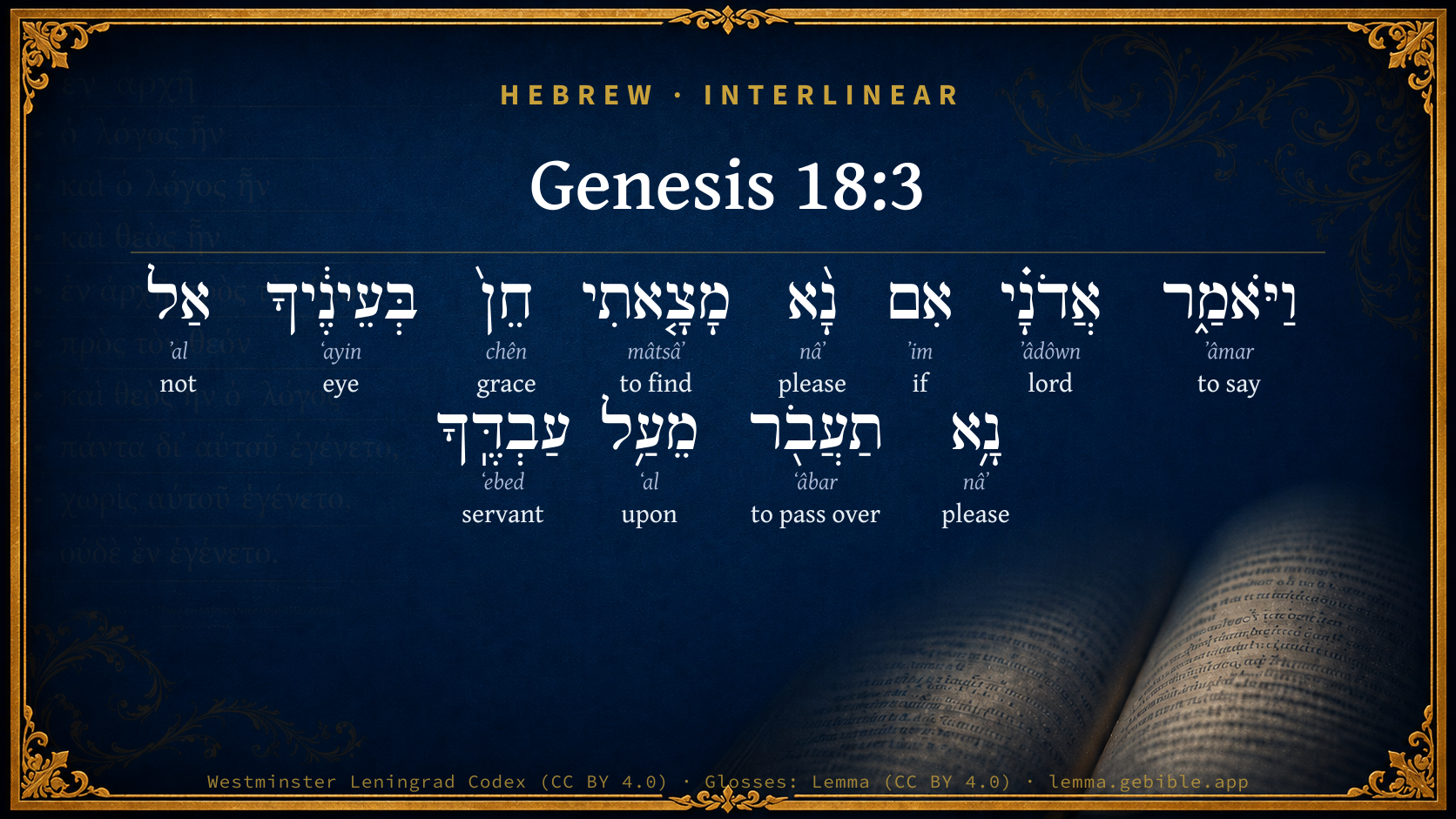
Hebrew (Westminster Leningrad Codex) Genesis 18:3 appears in the Hebrew Old Testament. The text above is from the Westminster Leningrad Codex. Each word links to its Strong’s number, a concise gloss, and parsing drawn from the Open Scriptures Hebrew Bible morphology. Click any word for its full Brown-Driver-Briggs (BDB) entry.
Download image
Cite this verse

Genesis 18:3 (World English Bible). Public Domain. Lemma interlinear Bible study tool, https://lemma.gebible.app/v/genesis/18/3.

Show BibTeX & RIS
BibTeX
RIS
English Translation
and said, "My lord, if now I have found favor in your sight, please don't go away from your servant.
World English Bible · Public Domain
Highlights
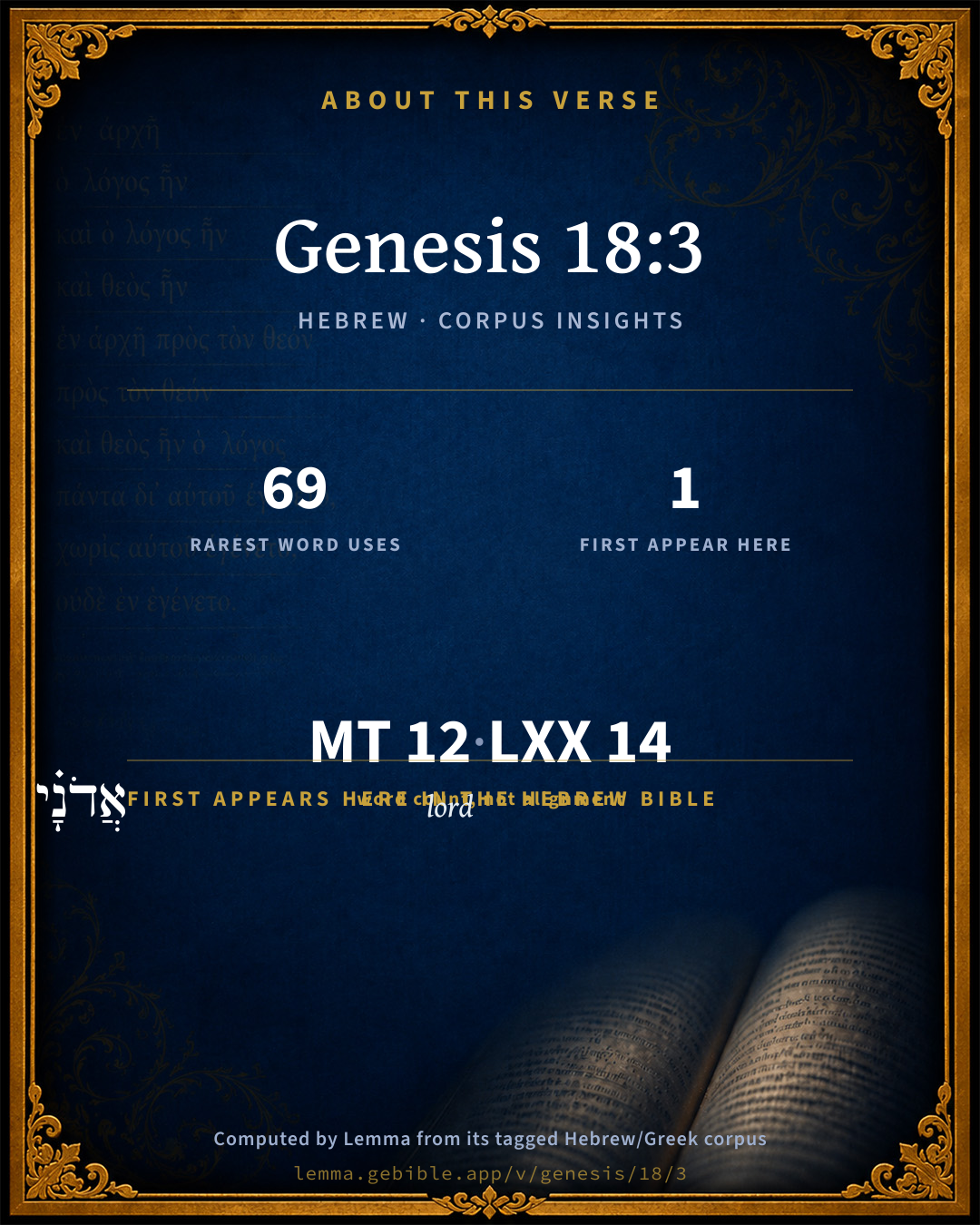
  • 1 first appearance in the Hebrew Bible
Full analysis ↓
Download a study sheet

One document with this verse’s original text, its word-by-word gloss line, the meaning frame, cross-references with their text, attributed commentary, and full source and license credits — printable, and it pastes into notes with its structure intact.

This verse Autodidact and up

Study sheet (.html) Plain text (.txt)

A passage Seminary Student

Up to 50 verses in one chapter. A passage sheet keeps up to 6 commentary sources and 12 cross-references per verse, in the order this page ranks them, and says so on the sheet whenever that leaves anything out. Ask for a single verse and you get the Autodidact verse sheet above.

Everything on this page stays free to read, with no account — the sheet is a download of what is already on screen, not access to it.

Want to remove ads? Support Godless Engineer
Compare translations 3

The same verse in 3 English versions, stacked beneath the original-language interlinear above. Click any original word for its lexicon entry.

Each is an independent rendering of the whole verse — the interlinear is not word-aligned to these translations.

Highlighted words mark where these versions differ — a whole-verse word diff, not a word-by-word alignment.

  • World English Bible Public Domain
    and said, "My lord, if now I have found favor in your sight, please don't go away from your servant.
  • King James Version Public Domain
    And said, My LORD, if now I have found favor in thy sight, pass not away, I pray thee, from thy servant:
  • unfoldingWord Literal Text CC BY-SA 4.0
    and he said, “My lords, if I have found favor in your eyes, please do not pass by your servant.

unfoldingWord Literal Text — © unfoldingWord, licensed CC BY-SA 4.0. Word-aligned USFM3 via Door43 (git.door43.org/unfoldingWord/en_ult).

Versions to compare (up to 4)

3 of 4 selected

Show all 17 translations

Every available English version of this verse, each an independent rendering of the whole verse.

  • World English Bible Public Domain
    and said, "My lord, if now I have found favor in your sight, please don't go away from your servant.
  • Berean Standard Bible Public Domain
    “My lord,” said Abraham, “if I have found favor in your sight, please do not pass your servant by.
  • Majority Standard Bible Public Domain
    “My lord,” said Abraham, “if I have found favor in your sight, please do not pass your servant by.
  • King James Version Public Domain
    And said, My LORD, if now I have found favor in thy sight, pass not away, I pray thee, from thy servant:
  • American Standard Version (1901) Public Domain
    and said, My lord, if now I have found favor in thy sight, pass not away, I pray thee, from thy servant:
  • Revised Version (1885) Public Domain
    and said, My lord, if now I have found favour in thy sight, pass not away, I pray thee, from thy servant:
  • Geneva Bible (1599) Public Domain
    And he said, Lord, if I haue now founde fauour in thy sight, goe not, I pray thee, from thy seruant.
  • Young's Literal Translation Public Domain
    And he saith, `My Lord, if, I pray thee, I have found grace in thine eyes, do not, I pray thee, pass on from thy servant;
  • Literal Standard Version CC BY-SA 4.0
    and he says, “My Lord, if now I have found grace in Your eyes, please do not pass on from Your servant;
  • Unlocked Literal Bible CC BY-SA 4.0
    He said, “Lord, if I have found favor in your eyes, do not pass by and leave your servant.
  • unfoldingWord Literal Text CC BY-SA 4.0
    and he said, “My lords, if I have found favor in your eyes, please do not pass by your servant.
  • Darby Bible Public Domain
    and said, Lord, if now I have found favour in thine eyes, pass not away, I pray thee, from thy servant.
  • World Messianic Bible Public Domain
    and said, “My lord, if now I have found favor in your sight, please don’t go away from your servant.
  • Webster's Bible Public Domain
    And said, My Lord, if now I have found favor in thy sight, pass not away, I pray thee, from thy servant:
  • Free Bible Version CC BY-SA 4.0
    He said, “Sir, if you please, don't continue your journey without spending some time here with me, your servant.
  • Bible in Basic English Public Domain
    And said, My Lord, if now I have grace in your eyes, do not go away from your servant:
  • JPS Tanakh (1917) Public Domain
    and said: 'My lord, if now I have found favour in thy sight, pass not away, I pray thee, from thy servant.

Literal Standard Version (2020), Covenant Press — licensed CC BY-SA 4.0. Text via the HelloAO Bible API (eBible.org). Unlocked Literal Bible (unfoldingWord) — licensed CC BY-SA 4.0. Text via the HelloAO Bible API (eBible.org). unfoldingWord Literal Text — © unfoldingWord, licensed CC BY-SA 4.0. Word-aligned USFM3 via Door43 (git.door43.org/unfoldingWord/en_ult). Free Bible Version, Dr. Jonathan Gallagher — licensed CC BY-SA 4.0. Text via the HelloAO Bible API (eBible.org).

Word by word

More ways to search: Search by grammar → Find every occurrence → Compare this word →

Practice this passage: Drill this verse → Learn its vocabulary →

חֵן֙
chên
H2580
“grace”
Noun, Common, Masculine, Singular, Absolute
Part of Speech
Noun
Type
Common
Gender
Masculine
Number
Singular
State
Absolute
Full BDB Definition

Origin: from H2603

TWOT: TWOT- 694a

favour, grace, charm - favour, grace, elegance - favour, acceptance
  1. וַיֹּאמַ֑ר ʼâmar H559 “and · to say” Conjunction + Verb, Qal, Sequential Imperfect, 3rd Person, Masculine, Singular
  2. אֲדֹנָ֗י ʼâdôwn H113 “lords · my” Noun, Common, Masculine, Plural, Construct + Suffix, Personal, 1st Person, Common, Singular
  3. אִם ʼim H518 “if” Conjunction
  4. נָ֨א nâʼ H4994 “please” Particle, Exhortation
  5. מָצָ֤אתִי mâtsâʼ H4672 “to find” Verb, Qal, Perfect, 1st Person, Common, Singular
  6. בְּעֵינֶ֔יךָ ʻayin H5869 “in/at · eyes · your” Preposition + Noun, Common, Both, Dual, Construct + Suffix, Personal, 2nd Person, Masculine, Singular
  7. אַל ʼal H408 “not” Particle, Negative
  8. נָ֥א nâʼ H4994 “please” Particle, Exhortation
  9. תַעֲבֹ֖ר ʻâbar H5674 “to pass over” Verb, Qal, Jussive, 2nd Person, Masculine, Singular
  10. מֵעַ֥ל ʻal H5921 “from · upon” Preposition + Preposition
  11. עַבְדֶּֽךָ ʻebed H5650 “servant · your” Noun, Common, Masculine, Singular, Construct + Suffix, Personal, 2nd Person, Masculine, Singular

About this verse

These counts appear in no published source. They are computed here, from the morphology-tagged text and Lemma’s own curated glosses. What Lemma adds →

12
words
11
distinct lemmas
Pentateuch
section

First appearance in Scripture

This word makes its first canonical appearance in the Hebrew Bible here:

  • אֲדֹנָ֗י lord H113

Grammatical profile

  • 3 verbs
  • 4 nouns
  • 1 preposition
  • 1 conjunction
  • 3 particles

Verb forms

  • וַיֹּאמַ֑ר Qal · Sequential Imperfect
  • מָצָ֤אתִי Qal · Perfect
  • תַעֲבֹ֖ר Qal · Jussive

Repetition

A word recurs within this verse — often emphatic in Hebrew:

  • נָ֨א please H4994 ×2

Hebrew & Septuagint length

In English translation the verse runs 20 words from the Hebrew and 18 from the Septuagint (LXX English) — closely comparable.

A rough comparison of the two English renderings, which tokenize alike — not a word-level alignment.

Word counts can differ between the Hebrew and the Greek without any difference in meaning — e.g. the Hebrew direct-object marker אֵת has no separate Greek word, and Greek often adds the article ὁ.

In the original languages it is 12 Hebrew tokens and 14 Greek tokens — but the two are counted differently (Hebrew bundles its prefixes and suffixes into one token; the Greek is in lemma form), so that isn’t a like-for-like length.

Hebrew and Greek witnesses Masoretic Hebrew ↔ Greek Septuagint

The same verse in the two great witnesses to the Old Testament, shown verse-for-verse.

These are two independent witnesses, not word-aligned to each other, and the Septuagint is shown in lemma (dictionary) form.

Hebrew Genesis 18:3 Masoretic · Westminster Leningrad Codex

וַיֹּאמַ֑ר אֲדֹנָ֗י אִם נָ֨א מָצָ֤אתִי חֵן֙ בְּעֵינֶ֔יךָ אַל נָ֥א תַעֲבֹ֖ר מֵעַ֥ל עַבְדֶּֽךָ

and said, "My lord, if now I have found favor in your sight, please don't go away from your servant.

World English Bible · Public Domain

Greek LXX Genesis 18:3 Septuagint · lemma form

καί εἶπον κύριος εἰ ἄρα εὑρίσκω χάρις ἐναντίον σύ μή παραἔρχομαι ὁ παῖς σύ

And he said, Lord, if indeed I have found grace in your sight, pass not by your servant.

LXX2012 (modern English Septuagint) · Public Domain

On this verse, The Pulpit Commentary discusses the Septuagint’s reading. Read the note in Commentary ↓

Hebrew: Westminster Leningrad Codex (CC BY 4.0). Greek: Septuagint (public domain); English from LXX2012 (modern English Septuagint) (Public Domain). How the Septuagint differs from the Hebrew →

Targum (Aramaic paraphrase)

2

The Targum is the ancient Jewish Aramaic paraphrase of the Hebrew Scriptures — an interpretive translation, not the Hebrew text itself. Onkelos (literal) and Pseudo-Jonathan (expansive) render the Torah, and Jonathan the Prophets. Coverage is partial: where no permissively-licensed English translation exists for a verse, only the Aramaic is shown. This is verse-level text, not a word-by-word alignment to the Hebrew.

  1. Targum Onkelos Torah (Genesis–Deuteronomy)
    וַאֲמָר יְיָ אִם כְּעַן אַשְׁכָּחִית רַחֲמִין קֳדָמָךְ (נ''י בְּעֵינָיךְ) לָא כְעַן תְּעִבַּר מֵעַל עַבְדָּךְ

    (no public-domain English translation for this verse)

    Targum Onkelos — Aramaic: “Onkelos Genesis” (public domain); “Onkelos Exodus” (public domain); “Onkelos Leviticus” (public domain); “Onkelos Numbers” (public domain); “Onkelos Deuteronomy” (public domain). English: “Sefaria Community Translation” (CC0 1.0 (public-domain dedication)); “J.W. Etheridge. The Targums of Onkelos and Jonathan Ben Uzziel on the Pentateuch. London: Longmans, Green, 1862” (public domain). Text via Sefaria.

  2. Targum Pseudo-Jonathan Torah (Genesis–Deuteronomy)
    וַאֲמַר בְּבָעוּ בְּרַחֲמִין מִן קֳדָמָךְ יְיָ אִין כְּדוֹן אַשְׁכָּחִית חִינָא קוּמָךְ לָא כְדוֹן תְּסַלֵק אִיקַר שְׁכִינְתָּךְ מֵעִילוֹי עַבְדָךְ עַד דְאֵיכְנוֹס עִיבּוּרַיָא

    And he said, I beseech, by the mercies (that are) before Thee, O Lord, if now I have found favour before Thee, that the glory of Thy Shekina may not now ascend from Thy servant, until I have set forth provisions

    Targum Pseudo-Jonathan — Aramaic: “Targum Jonathan on Genesis” (public domain); “Targum Jonathan on Exodus” (public domain); “Targum Jonathan on Leviticus” (public domain); “Targum Jonathan on Numbers” (public domain); “Targum Jonathan on Deuteronomy” (public domain). English: “The Targum of Jonathan ben Uzziel, trans. J. W. Etheridge, London, 1862” (public domain). Text via Sefaria.

Commentary

Notes on Genesis 18:3 from classic Christian and Jewish commentators (each source and its license shown beneath its notes). The classic Christian expositions comment on the surrounding passage and are grouped to its opening verse, so a note may address several verses; the Jewish commentaries on the Tanakh (Rashi and others) are per-verse, so they appear only where the commentator wrote on this verse.

Lemma curates 59 commentaries, every one of them public domain or Creative Commons licensed, each selected and text-cleaned for this edition rather than reprinted as found. About our sources →

The Cambridge Bible for Schools and Colleges

gen. ed. J. J. S. Perowne

3. My lord] R.V. marg. O Lord. The Heb. word so rendered has received three different translations.

(1) “O Lord,” as in Gen_18:27; Gen_18:30-32, Adonâi, addressed to God. So the Massoretic Heb. text, adding the word “holy,” as a note, to safeguard the meaning and the pronunciation.

(2) “my lords,” adonâi, as if Abraham addressed his three visitors together: compare the plural in Gen_18:4-5.

(3) “my lord” (with change of vocalization), adônî (cf. Gen_23:6; Gen_23:11). The sing. is used in Gen_18:3 (“thy servant”). This third rendering seems the most probable: (a) there is no sign of Abraham’s recognizing the real character of the strangers; (b) it would seem probable that he instinctively recognized one of them as the superior in position, though he does not perceive in him the manifestation of Jehovah until after Gen_18:15.

The Cambridge Bible for Schools and Colleges (gen. ed. J. J. S. Perowne; Cambridge University Press, 1878–1918) — public domain. Text from a community e-Sword module.

Trapp's Complete Commentary

John Trapp

Gen 18:3 And said, My Lord, if now I have found favour in thy sight, pass not away, I pray thee, from thy servant:

Ver. 3. My Lord.] He directs his speech to one of them, in whom appeared to be most majesty; and whom he afterwards knew to be the Lord by an excellency.

John Trapp, A Commentary or Exposition upon All the Books of the Old and New Testament (1647–1656) — public domain. Text from a community e-Sword module.

Joseph Benson's Commentary

Gen 18:3-4. And he said, My Lord — He addressed himself to one of the three, who seemed to have the pre-eminence, probably because of some peculiar majesty which appeared in his countenance, or the respect which the other two paid him. Let a little water be fetched — As in those hot climates people went bare-footed, or wore only sandals, washing the feet often was both customary and necessary.

Joseph Benson's Commentary on the Old and New Testaments (1811–1818) — public domain. Text from a community e-Sword module.

Tyndale Open Study Notes

Tyndale Open Resources

18:3 My lord: The Hebrew text uses ’adonay (“Lord”), the word that is usually reserved for God. In Hebrew tradition, it was spoken in places where the holy name Yahweh (the Lord) was in the text. Perhaps the text uses ’adonay rather than the more common ’adoni to show that this was the angel of the Lord—i.e., the Lord himself (see study note on 16:7). We don’t know whether Abraham knew his visitors’ identity at the outset, but by the story’s end Abraham certainly knew he had been talking with God.

Tyndale Open Study Notes — © Tyndale Open Resources, licensed CC BY-SA 4.0. Text via the HelloAO Bible API.

Geneva Bible (1599)

Geneva Bible translators

Speaking to one of them in whom appeared to be most majesty, for he thought they had been men.

Geneva Bible (1599) marginal notes — public domain. Text via Bolls.life.

Jamieson, Fausset & Brown

Robert Jamieson, A. R. Fausset & David Brown

My Lord, if now I have found favor--The hospitalities offered are just of the kind that are necessary and most grateful, the refreshment of water, for feet exposed to dust and heat by the sandals, being still the first observed among the pastoral people of Hebron.

Jamieson, Fausset & Brown — Commentary Critical and Explanatory on the Whole Bible (1871) — public domain (CC PDM 1.0). Text via the HelloAO Bible API.

Adam Clarke's Commentary

Verse 3. And said, My Lord, &c.] The word is אדני Adonai, not יהוה Yehovah, for as yet Abraham did not know the quality of his guests. For an explanation of this word, See Clarke on Gen 15:8.

Adam Clarke's Commentary on the Bible (1810–1826) — public domain. Text from a community e-Sword/MySword module.

John Calvin's Commentaries

3. Pass not away, I pray thee, from thy servant In asking thus meekly, and even suppliantly, there is no doubt that Abraham does it, moved by the reason which I have stated. For if he had slaughtered calves for all kinds of travelers, his house would soon have been emptied by his profuse expenditure. He, therefore, did honor to their virtue and their excellent endowments, lest he should pour contempt upon God. Thus, neither was he so liberal as to invite wanderers, or other men of all kinds, who herd together; nor did ambition induce him to deal thus bountifully with these three persons, but rather his love and affection for those gifts of God, and those virtues which appeared in them. As to his offering them simply a morsel of bread, he makes light of an act of kindness which he was about to do, not only for the sake of avoiding all boasting, but in order that they might the more easily yield to his counsel and his entreaties, when they were persuaded that they should not prove too burdensome and troublesome to him. For modest persons do not willingly put others to expense or trouble. The washing of feet, in that age, and in that region of the world, was very common, perhaps, because persons traveled with naked feet, under burning suns: and it was the great remedy for the alleviation of weariness, to wash the feet parched with heat.

John Calvin's Commentaries (1540-1563) — public domain. Text from the Calvin Translation Society English edition (1840s-50s) via the Christian Classics Ethereal Library (ccel.org). Calvin's coverage is partial (roughly two-thirds of the Bible); uncommented books and verses are honest gaps, never fabricated. The 19th-century editor's footnotes and remarks are omitted so the notes are faithfully Calvin's own voice.

Ellicott's Commentary for English Readers

(3) My lord.—Heb. ‘donai, a term of simple respect, just as the bowing towards the earth is exactly what an Arab sheik would do now to a passing traveller. Abraham’s conduct is marked by all that stately courtesy usual among Orientals. He calls himself their slave: regards it as a favour that they should partake of his hospitality; speaks slightingly of the repast prepared as a mere morsel of bread; and treats it as a providential act that they had come into his neighbourhood. It was only afterwards that he knew that he was entertaining angels unawares (Heb_13:2). While, moreover, he addresses the chief traveller first, as courtesy required, he immediately afterwards changes to the plural, lest he should seem wanting in hospitable welcome to his companions.

A Bible Commentary for English Readers, edited by Charles John Ellicott (1878–1897) — public domain. Text from a community e-Sword module.

John Gill's Exposition

And said, my Lord,.... He addressed himself to one of them who appeared to him to be the greatest and most honourable, either by the appearance of his countenance, or by his dress, or by the situation in which he was between the other two, and by their carriage and behaviour to him:

if now I have found favour in thy sight; signifying he should esteem it an honour done him, that he and his companions would vouchsafe to stop and refresh themselves:

pass not away, I pray thee, from thy servant; they might seem, by some motion they made, as if they were going another way, and declined turning in to him.

John Gill's Exposition of the Whole Bible (1746–1763) — public domain (CC PDM 1.0). Text via the HelloAO Bible API.

Matthew Poole's English Annotations

He directeth his speech to one, who, by the majesty of his countenance, and the respect which the other two showed him, seemed to be the chief of them.

Matthew Poole's English Annotations on the Holy Bible (1683–1685) — public domain. Text from a community e-Sword/MySword module.

Whedon's Commentary on the Bible

Daniel D. Whedon

3. My Lord — אדני, Adonai, not Jehovah, as the Targum of Onkelos here reads. The patriarch thus seems to address himself to one of the three messengers, as if in him he recognised at once the Angel who had visited him before. But we may translate it as plural, my lords. Comp. Gen_19:2; Gen_19:18. The passage in Heb_13:1, “Some have entertained angels unawares,” is generally supposed to refer to this event and that of Gen_19:2. We may believe that, at the first, Abraham was not aware that his guests were angels, but that gradually the fact became known to him; or he may have been impressed at once with the feeling that the one was Jehovah’s Angel, while he did not perceive that the others were angels also.

If now I have found favour — Abraham’s language throughout is a genuine and lifelike example of the manner of a hospitable and generous Oriental chief.

Daniel D. Whedon (gen. ed.), Commentary on the Old and New Testaments (1874–1909) — public domain. Text from a community e-Sword module.

The Pulpit Commentary

And said, My Lord Adonai, literally, Lord, as inrie; (Gen_15:2) q.v. (LXX, ku) Vulgate, Domine; Syriac, Onkelos, Kalisch, Alford, Lange), though the term may have indicated nothing more than-Abraham s recognition of the superior authority of the Being addressed (Murphy). The readings Adoni, my Lord (A.V, Dathius, Rosenm and Aden, my lords (Gesenius), are incorrectif now I have found favor in thy sight not implying dubiety on Abraham s part as to his acceptance before God (Knobel), but rather postulating his already conscious enjoyment of the Divine favor as the ground of the request about to be preferred (Delitzsch, Lange). Those who regard Abraham as unconscious of the Divinity of him to whom he spake see in his language nothing but the customary formula of Oriental address (Rosenm cf. Gen_30:27; 1Sa_20:29; Est_7:3) put not away, I pray thee, from thy servant. The hospitality of the Eastern, and even of the Arab, has been frequently remarked by travelers. Volney describes the Arab as dining at his tent door in order to invite passers-by ("Tray.," 1. p. 314). "The virtue of hospitality is one of the great redeeming virtues in the character of the Bedouins (Kalisch). Whenever our path led us near an encampment, as was frequently the case, we always found some active sheikh or venerable patriarch sitting "in his tent door," and as soon as we were within haft we heard the earnest words of welcome and invitation which the Old Testament Scriptures had rendered long ago familiar to us: Stay, my lord, stay. Pass not on till thou hast eaten bread, and rested under thy servant"s tent. Alight and remain until thy servant kills a kid and prepares, a feast (Porter"s "Giant Cities of Bashan," p. 326; cf. ibid. p. 87).

The Pulpit Commentary (1880–1919), ed. H.D.M. Spence-Jones & Joseph S. Exell — public domain. Text from a community e-Sword module.

unfoldingWord translationNotes

Door43 World Missions Community

Lord

This is a title of respect. Possible meanings are 1) Abraham knew that one of these men was God or 2) Abraham knew that these men came on behalf of God.

if I have found favor in your eyes

Here "found favor" is an idiom that means be approved of or that he is pleased with her. Here "eyes" are a metonym for sight, and sight is a metaphor representing his evaluation. AT: "if you have evaluated me and approve" or "if you are pleased with me" (See: Idiom and Metonymy and Metaphor)

in your eyes

Abraham is speaking to one of the men. (See: Forms of You)

do not pass by

"please do not keep on going"

your servant

"me." Abraham refers to himself this way in order to show respect to his guest.

Let a little water be brought

This can be stated in active form. AT: "Let me bring you some water" or "My servant will bring you some water" (See: Active or Passive)

a little water ... a little food

"some water ... some food." Saying "little" was a polite way of showing generosity. Abraham would give them more than enough water and food.

wash your feet

This custom helped tired travelers to refresh themselves after walking long distances.

your ... you

Abraham speaks to all three of the men, so "you" and "your" are plural. (See: Forms of You)

translationWords

lord

servant

unfoldingWord translationNotes — © Distant Shores Media and the Door43 World Missions Community, licensed CC BY-SA 4.0. Source: git.door43.org/Door43/en_tn.

Rashi

Rabbi Shlomo Yitzchaki (Rashi)

'ויאמר אדני אם נא וגו AND HE SAID, MY LORD, IF NOW etc. — He addressed himself to the Chief of them; calling them all “lords”, (אדני may mean “my lords”), whilst to their Chief he said “Do not I pray thee pass away”, for he knew that if he would not pass by, his companions would certainly remain with him. In this explanation the word אדני has a “profane” sense (does not refer to God, being merely a term of address, “Sirs”). Another explanation is that the word is “holy” (referring to God): he asked God to wait for him whilst he ran and invited the travellers. For although this is written after the words “and he ran to meet them”, yet the conversation took place beforehand. It, indeed, is the way of the Scriptures to speak in this manner as I have explained in my comment on “My spirit shall not strive” (Genesis 6:3) which is written after the passage. “And Noah begot” (Genesis 5:32) whereas it is impossible to say otherwise than that the decree of a respite of 120 years made in reference to this verse “My spirit shall not strive etc.” was twenty years before the birth of Noah’s sons.) Both these explanations of אדני are to be found in Genesis Rabbah 48:10 (see also Shevuot 35b).

Rashi on the Tanakh — English translations: “The Judaica Press complete Tanach with Rashi, translated by A. J. Rosenberg” (CC BY 4.0); “Pentateuch with Rashi's commentary by M. Rosenbaum and A.M. Silbermann, 1929-1934” (public domain); “The Metsudah Tanach series, Lakewood, N.J” (CC BY 4.0); and “The Book of Joshua, Metsudah Publications, 1997” (CC BY 4.0). Text via Sefaria.

Ramban (Nachmanides)

Rabbi Moshe ben Nachman (Ramban / Nachmanides)

‘ADONAY,’ IF NOW I HAVE FOUND FAVOR IN THY EYES. We find the word Adonay here in the books marked with a kamatz. stands by itself and is not in construct form. This is not the case with a word whose end is voweled with a patach. Thus, Ado-noy voweled with a kamatz, must have reference only to G-d, but Adonay voweled with a patach, has a “profane” sense and does not refer to G-d. Ramban continues: Since we find the word in this verse written in the books with a kamatz, and Abraham was speaking to the angels, it must be because he referred to them by the name of their Master. Thus it must be that he called them by the name of their Master, i.e., with the Aleph Dalet, as he recognized them to be angels of the Supreme One, even as they are called elohim and eilim. For this reason he bowed down to the earth to them.

PASS NOT AWAY, I PRAY THEE, FROM THY SERVANT. Abraham spoke to each one of the angels, as is the way of the whole Torah: Ye shall keep all My statutes… and do them; 18:5]: Ye shall keep My statutes, and Mine ordinances, which if a man do…. Here, as in the succeeding examples, the verse begins with a plural and ends with a singular because the Torah speaks to each person. The nakedness of thy father, and the nakedness of thy mother, shalt thou not uncover;, 18:7. And when ye reap the harvest of your land, thou shalt not wholly reap the corner of thy field;, 19:9. And from thence ye will seek the Eternal thy G-d, and thou shalt find Him, if thou search after Him with all thy heart and with all thy soul. The greater part of the Mishneh Torah, 17:18, for origin of the expression. is written in this manner. A counter-example to the above is the verse: Behold, I set before you this day a blessing and a curse., 11:26. Here He speaks to the whole congregation as a unit and not to each person individually.Now our Rabbis have said, “Abraham spoke to the chief of the angels.” does not refer to G-d. It is also possible that he said to the chief, “Pass not away, I pray thee, [in the singular sense], and thou and thy companions who will remain with thee wash your feet,” [the verb “wash” being in the plural form].The correct interpretation appears to me to be that he called them all “lords,” and he turned to each individual, saying to the first one: If now I have found favor in thy eyes, pass not away, and to the second one he said the same, and the same to the third one. He begged each one individually: If now I have found favor in thy eyes, pass not away, and, let now a little water be fetched, and all of ye wash your feet. This was by way of ethical conduct and respect out of his great desire to show kindness towards them. Now he recognized them as transients who did not have the desire to lodge there. This is why he asked of them only that a little water be fetched to wash their feet a little from the heat, to give cold waters to a faint soul, and that they recline under the tree in the cool of the day without coming into the tent and the tabernacle.

Ramban (Nachmanides) on the Tanakh — English translation: “Commentary on the Torah by Ramban (Nachmanides). Translated and annotated by Charles B. Chavel. New York, Shilo Pub. House, 1971-1976” (CC BY 4.0). Text via Sefaria.

Radak

Rabbi David Kimhi (Radak)

ויאמר אדוני, our sages (Shevuot 35) are of two minds as to the meaning of the word A-donay in this verse. Some say it is sacred, an attribute of G’d; others hold that it is profane. If it is the latter, Avraham would have addressed the biggest one of these men. He would have used his own intelligence in making this choice. According to Rashi in the Talmud quoted, Avraham chose the middle angel, (man) as the one whom he addressed as their leader. We know that the angels are not all on the same level. We also know from the descriptions in the Book of Daniel that the senior angels may give instructions to their junior companions. (Daniel 8,16) Even though these men had come to him in the guise of men, human beings, seeing that Avraham had prepared water for them to wash their feet, he addressed the leader in the plural mode, -with the vowel kametz instead of in the singular mode with the vowel chirik as an expression of special honour. We find something parallel in Judges 6,15 when Gideon asked the (lone) angel ”my lord(s), (adonay) how can I help the people of Israel?” He had not been aware at that time that he was addressing an angel. The sages who hold that the word a-donay here is sacred, explain that Avraham used the plural mode because he was addressing G’d Who had visited him, asking Him to wait until he had been able to perform the duty of being a good host to these travelers who had suddenly appeared at the entrance of his tent. The lesson to be derived from this is that the merit of welcoming guests and making them feel at home is even greater than the merit of welcoming G’d into one’s house.

אל נא תעבר מעל עבדך, the word נא is a kind of plea, Avraham begging these strangers not to pass him by without stopping to take some refreshment. The reason why this whole incident has been recorded in the Torah is to teach people how to relate to fellow human beings with charity and love. It is an act of loving kindness to welcome guests into one’s home in order to honour them and to look after their personal requirements, such as letting them wash up and stay overnight.

Radak on the Tanakh — English translations: “Sefaria Community Translation” (CC0 1.0 (public-domain dedication)); “Eliyahu Munk, HaChut Hameshulash” (CC BY 4.0); “Rabbi Mike Feuer, Jerusalem Anthology” (CC BY 4.0); and “R. David Kimhi on the first book of Psalms, Translated by R.G. Finch, London, 1919” (public domain). Text via Sefaria.

Lesson kit

Teaching starters — assembled from the data on this page, not authored interpretation. Every prompt links to the verse data it draws on. Edit before teaching.

Genesis, in the Pentateuch, opens this verse with 12 words (11 distinct Hebrew lemmas). Its most distinctive word is chên (“grace”). A historical commentator’s framing appears above. Read the whole chapter for the surrounding context.

Discussion questions

  1. How does “grace” (chên) shape what this verse is saying?
  2. The word “lord” first appears here in Scripture. What is being introduced at this debut?
  3. “please” occurs 2× in this one verse. What is the effect of the repetition?
  4. The translations on this page render this verse differently — a whole-verse word diff, not a word-by-word alignment. What might account for the different wordings?
  5. The verb «וַיֹּאמַ֑ר» is Qal Sequential Imperfect. How does its form color the action?
  6. Reading how The Cambridge Bible for Schools and Colleges and Trapp's Complete Commentary read this verse, where do the two commentators agree and where do they part?

Things to notice

Reading settings

Reading text

Shown beneath each verse's original-language words.

Old Testament
Old Testament edition

Read the OT as the Masoretic Hebrew (MT) or the Greek Septuagint (LXX).

English shown for the Greek Septuagint (in the Hebrew ↔ Greek comparison).

Comparing translations? Open the Compare panel on any verse page to stack up to four side by side.