
Ruth 1:13

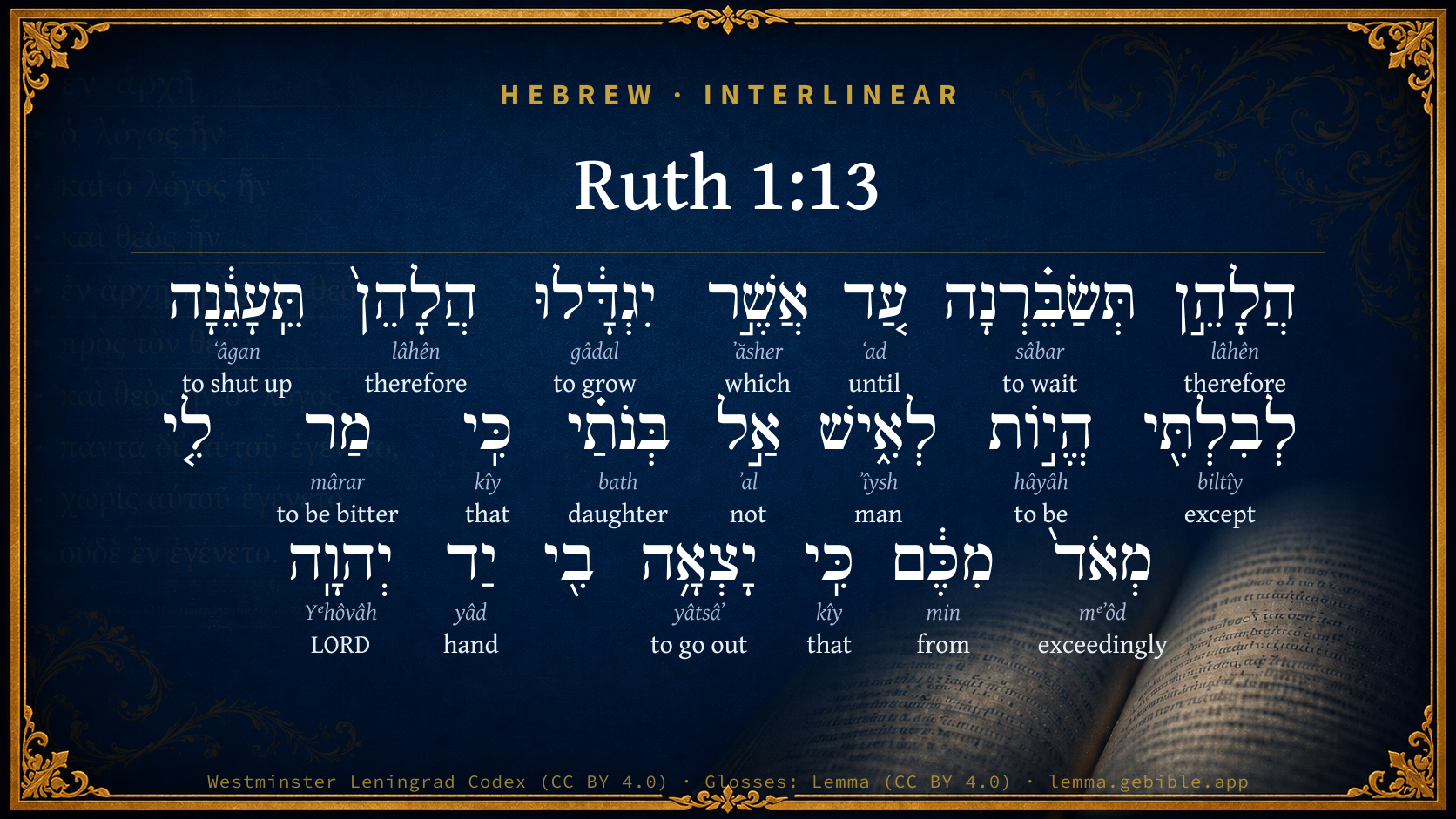
Hebrew (Westminster Leningrad Codex) Ruth 1:13 appears in the Hebrew Old Testament. The text above is from the Westminster Leningrad Codex. Each word links to its Strong’s number, a concise gloss, and parsing drawn from the Open Scriptures Hebrew Bible morphology. Click any word for its full Brown-Driver-Briggs (BDB) entry.
Download image
Cite this verse

Ruth 1:13 (World English Bible). Public Domain. Lemma interlinear Bible study tool, https://lemma.gebible.app/v/ruth/1/13.

Show BibTeX & RIS
BibTeX
RIS
English Translation
would you therefore wait until they were grown? would you therefore stay from having husbands? nay, my daughters, for it grieves me much for your sakes, for the hand of Yahweh is gone forth against me.
World English Bible · Public Domain
Highlights
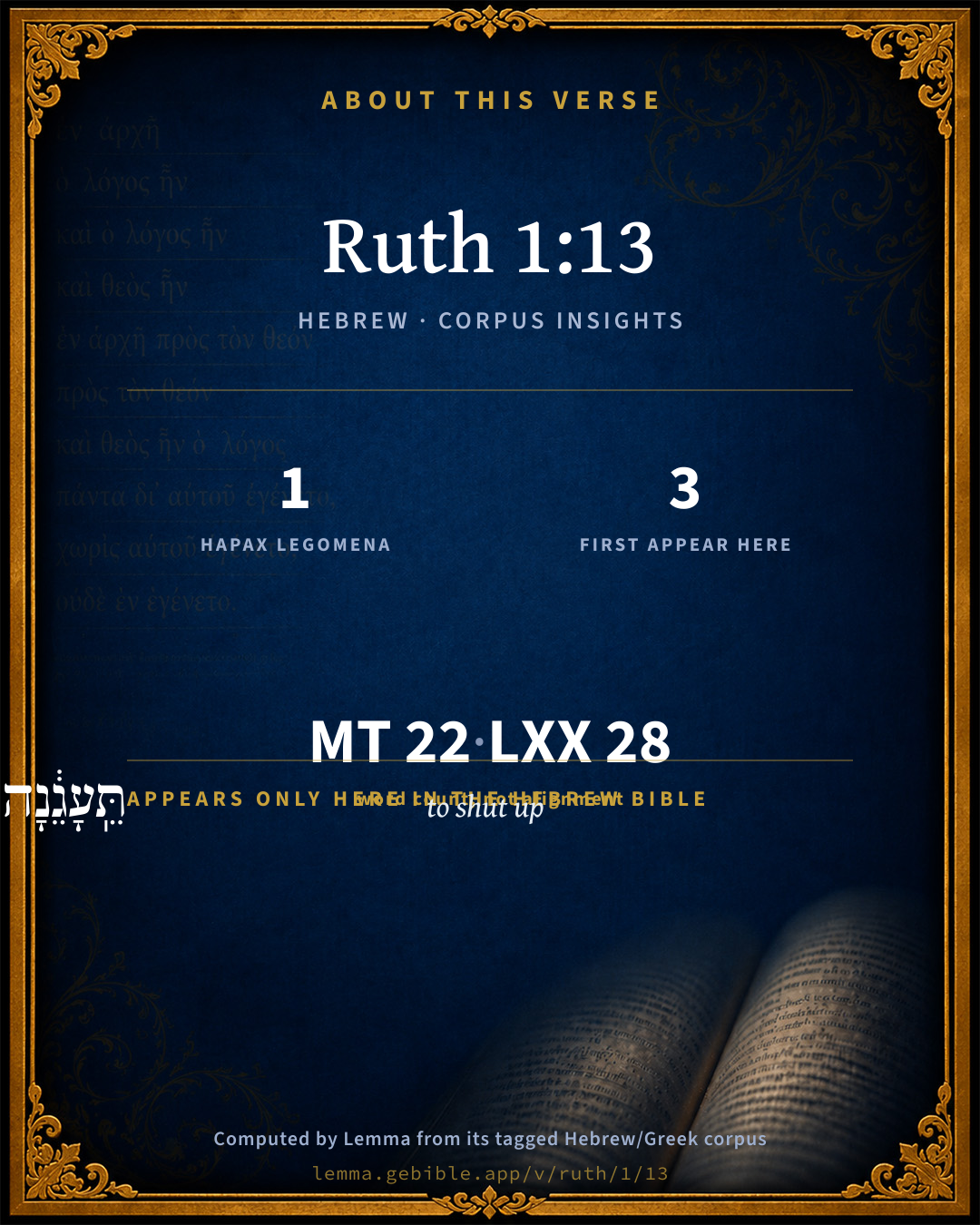
  • 1 hapax legomenon — only here in the Hebrew Bible
  • 3 first appearances in the Hebrew Bible
Full analysis ↓
Download a study sheet

One document with this verse’s original text, its word-by-word gloss line, the meaning frame, cross-references with their text, attributed commentary, and full source and license credits — printable, and it pastes into notes with its structure intact.

This verse Autodidact and up

Study sheet (.html) Plain text (.txt)

A passage Seminary Student

Up to 50 verses in one chapter. A passage sheet keeps up to 6 commentary sources and 12 cross-references per verse, in the order this page ranks them, and says so on the sheet whenever that leaves anything out. Ask for a single verse and you get the Autodidact verse sheet above.

Everything on this page stays free to read, with no account — the sheet is a download of what is already on screen, not access to it.

Want to remove ads? Support Godless Engineer
Compare translations 3

The same verse in 3 English versions, stacked beneath the original-language interlinear above. Click any original word for its lexicon entry.

Each is an independent rendering of the whole verse — the interlinear is not word-aligned to these translations.

Highlighted words mark where these versions differ — a whole-verse word diff, not a word-by-word alignment.

  • World English Bible Public Domain
    would you therefore wait until they were grown? would you therefore stay from having husbands? nay, my daughters, for it grieves me much for your sakes, for the hand of Yahweh is gone forth against me.
  • King James Version Public Domain
    Would ye tarry for them till they were grown? would ye stay for them from having husbands? nay, my daughters; for it grieveth me much for your sakes that the hand of the LORD is gone out against me.
  • unfoldingWord Literal Text CC BY-SA 4.0
    would you therefore wait until the time when they are grown? Would you for this reason keep yourselves from belonging to a husband? No, my daughters! For it is exceedingly bitter for me, more than for you, that the hand of Yahweh has gone out against me.”

unfoldingWord Literal Text — © unfoldingWord, licensed CC BY-SA 4.0. Word-aligned USFM3 via Door43 (git.door43.org/unfoldingWord/en_ult).

Versions to compare (up to 4)

3 of 4 selected

Show all 18 translations

Every available English version of this verse, each an independent rendering of the whole verse.

  • World English Bible Public Domain
    would you therefore wait until they were grown? would you therefore stay from having husbands? nay, my daughters, for it grieves me much for your sakes, for the hand of Yahweh is gone forth against me.
  • Berean Standard Bible Public Domain
    would you wait for them to grow up? Would you refrain from having husbands? No, my daughters, it grieves me very much for your sakes that the hand of the LORD has gone out against me.”
  • Majority Standard Bible Public Domain
    would you wait for them to grow up? Would you refrain from having husbands? No, my daughters, it is much more bitter for me than for you, because the hand of the LORD has gone out against me.”
  • King James Version Public Domain
    Would ye tarry for them till they were grown? would ye stay for them from having husbands? nay, my daughters; for it grieveth me much for your sakes that the hand of the LORD is gone out against me.
  • American Standard Version (1901) Public Domain
    would ye therefore tarry till they were grown? would ye therefore stay from having husbands? nay, my daughters, for it grieveth me much for your sakes, for the hand of Jehovah is gone forth against me.
  • Revised Version (1885) Public Domain
    would ye therefore tarry till they were grown? would ye therefore stay from having husbands? nay, my daughters; for it grieveth me much for your sakes, for the hand of the LORD is gone forth against me.
  • Geneva Bible (1599) Public Domain
    Would yee tarie for them, till they were of age? would ye be deferred for them from taking of husbands? nay my daughters: for it grieueth me much for your sakes that the hand of the Lord is gone out against me.
  • Douay-Rheims (1899) Public Domain
    If you would wait till they were grown up, and come to man's estate, you would be old women before you marry. Do not so, my daughters, I beseech you: for I am grieved the more for your distress, and the hand of the Lord is gone out against me.
  • Young's Literal Translation Public Domain
    for them do ye wait till that they grow up? for them do ye shut yourselves up, not to be to a husband? nay, my daughters, for more bitter to me than to you, for the hand of Jehovah hath gone out against me.'
  • Literal Standard Version CC BY-SA 4.0
    do you wait for them until they grow up? Do you shut yourselves up for them, not to be to a husband? No, my daughters, for more bitter to me than to you, for the hand of YHWH has gone out against me.”
  • Unlocked Literal Bible CC BY-SA 4.0
    would you therefore wait until they were grown? Would you choose not to marry a husband? No, my daughters! It is exceedingly bitter to me for your sake that the hand of Yahweh has gone out against me.”
  • unfoldingWord Literal Text CC BY-SA 4.0
    would you therefore wait until the time when they are grown? Would you for this reason keep yourselves from belonging to a husband? No, my daughters! For it is exceedingly bitter for me, more than for you, that the hand of Yahweh has gone out against me.”
  • Darby Bible Public Domain
    would ye wait on that account till they were grown? Would ye stay on that account from having husbands? No, my daughters, for I am in much more bitterness than you; for the hand of Jehovah is gone out against me.
  • World Messianic Bible Public Domain
    would you then wait until they were grown? Would you then refrain from having husbands? No, my daughters, for it grieves me seriously for your sakes, for the LORD’s hand has gone out against me.”
  • Webster's Bible Public Domain
    Would ye wait for them till they should be grown? would ye stay for them from having husbands? nay, my daughters; for it grieveth me much for your sakes, that the hand of the LORD has gone out against me.
  • Free Bible Version CC BY-SA 4.0
    would you wait for them to grow up? Would you decide you weren't going to marry anyone else? No. The whole situation is more bitter for me than it is for you, for the Lord has turned against me!”
  • Bible in Basic English Public Domain
    Would you keep yourselves till they were old enough? would you keep from having husbands for them? No, my daughters; but I am very sad for you that the hand of the Lord is against me.
  • JPS Tanakh (1917) Public Domain
    would ye tarry for them till they were grown? would ye shut yourselves off for them and have no husbands? nay, my daughters; for it grieveth me much for your sakes, for the hand of the LORD is gone forth against me.'

Literal Standard Version (2020), Covenant Press — licensed CC BY-SA 4.0. Text via the HelloAO Bible API (eBible.org). Unlocked Literal Bible (unfoldingWord) — licensed CC BY-SA 4.0. Text via the HelloAO Bible API (eBible.org). unfoldingWord Literal Text — © unfoldingWord, licensed CC BY-SA 4.0. Word-aligned USFM3 via Door43 (git.door43.org/unfoldingWord/en_ult). Free Bible Version, Dr. Jonathan Gallagher — licensed CC BY-SA 4.0. Text via the HelloAO Bible API (eBible.org).

Word by word

More ways to search: Search by grammar → Find every occurrence → Compare this word →

Practice this passage: Drill this verse → Learn its vocabulary →

תֵּֽעָגֵ֔נָה
ʻâgan
H5702
“to shut up”
Verb, Niphal, Imperfect, 2nd Person, Feminine, Plural
Part of Speech
Verb
Stem
Niphal
Form
Imperfect
Person
2nd Person
Gender
Feminine
Number
Plural
Full BDB Definition

Origin: a primitive root

TWOT: 1562

(Niphal) to shut oneself in or off or up
  1. הֲלָהֵ֣ן lâhên H3860 “therefore” Particle, Interrogative + Conjunction
  2. תְּשַׂבֵּ֗רְנָה sâbar H7663 “to wait” Verb, Piel, Imperfect, 2nd Person, Feminine, Plural
  3. עַ֚ד ʻad H5704 “until” Adverb
  4. אֲשֶׁ֣ר ʼăsher H834 “which” Particle, Relative
  5. יִגְדָּ֔לוּ gâdal H1431 “to grow” Verb, Qal, Imperfect, 3rd Person, Masculine, Plural
  6. הֲלָהֵן֙ lâhên H3860 “therefore” Particle, Interrogative + Conjunction
  7. לְבִלְתִּ֖י biltîy H1115 “to/for · except” Preposition + Conjunction
  8. הֱי֣וֹת hâyâh H1961 “to be” Verb, Qal, Infinitive Construct
  9. לְאִ֑ישׁ ʼîysh H376 “to/for · man” Preposition + Noun, Common, Masculine, Singular, Absolute
  10. אַ֣ל ʼal H408 “not” Particle, Negative
  11. בְּנֹתַ֗י bath H1323 “daughters · my” Noun, Common, Feminine, Plural, Construct + Suffix, Personal, 1st Person, Common, Singular
  12. כִּֽי kîy H3588 “that” Conjunction
  13. מַר mârar H4843 “to be bitter” Verb, Qal, Perfect, 3rd Person, Masculine, Singular
  14. מְאֹד֙ mᵉʼôd H3966 “exceedingly” Adverb
  15. מִכֶּ֔ם min H4480 “from · you” Preposition + Suffix, Personal, 2nd Person, Masculine, Plural
  16. כִּֽי kîy H3588 “that” Conjunction
  17. יָצְאָ֥ה yâtsâʼ H3318 “to go out” Verb, Qal, Perfect, 3rd Person, Feminine, Singular
  18. יַד yâd H3027 “hand of” Noun, Common, Both, Singular, Construct
  19. יְהוָֽה Yᵉhôvâh H3068 “LORD” Noun, Proper

About this verse

These counts appear in no published source. They are computed here, from the morphology-tagged text and Lemma’s own curated glosses. What Lemma adds →

22
words
18
distinct lemmas
Historical
section

Notable vocabulary

1 hapax legomenon — a word that appears only here in the entire Hebrew Bible:

  • תֵּֽעָגֵ֔נָה to shut up H5702

First appearance in Scripture

These words make their first canonical appearance in the Hebrew Bible here:

  • הֲלָהֵ֣ן therefore H3860
  • תְּשַׂבֵּ֗רְנָה to wait H7663
  • תֵּֽעָגֵ֔נָה to shut up H5702

Grammatical profile

  • 6 verbs
  • 4 nouns
  • 3 prepositions
  • 5 conjunctions
  • 2 adverbs
  • 2 particles

Verb forms

  • תְּשַׂבֵּ֗רְנָה Piel · Imperfect
  • יִגְדָּ֔לוּ Qal · Imperfect
  • תֵּֽעָגֵ֔נָה Niphal · Imperfect
  • הֱי֣וֹת Qal · Infinitive Construct
  • מַר Qal · Perfect
  • יָצְאָ֥ה Qal · Perfect

Repetition

Words recur within this verse — often emphatic in Hebrew:

  • הֲלָהֵ֣ן therefore H3860 ×2
  • כִּֽי that H3588 ×2

Hebrew & Septuagint length

In English translation the verse runs 36 words from the Hebrew and 41 from the Septuagint (LXX English) — closely comparable.

A rough comparison of the two English renderings, which tokenize alike — not a word-level alignment.

Word counts can differ between the Hebrew and the Greek without any difference in meaning — e.g. the Hebrew direct-object marker אֵת has no separate Greek word, and Greek often adds the article ὁ.

In the original languages it is 22 Hebrew tokens and 28 Greek tokens — but the two are counted differently (Hebrew bundles its prefixes and suffixes into one token; the Greek is in lemma form), so that isn’t a like-for-like length.

Cross-references

7

Topical passages linked to Ruth 1:13 in the Treasury of Scripture Knowledge — connected by theme and wording, ordered by reader-vote popularity; previews shown in the World English Bible.

  • Job 19:21 "Have pity on me, have pity on me, you my friends; For the hand of God has touched me.
  • Psalms 32:4 For day and night your hand was heavy on me. My strength was sapped in the heat of summer. Selah.
  • Judges 2:15 Wherever they went out, the hand of Yahweh was against them for evil, as Yahweh had spoken, and as Yahweh had sworn to them: and they were sore distressed.
  • Psalms 38:2 For your arrows have pierced me, Your hand presses hard on me.
  • Psalms 39:9–10 I was mute. I didn't open my mouth, Because you did it.
  • Deuteronomy 2:15 Moreover the hand of Yahweh was against them, to destroy them from the midst of the camp, until they were consumed.
  • 1 Samuel 5:11 They sent therefore and gathered together all the lords of the Philistines, and they said, Send away the ark of the God of Israel, and let it go again to its own place, that it not kill us and our people. For there was a deadly confusion throughout all the city; the hand of God was very heavy there.

Cross-references courtesy of OpenBible.info (CC BY 4.0).

Hebrew and Greek witnesses Masoretic Hebrew ↔ Greek Septuagint

The same verse in the two great witnesses to the Old Testament, shown verse-for-verse.

These are two independent witnesses, not word-aligned to each other, and the Septuagint is shown in lemma (dictionary) form.

Hebrew Ruth 1:13 Masoretic · Westminster Leningrad Codex

הֲלָהֵ֣ן תְּשַׂבֵּ֗רְנָה עַ֚ד אֲשֶׁ֣ר יִגְדָּ֔לוּ הֲלָהֵן֙ תֵּֽעָגֵ֔נָה לְבִלְתִּ֖י הֱי֣וֹת לְאִ֑ישׁ אַ֣ל בְּנֹתַ֗י כִּֽי מַר לִ֤י מְאֹד֙ מִכֶּ֔ם כִּֽי יָצְאָ֥ה בִ֖י יַד יְהוָֽה

would you therefore wait until they were grown? would you therefore stay from having husbands? nay, my daughters, for it grieves me much for your sakes, for the hand of Yahweh is gone forth against me.

World English Bible · Public Domain

Greek LXX Ruth 1:13 Septuagint · lemma form

μή αὐτός προςδέχομαι ἕως ὅς ἁδρύνω ἤ αὐτός καταἔχω ὁ μή γίγνομαι ἀνήρ μή δή θυγάτηρ ἐγώ ὅτι πικραίνω ἐγώ ὑπέρ σύ ὅτι ἐκἔρχομαι ἐν ἐγώ χείρ κύριος

would you⌃ wait for them till they should be grown? or would you⌃ refrain from being married for their sakes? Not so, my daughters; for I am grieved for you, that the hand of the Lord has gone forth against me.

LXX2012 (modern English Septuagint) · Public Domain

On this verse, Ellicott's Commentary for English Readers discusses the Septuagint’s reading. Read the note in Commentary ↓

Hebrew: Westminster Leningrad Codex (CC BY 4.0). Greek: Septuagint (public domain); English from LXX2012 (modern English Septuagint) (Public Domain). How the Septuagint differs from the Hebrew →

Commentary

Notes on Ruth 1:13 from classic Christian and Jewish commentators (each source and its license shown beneath its notes). The classic Christian expositions comment on the surrounding passage and are grouped to its opening verse, so a note may address several verses; the Jewish commentaries on the Tanakh (Rashi and others) are per-verse, so they appear only where the commentator wrote on this verse.

Lemma curates 59 commentaries, every one of them public domain or Creative Commons licensed, each selected and text-cleaned for this edition rather than reprinted as found. About our sources →

Trapp's Complete Commentary

John Trapp

Rth 1:13 Would ye tarry for them till they were grown? would ye stay for them from having husbands? nay, my daughters; for it grieveth me much for your sakes that the hand of the LORD is gone out against me.

Ver. 13. Would ye tarry for them?] Heb., Hope. The Hebrew word that signifieth hope, signifieth a line: because by hope the heart is stretched out as a line, to the thing it hopeth for.

Till they were grown.] Children are not to be married till mature and marriageable.

Nay, my daughters,] q.d., If you mean to marry at all, marry in due time, and defer not too long. Every Jew at this day is bound to marry before he is twenty years old, else he is looked upon as one that liveth in sin.

For it grieveth me much.] I have much bitterness: "remembering mine affliction and my misery, the wormwood and the gall." {Lam 3:19} But did not Naomi herself cast this gall into God’s cup, by her impatiency and excess of grief? which yet was much mitigated, no doubt, when she considered that it was -

The hand of the Lord that was gone out against her.] That her afflictions befell her not by fate or blind fortune. Among philosophers the most noted sect for patience was that of the Stoics, who ascribed all to fate. God’s people have better comforts. Virtus lecythos habet in malis.

John Trapp, A Commentary or Exposition upon All the Books of the Old and New Testament (1647–1656) — public domain. Text from a community e-Sword module.

Joseph Benson's Commentary

Rth 1:13. It grieveth me — That you are left without the comfort of husbands or children; that I must part with such affectionate daughters; and that my circumstances are such that I cannot invite you to go along with me. For her condition was so mean at this time that Ruth, when she came to her mother’s city, was forced to glean for a living. It is with me that God has a controversy. This language becomes us when we are under affliction; though many others share in the trouble, yet we are to hear the voice of the rod, as if it spake only to us. But did not she wish to bring them to the worship of the God of Israel? Undoubtedly she did. But she would have them first consider upon what terms, lest, having set their hand to the plough, they should look back.

Joseph Benson's Commentary on the Old and New Testaments (1811–1818) — public domain. Text from a community e-Sword module.

Geneva Bible (1599)

Geneva Bible translators

Or, more than you.

Geneva Bible (1599) marginal notes — public domain. Text via Bolls.life.

Jamieson, Fausset & Brown

Robert Jamieson, A. R. Fausset & David Brown

the hand of the Lord is gone out against me--that is, I am not only not in a condition to provide you with other husbands, but so reduced in circumstances that I cannot think of your being subjected to privations with me. The arguments of Naomi prevailed with Orpah, who returned to her people and her gods. But Ruth clave unto her; and even in the pages of Sterne, that great master of pathos, there is nothing which so calls forth the sensibilities of the reader as the simple effusion he has borrowed from Scripture--of Ruth to her mother-in-law [CHALMERS].

Jamieson, Fausset & Brown — Commentary Critical and Explanatory on the Whole Bible (1871) — public domain (CC PDM 1.0). Text via the HelloAO Bible API.

Ellicott's Commentary for English Readers

(13) It grieveth me much for your sakes.—A much more probable translation is, it is far more bitter for me than for you. An exact parallel to the construction is found in Gen_19:9. The ancient versions are divided, the LXX., Peshito Syriac, and Targum support this translation; the Vulg. is rather loose in its rendering.

A Bible Commentary for English Readers, edited by Charles John Ellicott (1878–1897) — public domain. Text from a community e-Sword module.

The Cambridge Bible for Schools and Colleges

gen. ed. J. J. S. Perowne

13. would ye therefore tarry till they were grown?] The narrative in Genesis 38. shews that the custom of levirate marriage was presupposed for the patriarchal age, but in a more primitive form than that of the modified law in Deuteronomy 25. According to Genesis 38. a son, though not of marriageable age, is bound by a positive requirement of the divine will to marry his brother’s widow, and she must remain a widow till he be grown up (ib. Rth_1:11). The identity of the latter expression with that in the present verse seems to imply a reminiscence of the patriarchal narrative. But Naomi’s imaginary sons, the offspring of an impossible second marriage, would be half-brothers to Mahlon and Chilion; and there is nothing to shew that a levirate marriage was customary in such a case. Moreover, the object of this kind of marriage was to prevent the extinction of a family and the transference of the family property into the hands of strangers. As a matter of fact, however, Naomi is not thinking of this at all; she is not lamenting that her sons died without children, but that Ruth and Orpah have lost their husbands; her one anxiety is for the future welfare of her daughters in law. Hence, though her language is coloured by a reference to a well-known social institution, the reference is not exact, not intended to be taken literally.

It is noticeable that several words in this verse point to the post-exilic date of the writer: therefore is represented by a pure Aramaic word, Dan_2:6; Dan_2:9; Dan_4:27 [Aram. 24]; tarry, again in Est_9:1, Psa_119:166 (‘hoped’); stay, lit. be restrained, shut up, only here in the O. T.; in Aramaic the pass. ptcp. is used of a wife tied to a husband and deserted and prohibited from marrying again, e.g. Talm. Jerus. Giṭṭin iv. 45c.

it grieveth me much for your sakes] lit. it is very bitter for me because of you; for this use of the prep. (min=because of) cf. Ecc_2:10, Psa_31:11; Psa_107:17 etc. Naomi’s sympathy goes out to the young widows, and she urges them to seek happiness elsewhere. The rendering in the marg. means, ‘You can go back and marry again; a worse lot is in store for me, I must remain a solitary.’ The rendering of the text is to be preferred as more in accordance with Naomi’s unselfish feeling.

The Cambridge Bible for Schools and Colleges (gen. ed. J. J. S. Perowne; Cambridge University Press, 1878–1918) — public domain. Text from a community e-Sword module.

John Gill's Exposition

Would you tarry for them till they were grown?.... It is not to be thought that they would tarry till she was married and had children, and then till these infants were grown up to men's estate, and be marriageable; for though Tamar tarried for Shelah, yet he was born, and of some years of age, though not a grown man, Gen 38:11.

would ye stay for them from having husbands? they were young widows, and it was fit they should marry again; and it could not be imagined that they would deny themselves having husbands, in expectation of any sons of her's:

nay, my daughters; I am well satisfied you will never tarry for them, nor deprive yourselves of such a benefit; it is unreasonable to suppose it:

for it grieveth me much for your sakes; that she could be of no manner of service to them, either to give them husbands, or to support and maintain them, should they go with her; or "I have exceedingly more bitterness than you" (d); her condition and circumstances were much worse than theirs; for though they had lost their husbands, she had lost both husband and children: or it was more bitter and grievous to her to be separated from them, than it was for them to be separated from her; her affection to them was as strong, or stronger than theirs to her; or they had friends in their own country that would be kind to them, but as for her, she was in deep poverty and distress, and when she came into her own country, knew not that she had any friends left to take any notice of her:

that the hand of the Lord is gone out against me; in taking away her husband and children, and reducing her to a low estate, penniless and friendless; so poor, as it appears, that her daughter-in-law, when come to the land of Canaan, was obliged to glean for the livelihood of them both, as in the next chapter.

(d) "amaritudo mihi (est) valde prae nobis", Montanus, Rambachius; so Pagninus, Junius & Tremellius, Piscator, Drusius.

John Gill's Exposition of the Whole Bible (1746–1763) — public domain (CC PDM 1.0). Text via the HelloAO Bible API.

Haydock's Catholic Bible Commentary

Marry. Hebrew, "would you stay for them from having husbands!"

George Leo Haydock (1774–1849), Haydock's Catholic Family Bible and Commentary, 1859 edition — public domain. Excludes Psalms (Douay-Rheims chapter numbering differs from Protestant) and Deuterocanonical books (Catholic canon only).

Matthew Poole's English Annotations

Would ye stay for them from having husbands? it is unreasonable for me to expect it, or for you to perform it.

For your sakes; that you are left without the comfort of husbands or children; that I must part with such dear and affectionate daughters; and that my circumstances are such that I cannot invite nor encourage you to go along with me. For her condition was so mean at this time, that Ruth, when she came to her mother’s city, was forced to glean for a living, Rth 2:2.

Matthew Poole's English Annotations on the Holy Bible (1683–1685) — public domain. Text from a community e-Sword/MySword module.

Whedon's Commentary on the Bible

Daniel D. Whedon

13. It grieveth me much for your sakes — More literally, It is much more bitter to me than to you that, etc. My hopes for earthly comfort in my own land are poorer than yours in Moab.

The hand of the Lord is gone out against me — In my own family a severe and mysterious Providence has cut off all temporal hope for you and for me. This was indeed a source of grief. Keil observes that Naomi omitted to notice one possible case, namely, that her daughters in law might find other husbands in Judea. He supposes she did not hint at this chiefly from feelings of delicacy on account of their Moabitish descent, which would be an obstacle to their marriage among the Israelites.

Daniel D. Whedon (gen. ed.), Commentary on the Old and New Testaments (1874–1909) — public domain. Text from a community e-Sword module.

John Wesley's Explanatory Notes

It grieveth me - That you are left without the comfort of husbands or children; that I must part with such affectionate daughters; and that my circumstances are such, that I cannot invite you to go alone with me. For her condition was so mean at this time, that Ruth, when she came to her mother's city, was forced to glean for a living. It is with me, that God has a controversy. This language becomes us, when we are under affliction; tho' many others share in the trouble, yet we are to hear the voice of the rod, as if it spake only to us. But did not she wish to bring them to the worship of the God of Israel? Undoubtedly she did. But she would have them first consider upon what terms, lest having set their hand to the plow, they should look back.

John Wesley, Explanatory Notes Upon the Whole Bible (1754–1765) — public domain. Text via the GEBible commentary corpus.

Rashi

Rabbi Shlomo Yitzchaki (Rashi)

Would you wait for them Heb. תְּשַּׂבֵּרְנָה. This is a question: Would you wait for them until they grew up? This is an expression similar to (Ps. 146:5): “his hope (שִּׂבְרוֹ) is in the Lord his God.”

Would you shut yourselves off Heb. תֵּעָגֵנָה. An expression of being bound and imprisoned, like (Taanith 3: 8): “He made a round hole (עָג עוּגָה) and stood within it.” Others interpret it as an expression of עִגוּן, anchoring, being unable to marry, but that cannot be, for if so, the “nun” should have been punctuated with a “dagesh” or it should have been spelled with two “nuns”.

for the hand of the Lord has gone forth against me Said Rabbi Levi: Wherever it says “the hand of the Lord,” it refers to a plague of pestilence, and the classic example is (Exod. 9:3): “Behold the hand of the Lord will be.”

Rashi on the Tanakh — English translations: “The Judaica Press complete Tanach with Rashi, translated by A. J. Rosenberg” (CC BY 4.0); “Pentateuch with Rashi's commentary by M. Rosenbaum and A.M. Silbermann, 1929-1934” (public domain); “The Metsudah Tanach series, Lakewood, N.J” (CC BY 4.0); and “The Book of Joshua, Metsudah Publications, 1997” (CC BY 4.0). Text via Sefaria.

Ibn Ezra

Rabbi Abraham ibn Ezra

"Would you tarry for them?": The final nun (נ) replaces a mem (מ), and it contrasts with "for it grieves me much for your sakes." The phrase "they came to Bethlehem" shows that "tarry for them" is connected to the letter lamed (ל) or the word "el" (אֶל), similar to "the eyes of all wait upon you" (Psalms 145:15).

"Refrain": This verb is in the Nifal form and has no parallel.

"From having husbands": Each one of them having a husband, similar to "and they hanged both of them on a tree" (Esther 9:14).

"No, my daughters": Meaning, do not go with me.

"That the hand of the Lord is gone out against me": A decree from God that has come forth from Him or that was issued and has reached me, making itself seen.

"The hand of the Lord": A metaphor for affliction, using the term "hand" as a way humans speak.

"The one who went up to your brother-in-law's house": From the root of "yabam" (levirate marriage); it has already been explained in the Torah.

"To her people and to her gods": Evidence that they converted.

Ibn Ezra on the Tanakh — English translations: “Sefaria Community Translation” (CC0 1.0 (public-domain dedication)); “Yalkut, Sifsei Chachomim Chumash, Metsudah Publications, 2009” (CC BY 4.0); and “Commentary of Ibn Ezra on Isaiah - trans. by M. Friedlander, 1873” (public domain). Text via Sefaria.

Lesson kit

Teaching starters — assembled from the data on this page, not authored interpretation. Every prompt links to the verse data it draws on. Edit before teaching.

Ruth, in the Historical, opens this verse with 22 words (18 distinct Hebrew lemmas). Its most distinctive word is ʻâgan (“to shut up”). A historical commentator’s framing appears above. Read the whole chapter for the surrounding context.

Discussion questions

  1. How does “to shut up” (ʻâgan) shape what this verse is saying?
  2. This verse holds 1 word here found nowhere else in the Hebrew Bible. What might the rare word draw attention to?
  3. 3 words here appear for the first time in Scripture. What is being introduced at this debut?
  4. Job 19:21 shares this passage’s theme. How do the two illuminate each other?
  5. “therefore” occurs 2× in this one verse. What is the effect of the repetition?
  6. The translations on this page render this verse differently — a whole-verse word diff, not a word-by-word alignment. What might account for the different wordings?
  7. The verb «תְּשַׂבֵּ֗רְנָה» is Piel Imperfect. How does its form color the action?
  8. Reading how Trapp's Complete Commentary and Joseph Benson's Commentary read this verse, where do the two commentators agree and where do they part?

Things to notice

  • 1 word in this verse appears nowhere else in the Hebrew Bible.
  • 3 words make their first canonical appearance in Scripture here.
  • This verse counts 22 Hebrew ↔ 28 Greek words.
  • These translations choose different wording for 29 words in this verse.
  • “therefore” occurs 2× in this single verse.

Reading settings

Reading text

Shown beneath each verse's original-language words.

Old Testament
Old Testament edition

Read the OT as the Masoretic Hebrew (MT) or the Greek Septuagint (LXX).

English shown for the Greek Septuagint (in the Hebrew ↔ Greek comparison).

Comparing translations? Open the Compare panel on any verse page to stack up to four side by side.