
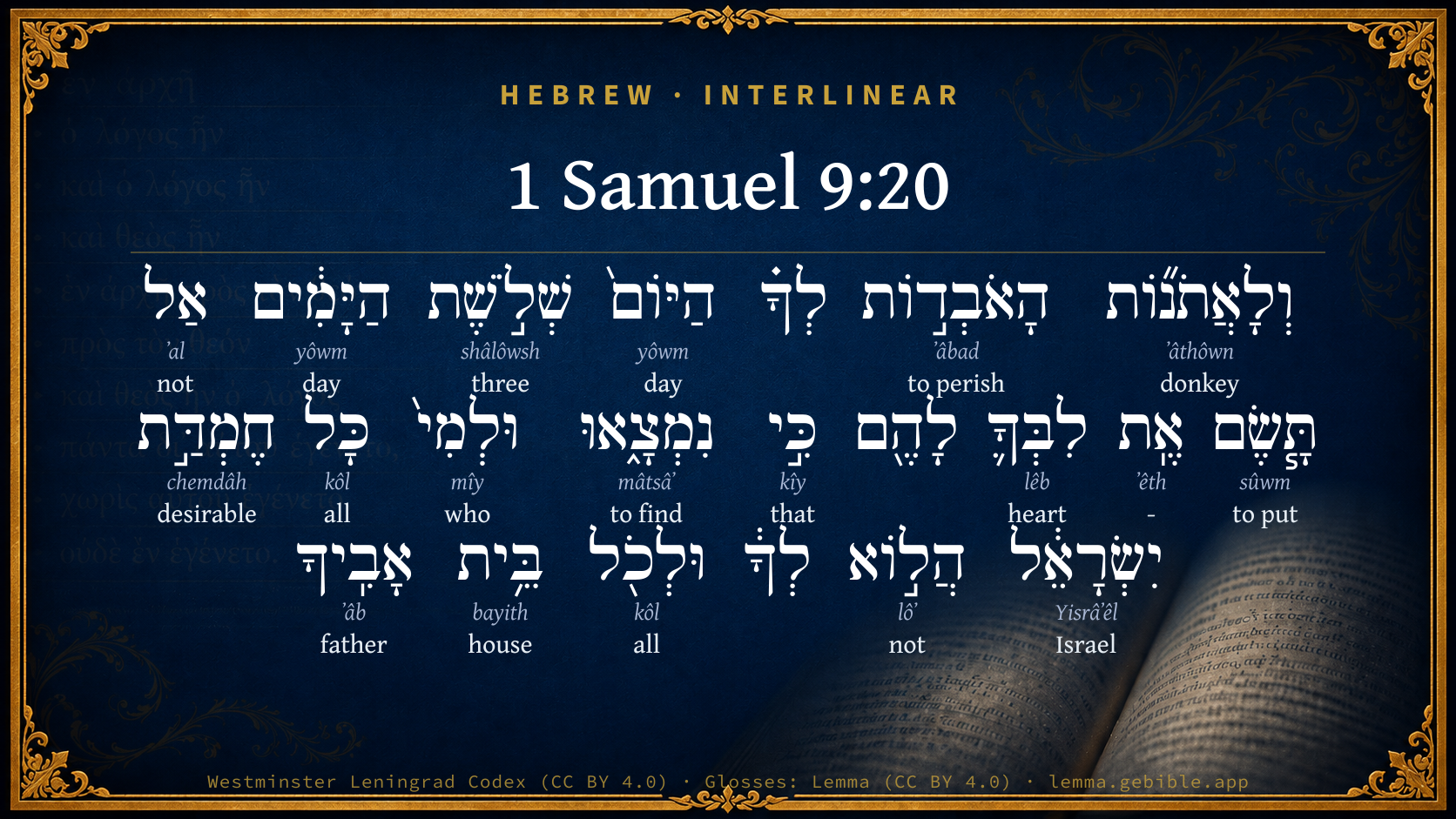
1 Samuel 9:20

Hebrew (Westminster Leningrad Codex) 1 Samuel 9:20 appears in the Hebrew Old Testament. The text above is from the Westminster Leningrad Codex. Each word links to its Strong’s number, a concise gloss, and parsing drawn from the Open Scriptures Hebrew Bible morphology. Click any word for its full Brown-Driver-Briggs (BDB) entry.
Download image
Cite this verse

1 Samuel 9:20 (World English Bible). Public Domain. Lemma interlinear Bible study tool, https://lemma.gebible.app/v/1-samuel/9/20.

Show BibTeX & RIS
BibTeX
RIS
English Translation
As for your donkeys who were lost three days ago, don't set your mind on them; for they are found. For whom is all that is desirable in Israel? Is it not for you, and for all your father's house?
World English Bible · Public Domain
Download a study sheet

One document with this verse’s original text, its word-by-word gloss line, the meaning frame, cross-references with their text, attributed commentary, and full source and license credits — printable, and it pastes into notes with its structure intact.

This verse Autodidact and up

Study sheet (.html) Plain text (.txt)

A passage Seminary Student

Up to 50 verses in one chapter. A passage sheet keeps up to 6 commentary sources and 12 cross-references per verse, in the order this page ranks them, and says so on the sheet whenever that leaves anything out. Ask for a single verse and you get the Autodidact verse sheet above.

Everything on this page stays free to read, with no account — the sheet is a download of what is already on screen, not access to it.

Want to remove ads? Support Godless Engineer
Compare translations 3

The same verse in 3 English versions, stacked beneath the original-language interlinear above. Click any original word for its lexicon entry.

Each is an independent rendering of the whole verse — the interlinear is not word-aligned to these translations.

Highlighted words mark where these versions differ — a whole-verse word diff, not a word-by-word alignment.

  • World English Bible Public Domain
    As for your donkeys who were lost three days ago, don't set your mind on them; for they are found. For whom is all that is desirable in Israel? Is it not for you, and for all your father's house?
  • King James Version Public Domain
    And as for thine asses that were lost three days ago, set not thy mind on them; for they are found. And on whom is all the desire of Israel? Is it not on thee, and on all thy father's house?
  • unfoldingWord Literal Text CC BY-SA 4.0
    Now as for the female donkeys to you having become lost today, three days, do not set your heart to them, for they have been found. Now to whom is all of the desire of Israel? not to you and to all of the house of your father?”

unfoldingWord Literal Text — © unfoldingWord, licensed CC BY-SA 4.0. Word-aligned USFM3 via Door43 (git.door43.org/unfoldingWord/en_ult).

Versions to compare (up to 4)

3 of 4 selected

Show all 18 translations

Every available English version of this verse, each an independent rendering of the whole verse.

  • World English Bible Public Domain
    As for your donkeys who were lost three days ago, don't set your mind on them; for they are found. For whom is all that is desirable in Israel? Is it not for you, and for all your father's house?
  • Berean Standard Bible Public Domain
    As for the donkeys you lost three days ago, do not worry about them, for they have been found. And upon whom is all the desire of Israel, if not upon you and all your father’s house?”
  • Majority Standard Bible Public Domain
    As for the donkeys you lost three days ago, do not worry about them, for they have been found. And upon whom is all the desire of Israel, if not upon you and all your father’s house?”
  • King James Version Public Domain
    And as for thine asses that were lost three days ago, set not thy mind on them; for they are found. And on whom is all the desire of Israel? Is it not on thee, and on all thy father's house?
  • American Standard Version (1901) Public Domain
    And as for thine asses that were lost three days ago, set not they mind on them; for they are found. And for whom is all that is desirable in Israel? Is it not for thee, and for all thy father's house?
  • Revised Version (1885) Public Domain
    And as for thine asses that were lost three days ago, set not thy mind on them; for they are found. And for whom is all that is desirable in Israel? Is it not for thee, and for all thy father’s house?
  • Geneva Bible (1599) Public Domain
    And as for thine asses that were lost three dayes ago, care not for them: for they are founde. and on whom is set all the desire of Israel? is it not vpon thee and on all thy fathers house?
  • Douay-Rheims (1899) Public Domain
    And as for the asses, which were lost three days ago, be not solicitous, because they are found. And for whom shall be all the best things of Israel? Shall they not be for thee and for all thy father's house?
  • Young's Literal Translation Public Domain
    As to the asses which are lost to thee this day three days, set not thy heart to them, for they have been found; and to whom `is' all the desire of Israel?' is it not to thee and to all thy father's house?'
  • Literal Standard Version CC BY-SA 4.0
    And as for the donkeys which are lost from you [for] three days as of today, do not set your heart to them, for they have been found; and to whom [is] all the desire of Israel? Is it not to you and to all your father’s house?”
  • Unlocked Literal Bible CC BY-SA 4.0
    As for your donkeys that were lost three days ago, do not worry about them, for they have been found. Then on whom are all the desires of Israel set? Is it not on you and all your father's house?”
  • unfoldingWord Literal Text CC BY-SA 4.0
    Now as for the female donkeys to you having become lost today, three days, do not set your heart to them, for they have been found. Now to whom is all of the desire of Israel? not to you and to all of the house of your father?”
  • Darby Bible Public Domain
    And as for the asses that thou didst lose three days ago, set not thy heart on them; for they are found. And on whom is all the desire of Israel [set]? Is it not on thee, and on all thy father's house?
  • World Messianic Bible Public Domain
    As for your donkeys who were lost three days ago, don’t set your mind on them, for they have been found. For whom does all Israel desire? Is it not you and all your father’s house?”
  • Webster's Bible Public Domain
    And as for thy asses that were lost three days ago, set not thy mind on them; for they are found. And on whom is all the desire of Israel? Is it not on thee, and on all thy father's house?
  • Free Bible Version CC BY-SA 4.0
    About the donkeys you lost three days ago—don't worry about them because they've been found. But now—doesn't the hope of all of Israel rest on you and your family line?”
  • Bible in Basic English Public Domain
    As for your asses which have been wandering for three days, give no thought to them, for they have come back. And for whom are all the desired things in Israel? are they not for you and your father's family?
  • JPS Tanakh (1917) Public Domain
    And as for thine asses that were lost three days ago, set not thy mind on them; for they are found. And on whom is all the desire of Israel? Is it not on thee, and on all thy father's house?'

Literal Standard Version (2020), Covenant Press — licensed CC BY-SA 4.0. Text via the HelloAO Bible API (eBible.org). Unlocked Literal Bible (unfoldingWord) — licensed CC BY-SA 4.0. Text via the HelloAO Bible API (eBible.org). unfoldingWord Literal Text — © unfoldingWord, licensed CC BY-SA 4.0. Word-aligned USFM3 via Door43 (git.door43.org/unfoldingWord/en_ult). Free Bible Version, Dr. Jonathan Gallagher — licensed CC BY-SA 4.0. Text via the HelloAO Bible API (eBible.org).

Word by word

More ways to search: Search by grammar → Find every occurrence → Compare this word →

Practice this passage: Drill this verse → Learn its vocabulary →

חֶמְדַּ֣ת
chemdâh
H2532
“desirable of”
Noun, Common, Feminine, Singular, Construct
Part of Speech
Noun
Type
Common
Gender
Feminine
Number
Singular
State
Construct
Full BDB Definition

Origin: from H2531

TWOT: 673b

desire, that which is desirable (noun feminine) - pleasant, precious (adjective)
  1. וְלָאֲתֹנ֞וֹת ʼâthôwn H860 “and · to/for the · donkeys” Conjunction + Preposition, Determined + Noun, Common, Feminine, Plural, Absolute
  2. הָאֹבְד֣וֹת ʼâbad H6 “the · perishing” Particle, Definite Article + Verb, Qal, Participle Active, Feminine, Plural, Absolute
  3. הַיּוֹם֙ yôwm H3117 “the · day” Particle, Definite Article + Noun, Common, Masculine, Singular, Absolute
  4. שְׁלֹ֣שֶׁת shâlôwsh H7969 “three” Adjective, Cardinal number, Masculine, Singular, Construct
  5. הַיָּמִ֔ים yôwm H3117 “the · days” Particle, Definite Article + Noun, Common, Masculine, Plural, Absolute
  6. אַל ʼal H408 “not” Particle, Negative
  7. תָּ֧שֶׂם sûwm H7760 “to put” Verb, Qal, Jussive, 2nd Person, Masculine, Singular
  8. אֶֽת ʼêth H853 “-” Particle, Direct Object
  9. לִבְּךָ֛ lêb H3820 “heart · your” Noun, Common, Masculine, Singular, Construct + Suffix, Personal, 2nd Person, Masculine, Singular
  10. כִּ֣י kîy H3588 “that” Conjunction
  11. נִמְצָ֑אוּ mâtsâʼ H4672 “to find” Verb, Niphal, Perfect, 3rd Person, Common, Plural
  12. וּלְמִי֙ mîy H4310 “and · to/for · who” Conjunction + Preposition + Particle, Interrogative
  13. כָּל kôl H3605 “all of” Noun, Common, Masculine, Singular, Construct
  14. יִשְׂרָאֵ֔ל Yisrâʼêl H3478 “Israel” Noun, Proper
  15. הֲל֣וֹא lôʼ H3808 “not” Particle, Interrogative + Particle, Negative
  16. וּלְכֹ֖ל kôl H3605 “and · to/for · all of” Conjunction + Preposition + Noun, Common, Masculine, Singular, Construct
  17. בֵּ֥ית bayith H1004 “house of” Noun, Common, Masculine, Singular, Construct
  18. אָבִֽיךָ ʼâb H1 “father · your” Noun, Common, Masculine, Singular, Construct + Suffix, Personal, 2nd Person, Masculine, Singular

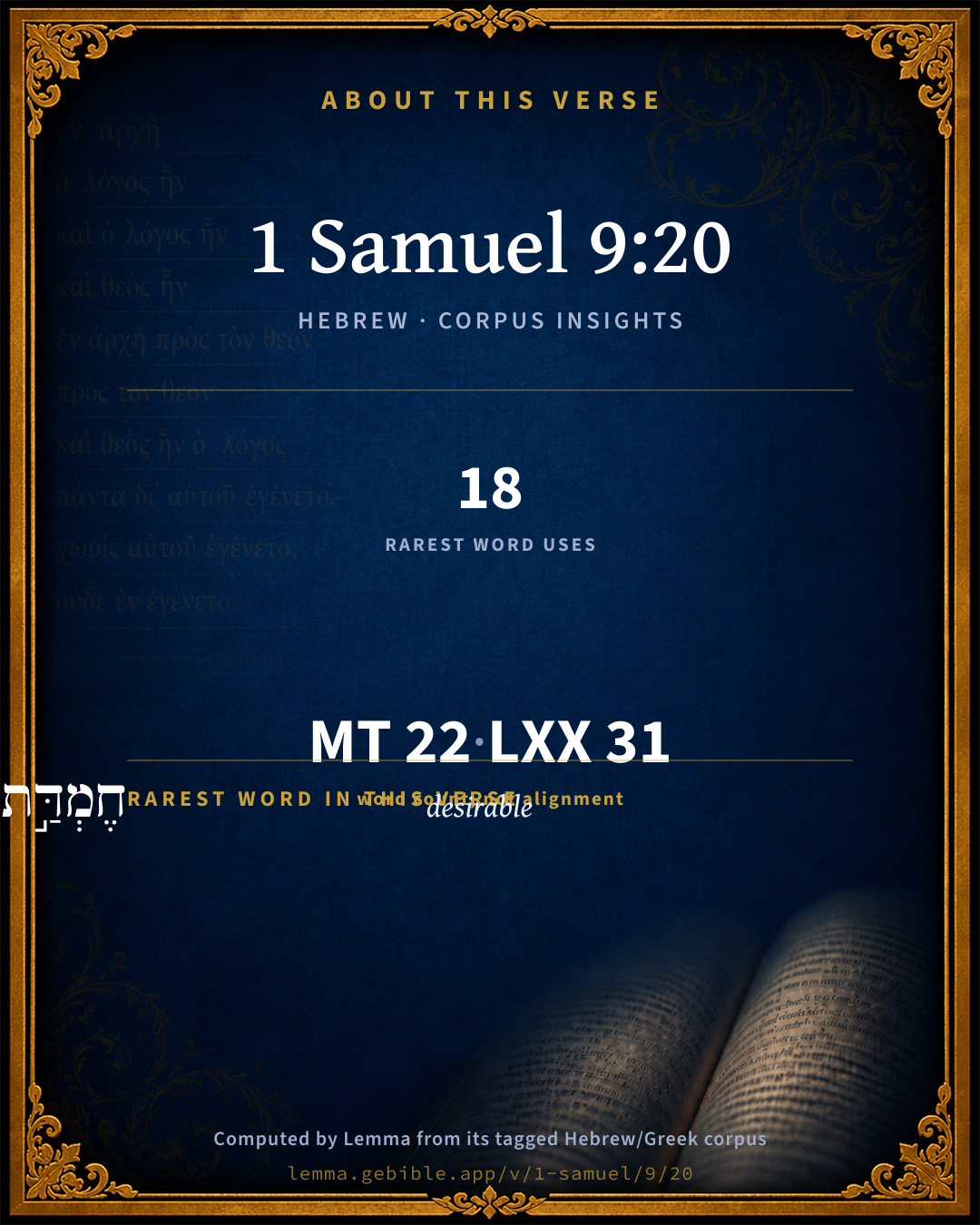
About this verse

These counts appear in no published source. They are computed here, from the morphology-tagged text and Lemma’s own curated glosses. What Lemma adds →

22
words
17
distinct lemmas
Historical
section

Notable vocabulary

The rarest word here is חֶמְדַּ֣ת desirable H2532 — appearing just 18 times in the whole Hebrew Bible.

Shared distinctive vocabulary

חֶמְדַּ֣ת desirable H2532 occurs in 18 verses of the Hebrew Bible. Also found in:

Grammatical profile

  • 3 verbs
  • 10 nouns
  • 1 adjective
  • 3 prepositions
  • 1 conjunction
  • 4 particles

Verb forms

  • הָאֹבְד֣וֹת Qal · Participle Active
  • תָּ֧שֶׂם Qal · Jussive
  • נִמְצָ֑אוּ Niphal · Perfect

Repetition

Words recur within this verse — often emphatic in Hebrew:

  • הַיּוֹם֙ day H3117 ×2
  • כָּל all H3605 ×2

Hebrew & Septuagint length

In English translation the verse runs 40 words from the Hebrew and 39 from the Septuagint (LXX English) — closely comparable.

A rough comparison of the two English renderings, which tokenize alike — not a word-level alignment.

Word counts can differ between the Hebrew and the Greek without any difference in meaning — e.g. the Hebrew direct-object marker אֵת has no separate Greek word, and Greek often adds the article ὁ.

In the original languages it is 22 Hebrew tokens and 31 Greek tokens — but the two are counted differently (Hebrew bundles its prefixes and suffixes into one token; the Greek is in lemma form), so that isn’t a like-for-like length.

Cross-references

9

Topical passages linked to 1 Samuel 9:20 in the Treasury of Scripture Knowledge — connected by theme and wording, ordered by reader-vote popularity; previews shown in the World English Bible.

  • 1 Samuel 8:5 and they said to him, Behold, you are old, and your sons don't walk in your ways: now make us a king to judge us like all the nations.
  • 1 Samuel 12:13 Now therefore see the king whom you have chosen, and whom you have asked for: and, behold, Yahweh has set a king over you.
  • 1 Samuel 9:3 The donkeys of Kish, Saul's father, were lost. Kish said to Saul his son, Take now one of the servants with you, and arise, go seek the donkeys.
  • 1 Samuel 4:20 About the time of her death the women who stood by her said to her, Don't be afraid; for you have brought forth a son. But she didn't answer, neither did she regard it.
  • 1 Samuel 8:19 But the people refused to listen to the voice of Samuel; and they said, No: but we will have a king over us,
  • 1 Samuel 12:15 but if you will not listen to the voice of Yahweh, but rebel against the commandment of Yahweh, then will the hand of Yahweh be against you, as it was against your fathers.
  • 1 Chronicles 29:3 In addition, because I have set my affection on the house of my God, seeing that I have a treasure of my own of gold and silver, I give it to the house of my God, over and above all that I have prepared for the holy house,
  • Psalms 62:10 Don't trust in oppression. Don't become vain in robbery. If riches increase, Don't set your heart on them.
  • Colossians 3:2 Set your mind on the things that are above, not on the things that are on the earth.

Cross-references courtesy of OpenBible.info (CC BY 4.0).

Hebrew and Greek witnesses Masoretic Hebrew ↔ Greek Septuagint

The same verse in the two great witnesses to the Old Testament, shown verse-for-verse.

These are two independent witnesses, not word-aligned to each other, and the Septuagint is shown in lemma (dictionary) form.

Hebrew 1 Samuel 9:20 Masoretic · Westminster Leningrad Codex

וְלָאֲתֹנ֞וֹת הָאֹבְד֣וֹת לְךָ֗ הַיּוֹם֙ שְׁלֹ֣שֶׁת הַיָּמִ֔ים אַל תָּ֧שֶׂם אֶֽת לִבְּךָ֛ לָהֶ֖ם כִּ֣י נִמְצָ֑אוּ וּלְמִי֙ כָּל חֶמְדַּ֣ת יִשְׂרָאֵ֔ל הֲל֣וֹא לְךָ֔ וּלְכֹ֖ל בֵּ֥ית אָבִֽיךָ

As for your donkeys who were lost three days ago, don't set your mind on them; for they are found. For whom is all that is desirable in Israel? Is it not for you, and for all your father's house?

World English Bible · Public Domain

Greek LXX 1 Samuel 9:20 Septuagint · lemma form

καί περί ὁ ὄνος σύ ὁ ἀποὀλλύω σήμερον τριταίων μή τίθημι ὁ καρδία σύ αὐτός ὅτι εὑρίσκω καί τίς ὁ ὡραῖος ὁ ἰσραήλ οὐ σύ καί ὁ οἶκος ὁ πατήρ σύ

And concerning your asses that have been lost now these three days, care not for them, for they are found. And to whom does the excellency of Israel belong? does it not to you and to your father's house?

LXX2012 (modern English Septuagint) · Public Domain

On this verse, Trapp's Complete Commentary discusses the Septuagint’s reading. Read the note in Commentary ↓

Hebrew: Westminster Leningrad Codex (CC BY 4.0). Greek: Septuagint (public domain); English from LXX2012 (modern English Septuagint) (Public Domain). How the Septuagint differs from the Hebrew →

Targum (Aramaic paraphrase)

1

The Targum is the ancient Jewish Aramaic paraphrase of the Hebrew Scriptures — an interpretive translation, not the Hebrew text itself. Onkelos (literal) and Pseudo-Jonathan (expansive) render the Torah, and Jonathan the Prophets. Coverage is partial: where no permissively-licensed English translation exists for a verse, only the Aramaic is shown. This is verse-level text, not a word-by-word alignment to the Hebrew.

  1. Targum Jonathan Prophets (Joshua–Malachi)
    וְעַל עֵסֶק אֲתָנַיָא דַאֲבָדָא לָךְ וְאַתְּ אֲתֵיתָא לְמִבְעֵיהוֹן יוֹמָא דֵין דְנַן תְּלָתָא יוֹמִין לָא תְשַׁוֵי יַת לִבָּךְ עֲלֵיהוֹן אֲרֵי אִשְׁתְּכָחָא וּדְמַן כָּל חֶמְדַת יִשְׂרָאֵל הֲלָא דִי לָךְ וּלְכָל בֵּית אֲבוּךְ:

    (no public-domain English translation for this verse)

    Targum Jonathan — Aramaic: “Mikraot Gedolot” (public domain). English: “Sefaria Community Translation” (CC0 1.0 (public-domain dedication)); “London "Chaldee Paraphrase," 1871” (public domain). Text via Sefaria.

Commentary

Notes on 1 Samuel 9:20 from classic Christian and Jewish commentators (each source and its license shown beneath its notes). The classic Christian expositions comment on the surrounding passage and are grouped to its opening verse, so a note may address several verses; the Jewish commentaries on the Tanakh (Rashi and others) are per-verse, so they appear only where the commentator wrote on this verse.

Lemma curates 59 commentaries, every one of them public domain or Creative Commons licensed, each selected and text-cleaned for this edition rather than reprinted as found. About our sources →

Trapp's Complete Commentary

John Trapp

1Sa 9:20 And as for thine asses that were lost three days ago, set not thy mind on them; for they are found. And on whom [is] all the desire of Israel? [Is it] not on thee, and on all thy father’s house?

Ver. 20. And on whom is all the desire of Israel?] Sed cuius est omne desiderabile Israelis? so Martyr rendereth it. And whose shall be the best, or fairest, things of Israel? {a} so the Vulgate after the Septuagint. {See Trapp on "Hag 2:7"} They desire a king, and God hath pitched upon thee.

{a} Jerome in lib. Heb. Qu.

John Trapp, A Commentary or Exposition upon All the Books of the Old and New Testament (1647–1656) — public domain. Text from a community e-Sword module.

Joseph Benson's Commentary

1Sa 9:20. As for thine asses that were lost, &c. — This must have satisfied Saul that he was a prophet, as he hereby showed that he knew for what Saul came to him, though he had not told him. And on whom is all the desire of Israel? — That is, all Israel desire a king, and there is no one more fit for such an office than thyself. On all thy father’s house — That honour is designed for thee, and after thy death for thy family and posterity, if by thy sin thou dost not cut off the entail.

Joseph Benson's Commentary on the Old and New Testaments (1811–1818) — public domain. Text from a community e-Sword module.

Geneva Bible (1599)

Geneva Bible translators

Whom doth Israel desire to be their King, but thee?

Geneva Bible (1599) marginal notes — public domain. Text via Bolls.life.

Jamieson, Fausset & Brown

Robert Jamieson, A. R. Fausset & David Brown

on whom is all the desire of Israel? Is it not on thee, and on all thy father's house?--This was a covert and indirect premonition of the royal dignity that awaited him; and, though Saul's answer shows that he fully understood it, he affected to doubt that the prophet was in earnest.

Jamieson, Fausset & Brown — Commentary Critical and Explanatory on the Whole Bible (1871) — public domain (CC PDM 1.0). Text via the HelloAO Bible API.

Adam Clarke's Commentary

Verse 20. As for thine asses] Thus he shows him that he knew what was in his heart, God having previously revealed these things to Samuel.

And on whom is all the desire of Israel?] Saul understood this as implying that he was chosen to be king.

Adam Clarke's Commentary on the Bible (1810–1826) — public domain. Text from a community e-Sword/MySword module.

The Cambridge Bible for Schools and Colleges

gen. ed. J. J. S. Perowne

20. three days ago] Heb. “to-day three days” = “the day before yesterday,” according to the inclusive Hebrew reckoning.

set not thy mind on them] “Set not thy heart on them.” Be not anxious for them.

on whom is all the desire of Israel] Rather, For whom are all the desirable things of Israel? are they not for thee and for all thy father’s house? i.e. ‘Care not for these asses for they are found: and even if they were lost, what matter? is not the best that Israel has to give at thy service?’

The Cambridge Bible for Schools and Colleges (gen. ed. J. J. S. Perowne; Cambridge University Press, 1878–1918) — public domain. Text from a community e-Sword module.

John Gill's Exposition

And as for thine asses that were lost three days ago,.... Which, according to Kimchi, is to be understood not of the time from whence they were lost, but to be reckoned from the time that Saul had been seeking of them; so the Targum,"as to the business of the asses, which are lost to thee, and thou art come to seek them today, these three days:''though it is probable enough that the same day they were lost Saul set out to seek them, Now Samuel telling him of the asses that were lost, and of the time of their being lost, or of his seeking them, so exactly, before ever he said a word to him about them, must at once convince him that he was a true prophet, and which must prepare him to give credit to all that he should hereafter say to him:

set not thy mind on them, for they are found; of the truth of which he could not doubt, after he had said the above words; and which he said to make his mind easy, that he might the more cheerfully attend the feast, and be the more willing to stay all night:

and on whom is all the desire of Israel? which was to have a king; in this they were unanimous, and who so fit and proper as Saul, it is intimated, whom Samuel knew God had chosen and appointed to be king over them?

is it not on thee, and on all thy father's house? not that the Israelites had their eye on Saul, and their desire after him to be their king, though he was such an one as they wished for; but that as this desire of theirs was granted, it would issue and terminate in him and his family; he should be advanced to the throne, which would be attended with the promotion of his father's house, as Abner particularly, who was his uncle's son, and was made the general of the army.

John Gill's Exposition of the Whole Bible (1746–1763) — public domain (CC PDM 1.0). Text via the HelloAO Bible API.

Haydock's Catholic Bible Commentary

CHAPTER IX.

Best. The regal power, which all desired. Hebrew, "to or on whom is all the desire of Israel?" Any great felicity is called a desire, as the Messias, the spouse in the Canticle [of Canticles], v. 16. (Aggeus ii. 8.) Septuagint, "to whom the beautiful things of Israel?"

George Leo Haydock (1774–1849), Haydock's Catholic Family Bible and Commentary, 1859 edition — public domain. Excludes Psalms (Douay-Rheims chapter numbering differs from Protestant) and Deuterocanonical books (Catholic canon only).

Matthew Poole's English Annotations

Set not thy mind on them; trouble not thy mind about them.

On whom is all the desire of Israel? who is he that shall be that thing or person which all Israel desire to have, to wit, a king?

Is it not on thee, and on all thy father’s house? that honour is designed for thee, and, after thy death, for thy family or posterity, if by thy sin thou dost not cut off the entail.

Matthew Poole's English Annotations on the Holy Bible (1683–1685) — public domain. Text from a community e-Sword/MySword module.

Whedon's Commentary on the Bible

Daniel D. Whedon

20. Thine asses… are found — This must have convinced Saul that a true seer looked upon his heart.

All the desire of Israel — Israel’s desire was for a king, and Samuel sees that Saul is the man to meet this desire. It is nowise improbable that Saul, the goodly, broad-shouldered youth of Gibeah, had already been talked of as a proper candidate for king, and many eyes in Israel had turned towards him with special interest. A man of great physical power and tall and commanding presence was the popular ideal of a king. And Saul filled this ideal well.

Daniel D. Whedon (gen. ed.), Commentary on the Old and New Testaments (1874–1909) — public domain. Text from a community e-Sword module.

John Wesley's Explanatory Notes

On whom - Who is he that shall be that, which all Israel desire to have, namely, a king. Father's house - That honour is designed for thee, and, after thy death, for thy family or posterity, is by thy sin thou dost not cut off the entail.

John Wesley, Explanatory Notes Upon the Whole Bible (1754–1765) — public domain. Text via the GEBible commentary corpus.

unfoldingWord translationNotes

Door43 World Missions Community

Then on whom are all the desires of Israel set? Is it not on you and all your father's house?

These questions are an expression of deep conviction that Saul is the one whom Yahweh wants to be the king that the Israelites are looking for. The questions can be translated as statements. AT: "You should know that it is on you that all the desires of Israel are set. They are set on you and your father's family." (See: Rhetorical Question)

Am not I a Benjamite ... of Israel? Is not my clan ... Benjamin? Why then have you spoken to me in this manner?

Saul is expressing surprise because Benjamin was the smallest tribe in Israel, and other Israelites considered the tribe unimportant. Also, Benjamites considered the clan of which Saul was a member as unimportant. These questions can be translated as statements. AT: "I am from the tribe of Benjamin, the least important of all tribes. And my clan is the least important clan in our tribe. I do not understand why you are saying that the Israelite people want me and my family to do something important." (See: Rhetorical Question)

translationWords

ancestor

house

tribe

clan

unfoldingWord translationNotes — © Distant Shores Media and the Door43 World Missions Community, licensed CC BY-SA 4.0. Source: git.door43.org/Door43/en_tn.

Rashi

Rabbi Shlomo Yitzchaki (Rashi)

But for whom does all of Yisroel desire? Here he [Shmuel] hints to him the matter of the kingship.

Rashi on the Tanakh — English translations: “The Judaica Press complete Tanach with Rashi, translated by A. J. Rosenberg” (CC BY 4.0); “Pentateuch with Rashi's commentary by M. Rosenbaum and A.M. Silbermann, 1929-1934” (public domain); “The Metsudah Tanach series, Lakewood, N.J” (CC BY 4.0); and “The Book of Joshua, Metsudah Publications, 1997” (CC BY 4.0). Text via Sefaria.

Lesson kit

Teaching starters — assembled from the data on this page, not authored interpretation. Every prompt links to the verse data it draws on. Edit before teaching.

1 Samuel, in the Historical, opens this verse with 22 words (17 distinct Hebrew lemmas). Its most distinctive word is chemdâh (“desirable”). A historical commentator’s framing appears above. Read the whole chapter for the surrounding context.

Discussion questions

  1. The word chemdâh carries the sense “desirable.” How does it shape the verse?
  2. How does Genesis 27:15, which shares the word «desirable», read alongside this verse?
  3. What does the repetition of “day” (2× in this one verse) do in this verse?
  4. These translations render this verse differently. What is at stake in choosing one wording over another?
  5. «הָאֹבְד֣וֹת» is a Qal Participle Active verb. How does that grammatical form shape the action described?
  6. Compare how Trapp's Complete Commentary and Joseph Benson's Commentary read this verse. Where do they agree or differ?

Things to notice

Reading settings

Reading text

Shown beneath each verse's original-language words.

Old Testament
Old Testament edition

Read the OT as the Masoretic Hebrew (MT) or the Greek Septuagint (LXX).

English shown for the Greek Septuagint (in the Hebrew ↔ Greek comparison).

Comparing translations? Open the Compare panel on any verse page to stack up to four side by side.