
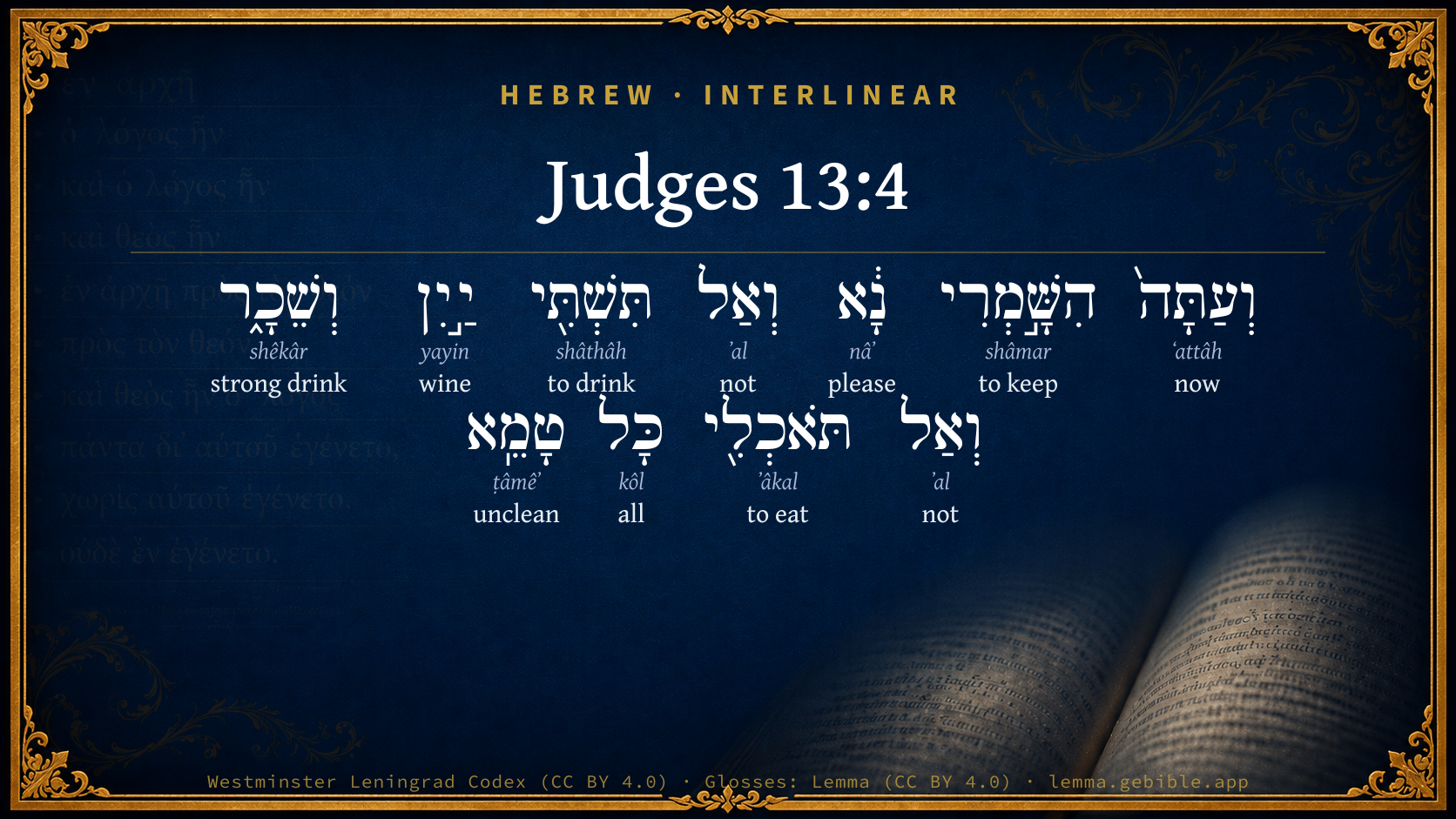
Judges 13:4

Hebrew (Westminster Leningrad Codex) Judges 13:4 appears in the Hebrew Old Testament. The text above is from the Westminster Leningrad Codex. Each word links to its Strong’s number, a concise gloss, and parsing drawn from the Open Scriptures Hebrew Bible morphology. Click any word for its full Brown-Driver-Briggs (BDB) entry.
Download image
Cite this verse

Judges 13:4 (World English Bible). Public Domain. Lemma interlinear Bible study tool, https://lemma.gebible.app/v/judges/13/4.

Show BibTeX & RIS
BibTeX
RIS
English Translation
Now therefore please beware and drink no wine nor strong drink, and don't eat any unclean thing:
World English Bible · Public Domain
Download a study sheet

One document with this verse’s original text, its word-by-word gloss line, the meaning frame, cross-references with their text, attributed commentary, and full source and license credits — printable, and it pastes into notes with its structure intact.

This verse Autodidact and up

Study sheet (.html) Plain text (.txt)

A passage Seminary Student

Up to 50 verses in one chapter. A passage sheet keeps up to 6 commentary sources and 12 cross-references per verse, in the order this page ranks them, and says so on the sheet whenever that leaves anything out. Ask for a single verse and you get the Autodidact verse sheet above.

Everything on this page stays free to read, with no account — the sheet is a download of what is already on screen, not access to it.

Want to remove ads? Support Godless Engineer
Compare translations 3

The same verse in 3 English versions, stacked beneath the original-language interlinear above. Click any original word for its lexicon entry.

Each is an independent rendering of the whole verse — the interlinear is not word-aligned to these translations.

Highlighted words mark where these versions differ — a whole-verse word diff, not a word-by-word alignment.

  • World English Bible Public Domain
    Now therefore please beware and drink no wine nor strong drink, and don't eat any unclean thing:
  • King James Version Public Domain
    Now therefore beware, I pray thee, and drink not wine nor strong drink, and eat not any unclean thing:
  • unfoldingWord Literal Text CC BY-SA 4.0
    And now, please be careful and do not drink wine or beer, and do not eat any unclean.

unfoldingWord Literal Text — © unfoldingWord, licensed CC BY-SA 4.0. Word-aligned USFM3 via Door43 (git.door43.org/unfoldingWord/en_ult).

Versions to compare (up to 4)

3 of 4 selected

Show all 18 translations

Every available English version of this verse, each an independent rendering of the whole verse.

  • World English Bible Public Domain
    Now therefore please beware and drink no wine nor strong drink, and don't eat any unclean thing:
  • Berean Standard Bible Public Domain
    Now please be careful not to drink wine or strong drink, and not to eat anything unclean.
  • Majority Standard Bible Public Domain
    Now please be careful not to drink wine or strong drink, and not to eat anything unclean.
  • King James Version Public Domain
    Now therefore beware, I pray thee, and drink not wine nor strong drink, and eat not any unclean thing:
  • American Standard Version (1901) Public Domain
    Now therefore beware, I pray thee, and drink no wine nor strong drink, and eat not any unclean thing:
  • Revised Version (1885) Public Domain
    Now therefore beware, I pray thee, and drink no wine nor strong drink, and eat not any unclean thing:
  • Geneva Bible (1599) Public Domain
    And nowe therefore beware that thou drinke no wine, nor strong drinke, neither eate any vncleane thing.
  • Douay-Rheims (1899) Public Domain
    Now therefore beware and drink no wine nor strong drink, and eat not any unclean thing.
  • Young's Literal Translation Public Domain
    And, now, take heed, I pray thee, and do not drink wine, and strong drink, and do not eat any unclean thing,
  • Literal Standard Version CC BY-SA 4.0
    And now, please take heed and do not drink wine and strong drink, and do not eat any unclean thing,
  • Unlocked Literal Bible CC BY-SA 4.0
    Now be careful not to drink wine or strong drink, and do not eat anything unclean.
  • unfoldingWord Literal Text CC BY-SA 4.0
    And now, please be careful and do not drink wine or beer, and do not eat any unclean.
  • Darby Bible Public Domain
    Therefore beware, and drink no wine or strong drink, and eat nothing unclean,
  • World Messianic Bible Public Domain
    Now therefore please beware and drink no wine nor strong drink, and don’t eat any unclean thing;
  • Webster's Bible Public Domain
    Now therefore beware, I pray thee, and drink not wine, nor strong drink, and eat not any unclean thing:
  • Free Bible Version CC BY-SA 4.0
    So then please be careful not to drink any wine or other alcoholic drink, and don't eat anything unclean.
  • Bible in Basic English Public Domain
    Now then take care to have no wine or strong drink and to take no unclean thing for food;
  • JPS Tanakh (1917) Public Domain
    Now therefore beware, I pray thee, and drink no wine nor strong drink, and eat not any unclean thing.

Literal Standard Version (2020), Covenant Press — licensed CC BY-SA 4.0. Text via the HelloAO Bible API (eBible.org). Unlocked Literal Bible (unfoldingWord) — licensed CC BY-SA 4.0. Text via the HelloAO Bible API (eBible.org). unfoldingWord Literal Text — © unfoldingWord, licensed CC BY-SA 4.0. Word-aligned USFM3 via Door43 (git.door43.org/unfoldingWord/en_ult). Free Bible Version, Dr. Jonathan Gallagher — licensed CC BY-SA 4.0. Text via the HelloAO Bible API (eBible.org).

Word by word

More ways to search: Search by grammar → Find every occurrence → Compare this word →

Practice this passage: Drill this verse → Learn its vocabulary →

וְשֵׁכָ֑ר
shêkâr
H7941
“and · strong drink”
Conjunction + Noun, Common, Masculine, Singular, Absolute
Part of Speech
Conjunction + Noun
Type
Common
Gender
Masculine
Number
Singular
State
Absolute
Full BDB Definition

Origin: from H7937

TWOT: 2388a

strong drink, intoxicating drink, fermented or intoxicating liquor
  1. וְעַתָּה֙ ʻattâh H6258 “and · now” Conjunction + Adverb
  2. הִשָּׁ֣מְרִי shâmar H8104 “keep” Verb, Niphal, Imperative, 2nd Person, Feminine, Singular
  3. נָ֔א nâʼ H4994 “please” Particle, Exhortation
  4. וְאַל ʼal H408 “and · not” Conjunction + Particle, Negative
  5. תִּשְׁתִּ֖י shâthâh H8354 “to drink” Verb, Qal, Jussive, 2nd Person, Feminine, Singular
  6. יַ֣יִן yayin H3196 “wine” Noun, Common, Masculine, Singular, Absolute
  7. וְאַל ʼal H408 “and · not” Conjunction + Particle, Negative
  8. תֹּאכְלִ֖י ʼâkal H398 “to eat” Verb, Qal, Jussive, 2nd Person, Feminine, Singular
  9. כָּל kôl H3605 “all of” Noun, Common, Masculine, Singular, Construct
  10. טָמֵֽא ṭâmêʼ H2931 “unclean” Adjective, Adjective, Masculine, Singular, Absolute

About this verse

These counts appear in no published source. They are computed here, from the morphology-tagged text and Lemma’s own curated glosses. What Lemma adds →

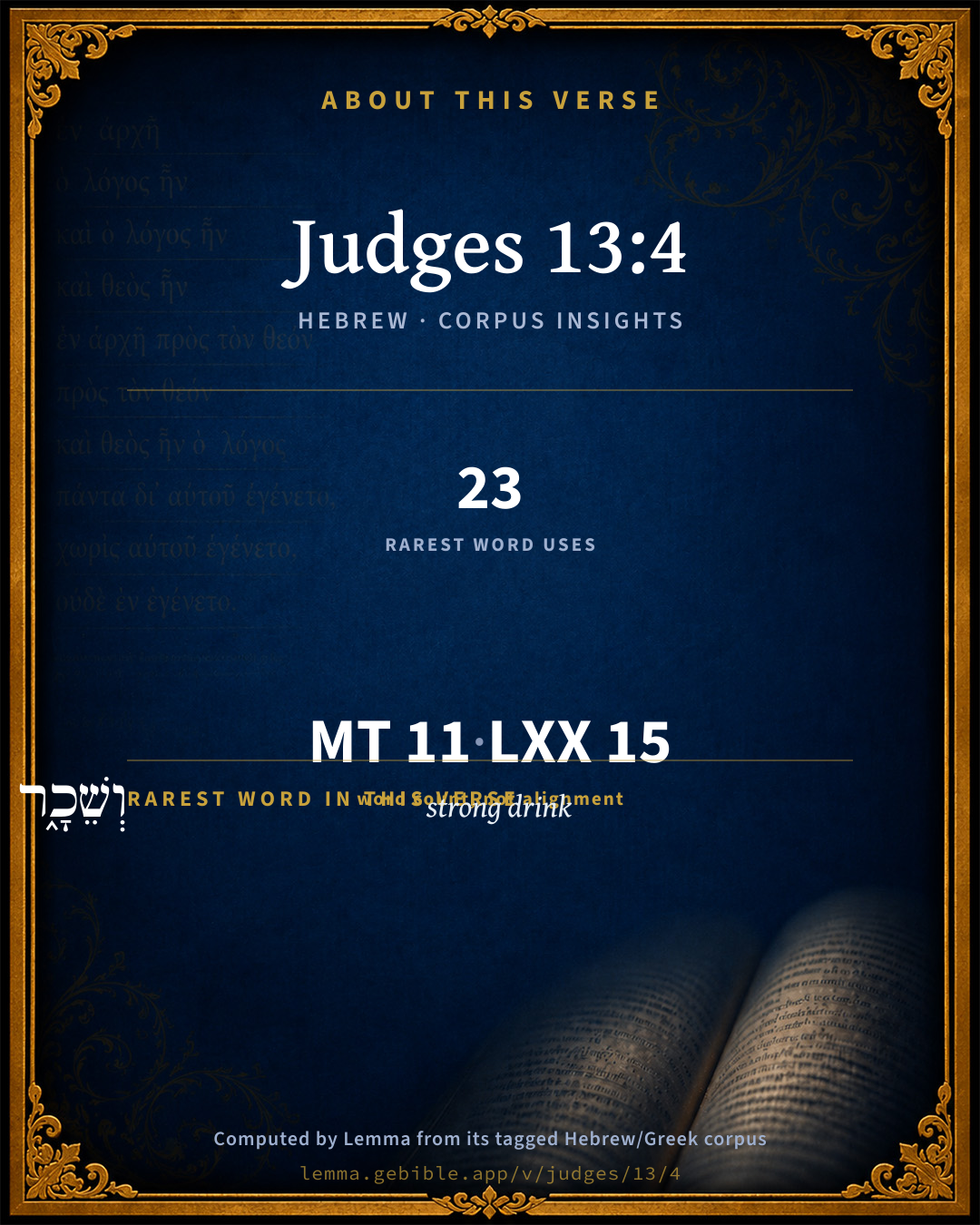
11
words
10
distinct lemmas
Historical
section

Notable vocabulary

The rarest word here is וְשֵׁכָ֑ר strong drink H7941 — appearing just 23 times in the whole Hebrew Bible.

Shared distinctive vocabulary

וְשֵׁכָ֑ר strong drink H7941 occurs in 20 verses of the Hebrew Bible. Also found in:

Grammatical profile

  • 3 verbs
  • 3 nouns
  • 1 adjective
  • 1 adverb
  • 3 particles

Verb forms

  • הִשָּׁ֣מְרִי Niphal · Imperative
  • תִּשְׁתִּ֖י Qal · Jussive
  • תֹּאכְלִ֖י Qal · Jussive

Repetition

A word recurs within this verse — often emphatic in Hebrew:

  • וְאַל not H408 ×2

Hebrew & Septuagint length

In English translation the verse runs 17 words from the Hebrew and 17 from the Septuagint (LXX English) — the same length.

A rough comparison of the two English renderings, which tokenize alike — not a word-level alignment.

Word counts can differ between the Hebrew and the Greek without any difference in meaning — e.g. the Hebrew direct-object marker אֵת has no separate Greek word, and Greek often adds the article ὁ.

In the original languages it is 11 Hebrew tokens and 15 Greek tokens — but the two are counted differently (Hebrew bundles its prefixes and suffixes into one token; the Greek is in lemma form), so that isn’t a like-for-like length.

Cross-references

7

Topical passages linked to Judges 13:4 in the Treasury of Scripture Knowledge — connected by theme and wording, ordered by reader-vote popularity; previews shown in the World English Bible.

  • Luke 1:15 For he will be great in the sight of the Lord, and he will drink no wine nor strong drink. He will be filled with the Holy Spirit, even from his mother's womb.
  • Judges 13:14 She may not eat of anything that comes of the vine, neither let her drink wine or strong drink, nor eat any unclean thing; all that I commanded her let her observe.
  • Numbers 6:2–3 "Speak to the children of Israel, and tell them: When either man or woman shall make a special vow, the vow of a Nazirite, to separate himself to Yahweh,
  • Judges 13:7 but he said to me, Behold, you shall conceive, and bear a son; and now drink no wine nor strong drink, and eat not any unclean thing; for the child shall be a Nazirite to God from the womb to the day of his death.
  • Leviticus 11:27 Whatever goes on its paws, among all animals that go on all fours, they are unclean to you. Whoever touches their carcass shall be unclean until the evening.
  • Leviticus 11:47 to make a distinction between the unclean and the clean, and between the living thing that may be eaten and the living thing that may not be eaten.'"
  • Acts 10:14 But Peter said, "Not so, Lord; for I have never eaten anything that is common or unclean."

Cross-references courtesy of OpenBible.info (CC BY 4.0).

Hebrew and Greek witnesses Masoretic Hebrew ↔ Greek Septuagint

The same verse in the two great witnesses to the Old Testament, shown verse-for-verse.

These are two independent witnesses, not word-aligned to each other, and the Septuagint is shown in lemma (dictionary) form.

Hebrew Judges 13:4 Masoretic · Westminster Leningrad Codex

וְעַתָּה֙ הִשָּׁ֣מְרִי נָ֔א וְאַל תִּשְׁתִּ֖י יַ֣יִן וְשֵׁכָ֑ר וְאַל תֹּאכְלִ֖י כָּל טָמֵֽא

Now therefore please beware and drink no wine nor strong drink, and don't eat any unclean thing:

World English Bible · Public Domain

Greek LXX Judges 13:4 Septuagint · lemma form

καί νῦν φυλάσσω δή καί μή πίνω οἶνος καί μέθυσμα καί μή ἐσθίω πᾶς ἀκάθαρτος

And now be very cautious, and drink no wine nor strong drink, and eat no unclean thing;

LXX2012 (modern English Septuagint) · Public Domain

On this verse, Ellicott's Commentary for English Readers discusses the Septuagint’s reading. Read the note in Commentary ↓

Hebrew: Westminster Leningrad Codex (CC BY 4.0). Greek: Septuagint (public domain); English from LXX2012 (modern English Septuagint) (Public Domain). How the Septuagint differs from the Hebrew →

Targum (Aramaic paraphrase)

1

The Targum is the ancient Jewish Aramaic paraphrase of the Hebrew Scriptures — an interpretive translation, not the Hebrew text itself. Onkelos (literal) and Pseudo-Jonathan (expansive) render the Torah, and Jonathan the Prophets. Coverage is partial: where no permissively-licensed English translation exists for a verse, only the Aramaic is shown. This is verse-level text, not a word-by-word alignment to the Hebrew.

  1. Targum Jonathan Prophets (Joshua–Malachi)
    וּכְעַן אִסְתַּמָרִי כְעַן וְלָא תִשְׁתִּין חֲמַר חֲדַת וְעַתִּיק וְלָא תֵיכְלִין כָּל מְסָאָב:

    (no public-domain English translation for this verse)

    Targum Jonathan — Aramaic: “Mikraot Gedolot” (public domain). English: “Sefaria Community Translation” (CC0 1.0 (public-domain dedication)); “London "Chaldee Paraphrase," 1871” (public domain). Text via Sefaria.

Commentary

Notes on Judges 13:4 from classic Christian and Jewish commentators (each source and its license shown beneath its notes). The classic Christian expositions comment on the surrounding passage and are grouped to its opening verse, so a note may address several verses; the Jewish commentaries on the Tanakh (Rashi and others) are per-verse, so they appear only where the commentator wrote on this verse.

Lemma curates 59 commentaries, every one of them public domain or Creative Commons licensed, each selected and text-cleaned for this edition rather than reprinted as found. About our sources →

Trapp's Complete Commentary

John Trapp

Jdg 13:4 Now therefore beware, I pray thee, and drink not wine nor strong drink, and eat not any unclean [thing]:

Ver. 4. Now therefore beware, I pray thee.] Since he must draw nourishment from thee, both in the womb and at the breasts; since the sanctifying of thy son must take beginning from thyself; beware therefore for his sake, and inure him to abstinence and sobriety of a little child. See also that he nourish his hair, which is the crown of his Nazariteship, {Num 6:1-27} and that he come not at funerals, &c. Quintilian requireth in him that shall be an orator, that by his parents, nurses, attendants, he be inured to the best words well pronounced, and that from his infancy; that so he may soon become Vir bonus dicendi peritus, a good man and well-spoken. How much more requisite is this to a magistrate or minister!

John Trapp, A Commentary or Exposition upon All the Books of the Old and New Testament (1647–1656) — public domain. Text from a community e-Sword module.

Joseph Benson's Commentary

Jdg 13:4. Now therefore beware — She was to conform to the manner of life observed by the Nazarites, while she carried her infant in her womb, and perhaps while she nursed him; because, as it follows in the next verse, he was to be a perpetual Nazarite to God, from his conception to his death; which would have bear impossible if she had drunk wine or strong drink, because a child in the womb and its mother subsist by the same nourishment. Drink not wine nor strong drink — Under which are comprehended the other particulars mentioned Num 6:2-4. And eat not any unclean thing — Any of those meats forbidden Leviticus 11. These were forbidden to all, but especially to the Nazarites. In all probability the Israelites were negligent at that time in observing the precept with relation to meats, otherwise there would have been no need to mention this.

Joseph Benson's Commentary on the Old and New Testaments (1811–1818) — public domain. Text from a community e-Sword module.

Adam Clarke's Commentary

Verse 4. Beware - drink not wine] As Samson was designed to be a Nazarite from the womb, it was necessary that, while his mother carried and nursed him, she should live the life of a Nazarite, neither drinking wine nor any inebriating liquor, nor eating any kind of forbidden meat. See the account of the Nazarite and his vow, see in Clarke's notes on "Nu 6:2", &c.

Adam Clarke's Commentary on the Bible (1810–1826) — public domain. Text from a community e-Sword/MySword module.

Ellicott's Commentary for English Readers

(4) Drink not wine.—The mother is to share for a time in part of the Nazarite vow.

Strong drink.—Sheekar (LXX., Sikera) means intoxicating liquor not made from grapes (Luk_1:15).

Eat not any unclean thing.—Leviticus 11. The law applied to all Israelites, but is to be specially observed by the wife of Manoah, to impress on her and on the nation the separated character of her son.

A Bible Commentary for English Readers, edited by Charles John Ellicott (1878–1897) — public domain. Text from a community e-Sword module.

The Cambridge Bible for Schools and Colleges

gen. ed. J. J. S. Perowne

4. The mother during the time of pregnancy is to observe certain ceremonial restrictions (Jdg_13:7; Jdg_13:14); she is to live in a state of consecration, in order that her child may be consecrated from the very moment of conception. The two prohibitions are classed together, apparently on the principle that to partake of anything fermented or putrified renders a person unfit for consecration to the Deity1[50]. Thus priests during their service were not allowed to drink wine (Lev_10:9, Eze_44:21); while unclean foods, i.e. carrion (Exo_22:31, Lev_7:24, Deu_14:21) and tabooed animals (Lev_11:2-23, Deu_14:3-20) were forbidden, the former because it had begun to decompose, the latter because in accordance with ancient ideas and custom they could not be used for sacrifice or for food. The restrictions are laid upon the mother; nothing is said about the child observing them. Samson did not consider himself bound to abstain from wine (see below); the second prohibition was not distinctive of the Nazirite consecration.

[50] See Robertson Smith, Rel. of Sem., 203 f., 367, 465. Frazer, Golden Bough i. 183–185, suggests that the ultimate reason for abstinence from intoxicating wine was the idea that ‘whoever drinks wine drinks the blood, and so receives into himself the soul or spirit of the god of the vine.’ Such intercourse with a spirit alien to Jehovah would be regarded by a Hebrew as unlawful. The Nazirite abstinence from wine seems to have been determined by other reasons, as suggested above; when it came into practice the original meaning of the prohibition was lost.

The Cambridge Bible for Schools and Colleges (gen. ed. J. J. S. Perowne; Cambridge University Press, 1878–1918) — public domain. Text from a community e-Sword module.

John Gill's Exposition

Now therefore beware, I pray thee, and drink not wine nor strong drink,.... Any liquor inebriating and intoxicating, neither new wine nor old wine, as the Targum, and so Jarchi; the reason of this appears in the next verse, because the child she should conceive and bear was to be a Nazarite, and to be one from his mother's womb; and from all such liquors, Nazarites, according to the law, were to abstain, Num 6:3.

and eat not any unclean thing; meaning not so much such sort of food as was forbidden by the law to be eaten, which every Israelite was to abstain from, but such as were particularly forbidden to Nazarites, as moist and dried grapes, or anything made of the vine tree, from the kernel to the husk, Num 6:3. The reason of this is, because the child in the womb is nourished with the same the mother is; and as this child was to be a Nazarite from the womb, and even in it, his mother was to abstain both from eatables and drinkables forbidden a Nazarite by the law.

John Gill's Exposition of the Whole Bible (1746–1763) — public domain (CC PDM 1.0). Text via the HelloAO Bible API.

Haydock's Catholic Bible Commentary

Thing. Exhortations to observe the law are not unnecessary. (St. Augustine, q. 50.) Besides the things which common people might take, such as wine, grapes, &c., were unclean for the Nazarites. The mother of Samson was required to abstain from every species of uncleanness as much as possible, at least while she bore and nursed her child. (Calmet) --- Abulensis says, she was unquestionably under peculiar restrictions till her delivery. (Menochius) --- This was a preparation for the child who should abstain from all unclean things, not only for a time, (Numbers vi.) but during his whole life, that he might be a more perfect figure of Christ. (Worthington) --- His dignity was not of choice, nor could he forfeit it by touching any thing unclean, nor by the violent cutting off his hair. As the deliverer of the people, he must often have been obliged to touch dead bodies. (Calmet) --- Begin. The power of the Philistines was greatly broken by Samson, chap xvi. 13. (Menochius) --- But Samuel, Saul, and David had still to contend with them, 1 Kings vii. 13. (Haydock)

George Leo Haydock (1774–1849), Haydock's Catholic Family Bible and Commentary, 1859 edition — public domain. Excludes Psalms (Douay-Rheims chapter numbering differs from Protestant) and Deuterocanonical books (Catholic canon only).

Matthew Poole's English Annotations

Beware, I pray thee; because the child was to be a Nazarite from the womb, Jdg 13:5, and from the conception; and because the mother’s pollution extends to the child, she is enjoined from this time to observe the following rules belonging to the Nazarites.

And drink not wine, nor strong drink; under which by a synecdoche are comprehended the other particulars mentioned Num 6:2-4, as is implied Jdg 13:14.

Any unclean thing; any of those meats forbidden Le 11, which were forbidden to all, but especially to the Nazarites.

Matthew Poole's English Annotations on the Holy Bible (1683–1685) — public domain. Text from a community e-Sword/MySword module.

John Wesley's Explanatory Notes

Beware - Because the child was to be a Nazarite from the womb, ver. 5, and from the conception; and because the mother's pollution extends to the child, she is enjoined from this time to observe the following rules belonging to the Nazarites. Strong drink - Under which are comprehended the other particulars mentioned, Num. vi, 2-4. Nor eat - Any of those meats forbidden, Levit xi, 1-47, which were forbidden to all, but especially to the Nazarites.

John Wesley, Explanatory Notes Upon the Whole Bible (1754–1765) — public domain. Text via the GEBible commentary corpus.

Rashi

Rabbi Shlomo Yitzchaki (Rashi)

Freshly pressed or intoxicating wine Freshly pressed or aged wine.

Rashi on the Tanakh — English translations: “The Judaica Press complete Tanach with Rashi, translated by A. J. Rosenberg” (CC BY 4.0); “Pentateuch with Rashi's commentary by M. Rosenbaum and A.M. Silbermann, 1929-1934” (public domain); “The Metsudah Tanach series, Lakewood, N.J” (CC BY 4.0); and “The Book of Joshua, Metsudah Publications, 1997” (CC BY 4.0). Text via Sefaria.

Lesson kit

Teaching starters — assembled from the data on this page, not authored interpretation. Every prompt links to the verse data it draws on. Edit before teaching.

Judges, in the Historical, opens this verse with 11 words (10 distinct Hebrew lemmas). Its most distinctive word is shêkâr (“strong drink”). A historical commentator’s framing appears above. Read the whole chapter for the surrounding context.

Discussion questions

  1. What does “strong drink” (shêkâr) contribute to the verse as a whole?
  2. Leviticus 10:9 shares the word «strong drink» with this verse. How do the two illuminate each other?
  3. “not” occurs 2× in this one verse. What is the effect of the repetition?
  4. These translations render this verse differently. What is at stake in choosing one wording over another?
  5. The verb «הִשָּׁ֣מְרִי» is Niphal Imperative. How does its form color the action?
  6. Reading how Trapp's Complete Commentary and Joseph Benson's Commentary read this verse, where do the two commentators agree and where do they part?

Things to notice

Reading settings

Reading text

Shown beneath each verse's original-language words.

Old Testament
Old Testament edition

Read the OT as the Masoretic Hebrew (MT) or the Greek Septuagint (LXX).

English shown for the Greek Septuagint (in the Hebrew ↔ Greek comparison).

Comparing translations? Open the Compare panel on any verse page to stack up to four side by side.