
1 Samuel 18:17

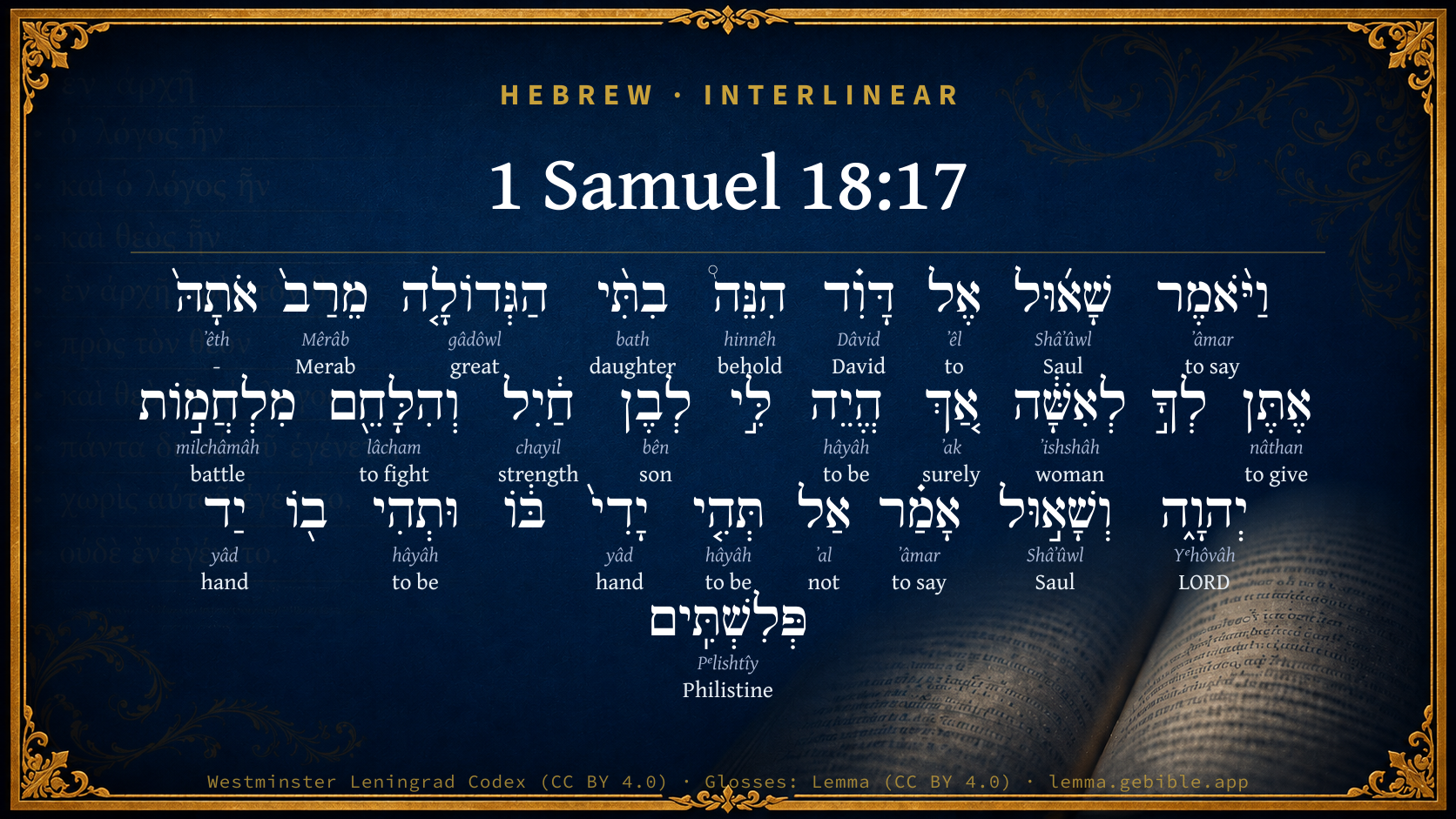
Hebrew (Westminster Leningrad Codex) 1 Samuel 18:17 appears in the Hebrew Old Testament. The text above is from the Westminster Leningrad Codex. Each word links to its Strong’s number, a concise gloss, and parsing drawn from the Open Scriptures Hebrew Bible morphology. Click any word for its full Brown-Driver-Briggs (BDB) entry.
Download image
Cite this verse

1 Samuel 18:17 (World English Bible). Public Domain. Lemma interlinear Bible study tool, https://lemma.gebible.app/v/1-samuel/18/17.

Show BibTeX & RIS
BibTeX
RIS
English Translation
Saul said to David, Behold, my elder daughter Merab, her will I give you as wife: only be valiant for me, and fight Yahweh's battles. For Saul said, Don't let my hand be on him, but let the hand of the Philistines be on him.
World English Bible · Public Domain
Download a study sheet

One document with this verse’s original text, its word-by-word gloss line, the meaning frame, cross-references with their text, attributed commentary, and full source and license credits — printable, and it pastes into notes with its structure intact.

This verse Autodidact and up

Study sheet (.html) Plain text (.txt)

A passage Seminary Student

Up to 50 verses in one chapter. A passage sheet keeps up to 6 commentary sources and 12 cross-references per verse, in the order this page ranks them, and says so on the sheet whenever that leaves anything out. Ask for a single verse and you get the Autodidact verse sheet above.

Everything on this page stays free to read, with no account — the sheet is a download of what is already on screen, not access to it.

Want to remove ads? Support Godless Engineer
Compare translations 3

The same verse in 3 English versions, stacked beneath the original-language interlinear above. Click any original word for its lexicon entry.

Each is an independent rendering of the whole verse — the interlinear is not word-aligned to these translations.

Highlighted words mark where these versions differ — a whole-verse word diff, not a word-by-word alignment.

  • World English Bible Public Domain
    Saul said to David, Behold, my elder daughter Merab, her will I give you as wife: only be valiant for me, and fight Yahweh's battles. For Saul said, Don't let my hand be on him, but let the hand of the Philistines be on him.
  • King James Version Public Domain
    And Saul said to David, Behold my elder daughter Merab, her will I give thee to wife: only be thou valiant for me, and fight the LORD's battles. For Saul said, Let not mine hand be upon him, but let the hand of the Philistines be upon him.
  • unfoldingWord Literal Text CC BY-SA 4.0
    And Saul said to David, “Behold my older daughter Merab. I will give her to you for a wife. Only be for me a son of valor and fight the battles of Yahweh.” And Saul said, “Let not my hand be against him, but let the hand of the Philistines be against him.”

unfoldingWord Literal Text — © unfoldingWord, licensed CC BY-SA 4.0. Word-aligned USFM3 via Door43 (git.door43.org/unfoldingWord/en_ult).

Versions to compare (up to 4)

3 of 4 selected

Show all 18 translations

Every available English version of this verse, each an independent rendering of the whole verse.

  • World English Bible Public Domain
    Saul said to David, Behold, my elder daughter Merab, her will I give you as wife: only be valiant for me, and fight Yahweh's battles. For Saul said, Don't let my hand be on him, but let the hand of the Philistines be on him.
  • Berean Standard Bible Public Domain
    Then Saul said to David, “Here is my older daughter Merab. I will give her to you in marriage. Only be valiant for me and fight the LORD’s battles.” But Saul was thinking, “I need not raise my hand against him; let the hand of the Philistines be against him.”
  • Majority Standard Bible Public Domain
    Then Saul said to David, “Here is my older daughter Merab. I will give her to you in marriage. Only be valiant for me and fight the LORD’s battles.” But Saul was thinking, “I need not raise my hand against him; let the hand of the Philistines be against him.”
  • King James Version Public Domain
    And Saul said to David, Behold my elder daughter Merab, her will I give thee to wife: only be thou valiant for me, and fight the LORD's battles. For Saul said, Let not mine hand be upon him, but let the hand of the Philistines be upon him.
  • American Standard Version (1901) Public Domain
    And Saul said to David, Behold, my elder daughter Merab, her will I give thee to wife: only be thou valiant for me, and fight Jehovah's battles. For Saul said, Let not my hand be upon him, but let the hand of the Philistines be upon him.
  • Revised Version (1885) Public Domain
    And Saul said to David, Behold, my elder daughter Merab, her will I give thee to wife: only be thou valiant for me. and fight the LORD’S battles. For Saul said, Let not mine hand be upon him, but let the hand of the Philistines be upon him.
  • Geneva Bible (1599) Public Domain
    Then Saul sayd to Dauid, Beholde mine eldest daughter Merab, her I will giue thee to wife: onely be a valiant sonne vnto me, and fight the Lordes battels: for Saul thought, Mine hand shall not be vpon him, but the hand of the Philistims shalbe vpon him.
  • Douay-Rheims (1899) Public Domain
    And Saul said to David: Behold my elder daughter Merob, her will I give thee to wife: only be a valiant man, and fight the battles of the Lord. Now Saul said within himself: Let not my hand be upon him, but let the hands of the Philistines be upon him.
  • Young's Literal Translation Public Domain
    And Saul saith unto David, `Lo, my elder daughter Merab -- her I give to thee for a wife; only, be to me for a son of valour, and fight the battles of Jehovah;' and Saul said, `Let not my hand be on him, but let the hand of the Philistines be upon him.'
  • Literal Standard Version CC BY-SA 4.0
    And Saul says to David, “Behold, my elder daughter Merab—I give her to you for a wife; only, be for a son of valor to me, and fight the battles of YHWH”; and Saul said, “Do not let my hand be on him, but let the hand of the Philistines be on him.”
  • Unlocked Literal Bible CC BY-SA 4.0
    Then Saul said to David, “Here is my oldest daughter Merab. I will give her to you as a wife. Only be courageous for me and fight Yahweh's battles.” For Saul thought, “Let not my hand be on him, but let the hand of the Philistines be on him.”
  • unfoldingWord Literal Text CC BY-SA 4.0
    And Saul said to David, “Behold my older daughter Merab. I will give her to you for a wife. Only be for me a son of valor and fight the battles of Yahweh.” And Saul said, “Let not my hand be against him, but let the hand of the Philistines be against him.”
  • Darby Bible Public Domain
    And Saul said to David, Behold my eldest daughter Merab, her will I give thee to wife; only be thou valiant for me, and fight Jehovah's battles. But Saul thought, My hand shall not be upon him, but the hand of the Philistines shall be upon him.
  • World Messianic Bible Public Domain
    Saul said to David, “Behold, my elder daughter Merab. I will give her to you as wife. Only be valiant for me, and fight the LORD’s battles.” For Saul said, “Don’t let my hand be on him, but let the hand of the Philistines be on him.”
  • Webster's Bible Public Domain
    And Saul said to David, Behold, my elder daughter Merab, her will I give thee for a wife: only be thou valiant for me, and fight the LORD'S battles. For Saul said, Let not my hand be upon him, but let the hand of the Philistines be upon him.
  • Free Bible Version CC BY-SA 4.0
    One day Saul told David, “Here's my oldest daughter Merab. I will give her to you in marriage, but only if you prove to me you're a brave warrior and fight the battles of the Lord.” For Saul was thinking, “I don't need to be the one to kill him—let the Philistines do it!”
  • Bible in Basic English Public Domain
    And Saul said to David, Here is my oldest daughter Merab, whom I will give you for your wife: only be strong for me, fighting in the Lord's wars. For Saul said, Let it not be through me that his fate comes to him, but through the Philistines.
  • JPS Tanakh (1917) Public Domain
    And Saul said to David: 'Behold my elder daughter Merab, her will I give thee to wife; only be thou valiant for me, and fight the LORD'S battles.' For Saul said: 'Let not my hand be upon him, but let the hand of the Philistines be upon him.'

Literal Standard Version (2020), Covenant Press — licensed CC BY-SA 4.0. Text via the HelloAO Bible API (eBible.org). Unlocked Literal Bible (unfoldingWord) — licensed CC BY-SA 4.0. Text via the HelloAO Bible API (eBible.org). unfoldingWord Literal Text — © unfoldingWord, licensed CC BY-SA 4.0. Word-aligned USFM3 via Door43 (git.door43.org/unfoldingWord/en_ult). Free Bible Version, Dr. Jonathan Gallagher — licensed CC BY-SA 4.0. Text via the HelloAO Bible API (eBible.org).

Word by word

More ways to search: Search by grammar → Find every occurrence → Compare this word →

Practice this passage: Drill this verse → Learn its vocabulary →

מֵרַב֙
Mêrâb
H4764
“Merab”
Noun, Proper
Part of Speech
Noun
Type
Proper
Full BDB Definition

Origin: from H7231

TWOT: None

Merab = "increase" - the eldest daughter of king Saul; promised to David but given instead to Adriel the Meholathite; mother of 5 children
  1. וַיֹּ֨אמֶר ʼâmar H559 “and · to say” Conjunction + Verb, Qal, Sequential Imperfect, 3rd Person, Masculine, Singular
  2. שָׁא֜וּל Shâʼûwl H7586 “Saul” Noun, Proper
  3. אֶל ʼêl H413 “to” Preposition
  4. דָּוִ֗ד Dâvid H1732 “David” Noun, Proper
  5. הִנֵּה֩ hinnêh H2009 “behold” Particle, Demonstrative
  6. בִתִּ֨י bath H1323 “daughter · my” Noun, Common, Feminine, Singular, Construct + Suffix, Personal, 1st Person, Common, Singular
  7. הַגְּדוֹלָ֤ה gâdôwl H1419 “the · great” Particle, Definite Article + Adjective, Adjective, Feminine, Singular, Absolute
  8. אֹתָהּ֙ ʼêth H853 “- · her” Particle, Direct Object + Suffix, Personal, 3rd Person, Feminine, Singular
  9. אֶתֶּן nâthan H5414 “to give” Verb, Qal, Imperfect, 1st Person, Common, Singular
  10. לְאִשָּׁ֔ה ʼishshâh H802 “to/for · woman” Preposition + Noun, Common, Feminine, Singular, Absolute
  11. אַ֚ךְ ʼak H389 “surely” Particle, Accusative
  12. הֱיֵה hâyâh H1961 “be” Verb, Qal, Imperative, 2nd Person, Masculine, Singular
  13. לְבֶן bên H1121 “to/for · son of” Preposition + Noun, Common, Masculine, Singular, Construct
  14. חַ֔יִל chayil H2428 “strength” Noun, Common, Masculine, Singular, Absolute
  15. וְהִלָּחֵ֖ם lâcham H3898 “and · fight” Conjunction + Verb, Niphal, Imperative, 2nd Person, Masculine, Singular
  16. מִלְחֲמ֣וֹת milchâmâh H4421 “battles of” Noun, Common, Feminine, Plural, Construct
  17. יְהוָ֑ה Yᵉhôvâh H3068 “LORD” Noun, Proper
  18. וְשָׁא֣וּל Shâʼûwl H7586 “and · Saul” Conjunction + Noun, Proper
  19. אָמַ֗ר ʼâmar H559 “to say” Verb, Qal, Perfect, 3rd Person, Masculine, Singular
  20. אַל ʼal H408 “not” Particle, Negative
  21. תְּהִ֤י hâyâh H1961 “to be” Verb, Qal, Jussive, 3rd Person, Feminine, Singular
  22. יָדִי֙ yâd H3027 “hand · my” Noun, Common, Both, Singular, Construct + Suffix, Personal, 1st Person, Common, Singular
  23. וּתְהִי hâyâh H1961 “and · to be” Conjunction + Verb, Qal, Jussive, 3rd Person, Feminine, Singular
  24. יַד yâd H3027 “hand of” Noun, Common, Both, Singular, Construct
  25. פְּלִשְׁתִּֽים Pᵉlishtîy H6430 “Philistines” Noun, Gentilic, Masculine, Plural, Absolute

About this verse

These counts appear in no published source. They are computed here, from the morphology-tagged text and Lemma’s own curated glosses. What Lemma adds →

30
words
21
distinct lemmas
Historical
section

Notable vocabulary

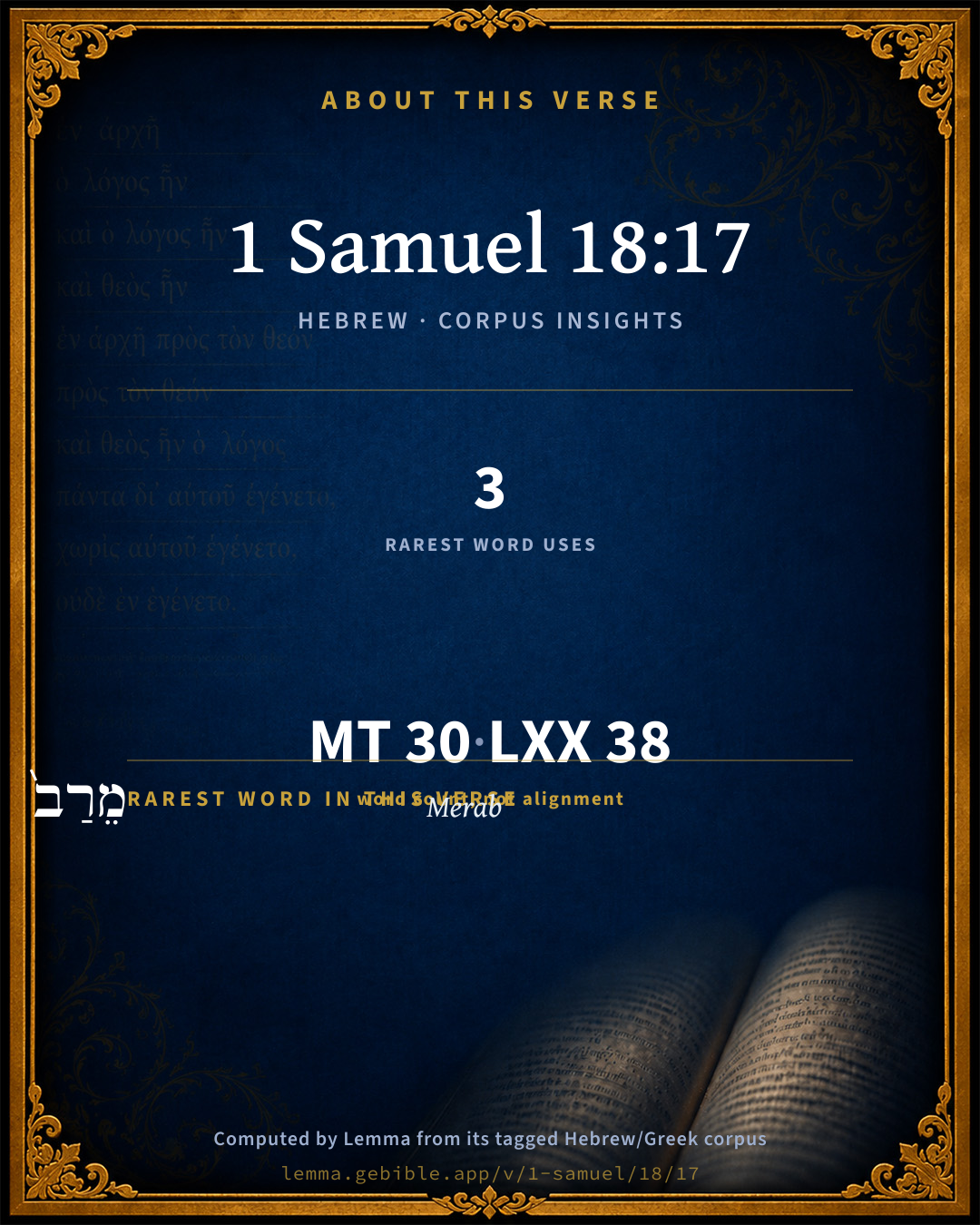
The rarest word here is מֵרַב֙ Merab H4764 — appearing just 3 times in the whole Hebrew Bible.

Shared distinctive vocabulary

מֵרַב֙ Merab H4764 occurs in 3 verses of the Hebrew Bible. Also found in:

Grammatical profile

  • 7 verbs
  • 13 nouns
  • 1 adjective
  • 5 prepositions
  • 4 particles

Verb forms

  • וַיֹּ֨אמֶר Qal · Sequential Imperfect
  • אֶתֶּן Qal · Imperfect
  • הֱיֵה Qal · Imperative
  • וְהִלָּחֵ֖ם Niphal · Imperative
  • אָמַ֗ר Qal · Perfect
  • תְּהִ֤י Qal · Jussive
  • וּתְהִי Qal · Jussive

Repetition

Words recur within this verse — often emphatic in Hebrew:

  • הֱיֵה to be H1961 ×3
  • וַיֹּ֨אמֶר to say H559 ×2
  • שָׁא֜וּל Saul H7586 ×2
  • יָדִי֙ hand H3027 ×2

Hebrew & Septuagint length

In English translation the verse runs 45 words from the Hebrew and 53 from the Septuagint (LXX English) — closely comparable.

A rough comparison of the two English renderings, which tokenize alike — not a word-level alignment.

Word counts can differ between the Hebrew and the Greek without any difference in meaning — e.g. the Hebrew direct-object marker אֵת has no separate Greek word, and Greek often adds the article ὁ.

In the original languages it is 30 Hebrew tokens and 38 Greek tokens — but the two are counted differently (Hebrew bundles its prefixes and suffixes into one token; the Greek is in lemma form), so that isn’t a like-for-like length.

Cross-references

14

Topical passages linked to 1 Samuel 18:17 in the Treasury of Scripture Knowledge — connected by theme and wording, ordered by reader-vote popularity; previews shown in the World English Bible.

  • 1 Samuel 17:25 The men of Israel said, Have you seen this man who is come up? surely to defy Israel is he come up: and it shall be, that the man who kills him, the king will enrich him with great riches, and will give him his daughter, and make his father's house free in Israel.
  • 1 Samuel 18:25 Saul said, Thus shall you tell David, The king desires no dowry except one hundred foreskins of the Philistines, to be avenged of the king's enemies. Now Saul thought to make David fall by the hand of the Philistines.
  • 1 Samuel 25:28 Please forgive the trespass of your handmaid: for Yahweh will certainly make my lord a sure house, because my lord fights the battles of Yahweh; and evil shall not be found in you all your days.
  • 1 Samuel 18:21 Saul said, I will give her to him, that she may be a snare to him, and that the hand of the Philistines may be against him. Therefore Saul said to David, You shall this day be my son-in-law a second time.
  • 1 Samuel 17:47 and that all this assembly may know that Yahweh doesn't save with sword and spear: for the battle is Yahweh's, and he will give you into our hand.
  • Numbers 21:14 Therefore it is said in the book of the Wars of Yahweh, Vaheb in Suphah, The valleys of the Arnon,
  • Numbers 32:20 Moses said to them, If you will do this thing, if you will arm yourselves to go before Yahweh to the war,
  • Numbers 32:27 but your servants will pass over, every man who is armed for war, before Yahweh to battle, as my lord says.
  • Numbers 32:29 Moses said to them, If the children of Gad and the children of Reuben will pass with you over the Jordan, every man who is armed to battle, before Yahweh, and the land shall be subdued before you; then you shall give them the land of Gilead for a possession:
  • Deuteronomy 17:7 The hand of the witnesses shall be first on him to put him to death, and afterward the hand of all the people. So you shall put away the evil from the midst of you.
  • 2 Samuel 11:15 He wrote in the letter, saying, Set Uriah in the forefront of the hottest battle, and retire you from him, that he may be struck, and die.
  • 2 Samuel 12:9 Why have you despised the word of Yahweh, to do that which is evil in his sight? You have struck Uriah the Hittite with the sword, and have taken his wife to be your wife, and have slain him with the sword of the children of Ammon.
  • Psalms 12:2 Everyone lies to his neighbor. They speak with flattering lips, and with a double heart.
  • Psalms 55:21 His mouth was smooth as butter, But his heart was war. His words were softer than oil, Yet they were drawn swords.

Cross-references courtesy of OpenBible.info (CC BY 4.0).

Hebrew and Greek witnesses Masoretic Hebrew ↔ Greek Septuagint

The same verse in the two great witnesses to the Old Testament, shown verse-for-verse.

These are two independent witnesses, not word-aligned to each other, and the Septuagint is shown in lemma (dictionary) form.

Hebrew 1 Samuel 18:17 Masoretic · Westminster Leningrad Codex

וַיֹּ֨אמֶר שָׁא֜וּל אֶל דָּוִ֗ד הִנֵּה֩ בִתִּ֨י הַגְּדוֹלָ֤ה מֵרַב֙ אֹתָהּ֙ אֶתֶּן לְךָ֣ לְאִשָּׁ֔ה אַ֚ךְ הֱיֵה לִּ֣י לְבֶן חַ֔יִל וְהִלָּחֵ֖ם מִלְחֲמ֣וֹת יְהוָ֑ה וְשָׁא֣וּל אָמַ֗ר אַל תְּהִ֤י יָדִי֙ בּ֔וֹ וּתְהִי ב֖וֹ יַד פְּלִשְׁתִּֽים

Saul said to David, Behold, my elder daughter Merab, her will I give you as wife: only be valiant for me, and fight Yahweh's battles. For Saul said, Don't let my hand be on him, but let the hand of the Philistines be on him.

World English Bible · Public Domain

Greek LXX 1 Samuel 18:17 Septuagint · lemma form

καί ἀναἵστημι δαυίδ καί πορεύομαι αὐτός καί ὁ ἀνήρ αὐτός καί πατάσσω ἐν ὁ ἀλλόφυλος ἑκατόν ἀνήρ καί ἀναφέρω ὁ ἀκροβυστία αὐτός ὁ βασιλεύς καί ἐπιγαμβρεύω ὁ βασιλεύς καί δίδωμι αὐτός ὁ μελχολ θυγάτηρ αὐτός αὐτός εἰς γυνή

And Saul said to David, Behold my elder daughter Merob, I will give her to you to Wife, only be you to me a mighty man and fight the wars of the Lord. And Saul said, Let not my hand be upon him, but the hand of the Philistines shall be upon him.

LXX2012 (modern English Septuagint) · Public Domain

On this verse, Keil & Delitzsch discusses the Septuagint’s reading. Read the note in Commentary ↓

Hebrew: Westminster Leningrad Codex (CC BY 4.0). Greek: Septuagint (public domain); English from LXX2012 (modern English Septuagint) (Public Domain). How the Septuagint differs from the Hebrew →

Targum (Aramaic paraphrase)

1

The Targum is the ancient Jewish Aramaic paraphrase of the Hebrew Scriptures — an interpretive translation, not the Hebrew text itself. Onkelos (literal) and Pseudo-Jonathan (expansive) render the Torah, and Jonathan the Prophets. Coverage is partial: where no permissively-licensed English translation exists for a verse, only the Aramaic is shown. This is verse-level text, not a word-by-word alignment to the Hebrew.

  1. Targum Jonathan Prophets (Joshua–Malachi)
    וַאֲמַר שָׁאוּל לְדָוִד הָא בְרַתִּי רַבְּתָא מֵרַב יָתָהּ אֶתֵּן לָךְ לְאִתּוּ בְּרַם הֱוֵי לִי לִגְבַר עָבֵיד קְרָבִי וְאַגַח קְרָבָא דְעַמֵיהּ דַייָ וְשָׁאוּל אֲמַר לָא תְהֵי יְדִי בֵּיהּ וְיִתְמְסַר בִּידָא דִפְלִשְׁתָּאֵי:

    (no public-domain English translation for this verse)

    Targum Jonathan — Aramaic: “Mikraot Gedolot” (public domain). English: “Sefaria Community Translation” (CC0 1.0 (public-domain dedication)); “London "Chaldee Paraphrase," 1871” (public domain). Text via Sefaria.

Commentary

Notes on 1 Samuel 18:17 from classic Christian and Jewish commentators (each source and its license shown beneath its notes). The classic Christian expositions comment on the surrounding passage and are grouped to its opening verse, so a note may address several verses; the Jewish commentaries on the Tanakh (Rashi and others) are per-verse, so they appear only where the commentator wrote on this verse.

Lemma curates 59 commentaries, every one of them public domain or Creative Commons licensed, each selected and text-cleaned for this edition rather than reprinted as found. About our sources →

Jamieson, Fausset & Brown

Robert Jamieson, A. R. Fausset & David Brown

HE OFFERS HIM HIS DAUGHTER FOR A SNARE. (Sa1 18:17-21)

Saul said to David, Behold my elder daughter Merab, her will I give thee to wife--Though bound to this already [Sa1 17:25], he had found it convenient to forget his former promise. He now holds it out as a new offer, which would tempt David to give additional proofs of his valor. But the fickle and perfidious monarch broke his pledge at the time when the marriage was on the eve of being celebrated, and bestowed Merab on another man (see on Sa2 21:8); an indignity as well as a wrong, which was calculated deeply to wound the feelings and provoke the resentment of David. Perhaps it was intended to do so, that advantage might be taken of his indiscretion. But David was preserved from this snare.

Jamieson, Fausset & Brown — Commentary Critical and Explanatory on the Whole Bible (1871) — public domain (CC PDM 1.0). Text via the HelloAO Bible API.

Trapp's Complete Commentary

John Trapp

1Sa 18:17 And Saul said to David, Behold my elder daughter Merab, her will I give thee to wife: only be thou valiant for me, and fight the LORD’S battles. For Saul said, Let not mine hand be upon him, but let the hand of the Philistines be upon him.

Ver. 17. Behold mine elder daughter Merab.] She was due to him before by promise, for killing Goliath; yet he that twice inquired into the reward of that enterprise before he undertook it, never demanded it after that achievement. Now, no remedy but he must be a son, where he was a rival. Love is pretended, but mischief purposed. So dealt Herod, Domitian, Charles IX.

Let not mine hand be upon him.] Saul did not kill David, because he durst not for fear of the people; or, as Kimchi thinketh, lest he should afterwards have been brought into question for murder.

John Trapp, A Commentary or Exposition upon All the Books of the Old and New Testament (1647–1656) — public domain. Text from a community e-Sword module.

The Biblical Illustrator

Joseph S. Exell

1Sa_18:17

Fight the Lords battles.

Aggressive work

The history of the human race is one of progress. Divine revelation has moved accordingly. The character of David is a sore problem to the narrow observer, because he who killed his tens of thousands drew his courage from a Divine fountain. The blame is thrown upon the fountain. A much more elastic view must be taken, and the physical regarded as the basilar of the moral, as the flint hammer of Spiennes was the forerunner of the steam hammer of today. The prowess which slew the giant of Philistia has developed into a moral force which crushes tyranny, slavery, ignorance, and irreligion. As Saul said to David, Fight the battles of the Lord, so saith the Spirit, to the Christian Church. The weapons of our warfare differ, and the condition of our courage is not identical. The noble and disinterested Christian has taken the place of the lion-hearted warrior. There must be a determined opposition to every evil, and the war must be carried into the enemys camp. When the enormous crimes of today are taken out of the calendar, and society so far regenerated that all shall know the Lord, then, and not till then, may the Church lay aside the weapons of war, to enjoy the spoils, the dance, and the timbrel. The conditions of power and efficiency which the Church needs in order to aggressive work. The test question of the late Carlyle to persons seeking his influence was, What work are you doing? He measured mens capacities for that, which they sought by that which they had accomplished. The fact that the followers of Jesus wield an enormous influence, and are doing a grand work at the present time, encourages the belief that they will yet do more. To extend that influence, and multiply actions, two things are needed, viz., the dedication of all learning, talent, riches, power, and time, which the Church possesses, to the service of Christ and man; and then the energising of all these resources by the Spirit of God, that they may become Divine forces in the salvation of the world. It is needless to say that this has not been done to the extent required.

1. There must be a deeper sense of the responsibility of the situation. The Masters injunction is, Occupy till I come. See how it is acted upon in other spheres--the captain on the bridge, the soldier on the battlefield, the premier at the helm of the state, the merchant in the counting house, the scientist in his laboratory, the artist, before the canvas, the musician at the organ, the poet in his study, as well as the husbandman and the workman in their spheres of labour. They all occupy very earnestly their stations. Christians are the dramatis personae who take the stage to show the love of God in Christ Jesus. Time and eternity alike demand the white heat of that earnestness which sacrifices all in order to save come.

2. There must be a stronger faith in the weapons of our warfare. And take the helmet of salvation, and the sword of the Spirit, which is the word of God. In the hand of faith the sword becomes omnipotent. (T. Davies, M. A.)

War! War! War!

I. The Lords battles, what are they?

1. The Lords battle is first of all with sin. Seek grace to fight that battle in your own heart. Endeavour by Divine grace to overcome those propensities which continually push you towards iniquity. On your knees wrestle against your besetting sins. As habits appear endeavour to break them by the battleaxe of strong resolution wielded by the arm of faith. Put down pride, and sloth, and lust, and unbelief, and you have now a battle before you which may fill your hands, and more than fill them. And while this battle is being fought, ay, and while it is still fighting, go out and fight with other mens sins. Smite them first with the weapon of holy example. Be yourselves what you would have others be; be ye clean that bear the vessels of the Lord. Be yourselves clean ere ye can hope to be the purifiers of the world. Let your testimony be unflinching; never let a sin pass under your eye without rebuke. Go ye forth where sin is the most rampant. Go down the dark alley; climb the creaking staircase; penetrate the dens of iniquity.

2. And even so must we cry against error. It is the preachers business to preach the whole gospel of God, and to vindicate the truth as it is in Jesus from the opposition of man. Thousands are the heresies which now beset the church. O children of God! fight the Lords battles for truth. I am astonished, and yet more astonished when I come to turn it over, at the want of earnestness that there is in the Protestantism of the present age.

3. And yet again, it is the Christians duty always to have war with war. To have bitterness in our hearts against any man that lives is to serve Satan. We must speak very sternly against error, and against sin; but against men we have not a word to say. With men the Christian is one. Are we not every mans brother? God hath made of one flesh all people that dwell upon the face of the earth. The cause of Christ is the cause of humanity. We are friends to all, and are enemies to none.

II. The Lords soldiers: who are they that are to fight the Lords battles? Not everybody. The Lord has His army, His church: who are they? The Lords soldiers are all of His own choosing. He has chosen them out of the world; and they are not of the world, even as Christ is not of the world.

III. The exhortation. Fight the Lords battles. If you are the soldier of the heavenly King, To arms! to arms! And now, I will read you over the code martial--the rules which Christ, the Captain, would have you obey in fighting His battles.

Regulation

I.

No communication nor union with the enemy! No truce, no league, no treaty, are you to make with the enemies of Christ.

Regulation

II.--No quarter to be given or taken! Have nought to do with its pretended friendship. Ask nothing at its hands; let it be crucified to you, and you to it.

Regulation

III.--No weapons or ammunition taken from the enemy are to be used by Immanuels soldiers, but are to be utterly burned with fire!

Regulation

IV.--No fear, trembling, or cowardice! Fear not. Remember, if any man be ashamed of Christ in this generation, of him will Christ be ashamed in the day when He comes in the glory of His Father and all His holy angels.

Regulation

V.--No slumbering, rest, ease, or surrender! Be always at it, all at it, constantly at it, with all your might at it. No rest. I see sometimes the captains marching their soldiers to and fro, and you may laugh and say they are doing nothing; but mark, all that manoeuvring, that forming into square, and so forth, has its practical effect when they come into the field of battle. Suffer me, then, to put the Christian through his postures.

1. The first posture the Christian ought to take, and in which he ought to be very well practised, is this. Down upon both knees, hands up, and eyes up to Heaven!

2. The next posture is: Feet fast, hands still, and eyes up! A hard posture that, though it looks very easy.

3. Another posture is this: Quick march, continually going onward! Ah! there are some Christians who are constantly sleeping on their guns; but they do not understand the posture of going onward. Quick march!

4. Another posture is one that is very hard to learn indeed. It is what no soldier, I think, was ever told to do by his captain, except the soldier of Christ: Eyes shut, and ears shut, and heart shut! That is when you go through Vanity Fair.

5. And then there is another posture: Feet firm, sword in hand, eyes open; looking at your enemy, watching every feint that he makes, and watching too your opportunity to let fly at him, sword in hand! That posture you must maintain every day.

6. There is one other posture, which is a very happy one for the child of God to take up and I would have you remember today. Hands wide open, and heart wide open, when you are helping your brethren.

7. Above all, the best posture for Christs Church is that of patient waiting for the advent of Christ, a looking forward for His glorious appearance, Who must come and will not tarry, but Who will get unto Himself the victory. (C. H. Spurgeon.)

The Biblical Illustrator, edited by Joseph S. Exell (c. 1880s–1900s) — public domain. Text from a community e-Sword module.

Joseph Benson's Commentary

1Sa 18:17. And Saul said to David, Behold my elder daughter Merab, &c. — He at last bethinks himself of the promise he had publicly made unto him that should kill Goliath; the performance of which David did not demand, but in modesty left it to Saul’s own conscience; who now judges it would be a proper bait to be laid for his destruction. “David had been very successful; but it did not follow that he must always be so; he had prudence, prowess, and conduct; but all these are often disappointed and defeated in their best-laid schemes. What means, then, so likely to destroy him as flattering him in his good fortune, and inflaming his vanity to yet higher and bolder attempts? What human heart is proof against flattery well conducted? and what so likely to point it right as the prospect of the king’s alliance? Merab, therefore, the king’s eldest daughter, is promised to him in marriage, on condition of his exerting all his fortitude in the defence of his master and his country, against the enemies of God and them.” — Delaney. Only be thou valiant for me — Thus, at the same time that he proposed to give David his daughter, he intimated that he should first perform some other military exploits, and, to give the better colour to this request, he calls it fighting the Lord’s battles. Let not my hand be upon him — Now he seems to have some sense of honour, and to lay aside those base thoughts of murdering him himself. But the hand of the Philistines — By whose hand God’s just judgment so ordered things that Saul himself fell!

Joseph Benson's Commentary on the Old and New Testaments (1811–1818) — public domain. Text from a community e-Sword module.

Keil & Delitzsch

C. F. Keil & F. Delitzsch

Craftiness of Saul in the betrothal of his daughters to David. - Sa1 18:17. As Saul had promised to give his daughter for a wife to the conqueror of Goliath (Sa1 17:25), he felt obliged, by the growing love and attachment of the people to David, to fulfil this promise, and told him that he was ready to do so, with the hope of finding in this some means of destroying David. He therefore offered him his elder daughter Merab with words that sounded friendly and kind: "Only be a brave man to me, and wage the wars of the Lord." He called the wars with the Philistines "wars of Jehovah," i.e., wars for the maintenance and defence of the kingdom of God, to conceal his own cunning design, and make David feel all the more sure that the king's heart was only set upon the welfare of the kingdom of God. Whoever waged the wars of the Lord might also hope for the help of the Lord. But Saul had intentions of a very different kind. He thought ("said," sc., to himself), "My hand shall not be upon him, but let the hand of the Philistines be upon him;" i.e., I will not put him to death; the Philistines may do that. When Saul's reason had returned, he shrank from laying hands upon David again, as he had done before in a fit of madness. He therefore hoped to destroy him through the medium of the Philistines.

Sa1 18:18

But David replied with true humility, without suspecting the craftiness of Saul: "Who am I, and what is my condition in life, my father's family in Israel, that I should become son-in-law to the king?" חיּי מי is a difficult expression, and has been translated in different ways, as the meaning which suggests itself first (viz., "what is my life") is neither reconcilable with the מי (the interrogative personal pronoun), nor suitable to the context. Gesenius (Thes. p. 471) and Bttcher give the meaning "people" for חיּים, and Ewald (Gramm. 179, b.) the meaning "family." But neither of these meanings can be established. חיּים seems evidently to signify the condition in life, the relation in which a person stands to others, and מי is to be explained on the ground that David referred to the persons who formed the class to which he belonged. "My father's family" includes all his relations. David's meaning was, that neither on personal grounds, nor on account of his social standing, nor because of his lineage, could he make the slightest pretension to the honour of becoming the son-in-law of the king.

Sa1 18:19

But Saul did not keep his promise. When the time arrived for its fulfilment, he gave his daughter to Adriel the Meholathite, a man of whom nothing further is known.

(Note: Sa1 18:17-19 are omitted from the Septuagint version; but they are so, no doubt, only because Saul's first promise was without result so far as David was concerned.)

Sa1 18:20-21

Michal is married to David. - The pretext under which Saul broke his promise is not given, but it appears to have been, at any rate in part, that Merab had no love to David. This may be inferred from Sa1 18:17, Sa1 18:18, compared with Sa1 18:20. Michal, the younger daughter of Saul, loved David. When Saul was told this, the thing was quite right in his eyes. He said, "I will give her to him, that she may become a snare to him, and the hand of the Philistines may come upon him" (sc., if he tries to get the price which I shall require a dowry; cf. Sa1 18:25). He therefore said to David, "In a second way (בּשׁתּים, as in Job 33:14) shalt thou become my son-in-law." Saul said this casually to David; but he made no reply, because he had found out the fickleness of Saul, and therefore put no further trust in his words.

Sa1 18:22

Saul therefore employed his courtiers to persuade David to accept his offer. In this way we may reconcile in a very simple manner the apparent discrepancy, that Saul is said to have offered his daughter to David himself, and yet he commissioned his servants to talk to David privately of the king's willingness to give him his daughter. The omission of Sa1 18:21 in the Septuagint is to be explained partly from the fact that בּשׁתּים points back to Sa1 18:17-19, which are wanting in this version, and partly also in all probability from the idea entertained by the translators that the statement itself is at variance with Sa1 18:22. The courtiers were to talk to David בּלּט, "in private," i.e., as though they were doing it behind the king's back.

Sa1 18:23

David replied to the courtiers, "Does it seem to you a little thing to become son-in-law to the king, seeing that I am a poor and humble man?" "Poor," i.e., utterly unable to offer anything like a suitable dowry to the king. This reply was given by David in perfect sincerity, since he could not possibly suppose that the king would give him his daughter without a considerable marriage portion.

Sa1 18:24-25

When this answer was reported to the king, he sent word through his courtiers what the price was for which he would give him his daughter. He required no dowry (see at Gen 34:12), but only a hundred foreskins of the Philistines, i.e., the slaughter of a hundred Philistines, and the proof that this had been done, to avenge himself upon the enemies of the king; whereas, as the writer observes, Saul supposed that he should thus cause David to fall, i.e., bring about his death by the hand of the Philistines.

Sa1 18:26-27

But David was satisfied with Saul's demand, since he had no suspicion of his craftiness, and loved Michal. Even before the days were full, i.e., before the time appointed for the delivery of the dowry and for the marriage had arrived, he rose up with his men, smote two hundred Philistines, and brought their foreskins, which were placed in their full number before the king; whereupon Saul was obliged to give him Michal his daughter to wife. The words "and the days were not full" (Sa1 18:26) form a circumstantial clause, which is to be connected with the following sentence, "David arose," etc. David delivered twice the price demanded. "They made them full to the king," i.e., they placed them in their full number before him.

Sa1 18:28-29

The knowledge of the fact that David had carried out all his enterprises with success had already filled the melancholy king with fear. But when the failure of this new plan for devoting David to certain death had forced the conviction upon him that Jehovah was with David, and that he was miraculously protected by Him; and when, in addition to this, there was the love of his daughter Michal to David; his fear of David grew into a lifelong enmity. Thus his evil spirit urged him ever forward to greater and greater hardness of heart.

Sa1 18:30

The occasion for the practical manifestation of this enmity was the success of David in all his engagements with the Philistines. As often as the princes of the Philistines went out (sc., to war with Israel), David acted more wisely and prosperously than all the servants of Saul, so that his name was held in great honour. With this general remark the way is prepared for the further history of Saul's conduct towards David.

Keil & Delitzsch — Biblical Commentary on the Old Testament (1861–1891) — public domain (CC PDM 1.0). Text via the HelloAO Bible API. (Old Testament only.)

Tyndale Open Study Notes

Tyndale Open Resources

18:17-19 Saul offered his older daughter, Merab, to David. But it was an insincere gesture.

18:17 Saul had promised his daughter to anyone who could slay Goliath (17:25; cp. Josh 15:16; Judg 1:12), but he tacked on additional risks for David (see also 1 Sam 18:21, 25).

Tyndale Open Study Notes — © Tyndale Open Resources, licensed CC BY-SA 4.0. Text via the HelloAO Bible API.

Geneva Bible (1599)

Geneva Bible translators

Fight against them that war against God’s people.

Geneva Bible (1599) marginal notes — public domain. Text via Bolls.life.

Adam Clarke's Commentary

Verse 17. Fight the Lord's battles.] Mr. Calmet properly remarks that the wars of the Hebrews, while conducted by the express orders of God, were truly the wars of the Lord; but when the spirit of worldly ambition and domination became mingled with them, they were no longer the wars of the Lord, but wars of lust and profanity.

Adam Clarke's Commentary on the Bible (1810–1826) — public domain. Text from a community e-Sword/MySword module.

Ellicott's Commentary for English Readers

(17) Behold my elder daughter Merab, her will I give thee to wife.—This was but the fulfilment of a much earlier promise. The king had said he would give his daughter in marriage to the hero who should slay the Philistine giant champion. For one cause or other he had declined, or at least postponed, the carrying out of his pledge; and the dark thought crossed his mind, Could he not endanger the hated life, while seeming to wish to keep the old promise? He speaks of the Philistine war as the Lord’s battles. This was a feeling which inspired every patriotic Israelite. “He was,” when fighting with the idolatrous nations, “warring for the Lord”—so David felt when he spoke of the Philistine giant as having defied the ranks of the living God, and alluded to the battle as the Lord’s (1Sa_17:26; 1Sa_17:47). The same idea is expressed in the title of that most ancient collection of songs which has not been preserved to us—“Book of the Wars of the Lord” (Num_21:14).

A Bible Commentary for English Readers, edited by Charles John Ellicott (1878–1897) — public domain. Text from a community e-Sword module.

The Cambridge Bible for Schools and Colleges

gen. ed. J. J. S. Perowne

17. Merab] = Increase. Saul offered her to David in fulfilment of his promise (1Sa_17:25). In return for this honour Saul expects him to fight his battles, treacherously hoping that he may fall by the hand of the Philistines.

the Lord’s battles] Israel’s wars were “the wars of Jehovah,” because they were undertaken for the defence and establishment of His Kingdom, and His aid might be claimed in waging them. Cp. ch. 1Sa_25:28; Num_21:14 David expresses the same idea in 1Sa_17:36; 1Sa_17:47.

Saul said] i.e. thought, as above in 1Sa_18:11, 1Sa_16:6, &c. To such cowardly and treacherous hypocrisy has jealousy reduced the once brave and generous soldier!

17–19. Saul’s treacherous offer of his daughter Merab to David

17–19 This section and the clause of 1Sa_18:21 which refers to it are omitted in the Sept. (B). See Note VI. p. 241.

The Cambridge Bible for Schools and Colleges (gen. ed. J. J. S. Perowne; Cambridge University Press, 1878–1918) — public domain. Text from a community e-Sword module.

John Gill's Exposition

And David said unto Saul,.... Surprised at the offer Saul made him, yet not refusing it, but expressing himself with great modesty and humility:

who am I? as to his person, parentage, and employment, mean and despicable, at least in his own eyes, a type of the lowly Jesus, Mat 11:29,

and what is my life? keeping sheep, for from thence was he taken and advanced; though some think his meaning is, that to hazard his life, as Saul proposed, was not equivalent to such an honour he meant to confer upon him, and that he was ready to do it at all times:

or my father's family in Israel; though in an honourable tribe, and was an honourable family, yet it seems not to be very great, at least was not in David's esteem worthy of such high advancement, as that one of it should be so nearly related to the king; Ben Gersom thinks David has reference to the original of his family, Ruth the Moabitess:

that I should be son in law to the king? as he would be by marrying his daughter.

John Gill's Exposition of the Whole Bible (1746–1763) — public domain (CC PDM 1.0). Text via the HelloAO Bible API.

Albert Barnes' Notes on the Bible

Saul had not hitherto fulfilled the promise of which David had heard (marginal reference); nor was it unnatural that Saul should delay to do so, until the shepherd’s boy had risen to a higher rank.

Albert Barnes' Notes on the Bible (1834–1885) — public domain. Text from a community e-Sword/MySword module.

Haydock's Catholic Bible Commentary

And Saul. This an the two following verses are omitted in the Roman Septuagint, which subjoins, "and Michol, the daughter of Saul, loved David," &c. (Haydock) --- Wife. He had promised her already, (Menochius) if the verses in the preceding chapter be genuine. But why then had he delayed so long, and why does he require other conditions? The comparison made by the women, (ver. 7,) and the inconstant temper of Saul, might account for this. (Haydock) --- The Lord defends his people. As long as the Israelites followed the orders of God, their wars might justly be attributed to him; but not when they were waged to satisfy the cravings of ambition. (Calmet)

George Leo Haydock (1774–1849), Haydock's Catholic Family Bible and Commentary, 1859 edition — public domain. Excludes Psalms (Douay-Rheims chapter numbering differs from Protestant) and Deuterocanonical books (Catholic canon only).

Matthew Poole's English Annotations

Her will I give thee to wife: this was no more than Saul was obliged to do by his former promise, 1Sa 17:25, which here he renews and pretends to perform, though he intended nothing less, as the sequel shows; whereby he makes himself guilty of ingratitude, injustice, and breach of trust, and withal of gross hypocrisy.

Let the hand of the Philistines be upon him; he thought so great an offer would oblige him, who was of himself valiant enough to give proofs of more than common valour, and to venture upon the most dangerous enterprises.

Matthew Poole's English Annotations on the Holy Bible (1683–1685) — public domain. Text from a community e-Sword/MySword module.

Whedon's Commentary on the Bible

Daniel D. Whedon

17. My elder daughter — Perceiving the growing popularity and influence of David, Saul feels under obligation to redeem his promise, recorded 1Sa_17:25.

Let not mine hand be upon him — In his calmer moods, when his madness had departed, he shrunk from openly attempting to destroy David; but, disguising his fell purpose under fair pretentious, he darkly plotted against his life.

Daniel D. Whedon (gen. ed.), Commentary on the Old and New Testaments (1874–1909) — public domain. Text from a community e-Sword module.

The Pulpit Commentary

SAUL, UNDER PRETENCE OF A MARRIAGE WITH HIS DAUGHTER, PLOTS DAVID"S DEATH (vers. 17-30).

Vers. 17, 18. Behold my elder daughter Merab. Saul had promised that he would give his daughter in marriage to whosoever should slay the; (1Sa_17:25) and not only was there in this the honour of a close alliance with the royal house, but, as it was usual to give large presents to the father in return for the daughter"s hand, the gift had also a substantial value. After long delay Saul now refers to this promise, not so much with the intention of fulfilling it, as of leading David on to enterprises which might cost him his life. The marriage may have been deferred at first on account of David"s youth; the subject is now revived, but with evil intentions. My eider daughter is literally "my daughter, the great one," while Michal is "the little one," a way of speaking used only where there are but two daughters. Be thou valiant, etc. This exhortation would be natural under the circumstances; but Saul hoped that David, in order to secure so great a prize, would be encouraged to undertake rash adventures. For Saul said. Ie. in himself; his purpose was to urge David to perpetual fighting, that so in some rash undertaking he might be slam. Thus Saul s malice grows, and though not prepared as yet to put David to death himself, he would have felt relief if he had died by the fortune of war. David answers modestly and discreetly that he is not worthy of so great an honour. We are not to suppose that he discerned Saul"s treachery, which only came-to light afterwards. What is my life,i.e. my condition,or my father"s family? The or is not in the Hebrew, and the meaning is, What is my condition, even my father"s family? etc. David"s condition or rank in life was settled by the rank which his father held.

Vers. 17-30.

The plot and its lessons.

The facts are

1. Saul, in hopes of compassing the death of David, promises him his eldestdaughter to wife, on condition that he is valiant against the Philistines.

2. David expresses his unworthiness of so great an honour.

3. Saul, having broken this promise by giving Merab to Adriel, offers David his daughter Michal.

4. On David intimating that, being poor, he was not able to provide abecoming dowry, Saul is content with proof of the death of a hundred enemies of Israel.

5. David presents double the number required, and takes Michal to wife.

6. In spite of his devices, Saul sees the growing prosperity of David, andbecomes more than ever afraid of him. This section further unfolds, on the one side, the downward progress of the man who has wilfully sinned under circumstances favourable to obedience, and has consequently been left to the tendencies of his impenitent heart; and, on the other side, the steady advance in wisdom and aptitude for affairs of the man who gloried only in the "name of the Lord of hosts." The narrative relates events as they appeared to observers at the time, and introduces statements of the sacred historian designed to indicate how those events were regarded by God. The outward acts are connected with the hidden motive, and so made to bear their proper moral character.

I THE CHARACTERISTICS OF THE PLOT. Did we not know Saul"s entire history, there is much in the narrative of this section which might suggest to a casual reader no thought of a plot. The addition of statements unveiling the hidden purpose of his words and deeds changes the moral bearing of the whole, and sets forth the triple characteristics of the plot.

1. Cleverness. It is said that insane persons often display unusual cunning and skill in compassing their ends; and also the "devices" of the wicked, both in relation to God and to man, are in Scripture proverbial. (Psa_10:2 Psa_33:10) The incipient madness and settled wickedness of Saul at this period of his life indicate the truth of these remarks; for consider the plausibility of his conduct.

(1) There was a fair appearance of truthfulness. He had virtually promised his daughter to the man who should slay Goliath. (1Sa_17:25) To keep one"s word was becoming a king and due to a youthful hero.

(2) There was an obvious display of magnanimity. For the recent violent attempt on the life of David (ver. 11) must have produced an impression of injustice on both David and the people. What then more proper than that a fit of unreasonable anger should be followed by some expression of the wrong done, and some effort to render compensation.

(3) Religions feeling was conspicuous. Had not David appeared on the arena to fight the battle of the Lord?. (1Sa_17:47) Was it not proper, after the signal victory in the Lord"s name, that the king should recognise the conflict with the heathen oppressor in its theocratic aspect, and encourage the valiant youth still to go forth in the same holy name?

(4) Personal interest was natural. Saul"s instructions to the courtiers to endeavour to induce David to accept of Michal had an appearance of naturalness, as it was important to honour so able a man and to ally him with the interests of the monarchy, as also to remove any chagrin on account of Merab having been given, probably for state reasons, to Adriel.

(5) There was a kindly consideration for David"s position. A sense of poverty is hard to bear when it stands in the way to honour and influence. David felt that, despite his services, he was too poor to comply with custom in offering as dowry what became a suitor to a king"s daughter. It was, therefore, very thoughtful on the part of Saul to ask as dowry what certainly few men could provide, but what the conqueror of Goliath would, no doubt, readily and with increasing honours secure. A kindly, considerate bearing disarms suspicion. The plot was clever, like all the plots whereby our great adversary, the devil, seeks to ensnare the innocent. A parallel might be developed without much difficulty.

2. Vileness. The cleverness is discovered by tracing the course apparent to men; the vileness by the light thrown upon that course by the Searcher of hearts. We are enabled to look beneath the surface, and to estimate words and deeds by their relation to motive. The vileness is seen in

(1) The deliberate intent to commit murder. The whole procedure originated in a determination to insure David"s death. Blood was shed in intent. The true universe is the unseen, for it is enduring. In that sphere Saul slew, before the clear, searching eye of God, the best friend he ever had next to Samuel.

(2) The covering of murderous intent, with professions of kindness and esteem. Open hostility is bad enough in an evil cause, but to play the hypocrite for compassing a cruel purpose is the blackest of crimes. (Psa_10:7) To be clothed as an angel of light is not confined to Satan.

(3) The attempt to make Providence subservient to a secret intent. Saul dare not lay hands on David, but he dare lay a train of circumstances by which Providence should be charged with doing what all men would deplore except himself. Man would make God the servant of his vile designs. Cowards wish Providence to do what they have not the courage to avow.

3. Foolishness. It is no uncommon thing for the cunning and skill of the wicked to turn out the veriest foolishness. Such is the force of right and justice, that wicked wisdom is always found in the issue to be mad folly. That it was so in this case is seen by observing

(1) God knew all from the first. It is a proof of the utter stupidity of the sinful heart that it acts as though God were not. This unreasonableness enters into all sin. The wicked heart retires into its own darkness, and says, "He will never see it". (Psa_10:11)

(2) The plot secured to David the special protection promised to the innocent. God pledges his care to the poor and needy when they walk in innocency. He "sayeth the upright in heart. (Psa_7:10) The "needy shall not alway be forgotten". (Psa_9:18 Psa_37:32, Psa_37:33) Saul ought to have known that a holy man, one who had been blessed in conflict, would not be left to himself in the day of danger.

(3) It issued in David"s advantage. Saul really fell into a pit prepared for another. The man who was to be put down rose higher, while Saul himself sank in the esteem of all. The scheme brought out in clear and beautiful form David"s personal integrity (vers. 18, 23). Its issue gave him greater influence with Israel (ver. 30). He became a greater terror to his enemies (ver. 27), and his marriage with Michal subsequently proved a great help in escaping the snares of Saul (ver. 21; cf. 19:12).

II THE GENERAL TRUTHS IT TEACHES. Among the many truths set forth in the plot of Saul and escape of David, the following may be specially noticed:

1. The moral value of conduct? seen when the light of God shines on it. Saul"s conduct, as watched by casual observers ignorant of the secret between him and Samuel, (1Sa_15:26-28, 1Sa_15:30) would have attached to it a moral value quite inconsistent with real truth. It is the light which God enabled the historian to pour on the inner motive that reveals the whole as vile. Our estimate of conduct is necessarily approximate. A measure of doubt or suspense attends our judgments of character. There is no principle more clearly held than that the secret intent, the private, unexpressed, and often inexpressible motive, is the real determinant of moral character in actions. Yet such are the depths and intricacies of human thought and feeling, that every man is largely an unknown being to his fellows. This uncertainty creates a belief in a future manifestation of character, when every man shall receive from all exactly his due. Otherwise justice is defeated, and moral worth is cheated of its honour. Scripture assures us of the truth that the day will come when the true spring of conduct shall be manifested; the inner real man will be known. The day is coming on when men shall see themselves and others in that all-revealing (Ecc_12:14; Mat_10:26 Mat_25:31, Mat_25:32) Hence the good cheer of the upright in heart whose actions are misinterpreted, whose position is obscure, who suffer from the scorning of the proud, and whose outward success in life is not commensurate with the largeness and purity of their desires. Hence, also, the warning for those who cover up a defiled heart beneath an attractive exterior.

2. Integrity is the best human defence against wicked craft. The manifest integrity of David in all his relations to Saul and the people was better to him than all possible contrivances to cunningly checkmate the movements of his enemy. There was a moral power in his blameless, unaffected conduct which caused his secret foe to dwell in fear. Looking back on this period, he could say, "I have walked in mine integrity"; (Psa_26:1) and doubtless, knowing the value of such defence in the past, he could say, in view of future dangers, "Let integrity and uprightness preserve me". (Psa_25:21) It is ever so. As simple truth is mightier than all ramifications of falsehood, so an upright heart, an innocent life, is, in the issue, more than a match for all cunning combinations of evil. Were men more simple in purpose, less given to mere policy, keeping their hearts free from petty jealousies and ambitions, their foot would be less often caught in a snare, and their reputation would take care of itself.

3. God takes care of his faithful servants who have a work to do in the world. David"s innocence was an object of interest to God, and received his protection; but David was a chosen servant in course of unconscious preparation for high and important duties. He, therefore, was cared for by God in the midst of unknown dangers. Nor was there anything exceptional in this, for such is the heritage of all who fear the Lord. Bodily suffering, and even death, may come on the innocent and true, but these are not the worst of evils. There is a more fearful fall; and in this respect, such is the care of God, that though a thousand fall at the side of the faithful, the great spiritual evil does not touch him. (Psa_91:7, Psa_91:14) Every one has a charmed life in Christ"s service as long as his work is not finished. No weapon formed against David could prosper before he became king. No power was allowed to take away our Saviour"s life till he had finished the work the Father gave him to do. No stones and lying in wait of wicked men were of any avail against Paul before he had preached the gospel to the Gentiles (Act_9:15, Act_9:23, Act_9:24; 2Co_11:24-27)

4. The ulterior object of a sinful course is never attained. One object of Saul s cunning was to get rid of David. History tells us how this object was frustrated. The Lord was with David. Disappointment, vexation, intenser misery were the result to Saul. It is not too wide an assertion to affirm that the ulterior object is never attained in a sinful course. A careful analysis of the workings of sin in every instance will show that the end in view is to secure a pleasure deemed greater and more welcome than any supposed to result from obedience to God"s will. If sin in its origin be self-assertion, as against conformity to a supreme will, the object in view is evidently to attain to a state of being superior to that involved in conformity. It seeks a rise, and, behold, it is itself a fall. It is always self-defeated. This can be shown to be true of all who wilfully refuse to have rest in God they miss the bliss they sought in rebellion; of all who prefer to be saved by other means than by the one Mediator they never attain to the pardon and purity which alone constitute salvation; of all who sacrifice Christian principle to acquire wealth or power they get the wealth and power, but not the satisfaction of soul which their possession was believed to insure. It cannot be insisted on too strongly, that not only is sin essentially evil and degrading, however fascinating its form, but is also in its issue a bitter disappointment. "He that sinneth against me "wrongeth his own soul". (Pro_8:36) The desire, the expectation, the way of the wicked shall perish (Psa_1:6 Psa_112:10; Pro_10:28)

5. Exalted piety and simplicity of life are consistent with pre-eminence in secular affairs. It is often supposed that a very pious man, and one of simple purpose in life, cannot compete with men less spiritual in character. The language of Christians has sometimes given sanction to this belief. But facts and reason are against it. David, the most pious of men, attained to a capacity for affairs far in advance of others (ver. 30). Newton was not a worse mathematician and astronomer for his deep and simple piety. It is reasonable that a mind pure, devout, calm in sense of God"s favour, free from the distraction induced by waywardness of will, and enjoying the promised blessing of God, should, when called by Providence to any sphere of activity, excel those of equal natural powers, but destitute of the spiritual tone. If such men do not attain to highest public stations, it may be because Providence has other work for them to do; or if only a few rise to pre-eminence, it may be because the combination of great piety and great natural aptitude for special pursuits is rare.

Vers. 17-30. (GIBEAH.)

Simplicity.

There is a simplicity which springs from ignorance, and is displayed in folly and presumption. (Pro_22:3) There is also a simplicity which is the fruit of innocence, truthfulness, and goodness, and appears in an ingenuous mind, a guileless disposition, and straightforward speech and conduct. In its best sense (simplicitas without fold or twist) it is opposed to duplicity, deception, and "cunning craftiness" (Rom_12:8 Rom_16:19; 2Co_1:12 2Co_11:3) and it was exemplified, in an eminent degree, by David, especially in his earlier intercourse with Saul; for, through familiarity with court life, and much more in consequence of the straits to which he was reduced by the craft and persecution of the king, the simpleminded, open-hearted shepherd youth once and again turned aside:from the right path. (1Sa_21:2) Consider simplicity as

I BESET BY THE WORKING or CRAFT. Having given way to envy, and in a violent fit of madness threatened the life of David, Saul continued to hate and fear him, (Mar_11:18) and sought to get rid of him, though indirectly from restraint of conscience and secretly from fear of the people (Mar_6:20; Luk_22:2) Sin works in the dark. Malicious craft often

1. Seeks to accomplish ends which it may not dare to avow. Springing from jealousy for personal position and renown, it aims at the depreciation of every one by whom they seem to be endangered; and at his removal, whether accidentally by the hands of others, or by his committing some overt act which may justify his open punishment (vers. 17, 21, 25). And toward these ends it works with ever greater directness and less concealment; for that which is hidden in the heart must sooner or later come to light.

2. Makes use of fair professions, and uses pretexts which are specious, false, and hypocritical. David was assured that no harm was really meant him, and made "captain over a thousand" (ver. 13); whereas he was removed from the presence of the king because he was hated and feared, and that he might be exposed to greater danger. His not receiving the fulfilment of Saul"s promise (1Sa_17:25) was probably accounted for by his lack of wealth and social status (ver. 25); but the promise was repeated insincerely. "Only be thou valiant for me (expose thyself to every hazard)," and fight the Lord"s battles (with zeal for Jehovah, which I know thou hast), and (sub voce) "let not my hand be upon him," etc. (ver. 17). On the loss of Merab he was consoled by the promise of Michal (ver. 21), but only as "a snare," and her love was made use of for the purpose. And at length (when the king had formed his plan, and felt sure of its success), he was told by his servants (as if in confidential communication), "Behold, the king hath delight in thee," etc. (ver. 22), "desireth not any dowry," etc. (ver. 25); "but Saul thought to make David fall by the hand of the Philistines.

3. Adopts means which are unworthy, base, and godless. Scheming, plotting, murderous attempts on life under the sanctities of affection and religion; at heart, infatuated opposition to the will of God. If it were not the Divine purpose that David should be king, why fear him? if it were, of what avail would resistance be?

II DISPLAYED IN THE MIDST OF CRAFT. The snares that were woven around David seem plain enough to us; but there is no reason to suppose that they were at first observed by him. The simple-hearted man

1. Is accustomed to look upon others as sincere like himself, regards their statements and assurances as truthful, and is slow to suspect their evil intentions. Even to the last David could hardly believe that Saul, of his own accord, sought his life. (1Sa_26:19) He is "simile concerning evil." Large experience makes men cautious; but it is better to be deceived a hundred times than to lead a life of continual suspicion.

2. Entertains modest and lowly views of himself, takes contempt and disappointment without complaint, and accepts humbly and cheerfully whatever honour may be conferred upon him (vers. 18, 23). "Seekest thou great things for thyself? seek them not". (Jer_45:5) "A pious man is even in prosperity humble in heart.

3. Is intent upon the honest, faithful, and efficient discharge of the duty that lies before him, and fears danger little because he fears God much (vers. 5, 14, 27). "David"s calm indifference to outward circumstances affecting himself were very strikingly expressed in his conduct. Partly from his poetic temperament, partly from his sweet, natural unselfishness, and chiefly from his loving trust in God, he accepts whatever happens with equanimity, and makes no effort to alter it" (Maclaren). It has been remarked that "genius is rumply the carrying into the maturity of our powers the simplicity and ardour of childhood.

III PRESERVED FROM THE DEVICES OF CRAFT. It is the best means of preservation, inasmuch as

1. It affords the least occasion for an adversary to take an advantage. Although the ingenuous man may appear to lie open to attack, yet he is really most effectually guarded against it.

2. It attracts the respect of other men (ver. 16), gains the love of those who warn and help him (ver. 28; 1Sa_19:11) and makes it difficult for his enemies to prevail over him.

3. It insures the favour of God. "The Lord was with him" (vers. 12, 14, 28) to guide, defend, and help him. (Psa_37:24, Psa_37:33) "In thee do I trust.

IV RESULTING IN AN END OPPOSED TO THAT OF CRAFT.

1. Instead of returning no more from the conflict, he returns in triumph,and receives an unwilling honour from the hand that was lifted up against him (vers. 27, 28; Rev_3:9)

2. Instead of being less an object of terror to the wicked, he is more so( ver. 29).

3. Instead of being deprived of the love of the people of God (ver. 16: "AllIsrael and Judah loved David"), he is more completely enthroned in their hearts (ver. 30).

Remark

1. How ineffectual are the devices of the wicked against "the upright in heart.

2. How beneficial may even their devices become when met with"simplicity and godly sincerity.

3. How inexpressibly beautiful is the character of the Son of David and lowly in heart.

4. How necessary is the "anointing of the holy One," that we may becomelike unto him. D.

The Pulpit Commentary (1880–1919), ed. H.D.M. Spence-Jones & Joseph S. Exell — public domain. Text from a community e-Sword module.

Kretzmann's Popular Commentary

Paul E. Kretzmann

Saul Plans to have David Removed

v. 17. And Saul said to David, Behold my elder daughter Merab, her will I give thee to wife, in fufilling the promise which was well known to all the soldiers of the army, 1Sa 17:25; only be thou valiant for me, distinguished for courage, and fight the Lord’s battles. This was not a condition, but an obligation laid upon David, Saul taking this opportunity to impress the younger man with his zeal for the people of God and with the necessity of thwarting the evil intentions of the heathen neighbors. "But behind this proper language of Canaan was hid Saul’s cunning and wickedness towards David. " (Lange. ) For Saul said, namely, within himself, this was the thought which urged him on, Let not mine hand be upon him, it would have been a dangerous matter for him to take the life of David outright, but let the hand of the Philistines be upon him; Saul hoped that David would at some time fall in battle, and that the desired end would thus be obtained.

v. 18. And David said unto Saul, in true modesty, without the least suspicion of Saul’s guile, Who am I? and what is my life or my father’s family in Israel that I should be son-in-law to the king? David implied that neither his own person nor his position in life, nor his family connections made him worthy of the honor offered him by the king.

v. 19. But it came to pass at the time when Merab, Saul’s daughter, should have been given to David that she was given unto Adriel, the Meholathite, to wife. It was simply a whim of Saul’s which caused him to break his promise to David, for he grew more capricious as the years went by.

v. 20. And Michal, Saul’s daughter, loved David; and they told Saul, and the thing pleased him, this turn of affairs promised to fit well with his plans.

v. 21. And Saul said, I will give him her that she may be a snare to him, serve as a bait or lure to him, and that the hand of the Philistines may be against him; he had a scheme in mind which would surely be successful. Wherefore Saul said to David, Thou shalt this day be my son-in-law in the one of the twain, literally, "The second time thou shalt become my son-in-law," namely, first by the betrothal to Merab, the second time by the actual marriage to Michal.

v. 22. And Saul commanded his servants, saying, Commune with David secretly, as if they did it without the king’s knowledge, and say, Behold, the king hath delight in thee, and all his servants love thee; now, therefore, be the king’s son-in-law. The offer was pure hypocrisy, and all the more revolting since it was a part of the king’s scheme to destroy David through Michal’s love.

v. 23. And Saul’s servants spake those words in the ears of David. And David, remembering his first experience with Saul, said, Seemeth it to you a light thing, a small matter, to be a king’s son-in-law, seeing that I am a poor man and lightly esteemed? His experience in the matter of Merab had impressed upon him once more the great distance between his station and the honored position for which he was supposed to strive, and being a poor man, it was hardly possible for him to pay the dowry or morning gift expected of a suitor.

v. 24. And the servants of Saul told him, saying, On this manner spake David, stating the objections advanced by David.

v. 25. And Saul said, still with the same anxiety to attain his object, Thus shall ye say to David, The king desireth not any dowry, but an hundred foreskins of the Philistines, taken, of course, from their dead bodies, to be avenged of the king’s enemies. But Saul thought to make David fall by the hand of the Philistines; he was sure that this scheme to put David out of the way could not fail.

v. 26. And when his servants told David these words, it pleased David well to be the king’s son-in-law, especially since he was to win Michal by a heroic achievement; and the days were not expired, that is, the period set by Saul for obtaining the morning-gift.

v. 27. Wherefore David arose and went, he and his men, the thousand of whom he was commander, and slew of the Philistines two hundred men; and David brought their foreskins, and they gave them in full tale to the king, counted them out in full number, not only those required, but the hundred extra ones as a free gift, that he might be the king’s son-in-law. And Saul gave him Michal, his daughter, to wife. His hostile schemes being thwarted once more, he was obliged to fulfil his promise.

v. 28. And Saul saw and knew that the Lord was with David, it was so obvious that he could not close his eyes against the fact, and that Michal, Saul’s daughter, loved him; even the fact of her love for David was a thorn in the king’s side.

v. 29. And Saul was yet the more afraid of David, for it was evident that God shielded the young man against his wicked designs; and Saul became David’s enemy continually, all the days of his life.

v. 30. Then the princes of the Philistines went forth, in campaigns to overthrow the power of Israel; and it came to pass, after they went forth, that David behaved himself more wisely than all the servants of Saul, he always exercised prudent judgment and thus had success in his undertakings, so that his name was much set by, he was highly thought of by all the people. All the upright in heart honor and love the faithful servants of God and acknowledge the blessings which the Lord gives to His people through them.

Paul E. Kretzmann, Popular Commentary of the Bible (1921–1924) — public domain. Text from a community e-Sword module.

unfoldingWord translationNotes

Door43 World Missions Community

Let not my hand be on him, but let the hand of the Philistines be on him

Harming someone is spoken of as if it were placing one's hand on that person. Here, Saul is referring to killing David. AT: "I will not be the one to kill him; I will let the Philistines kill him" (See: Metaphor and Euphemism)

Who am I, and who are my relatives, or my father's clan in Israel ... to the king?

David uses this rhetorical question to emphasize that he is not worthy of being Saul's son-in-law. AT: "I am nobody and neither my relatives nor my father's family are important enough in Israel ... to the king." (See: Rhetorical Question)

son-in-law to the king

"husband of the king's daughter"

translationWords

Yahweh

hand

Philistines

clan

king

unfoldingWord translationNotes — © Distant Shores Media and the Door43 World Missions Community, licensed CC BY-SA 4.0. Source: git.door43.org/Door43/en_tn.

Rashi

Rabbi Shlomo Yitzchaki (Rashi)

Shaul said. To himself.

Let not my hand be upon him. Lest I will be punished.

But let the hand of the Philistines be upon him. Therefore, he said to him, "and fight Adonoy's wars."

Rashi on the Tanakh — English translations: “The Judaica Press complete Tanach with Rashi, translated by A. J. Rosenberg” (CC BY 4.0); “Pentateuch with Rashi's commentary by M. Rosenbaum and A.M. Silbermann, 1929-1934” (public domain); “The Metsudah Tanach series, Lakewood, N.J” (CC BY 4.0); and “The Book of Joshua, Metsudah Publications, 1997” (CC BY 4.0). Text via Sefaria.

Lesson kit

Teaching starters — assembled from the data on this page, not authored interpretation. Every prompt links to the verse data it draws on. Edit before teaching.

1 Samuel, in the Historical, opens this verse with 30 words (21 distinct Hebrew lemmas). Its most distinctive word is Mêrâb (“Merab”). A historical commentator’s framing appears above. Read the whole chapter for the surrounding context.

Discussion questions

  1. How does “Merab” (Mêrâb) shape what this verse is saying?
  2. How does 1 Samuel 14:49, which shares the word «Merab», read alongside this verse?
  3. What does the repetition of “to be” (3× in this one verse) do in this verse?
  4. These translations render this verse differently; the difference is in the English rendering, not the original. What questions does that raise?
  5. «וַיֹּ֨אמֶר» is a Qal Sequential Imperfect verb. How does that grammatical form shape the action described?
  6. Compare how Jamieson, Fausset & Brown and Trapp's Complete Commentary read this verse. Where do they agree or differ?

Things to notice

Reading settings

Reading text

Shown beneath each verse's original-language words.

Old Testament
Old Testament edition

Read the OT as the Masoretic Hebrew (MT) or the Greek Septuagint (LXX).

English shown for the Greek Septuagint (in the Hebrew ↔ Greek comparison).

Comparing translations? Open the Compare panel on any verse page to stack up to four side by side.