Genesis 24:56

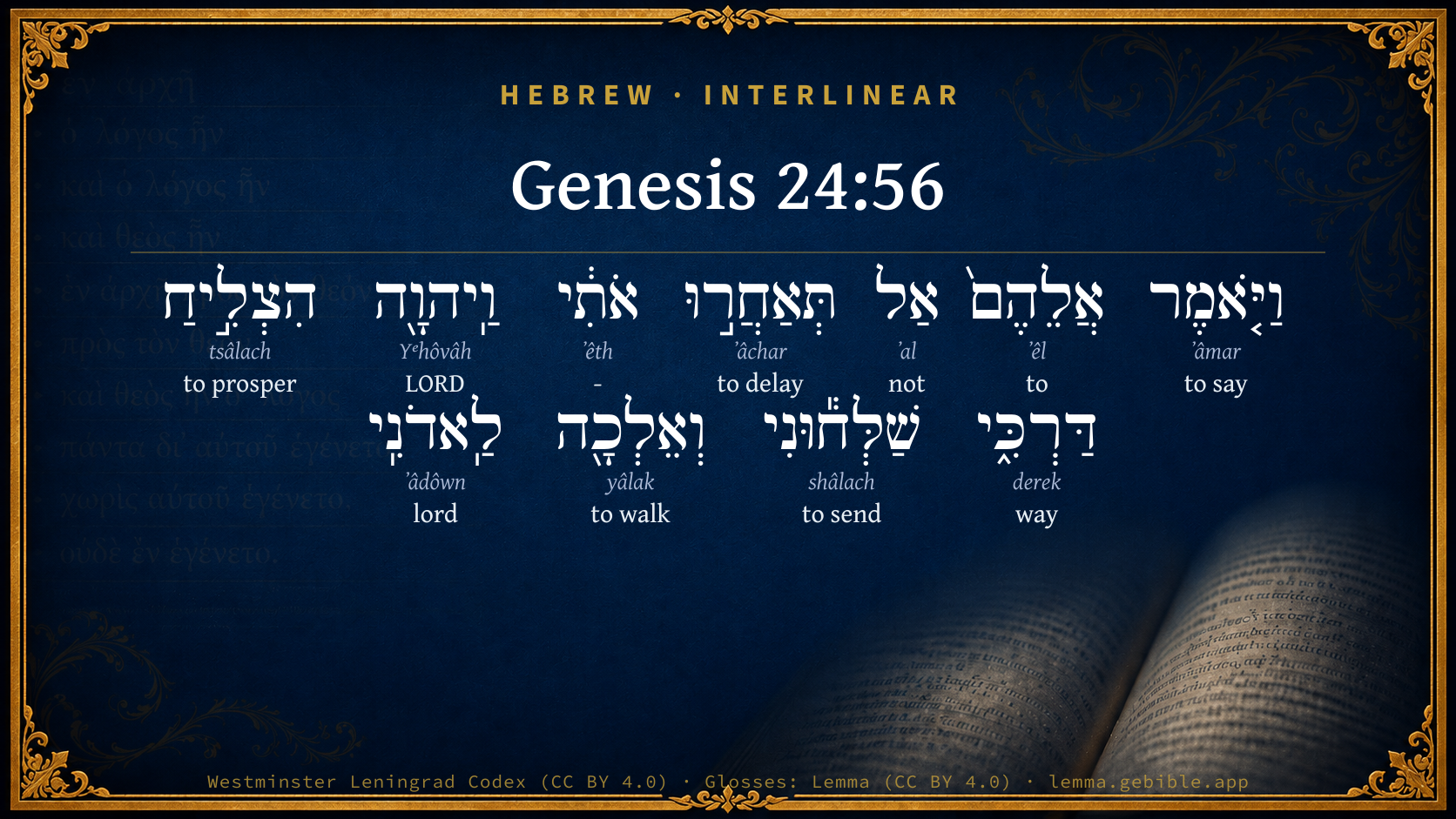
Hebrew (Westminster Leningrad Codex) Genesis 24:56 appears in the Hebrew Old Testament. The text above is from the Westminster Leningrad Codex. Each word links to its Strong’s number, a concise gloss, and parsing drawn from the Open Scriptures Hebrew Bible morphology. Click any word for its full Brown-Driver-Briggs (BDB) entry.
Download image
Cite this verse

Genesis 24:56 (World English Bible). Public Domain. Lemma interlinear Bible study tool, https://lemma.gebible.app/v/genesis/24/56.

Show BibTeX & RIS
BibTeX
RIS
English Translation
He said to them, "Don't hinder me, seeing Yahweh has prospered my way. Send me away that I may go to my master."
World English Bible · Public Domain
Highlights
  • 1 first appearance in the Hebrew Bible
Full analysis ↓
Download a study sheet

One document with this verse’s original text, its word-by-word gloss line, the meaning frame, cross-references with their text, attributed commentary, and full source and license credits — printable, and it pastes into notes with its structure intact.

This verse Autodidact and up

Study sheet (.html) Plain text (.txt)

A passage Seminary Student

Up to 50 verses in one chapter. A passage sheet keeps up to 6 commentary sources and 12 cross-references per verse, in the order this page ranks them, and says so on the sheet whenever that leaves anything out. Ask for a single verse and you get the Autodidact verse sheet above.

Everything on this page stays free to read, with no account — the sheet is a download of what is already on screen, not access to it.

Want to remove ads? Support Godless Engineer
Compare translations 3

The same verse in 3 English versions, stacked beneath the original-language interlinear above. Click any original word for its lexicon entry.

Each is an independent rendering of the whole verse — the interlinear is not word-aligned to these translations.

Highlighted words mark where these versions differ — a whole-verse word diff, not a word-by-word alignment.

  • World English Bible Public Domain
    He said to them, "Don't hinder me, seeing Yahweh has prospered my way. Send me away that I may go to my master."
  • King James Version Public Domain
    And he said unto them, Hinder me not, seeing the LORD hath prospered my way; send me away that I may go to my master.
  • unfoldingWord Literal Text CC BY-SA 4.0
    But he said to them, “Do not detain me, since Yahweh has made my journey succeed. Send me off so that I will go to my master.”

unfoldingWord Literal Text — © unfoldingWord, licensed CC BY-SA 4.0. Word-aligned USFM3 via Door43 (git.door43.org/unfoldingWord/en_ult).

Versions to compare (up to 4)

3 of 4 selected

Show all 18 translations

Every available English version of this verse, each an independent rendering of the whole verse.

  • World English Bible Public Domain
    He said to them, "Don't hinder me, seeing Yahweh has prospered my way. Send me away that I may go to my master."
  • Berean Standard Bible Public Domain
    But he replied, “Do not delay me, since the LORD has made my journey a success. Send me on my way so that I may go to my master.”
  • Majority Standard Bible Public Domain
    But he replied, “Do not delay me, since the LORD has made my journey a success. Send me on my way so that I may go to my master.”
  • King James Version Public Domain
    And he said unto them, Hinder me not, seeing the LORD hath prospered my way; send me away that I may go to my master.
  • American Standard Version (1901) Public Domain
    And he said unto them, Hinder me not, seeing Jehovah hath prospered my way. Send me away that I may go to my master.
  • Revised Version (1885) Public Domain
    And he said unto them, Hinder me not, seeing the LORD hath prospered my way; send me away that I may go to my master.
  • Geneva Bible (1599) Public Domain
    But he said vnto them, Hinder you me not, seeing the Lord hath prospered my iourney: send me away, that I may goe to my master.
  • Douay-Rheims (1899) Public Domain
    Stay me not, said he, because the Lord hath prospered my way: send me away, that I may go to my master.
  • Young's Literal Translation Public Domain
    And he saith unto them, `Do not delay me, seeing Jehovah hath prospered my way; send me away, and I go to my lord;'
  • Literal Standard Version CC BY-SA 4.0
    And he says to them, “Do not delay me, seeing YHWH has prospered my way; send me away, and I go to my lord”;
  • Unlocked Literal Bible CC BY-SA 4.0
    But he said to them, “Do not hinder me, since Yahweh has prospered my way. Send me on my way so that I may go to my master.”
  • unfoldingWord Literal Text CC BY-SA 4.0
    But he said to them, “Do not detain me, since Yahweh has made my journey succeed. Send me off so that I will go to my master.”
  • Darby Bible Public Domain
    And he said to them, Do not hinder me, seeing Jehovah has prospered my way: send me away, and I will go to my master.
  • World Messianic Bible Public Domain
    He said to them, “Don’t hinder me, since the LORD has prospered my way. Send me away that I may go to my master.”
  • Webster's Bible Public Domain
    And he said to them, Hinder me not, seeing the LORD hath prospered my way: send me away, that I may go to my master.
  • Free Bible Version CC BY-SA 4.0
    “Please don't delay me,” he told them. “The Lord has made my journey successful, so let me leave and go back to my master.”
  • Bible in Basic English Public Domain
    And he said, Do not keep me; the Lord has given a good outcome to my journey; let me now go back to my master.
  • JPS Tanakh (1917) Public Domain
    And he said unto them: 'Delay me not, seeing the LORD hath prospered my way; send me away that I may go to my master.'

Literal Standard Version (2020), Covenant Press — licensed CC BY-SA 4.0. Text via the HelloAO Bible API (eBible.org). Unlocked Literal Bible (unfoldingWord) — licensed CC BY-SA 4.0. Text via the HelloAO Bible API (eBible.org). unfoldingWord Literal Text — © unfoldingWord, licensed CC BY-SA 4.0. Word-aligned USFM3 via Door43 (git.door43.org/unfoldingWord/en_ult). Free Bible Version, Dr. Jonathan Gallagher — licensed CC BY-SA 4.0. Text via the HelloAO Bible API (eBible.org).

Word by word

More ways to search: Search by grammar → Find every occurrence → Compare this word →

Practice this passage: Drill this verse → Learn its vocabulary →

תְּאַחֲר֣וּ
ʼâchar
H309
“to delay”
Verb, Piel, Jussive, 2nd Person, Masculine, Plural
Part of Speech
Verb
Stem
Piel
Form
Jussive
Person
2nd Person
Gender
Masculine
Number
Plural
Full BDB Definition

Origin: a primitive root

TWOT: 68

to delay, hesitate, tarry, defer, remain behind - (Qal) - to delay, tarry (intensive) - to cause one to delay, hinder, keep back - (Piel) to delay, wait, stay behind (but not in hope)
  1. וַיֹּ֤אמֶר ʼâmar H559 “and · to say” Conjunction + Verb, Qal, Sequential Imperfect, 3rd Person, Masculine, Singular
  2. אֲלֵהֶם֙ ʼêl H413 “to · them” Preposition + Suffix, Personal, 3rd Person, Masculine, Plural
  3. אַל ʼal H408 “not” Particle, Negative
  4. אֹתִ֔י ʼêth H853 “- · me” Particle, Direct Object + Suffix, Personal, 1st Person, Common, Singular
  5. וַֽיהוָ֖ה Yᵉhôvâh H3068 “and · LORD” Conjunction + Noun, Proper
  6. הִצְלִ֣יחַ tsâlach H6743 “to prosper” Verb, Hiphil, Perfect, 3rd Person, Masculine, Singular
  7. דַּרְכִּ֑י derek H1870 “way · my” Noun, Common, Both, Singular, Construct + Suffix, Personal, 1st Person, Common, Singular
  8. שַׁלְּח֕וּנִי shâlach H7971 “send · me” Verb, Piel, Imperative, 2nd Person, Masculine, Plural + Suffix, Personal, 1st Person, Common, Singular
  9. וְאֵלְכָ֖ה yâlak H3212 “and · to walk” Conjunction + Verb, Qal, Cohortative, 1st Person, Common, Singular
  10. לַֽאדֹנִֽי ʼâdôwn H113 “to/for · lord · my” Preposition + Noun, Common, Masculine, Singular, Construct + Suffix, Personal, 1st Person, Common, Singular

About this verse

These counts appear in no published source. They are computed here, from the morphology-tagged text and Lemma’s own curated glosses. What Lemma adds →

11
words
11
distinct lemmas
Pentateuch
section

Notable vocabulary

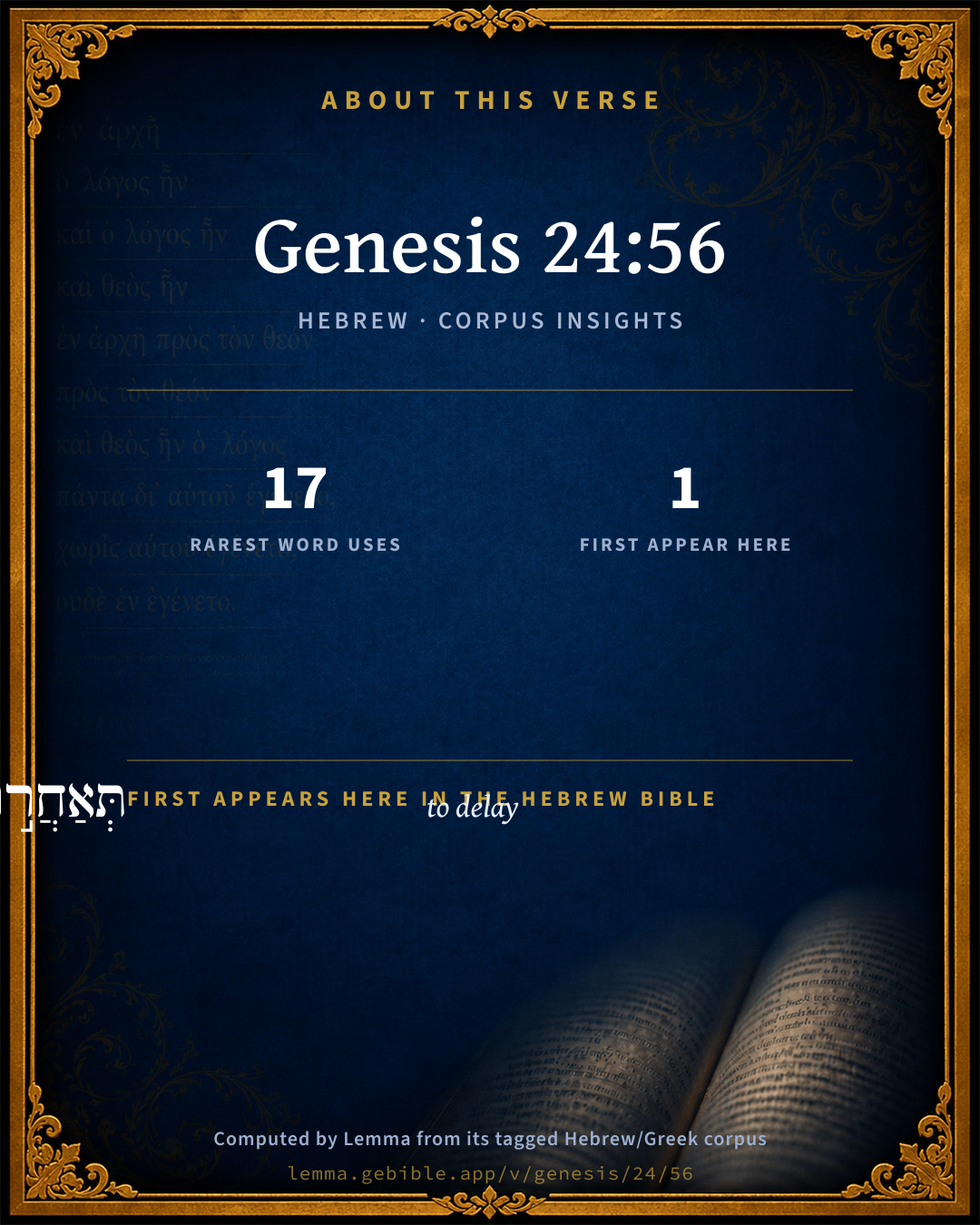
The rarest word here is תְּאַחֲר֣וּ to delay H309 — appearing just 17 times in the whole Hebrew Bible.

First appearance in Scripture

This word makes its first canonical appearance in the Hebrew Bible here:

  • תְּאַחֲר֣וּ to delay H309

Shared distinctive vocabulary

תְּאַחֲר֣וּ to delay H309 occurs in 17 verses of the Hebrew Bible. Also found in:

Grammatical profile

  • 5 verbs
  • 3 nouns
  • 1 preposition
  • 2 particles

Verb forms

  • וַיֹּ֤אמֶר Qal · Sequential Imperfect
  • תְּאַחֲר֣וּ Piel · Jussive
  • הִצְלִ֣יחַ Hiphil · Perfect
  • שַׁלְּח֕וּנִי Piel · Imperative
  • וְאֵלְכָ֖ה Qal · Cohortative

Hebrew & Septuagint length

In English translation the verse runs 23 words from the Hebrew and 27 from the Septuagint (LXX English) — closely comparable.

A rough comparison of the two English renderings, which tokenize alike — not a word-level alignment.

Word counts can differ between the Hebrew and the Greek without any difference in meaning — e.g. the Hebrew direct-object marker אֵת has no separate Greek word, and Greek often adds the article ὁ.

Cross-references

4

Topical passages linked to Genesis 24:56 in the Treasury of Scripture Knowledge — connected by theme and wording, ordered by reader-vote popularity; previews shown in the World English Bible.

  • Joshua 1:8 This book of the law shall not depart out of your mouth, but you shall meditate thereon day and night, that you may observe to do according to all that is written therein: for then you shall make your way prosperous, and then you shall have good success.
  • Proverbs 25:25 Like cold water to a thirsty soul, So is good news from a far country.
  • Isaiah 48:15 I, even I, have spoken; yes, I have called him; I have brought him, and he shall make his way prosperous.
  • Genesis 45:9–13 Hurry, and go up to my father, and tell him, 'This is what your son Joseph says, "God has made me lord of all Egypt. Come down to me. Don't wait.

Cross-references courtesy of OpenBible.info (CC BY 4.0).

Hebrew and Greek witnesses Masoretic Hebrew ↔ Greek Septuagint

The same verse in the two great witnesses to the Old Testament, shown verse-for-verse.

These are two independent witnesses, not word-aligned to each other, and the Septuagint is shown in lemma (dictionary) form.

Hebrew Genesis 24:56 Masoretic · Westminster Leningrad Codex

וַיֹּ֤אמֶר אֲלֵהֶם֙ אַל תְּאַחֲר֣וּ אֹתִ֔י וַֽיהוָ֖ה הִצְלִ֣יחַ דַּרְכִּ֑י שַׁלְּח֕וּנִי וְאֵלְכָ֖ה לַֽאדֹנִֽי

He said to them, "Don't hinder me, seeing Yahweh has prospered my way. Send me away that I may go to my master."

World English Bible · Public Domain

Greek LXX Genesis 24:56 Septuagint · lemma form

ὁ δέ εἶπον πρός αὐτός μή καταἔχω ἐγώ καί κύριος εὐοδόω ὁ ὁδός ἐγώ ἐκπέμπω ἐγώ ἵνα ἀποἔρχομαι πρός ὁ κύριος ἐγώ

But he said to them, Hinder me not, for the Lord has prospered my journey for me; send me away, that I may depart to my master.

LXX2012 (modern English Septuagint) · Public Domain

Hebrew: Westminster Leningrad Codex (CC BY 4.0). Greek: Septuagint (public domain); English from LXX2012 (modern English Septuagint) (Public Domain). How the Septuagint differs from the Hebrew →

Targum (Aramaic paraphrase)

2

The Targum is the ancient Jewish Aramaic paraphrase of the Hebrew Scriptures — an interpretive translation, not the Hebrew text itself. Onkelos (literal) and Pseudo-Jonathan (expansive) render the Torah, and Jonathan the Prophets. Coverage is partial: where no permissively-licensed English translation exists for a verse, only the Aramaic is shown. This is verse-level text, not a word-by-word alignment to the Hebrew.

  1. Targum Onkelos Torah (Genesis–Deuteronomy)
    וַאֲמַר לְהוֹן לָא תְאַחֲרוּן יָתִי וַיְיָ אַצְלַח אָרְחִי שַׁלְּחוּנִי וְאֵיהַךְ לְוַת רִבּוֹנִי

    (no public-domain English translation for this verse)

    Targum Onkelos — Aramaic: “Onkelos Genesis” (public domain); “Onkelos Exodus” (public domain); “Onkelos Leviticus” (public domain); “Onkelos Numbers” (public domain); “Onkelos Deuteronomy” (public domain). English: “Sefaria Community Translation” (CC0 1.0 (public-domain dedication)); “J.W. Etheridge. The Targums of Onkelos and Jonathan Ben Uzziel on the Pentateuch. London: Longmans, Green, 1862” (public domain). Text via Sefaria.

  2. Targum Pseudo-Jonathan Torah (Genesis–Deuteronomy)
    וַאֲמַר לְהוֹם לָא תְעַכְּבוּן יָתִי וַיְיָ אַצְלַח אוֹרְחִי אִלְוְויוּנִי וְאֵיזִיל לְרִבּוֹנִי

    And he said, Hinder me not, when the Lord hath prospered my way; let me depart, and I will go to my master.

    Targum Pseudo-Jonathan — Aramaic: “Targum Jonathan on Genesis” (public domain); “Targum Jonathan on Exodus” (public domain); “Targum Jonathan on Leviticus” (public domain); “Targum Jonathan on Numbers” (public domain); “Targum Jonathan on Deuteronomy” (public domain). English: “The Targum of Jonathan ben Uzziel, trans. J. W. Etheridge, London, 1862” (public domain). Text via Sefaria.

Commentary

Notes on Genesis 24:56 from classic Christian and Jewish commentators (each source and its license shown beneath its notes). The classic Christian expositions comment on the surrounding passage and are grouped to its opening verse, so a note may address several verses; the Jewish commentaries on the Tanakh (Rashi and others) are per-verse, so they appear only where the commentator wrote on this verse.

Lemma curates 59 commentaries, every one of them public domain or Creative Commons licensed, each selected and text-cleaned for this edition rather than reprinted as found. About our sources →

Trapp's Complete Commentary

John Trapp

Gen 24:56 And he said unto them, Hinder me not, seeing the LORD hath prospered my way; send me away that I may go to my master.

Ver. 56. Hinder me not.] Say we so to Satan soliciting us to stay a while in our old courses and companies.

John Trapp, A Commentary or Exposition upon All the Books of the Old and New Testament (1647–1656) — public domain. Text from a community e-Sword module.

The Biblical Illustrator

Joseph S. Exell

Gen_24:56

Hinder me not, seeing the Lord hath prospered my way

The Christians hindrances

The Lord hath prospered our way.

He has provided means for our return to Him. He has awakened us from entire carelessness. He has bestowed upon us thus far all the comfort and peace which we have received, and enabled us to do all that we have done for Him. Our past prosperity is an unceasing encouragement to future effort, and may be employed as an answer to every hindrance. Under this view would I adopt the expression of our text.

I. It is the entreaty of an awakened sinner returning to the Lord. Hinder me not, seeing the Lord hath prospered my way. A new and living way of salvation invites him. But there are many adversaries. The worldly and careless around him scoff at his fears, and deride his apprehensions. They know not the terrors of an awakened conscience, and they can mock when fear cometh. Hinder me not, the persecuted penitent replies. I have seen enough of worldly cheerfulness and mirth. I have seen that the end of that laughter is bitterness. The sorrows of a sinners death-bed I will not try. The portion of the worldly shall not be mine. He offers me forgiveness, and I will embrace it.

II. The words of our text may be the prayer of the new convert to Christ--the Christian who has just experienced the new creating grace of God;hinder me not, seeing the Lord hath prospered my way. The character of God appears to him full of glory, and shining in love. The great salvation which He has offered, seems worthy of all acceptation. His whole heart is arrested and occupied with the objects and excitements of this first love. But there are many hindrances surrounding this infantile state of grace. At one time he meets a sneer from some former companion in folly, at another, a false and unkind construction of the motives by which he is governed in his new determinations. The merely nominal Christian, the cold and carnally minded professor, hates him, as one who assumes a higher standard of religious character than he is pleased with. These various outward trials are severe.

III. But hindrances do not disappear, even when men become old in grace. Our text may, therefore, be the petition of the Christian who is established in the faith; hinder me not, seeing the Lord hath prospered my way. Through the whole period of a mortal life, he not only dwells in a laud of enemies, but drags about with himself a weight which is painfully retarding. There arises often around him a cloud of darkness, which hides all his evidences of grace, and conceals the blessed witness which God has given him within himself. Momentary feelings of unbelief intrude themselves into his breast. Occasional coldness and torpidity spreads itself through the members of his spiritual man, threatening permanent paralysis and death. He obtains larger conceptions of the depravity of his own heart; and his soul often sickens over the views which are presented to him, as the Spirit of God carries him still farther into its recesses, and exposes to his observation greater abominations than he has seen before. Then does he exclaim in the language of our text, Hinder me not, for the Lord hath prospered my way. Rejoice not against me, O mine enemy, though I fall, yet shall I rise again; and though I sit in darkness, the Lord shall be a light unto me. Sin has been pardoned; God has received, and is able to keep me. I have entered into a covenant with Him, from which I will never shrink, to walk before Him, and to be His for ever.

IV. Lastly, I may consider this as the demand of the faithful minister of the Gospel. Hinder me not, seeing the Lord hath prospered my way. This joy would be vastly increased were there none disposed to hinder his way, and to retard the progress of the word of God. (S. H. Tyng, D. D.)

The Biblical Illustrator, edited by Joseph S. Exell (c. 1880s–1900s) — public domain. Text from a community e-Sword module.

The Cambridge Bible for Schools and Colleges

gen. ed. J. J. S. Perowne

56. to my master] The servant entreats that there should be no delay. He wishes to return with the bride to his master. Whether this is Abraham or Isaac, is not stated. But, judging from Gen_24:65, there is ground for the supposition that Isaac is intended.

Otherwise, the servant’s haste may be supposed to have been dictated by a knowledge of Abraham’s failing condition. If so, it is strange that there is no mention of Abraham on the return.

The Cambridge Bible for Schools and Colleges (gen. ed. J. J. S. Perowne; Cambridge University Press, 1878–1918) — public domain. Text from a community e-Sword module.

John Gill's Exposition

And Rebekah arose, and her damsels,.... Her maids that were given her by her parents to wait upon her, as was usual in those times and countries:

and they rode upon the camels; that Abraham's servant had brought with him:

and followed the man; who rode before and directed the way; the sense is only, that she went along with him:

and the servant took Rebekah, and went his way; took her under his care, and to be the wife of his master's son, at the hands of her friends, and then set forward on his journey.

John Gill's Exposition of the Whole Bible (1746–1763) — public domain (CC PDM 1.0). Text via the HelloAO Bible API.

Whedon's Commentary on the Bible

Daniel D. Whedon

56. Hinder me not — The servant is too anxious to break the glad news of his success to his master.

Daniel D. Whedon (gen. ed.), Commentary on the Old and New Testaments (1874–1909) — public domain. Text from a community e-Sword module.

The Pulpit Commentary

Vers. 56-60. Still urging his suit for permission to depart, Laban and the mother of Rebekah proposed that the maiden should be left to decide a matter so important for her by her own inclinations. When consulted she expressed her readiness at once to accompany the venerable messenger to his distant home; and accordingly, without more delay, she was dismissed from her mother"s tent, attended by a faithful nurse (Gen_35:8) and enriched by the blessing of her pious relatives, who said unto her, Thou art our sister, be thou the mother of thousands of millions (literally, our sister thou, become to thousands of myriads, i.e. let thy descendants be very numerous), and let thy seed possess the gate (vide Gen_22:17) of those which hate them.

The Pulpit Commentary (1880–1919), ed. H.D.M. Spence-Jones & Joseph S. Exell — public domain. Text from a community e-Sword module.

unfoldingWord translationNotes

Door43 World Missions Community

he said

"Abraham's servant said"

to them

"to Rebekah's brother and mother"

Do not hinder me

"Do not delay me" or "Do not make me wait"

Yahweh has prospered my way

Here "way" stands for a journey. AT: "Yahweh has caused me to succeed in the purpose my journey" (See: Metonymy)

Send me on my way

"Allow me to leave"

translationWords

Yahweh

lord

Rebekah

unfoldingWord translationNotes — © Distant Shores Media and the Door43 World Missions Community, licensed CC BY-SA 4.0. Source: git.door43.org/Door43/en_tn.

Radak

Rabbi David Kimhi (Radak)

ויאמר אליהם, seeing that it is clear that G’d has made my mission successful, do not cause me any delay of even a single day. אל תאחרו אותי, By delaying her departure you would be delaying my return home. שלחוני, let me depart with the girl, ואלכה לאדוני, and I will go to my master as he has commanded me in order to bring him a wife for his son. How could I possibly return empty-handed?

Radak on the Tanakh — English translations: “Sefaria Community Translation” (CC0 1.0 (public-domain dedication)); “Eliyahu Munk, HaChut Hameshulash” (CC BY 4.0); “Rabbi Mike Feuer, Jerusalem Anthology” (CC BY 4.0); and “R. David Kimhi on the first book of Psalms, Translated by R.G. Finch, London, 1919” (public domain). Text via Sefaria.

Lesson kit

Teaching starters — assembled from the data on this page, not authored interpretation. Every prompt links to the verse data it draws on. Edit before teaching.

Genesis, in the Pentateuch, opens this verse with 11 words (11 distinct Hebrew lemmas). Its most distinctive word is ʼâchar (“to delay”). A historical commentator’s framing appears above. Read the whole chapter for the surrounding context.

Discussion questions

  1. What does “to delay” (ʼâchar) contribute to the verse as a whole?
  2. This is the first place “to delay” appears in Scripture (first appears here). What does its debut here establish?
  3. How does Genesis 32:4, which shares the word «to delay», read alongside this verse?
  4. These translations render this verse differently. What is at stake in choosing one wording over another?
  5. «וַיֹּ֤אמֶר» is a Qal Sequential Imperfect verb. How does that grammatical form shape the action described?
  6. Compare how Trapp's Complete Commentary and The Biblical Illustrator read this verse. Where do they agree or differ?

Things to notice

Reading settings

Reading text

Shown beneath each verse's original-language words.

Old Testament
Old Testament edition

Read the OT as the Masoretic Hebrew (MT) or the Greek Septuagint (LXX).

English shown for the Greek Septuagint (in the Hebrew ↔ Greek comparison).

Comparing translations? Open the Compare panel on any verse page to stack up to four side by side.