
1 Samuel 3:17

Hebrew (Westminster Leningrad Codex) 1 Samuel 3:17 appears in the Hebrew Old Testament. The text above is from the Westminster Leningrad Codex. Each word links to its Strong’s number, a concise gloss, and parsing drawn from the Open Scriptures Hebrew Bible morphology. Click any word for its full Brown-Driver-Briggs (BDB) entry.
Download image
Cite this verse

1 Samuel 3:17 (World English Bible). Public Domain. Lemma interlinear Bible study tool, https://lemma.gebible.app/v/1-samuel/3/17.

Show BibTeX & RIS
BibTeX
RIS
English Translation
He said, "What is the thing that [Yahweh] has spoken to you? Please don't hide it from me. God do so to you, and more also, if you hide anything from me of all the things that he spoke to you."
World English Bible · Public Domain
Download a study sheet

One document with this verse’s original text, its word-by-word gloss line, the meaning frame, cross-references with their text, attributed commentary, and full source and license credits — printable, and it pastes into notes with its structure intact.

This verse Autodidact and up

Study sheet (.html) Plain text (.txt)

A passage Seminary Student

Up to 50 verses in one chapter. A passage sheet keeps up to 6 commentary sources and 12 cross-references per verse, in the order this page ranks them, and says so on the sheet whenever that leaves anything out. Ask for a single verse and you get the Autodidact verse sheet above.

Everything on this page stays free to read, with no account — the sheet is a download of what is already on screen, not access to it.

Want to remove ads? Support Godless Engineer
Compare translations 3

The same verse in 3 English versions, stacked beneath the original-language interlinear above. Click any original word for its lexicon entry.

Each is an independent rendering of the whole verse — the interlinear is not word-aligned to these translations.

Highlighted words mark where these versions differ — a whole-verse word diff, not a word-by-word alignment.

  • World English Bible Public Domain
    He said, "What is the thing that [Yahweh] has spoken to you? Please don't hide it from me. God do so to you, and more also, if you hide anything from me of all the things that he spoke to you."
  • King James Version Public Domain
    And he said, What is the thing that the LORD hath said unto thee? I pray thee hide it not from me: God do so to thee, and more also, if thou hide any thing from me of all the things that he said unto thee.
  • unfoldingWord Literal Text CC BY-SA 4.0
    And he said, “What the word that he spoke to you? Please do not hide from me. Thus may God do to you, and thus may he add, if you hide from me a word from all of the word that he spoke to you.”

unfoldingWord Literal Text — © unfoldingWord, licensed CC BY-SA 4.0. Word-aligned USFM3 via Door43 (git.door43.org/unfoldingWord/en_ult).

Versions to compare (up to 4)

3 of 4 selected

Show all 18 translations

Every available English version of this verse, each an independent rendering of the whole verse.

  • World English Bible Public Domain
    He said, "What is the thing that [Yahweh] has spoken to you? Please don't hide it from me. God do so to you, and more also, if you hide anything from me of all the things that he spoke to you."
  • Berean Standard Bible Public Domain
    “What was the message He gave you?” Eli asked. “Do not hide it from me. May God punish you, and ever so severely, if you hide from me anything He said to you.”
  • Majority Standard Bible Public Domain
    “What was the message He gave you?” Eli asked. “Do not hide it from me. May God punish you, and ever so severely, if you hide from me anything He said to you.”
  • King James Version Public Domain
    And he said, What is the thing that the LORD hath said unto thee? I pray thee hide it not from me: God do so to thee, and more also, if thou hide any thing from me of all the things that he said unto thee.
  • American Standard Version (1901) Public Domain
    And he said, What is the thing that `Jehovah' hath spoken unto thee? I pray thee, hide it not from me: God do so to thee, and more also, if thou hide anything from me of all the things that he spake unto thee.
  • Revised Version (1885) Public Domain
    And he said, What is the thing that the LORD hath spoken unto thee? I pray thee hide it not from me: God do so to thee, and more also, if thou hide any thing from me of all the things that he spake unto thee.
  • Geneva Bible (1599) Public Domain
    Then he said, What is it, that the Lord said vnto thee? I pray thee, hide it not from mee. God doe so to thee, and more also, if thou hide any thing from me, of all that he said vnto thee.
  • Douay-Rheims (1899) Public Domain
    And he asked him: What is the word that the Lord hath spoken to thee? I beseech thee hide it not from me. May God do so and so to thee, and add so and so, if thou hide from me one word of all that were said to thee.
  • Young's Literal Translation Public Domain
    And he saith, `What `is' the word which He hath spoken unto thee? I pray thee, hide it not from me; so doth God do to thee, and so doth He add, if thou hidest from me a word of all the words that He hath spoken unto thee.'
  • Literal Standard Version CC BY-SA 4.0
    And he says, “What [is] the word which He has spoken to you? Please do not hide it from me; so God does to you, and so does He add, if you hide from me a word of all the words that He has spoken to you.”
  • Unlocked Literal Bible CC BY-SA 4.0
    He said, “What was the word he spoke to you? Please do not hide it from me. May God do so to you, and even more, if you hide anything from me of all the words that he spoke to you.”
  • unfoldingWord Literal Text CC BY-SA 4.0
    And he said, “What the word that he spoke to you? Please do not hide from me. Thus may God do to you, and thus may he add, if you hide from me a word from all of the word that he spoke to you.”
  • Darby Bible Public Domain
    And he said, What is the word that he has spoken to thee? I pray thee, keep it not back from me: God do so to thee, and more also, if thou keep back anything from me of all the word that he spoke to thee.
  • World Messianic Bible Public Domain
    He said, “What is the thing that he has spoken to you? Please don’t hide it from me. God do so to you, and more also, if you hide anything from me of all the things that he spoke to you.”
  • Webster's Bible Public Domain
    And he said, What is the thing that the LORD hath said to thee? I pray thee hide it not from me: God do so to thee, and more also, if thou shalt hide any thing from me, of all the things that he said to thee.
  • Free Bible Version CC BY-SA 4.0
    “What did he tell you?” Eli asked. “Don't hide it from me. May God punish you very severely if you hide anything he told you from me!”
  • Bible in Basic English Public Domain
    And he said, What did the Lord say to you? Do not keep it from me: may God's punishment be on you if you keep from me anything he said to you.
  • JPS Tanakh (1917) Public Domain
    And he said: 'What is the thing that He hath spoken unto thee? I pray thee, hide it not from me, God do so to thee, and more also, if thou hide any thing from me of all the things that He spoke unto thee.'

Literal Standard Version (2020), Covenant Press — licensed CC BY-SA 4.0. Text via the HelloAO Bible API (eBible.org). Unlocked Literal Bible (unfoldingWord) — licensed CC BY-SA 4.0. Text via the HelloAO Bible API (eBible.org). unfoldingWord Literal Text — © unfoldingWord, licensed CC BY-SA 4.0. Word-aligned USFM3 via Door43 (git.door43.org/unfoldingWord/en_ult). Free Bible Version, Dr. Jonathan Gallagher — licensed CC BY-SA 4.0. Text via the HelloAO Bible API (eBible.org).

Word by word

More ways to search: Search by grammar → Find every occurrence → Compare this word →

Practice this passage: Drill this verse → Learn its vocabulary →

תְכַחֵ֖ד
kâchad
H3582
“to hide”
Verb, Piel, Jussive, 2nd Person, Masculine, Singular
Part of Speech
Verb
Stem
Piel
Form
Jussive
Person
2nd Person
Gender
Masculine
Number
Singular
Full BDB Definition

Origin: a primitive root

TWOT: 972

to hide, conceal, cut off, cut down, make desolate, kick - (Niphal) - to be hidden - to be effaced, be destroyed, be cut off - (Piel) to cover, hide - (Hiphil) - to hide - to efface, annihilate
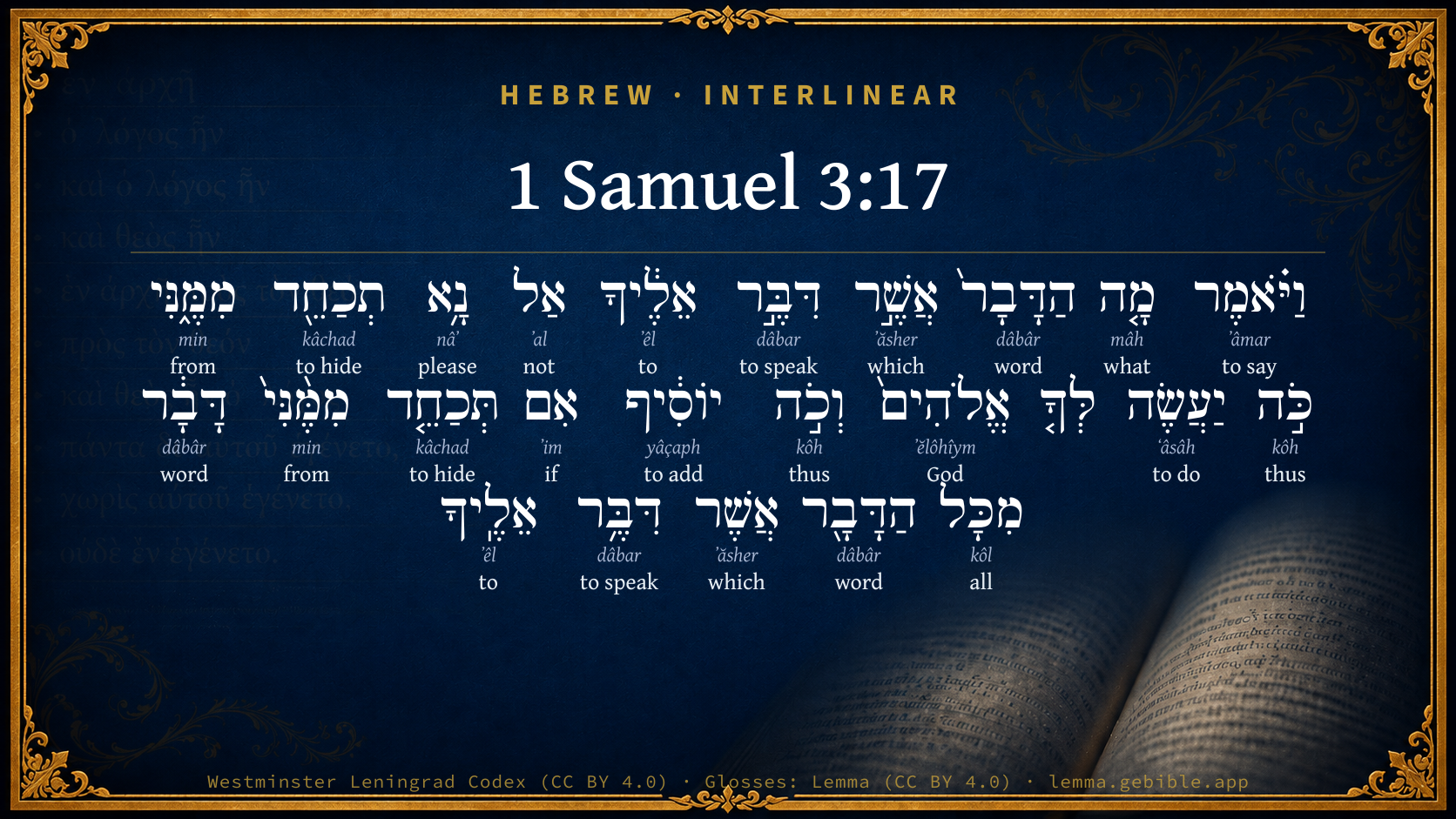
  1. וַיֹּ֗אמֶר ʼâmar H559 “and · to say” Conjunction + Verb, Qal, Sequential Imperfect, 3rd Person, Masculine, Singular
  2. מָ֤ה mâh H4100 “what” Particle, Interrogative
  3. הַדָּבָר֙ dâbâr H1697 “the · word” Particle, Definite Article + Noun, Common, Masculine, Singular, Absolute
  4. אֲשֶׁ֣ר ʼăsher H834 “which” Particle, Relative
  5. דִּבֶּ֣ר dâbar H1696 “to speak” Verb, Piel, Perfect, 3rd Person, Masculine, Singular
  6. אֵלֶ֔יךָ ʼêl H413 “to · you” Preposition + Suffix, Personal, 2nd Person, Masculine, Singular
  7. אַל ʼal H408 “not” Particle, Negative
  8. נָ֥א nâʼ H4994 “please” Particle, Exhortation
  9. מִמֶּ֑נִּי min H4480 “from · me” Preposition + Suffix, Personal, 1st Person, Common, Singular
  10. כֹּ֣ה kôh H3541 “thus” Adverb
  11. יַעֲשֶׂה ʻâsâh H6213 “to do” Verb, Qal, Jussive, 3rd Person, Masculine, Singular
  12. אֱלֹהִים֙ ʼĕlôhîym H430 “God(s)” Noun, Common, Masculine, Plural, Absolute
  13. וְכֹ֣ה kôh H3541 “and · thus” Conjunction + Adverb
  14. יוֹסִ֔יף yâçaph H3254 “to add” Verb, Hiphil, Jussive, 3rd Person, Masculine, Singular
  15. אִם ʼim H518 “if” Conjunction
  16. תְּכַחֵ֤ד kâchad H3582 “to hide” Verb, Piel, Imperfect, 2nd Person, Masculine, Singular
  17. מִמֶּ֨נִּי֙ min H4480 “from · me” Preposition + Suffix, Personal, 1st Person, Common, Singular
  18. דָּבָ֔ר dâbâr H1697 “word” Noun, Common, Masculine, Singular, Absolute
  19. מִכָּל kôl H3605 “from · all of” Preposition + Noun, Common, Masculine, Singular, Construct
  20. הַדָּבָ֖ר dâbâr H1697 “the · word” Particle, Definite Article + Noun, Common, Masculine, Singular, Absolute
  21. אֲשֶׁר ʼăsher H834 “which” Particle, Relative
  22. דִּבֶּ֥ר dâbar H1696 “to speak” Verb, Piel, Perfect, 3rd Person, Masculine, Singular
  23. אֵלֶֽיךָ ʼêl H413 “to · you” Preposition + Suffix, Personal, 2nd Person, Masculine, Singular

About this verse

These counts appear in no published source. They are computed here, from the morphology-tagged text and Lemma’s own curated glosses. What Lemma adds →

25
words
16
distinct lemmas
Historical
section

Shared distinctive vocabulary

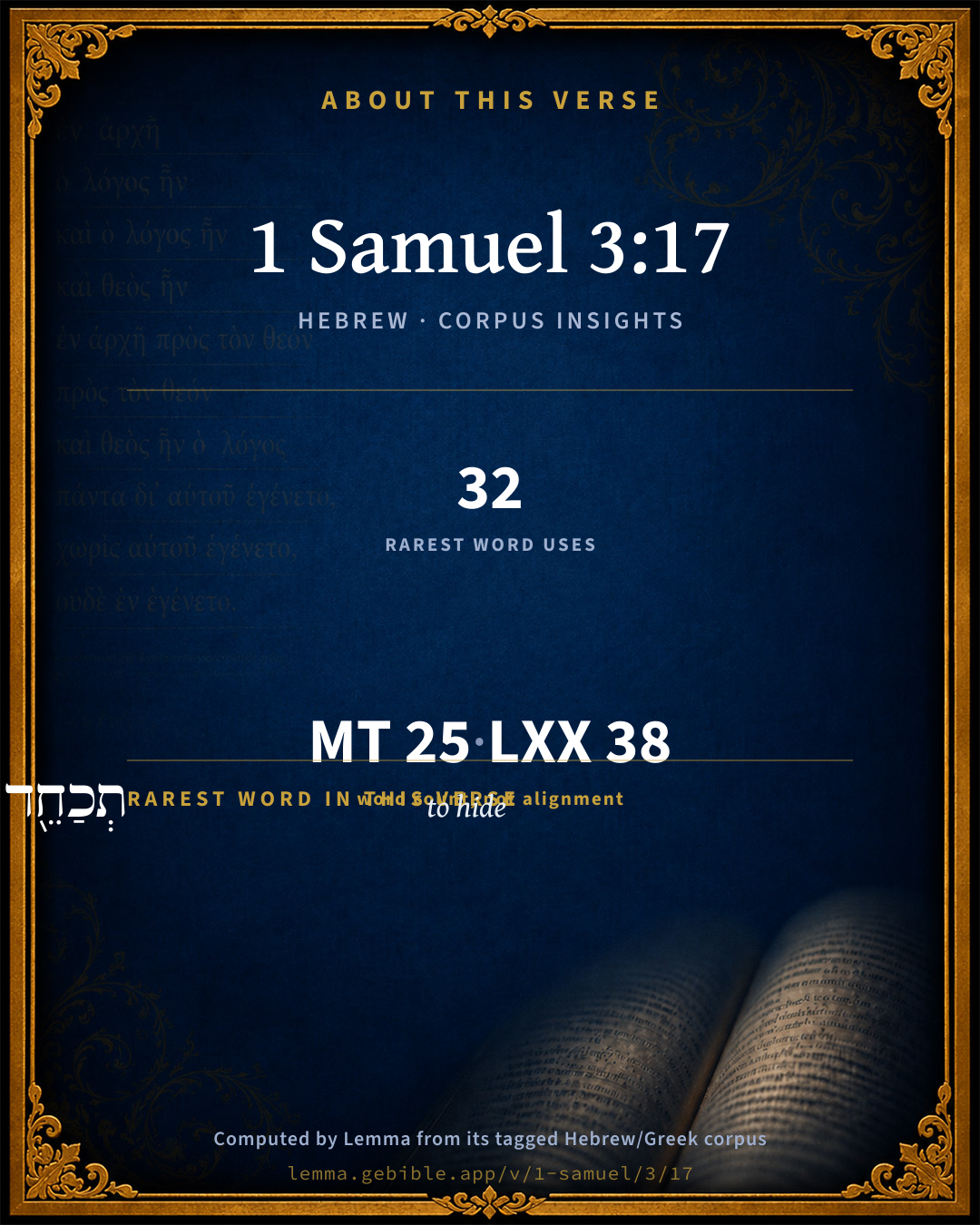
תְכַחֵ֖ד to hide H3582 occurs in 30 verses of the Hebrew Bible. Also found in:

Grammatical profile

  • 7 verbs
  • 5 nouns
  • 5 prepositions
  • 1 conjunction
  • 2 adverbs
  • 5 particles

Verb forms

  • וַיֹּ֗אמֶר Qal · Sequential Imperfect
  • דִּבֶּ֣ר Piel · Perfect
  • תְכַחֵ֖ד Piel · Jussive
  • יַעֲשֶׂה Qal · Jussive
  • יוֹסִ֔יף Hiphil · Jussive
  • תְּכַחֵ֤ד Piel · Imperfect
  • דִּבֶּ֥ר Piel · Perfect

Repetition

Words recur within this verse — often emphatic in Hebrew:

  • הַדָּבָר֙ word H1697 ×3
  • דִּבֶּ֣ר to speak H1696 ×2
  • תְכַחֵ֖ד to hide H3582 ×2
  • כֹּ֣ה thus H3541 ×2
  • אֲשֶׁ֣ר which H834 ×2
  • אֵלֶ֔יךָ to H413 ×2
  • מִמֶּ֑נִּי from H4480 ×2

Hebrew & Septuagint length

In English translation the verse runs 41 words from the Hebrew and 49 from the Septuagint (LXX English) — closely comparable.

A rough comparison of the two English renderings, which tokenize alike — not a word-level alignment.

Word counts can differ between the Hebrew and the Greek without any difference in meaning — e.g. the Hebrew direct-object marker אֵת has no separate Greek word, and Greek often adds the article ὁ.

In the original languages it is 25 Hebrew tokens and 38 Greek tokens — but the two are counted differently (Hebrew bundles its prefixes and suffixes into one token; the Greek is in lemma form), so that isn’t a like-for-like length.

Cross-references

9

Topical passages linked to 1 Samuel 3:17 in the Treasury of Scripture Knowledge — connected by theme and wording, ordered by reader-vote popularity; previews shown in the World English Bible.

  • Ruth 1:17 where you die, will I die, and there will I be buried: Yahweh do so to me, and more also, if anything but death part you and me."
  • 2 Samuel 3:35 All the people came to cause David to eat bread while it was yet day; but David swore, saying, God do so to me, and more also, if I taste bread, or anything else, until the sun be down.
  • 1 Samuel 20:13 Yahweh do so to Jonathan, and more also, should it please my father to do you evil, if I don't disclose it to you, and send you away, that you may go in peace: and Yahweh be with you, as he has been with my father.
  • 2 Samuel 19:13 Say you to Amasa, Aren't you my bone and my flesh? God do so to me, and more also, if you aren't captain of the host before me continually in the room of Joab.
  • 1 Kings 22:16 The king said to him, How many times shall I adjure you that you speak to me nothing but the truth in the name of Yahweh?
  • Psalms 141:5 Let the righteous strike me, it is kindness; Let him reprove me, it is like oil on the head; Don't let my head refuse it; Yet my prayer is always against evil deeds.
  • Daniel 4:19 Then Daniel, whose name was Belteshazzar, was stricken mute for a while, and his thoughts troubled him. The king answered, Belteshazzar, don't let the dream, or the interpretation, trouble you. Belteshazzar answered, My lord, the dream be to those who hate you, and the interpretation of it to your adversaries.
  • Micah 2:7 Shall it be said, O house of Jacob: "Is the Spirit of Yahweh angry? Are these his doings? Don't my words do good to him who walks blamelessly?"
  • Matthew 26:63 But Jesus held his peace. The high priest answered him, "I adjure you by the living God, that you tell us whether you are the Christ, the Son of God."

Cross-references courtesy of OpenBible.info (CC BY 4.0).

Hebrew and Greek witnesses Masoretic Hebrew ↔ Greek Septuagint

The same verse in the two great witnesses to the Old Testament, shown verse-for-verse.

These are two independent witnesses, not word-aligned to each other, and the Septuagint is shown in lemma (dictionary) form.

Hebrew 1 Samuel 3:17 Masoretic · Westminster Leningrad Codex

וַיֹּ֗אמֶר מָ֤ה הַדָּבָר֙ אֲשֶׁ֣ר דִּבֶּ֣ר אֵלֶ֔יךָ אַל נָ֥א תְכַחֵ֖ד מִמֶּ֑נִּי כֹּ֣ה יַעֲשֶׂה לְּךָ֤ אֱלֹהִים֙ וְכֹ֣ה יוֹסִ֔יף אִם תְּכַחֵ֤ד מִמֶּ֨נִּי֙ דָּבָ֔ר מִכָּל הַדָּבָ֖ר אֲשֶׁר דִּבֶּ֥ר אֵלֶֽיךָ

He said, "What is the thing that [Yahweh] has spoken to you? Please don't hide it from me. God do so to you, and more also, if you hide anything from me of all the things that he spoke to you."

World English Bible · Public Domain

Greek LXX 1 Samuel 3:17 Septuagint · lemma form

καί εἶπον τίς ὁ ῥῆμα ὁ λαλέω πρός σύ μή δή κρύπτω ἀπό ἐγώ ὅδε ποιέω σύ ὁ θεός καί ὅδε προςτίθημι ἐάν κρύπτω ἀπό ἐγώ ῥῆμα ἐκ πᾶς ὁ λόγος ὁ λαλέω σύ ἐν ὁ οὖς σύ

And he said, What was the word that was spoken to you? I pray you hide it not from me: may God do these things to you, and more also, if you hide from me any thing of all the words that were spoken to you in your ears.

LXX2012 (modern English Septuagint) · Public Domain

Hebrew: Westminster Leningrad Codex (CC BY 4.0). Greek: Septuagint (public domain); English from LXX2012 (modern English Septuagint) (Public Domain). How the Septuagint differs from the Hebrew →

Targum (Aramaic paraphrase)

1

The Targum is the ancient Jewish Aramaic paraphrase of the Hebrew Scriptures — an interpretive translation, not the Hebrew text itself. Onkelos (literal) and Pseudo-Jonathan (expansive) render the Torah, and Jonathan the Prophets. Coverage is partial: where no permissively-licensed English translation exists for a verse, only the Aramaic is shown. This is verse-level text, not a word-by-word alignment to the Hebrew.

  1. Targum Jonathan Prophets (Joshua–Malachi)
    וַאֲמַר מַה פִּתְגָמָא דְמַלֵיל עִמָךְ לָא כְעַן תְּכַסֵי מִנִי כְּדֵין יַעְבֵּיד לָךְ יְיָ וּכְדֵין יוֹסִיף אִם תְּכַסֵי מִנִי פִּתְגָם מִכָּל פִּתְגָמָא דְמַלֵיל עַמָךְ:

    (no public-domain English translation for this verse)

    Targum Jonathan — Aramaic: “Mikraot Gedolot” (public domain). English: “Sefaria Community Translation” (CC0 1.0 (public-domain dedication)); “London "Chaldee Paraphrase," 1871” (public domain). Text via Sefaria.

Commentary

Notes on 1 Samuel 3:17 from classic Christian and Jewish commentators (each source and its license shown beneath its notes). The classic Christian expositions comment on the surrounding passage and are grouped to its opening verse, so a note may address several verses; the Jewish commentaries on the Tanakh (Rashi and others) are per-verse, so they appear only where the commentator wrote on this verse.

Lemma curates 59 commentaries, every one of them public domain or Creative Commons licensed, each selected and text-cleaned for this edition rather than reprinted as found. About our sources →

Trapp's Complete Commentary

John Trapp

1Sa 3:17 And he said, What [is] the thing that [the LORD] hath said unto thee? I pray thee hide [it] not from me: God do so to thee, and more also, if thou hide [any] thing from me of all the things that he said unto thee.

Ver. 17. What is the thing that the Lord, &c.] He is earnest to know the worst: for any good from an offended God he expected not. But "do not my words do good to him that walketh uprightly?" {Mic 2:7} {See Trapp on "Mic 2:7"}

John Trapp, A Commentary or Exposition upon All the Books of the Old and New Testament (1647–1656) — public domain. Text from a community e-Sword module.

The Biblical Illustrator

Joseph S. Exell

1Sa_3:17

What is the thing that the Lord hath said unto thee?

A private enquiry

I. Let us view the question as addressed to Samuel.

1. The first remark which we shall make upon it is that God does speak to men. In ways suitable to their feeble nature the Lord has spoken to men.

(1) He has done so in the inspired volume of His sacred Word. Every line in this priceless volume was dictated by the Spirit, and is a message from God to men.

(2) God, in a renewed manner, speaks to us by His Word when His Spirit applies it to us individually.

(3) Moreover, our God has ways of communicating His mind to His children by those of His servants who speak in His name. He directs the thoughts of His ministers, and suggests their words, so that they speak to the cases of those who are led to hear the Word of God.

(4) By our own thoughts, also, the Lord communes with us.

(5) Our God speaks to us also in Providence.

2. God regards not age in His speaking, but He condescends to speak with young children.

3. When we do hear the voice of God we should be deeply impressed by it.

4. We should store up in our memories whatever God says to us.

5. Looking at the text in its light toward Samuel, we learn that we should be able to tell what we hear from God.

(1) Samuel did this very solemnly, with a deep sense of its weight.

(2) Samuel did his work very carefully and completely. We read, and Samuel told him every whit, and hid nothing from him. He said nothing more and nothing less than God had spoken. You know how difficult it is to repeat a story correctly. Additions and subtractions are seeds which it is hard to keep out of the garden of conversation. Alas! this holds good even of the Word of the Lord: how many add to it or take from it!

(3) It was a very painful duty, which the holy child was called upon to perform.

(4) But then, in Samuels case, it was an obvious duty.

(5) And to communicate the message of God was a very weighty duty to the child Samuel.

II. Let us now view the question as it comes from Eli.

1. I understand from Elis question, first, that we should willingly learn, even from a child.

2. Next, learn from Eli, that we should be willing to know the very worst of the ease.

3. Next, we should desire to hear the whole of Gods word. Men aspire to be clever, and to that end they must appear to be bold thinkers, highly cultured, and far removed from the old worn out notions of orthodoxy. Many are the floral displays in sermons! Sheaves of corn are too plain and rustic. This is the age of bouquets and wreaths of rare flowers. Paul must give way to Browning, and David to Tennyson. Brethren, there are enough in the novelty business without us; and we have something better to do. Keep us right by saying to us, What is the thing the Lord hath said to thee? I pray thee, hide it not from me!

III. And now consider the question, to and from ourselves. I want to put a series of questions.

1. Have we ever asked the Lord to speak to us?

2. Next, have we all regarded what God has spoken?

3. A further question is this: Have we shaped our lives by what God has said?

4. Next, have we told what we know?

5. Do our children ever rebuke us? This Samuel was to Eli like a grandchild. His sons were grown up, and had left him; but here was this little one brought into the temple to minister there, and the old man came to be rebuked by this little child. (C. H. Spurgeon.)

The Biblical Illustrator, edited by Joseph S. Exell (c. 1880s–1900s) — public domain. Text from a community e-Sword module.

Joseph Benson's Commentary

1Sa 3:17. God do so, &c. — God inflict the same evils upon thee which I suspect he hath pronounced against me, and greater evils too.

Joseph Benson's Commentary on the Old and New Testaments (1811–1818) — public domain. Text from a community e-Sword module.

Geneva Bible (1599)

Geneva Bible translators

God punish thee after this and that sort, except thou tell me truth, Ruth 1:17.

Geneva Bible (1599) marginal notes — public domain. Text via Bolls.life.

Adam Clarke's Commentary

Verse 17. God do so to thee, and more also] This was a very solemn adjuration: he suspected that God had threatened severe judgments, for he knew that his house was very criminal; and he wished to know what God had spoken. The words imply thus much: If thou do not tell me fully what God has threatened, may the same and greater curses fall on thyself.

Adam Clarke's Commentary on the Bible (1810–1826) — public domain. Text from a community e-Sword/MySword module.

The Cambridge Bible for Schools and Colleges

gen. ed. J. J. S. Perowne

17. What is the thing that the Lord hath said unto thee?] The word Lord is not in the Hebrew. As in 1Sa_3:9 it is tacitly assumed that the speaker was Jehovah.

Observe how Eli first simply asks for an account of what had passed, then demands a complete statement, and finally adjures Samuel to conceal nothing from him.

God do so to thee, and more also] Literally, “so shall God do to thee and so shall He add.” This form of adjuration is characteristic of the books of Samuel and Kings, in which it occurs eleven times. elsewhere it is found in Rth_1:17 only.

The Cambridge Bible for Schools and Colleges (gen. ed. J. J. S. Perowne; Cambridge University Press, 1878–1918) — public domain. Text from a community e-Sword module.

John Gill's Exposition

And he said, what is the thing that the Lord hath said unto thee?.... The word "Lord" is not in the text, but it is "that it hath said"; the voice that had so often called him in the night, and which yet Eli knew was the voice of the Lord; and as it was, he was sensible there was something of importance said, and he had great reason to believe it respected him and his family; and the rather he might conclude this, by what the man of God had lately said to him, whose words perhaps he had too much slighted, questioning his authority; and therefore the Lord took this way and method to assure him that what was said came from him; for hereby Eli was fully convinced that this voice Samuel heard was of the Lord, and so what was said must be from him, and this he was impatient to know:

I pray thee, hide it not from me; and he not only beseeched and entreated him, but adjured him, as in the next clause:

God do so to thee, and more also, if thou hide anything from me of all the things that said unto thee; it is the form of an oath or curse, wishing that God would do some great evil to him, and more than he chose to express, if he concealed anything from him that had been told him. So Kimchi and Abarbinel take it to be an oath; and Josephus, (u) and Procopius Gazaeus on the place say, that Eli obliged Samuel by oaths and curses to declare what had been said to him.

(u) Antiqu. l. 5. c. 10. sect. 4.

John Gill's Exposition of the Whole Bible (1746–1763) — public domain (CC PDM 1.0). Text via the HelloAO Bible API.

Haydock's Catholic Bible Commentary

And so. Literally, "May God do these things to thee, and add these also." It is not certain that he mentioned the particular punishment, (Haydock) though it is most probable. The Scripture refrains from repeating them. (Grotius) --- Ruth i. 17. (Calmet)

George Leo Haydock (1774–1849), Haydock's Catholic Family Bible and Commentary, 1859 edition — public domain. Excludes Psalms (Douay-Rheims chapter numbering differs from Protestant) and Deuterocanonical books (Catholic canon only).

Matthew Poole's English Annotations

God inflict the same evils upon thee, which I suspect he hath pronounced against me, and greater evils too. Or, God do so, i.e. let God deal with thee so severely, as I cannot, or am loth to express. So it is a kind of aposiopesis, usual in oaths and in adjurations. The same phrase is in Rth 1:17. Thus he adjures him to utter the whole truth, as was usual among the Hebrews, as 1Ki 22:16; Mat 26:63.

Matthew Poole's English Annotations on the Holy Bible (1683–1685) — public domain. Text from a community e-Sword/MySword module.

Whedon's Commentary on the Bible

Daniel D. Whedon

17, 18. What is the thing that… said unto thee — It will be observed that the English version supplies the words the LORD, but in his question Eli seems to have intentionally omitted the subject of the verb said. His words imply that he himself was uncertain who had called Samuel. He was doubtless strongly persuaded that it was Jehovah, for this had been his conviction when the child came to him the third time, (1Sa_3:8,) but not until Samuel had told him every whit, (1Sa_3:18 — כל הדברים, all the words, that is, the entire communication of 1Sa_3:11-14,) was he absolutely sure; then he said, It is the Lord, and bowed in humble submissiveness before the sad and solemn prophecy. If he had entertained any doubts respecting the message of 1Sa_2:27-36, all doubt must have vanished now, as that message received confirmation through the child Samuel, whose word he could not doubt.

Daniel D. Whedon (gen. ed.), Commentary on the Old and New Testaments (1874–1909) — public domain. Text from a community e-Sword module.

John Wesley's Explanatory Notes

God do so, &c. - God inflict the same evils upon thee, which I suspect he hath pronounced against me, and greater evils too.

John Wesley, Explanatory Notes Upon the Whole Bible (1754–1765) — public domain. Text via the GEBible commentary corpus.

unfoldingWord translationNotes

Door43 World Missions Community

the word he spoke

"the message Yahweh gave"

May God do so to you, and even more

This is an idiom to emphasize how serious Eli is. AT: "May God punish you the same way he said he will punish me, and even more" (See: Idiom)

translationWords

word

God

Yahweh

unfoldingWord translationNotes — © Distant Shores Media and the Door43 World Missions Community, licensed CC BY-SA 4.0. Source: git.door43.org/Door43/en_tn.

Rashi

Rabbi Shlomo Yitzchaki (Rashi)

Such shall [God] do to you. Like that very curse, that you shall not have worthy children. And that curse actually befell him even though he did tell him. And did not withhold. From here [the Sages concluded]: A curse of a wise man, even though pronounced on condition, will be realized.

Rashi on the Tanakh — English translations: “The Judaica Press complete Tanach with Rashi, translated by A. J. Rosenberg” (CC BY 4.0); “Pentateuch with Rashi's commentary by M. Rosenbaum and A.M. Silbermann, 1929-1934” (public domain); “The Metsudah Tanach series, Lakewood, N.J” (CC BY 4.0); and “The Book of Joshua, Metsudah Publications, 1997” (CC BY 4.0). Text via Sefaria.

Lesson kit

Teaching starters — assembled from the data on this page, not authored interpretation. Every prompt links to the verse data it draws on. Edit before teaching.

1 Samuel, in the Historical, opens this verse with 25 words (16 distinct Hebrew lemmas). Its most distinctive word is kâchad (“to hide”). A historical commentator’s framing appears above. Read the whole chapter for the surrounding context.

Discussion questions

  1. The word kâchad carries the sense “to hide.” How does it shape the verse?
  2. How does Genesis 47:18, which shares the word «to hide», read alongside this verse?
  3. What does the repetition of “word” (3× in this one verse) do in this verse?
  4. The translations on this page render this verse differently — a whole-verse word diff, not a word-by-word alignment. What might account for the different wordings?
  5. «וַיֹּ֗אמֶר» is a Qal Sequential Imperfect verb. How does that grammatical form shape the action described?
  6. Compare how Trapp's Complete Commentary and The Biblical Illustrator read this verse. Where do they agree or differ?

Things to notice

Reading settings

Reading text

Shown beneath each verse's original-language words.

Old Testament
Old Testament edition

Read the OT as the Masoretic Hebrew (MT) or the Greek Septuagint (LXX).

English shown for the Greek Septuagint (in the Hebrew ↔ Greek comparison).

Comparing translations? Open the Compare panel on any verse page to stack up to four side by side.