Leviticus 11:43

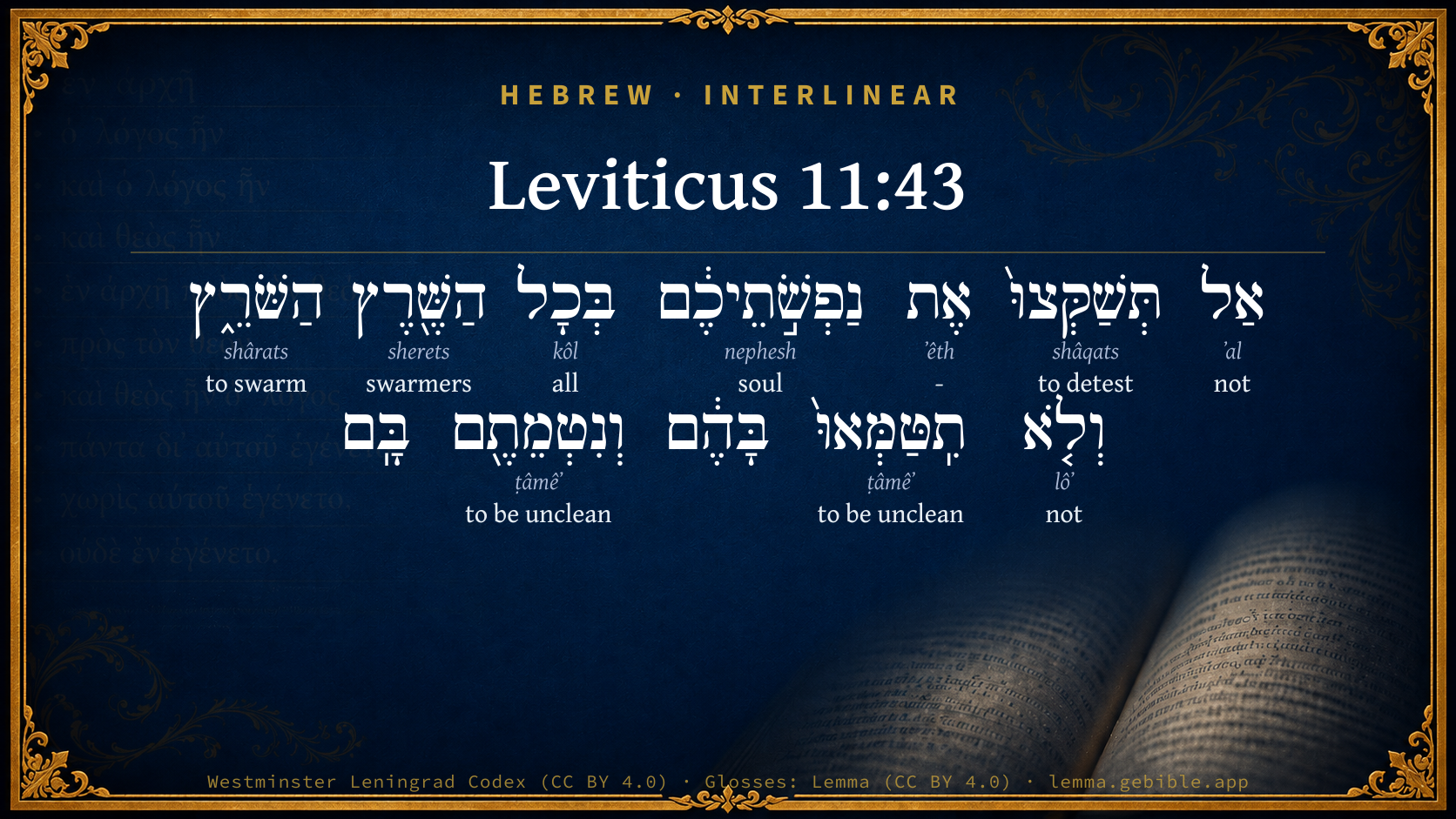
Hebrew (Westminster Leningrad Codex) Leviticus 11:43 appears in the Hebrew Old Testament. The text above is from the Westminster Leningrad Codex. Each word links to its Strong’s number, a concise gloss, and parsing drawn from the Open Scriptures Hebrew Bible morphology. Click any word for its full Brown-Driver-Briggs (BDB) entry.
Download image
Cite this verse

Leviticus 11:43 (World English Bible). Public Domain. Lemma interlinear Bible study tool, https://lemma.gebible.app/v/leviticus/11/43.

Show BibTeX & RIS
BibTeX
RIS
English Translation
You shall not make yourselves abominable with any creeping thing that creeps, neither shall you make yourselves unclean with them, that you should be defiled thereby.
World English Bible · Public Domain
Download a study sheet

One document with this verse’s original text, its word-by-word gloss line, the meaning frame, cross-references with their text, attributed commentary, and full source and license credits — printable, and it pastes into notes with its structure intact.

This verse Autodidact and up

Study sheet (.html) Plain text (.txt)

A passage Seminary Student

Up to 50 verses in one chapter. A passage sheet keeps up to 6 commentary sources and 12 cross-references per verse, in the order this page ranks them, and says so on the sheet whenever that leaves anything out. Ask for a single verse and you get the Autodidact verse sheet above.

Everything on this page stays free to read, with no account — the sheet is a download of what is already on screen, not access to it.

Want to remove ads? Support Godless Engineer
Compare translations 3

The same verse in 3 English versions, stacked beneath the original-language interlinear above. Click any original word for its lexicon entry.

Each is an independent rendering of the whole verse — the interlinear is not word-aligned to these translations.

Highlighted words mark where these versions differ — a whole-verse word diff, not a word-by-word alignment.

  • World English Bible Public Domain
    You shall not make yourselves abominable with any creeping thing that creeps, neither shall you make yourselves unclean with them, that you should be defiled thereby.
  • King James Version Public Domain
    Ye shall not make yourselves abominable with any creeping thing that creepeth, neither shall ye make yourselves unclean with them, that ye should be defiled thereby.
  • unfoldingWord Literal Text CC BY-SA 4.0
    You shall not make your lives detestable with any swarming thing, the one swarming. And you shall not make yourselves unclean with them and be made unclean by them.

unfoldingWord Literal Text — © unfoldingWord, licensed CC BY-SA 4.0. Word-aligned USFM3 via Door43 (git.door43.org/unfoldingWord/en_ult).

Versions to compare (up to 4)

3 of 4 selected

Show all 18 translations

Every available English version of this verse, each an independent rendering of the whole verse.

  • World English Bible Public Domain
    You shall not make yourselves abominable with any creeping thing that creeps, neither shall you make yourselves unclean with them, that you should be defiled thereby.
  • Berean Standard Bible Public Domain
    Do not defile yourselves by any crawling creature; do not become unclean or defiled by them.
  • Majority Standard Bible Public Domain
    Do not defile yourselves by any crawling creature; do not become unclean or defiled by them.
  • King James Version Public Domain
    Ye shall not make yourselves abominable with any creeping thing that creepeth, neither shall ye make yourselves unclean with them, that ye should be defiled thereby.
  • American Standard Version (1901) Public Domain
    Ye shall not make yourselves abominable with any creeping thing that creepeth, neither shall ye make yourselves unclean with them, that ye should be defiled thereby.
  • Revised Version (1885) Public Domain
    Ye shall not make yourselves abominable with any creeping thing that creepeth, neither shall ye make yourselves unclean with them, that ye should be defiled thereby.
  • Geneva Bible (1599) Public Domain
    Ye shall not pollute your selues with any thing that creepeth, neither make your selues vncleane with them, neither defile your selues thereby: ye shall not, I say, be defiled by them,
  • Douay-Rheims (1899) Public Domain
    Do not defile your souls, nor touch aught thereof, lest you be unclean,
  • Young's Literal Translation Public Domain
    ye do not make yourselves abominable with any teeming thing which is teeming, nor do ye make yourselves unclean with them, so that ye have been unclean thereby.
  • Literal Standard Version CC BY-SA 4.0
    you do not make yourselves abominable with any teeming thing which is teeming, nor do you make yourselves unclean with them, so that you have been unclean with them.
  • Unlocked Literal Bible CC BY-SA 4.0
    You must not make yourselves unclean with any living creatures that creep; you must not make yourselves unclean with them, that you should be made impure by them.
  • unfoldingWord Literal Text CC BY-SA 4.0
    You shall not make your lives detestable with any swarming thing, the one swarming. And you shall not make yourselves unclean with them and be made unclean by them.
  • Darby Bible Public Domain
    Ye shall not make yourselves abominable through any crawling thing which crawleth, neither shall ye make yourselves unclean with them, that ye should be defiled thereby.
  • World Messianic Bible Public Domain
    You shall not make yourselves abominable with any creeping thing that creeps. You shall not make yourselves unclean with them, that you should be defiled by them.
  • Webster's Bible Public Domain
    Ye shall not make your selves abominable with any creeping animal that creepeth, neither shall ye make yourselves unclean with them, that ye should be defiled by them.
  • Free Bible Version CC BY-SA 4.0
    Don't defile yourselves by any such crawling animal. Don't make yourselves unclean or defiled by them,
  • Bible in Basic English Public Domain
    You are not to make yourselves disgusting with anything which goes about flat on the earth; you may not make yourselves unclean with them, in such a way that you are not holy to me.
  • JPS Tanakh (1917) Public Domain
    Ye shall not make yourselves detestable with any swarming thing that swarmeth, neither shall ye make yourselves unclean with them, that ye should be defiled thereby.

Literal Standard Version (2020), Covenant Press — licensed CC BY-SA 4.0. Text via the HelloAO Bible API (eBible.org). Unlocked Literal Bible (unfoldingWord) — licensed CC BY-SA 4.0. Text via the HelloAO Bible API (eBible.org). unfoldingWord Literal Text — © unfoldingWord, licensed CC BY-SA 4.0. Word-aligned USFM3 via Door43 (git.door43.org/unfoldingWord/en_ult). Free Bible Version, Dr. Jonathan Gallagher — licensed CC BY-SA 4.0. Text via the HelloAO Bible API (eBible.org).

Word by word

More ways to search: Search by grammar → Find every occurrence → Compare this word →

Practice this passage: Drill this verse → Learn its vocabulary →

תְּשַׁקְּצוּ֙
shâqats
H8262
“to detest”
Verb, Piel, Jussive, 2nd Person, Masculine, Plural
Part of Speech
Verb
Stem
Piel
Form
Jussive
Person
2nd Person
Gender
Masculine
Number
Plural
Full BDB Definition

Origin: a primitive root

TWOT: 2459

(Piel) to detest, make abominable, count filthy, make detestable - to detest - to make detestable
  1. אַל ʼal H408 “not” Particle, Negative
  2. אֶת ʼêth H853 “-” Particle, Direct Object
  3. נַפְשֹׁ֣תֵיכֶ֔ם nephesh H5315 “souls · your” Noun, Common, Both, Plural, Construct + Suffix, Personal, 2nd Person, Common, Plural
  4. בְּכָל kôl H3605 “in/at · all of” Preposition + Noun, Common, Masculine, Singular, Construct
  5. הַשֶּׁ֖רֶץ sherets H8318 “the · swarmers” Particle, Definite Article + Noun, Common, Masculine, Singular, Absolute
  6. הַשֹּׁרֵ֑ץ shârats H8317 “the · swarming” Particle, Definite Article + Verb, Qal, Participle Active, Masculine, Singular, Absolute
  7. וְלֹ֤א lôʼ H3808 “and · not” Conjunction + Particle, Negative
  8. תִֽטַּמְּאוּ֙ ṭâmêʼ H2930 “to be unclean” Verb, Hithpael, Imperfect, 2nd Person, Masculine, Plural
  9. וְנִטְמֵתֶ֖ם ṭâmêʼ H2930 “and · to be unclean” Conjunction + Verb, Niphal, Sequential Perfect, 2nd Person, Masculine, Plural

About this verse

These counts appear in no published source. They are computed here, from the morphology-tagged text and Lemma’s own curated glosses. What Lemma adds →

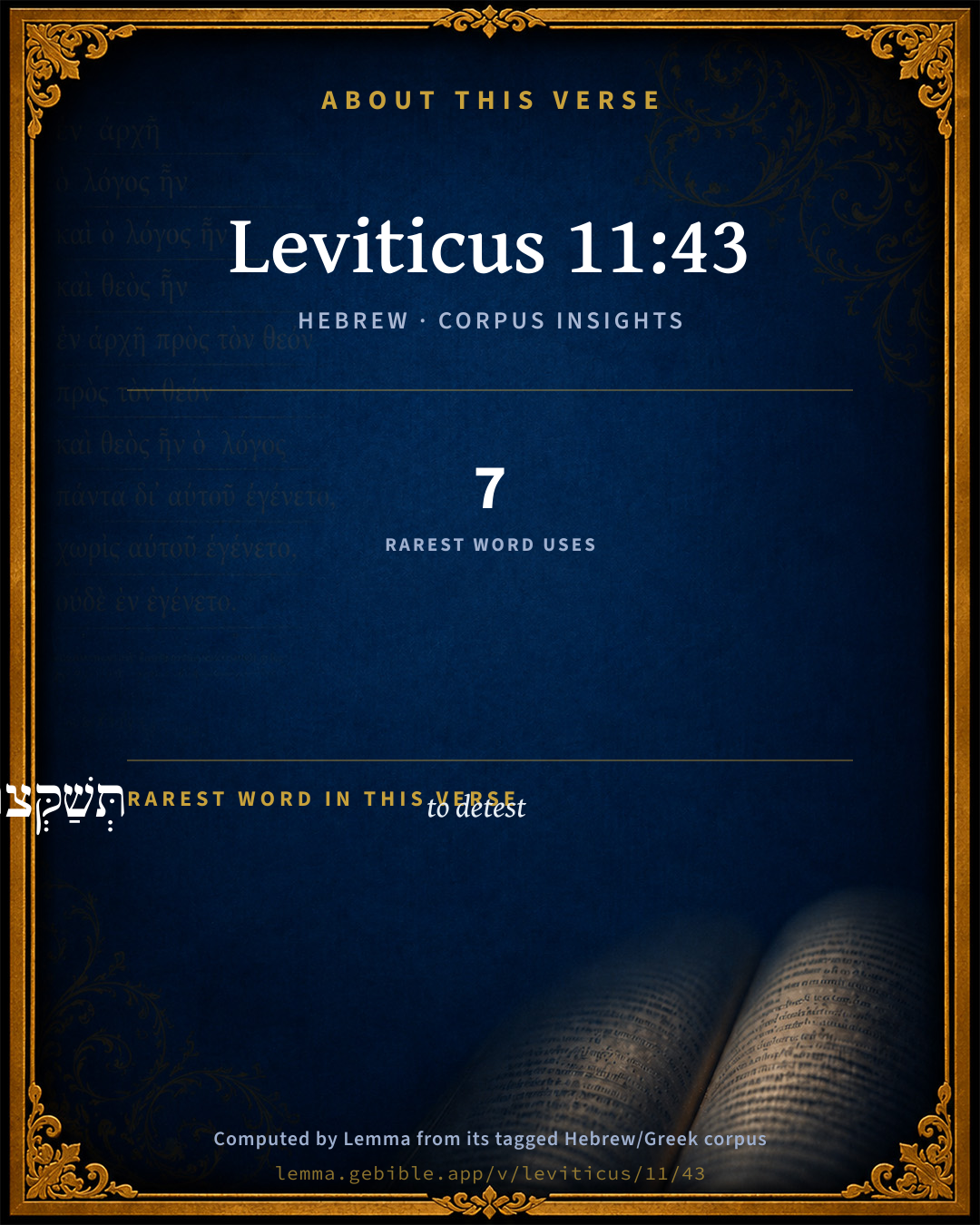
12
words
9
distinct lemmas
Pentateuch
section

Notable vocabulary

The rarest word here is תְּשַׁקְּצוּ֙ to detest H8262 — appearing just 7 times in the whole Hebrew Bible.

Shared distinctive vocabulary

תְּשַׁקְּצוּ֙ to detest H8262 occurs in 6 verses of the Hebrew Bible. Also found in:

Grammatical profile

  • 4 verbs
  • 3 nouns
  • 2 prepositions
  • 3 particles

Verb forms

  • תְּשַׁקְּצוּ֙ Piel · Jussive
  • הַשֹּׁרֵ֑ץ Qal · Participle Active
  • תִֽטַּמְּאוּ֙ Hithpael · Imperfect
  • וְנִטְמֵתֶ֖ם Niphal · Sequential Perfect

Repetition

A word recurs within this verse — often emphatic in Hebrew:

  • תִֽטַּמְּאוּ֙ to be unclean H2930 ×2

Hebrew & Septuagint length

In English translation the verse runs 26 words from the Hebrew and 33 from the Septuagint (LXX English) — closely comparable.

A rough comparison of the two English renderings, which tokenize alike — not a word-level alignment.

Word counts can differ between the Hebrew and the Greek without any difference in meaning — e.g. the Hebrew direct-object marker אֵת has no separate Greek word, and Greek often adds the article ὁ.

Cross-references

2

Topical passages linked to Leviticus 11:43 in the Treasury of Scripture Knowledge — connected by theme and wording, ordered by reader-vote popularity; previews shown in the World English Bible.

  • Leviticus 20:25 "'You shall therefore make a distinction between the clean animal and the unclean, and between the unclean fowl and the clean: and you shall not make yourselves abominable by animal, or by bird, or by anything with which the ground teems, which I have separated from you as unclean for you.
  • Leviticus 11:41–42 "'Every creeping thing that creeps on the earth is an abomination. It shall not be eaten.

Cross-references courtesy of OpenBible.info (CC BY 4.0).

Hebrew and Greek witnesses Masoretic Hebrew ↔ Greek Septuagint

The same verse in the two great witnesses to the Old Testament, shown verse-for-verse.

These are two independent witnesses, not word-aligned to each other, and the Septuagint is shown in lemma (dictionary) form.

Hebrew Leviticus 11:43 Masoretic · Westminster Leningrad Codex

אַל תְּשַׁקְּצוּ֙ אֶת נַפְשֹׁ֣תֵיכֶ֔ם בְּכָל הַשֶּׁ֖רֶץ הַשֹּׁרֵ֑ץ וְלֹ֤א תִֽטַּמְּאוּ֙ בָּהֶ֔ם וְנִטְמֵתֶ֖ם בָּֽם

You shall not make yourselves abominable with any creeping thing that creeps, neither shall you make yourselves unclean with them, that you should be defiled thereby.

World English Bible · Public Domain

Greek LXX Leviticus 11:43 Septuagint · lemma form

καί οὐ μή βδελύσσω ὁ ψυχή σύ ἐν πᾶς ὁ ἑρπετόν ὁ ἕρπω ἐπί ὁ γῆ καί οὐ μιαίνω ἐν οὗτος καί οὐ ἀκάθαρτος εἰμί ἐν αὐτός

And you⌃ shall not defile your souls with any of the reptiles that creep upon the earth, and you⌃ shall not be polluted with them, and you⌃ shall not be unclean by them.

LXX2012 (modern English Septuagint) · Public Domain

Hebrew: Westminster Leningrad Codex (CC BY 4.0). Greek: Septuagint (public domain); English from LXX2012 (modern English Septuagint) (Public Domain). How the Septuagint differs from the Hebrew →

Targum (Aramaic paraphrase)

2

The Targum is the ancient Jewish Aramaic paraphrase of the Hebrew Scriptures — an interpretive translation, not the Hebrew text itself. Onkelos (literal) and Pseudo-Jonathan (expansive) render the Torah, and Jonathan the Prophets. Coverage is partial: where no permissively-licensed English translation exists for a verse, only the Aramaic is shown. This is verse-level text, not a word-by-word alignment to the Hebrew.

  1. Targum Onkelos Torah (Genesis–Deuteronomy)
    לָא תְשַׁקְצוּ יָת נַפְשָׁתֵיכוֹן בְּכָל רִחֲשָׁא דְרָחֵשׁ וְלָא תִסְתַּאֲבוּן בְּהוֹן וְתִסְתַּאֲבוּן פּוֹן בְּהוֹן

    (no public-domain English translation for this verse)

    Targum Onkelos — Aramaic: “Onkelos Genesis” (public domain); “Onkelos Exodus” (public domain); “Onkelos Leviticus” (public domain); “Onkelos Numbers” (public domain); “Onkelos Deuteronomy” (public domain). English: “Sefaria Community Translation” (CC0 1.0 (public-domain dedication)); “J.W. Etheridge. The Targums of Onkelos and Jonathan Ben Uzziel on the Pentateuch. London: Longmans, Green, 1862” (public domain). Text via Sefaria.

  2. Targum Pseudo-Jonathan Torah (Genesis–Deuteronomy)
    לָא תְשַׁקְצוּן יַת נַפְשָׁתֵיכוֹן בְּכָל רִיחֲשָׁא דִרְחֵישׁ וְלָא תִסְתַּאֲבוּן בְּהוֹן דִילְמָא תִּסְתַּאֲבוּן פּוֹן בְּהוֹן

    You shall not contaminate your souls by any reptile that creepeth, nor defile yourselves with them, lest by them you make yourselves unclean.

    Targum Pseudo-Jonathan — Aramaic: “Targum Jonathan on Genesis” (public domain); “Targum Jonathan on Exodus” (public domain); “Targum Jonathan on Leviticus” (public domain); “Targum Jonathan on Numbers” (public domain); “Targum Jonathan on Deuteronomy” (public domain). English: “The Targum of Jonathan ben Uzziel, trans. J. W. Etheridge, London, 1862” (public domain). Text via Sefaria.

Commentary

Notes on Leviticus 11:43 from classic Christian and Jewish commentators (each source and its license shown beneath its notes). The classic Christian expositions comment on the surrounding passage and are grouped to its opening verse, so a note may address several verses; the Jewish commentaries on the Tanakh (Rashi and others) are per-verse, so they appear only where the commentator wrote on this verse.

Lemma curates 59 commentaries, every one of them public domain or Creative Commons licensed, each selected and text-cleaned for this edition rather than reprinted as found. About our sources →

Matthew Henry's Commentary

Here is, I. The exposition of this law, or a key to let us into the meaning of it. It was not intended merely for a bill of fare, or as the directions of a physician about their diet, but God would hereby teach them to sanctify themselves and to be holy, Lev 11:44. That is, 1. They must hereby learn to put a difference between good and evil, and to reckon that it could not be all alike what they did, when it was not all alike what they ate. 2. To maintain a constant observance of the divine law, and to govern themselves by that in all their actions, even those that are common, which ought to be performed after a godly sort, Jo3 1:6. Even eating and drinking must be by rule, and to the glory of God, Co1 10:31. 3. To distinguish themselves from all their neighbours, as a people set apart for God, and obliged not to walk as the Gentiles: and all this is holiness. Thus these rudiments of the world were their tutors and governors (Gal 4:2, Gal 4:3), to bring them to that which is the revival of our first state in Adam and the earnest of our best state with Christ, that is, holiness, without which no man shall see the Lord. This is indeed the great design of all the ordinances, that by them we may sanctify ourselves and learn to be holy. Even This law concerning their food, which seemed to stoop so very low, aimed thus high, for it was the statute-law of heaven, under the Old Testament as well as the New, that without holiness no man shall see the Lord. The caution therefore (Lev 11:43) is, You shall not make yourselves abominable. Note, By having fellowship with sin, which is abominable, we make ourselves abominable. That man is truly miserable who is in the sight of God abominable; and none are so but those that make themselves so. The Jewish writers themselves suggest that the intention of this law was to forbid them all communion by marriage, or otherwise, with the heathen, Deu 7:2, Deu 7:3. And thus the moral of it is obligatory on us, forbidding us to have fellowship with the unfruitful works of darkness; and, without this real holiness of the heart and life, he that offereth an oblation is as if he offered swine's blood (Isa 66:3); and, if it was such a provocation for a man to eat swine's flesh himself, much more it must be so to offer swine's blood at God's altar; see Pro 15:8.

II. The reasons of this law; and they are all taken from the Law-maker himself, to whom we must have respect in all acts of obedience. 1. I am the Lord your God, Lev 11:44. "Therefore you are bound to do thus, in pure obedience." God's sovereignty over us, and propriety in us, oblige us to do whatever he commands us, how much soever it crosses our inclinations. 2. I am holy, Lev 11:44, and again, Lev 11:45. If God be holy, we must be so, else we cannot expect to be accepted of him. His holiness is his glory (Exo 15:11), and therefore it becomes his house for ever, Psa 93:5. This great precept, thus enforced, though it comes in here in the midst of abrogated laws, is quoted and stamped for a gospel precept, Pe1 1:16, where it is intimated that all these ceremonial restraints were designed to teach us that we must not fashion ourselves according to our former lusts in our ignorance, Lev 11:14. 3. I am the Lord that bringeth you out of the land of Egypt, Lev 11:45. This was a reason why they should cheerfully submit to distinguishing laws, having of late been so wonderfully dignified with distinguishing favours. He that had done more for them than for any other people might justly expect more from them.

III. The conclusion of this statute: This is the law of the beasts, and of the fowl, etc., Lev 11:46, Lev 11:47. This law was to them a statute for ever, that is, as long as that economy lasted; but under the gospel we find it expressly repealed by a voice from heaven to Peter (Act 10:15), as it had before been virtually set aside by the death of Christ, with the other ordinances that perished in the using: Touch not, taste not, handle not, Col 2:21, Col 2:22. And now we are sure that meat commends us not to God (Co1 8:8), and that nothing is unclean of itself (Rom 14:14), nor does that defile a man which goes into his mouth, but that which comes out from the heart, Mat 15:11. Let us therefore, 1. Give thanks to God that we are not under this yoke, but that to us every creature of God is allowed as good, and nothing to be refused. 2. Stand fast in the liberty wherewith Christ has made us free, and take heed of those doctrines which command to abstain from meats, and so would revive Moses again, Ti1 4:3, Ti1 4:4. 3. Be strictly and conscientiously temperate in the use of the good creatures God has allowed us. If God's law has given us liberty, let us lay restraints upon ourselves, and never feed ourselves without fear, lest our table be a snare. Set a knife to thy throat, if thou be a man given to appetite; and be not desirous of dainties or varieties, Pro 23:2, Pro 23:3. Nature is content with little, grace with less, but lust with nothing.

Matthew Henry's Commentary on the Whole Bible (1708–1710) — public domain (CC PDM 1.0). Text via the HelloAO Bible API.

Trapp's Complete Commentary

John Trapp

Lev 11:43 Ye shall not make yourselves abominable with any creeping thing that creepeth, neither shall ye make yourselves unclean with them, that ye should be defiled thereby.

Ver. 43. Ye shall not make yourselves.] Heb., Your souls. See on Lev 11:32.

John Trapp, A Commentary or Exposition upon All the Books of the Old and New Testament (1647–1656) — public domain. Text from a community e-Sword module.

Ellicott's Commentary for English Readers

(43) Ye shall not make your selves abominable.—By eating the unclean creatures which are constantly characterised in this book as “abominable” (see Lev_7:21; Lev_11:10-13; Lev_11:20; Lev_11:23; Lev_11:41-42)—a term which only occurs twice more in the Hebrew Scriptures (Isa_66:17; Eze_8:10)—those who do so render themselves abominable and repulsive; hence the admonition. The phrase only occurs once more, viz., Lev_20:25, where it is translated in the Authorised Version, “Ye shall not make your souls abominable.” This is the reason why “soul” is put here in the margin on the word “selves.”

Neither shall ye make yourselves unclean.—But not only is it disgusting to eat these abominable creatures, but their carcases defile and debar him who comes in contact with them from entering into the sanctuary and from partaking of the sacrificial meal.

A Bible Commentary for English Readers, edited by Charles John Ellicott (1878–1897) — public domain. Text from a community e-Sword module.

John Gill's Exposition

Ye shall not make yourselves abominable with any creeping thing that creepeth,.... With any creeping thing that flies in the air, excepting the four sorts of locusts, Lev 11:22 and with any creeping thing in the waters, Lev 11:10 or with anything that creeps on the land, by eating any of them; which being abominable for food, would make the eater of them so to God, he thereby breaking a command of his:

neither shall you make yourselves unclean with them; by touching and bearing them, as with dead beasts, so with dead flies and the like:

that ye should be defiled thereby; in a ceremonial sense.

John Gill's Exposition of the Whole Bible (1746–1763) — public domain (CC PDM 1.0). Text via the HelloAO Bible API.

Whedon's Commentary on the Bible

Daniel D. Whedon

43. Ye shall not make yourselves abominable — Hebrew, your souls.

See Lev_4:2.

Daniel D. Whedon (gen. ed.), Commentary on the Old and New Testaments (1874–1909) — public domain. Text from a community e-Sword module.

unfoldingWord translationNotes

Door43 World Missions Community

General Information:

Yahweh continues telling Moses and Aaron which animals the people are to consider unclean.

You must not make yourselves unclean ... you should be made impure by them

Yahweh repeats the same idea twice in order to strengthen the command that they are not to eat any unclean animal. (See: Parallelism)

You must not make yourselves unclean

A person who is unacceptable for God's purposes is spoken of as if he were physically unclean. (See: Metaphor)

that you should be made impure by them

This can be translated in active form. AT: "so that you are no longer pure because of them" (See: Active or Passive)

translationWords

clean

pure

Yahweh

God

holy

defile

Egypt

unfoldingWord translationNotes — © Distant Shores Media and the Door43 World Missions Community, licensed CC BY-SA 4.0. Source: git.door43.org/Door43/en_tn.

Rashi

Rabbi Shlomo Yitzchaki (Rashi)

אל תשקצו YE SHALL NOT MAKE [YOUR SOULS] ABOMINABLE, by eating these (Meilah 16b): this must be the meaning, because you see it is written “[ye shall not make] your souls [abominable]” and no soiling of the soul arises from touching these creatures. And similarly the words (v. 44) “neither shall ye defile [your souls]” mean: by eating them.

ונטמתם בם THAT YE SHOULD BE DEFILED THEREBY — If you become defiled thereby on earth I will treat you as defiled in the world-to-come and in the heavenly academy (cf. Yoma 39a).

Rashi on the Tanakh — English translations: “The Judaica Press complete Tanach with Rashi, translated by A. J. Rosenberg” (CC BY 4.0); “Pentateuch with Rashi's commentary by M. Rosenbaum and A.M. Silbermann, 1929-1934” (public domain); “The Metsudah Tanach series, Lakewood, N.J” (CC BY 4.0); and “The Book of Joshua, Metsudah Publications, 1997” (CC BY 4.0). Text via Sefaria.

Ibn Ezra

Rabbi Abraham ibn Ezra

Do not make yourselves repulsive. Because they are dirty and disgusting. And do not make yourselves unclean with them. For it is known that the entity that is eaten will become flesh in the body of the one who eats it.

Ibn Ezra on the Tanakh — English translations: “Sefaria Community Translation” (CC0 1.0 (public-domain dedication)); “Yalkut, Sifsei Chachomim Chumash, Metsudah Publications, 2009” (CC BY 4.0); and “Commentary of Ibn Ezra on Isaiah - trans. by M. Friedlander, 1873” (public domain). Text via Sefaria.

Lesson kit

Teaching starters — assembled from the data on this page, not authored interpretation. Every prompt links to the verse data it draws on. Edit before teaching.

Leviticus, in the Pentateuch, opens this verse with 12 words (9 distinct Hebrew lemmas). Its most distinctive word is shâqats (“to detest”). A historical commentator’s framing appears above. Read the whole chapter for the surrounding context.

Discussion questions

  1. What does “to detest” (shâqats) contribute to the verse as a whole?
  2. How does Leviticus 11:11, which shares the word «to detest», read alongside this verse?
  3. What does the repetition of “to be unclean” (2× in this one verse) do in this verse?
  4. These translations render this verse differently. What is at stake in choosing one wording over another?
  5. «תְּשַׁקְּצוּ֙» is a Piel Jussive verb. How does that grammatical form shape the action described?
  6. Compare how Matthew Henry's Commentary and Trapp's Complete Commentary read this verse. Where do they agree or differ?

Things to notice

  • These translations choose different wording for 14 words in this verse.
  • “to be unclean” occurs 2× in this single verse.
  • 9 distinct Hebrew lemmas span 12 words in this verse.

Reading settings

Reading text

Shown beneath each verse's original-language words.

Old Testament
Old Testament edition

Read the OT as the Masoretic Hebrew (MT) or the Greek Septuagint (LXX).

English shown for the Greek Septuagint (in the Hebrew ↔ Greek comparison).

Comparing translations? Open the Compare panel on any verse page to stack up to four side by side.