2 Samuel 13:16

Hebrew (Westminster Leningrad Codex) 2 Samuel 13:16 appears in the Hebrew Old Testament. The text above is from the Westminster Leningrad Codex. Each word links to its Strong’s number, a concise gloss, and parsing drawn from the Open Scriptures Hebrew Bible morphology. Click any word for its full Brown-Driver-Briggs (BDB) entry.
Download image
Cite this verse

2 Samuel 13:16 (World English Bible). Public Domain. Lemma interlinear Bible study tool, https://lemma.gebible.app/v/2-samuel/13/16.

Show BibTeX & RIS
BibTeX
RIS
English Translation
She said to him, Not so, because this great wrong in putting me forth is [worse] than the other that you did to me. But he would not listen to her.
World English Bible · Public Domain
Download a study sheet

One document with this verse’s original text, its word-by-word gloss line, the meaning frame, cross-references with their text, attributed commentary, and full source and license credits — printable, and it pastes into notes with its structure intact.

This verse Autodidact and up

Study sheet (.html) Plain text (.txt)

A passage Seminary Student

Up to 50 verses in one chapter. A passage sheet keeps up to 6 commentary sources and 12 cross-references per verse, in the order this page ranks them, and says so on the sheet whenever that leaves anything out. Ask for a single verse and you get the Autodidact verse sheet above.

Everything on this page stays free to read, with no account — the sheet is a download of what is already on screen, not access to it.

Want to remove ads? Support Godless Engineer
Compare translations 3

The same verse in 3 English versions, stacked beneath the original-language interlinear above. Click any original word for its lexicon entry.

Each is an independent rendering of the whole verse — the interlinear is not word-aligned to these translations.

Highlighted words mark where these versions differ — a whole-verse word diff, not a word-by-word alignment.

  • World English Bible Public Domain
    She said to him, Not so, because this great wrong in putting me forth is [worse] than the other that you did to me. But he would not listen to her.
  • King James Version Public Domain
    And she said unto him, There is no cause: this evil in sending me away is greater than the other that thou didst unto me. But he would not hearken unto her.
  • unfoldingWord Literal Text CC BY-SA 4.0
    But she said to him, “No, because this great evil, to send me away, than the other that you did to me.” But he was not willing to listen to her.

unfoldingWord Literal Text — © unfoldingWord, licensed CC BY-SA 4.0. Word-aligned USFM3 via Door43 (git.door43.org/unfoldingWord/en_ult).

Versions to compare (up to 4)

3 of 4 selected

Show all 18 translations

Every available English version of this verse, each an independent rendering of the whole verse.

  • World English Bible Public Domain
    She said to him, Not so, because this great wrong in putting me forth is [worse] than the other that you did to me. But he would not listen to her.
  • Berean Standard Bible Public Domain
    “No,” she replied, “sending me away is worse than this great wrong you have already done to me!” But he refused to listen to her.
  • Majority Standard Bible Public Domain
    “No,” she replied, “sending me away is worse than this great wrong you have already done to me!” But he refused to listen to her.
  • King James Version Public Domain
    And she said unto him, There is no cause: this evil in sending me away is greater than the other that thou didst unto me. But he would not hearken unto her.
  • American Standard Version (1901) Public Domain
    And she said unto him, Not so, because this great wrong in putting me forth is `worse' than the other that thou didst unto me. But he would not hearken unto her.
  • Revised Version (1885) Public Domain
    And she said unto him, Not so, because this great wrong in putting me forth is worse than the other that thou didst unto me. But he would not hearken unto her.
  • Geneva Bible (1599) Public Domain
    And she answered him, There is no cause: this euill (to put mee away) is greater then the other that thou diddest vnto me: but he would not heare her,
  • Douay-Rheims (1899) Public Domain
    She answered him: This evil which now thou dost against me, in driving me away, is greater than that which thou didst before. And he would not hearken to her:
  • Young's Literal Translation Public Domain
    And she saith to him, `Because of the circumstances this evil is greater than the other that thou hast done with me -- to send me away;' and he hath not been willing to hearken to her,
  • Literal Standard Version CC BY-SA 4.0
    And she says to him, “Because of the circumstances this evil is greater than the other that you have done with me—to send me away”; and he has not been willing to listen to her,
  • Unlocked Literal Bible CC BY-SA 4.0
    But she responded to him, “No! Because this great evil of making me leave is even worse than what you did to me!” But Amnon did not listen to her.
  • unfoldingWord Literal Text CC BY-SA 4.0
    But she said to him, “No, because this great evil, to send me away, than the other that you did to me.” But he was not willing to listen to her.
  • Darby Bible Public Domain
    And she said to him, There is no cause for this evil in sending me away, [which] is greater than the other that thou didst to me. But he would not hearken to her.
  • World Messianic Bible Public Domain
    She said to him, “Not so, because this great wrong in sending me away is worse than the other that you did to me!” But he would not listen to her.
  • Webster's Bible Public Domain
    And she said to him, There is no cause: this evil in sending me away is greater than the other that thou didst to me. But he would not hearken to her.
  • Free Bible Version CC BY-SA 4.0
    “No! Don't do this!” she answered. “Sending me away in disgrace would be an even greater evil than what you've already done to me.” But he wouldn't listen to her.
  • Bible in Basic English Public Domain
    And she said to him, Not so, my brother, for this great wrong in sending me away is worse than what you did to me before. But he gave no attention to her.
  • JPS Tanakh (1917) Public Domain
    And she said unto him: 'Not so, because this great wrong in putting me forth is worse than the other that thou didst unto me.' But he would not hearken unto her.

Literal Standard Version (2020), Covenant Press — licensed CC BY-SA 4.0. Text via the HelloAO Bible API (eBible.org). Unlocked Literal Bible (unfoldingWord) — licensed CC BY-SA 4.0. Text via the HelloAO Bible API (eBible.org). unfoldingWord Literal Text — © unfoldingWord, licensed CC BY-SA 4.0. Word-aligned USFM3 via Door43 (git.door43.org/unfoldingWord/en_ult). Free Bible Version, Dr. Jonathan Gallagher — licensed CC BY-SA 4.0. Text via the HelloAO Bible API (eBible.org).

Word by word

More ways to search: Search by grammar → Find every occurrence → Compare this word →

Practice this passage: Drill this verse → Learn its vocabulary →

אוֹדֹ֞ת
ʼôwdôwth
H182
“cause of”
Noun, Common, Feminine, Plural, Construct
Part of Speech
Noun
Type
Common
Gender
Feminine
Number
Plural
State
Construct
Full BDB Definition

Origin: from the same as H181

TWOT: 38b

cause - cause, reason for - the occasion of
  1. וַתֹּ֣אמֶר ʼâmar H559 “and · to say” Conjunction + Verb, Qal, Sequential Imperfect, 3rd Person, Feminine, Singular
  2. אַל ʼal H408 “not” Particle, Negative
  3. הָרָעָ֤ה raʻ H7451 “the · evil” Particle, Definite Article + Noun, Common, Feminine, Singular, Absolute
  4. הַגְּדוֹלָה֙ gâdôwl H1419 “the · great” Particle, Definite Article + Adjective, Adjective, Feminine, Singular, Absolute
  5. הַזֹּ֔את zôʼth H2063 “the · this” Particle, Definite Article + Pronoun, Demonstrative, Feminine, Singular
  6. מֵאַחֶ֛רֶת ʼachêr H312 “from · other” Preposition + Adjective, Adjective, Feminine, Singular, Absolute
  7. אֲשֶׁר ʼăsher H834 “which” Particle, Relative
  8. עָשִׂ֥יתָ ʻâsâh H6213 “to do” Verb, Qal, Perfect, 2nd Person, Masculine, Singular
  9. עִמִּ֖י ʻim H5973 “with · me” Preposition + Suffix, Personal, 1st Person, Common, Singular
  10. לְשַׁלְּחֵ֑נִי shâlach H7971 “to send · me” Preposition + Verb, Piel, Infinitive Construct + Suffix, Personal, 1st Person, Common, Singular
  11. וְלֹ֥א lôʼ H3808 “and · not” Conjunction + Particle, Negative
  12. אָבָ֖ה ʼâbâh H14 “to be willing” Verb, Qal, Perfect, 3rd Person, Masculine, Singular
  13. לִשְׁמֹ֥עַֽ shâmaʻ H8085 “to hear” Preposition + Verb, Qal, Infinitive Construct

About this verse

These counts appear in no published source. They are computed here, from the morphology-tagged text and Lemma’s own curated glosses. What Lemma adds →

16
words
14
distinct lemmas
Historical
section

Notable vocabulary

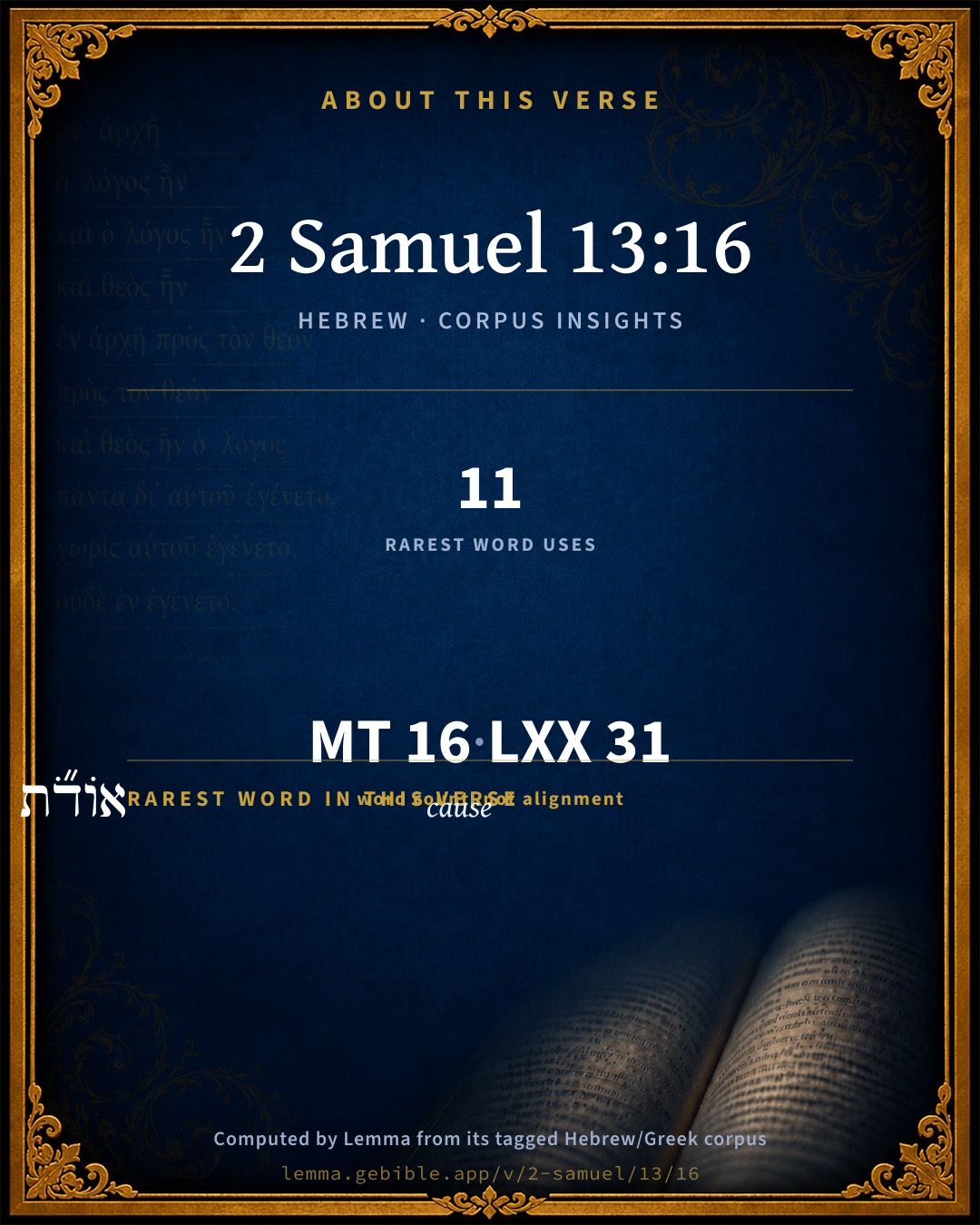
The rarest word here is אוֹדֹ֞ת cause H182 — appearing just 11 times in the whole Hebrew Bible.

Shared distinctive vocabulary

אוֹדֹ֞ת cause H182 occurs in 10 verses of the Hebrew Bible. Also found in:

Grammatical profile

  • 5 verbs
  • 2 nouns
  • 2 adjectives
  • 1 pronoun
  • 3 prepositions
  • 3 particles

Verb forms

  • וַתֹּ֣אמֶר Qal · Sequential Imperfect
  • עָשִׂ֥יתָ Qal · Perfect
  • לְשַׁלְּחֵ֑נִי Piel · Infinitive Construct
  • אָבָ֖ה Qal · Perfect
  • לִשְׁמֹ֥עַֽ Qal · Infinitive Construct

Hebrew & Septuagint length

In English translation the verse runs 31 words from the Hebrew and 31 from the Septuagint (LXX English) — the same length.

A rough comparison of the two English renderings, which tokenize alike — not a word-level alignment.

Word counts can differ between the Hebrew and the Greek without any difference in meaning — e.g. the Hebrew direct-object marker אֵת has no separate Greek word, and Greek often adds the article ὁ.

In the original languages it is 16 Hebrew tokens and 31 Greek tokens — but the two are counted differently (Hebrew bundles its prefixes and suffixes into one token; the Greek is in lemma form), so that isn’t a like-for-like length.

Hebrew and Greek witnesses Masoretic Hebrew ↔ Greek Septuagint

The same verse in the two great witnesses to the Old Testament, shown verse-for-verse.

These are two independent witnesses, not word-aligned to each other, and the Septuagint is shown in lemma (dictionary) form.

Hebrew 2 Samuel 13:16 Masoretic · Westminster Leningrad Codex

וַתֹּ֣אמֶר ל֗וֹ אַל אוֹדֹ֞ת הָרָעָ֤ה הַגְּדוֹלָה֙ הַזֹּ֔את מֵאַחֶ֛רֶת אֲשֶׁר עָשִׂ֥יתָ עִמִּ֖י לְשַׁלְּחֵ֑נִי וְלֹ֥א אָבָ֖ה לִשְׁמֹ֥עַֽ לָֽהּ

She said to him, Not so, because this great wrong in putting me forth is [worse] than the other that you did to me. But he would not listen to her.

World English Bible · Public Domain

Greek LXX 2 Samuel 13:16 Septuagint · lemma form

καί εἶπον αὐτός θημαρ μή ἀδελφός ὅτι μέγας ὁ κακία ὁ ἔσχατος ὑπέρ ὁ πρῶτος ὅς ποιέω μετά ἐγώ ὁ ἐκ ἀποστέλλω ἐγώ καί οὐ θέλω αμνων ἀκούω ὁ φωνή αὐτός

And Themar spoke to him concerning this great mischief, greater, said she, than the other that you did me, to send me away: but Amnon would not listen to her voice.

LXX2012 (modern English Septuagint) · Public Domain

On this verse, The Pulpit Commentary discusses the Septuagint’s reading. Read the note in Commentary ↓

Hebrew: Westminster Leningrad Codex (CC BY 4.0). Greek: Septuagint (public domain); English from LXX2012 (modern English Septuagint) (Public Domain). How the Septuagint differs from the Hebrew →

Targum (Aramaic paraphrase)

1

The Targum is the ancient Jewish Aramaic paraphrase of the Hebrew Scriptures — an interpretive translation, not the Hebrew text itself. Onkelos (literal) and Pseudo-Jonathan (expansive) render the Torah, and Jonathan the Prophets. Coverage is partial: where no permissively-licensed English translation exists for a verse, only the Aramaic is shown. This is verse-level text, not a word-by-word alignment to the Hebrew.

  1. Targum Jonathan Prophets (Joshua–Malachi)
    וַאֲמַרַת לֵיהּ עַל עֵיסַק בִּישְׁתָא רַבְּתָא הָדָא מֵאוֹחֲרַנְתָּא דַעֲבַדְתָּא עִמִי אַתְּ אֲמַר לְשַׁלָחוּתִי וְלָא אֲבָא לְקַבְּלָא מִנָהּ:

    (no public-domain English translation for this verse)

    Targum Jonathan — Aramaic: “Mikraot Gedolot” (public domain). English: “Sefaria Community Translation” (CC0 1.0 (public-domain dedication)); “London "Chaldee Paraphrase," 1871” (public domain). Text via Sefaria.

Commentary

Notes on 2 Samuel 13:16 from classic Christian and Jewish commentators (each source and its license shown beneath its notes). The classic Christian expositions comment on the surrounding passage and are grouped to its opening verse, so a note may address several verses; the Jewish commentaries on the Tanakh (Rashi and others) are per-verse, so they appear only where the commentator wrote on this verse.

Lemma curates 59 commentaries, every one of them public domain or Creative Commons licensed, each selected and text-cleaned for this edition rather than reprinted as found. About our sources →

Trapp's Complete Commentary

John Trapp

2Sa 13:16 And she said unto him, [There is] no cause: this evil in sending me away [is] greater than the other that thou didst unto me. But he would not hearken unto her.

Ver. 16. There is no cause,] sc., Of adding this inhumanity to thy former impiety. I have given thee no just occasion for so serving me. She had not therefore exasperated him, either by railing upon him, or hurting him in the bustle. We read {a} of a certain seamster who thrust her scissors into the belly of Walter, bishop of Hereford, who would have ravished her, A.D. 1060; but here was no such violence offered, whatever the Rabbins here feign.

This evil … is greater than the other] Because done in cold blood, and not without public notice; whereas else, the rape might have been concealed, and the matter taken up, by repentance, in the judge’s privy chamber of mercy, to the stopping of all open judicial proceedings in court.

{a} Godw. Catal., 452.

John Trapp, A Commentary or Exposition upon All the Books of the Old and New Testament (1647–1656) — public domain. Text from a community e-Sword module.

Tyndale Open Study Notes

Tyndale Open Resources

13:16 worse than what you’ve already done: A virgin who had been raped became unmarriageable (13:20; see Deut 22:28-29).

Tyndale Open Study Notes — © Tyndale Open Resources, licensed CC BY-SA 4.0. Text via the HelloAO Bible API.

Geneva Bible (1599)

Geneva Bible translators

Or, for this cause.

Geneva Bible (1599) marginal notes — public domain. Text via Bolls.life.

Ellicott's Commentary for English Readers

(16) There is no cause.—The Hebrew is elliptical and difficult; various interpretations are suggested, among which that given in the Authorised Version expresses very well the sense, although not an accurate translation. Amnon was now doing her a greater wrong than at first, because he was now bound, in consequence of that, to protect and comfort her.

A Bible Commentary for English Readers, edited by Charles John Ellicott (1878–1897) — public domain. Text from a community e-Sword module.

The Cambridge Bible for Schools and Colleges

gen. ed. J. J. S. Perowne

16. There is no cause] The Heb. text cannot be so translated, and is certainly corrupt. The Sept. is also confused, but its original reading as indicated by the Old Latin Version gives an excellent sense, thus; “And she said unto him, Nay, my brother, for greater will be this latter wrong, in sending me away, than the former that thou didst unto me.”

The Cambridge Bible for Schools and Colleges (gen. ed. J. J. S. Perowne; Cambridge University Press, 1878–1918) — public domain. Text from a community e-Sword module.

John Gill's Exposition

And she said unto him, there is no cause,.... For such treatment as this:

this evil in sending me away is greater than the other that thou didst unto me; not that this was a greater sin, but it was a greater evil or injury to her, that being done secretly, this openly; being turned out in that open manner, it might look as if she was the aggressor, and had drawn her brother into this sin, or however had consented to it; had it been kept a secret, she would not have been exposed to public shame and disgrace, and she might have been disposed of in marriage to another; it would not have been known to the grief of her father, to the revenge of Absalom, and to the dishonour of religion; besides, the sin of Amnon might have been more easily excused, if any excuse could be made for it, as that it arose from the force of lust, and a strong impure affection, but this from barbarity and inhumanity:

but he would not hearken unto her; but insisted upon her immediate departure.

John Gill's Exposition of the Whole Bible (1746–1763) — public domain (CC PDM 1.0). Text via the HelloAO Bible API.

Albert Barnes' Notes on the Bible

The sense of the passage probably is, “And she spake with him on account of this great wrong in sending me away, greater than the other wrong which thou hast done me (said she), but he hearkened not unto her.” The Hebrew text is probably corrupt, and the writer blends Tamar’s words with his own narrative.

Albert Barnes' Notes on the Bible (1834–1885) — public domain. Text from a community e-Sword/MySword module.

Haydock's Catholic Bible Commentary

Greater, as being more public; (Tirinus) and all would think her guilty of some horrible misdemeanor. (Haydock) --- It made the divulging of the crime in some degree necessary. (Menochius) --- Unhappy woman! why did she not cry out, at least, before the perpetration of the act, as the law directed? (Deuteronomy xxii. 24.) (Salien, the year of the world 3000.)

George Leo Haydock (1774–1849), Haydock's Catholic Family Bible and Commentary, 1859 edition — public domain. Excludes Psalms (Douay-Rheims chapter numbering differs from Protestant) and Deuterocanonical books (Catholic canon only).

Matthew Poole's English Annotations

There is no cause, to wit, given thee by me.

This evil is greater than the other: this she might truly say, because though the other was in itself a greater sin, yet this was an act of greater inhumanity and barbarous cruelty, and a greater wrong and calamity to her, (which she means by evil,) because it exposed her to public infamy and contempt, as if she had been an impudent strumpet, and had either enticed him to the sin, or at least consented to it; and besides, it turned a private offence into a public scandal, to the great dishonour of God and of his people Israel, and especially of all the royal family, and was likely to cause direful passions, and breaches, and mischiefs among them.

Matthew Poole's English Annotations on the Holy Bible (1683–1685) — public domain. Text from a community e-Sword/MySword module.

Whedon's Commentary on the Bible

Daniel D. Whedon

16. No cause — For this additional violence and rage. The passage should be rendered thus: There is not cause for this greater evil than the other which thou hast done with me, to thrust me away.

This evil… is greater than the other — For it would publish their shame to all the city, and make it appear that their incest had been brought about by some lewd proposal of hers.

Daniel D. Whedon (gen. ed.), Commentary on the Old and New Testaments (1874–1909) — public domain. Text from a community e-Sword module.

The Pulpit Commentary

There is no cause. This is certainly not a possible translation of the Hebrew, which is probably corrupt; and though Tamar"s words may have been broken and hysterical, we cannot suppose that the narrator intended to represent her sobs. The text is rendered by Philippsohn, "And she said to him respecting the evil deed, Greater is this than the other." Similarly Cahen renders it, "au sujet de ce mal." Flat as this is, no better rendering is possible; but the Vatican copy of the Septuagint has a reading which suggests the line of probable emendation: "Nay, my brother, this evil is greater than the other." It was greater because it east the reproach upon her, refused her the solace of his affection, and made her feel that she had been humbled, not because he loved her, but for mere phantasy. He has had his will, and, careless of her sorrow, he scuds her contemptuously away, indifferent to the wrong he has done her, and piqued and mortified at her indignant resistance. However much we may disapprove of Absalom"s conduct, Amnon richly deserved his punishment.

The Pulpit Commentary (1880–1919), ed. H.D.M. Spence-Jones & Joseph S. Exell — public domain. Text from a community e-Sword module.

John Wesley's Explanatory Notes

No cause - For me to go. Greater thou the other - This she might truly say, because though the other was in itself a greater sin, yet this was an act of greater cruelty, and a greater calamity to her because it exposed her to publick infamy and contempt, and besides, it turned a private offense into a publick scandal, to the great dishonour of God and of his people, and especially of all the royal family.

John Wesley, Explanatory Notes Upon the Whole Bible (1754–1765) — public domain. Text via the GEBible commentary corpus.

Rashi

Rabbi Shlomo Yitzchaki (Rashi)

Do not do this thing. Do not do this evil thing of sending [me] away which is worse then the other [evil thing] that you did to me. You raped me and then you added on more evil than that by sending me away.

Rashi on the Tanakh — English translations: “The Judaica Press complete Tanach with Rashi, translated by A. J. Rosenberg” (CC BY 4.0); “Pentateuch with Rashi's commentary by M. Rosenbaum and A.M. Silbermann, 1929-1934” (public domain); “The Metsudah Tanach series, Lakewood, N.J” (CC BY 4.0); and “The Book of Joshua, Metsudah Publications, 1997” (CC BY 4.0). Text via Sefaria.

Lesson kit

Teaching starters — assembled from the data on this page, not authored interpretation. Every prompt links to the verse data it draws on. Edit before teaching.

2 Samuel, in the Historical, opens this verse with 16 words (14 distinct Hebrew lemmas). Its most distinctive word is ʼôwdôwth (“cause”). A historical commentator’s framing appears above. Read the whole chapter for the surrounding context.

Discussion questions

  1. What does “cause” (ʼôwdôwth) contribute to the verse as a whole?
  2. Genesis 21:11 shares the word «cause» with this verse. How do the two illuminate each other?
  3. The translations on this page render this verse differently — a whole-verse word diff, not a word-by-word alignment. What might account for the different wordings?
  4. The verb «וַתֹּ֣אמֶר» is Qal Sequential Imperfect. How does its form color the action?
  5. Reading how Trapp's Complete Commentary and Tyndale Open Study Notes read this verse, where do the two commentators agree and where do they part?

Things to notice

Reading settings

Reading text

Shown beneath each verse's original-language words.

Old Testament
Old Testament edition

Read the OT as the Masoretic Hebrew (MT) or the Greek Septuagint (LXX).

English shown for the Greek Septuagint (in the Hebrew ↔ Greek comparison).

Comparing translations? Open the Compare panel on any verse page to stack up to four side by side.