
Deuteronomy 3:26

Hebrew (Westminster Leningrad Codex) Deuteronomy 3:26 appears in the Hebrew Old Testament. The text above is from the Westminster Leningrad Codex. Each word links to its Strong’s number, a concise gloss, and parsing drawn from the Open Scriptures Hebrew Bible morphology. Click any word for its full Brown-Driver-Briggs (BDB) entry.
Download image
Cite this verse

Deuteronomy 3:26 (World English Bible). Public Domain. Lemma interlinear Bible study tool, https://lemma.gebible.app/v/deuteronomy/3/26.

Show BibTeX & RIS
BibTeX
RIS
English Translation
But Yahweh was angry with me for your sakes, and didn't listen to me; and Yahweh said to me, Let it suffice you; speak no more to me of this matter.
World English Bible · Public Domain
Download a study sheet

One document with this verse’s original text, its word-by-word gloss line, the meaning frame, cross-references with their text, attributed commentary, and full source and license credits — printable, and it pastes into notes with its structure intact.

This verse Autodidact and up

Study sheet (.html) Plain text (.txt)

A passage Seminary Student

Up to 50 verses in one chapter. A passage sheet keeps up to 6 commentary sources and 12 cross-references per verse, in the order this page ranks them, and says so on the sheet whenever that leaves anything out. Ask for a single verse and you get the Autodidact verse sheet above.

Everything on this page stays free to read, with no account — the sheet is a download of what is already on screen, not access to it.

Want to remove ads? Support Godless Engineer
Compare translations 3

The same verse in 3 English versions, stacked beneath the original-language interlinear above. Click any original word for its lexicon entry.

Each is an independent rendering of the whole verse — the interlinear is not word-aligned to these translations.

Highlighted words mark where these versions differ — a whole-verse word diff, not a word-by-word alignment.

  • World English Bible Public Domain
    But Yahweh was angry with me for your sakes, and didn't listen to me; and Yahweh said to me, Let it suffice you; speak no more to me of this matter.
  • King James Version Public Domain
    But the LORD was wroth with me for your sakes, and would not hear me: and the LORD said unto me, Let it suffice thee; speak no more unto me of this matter.
  • unfoldingWord Literal Text CC BY-SA 4.0
    But Yahweh was angry with me because of you, and he did not listen to me. And Yahweh said to me, ‘Enough for you—you shall not continue speaking to me again on this matter.

unfoldingWord Literal Text — © unfoldingWord, licensed CC BY-SA 4.0. Word-aligned USFM3 via Door43 (git.door43.org/unfoldingWord/en_ult).

Versions to compare (up to 4)

3 of 4 selected

Show all 18 translations

Every available English version of this verse, each an independent rendering of the whole verse.

  • World English Bible Public Domain
    But Yahweh was angry with me for your sakes, and didn't listen to me; and Yahweh said to me, Let it suffice you; speak no more to me of this matter.
  • Berean Standard Bible Public Domain
    But the LORD was angry with me on account of you, and He would not listen to me. “That is enough,” the LORD said to me. “Do not speak to Me again about this matter.
  • Majority Standard Bible Public Domain
    But the LORD was angry with me on account of you, and He would not listen to me. “That is enough,” the LORD said to me. “Do not speak to Me again about this matter.
  • King James Version Public Domain
    But the LORD was wroth with me for your sakes, and would not hear me: and the LORD said unto me, Let it suffice thee; speak no more unto me of this matter.
  • American Standard Version (1901) Public Domain
    But Jehovah was wroth with me for your sakes, and hearkened not unto me; and Jehovah said unto me, Let it suffice thee; speak no more unto me of this matter.
  • Revised Version (1885) Public Domain
    But the LORD was wroth with me for your sakes, and hearkened not unto me: and the LORD said unto me, Let it suffice thee; speak no more unto me of this matter.
  • Geneva Bible (1599) Public Domain
    But the Lord was angrie with me for your sakes, and would not heare me: and the Lord said vnto me, Let it suffice thee, speake no more vnto me of this matter.
  • Douay-Rheims (1899) Public Domain
    And the Lord was angry with me on your account and heard me not, but said to me: It is enough: speak no more to me of this matter.
  • Young's Literal Translation Public Domain
    `And Jehovah sheweth himself wroth with me, for your sake, and hath not hearkened unto me, and Jehovah saith unto me, Enough for thee; add not to speak unto Me any more about this thing:
  • Literal Standard Version CC BY-SA 4.0
    And YHWH shows Himself angry with me for your sake, and has not listened to me, and YHWH says to me, Enough of you; do not add to speak to Me about this thing anymore;
  • Unlocked Literal Bible CC BY-SA 4.0
    But Yahweh was angry with me because of you; he did not listen to me. Yahweh said to me, 'Let this be enough for you—speak no more to me about this matter:
  • unfoldingWord Literal Text CC BY-SA 4.0
    But Yahweh was angry with me because of you, and he did not listen to me. And Yahweh said to me, ‘Enough for you—you shall not continue speaking to me again on this matter.
  • Darby Bible Public Domain
    But Jehovah was wroth with me on your account, and did not hear me; and Jehovah said to me, Let it suffice thee; speak no more unto me of this matter!
  • World Messianic Bible Public Domain
    But the LORD was angry with me because of you, and didn’t listen to me. The LORD said to me, “That is enough! Speak no more to me of this matter.
  • Webster's Bible Public Domain
    But the LORD was wroth with me for your sakes, and would not hear me: and the LORD said to me, Let it suffice thee; speak no more to me of this matter.
  • Free Bible Version CC BY-SA 4.0
    But the Lord was angry with me because of you, and he refused to listen to me. “That's enough,” he told me. “Don't talk to me about this anymore.
  • Bible in Basic English Public Domain
    But the Lord was angry with me because of you and would not give ear to my prayer; and the Lord said to me, Let it be enough, say no more about this thing.
  • JPS Tanakh (1917) Public Domain
    But the LORD was wroth with me for your sakes, and hearkened not unto me; and the LORD said unto me: 'Let it suffice thee; speak no more unto Me of this matter.

Literal Standard Version (2020), Covenant Press — licensed CC BY-SA 4.0. Text via the HelloAO Bible API (eBible.org). Unlocked Literal Bible (unfoldingWord) — licensed CC BY-SA 4.0. Text via the HelloAO Bible API (eBible.org). unfoldingWord Literal Text — © unfoldingWord, licensed CC BY-SA 4.0. Word-aligned USFM3 via Door43 (git.door43.org/unfoldingWord/en_ult). Free Bible Version, Dr. Jonathan Gallagher — licensed CC BY-SA 4.0. Text via the HelloAO Bible API (eBible.org).

Word by word

More ways to search: Search by grammar → Find every occurrence → Compare this word →

Practice this passage: Drill this verse → Learn its vocabulary →

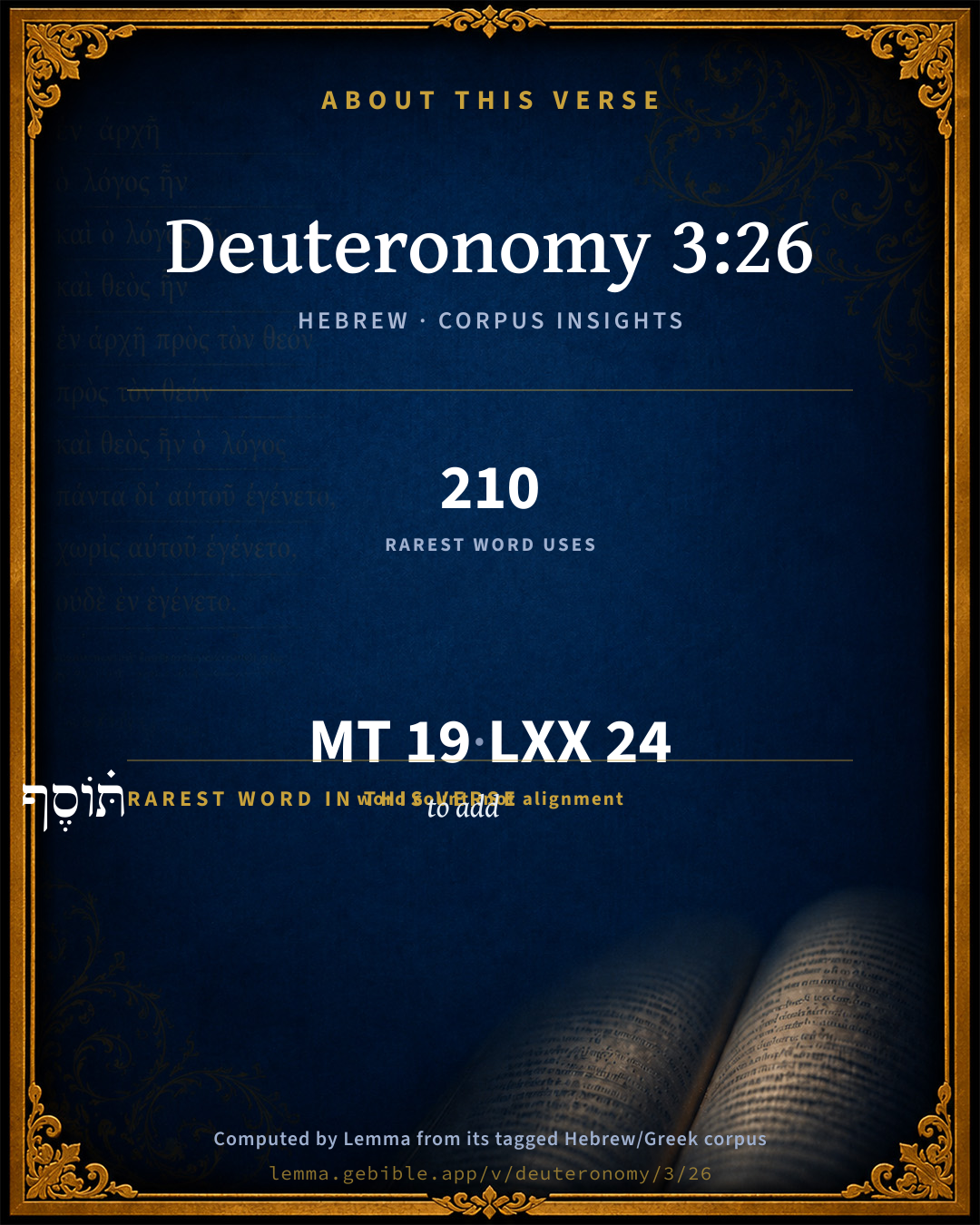
תּ֗וֹסֶף
yâçaph
H3254
“to add”
Verb, Hiphil, Jussive, 2nd Person, Masculine, Singular
Part of Speech
Verb
Stem
Hiphil
Form
Jussive
Person
2nd Person
Gender
Masculine
Number
Singular
Full BDB Definition

Origin: a primitive root

TWOT: 876

to add, increase, do again - (Qal) to add, increase, do again - (Niphal) - to join, join oneself to - to be joined, be added to - (Hiphil) - to cause to add, increase - to do more, do again
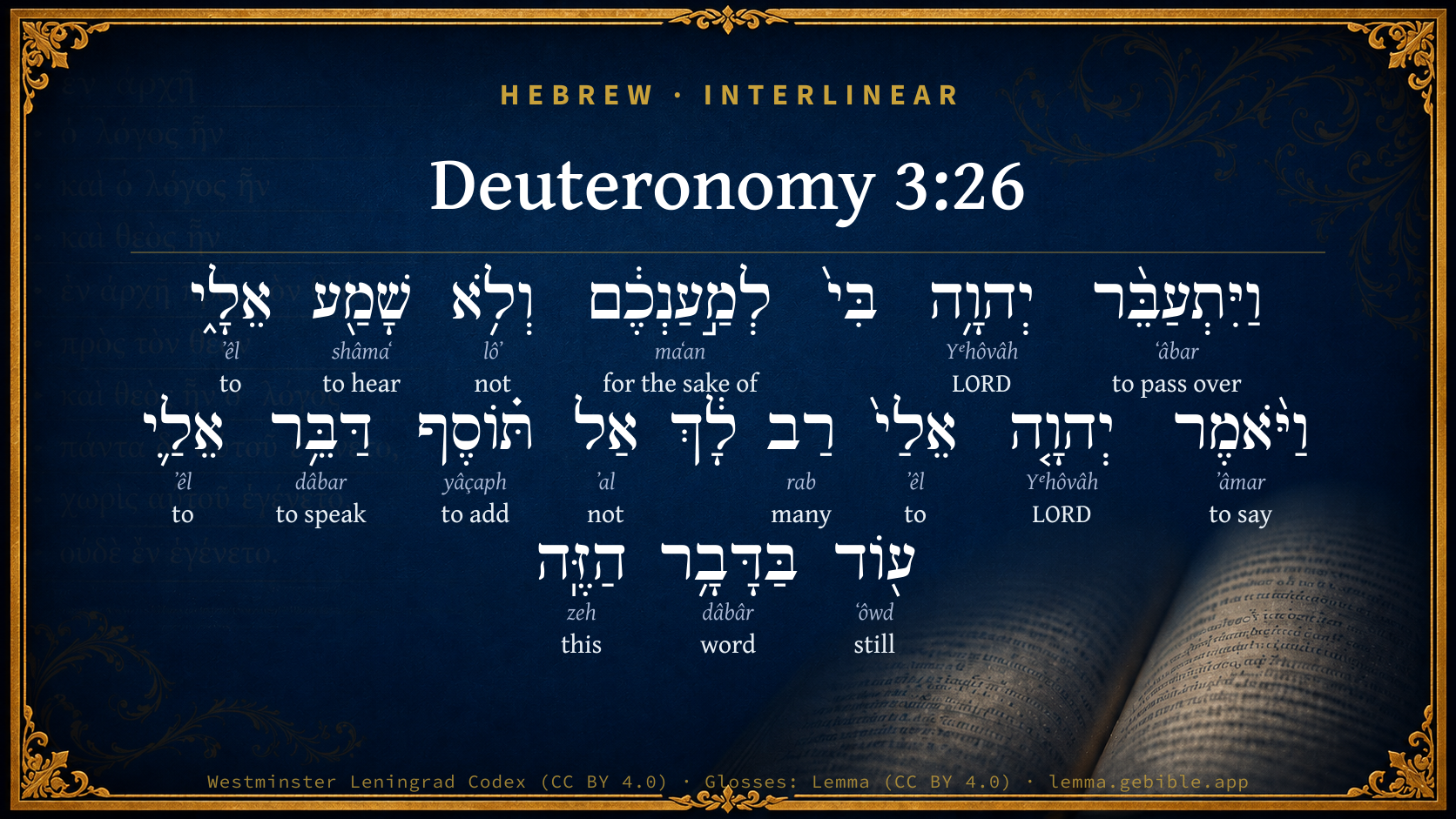
  1. וַיִּתְעַבֵּ֨ר ʻâbar H5674 “and · to pass over” Conjunction + Verb, Hithpael, Sequential Imperfect, 3rd Person, Masculine, Singular
  2. יְהוָ֥ה Yᵉhôvâh H3068 “LORD” Noun, Proper
  3. לְמַ֣עַנְכֶ֔ם maʻan H4616 “for the sake of · you” Preposition + Suffix, Personal, 2nd Person, Masculine, Plural
  4. וְלֹ֥א lôʼ H3808 “and · not” Conjunction + Particle, Negative
  5. שָׁמַ֖ע shâmaʻ H8085 “to hear” Verb, Qal, Perfect, 3rd Person, Masculine, Singular
  6. אֵלָ֑י ʼêl H413 “to · me” Preposition + Suffix, Personal, 1st Person, Common, Singular
  7. וַיֹּ֨אמֶר ʼâmar H559 “and · to say” Conjunction + Verb, Qal, Sequential Imperfect, 3rd Person, Masculine, Singular
  8. יְהוָ֤ה Yᵉhôvâh H3068 “LORD” Noun, Proper
  9. אֵלַי֙ ʼêl H413 “to · me” Preposition + Suffix, Personal, 1st Person, Common, Singular
  10. רַב rab H7227 “many of” Adjective, Adjective, Masculine, Singular, Construct
  11. אַל ʼal H408 “not” Particle, Negative
  12. דַּבֵּ֥ר dâbar H1696 “to speak” Verb, Piel, Infinitive Construct
  13. אֵלַ֛י ʼêl H413 “to · me” Preposition + Suffix, Personal, 1st Person, Common, Singular
  14. ע֖וֹד ʻôwd H5750 “still” Adverb
  15. בַּדָּבָ֥ר dâbâr H1697 “in/at the · word” Preposition, Determined + Noun, Common, Masculine, Singular, Absolute
  16. הַזֶּֽה zeh H2088 “the · this” Particle, Definite Article + Pronoun, Demonstrative, Masculine, Singular

About this verse

These counts appear in no published source. They are computed here, from the morphology-tagged text and Lemma’s own curated glosses. What Lemma adds →

19
words
14
distinct lemmas
Pentateuch
section

Grammatical profile

  • 5 verbs
  • 3 nouns
  • 1 adjective
  • 1 pronoun
  • 6 prepositions
  • 1 adverb
  • 2 particles

Verb forms

  • וַיִּתְעַבֵּ֨ר Hithpael · Sequential Imperfect
  • שָׁמַ֖ע Qal · Perfect
  • וַיֹּ֨אמֶר Qal · Sequential Imperfect
  • תּ֗וֹסֶף Hiphil · Jussive
  • דַּבֵּ֥ר Piel · Infinitive Construct

Repetition

Words recur within this verse — often emphatic in Hebrew:

  • יְהוָ֥ה LORD H3068 ×2
  • אֵלָ֑י to H413 ×3

Hebrew & Septuagint length

In English translation the verse runs 31 words from the Hebrew and 34 from the Septuagint (LXX English) — closely comparable.

A rough comparison of the two English renderings, which tokenize alike — not a word-level alignment.

Word counts can differ between the Hebrew and the Greek without any difference in meaning — e.g. the Hebrew direct-object marker אֵת has no separate Greek word, and Greek often adds the article ὁ.

In the original languages it is 19 Hebrew tokens and 24 Greek tokens — but the two are counted differently (Hebrew bundles its prefixes and suffixes into one token; the Greek is in lemma form), so that isn’t a like-for-like length.

Cross-references

15

Topical passages linked to Deuteronomy 3:26 in the Treasury of Scripture Knowledge — connected by theme and wording, ordered by reader-vote popularity; previews shown in the World English Bible.

  • Deuteronomy 1:37 Also Yahweh was angry with me for your sakes, saying, You also shall not go in there:
  • Deuteronomy 31:2 He said to them, I am one hundred twenty years old this day; I can no more go out and come in: and Yahweh has said to me, You shall not go over this Jordan.
  • 1 Chronicles 22:7–9 David said to Solomon his son, As for me, it was in my heart to build a house to the name of Yahweh my God.
  • 1 Chronicles 28:2–4 Then David the king stood up on his feet, and said, Hear me, my brothers, and my people: as for me, it was in my heart to build a house of rest for the ark of the covenant of Yahweh, and for the footstool of our God; and I had made ready for the building.
  • Psalms 106:32–33 They angered him also at the waters of Meribah, So that Moses was troubled for their sakes;
  • Isaiah 53:5–6 But he was pierced for our transgressions, he was crushed for our iniquities; the punishment that brought our peace was on him; and by his wounds we are healed.
  • Matthew 26:39 He went forward a little, fell on his face, and prayed, saying, "My Father, if it is possible, let this cup pass away from me; nevertheless, not what I desire, but what you desire."
  • 2 Corinthians 12:8 Concerning this thing, I begged the Lord three times that it might depart from me.
  • Numbers 20:7–12 Yahweh spoke to Moses, saying,
  • Numbers 27:12–14 Yahweh said to Moses, Go up into this mountain of Abarim, and see the land which I have given to the children of Israel.
  • Deuteronomy 32:51–52 because you trespassed against me in the midst of the children of Israel at the waters of Meribah of Kadesh, in the wilderness of Zin; because you didn't sanctify me in the midst of the children of Israel.
  • Deuteronomy 34:4 Yahweh said to him, This is the land which I swore to Abraham, to Isaac, and to Jacob, saying, I will give it to your seed: I have caused you to see it with your eyes, but you shall not go over there.
  • 1 Chronicles 17:4 Go and tell David my servant, Thus says Yahweh, You shall not build me a house to dwell in:
  • 1 Chronicles 17:12–13 He shall build me a house, and I will establish his throne forever.
  • Matthew 20:22 But Jesus answered, "You don't know what you are asking. Are you able to drink the cup that I am about to drink, and be baptized with the baptism that I am baptized with?" They said to him, "We are able."

Cross-references courtesy of OpenBible.info (CC BY 4.0).

Hebrew and Greek witnesses Masoretic Hebrew ↔ Greek Septuagint

The same verse in the two great witnesses to the Old Testament, shown verse-for-verse.

These are two independent witnesses, not word-aligned to each other, and the Septuagint is shown in lemma (dictionary) form.

Hebrew Deuteronomy 3:26 Masoretic · Westminster Leningrad Codex

וַיִּתְעַבֵּ֨ר יְהוָ֥ה בִּי֙ לְמַ֣עַנְכֶ֔ם וְלֹ֥א שָׁמַ֖ע אֵלָ֑י וַיֹּ֨אמֶר יְהוָ֤ה אֵלַי֙ רַב לָ֔ךְ אַל תּ֗וֹסֶף דַּבֵּ֥ר אֵלַ֛י ע֖וֹד בַּדָּבָ֥ר הַזֶּֽה

But Yahweh was angry with me for your sakes, and didn't listen to me; and Yahweh said to me, Let it suffice you; speak no more to me of this matter.

World English Bible · Public Domain

Greek LXX Deuteronomy 3:26 Septuagint · lemma form

καί ὑπερὁράω κύριος ἐγώ ἕνεκεν σύ καί οὐ εἰςἀκούω ἐγώ καί εἶπον κύριος πρός ἐγώ ἱκανόω σύ μή προςτίθημι ἔτι λαλέω ὁ λόγος οὗτος

And the Lord because of you did not regard me, and listened not to me; and the Lord said to me, Let it suffice you, speak not of this matter to me any more.

LXX2012 (modern English Septuagint) · Public Domain

Hebrew: Westminster Leningrad Codex (CC BY 4.0). Greek: Septuagint (public domain); English from LXX2012 (modern English Septuagint) (Public Domain). How the Septuagint differs from the Hebrew →

Targum (Aramaic paraphrase)

2

The Targum is the ancient Jewish Aramaic paraphrase of the Hebrew Scriptures — an interpretive translation, not the Hebrew text itself. Onkelos (literal) and Pseudo-Jonathan (expansive) render the Torah, and Jonathan the Prophets. Coverage is partial: where no permissively-licensed English translation exists for a verse, only the Aramaic is shown. This is verse-level text, not a word-by-word alignment to the Hebrew.

  1. Targum Onkelos Torah (Genesis–Deuteronomy)
    וַהֲוָה רְגַז מִן קֳדָם יְיָ עֲלַי בְּדִילְכוֹן וְלָא קַבִּיל מִנִי וַאֲמַר יְיָ לִי סַגִי לָךְ לָא תוֹסֵף לְמַלָלָא קֳדָמַי עוֹד בְּפִתְגָמָא הָדֵין

    (no public-domain English translation for this verse)

    Targum Onkelos — Aramaic: “Onkelos Genesis” (public domain); “Onkelos Exodus” (public domain); “Onkelos Leviticus” (public domain); “Onkelos Numbers” (public domain); “Onkelos Deuteronomy” (public domain). English: “Sefaria Community Translation” (CC0 1.0 (public-domain dedication)); “J.W. Etheridge. The Targums of Onkelos and Jonathan Ben Uzziel on the Pentateuch. London: Longmans, Green, 1862” (public domain). Text via Sefaria.

  2. Targum Pseudo-Jonathan Torah (Genesis–Deuteronomy)
    וּרְגֵיז יְיָ עָלַי בִּגְלַלְכוֹן וְלָא קַבֵּיל צְלוֹתִי וַאֲמַר יְיָ לִי סַגִי לָךְ לָא תוֹסִיף לְמַלָלָא קָדָמַי תּוּב בְּפִתְגָמָא הָדֵין

    But the Lord was displeased with me on your account, and received not my prayer; but the Lord said to me: Let it be enough for thee; speak not before Me again of this matter:

    Targum Pseudo-Jonathan — Aramaic: “Targum Jonathan on Genesis” (public domain); “Targum Jonathan on Exodus” (public domain); “Targum Jonathan on Leviticus” (public domain); “Targum Jonathan on Numbers” (public domain); “Targum Jonathan on Deuteronomy” (public domain). English: “The Targum of Jonathan ben Uzziel, trans. J. W. Etheridge, London, 1862” (public domain). Text via Sefaria.

Commentary

Notes on Deuteronomy 3:26 from classic Christian and Jewish commentators (each source and its license shown beneath its notes). The classic Christian expositions comment on the surrounding passage and are grouped to its opening verse, so a note may address several verses; the Jewish commentaries on the Tanakh (Rashi and others) are per-verse, so they appear only where the commentator wrote on this verse.

Lemma curates 59 commentaries, every one of them public domain or Creative Commons licensed, each selected and text-cleaned for this edition rather than reprinted as found. About our sources →

Trapp's Complete Commentary

John Trapp

Deu 3:26 But the LORD was wroth with me for your sakes, and would not hear me: and the LORD said unto me, Let it suffice thee; speak no more unto me of this matter.

Ver. 26. Speak no more.] Christians must be sober in prayer. {1Pe 4:7} Socrates, a heathen, could say, We should pray for no more but this, that good things may be given us of God, who best knoweth what is best for us to receive.

John Trapp, A Commentary or Exposition upon All the Books of the Old and New Testament (1647–1656) — public domain. Text from a community e-Sword module.

Jamieson, Fausset & Brown

Robert Jamieson, A. R. Fausset & David Brown

speak no more unto me of this matter--that is, My decree is unalterable.

Next: Deuteronomy Chapter 4

Jamieson, Fausset & Brown — Commentary Critical and Explanatory on the Whole Bible (1871) — public domain (CC PDM 1.0). Text via the HelloAO Bible API.

Adam Clarke's Commentary

Verse 26. Let it suffice thee] רב לך rab lach, there is an abundance to thee - thou hast had honour enough already, and may well dispense with going over Jordan. He surely has no reason to complain who is taken from earthly felicity to heavenly glory. In this act God showed to Moses both his goodness and severity.

Adam Clarke's Commentary on the Bible (1810–1826) — public domain. Text from a community e-Sword/MySword module.

Ellicott's Commentary for English Readers

(26) For your sakes.—Because “I will be sanctified in them that come nigh me, and before all the people I will be glorified” (Lev_10:3; Num_20:12-13); And also because the death of Moses and the succession of Joshua were “for a testimony of things to be spoken after,” a figure of things to come. Moses, like Ezekiel (Deu_24:15-22), was made a sign.

(26) Let it suffice thee.—Literally, enough for thee, or, as it is paraphrased by Rashi from older commontatore, “Far more than this is reserved for thee; plentiful goodness is hidden for thee.” And so indeed it proved. For on some “goodly mountain” (Hermon or “Lebanon,”) Moses and Elias stood with the Saviour of the world, and spake of a far more glorious conquest than Joshua’s, even “His exodus, which He should fulfil at Jerusalem” (St. Luk_9:31).

A Bible Commentary for English Readers, edited by Charles John Ellicott (1878–1897) — public domain. Text from a community e-Sword module.

The Cambridge Bible for Schools and Colleges

gen. ed. J. J. S. Perowne

26. But the Lord was wroth with me] Heb. hith‘abber (lit. to exceed bounds) was enraged, a stronger term than that in Deu_1:37, the note on which see for the whole of this verse.

The Cambridge Bible for Schools and Colleges (gen. ed. J. J. S. Perowne; Cambridge University Press, 1878–1918) — public domain. Text from a community e-Sword module.

John Gill's Exposition

Get thee up into the top of Pisgah,.... Which was the highest eminence of Mount Nebo, and so a very proper place to take a prospect from; see Deu 32:49.

and lift up thine eyes westward, and northward, and southward, and eastward; to all the four points of the heaven, and to all the four quarters and borders of the land of Canaan:

and behold it with thine eyes; even the land of Canaan, and particularly Lebanon, though it lay to the north of it, that mountain he had such a desire to see. Moses, though old, his natural sight was very strong, and not in the least dim; and it is not improbable that it might be more than ordinarily increased and assisted at this time:

for thou shall not go over this Jordan; into the land of Canaan; this affair, of not being suffered to enter there, Moses frequently takes notice of, no less than four or five times, it being what lay near his heart.

John Gill's Exposition of the Whole Bible (1746–1763) — public domain (CC PDM 1.0). Text via the HelloAO Bible API.

Albert Barnes' Notes on the Bible

The Lord was wroth with me for your sakes - Here, as in Deu 1:37; Deu 4:21; the sin of the people is stated to be the ground on which Moses’ prayer is denied. In Deu 32:51; and in Num 27:14; the transgression of Moses and Aaron themselves is assigned as the cause of their punishment. The reason why one side of the transaction is put forward in this place, and the other elsewhere, is evident. Here Moses is addressing the people, and mentions the punishment of their leaders as a most impressive warning to them, whose principal fault it was. In Deut. 32 and Num. 27, God is addressing Moses, and visits on him, as is fitting, not the sin of the people hut his own.

Albert Barnes' Notes on the Bible (1834–1885) — public domain. Text from a community e-Sword/MySword module.

Haydock's Catholic Bible Commentary

Your account. Moses cannot help reminding the people that they were the occasion of his giving way to diffidence, and thus incurring a most sensible chastisement from the hands of God. Their conduct had provoked him so, that he gave some outward signs of the trouble with which his mind was so much disturbed, chap. xx. 12. Yet God admits of no excuse, particularly in the sins of those who act in his name, and who, of course, ought to guard against the smallest deviation from virtue. Be ye holy and perfect, is addressed to such in a particular manner. (Haydock)

George Leo Haydock (1774–1849), Haydock's Catholic Family Bible and Commentary, 1859 edition — public domain. Excludes Psalms (Douay-Rheims chapter numbering differs from Protestant) and Deuterocanonical books (Catholic canon only).

Matthew Poole's English Annotations

For your sakes; by occasion of your sins, which provoked me to unadvised words and carriages, Psa 106:32,33. See Num 20:12; Deu 31:2; 34:4. Let it suffice thee that this is my pleasure and unalterable resolution. Compare 2Co 12:8,9.

Matthew Poole's English Annotations on the Holy Bible (1683–1685) — public domain. Text from a community e-Sword/MySword module.

Whedon's Commentary on the Bible

Daniel D. Whedon

26. The Lord was wroth with me — See notes on Deu_1:37.

Daniel D. Whedon (gen. ed.), Commentary on the Old and New Testaments (1874–1909) — public domain. Text from a community e-Sword module.

The Pulpit Commentary

The Lord was wroth, etc. (cf. Deu_1:37; Num_20:12 Num_27:13, Num_27:14) Let it suffice thee; literally, Enough for thee! i.e. either Thou hast said enough; say no more, or Be content; let what I have done, and the grace I have given, be enough for thee. (comp. the use of this formula in Gen_45:28; Num_16:3; Deu_1:6 Deu_2:3) Keil and others refer to 2Co_12:8, as "substantially equivalent," but the expression there seems to have quite a different meaning and reference from that used here.

The Pulpit Commentary (1880–1919), ed. H.D.M. Spence-Jones & Joseph S. Exell — public domain. Text from a community e-Sword module.

unfoldingWord translationNotes

Door43 World Missions Community

General Information:

Moses continues telling the people of Israel what happened in the past.

Yahweh was angry with me because of you

This refers to when Moses disobeyed what Yahweh told him to do because Moses was angry with the people of Israel. See how you translated this in Deuteronomy 1:37. (See: Assumed Knowledge and Implicit Information)

Pisgah

See how you translated this is in Deuteronomy 3:17.

lift up your eyes

The words "lift up your eyes" are an idiom that means look. AT: "look" (See: Idiom)

translationWords

Yahweh

anger

Jordan River

unfoldingWord translationNotes — © Distant Shores Media and the Door43 World Missions Community, licensed CC BY-SA 4.0. Source: git.door43.org/Door43/en_tn.

Rashi

Rabbi Shlomo Yitzchaki (Rashi)

ויתעבר ה׳ This means, GOD WAS FILLED WITH WRATH (Sifrei Bamidbar 135).

למענכם ON ACCOUNT OF YOU — You caused this for me (that God was wroth with me); similarly it states, (Psalms 106:32) “And they provoked Him at the waters of Meriba, and He did evil to Moses on their account".

רב לך LET IT SUFFICE THEE (i.e. pray no more), so that people should not say, “How harsh is the Master, and how obstinate and importunate is the disciple" (Sotah 13b). Another explanation of רב לך (lit., there is much for you) — more than this is reserved for you; much is the goodness that is stored up for thee (Sifrei Bamidbar 135).

Rashi on the Tanakh — English translations: “The Judaica Press complete Tanach with Rashi, translated by A. J. Rosenberg” (CC BY 4.0); “Pentateuch with Rashi's commentary by M. Rosenbaum and A.M. Silbermann, 1929-1934” (public domain); “The Metsudah Tanach series, Lakewood, N.J” (CC BY 4.0); and “The Book of Joshua, Metsudah Publications, 1997” (CC BY 4.0). Text via Sefaria.

Lesson kit

Teaching starters — assembled from the data on this page, not authored interpretation. Every prompt links to the verse data it draws on. Edit before teaching.

Deuteronomy, in the Pentateuch, opens this verse with 19 words (14 distinct Hebrew lemmas). Its most distinctive word is yâçaph (“to add”). A historical commentator’s framing appears above. Read the whole chapter for the surrounding context.

Discussion questions

  1. What does “to add” (yâçaph) contribute to the verse as a whole?
  2. Deuteronomy 1:37 shares this passage’s theme. How do the two illuminate each other?
  3. “LORD” occurs 2× in this one verse. What is the effect of the repetition?
  4. These translations render this verse differently. What is at stake in choosing one wording over another?
  5. The verb «וַיִּתְעַבֵּ֨ר» is Hithpael Sequential Imperfect. How does its form color the action?
  6. Reading how Trapp's Complete Commentary and Jamieson, Fausset & Brown read this verse, where do the two commentators agree and where do they part?

Things to notice

Reading settings

Reading text

Shown beneath each verse's original-language words.

Old Testament
Old Testament edition

Read the OT as the Masoretic Hebrew (MT) or the Greek Septuagint (LXX).

English shown for the Greek Septuagint (in the Hebrew ↔ Greek comparison).

Comparing translations? Open the Compare panel on any verse page to stack up to four side by side.