
Joshua 11:6

Hebrew (Westminster Leningrad Codex) Joshua 11:6 appears in the Hebrew Old Testament. The text above is from the Westminster Leningrad Codex. Each word links to its Strong’s number, a concise gloss, and parsing drawn from the Open Scriptures Hebrew Bible morphology. Click any word for its full Brown-Driver-Briggs (BDB) entry.
Download image
Cite this verse

Joshua 11:6 (World English Bible). Public Domain. Lemma interlinear Bible study tool, https://lemma.gebible.app/v/joshua/11/6.

Show BibTeX & RIS
BibTeX
RIS
English Translation
Yahweh said to Joshua, Don't be afraid because of them; for tomorrow at this time will I deliver them up all slain before Israel: you shall hamstring their horses, and burn their chariots with fire.
World English Bible · Public Domain
Download a study sheet

One document with this verse’s original text, its word-by-word gloss line, the meaning frame, cross-references with their text, attributed commentary, and full source and license credits — printable, and it pastes into notes with its structure intact.

This verse Autodidact and up

Study sheet (.html) Plain text (.txt)

A passage Seminary Student

Up to 50 verses in one chapter. A passage sheet keeps up to 6 commentary sources and 12 cross-references per verse, in the order this page ranks them, and says so on the sheet whenever that leaves anything out. Ask for a single verse and you get the Autodidact verse sheet above.

Everything on this page stays free to read, with no account — the sheet is a download of what is already on screen, not access to it.

Want to remove ads? Support Godless Engineer
Compare translations 3

The same verse in 3 English versions, stacked beneath the original-language interlinear above. Click any original word for its lexicon entry.

Each is an independent rendering of the whole verse — the interlinear is not word-aligned to these translations.

Highlighted words mark where these versions differ — a whole-verse word diff, not a word-by-word alignment.

  • World English Bible Public Domain
    Yahweh said to Joshua, Don't be afraid because of them; for tomorrow at this time will I deliver them up all slain before Israel: you shall hamstring their horses, and burn their chariots with fire.
  • King James Version Public Domain
    And the LORD said unto Joshua, Be not afraid because of them: for to morrow about this time will I deliver them up all slain before Israel: thou shalt hough their horses, and burn their chariots with fire.
  • unfoldingWord Literal Text CC BY-SA 4.0
    And Yahweh said to Joshua, “Do not be afraid from their faces, because tomorrow about this time I will give all of them slain to the face of Israel. You will hamstring their horses and burn their chariots with fire.”

unfoldingWord Literal Text — © unfoldingWord, licensed CC BY-SA 4.0. Word-aligned USFM3 via Door43 (git.door43.org/unfoldingWord/en_ult).

Versions to compare (up to 4)

3 of 4 selected

Show all 18 translations

Every available English version of this verse, each an independent rendering of the whole verse.

  • World English Bible Public Domain
    Yahweh said to Joshua, Don't be afraid because of them; for tomorrow at this time will I deliver them up all slain before Israel: you shall hamstring their horses, and burn their chariots with fire.
  • Berean Standard Bible Public Domain
    Then the LORD said to Joshua, “Do not be afraid of them, for by this time tomorrow I will deliver all of them slain before Israel. You are to hamstring their horses and burn up their chariots.”
  • Majority Standard Bible Public Domain
    Then the LORD said to Joshua, “Do not be afraid of them, for by this time tomorrow I will deliver all of them slain before Israel. You are to hamstring their horses and burn up their chariots.”
  • King James Version Public Domain
    And the LORD said unto Joshua, Be not afraid because of them: for to morrow about this time will I deliver them up all slain before Israel: thou shalt hough their horses, and burn their chariots with fire.
  • American Standard Version (1901) Public Domain
    And Jehovah said unto Joshua, Be not afraid because of them; for to-morrow at this time will I deliver them up all slain before Israel: thou shalt hock their horses, and burn their chariots with fire.
  • Revised Version (1885) Public Domain
    And the LORD said unto Joshua, Be not afraid because of them: for tomorrow at this time will I deliver them up all slain before Israel: thou shalt hough their horses, and burn their chariots with fire.
  • Geneva Bible (1599) Public Domain
    Then the Lord sayd vnto Ioshua, Be not afrayd for them: for to morowe about this time will I deliuer them all slaine before Israel: thou shalt hough their horses, and burne their charets with fire.
  • Douay-Rheims (1899) Public Domain
    And the Lord said to Josue: Fear them not: for to morrow at this same hour I will deliver all these to be slain in the sight of Israel: thou shalt hamstring their horses, and thou shalt burn their chariots with fire.
  • Young's Literal Translation Public Domain
    And Jehovah saith unto Joshua, `Be not afraid of their presence, for to-morrow about this time I am giving all of them wounded before Israel; their horses thou dost hough, and their chariots burn with fire.'
  • Literal Standard Version CC BY-SA 4.0
    And YHWH says to Joshua, “Do not be afraid of their presence, for about this time tomorrow I am giving all of them slain before Israel; hamstring their horses, and burn their chariots with fire.”
  • Unlocked Literal Bible CC BY-SA 4.0
    Yahweh said to Joshua, “Do not be afraid in their presence, because tomorrow at this time I am giving them all to Israel as dead men. You will hamstring their horses, and you will burn their chariots.”
  • unfoldingWord Literal Text CC BY-SA 4.0
    And Yahweh said to Joshua, “Do not be afraid from their faces, because tomorrow about this time I will give all of them slain to the face of Israel. You will hamstring their horses and burn their chariots with fire.”
  • Darby Bible Public Domain
    And Jehovah said to Joshua, Be not afraid because of them; for to-morrow about this time will I give them all up slain before Israel: their horses shalt thou hough, and thou shalt burn their chariots with fire.
  • World Messianic Bible Public Domain
    The LORD said to Joshua, “Don’t be afraid because of them; for tomorrow at this time, I will deliver them up all slain before Israel. You shall hamstring their horses and burn their chariots with fire.”
  • Webster's Bible Public Domain
    And the LORD said to Joshua, Be not afraid because of them: for to-morrow about this time will I deliver them up all slain before Israel: thou shalt hough their horses, and burn their chariots with fire.
  • Free Bible Version CC BY-SA 4.0
    The Lord said to Joshua, “Don't be afraid because of them, for by this time tomorrow I myself will hand them all over to Israel, dead. Cripple their horses and burn their chariots.”
  • Bible in Basic English Public Domain
    And the Lord said to Joshua, Have no fear of them: for tomorrow at this time I will give them all up dead before Israel; you are to have the leg-muscles of their horses cut and their war-carriages burned with fire.
  • JPS Tanakh (1917) Public Domain
    And the LORD said unto Joshua: 'Be not afraid because of them; for to-morrow at this time will I deliver them up all slain before Israel; thou shalt hough their horses, and burn their chariots with fire.'

Literal Standard Version (2020), Covenant Press — licensed CC BY-SA 4.0. Text via the HelloAO Bible API (eBible.org). Unlocked Literal Bible (unfoldingWord) — licensed CC BY-SA 4.0. Text via the HelloAO Bible API (eBible.org). unfoldingWord Literal Text — © unfoldingWord, licensed CC BY-SA 4.0. Word-aligned USFM3 via Door43 (git.door43.org/unfoldingWord/en_ult). Free Bible Version, Dr. Jonathan Gallagher — licensed CC BY-SA 4.0. Text via the HelloAO Bible API (eBible.org).

Word by word

More ways to search: Search by grammar → Find every occurrence → Compare this word →

Practice this passage: Drill this verse → Learn its vocabulary →

תְּעַקֵּ֔ר
ʻâqar
H6131
“to pluck up”
Verb, Piel, Imperfect, 2nd Person, Masculine, Singular
Part of Speech
Verb
Stem
Piel
Form
Imperfect
Person
2nd Person
Gender
Masculine
Number
Singular
Full BDB Definition

Origin: a primitive root

TWOT: 1681 , 1682

to pluck up, root up - (Qal) to pluck up, root up - (Niphal) to be plucked up - to cut, hamstring - (Piel) to cut, hamstring
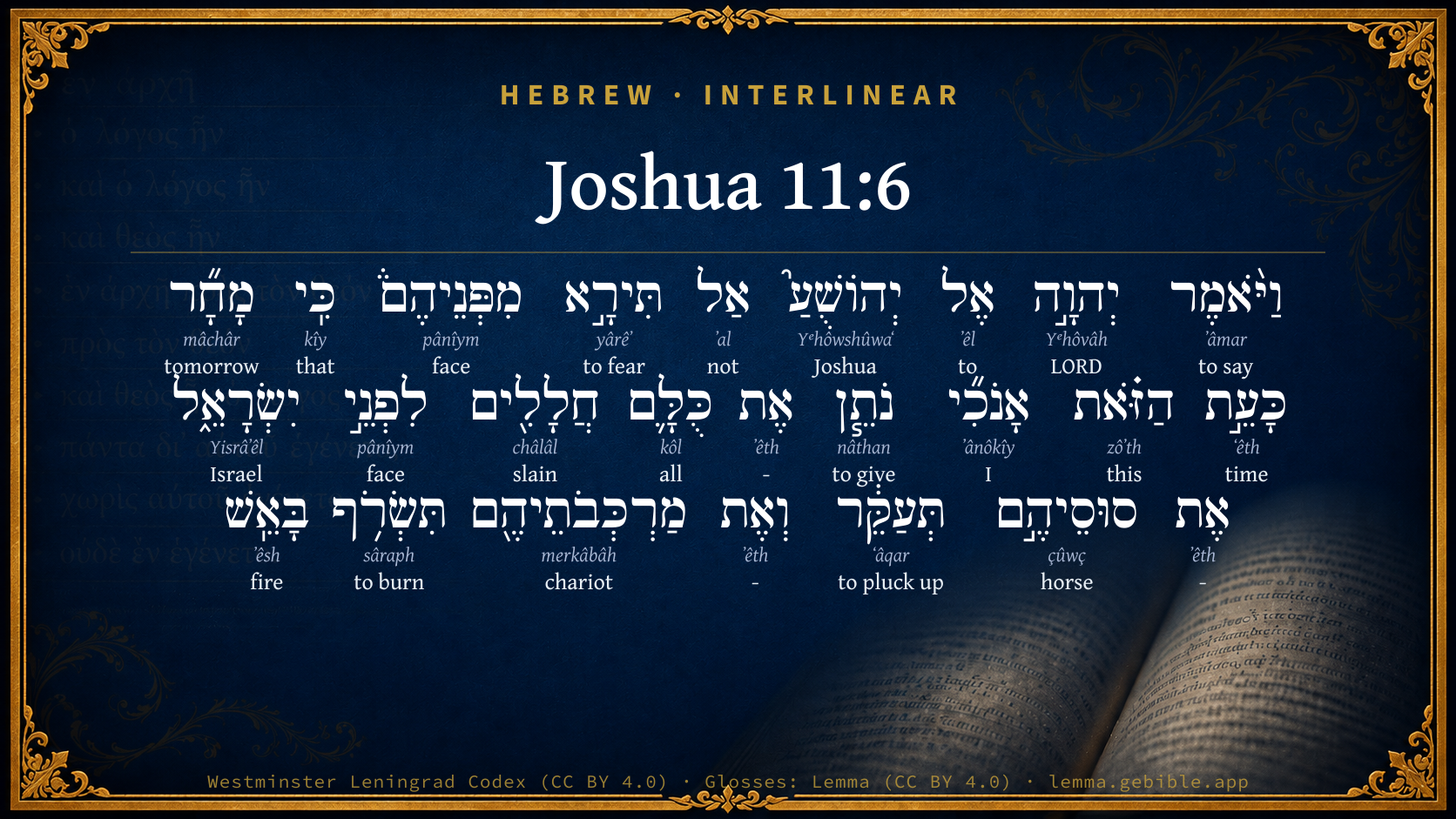
  1. וַיֹּ֨אמֶר ʼâmar H559 “and · to say” Conjunction + Verb, Qal, Sequential Imperfect, 3rd Person, Masculine, Singular
  2. יְהוָ֣ה Yᵉhôvâh H3068 “LORD” Noun, Proper
  3. אֶל ʼêl H413 “to” Preposition
  4. יְהוֹשֻׁעַ֮ Yᵉhôwshûwaʻ H3091 “Joshua” Noun, Proper
  5. אַל ʼal H408 “not” Particle, Negative
  6. תִּירָ֣א yârêʼ H3372 “to fear” Verb, Qal, Jussive, 2nd Person, Masculine, Singular
  7. מִפְּנֵיהֶם֒ pânîym H6440 “from · face(s) · their” Preposition + Noun, Common, Both, Plural, Construct + Suffix, Personal, 3rd Person, Masculine, Plural
  8. כִּֽי kîy H3588 “that” Conjunction
  9. מָחָ֞ר mâchâr H4279 “tomorrow” Noun, Common, Masculine, Singular, Absolute
  10. כָּעֵ֣ת ʻêth H6256 “like/as the · time” Preposition, Determined + Noun, Common, Both, Singular, Absolute
  11. הַזֹּ֗את zôʼth H2063 “the · this” Particle, Definite Article + Pronoun, Demonstrative, Feminine, Singular
  12. אָנֹכִ֞י ʼânôkîy H595 “I” Pronoun, Personal, 1st Person, Common, Singular
  13. נֹתֵ֧ן nâthan H5414 “giving” Verb, Qal, Participle Active, Masculine, Singular, Absolute
  14. אֶת ʼêth H853 “-” Particle, Direct Object
  15. כֻּלָּ֛ם kôl H3605 “all · their” Noun, Common, Masculine, Singular, Construct + Suffix, Personal, 3rd Person, Masculine, Plural
  16. חֲלָלִ֖ים châlâl H2491 “slain” Adjective, Adjective, Masculine, Plural, Absolute
  17. לִפְנֵ֣י pânîym H6440 “to/for · face(s) of” Preposition + Noun, Common, Both, Plural, Construct
  18. יִשְׂרָאֵ֑ל Yisrâʼêl H3478 “Israel” Noun, Proper
  19. אֶת ʼêth H853 “-” Particle, Direct Object
  20. סוּסֵיהֶ֣ם çûwç H5483 “horses · their” Noun, Common, Masculine, Plural, Construct + Suffix, Personal, 3rd Person, Masculine, Plural
  21. וְאֶת ʼêth H853 “and · -” Conjunction + Particle, Direct Object
  22. מַרְכְּבֹתֵיהֶ֖ם merkâbâh H4818 “chariots · their” Noun, Common, Feminine, Plural, Construct + Suffix, Personal, 3rd Person, Masculine, Plural
  23. תִּשְׂרֹ֥ף sâraph H8313 “to burn” Verb, Qal, Imperfect, 2nd Person, Masculine, Singular
  24. בָּאֵֽשׁ ʼêsh H784 “in/at the · fire” Preposition, Determined + Noun, Common, Both, Singular, Absolute

About this verse

These counts appear in no published source. They are computed here, from the morphology-tagged text and Lemma’s own curated glosses. What Lemma adds →

25
words
22
distinct lemmas
Historical
section

Notable vocabulary

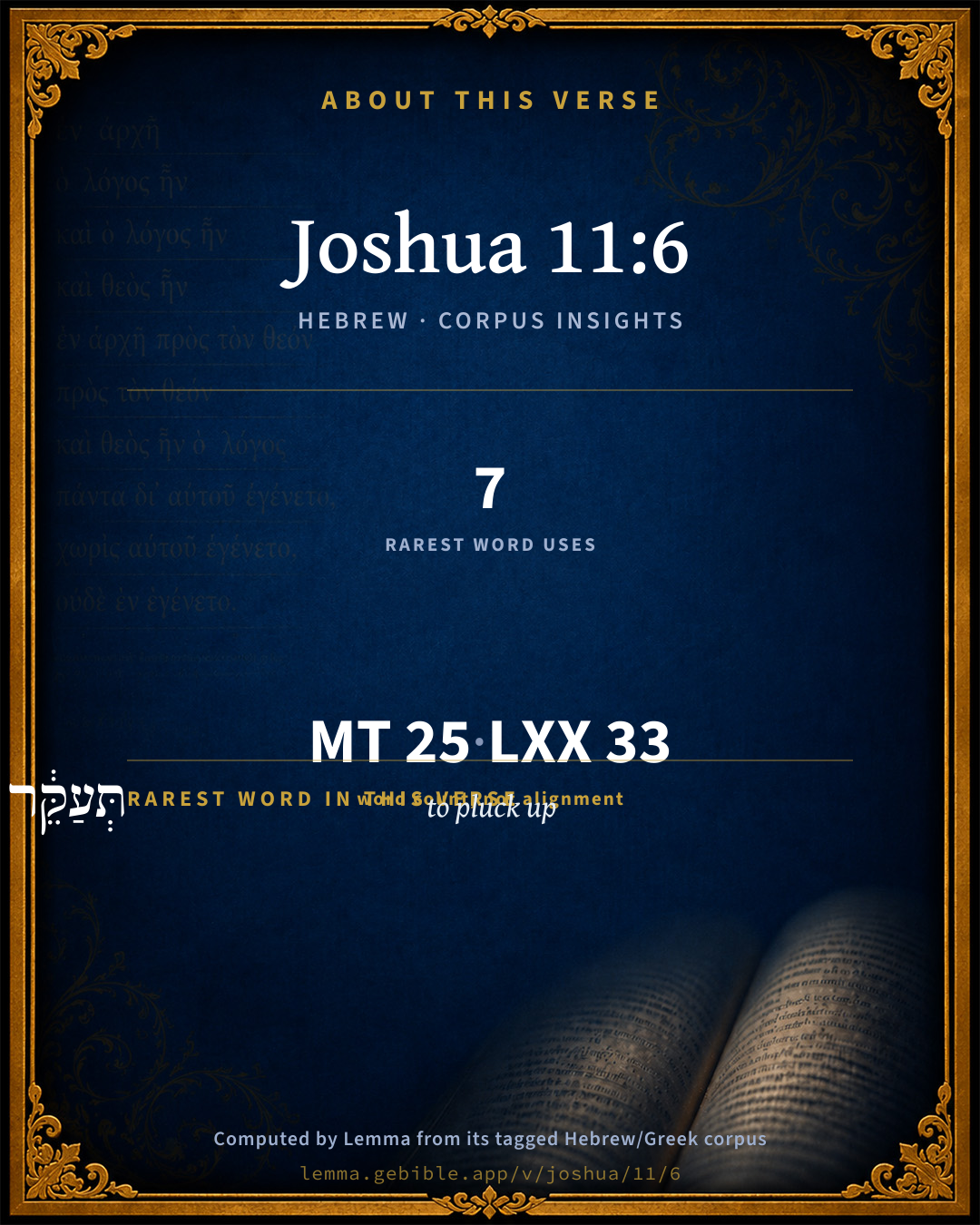
The rarest word here is תְּעַקֵּ֔ר to pluck up H6131 — appearing just 7 times in the whole Hebrew Bible.

Shared distinctive vocabulary

תְּעַקֵּ֔ר to pluck up H6131 occurs in 7 verses of the Hebrew Bible. Also found in:

Grammatical profile

  • 5 verbs
  • 11 nouns
  • 1 adjective
  • 2 pronouns
  • 1 preposition
  • 1 conjunction
  • 4 particles

Verb forms

  • וַיֹּ֨אמֶר Qal · Sequential Imperfect
  • תִּירָ֣א Qal · Jussive
  • נֹתֵ֧ן Qal · Participle Active
  • תְּעַקֵּ֔ר Piel · Imperfect
  • תִּשְׂרֹ֥ף Qal · Imperfect

Repetition

A word recurs within this verse — often emphatic in Hebrew:

  • מִפְּנֵיהֶם֒ face H6440 ×2

Hebrew & Septuagint length

In English translation the verse runs 35 words from the Hebrew and 35 from the Septuagint (LXX English) — the same length.

A rough comparison of the two English renderings, which tokenize alike — not a word-level alignment.

Word counts can differ between the Hebrew and the Greek without any difference in meaning — e.g. the Hebrew direct-object marker אֵת has no separate Greek word, and Greek often adds the article ὁ.

In the original languages it is 25 Hebrew tokens and 33 Greek tokens — but the two are counted differently (Hebrew bundles its prefixes and suffixes into one token; the Greek is in lemma form), so that isn’t a like-for-like length.

Cross-references

17

Topical passages linked to Joshua 11:6 in the Treasury of Scripture Knowledge — connected by theme and wording, ordered by reader-vote popularity; previews shown in the World English Bible.

  • Joshua 10:8 Yahweh said to Joshua, Don't fear them: for I have delivered them into your hands; there shall not a man of them stand before you.
  • 2 Samuel 8:4 David took from him one thousand seven hundred horsemen, and twenty thousand footmen: and David hamstrung all the chariot horses, but reserved of them for one hundred chariots.
  • Joshua 11:9 Joshua did to them as Yahweh bade him: he hamstrung their horses, and burnt their chariots with fire.
  • Judges 20:28 and Phinehas, the son of Eleazar, the son of Aaron, stood before it in those days), saying, Shall I yet again go out to battle against the children of Benjamin my brother, or shall I cease? Yahweh said, Go up; for tomorrow I will deliver him into your hand.
  • 1 Samuel 11:9 They said to the messengers who came, Thus shall you tell the men of Jabesh Gilead, Tomorrow, by the time the sun is hot, you shall have deliverance. The messengers came and told the men of Jabesh; and they were glad.
  • Joshua 3:5 Joshua said to the people, Sanctify yourselves; for tomorrow Yahweh will do wonders among you.
  • 2 Chronicles 20:16 Tomorrow go you down against them: behold, they come up by the ascent of Ziz; and you shall find them at the end of the valley, before the wilderness of Jeruel.
  • Psalms 20:7–8 Some trust in chariots, and some in horses, But we trust the name of Yahweh our God.
  • Psalms 27:1–2 Yahweh is my light and my salvation. Whom shall I fear? Yahweh is the strength of my life. Of whom shall I be afraid?
  • Psalms 46:9 He makes wars cease to the end of the earth. He breaks the bow, and shatters the spear. He burns the chariots in the fire.
  • Psalms 46:11 Yahweh of Hosts is with us. The God of Jacob is our refuge. Selah.
  • Psalms 147:10–11 He doesn't delight in the strength of the horse. He takes no pleasure in the legs of a man.
  • Proverbs 20:7 A righteous man walks in integrity. Blessed are his children after him.
  • Isaiah 30:16 but you said, No, for we will flee on horses; therefore shall you flee: and, We will ride on the swift; therefore shall those who pursue you be swift.
  • Isaiah 31:1 Woe to those who go down to Egypt for help, and rely on horses, and trust in chariots because they are many, and in horsemen because they are very strong, but they don't look to the Holy One of Israel, neither seek Yahweh!
  • Hosea 14:3 Assyria can't save us. We won't ride on horses; Neither will we say any more to the work of our hands, 'Our gods!' For in you the fatherless finds mercy."
  • Deuteronomy 7:16 You shall consume all the peoples who Yahweh your God shall deliver to you; your eye shall not pity them: neither shall you serve their gods; for that will be a snare to you.

Cross-references courtesy of OpenBible.info (CC BY 4.0).

Hebrew and Greek witnesses Masoretic Hebrew ↔ Greek Septuagint

The same verse in the two great witnesses to the Old Testament, shown verse-for-verse.

These are two independent witnesses, not word-aligned to each other, and the Septuagint is shown in lemma (dictionary) form.

Hebrew Joshua 11:6 Masoretic · Westminster Leningrad Codex

וַיֹּ֨אמֶר יְהוָ֣ה אֶל יְהוֹשֻׁעַ֮ אַל תִּירָ֣א מִפְּנֵיהֶם֒ כִּֽי מָחָ֞ר כָּעֵ֣ת הַזֹּ֗את אָנֹכִ֞י נֹתֵ֧ן אֶת כֻּלָּ֛ם חֲלָלִ֖ים לִפְנֵ֣י יִשְׂרָאֵ֑ל אֶת סוּסֵיהֶ֣ם תְּעַקֵּ֔ר וְאֶת מַרְכְּבֹתֵיהֶ֖ם תִּשְׂרֹ֥ף בָּאֵֽשׁ

Yahweh said to Joshua, Don't be afraid because of them; for tomorrow at this time will I deliver them up all slain before Israel: you shall hamstring their horses, and burn their chariots with fire.

World English Bible · Public Domain

Greek LXX Joshua 11:6 Septuagint · lemma form

καί εἶπον κύριος πρός ἰησοῦς μή φοβέω ἀπό πρόσωπον αὐτός ὅτι αὔριον οὗτος ὁ ὥρα ἐγώ παραδίδωμι τροπέω αὐτός ἐναντίον ὁ ἰσραήλ ὁ ἵππος αὐτός νευροκοπέω καί ὁ ἅρμα αὐτός κατακαίω ἐν πῦρ

And the Lord said to Joshua, Be not afraid of them, for to-morrow at this time I will put them to flight before Israel: you shall hough their horses, and burn their chariots with fire

LXX2012 (modern English Septuagint) · Public Domain

On this verse, Jamieson, Fausset & Brown discusses the Septuagint’s reading. Read the note in Commentary ↓

Hebrew: Westminster Leningrad Codex (CC BY 4.0). Greek: Septuagint (public domain); English from LXX2012 (modern English Septuagint) (Public Domain). How the Septuagint differs from the Hebrew →

Targum (Aramaic paraphrase)

1

The Targum is the ancient Jewish Aramaic paraphrase of the Hebrew Scriptures — an interpretive translation, not the Hebrew text itself. Onkelos (literal) and Pseudo-Jonathan (expansive) render the Torah, and Jonathan the Prophets. Coverage is partial: where no permissively-licensed English translation exists for a verse, only the Aramaic is shown. This is verse-level text, not a word-by-word alignment to the Hebrew.

  1. Targum Jonathan Prophets (Joshua–Malachi)
    וַאֲמַר יְיָ לִיהוֹשֻׁעַ לָא תִדְחַל מִן קֳדָמֵיהוֹן אֲרֵי מְחַר כְּעִידָנָא הָדֵין אֲנָא מְסַר יַת כּוּלְהוֹן קְטִילִין קֳדָם יִשְׂרָאֵל יַת סוּסְוָתְהוֹן תְּעַקֵר וְיַת רְתִיכֵיהוֹן תּוֹקֵד בְּנוּרָא:

    (no public-domain English translation for this verse)

    Targum Jonathan — Aramaic: “Mikraot Gedolot” (public domain). English: “Sefaria Community Translation” (CC0 1.0 (public-domain dedication)); “London "Chaldee Paraphrase," 1871” (public domain). Text via Sefaria.

Commentary

Notes on Joshua 11:6 from classic Christian and Jewish commentators (each source and its license shown beneath its notes). The classic Christian expositions comment on the surrounding passage and are grouped to its opening verse, so a note may address several verses; the Jewish commentaries on the Tanakh (Rashi and others) are per-verse, so they appear only where the commentator wrote on this verse.

Lemma curates 59 commentaries, every one of them public domain or Creative Commons licensed, each selected and text-cleaned for this edition rather than reprinted as found. About our sources →

Trapp's Complete Commentary

John Trapp

Jos 11:6 And the LORD said unto Joshua, Be not afraid because of them: for to morrow about this time will I deliver them up all slain before Israel: thou shalt hough their horses, and burn their chariots with fire.

Ver. 6. Be not afraid because of them.] Though many, and mighty, and malicious, and combined. Joshua had his fears and frailties; else what needed this encouragement? {a}

I will deliver them.] I am for thee; and how many reckonest thou me at? I am God Almighty; fear not therefore their horses and chariots: I will make thee master of them all.

Thou shalt hough their horses.] And thereby make them unserviceable; that ye may trust in mine aid alone.

{a} Si modo victor eras, ad crastina bella pavebas.

John Trapp, A Commentary or Exposition upon All the Books of the Old and New Testament (1647–1656) — public domain. Text from a community e-Sword module.

Joseph Benson's Commentary

Jos 11:6. I will deliver them up all slain — The Seventy translate this τετροπωμενους, put to flight: and it is certain they were not all slain, but many of them fled. The meaning therefore can only be, that they should be so broken and scattered by that time, as to have no more power to resist than dead men. Thou shalt hough their horses — Disable them for war, by cutting the sinews of the ham. They might, however, be still fit for other uses. God forbade them to keep many horses, now especially, that they might not trust to their horses, nor ascribe the conquest of the land to their own strength, but wholly to God, by whose power alone a company of raw and unexperienced footmen were able to subdue so potent a people, who, besides their great numbers, and giants, and walled cities, had the advantage of many thousands of horses and chariots.

Joseph Benson's Commentary on the Old and New Testaments (1811–1818) — public domain. Text from a community e-Sword module.

Tyndale Open Study Notes

Tyndale Open Resources

11:6 God again urged Joshua not to be afraid, promising Israel the victory, even against horses and chariots. • cripple their horses and burn their chariots: God wanted Israel to rely on him rather than weaponry and equipment (cp. Deut 17:16; Isa 31:1).

Tyndale Open Study Notes — © Tyndale Open Resources, licensed CC BY-SA 4.0. Text via the HelloAO Bible API.

Geneva Bible (1599)

Geneva Bible translators

That neither they should serve to the use of war, nor the Israelites should put their trust in them.

Geneva Bible (1599) marginal notes — public domain. Text via Bolls.life.

Jamieson, Fausset & Brown

Robert Jamieson, A. R. Fausset & David Brown

to-morrow, about this time will I deliver them up all slain before Israel--As it was impossible to have marched from Gilgal to Merom in one day, we must suppose Joshua already moving northward and within a day's distance of the Canaanite camp, when the Lord gave him this assurance of success. With characteristic energy he made a sudden advance, probably during the night, and fell upon them like a thunderbolt, when scattered along the rising grounds (Septuagint), before they had time to rally on the plain. In the sudden panic "the Lord delivered them into the hand of Israel, who smote them, and chased them." The rout was complete; some went westward, over the mountains, above the gorge of the Leontes, to Sidon and Misrephothmaim ("glass-smelting houses"), in the neighborhood, and others eastward to the plain of Mizpeh.

Jamieson, Fausset & Brown — Commentary Critical and Explanatory on the Whole Bible (1871) — public domain (CC PDM 1.0). Text via the HelloAO Bible API.

Adam Clarke's Commentary

Verse 6. Be not afraid - of them] To meet such a formidable host so well equipped, in their own country, furnished with all that was necessary to supply a numerous army, required more than ordinary encouragement in Joshua's circumstances. This communication from God was highly necessary, in order to prevent the people from desponding on the eve of a conflict, in which their all was at stake.

Adam Clarke's Commentary on the Bible (1810–1826) — public domain. Text from a community e-Sword/MySword module.

John Calvin's Commentaries

6. And the Lord said unto, Joshua, etc The greater the labor and difficulty of destroying an army, so numerous and so well equipped, the more necessary was it to inspire them with new confidence. The Lord, therefore, appears to his servant Joshua, and promises the same success as he had previously given him on several occasions. It is to be carefully observed, that as often as he reiterates his promises men are reminded of their forgetfulness, or their sloth, or their fickleness. For unless new nourishment is every now and then given to faith, they forthwith faint and fall away. And yet such is our perverse fastidiousness, that to hear the same thing twice is usually felt to be irksome. Wherefore let us learn, as often as we are called to engage in new contests, to recall the remembrance of the divine promises, which may correct our languor, or rouse us from our sloth. And especially let us make an application of that which is here said in general, to our daily practice; as the Lord now intimates, that that which he had declared concerning all nations would be specially sure and stable on the present occasion.

We infer from the account of the time employed, that these kings had marched a considerable distance, in order to attack Joshua and the people in Gilgal. For immediately after the divine intimation, mention is made of the expedition used by Joshua. He is promised the victory on the following day. Hence they were not far distant. And the lake of Merom, where they had pitched their camp, is contiguous to the Jordan, and much nearer to Gilgal than Gennesaret, from which district some of the enemy had come. It is said that this lake diminishes or increases according to the freezing of the snow on the mountains, or to its melting. Moreover, the command given to Joshua and the people, to cut the legs or thighs of the horses, and to burn the chariots, was undoubtedly intended to prevent them from adopting those more studied modes of warfare which were in use among profane nations. It was indeed necessary that they should serve as soldiers, and fight strenuously with the enemy, but still they were to depend only on the Lord, to consider themselves strong only in his might, and to recline on him alone.

This could scarcely have been the case, if they had been provided with cavalry, and an array of chariots. For we know how such showy equipment dazzles the eye, and intoxicates the mind with overweening confidence. Moreover, a law had been enacted, (Deuteronomy 17:16) that their kings were not to provide themselves with horses and chariots, obviously because they would have been extremely apt to ascribe to their own military discipline that which God claimed for himself. Hence the common saying, (Psalm 20:7)

“Some trust in chariots and some in horses, but we will remember the name of the Lord our God.”

God wished to deprive them of all stimulants to audacity, in order that they might live quietly contented with their own limits, and not unjustly attack their neighbors. And experience showed, that when a bad ambition had impelled their kings to buy horses, they engaged in wars not less rashly than unsuccessfully. It was necessary, therefore, to render the horses useless for war, by cutting their sinews, and to destroy the chariots, in order that the Israelites might not become accustomed to the practices of the heathen.

John Calvin's Commentaries (1540-1563) — public domain. Text from the Calvin Translation Society English edition (1840s-50s) via the Christian Classics Ethereal Library (ccel.org). Calvin's coverage is partial (roughly two-thirds of the Bible); uncommented books and verses are honest gaps, never fabricated. The 19th-century editor's footnotes and remarks are omitted so the notes are faithfully Calvin's own voice.

Ellicott's Commentary for English Readers

(6) Thou shalt hough their horses.—See Note on Jos_11:9, and observe that the command of Jehovah is the authority for the act.

A Bible Commentary for English Readers, edited by Charles John Ellicott (1878–1897) — public domain. Text from a community e-Sword module.

The Cambridge Bible for Schools and Colleges

gen. ed. J. J. S. Perowne

6. And the Lord said] We may believe that Joshua was already some way on the march when these encouraging words were addressed to him. The distance from his encampment to the waters of Merom was too great for him to reach the latter place between one day and the next.

thou shalt hough their horses] So especially formidable to the Israelites, who had none. The word “hough” also occurs in 2Sa_8:4, where we read that David “houghed all the chariot horses.” It comes from the A. S. hoh, and means to cut the ham-strings or back sinews of cattle, so as to disable them and render them utterly unfit for use, since the sinew, once severed, can never be healed again, and as a rule the arteries are cut at the same time, so that the horses bleed to death. In the late version of Wyclif the verse is rendered, “Thou shalt hoxe the horsis of hem,” while in the earlier version it runs, “The hors of hem thow shalt kut of the synewis at the knees” “Hox” is the form found in Shakespeare,

“If thou inclin’st that way, thou art a coward;

Which hoxes honesty behind, restraining

From course requir’d”. Winter’s Tale, 1. 2. 243.

The Scotch hoch is used in the same way.

and burn their chariots] of which it is said (Jos_17:18) that they were iron chariots, i.e. had wheels with iron tires. Scythe-chariots were first introduced by Cyrus: Xen. Cyrop. VI. 1. 30.

The Cambridge Bible for Schools and Colleges (gen. ed. J. J. S. Perowne; Cambridge University Press, 1878–1918) — public domain. Text from a community e-Sword module.

John Gill's Exposition

And the Lord said unto Joshua, be not afraid because of them,.... Of their number, of their horsemen, and of their scythed chariots; which might at first hearing occasion some fear and dread. And according to Josephus (f), the multitude of them terrified both Joshua and the Israelites; and therefore the Lord appeared and spoke to him for his encouragement: though what was said was for the sake of the Israelites, and to animate them who might be disheartened, rather than for the sake of Joshua, who was of a bold and courageous spirit. Whether this was said to him at Gilgal, and out of the tabernacle there, quickly after the tidings of the combination of the kings were brought to him, or whether when upon his march towards them, is uncertain:

for tomorrow about this time will I deliver them up slain before Israel; as many were, and others wounded and put to flight, as the word signifies, so as to be as good as dead. If Gilgal was twenty two miles from the waters of Merom, as Bunting says (g), and supposing this to be said to him before he set out, he must travel all night to reach thither the next day; and if it was sixty miles, as some say, this must be said to him when on his march, and within a day's march of the enemy; for Josephus says (h) it was on the fifth day that he came up with them, and fell upon them:

thou shalt hough their horses; cut their nerves under their hams, or hamstring them, so that they might be useless hereafter; for the kings of Israel were not to multiply horses; and Joshua, as their chief ruler, was to have no advantage of them by their falling into his hands:

and burn their chariots with fire; that so they might not be used by the Israelites afterwards, who might be tempted to put their trust and confidence in them, as many did.

(f) Antiqu. l. 5. c. 1. sect. 18. (g) Travels, p. 96. (h) Ut supra. (Antiqu. l. 5. c. 1. sect. 18.)

John Gill's Exposition of the Whole Bible (1746–1763) — public domain (CC PDM 1.0). Text via the HelloAO Bible API.

Albert Barnes' Notes on the Bible

Hough their horses - i. e. cut the sinews of the hinder hoofs. This sinew once severed cannot be healed, and the horses would thus be irreparably lamed. This is the first appearance of horses in the wars with the Canaanites (Deu 17:16 and note).

Albert Barnes' Notes on the Bible (1834–1885) — public domain. Text from a community e-Sword/MySword module.

Haydock's Catholic Bible Commentary

Hamstring their horses, &c. God so ordained, that his people might not trust in chariots and horses, but in him. (Challoner) --- He mentions the very time, when the victory will be obtained, to inspire the Israelites with greater confidence. Josue had proceeded from Galgal to Meron, about 90 miles; or if he had to go to the Semonite lake, 120 miles. Josephus says he had marched five days.

George Leo Haydock (1774–1849), Haydock's Catholic Family Bible and Commentary, 1859 edition — public domain. Excludes Psalms (Douay-Rheims chapter numbering differs from Protestant) and Deuterocanonical books (Catholic canon only).

Matthew Poole's English Annotations

Hough their horses, i.e. cut their hamstrings, that they may be unfit for war. For God forbade them to have or keep many horses, Deu 17:16, now especially, that they might not trust to their horses, as men are apt to do, nor distrust God for want of so necessary a help in battle; nor ascribe the conquest of the land to their own strength, but wholly to God, by whose power alone a company of raw and unexperienced footmen were able to subdue so potent a people, which besides their great numbers, and giants, and walled cities, had the advantage of many thousands of horses and chariots.

Matthew Poole's English Annotations on the Holy Bible (1683–1685) — public domain. Text from a community e-Sword/MySword module.

Whedon's Commentary on the Bible

Daniel D. Whedon

6. Be not afraid — The vast multitude of enemies provided with war chariots, instruments which Joshua had probably never before encountered in battle, would naturally awaken fear in the Hebrew army and its great leader. To allay this the Lord, whose opportunity is man’s extremity, interposes words of cheer and a promise of victory. It is not said that Joshua asked for this, but it was doubtless given in answer to prayer.

Tomorrow about this time — Only the God of battles can foretell the very day and hour of his people’s triumph.

Thou shalt hough their horses — They were to disable their horses by cutting the sinews of their legs. For this barbarous treatment of the horse we have in modern English the verb to hamstring. As the multiplication of horses was forbidden by God, (Deu_17:16,) they would have been a useless booty.

Burn their chariots — For they also would have been only a cumbrance to the Hebrews.

Daniel D. Whedon (gen. ed.), Commentary on the Old and New Testaments (1874–1909) — public domain. Text from a community e-Sword module.

The Pulpit Commentary

And the Lord said unto Joshua. The encouragement was not unnecessary. The task before Joshua was harder than any that had yet befallen him. The enemy was far more numerous and better equipped. And it is a well known fact that men of tried courage are often daunted by unaccustomed dangers. Therefore all Joshua"s strength of mind was required to inspirit even men who had experienced God"s wonderful support at the passing of the Jordan, at the siege of Jericho, at the battle before Gibeon, now that they were face to face with the unwonted spectacle of a vast host, furnished with all the best munitions of war known to that age. The Israelites had nothing to depend upon but their own tried valour, and the reliance they felt upon God"s support. "Unequal in arms and tactics," says Ewald ("Hist. Israel.," 2:2. C.), "they could oppose to the Canaanites only courage and confidence." Tomorrow about this time. The promise was made on the eve of the encounter, but not, of course, as some have supposed, while Joshua was still at Gilgal. We are not told how long Joshua was on the march. Probably (as in ch. 2.) he had sent scouts forward, who brought him intelligence on the day before the battle of the vastness of the host, and the formidable nature of its equipment. The martial spirit Joshua had infused into the host, and the spirit of faith in God begotten of His recent acts of favour, contrast remarkably with the conduct of the Israelites described in Nu 14. To each servant of God His own special gift is vouchsafed. Moses was the man to inspire the Israelites with a reverence for law. Joshua had the special aptitudes for the leader in a campaign. It is a confirmation of this view that, in the one successful engagement recorded during the forty years" wandering in the desert, Joshua, not Moses, was the leader of the troops, while the aged law giver remained at a distance, encouraging them by his prayers. (see Exo_17:8-13) But while we thus regard the secondary influences of individual character, we must not forget that the Israelites were also sustained at this moment by the assurances of Divine protection given at Jericho, at Ai, at Beth-horon, which had not been vouchsafed to them while under Moses"s leadership in the wilderness. Will I deliver up. The "I" in the original is emphatic. And the use of the present participle in the Hebrew adds vividness to the promise. Slain. LXX and Vulg., wounded.. Thou shalt hough their horses. To hough (or hoxe, Wiclif) is to hamstring, neurokopein , LXX, to cut the sinews behind the hoofs, the hocks, as they are called. This rendered the horse useless, for the sinew could not reunite. The effects of the horses and chariots upon the mind of Joshua and his host, who had neither, is here traceable. "Those very horses and chariots, which seem to you so formidable, will I, the Lord of hosts, be tomorrow at this time delivering into your hand. The horses shall be forever useless to your enemies, and the dreaded chariots shall cease to be." Why should Joshua have destroyed the horses? Perhaps (as Keil, following Calvin, suggests) in order that the Israelites should not put their trust in chariots or in horses, (Psa_20:7 Psa_147:10) but in God alone. (cf. Deu_17:16) But more obvious considerations of policy may have dictated the measure. God never (see Mat_4:1-7) makes use of supernatural means when natural ones are sufficient. Now the Israelites were unacquainted with the use of horses in warfare, while their enemies were not. To retain the horses while the country was as yet unsubdued would have been a double burden to them, for they would have had not only to keep them themselves, but to prevent the enemy from regaining them. On the same principle in modern warfare do we spike guns we cannot carry off, and destroy provisions we cannot convert to our own use.

The Pulpit Commentary (1880–1919), ed. H.D.M. Spence-Jones & Joseph S. Exell — public domain. Text from a community e-Sword module.

John Wesley's Explanatory Notes

Hough their horses - Cut their hamstrings that they may my be unfit for war. For God forbad them to keep many horses, now especially, that they might not trust to their horses, nor ascribe the conquest of the land to their own strength, but wholly to God, by whose power alone a company of raw and unexperienced footmen were able to subdue so potent a people, who besides their great numbers, and giants, and walled cities, had the advantage of many thousands of horses and chariots.

John Wesley, Explanatory Notes Upon the Whole Bible (1754–1765) — public domain. Text via the GEBible commentary corpus.

unfoldingWord translationNotes

Door43 World Missions Community

I am giving them all to Israel as dead men

Yahweh enabling Israel to conquer the enemy army and kill all of the soldiers is spoken of as if Yahweh killed the soldiers and then gave them to Israel. AT: "I will enable Israel to kill all of them in battle" (See: Metaphor)

hamstring their horses

"cripple their horses by cutting their legs." This is a practice where the tendons in the backs of the legs are cut so that the horses cannot walk.

Merom

This is the name of a place. (See: How to Translate Names)

translationWords

Yahweh

Joshua

fear

die

chariot

unfoldingWord translationNotes — © Distant Shores Media and the Door43 World Missions Community, licensed CC BY-SA 4.0. Source: git.door43.org/Door43/en_tn.

Lesson kit

Teaching starters — assembled from the data on this page, not authored interpretation. Every prompt links to the verse data it draws on. Edit before teaching.

Joshua, in the Historical, opens this verse with 25 words (22 distinct Hebrew lemmas). Its most distinctive word is ʻâqar (“to pluck up”). A historical commentator’s framing appears above. Read the whole chapter for the surrounding context.

Discussion questions

  1. The word ʻâqar carries the sense “to pluck up.” How does it shape the verse?
  2. Genesis 49:6 shares the word «to pluck up» with this verse. How do the two illuminate each other?
  3. “face” occurs 2× in this one verse. What is the effect of the repetition?
  4. These translations render this verse differently. What is at stake in choosing one wording over another?
  5. The verb «וַיֹּ֨אמֶר» is Qal Sequential Imperfect. How does its form color the action?
  6. Reading how Trapp's Complete Commentary and Joseph Benson's Commentary read this verse, where do the two commentators agree and where do they part?

Things to notice

Reading settings

Reading text

Shown beneath each verse's original-language words.

Old Testament
Old Testament edition

Read the OT as the Masoretic Hebrew (MT) or the Greek Septuagint (LXX).

English shown for the Greek Septuagint (in the Hebrew ↔ Greek comparison).

Comparing translations? Open the Compare panel on any verse page to stack up to four side by side.