
Deuteronomy 9:7

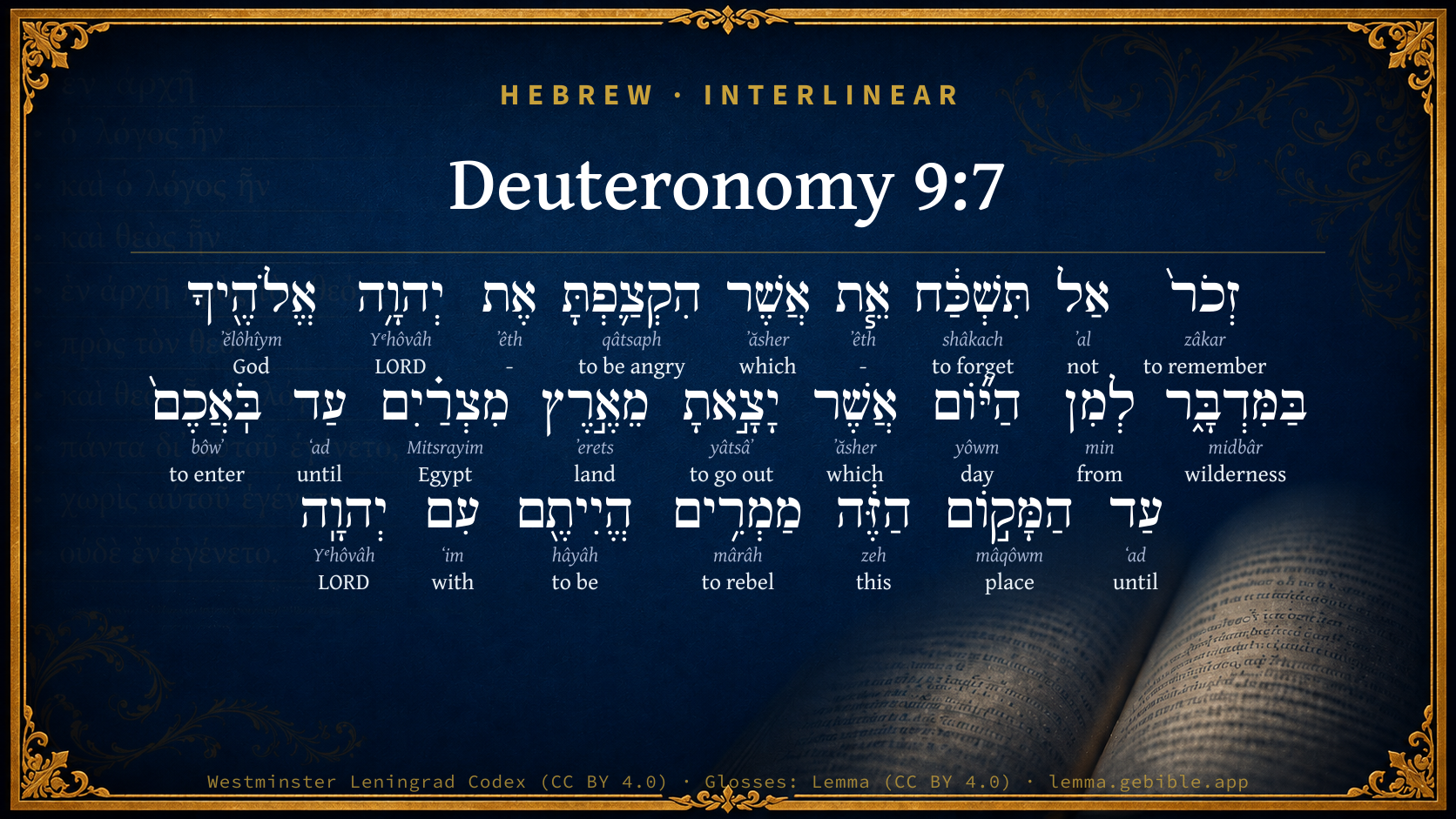
Hebrew (Westminster Leningrad Codex) Deuteronomy 9:7 appears in the Hebrew Old Testament. The text above is from the Westminster Leningrad Codex. Each word links to its Strong’s number, a concise gloss, and parsing drawn from the Open Scriptures Hebrew Bible morphology. Click any word for its full Brown-Driver-Briggs (BDB) entry.
Download image
Cite this verse

Deuteronomy 9:7 (World English Bible). Public Domain. Lemma interlinear Bible study tool, https://lemma.gebible.app/v/deuteronomy/9/7.

Show BibTeX & RIS
BibTeX
RIS
English Translation
Remember, don't forget, how you provoked Yahweh your God to wrath in the wilderness: from the day that you went forth out of the land of Egypt, until you came to this place, you have been rebellious against Yahweh.
World English Bible · Public Domain
Download a study sheet

One document with this verse’s original text, its word-by-word gloss line, the meaning frame, cross-references with their text, attributed commentary, and full source and license credits — printable, and it pastes into notes with its structure intact.

This verse Autodidact and up

Study sheet (.html) Plain text (.txt)

A passage Seminary Student

Up to 50 verses in one chapter. A passage sheet keeps up to 6 commentary sources and 12 cross-references per verse, in the order this page ranks them, and says so on the sheet whenever that leaves anything out. Ask for a single verse and you get the Autodidact verse sheet above.

Everything on this page stays free to read, with no account — the sheet is a download of what is already on screen, not access to it.

Want to remove ads? Support Godless Engineer
Compare translations 3

The same verse in 3 English versions, stacked beneath the original-language interlinear above. Click any original word for its lexicon entry.

Each is an independent rendering of the whole verse — the interlinear is not word-aligned to these translations.

Highlighted words mark where these versions differ — a whole-verse word diff, not a word-by-word alignment.

  • World English Bible Public Domain
    Remember, don't forget, how you provoked Yahweh your God to wrath in the wilderness: from the day that you went forth out of the land of Egypt, until you came to this place, you have been rebellious against Yahweh.
  • King James Version Public Domain
    Remember, and forget not, how thou provokedst the LORD thy God to wrath in the wilderness: from the day that thou didst depart out of the land of Egypt, until ye came unto this place, ye have been rebellious against the LORD.
  • unfoldingWord Literal Text CC BY-SA 4.0
    Remember, you shall not forget how you provoked Yahweh your God to anger in the wilderness; from the day that you went out from the land of Egypt until you came to this place, you have been rebellious against Yahweh.

unfoldingWord Literal Text — © unfoldingWord, licensed CC BY-SA 4.0. Word-aligned USFM3 via Door43 (git.door43.org/unfoldingWord/en_ult).

Versions to compare (up to 4)

3 of 4 selected

Show all 18 translations

Every available English version of this verse, each an independent rendering of the whole verse.

  • World English Bible Public Domain
    Remember, don't forget, how you provoked Yahweh your God to wrath in the wilderness: from the day that you went forth out of the land of Egypt, until you came to this place, you have been rebellious against Yahweh.
  • Berean Standard Bible Public Domain
    Remember this, and never forget how you provoked the LORD your God in the wilderness. From the day you left the land of Egypt until you reached this place, you have been rebelling against the LORD.
  • Majority Standard Bible Public Domain
    Remember this, and never forget how you provoked the LORD your God in the wilderness. From the day you left the land of Egypt until you reached this place, you have been rebelling against the LORD.
  • King James Version Public Domain
    Remember, and forget not, how thou provokedst the LORD thy God to wrath in the wilderness: from the day that thou didst depart out of the land of Egypt, until ye came unto this place, ye have been rebellious against the LORD.
  • American Standard Version (1901) Public Domain
    Remember, forget thou not, how thou provokedst Jehovah thy God to wrath in the wilderness: from the day that thou wentest forth out of the land of Egypt, until ye came unto this place, ye have been rebellious against Jehovah.
  • Revised Version (1885) Public Domain
    Remember, forget thou not, how thou provokedst the LORD thy God to wrath in the wilderness: from the day that thou wentest forth out of the land of Egypt, until ye came unto this place, ye have been rebellious against the LORD.
  • Geneva Bible (1599) Public Domain
    Remember, and forget not, howe thou prouokedst the Lord thy God to anger in the wildernesse: since the day that thou diddest depart out of the land of Egypt, vntill ye came vnto this place ye haue rebelled against the Lord.
  • Douay-Rheims (1899) Public Domain
    Remember, and forget not how then provokedst the Lord thy God to wrath in the wilderness. From the day that thou camest out of Egypt unto this place, thou hast always strove against the Lord.
  • Young's Literal Translation Public Domain
    `Remember -- do not forget -- that `with' which thou hast made Jehovah thy God wroth in the wilderness; even from the day that thou hast come out of the land of Egypt till your coming in unto this place rebels ye have been with Jehovah;
  • Literal Standard Version CC BY-SA 4.0
    Remember [and] do not forget that [with] which you have made your God YHWH angry in the wilderness; from the day that you have come out of the land of Egypt until your coming to this place, you have been rebellious against YHWH;
  • Unlocked Literal Bible CC BY-SA 4.0
    Remember and do not forget how you provoked Yahweh your God to anger in the wilderness; from the day that you left the land of Egypt until you came to this place, you have been rebellious against Yahweh.
  • unfoldingWord Literal Text CC BY-SA 4.0
    Remember, you shall not forget how you provoked Yahweh your God to anger in the wilderness; from the day that you went out from the land of Egypt until you came to this place, you have been rebellious against Yahweh.
  • Darby Bible Public Domain
    Remember, forget not, how thou provokedst Jehovah thy God to wrath in the wilderness. From the day that thou didst depart out of the land of Egypt, until ye came to this place, ye have been rebellious against Jehovah.
  • World Messianic Bible Public Domain
    Remember, and don’t forget, how you provoked the LORD your God to wrath in the wilderness. From the day that you left the land of Egypt until you came to this place, you have been rebellious against the LORD.
  • Webster's Bible Public Domain
    Remember, and forget not, how thou provokedst the LORD thy God to wrath in the wilderness: from the day that thou didst depart from the land of Egypt, until ye came to this place, ye have been rebellious against the LORD.
  • Free Bible Version CC BY-SA 4.0
    Remember how you provoked the Lord your God in the desert! Don't ever forget it! From the time you left the land of Egypt until you arrived here, you've been constantly rebelling against the Lord.
  • Bible in Basic English Public Domain
    Keep well in mind how you made the Lord your God angry in the waste land; from the day when you went out of Egypt till you came to this place, you have gone against the orders of the Lord.
  • JPS Tanakh (1917) Public Domain
    Remember, forget thou not, how thou didst make the LORD thy God wroth in the wilderness; from the day that thou didst go forth out of the land of Egypt, until ye came unto this place, ye have been rebellious against the LORD.

Literal Standard Version (2020), Covenant Press — licensed CC BY-SA 4.0. Text via the HelloAO Bible API (eBible.org). Unlocked Literal Bible (unfoldingWord) — licensed CC BY-SA 4.0. Text via the HelloAO Bible API (eBible.org). unfoldingWord Literal Text — © unfoldingWord, licensed CC BY-SA 4.0. Word-aligned USFM3 via Door43 (git.door43.org/unfoldingWord/en_ult). Free Bible Version, Dr. Jonathan Gallagher — licensed CC BY-SA 4.0. Text via the HelloAO Bible API (eBible.org).

Word by word

More ways to search: Search by grammar → Find every occurrence → Compare this word →

Practice this passage: Drill this verse → Learn its vocabulary →

הִקְצַ֛פְתָּ
qâtsaph
H7107
“to be angry”
Verb, Hiphil, Perfect, 2nd Person, Masculine, Singular
Part of Speech
Verb
Stem
Hiphil
Form
Perfect
Person
2nd Person
Gender
Masculine
Number
Singular
Full BDB Definition

Origin: a primitive root

TWOT: 2058

to be displeased, be angry, fret oneself, be wroth - (Qal) to be wroth, to be full of wrath, to be furious - (Hiphil) to provoke to wrath or anger - (Hithpael) to put oneself in a rage, anger oneself
  1. זְכֹר֙ zâkar H2142 “remember” Verb, Qal, Imperative, 2nd Person, Masculine, Singular
  2. אַל ʼal H408 “not” Particle, Negative
  3. תִּשְׁכַּ֔ח shâkach H7911 “to forget” Verb, Qal, Jussive, 2nd Person, Masculine, Singular
  4. אֵ֧ת ʼêth H853 “-” Particle, Direct Object
  5. אֲשֶׁר ʼăsher H834 “which” Particle, Relative
  6. אֶת ʼêth H853 “-” Particle, Direct Object
  7. יְהוָ֥ה Yᵉhôvâh H3068 “LORD” Noun, Proper
  8. אֱלֹהֶ֖יךָ ʼĕlôhîym H430 “God(s) · your” Noun, Common, Masculine, Plural, Construct + Suffix, Personal, 2nd Person, Masculine, Singular
  9. בַּמִּדְבָּ֑ר midbâr H4057 “in/at the · wilderness” Preposition, Determined + Noun, Common, Masculine, Singular, Absolute
  10. לְמִן min H4480 “to/for · from” Preposition + Preposition
  11. הַיּ֞וֹם yôwm H3117 “the · day” Particle, Definite Article + Noun, Common, Masculine, Singular, Absolute
  12. אֲשֶׁר ʼăsher H834 “which” Particle, Relative
  13. יָצָ֣אתָ yâtsâʼ H3318 “to go out” Verb, Qal, Perfect, 2nd Person, Masculine, Singular
  14. מֵאֶ֣רֶץ ʼerets H776 “from · land of” Preposition + Noun, Common, Both, Singular, Construct
  15. מִצְרַ֗יִם Mitsrayim H4714 “Egypt” Noun, Proper
  16. עַד ʻad H5704 “until” Preposition
  17. בֹּֽאֲכֶם֙ bôwʼ H935 “to enter · you” Verb, Qal, Infinitive Construct + Suffix, Personal, 2nd Person, Masculine, Plural
  18. עַד ʻad H5704 “until” Preposition
  19. הַמָּק֣וֹם mâqôwm H4725 “the · place” Particle, Definite Article + Noun, Common, Masculine, Singular, Absolute
  20. הַזֶּ֔ה zeh H2088 “the · this” Particle, Definite Article + Pronoun, Demonstrative, Masculine, Singular
  21. מַמְרִ֥ים mârâh H4784 “rebelling” Verb, Hiphil, Participle Active, Masculine, Plural, Absolute
  22. הֱיִיתֶ֖ם hâyâh H1961 “to be” Verb, Qal, Perfect, 2nd Person, Masculine, Plural
  23. עִם ʻim H5973 “with” Preposition
  24. יְהוָֽה Yᵉhôvâh H3068 “LORD” Noun, Proper

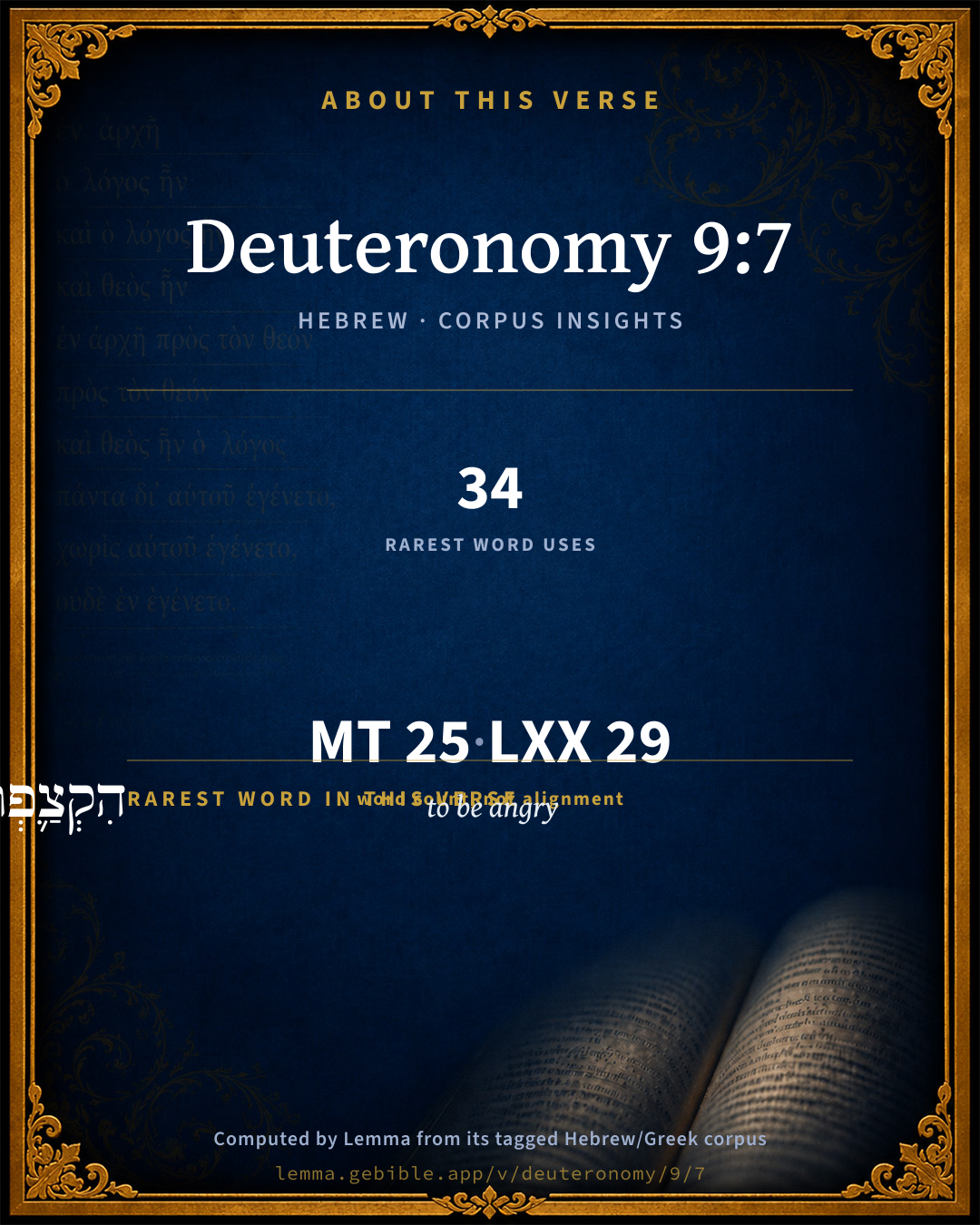
About this verse

These counts appear in no published source. They are computed here, from the morphology-tagged text and Lemma’s own curated glosses. What Lemma adds →

25
words
21
distinct lemmas
Pentateuch
section

Shared distinctive vocabulary

הִקְצַ֛פְתָּ to be angry H7107 occurs in 32 verses of the Hebrew Bible. Also found in:

Grammatical profile

  • 7 verbs
  • 8 nouns
  • 1 pronoun
  • 4 prepositions
  • 5 particles

Verb forms

  • זְכֹר֙ Qal · Imperative
  • תִּשְׁכַּ֔ח Qal · Jussive
  • הִקְצַ֛פְתָּ Hiphil · Perfect
  • יָצָ֣אתָ Qal · Perfect
  • בֹּֽאֲכֶם֙ Qal · Infinitive Construct
  • מַמְרִ֥ים Hiphil · Participle Active
  • הֱיִיתֶ֖ם Qal · Perfect

Repetition

Words recur within this verse — often emphatic in Hebrew:

  • יְהוָ֥ה LORD H3068 ×2
  • עַד until H5704 ×2
  • אֲשֶׁר which H834 ×2

Hebrew & Septuagint length

In English translation the verse runs 39 words from the Hebrew and 39 from the Septuagint (LXX English) — the same length.

A rough comparison of the two English renderings, which tokenize alike — not a word-level alignment.

Word counts can differ between the Hebrew and the Greek without any difference in meaning — e.g. the Hebrew direct-object marker אֵת has no separate Greek word, and Greek often adds the article ὁ.

In the original languages it is 25 Hebrew tokens and 29 Greek tokens — but the two are counted differently (Hebrew bundles its prefixes and suffixes into one token; the Greek is in lemma form), so that isn’t a like-for-like length.

Cross-references

21

Topical passages linked to Deuteronomy 9:7 in the Treasury of Scripture Knowledge — connected by theme and wording, ordered by reader-vote popularity; previews shown in the World English Bible.

  • Exodus 14:11 They said to Moses, "Because there were no graves in Egypt, have you taken us away to die in the wilderness? Why have you treated us this way, to bring us forth out of Egypt?
  • Exodus 16:2 The whole congregation of the children of Israel murmured against Moses and against Aaron in the wilderness;
  • Numbers 21:5 The people spoke against God, and against Moses, Why have you brought us up out of Egypt to die in the wilderness? for there is no bread, and there is no water; and our soul loathes this light bread.
  • Numbers 11:4 The mixed multitude that was among them lusted exceedingly: and the children of Israel also wept again, and said, Who shall give us flesh to eat?
  • Numbers 25:2 for they called the people to the sacrifices of their gods; and the people ate, and bowed down to their gods.
  • Exodus 17:2 Therefore the people quarreled with Moses, and said, "Give us water to drink." Moses said to them, "Why do you quarrel with me? Why do you test Yahweh?"
  • Numbers 20:2–5 There was no water for the congregation: and they assembled themselves together against Moses and against Aaron.
  • Deuteronomy 8:2 You shall remember all the way which Yahweh your God has led you these forty years in the wilderness, that he might humble you, to prove you, to know what was in your heart, whether you would keep his commandments, or not.
  • Deuteronomy 31:27 For I know your rebellion, and your stiff neck: behold, while I am yet alive with you this day, you have been rebellious against Yahweh; and how much more after my death?
  • Deuteronomy 32:5–6 They have dealt corruptly with him, [they are] not his children, [it is] their blemish; [They are] a perverse and crooked generation.
  • Nehemiah 9:16–18 But they and our fathers dealt proudly and hardened their neck, and didn't listen to your commandments,
  • Psalms 78:8–72 And might not be as their fathers, A stubborn and rebellious generation, A generation that didn't make their hearts loyal, Whose spirit was not steadfast with God.
  • Psalms 95:8–11 Don't harden your heart, as at Meribah, As in the day of Massah in the wilderness,
  • Ezekiel 16:61–63 Then shall you remember your ways, and be ashamed, when you shall receive your sisters, your elder [sisters] and your younger; and I will give them to you for daughters, but not by your covenant.
  • Ezekiel 20:43 There shall you remember your ways, and all your doings, in which you have polluted yourselves; and you shall loathe yourselves in your own sight for all your evils that you have committed.
  • Ezekiel 36:31 Then shall you remember your evil ways, and your doings that were not good; and you shall loathe yourselves in your own sight for your iniquities and for your abominations.
  • 1 Corinthians 15:9 For I am the least of the apostles, who is not worthy to be called an apostle, because I persecuted the assembly of God.
  • Ephesians 2:11 Therefore remember that once you, the Gentiles in the flesh, who are called "uncircumcision" by that which is called "circumcision," (in the flesh, made by hands);
  • 1 Timothy 1:13–15 although I was before a blasphemer, a persecutor, and insolent. However, I obtained mercy, because I did it ignorantly in unbelief.
  • Numbers 14:1–10 All the congregation lifted up their voice, and cried; and the people wept that night.
  • Numbers 16:1–35 Now Korah, the son of Izhar, the son of Kohath, the son of Levi, with Dathan and Abiram, the sons of Eliab, and On, the son of Peleth, sons of Reuben, took [men]:

Cross-references courtesy of OpenBible.info (CC BY 4.0).

Hebrew and Greek witnesses Masoretic Hebrew ↔ Greek Septuagint

The same verse in the two great witnesses to the Old Testament, shown verse-for-verse.

These are two independent witnesses, not word-aligned to each other, and the Septuagint is shown in lemma (dictionary) form.

Hebrew Deuteronomy 9:7 Masoretic · Westminster Leningrad Codex

זְכֹר֙ אַל תִּשְׁכַּ֔ח אֵ֧ת אֲשֶׁר הִקְצַ֛פְתָּ אֶת יְהוָ֥ה אֱלֹהֶ֖יךָ בַּמִּדְבָּ֑ר לְמִן הַיּ֞וֹם אֲשֶׁר יָצָ֣אתָ מֵאֶ֣רֶץ מִצְרַ֗יִם עַד בֹּֽאֲכֶם֙ עַד הַמָּק֣וֹם הַזֶּ֔ה מַמְרִ֥ים הֱיִיתֶ֖ם עִם יְהוָֽה

Remember, don't forget, how you provoked Yahweh your God to wrath in the wilderness: from the day that you went forth out of the land of Egypt, until you came to this place, you have been rebellious against Yahweh.

World English Bible · Public Domain

Greek LXX Deuteronomy 9:7 Septuagint · lemma form

μιμνήσκω μή ἐπιλανθάνω ὅσος παραὀξύνω κύριος ὁ θεός σύ ἐν ὁ ἔρημος ἀπό ὅς ἡμέρα ἐκἔρχομαι ἐκ αἴγυπτος ἕως ἔρχομαι εἰς ὁ τόπος οὗτος ἀπειθέω διατελέω ὁ πρός κύριος

Remember, forget not, how much you provoked the Lord your God in the wilderness: from the day that you⌃ came forth out of Egypt, even till you⌃ came into this place, you⌃ continued to be disobedient toward the Lord.

LXX2012 (modern English Septuagint) · Public Domain

On this verse, The Cambridge Bible for Schools and Colleges discusses the Septuagint’s reading. Read the note in Commentary ↓

Hebrew: Westminster Leningrad Codex (CC BY 4.0). Greek: Septuagint (public domain); English from LXX2012 (modern English Septuagint) (Public Domain). How the Septuagint differs from the Hebrew →

Targum (Aramaic paraphrase)

2

The Targum is the ancient Jewish Aramaic paraphrase of the Hebrew Scriptures — an interpretive translation, not the Hebrew text itself. Onkelos (literal) and Pseudo-Jonathan (expansive) render the Torah, and Jonathan the Prophets. Coverage is partial: where no permissively-licensed English translation exists for a verse, only the Aramaic is shown. This is verse-level text, not a word-by-word alignment to the Hebrew.

  1. Targum Onkelos Torah (Genesis–Deuteronomy)
    הֱוֵי דְכִיר לָא תִנְשֵׁי יָת דִי אַרְגֶזְתָּא קֳדָם יְיָ אֱלָהָךְ בְּמַדְבְּרָא לְמִן יוֹמָא דִי נְפַקְתָּא מֵאַרְעָא דְמִצְרַיִם עַד מֵיתֵיכוֹן עַד אַתְרָא הָדֵין מְסָרְבִין הֲוֵיתוּן קֳדָם יְיָ

    (no public-domain English translation for this verse)

    Targum Onkelos — Aramaic: “Onkelos Genesis” (public domain); “Onkelos Exodus” (public domain); “Onkelos Leviticus” (public domain); “Onkelos Numbers” (public domain); “Onkelos Deuteronomy” (public domain). English: “Sefaria Community Translation” (CC0 1.0 (public-domain dedication)); “J.W. Etheridge. The Targums of Onkelos and Jonathan Ben Uzziel on the Pentateuch. London: Longmans, Green, 1862” (public domain). Text via Sefaria.

  2. Targum Pseudo-Jonathan Torah (Genesis–Deuteronomy)
    הֲווֹ דְכִירִין לָא תִתְנְשׁוּן יַת דְּאַרְגַּזְתּוּן קֳדָם יְיָ אֱלָהָכוֹן בְּמַדְבְּרָא לְמִן יוֹמָא דִנְפַקְתּוּן מֵאַרְעָא דְמִצְרַיִם עַד מֵיתֵיכוֹן עַד אַתְרָא הָדֵין מְסַרְבִין הֲוֵיתוּן קֳדָם יְיָ

    Be mindful and forget not how you have provoked unto anger, before the Lord in the wilderness, from the day that you went out of the land of Mizraim until you came to this place, and have been perverse before the Lord.

    Targum Pseudo-Jonathan — Aramaic: “Targum Jonathan on Genesis” (public domain); “Targum Jonathan on Exodus” (public domain); “Targum Jonathan on Leviticus” (public domain); “Targum Jonathan on Numbers” (public domain); “Targum Jonathan on Deuteronomy” (public domain). English: “The Targum of Jonathan ben Uzziel, trans. J. W. Etheridge, London, 1862” (public domain). Text via Sefaria.

Commentary

Notes on Deuteronomy 9:7 from classic Christian and Jewish commentators (each source and its license shown beneath its notes). The classic Christian expositions comment on the surrounding passage and are grouped to its opening verse, so a note may address several verses; the Jewish commentaries on the Tanakh (Rashi and others) are per-verse, so they appear only where the commentator wrote on this verse.

Lemma curates 59 commentaries, every one of them public domain or Creative Commons licensed, each selected and text-cleaned for this edition rather than reprinted as found. About our sources →

Matthew Henry's Commentary

That they might have no pretence to think that God brought them to Canaan for their righteousness, Moses here shows them what a miracle of mercy it was that they had not long ere this been destroyed in the wilderness: "Remember, and forget not, how thou provokedst the Lord thy God (Deu 9:7); so far from purchasing his favour, thou hast many a time laid thyself open to his displeasure." Their fathers' provocations are here charged upon them; for, if God had dealt with their fathers according to their deserts, this generation would never have been, much less would they have entered Canaan. We are apt to forget our provocations, especially when the smart of the rod is over, and have need to be often put in mind of them, that we may never entertain any conceit of our own righteousness. Paul argues from the guilt which all mankind is under to prove that we cannot be justified before God by our own works, Rom 3:19, Rom 3:20. If our works condemn us, they will not justify us. Observe, 1. They had been a provoking people ever since they came out of Egypt, Deu 9:7. Forty years long, from first to last, were God and Moses grieved with them. It is a very sad character Moses now at parting leaves of them: You have been rebellious since the day I knew you, Deu 9:24. No sooner were they formed into a people than there was a faction formed among them, which upon all occasions made head against God and his government. Though the Mosaic history records little more than the occurrences of the first and last year of the forty, yet it seems by this general account that the rest of the years were not much better, but one continued provocation. 2. Even in Horeb they made a calf and worshipped it, Deu 9:8, etc. That was a sin so heinous, and by several aggravations made so exceedingly sinful, that they deserved upon all occasions to be upbraided with it. It was done in the very place where the law was given by which they were expressly forbidden to worship God by images, and while the mountain was yet burning before their eyes, and Moses had gone up to fetch them the law in writing. They turned aside quickly, Deu 9:16. 3. God was very angry with them for their sin. Let them not think that God overlooked what they did amiss, and gave them Canaan for what was good among them. No, God had determined to destroy them (Deu 9:8), could easily have done it, and would have been no loser by it; he even desired Moses to let him alone that he might do it, Deu 9:13, Deu 9:14. By this it appeared how heinous their sin was, for God is never angry with any above what there is cause for, as men often are. Moses himself, though a friend and favourite, trembled at the revelation of God's wrath from heaven against their ungodliness and unrighteousness (Deu 9:19): I was afraid of the anger of the Lord, afraid perhaps not for them only, but for himself, Psa 119:120. 4. They had by their sin broken covenant with God, and forfeited all the privileges of the covenant, which Moses signified to them by breaking the tables, Deu 9:17. A bill of divorce was given them, and thenceforward they might justly have been abandoned for ever, so that their mouth was certainly stopped from pleading any righteousness of their own. God had, in effect, disowned them, when he said to Moses (Deu 9:12), "They are thy people, they are none of mine, nor shall they be dealt with as mine." 5. Aaron himself fell under God's displeasure for it, though he was the saint of the Lord, and was only brought by surprise or terror to be confederate with them in the sin: The Lord was very angry with Aaron, Deu 9:20. No man's place or character can shelter him from the wrath of God if he have fellowship with the unfruitful works of darkness. Aaron, that should have made atonement for them if the iniquity could have been purged away by sacrifice and offering, did himself fall under the wrath of God: so little did they consider what they did when they drew him in. 6. It was with great difficulty and very long attendance that Moses himself prevailed to turn away the wrath of God, and prevent their utter ruin. He fasted and prayed full forty days and forty nights before he could obtain their pardon, Deu 9:18. And some think twice forty days (Deu 9:25), because it is said, as I fell down before, whereas his errand in the first forty was not of that nature. Others think it was but one forty, though twice mentioned (as also in Deu 10:10); but this was enough to make them sensible how great God's displeasure was against them, and what a narrow escape they had for their lives. And in this appears the greatness of God's anger against all mankind that no less a person than his Son, and no less a price than his own blood, would serve to turn it away. Moses here tells them the substance of his intercession for them. He was obliged to own their stubbornness, and their wickedness, and their sin, Deu 9:27. Their character was bad indeed when he that appeared an advocate for them could not give them a good word, and had nothing else to say in their behalf but that God had done great things for them, which really did but aggravate their crime (Deu 9:26), - that they were the posterity of good ancestors (Deu 9:27), which might also have been turned upon him, as making the matter worse and not better, - and that the Egyptians would reproach God, if he should destroy them, as unable to perfect what he had wrought for them (Deu 9:28), a plea which might easily enough have been answered: no matter what the Egyptians say, while the heavens declare God's righteousness; so that the saving of them from ruin at that time was owing purely to the mercy of God, and the importunity of Moses, and not to any merit of theirs, that could be offered so much as in mitigation of their offence. 7. To affect them the more with the destruction they were then at the brink of, he describes very particularly the destruction of the calf they had made, Deu 9:21. He calls it their sin: perhaps not only because it had been the matter of their sin, but because the destroying of it was intended for a testimony against their sin, and an indication to them what the sinners themselves did deserve. Those that made it were like unto it, and would have had no wrong done them if they had been thus stamped to dust, and consumed, and scattered, and no remains of them left. It was infinite mercy that accepted the destruction of the idol instead of the destruction of the idolaters. 8. Even after this fair escape that they had, in many other instances they provoked the Lord again and again. He needed only to name the places, for they carried the memorials either of the sin or of the punishment in their names (Deu 9:22): at Taberah, burning, where God set fire to them for their murmuring, - at Massah, the temptation, where they challenged almighty power to help them, - and at Kibroth-hattaavah, the graves of lusters, where the dainties they coveted were their poison; and, after these, their unbelief and distrust at Kadesh-barnea, of which he had already told them (ch. 1), and which he here mentions again (Deu 9:23), would certainly have completed their ruin if they had been dealt with according to their own merits.

Now let them lay all this together, and it will appear that whatever favour God should hereafter show them, in subduing their enemies and putting them in possession of the land of Canaan, it was not for their righteousness. It is good for us often to remember against ourselves, with sorrow and shame, our former sins, and to review the records conscience keeps of them, that we may see how much we are indebted to free grace, and may humbly own that we never merited at God's hand any thing but wrath and the curse.

Matthew Henry's Commentary on the Whole Bible (1708–1710) — public domain (CC PDM 1.0). Text via the HelloAO Bible API.

The Cambridge Bible for Schools and Colleges

gen. ed. J. J. S. Perowne

7. Remember, forget thou not] More musical without the intervening and which Sam. inserts.

thou provokedst … to wrath] See on Deu_1:34.

7b. It is in this clause that the Sg. form of address ceases and the Pl. begins, to continue up to Deu_10:9 or 11. Coincidently exhortation is replaced by a historical retrospect: a retrospect similar to the discourse in chs. 1–3, not merely by being couched in the Pl. as that also is, but by other features of its style and by its dependence (even more full and literal) on JE. With no reference to the P narrative with which the JE has been interlaced, Exo_24:12-18 it is supplementary to 1–3 for it gives an account of the legislation at Ḥoreb, which that discourse lacks. On these grounds the section has been assigned to the same author as 1–3 (Horst, Bertholet, etc.); while Steuern. takes it as the continuation of the Pl. discourse in ch. 5, and as having originally formed with that the introduction to the Law Code by the writer who used the PL address throughout (see Introd.). On this compare supplementary note at the end of the section; and for possible additions especially in Deu_9:10-14 see the separate notes. Driver, Deut. 112, gives a comparative table of the section and the corresponding passages in JE on which it is based. Notice how the divine title is given simply as Jehovah without the usual deuteronomic addition thy God (nowhere except in Deu_9:16; Deu_9:23). The style of the section is instructive both as to the way in which the original deuteronomic writer expanded JE and subsequent editors made further expansion by the addition of deuteronomic formulas.

Sam. and LXX differ from Heb. as to where the Pl. begins, reading ye went forth for thou wentest forth: possibly original, the Heb. Sg. being due to the omission of a consonant before its double in the next word1[128]; and the transition being more likely just here. Whether Deu_9:7 b and even Deu_9:8 as Steuern. supposes are from the hand of the editor who joined the originally separate sections is uncertain. Notice in Deu_9:7 b, Deu_9:8 phrases which like the rest of this Pl. section recall chs. 1–3.

[128] Does the Pasaḳ in the Massoretic text indicate a lost letter?

until ye came unto this place] Deu_1:31.

ye have been rebellious against Jehovah] been acting rebellion (part. with auxil. verb: a frequent constr. in Deut.) with (i.e. in your dealings with) Jehovah. The same constr. Deu_9:24, Deu_31:27. A different constr. of same verb Deu_1:26 q.v.

The Cambridge Bible for Schools and Colleges (gen. ed. J. J. S. Perowne; Cambridge University Press, 1878–1918) — public domain. Text from a community e-Sword module.

Trapp's Complete Commentary

John Trapp

Deu 9:7 Remember, [and] forget not, how thou provokedst the LORD thy God to wrath in the wilderness: from the day that thou didst depart out of the land of Egypt, until ye came unto this place, ye have been rebellious against the LORD.

Ver. 7. Ye have been rebellious against the Lord.] Nothing is so hard as to be humbled; for man is a proud, cross creature, that would be something at home, whatever he is abroad; and comes not down without a great deal of difficulty. Hence it is, that Moses so sets it on here, and with one knock after another drives this nail home to the head, that he might cripple their iron sinews, bring their stiff necks to the yoke of God’s obedience, and make them know that he was Jehovah, when he had "wrought with them for his name’s sake, not according to their wicked ways, nor according to their corrupt doings." {Eze 20:43-44; Eze 36:31-32}

John Trapp, A Commentary or Exposition upon All the Books of the Old and New Testament (1647–1656) — public domain. Text from a community e-Sword module.

The Biblical Illustrator

Joseph S. Exell

Deu_9:7

Remember . . . how thou provokedst the Lord.

Profitable remembrance

I. The fact asserted is this: we have provoked the Lord our God. Shall we call to mind the sins of our youth and the transgressions of our riper years? They are a long catalogue, and they testify strongly against us. But as professors of religion, what is the conviction of our minds? Have not our provocations, since we commenced this profession, been numerous and great? Pride: unbelief: unchristian tempers.

II. The evil implied in the text is our proneness to forget this fact. Remember, and forget not. Why this injunction, if the evil were not real? But how is this proneness to forget to be accounted for?

1. Inattention.

2. Light thoughts of sin.

3. Love of self.

III. The duty enjoined is: that we remember our provocations. Remember, and forget not. There is emphasis in this repetition; it implies not only a proneness to forget, but the importance of not forgetting, and having impressed on the heart our provocations against God. What is this importance and its utility?

1. To make us penitent.

2. To keep us humble.

3. To preserve us thankful for mercies.

4. To help our resignation under Divine corrections.

5. To endear the Saviour to us.

6. To convince us that salvation is entirely of grace. (T. Kidd.)

God provoked at Horeb

(in conjunction with Psa_106:7):--To provoke is an expression setting forth a more than ordinary degree of misbehaviour, and seems to import an insolent resolution to offend. A resolution not contented with one single stroke of disobedience, but such as multiplies and repeats the action till the offence rises into an affront; and as it relates to God, so I conceive it aimed at Him in a three-fold respect.

1. It rises up against the power and prerogative of God. An assault upon God sitting upon the throne, snatching His sceptre, defiance of His royalty and supremacy. He that provokes God dares Him to strike to revenge the injury and invasion upon His honour--considers not the weight of His arm, but puffs at all, and looks the terrors of revenging justice in the face.

2. Provoking God imports an abuse of His goodness. God clothed with power is the object of fear; but as He displays goodness, of love. By one He commands, by the other He courts our obedience. An affront on His goodness and love as much exceeds an affront of His power as a wound at the heart transcends a blow on the hand. For when God works miracles of mercy to do good upon a people as He did upon the Israelites, was it not a provocation infinitely base, a degree of ingratitude higher than the heavens struck at, and deeper than the sea that they passed through?

3. Provoking God imports an affront upon His long-suffering and His patience. The musings of nature in the breast tell us how keenly every man resents the abuse of His love; how hardly any prince, but one, can put up an offence against His mercy; and how much more affrontive to despise majesty ruling by the golden sceptre of pardon, than by the iron rod of penal law. But patience is a further, a higher advance of mercy--mercy drawn out at length, wrestling with baseness, and striving, if possible even to weary and outdo ingratitude; therefore sin against this is the highest pitch of provocation. For when patience is tired let all the inventions of mankind find something further upon which to hope, or against which to sin. The Israelites sinned against Gods patience, one offence following upon another, the last rising highest, until the treasures of grace and pardon were so far drained and exhausted that they provoked God to swear; and what is more, to swear in His wrath, and with a full purpose of revenge, that they should never enter into His rest. (R. South, D. D.)

The Biblical Illustrator, edited by Joseph S. Exell (c. 1880s–1900s) — public domain. Text from a community e-Sword module.

Joseph Benson's Commentary

Deu 9:7. Stiff-necked — Rebellious and perverse, and so destitute of all pretence to righteousness. And thus our gaining possession of the heavenly Canaan must be ascribed to God’s power and grace, and not to our own might or merit. In him we must glory, and not in ourselves.

Joseph Benson's Commentary on the Old and New Testaments (1811–1818) — public domain. Text from a community e-Sword module.

Keil & Delitzsch

C. F. Keil & F. Delitzsch

He reminded the people how they had provoked the Lord in the desert, and had shown themselves rebellious against God, from the day of their departure from Egypt till their arrival in the steppes of Moab. את־אשׁר, for אשׁר, is the object to תּשׁכּח (Ewald, 333, a.): "how thou hast provoked." המרה, generally with את־פּי (cf. Deu 1:26), to be rebellious against the commandment of the Lord: here with עם, construed with a person, to deal rebelliously with God, to act rebelliously in relation to Him (cf. Deu 31:27). The words "from the day that thou camest out," etc., are not to be pressed. It is to be observed, however, that the rebellion against the guidance of God commenced before they passed through the Red Sea (Exo 14:11). This general statement Moses then followed up with facts, first of all describing the worship of the calf at Horeb, according to its leading features (Deu 9:8-21), and then briefly pointing to the other rebellions of the people in the desert (Deu 9:22, Deu 9:23).

Deu 9:8

"And indeed even in Horeb ye provoked Jehovah to wrath." By the vav explic. this sin is brought into prominence, as having been a specially grievous one. It was so because of the circumstances under which it was committed.

Deu 9:9-19

When Moses went up the mountain, and stayed there forty days, entirely occupied with the holiest things, so that he neither ate nor drank, having gone up to receive the tables of the law, upon which the words were written with the finger of God, just as the Lord had spoken them directly to the people out of the midst of the fire, - at a time, therefore, when the Israelites should also have been meditating deeply upon the words of the Lord which they had but just heard, - they acted so corruptly, as to depart at once from the way that had been pointed out, and make themselves a molten image (comp. Ex 31:18-32:6, with chs. Deut 24:12-31:17). "The day of the assembly," i.e., the day on which Moses gathered the people together before God (Deu 4:10), calling them out of the camp, and bringing them to the Lord to the foot of Sinai (Exo 19:17). The construction of the sentence is this: the apodosis to "when I was gone up" commences with "the Lord delivered unto me," in Deu 9:10; and the clause, "then I abode," etc., in Deu 9:9, is a parenthesis. - The words of God in Deu 9:12-14 are taken almost word for word from Exo 32:7-10. הרף (Deu 9:14), the imperative Hiphil of רפה, desist from me, that I may destroy them, for לּי הנּיחה, in Exo 32:10. But notwithstanding the apostasy of the people, the Lord gave Moses the tables of the covenant, not only that they might be a testimony of His holiness before the faithless nation, but still more as a testimony that, in spite of His resolution to destroy the rebellious nation, without leaving a trace behind, He would still uphold His covenant, and make of Moses a greater people. There is nothing at all to favour the opinion, that handing over the tables (Deu 9:11) was the first beginning of the manifestations of divine wrath (Schultz); and this is also at variance with the preterite, נתן, in Deu 9:11, from which it is very evident that the Lord had already given the tables to Moses, when He commanded him to go down quickly, not only to declare to the people the holiness of God, but to stop the apostasy, and by his mediatorial intervention to avert from the people the execution of the divine purpose. It is true, that when Moses came down and saw the idolatrous conduct of the people, he threw the two tables from his hands, and broke them in pieces before the eyes of the people (Deu 9:15-17; comp. with Exo 32:15-19), as a practical declaration that the covenant of the Lord was broken by their apostasy. But this act of Moses furnishes no proof that the Lord had given him the tables to declare His holy wrath in the sight of the people. And even if the tables of the covenant were "in a certain sense the indictments in Moses' hands, accusing them of a capital crime" (Schultz), this was not the purpose for which God had given them to him. For if it had been, Moses would not have broken them in pieces, destroying, as it were, the indictments themselves, before the people had been tried. Moses passed over the fact, that even before coming down from the mountain he endeavoured to mitigate the wrath of the Lord by his intercession (Exo 32:11-14), and simply mentioned (in Deu 9:15-17) how, as soon as he came down, he charged the people with their great sin; and then, in Deu 9:18, Deu 9:19, how he spent another forty days upon the mountain fasting before God, on account of this sin, until he had averted the destructive wrath of the Lord from Israel, through his earnest intercession. The forty days that Moses spent upon the mountain, "as at the first," in prayer before the Lord, are the days mentioned in Exo 34:28 as having been passed upon Sinai for the perfect restoration of the covenant, and for the purpose of procuring the second tables (cf. Deu 10:1.).

Deu 9:20-21

It was not from the people only, but from Aaron also, that Moses averted the wrath of God through his intercession, when it was about to destroy him. In the historical account in Ex 32, there is no special reference to this intercession, as it is included in the intercession for the whole nation. On the present occasion, however, Moses gave especial prominence to this particular feature, not only that he might make the people thoroughly aware that at that time Israel could not even boast of the righteousness of its eminent men (cf. Isa 43:27), but also to bring out the fact, which is described still more fully in Deu 10:6., that Aaron's investiture with the priesthood, and the maintenance of this institution, was purely a work of divine grace. It is true that at that time Aaron was not yet high priest; but he had been placed at the head of the nation in connection with Hur, as the representative of Moses (Exo 24:14), and was already designated by God for the high-priesthood (Exo 28:1). The fact, however, that Aaron had drawn upon himself the wrath of God in a very high degree, was intimated plainly enough in what Moses told him in Exo 32:21. - In Deu 9:21, Moses mentions again how he destroyed that manifested sin of the nation, namely, the molten calf (see at Exo 32:20).

Deu 9:22-24

And it was not on this occasion only, viz., at Horeb, that Israel aroused the anger of the Lord its God by its sin, but it did so again and again at other places: at Tabeerah, by discontent at the guidance of God (Num 11:1-3); at Massah, by murmuring on account of the want of water (Exo 17:1.); at the graves of lust, by longing for flesh (Num 11:4.); and at Kadesh-barnea by unbelief, of which they had already been reminded at Deu 1:26. The list is not arranged chronologically, but advances gradually from the smaller to the more serious forms of guilt. For Moses was seeking to sharpen the consciences of the people, and to impress upon them the fact that they had been rebellious against the Lord (see at Deu 9:7) from the very beginning, "from the day that I knew you."

Keil & Delitzsch — Biblical Commentary on the Old Testament (1861–1891) — public domain (CC PDM 1.0). Text via the HelloAO Bible API. (Old Testament only.)

Geneva Bible (1599)

Geneva Bible translators

He proveth by the length of time, that their rebellion was most great and intolerable.

Geneva Bible (1599) marginal notes — public domain. Text via Bolls.life.

Jamieson, Fausset & Brown

Robert Jamieson, A. R. Fausset & David Brown

Remember, and forget not, how thou provokedst the Lord--To dislodge from their minds any presumptuous idea of their own righteousness, Moses rehearses their acts of disobedience and rebellion committed so frequently, and in circumstances of the most awful and impressive solemnity, that they had forfeited all claims to the favor of God. The candor and boldness with which he gave, and the patient submission with which the people bore, his recital of charges so discreditable to their national character, has often been appealed to as among the many evidences of the truth of this history.

Jamieson, Fausset & Brown — Commentary Critical and Explanatory on the Whole Bible (1871) — public domain (CC PDM 1.0). Text via the HelloAO Bible API.

Ellicott's Commentary for English Readers

(7) Remember, and forget not.—More abruptly in the original, “Remember—do not forget—how thou hast stirred the indignation of Jehovah.”

Rebellious.—Not simply rebels, as Moses called them (in Num_20:10) at Meribah, but provoking rebels—rebels who rouse the opposition of Him against whom they rebel.

A Bible Commentary for English Readers, edited by Charles John Ellicott (1878–1897) — public domain. Text from a community e-Sword module.

John Gill's Exposition

Remember, and forget not how thou provokedst the Lord thy God to wrath in the wilderness,.... Aben Ezra remarks that this was after they journeyed from Horeb; but before they came thither, even as soon as, they were in the wilderness, they provoked the Lord, as by their murmuring for water at Marah, when they had been but three days in the wilderness; and for bread in the wilderness of Sin, and for water again at Rephidim; all which were before they came to Horeb or Sinai, and which agrees with what follows:

from the day that thou didst depart out of the land of Egypt until ye came unto this place, ye have been rebellious against the Lord; though they had such a series of mercies, yet their life was a continued course of rebellion against the Lord: which is a sad character of them indeed, and given by one that thoroughly knew them, was an eyewitness of facts, and had a hearty respect for them too, and cannot be thought to exaggerate things; so that they were far from being righteous persons in themselves, nor was there any reason to conclude it was for their righteousness the land of Canaan was given them.

John Gill's Exposition of the Whole Bible (1746–1763) — public domain (CC PDM 1.0). Text via the HelloAO Bible API.

Haydock's Catholic Bible Commentary

Strove. Hebrew, "irritated." (Calmet) --- Septuagint, "continually disbelieved the Lord." Moses hence takes occasion to lay before the people their frequent and most heinous offences, on account of which they might justly have feared being destroyed, as much as the infamous nations whom they were about to supplant. They might thus be convinced that they had been chosen gratuitously. (Haydock) --- For God hates nothing more than ingratitude and presumption. (Calmet)

George Leo Haydock (1774–1849), Haydock's Catholic Family Bible and Commentary, 1859 edition — public domain. Excludes Psalms (Douay-Rheims chapter numbering differs from Protestant) and Deuterocanonical books (Catholic canon only).

The Pulpit Commentary

Vers. 7-25. Moses reminds them of many instances of their rebelliousness by which they had provoked the Lord, from the time of their escape out of Egypt until their arrival in the plains of Moab. Their rebellion began even before they had wholly escaped from their oppressors, before they had passed through the Bed Sea. (Exo_14:11) Even at Horeb, where, amid the most affecting manifestations alike of the Divine majesty and the Divine grace, just after the Lord had spoken to them directly out of the fire, and whilst Moses had gone up to receive the tables of the Law, on which the covenant of God with Israel was based, and whilst that covenant was being struck, they had sinned so grievously as to make to themselves a molten image, which they worshipped with idolatrous rites. (Ex 31; cf. Deu_24:12, etc.)

Vers. 7-17. Human memory a repository of guilt.

The memory of man is a book of God; and, though the entries may be temporarily obscured, yet the light of eternity will make them all legible. The present tendency of sin is to weaken memory; its effect, to obliterate recollection. Our profoundest gratitude is due to the man that reminds us of our falls.

I REMEMBER SIN IN THE LIGHT OF ITS OBJECT, VIZ. OF GOD. Discourtesy to a king is a graver offence than discourtesy to an equal. Sacrilege is worse than common theft.

1. This was sin against a known God. The evidence of his existence had been made as clear to them as noonday. The main attributes of his character had been plainly revealed, especially power and justice and goodness. They could not wear a mask of pretended ignorance.

2. He had been to them a most generous God. For their release signal power had been displayed. The course of nature had apparently been interrupted. To deliver them hosts had been destroyed, and the majestic hand of God had supplied their daily meal.

3. He had been a much-suffering God. They had been like petulant, discontented children; and he had been to them a pitiful and indulgent Father. In the midst of needful supply they had been basely unthankful. They had wounded him in the tenderest parts of his nature, insulted his majesty, spurned his laws, and covered him with contempt. Yet he had spared them. He had imposed on himself strong restraints, so that righteous anger should not break forth. The noblest features of human love are but feeble reflections of his patient compassion; and against such a God their sin was hurled.

4. He had been a God in covenant with them their God.

II REMEMBER SIN IN THE LIGHT OF RIGHTEOUSNESS. We perceive things best when placed in absolute contrast.

1. There was the sin of inattention. God had deigned to speak, but they "would not hear." The ear had been fashioned for this special end that they might hear God"s voice; they had abused and injured the delicate faculty. They that will not hear shall not hear.

2. There was the sin of ingratitude. We can conceive of no baser sin than this. "Tis a double crime a violation of heart and conscience.

3. There was the sin of disbelief. The God of truth had promised, but they had treated his word as a lie. They had enjoyed ocular demonstration of his faithfulness, yet they trusted their own fears and fancies rather than their God.

4. There was the sin of overt rebellion. They professed to regard God as their Leader and King; yet, as soon as service was irksome to flesh and blood, they resented his authority. Once and again they chose human leaders in opposition to the Supreme King.

5. There was the sin of self-will. Their characteristic sin was "stiffneckedness." "Our wills are our own," said they in substance; "who is Lord over us?

III REMEMBER SIN IN THE LIGHT OF SPECIAL PRIVILEGE.

1. Theirs was sin against the light. While others had only the light that comes through nature, they had possessed the light of special revelation. They had not appreciated the light. In various measures they had preferred the darkness.

2. It was sin against the inner light of conscience sin against personal convictions of duty. They had trifled with the regal voice of conscience, and bribed it to be silent. They had encouraged appetite and passion to speak, and their clamorous voices had prevailed.

3. Theirs was sin against faithful warning. The penalties of contumacy had been prominently set before them. The hints of nature and the dark presages of conscience had both supplemented by the clear announcements of Divine warning. For the fascinating fruit of present pleasure they risked expulsion from the garden loss of the great inheritance.

4. It was sin against covenant engagements. They had made an overt treaty with God to serve him. When the Voice from heaven had spoken at Sinai, they had quaked and said, "All that the Lord our God shall speak unto us will we do." Every step in their deliverance had been taken on the understanding that they would be loyal servants of the heavenly King. Thus every element of wickedness was mingled in their conduct. And is it not in ours also?

5. It was sin in the very presence of God sin at Sinai.

IV REMEMBER SIN IN THE LIGHT OF EXPERIENCE.

1. They had seen the direful effects of disobedience in others. Their eyes had beheld what God did to the Egyptians for their impious arrogance. They had seen their own comrades die for their petulant murmurings. They had seen a host of people slain for idolatry. Poisonous serpents had slain a myriad. The earth had opened and swallowed the sons of Korah. Their own memories contained abundant records that the fruit of transgression was death. Yet they sinned still.

2. They had seen the rewards of obedience among themselves. So long as they had followed the precepts of Jehovah they had prospered. They had sprinkled their doorposts with the Paschal blood, and the angel of destruction had spared their firstborn. They had crossed the Red Sea by a perilous path, and had gained a mighty triumph. They had followed Moses into the wilderness, and had been daily fed by a miraculous hand. It was obvious that obedience secured blessing. They had seen Moses exalted to regal power by virtue of his unwavering faith in God.

3. They had felt the scourge of Divine anger for their own follies. For eight and thirty years they had sojourned in the wilderness beyond what was needful, because they would not believe God"s promise. A thousand ills had afflicted them, every one of which was a chastisement for sin. Yet they dallied and coquetted with the accursed thing, as if it were a pleasant toy. And are we any better than they? If unpardoned, memory is preparing a scourge of scorpions with which to chastise us. "Son, remember! D.

Vers. 7-29. Humiliating memories.

Following up the idea of their waywardness, Moses proceeds to recall instances of it. The remembrance of sin is salutary, if it induces humiliation; but detrimental, if it induces a repetition of the sin. When assured of its forgiveness, we should forget it, so far as the remembrance would provoke repetition. Moses here recalls sin, that it may be salutary in the remembrance.

I THEIR REBELLION HAD BEEN CONTINUAL. (Vers. 7, 24.) It would seem that the pilgrimage of the people had been one long rebellion God manifesting his mercy, man manifesting his ingratitude. And maythis not be said of all the Lord"s people? They have been rebellious in the midst of manifold mercy.

II THE SIN AT HOREB WAS A SPECIAL PROVOCATION. (Vers. 812.) So grievous had it been that God threatened them with destruction. It took place while the media-tot was, through fasting and prayer, receiving the Law. The circumstances made it more aggravated. And it is well to remember our special provocations of God, if we are thereby strengthened against a repetition of them.

III THE DANGER INCURRED BY ISRAEL WAS VERY GREAT. (Vers. 13, 14.) God proposed to consume them in a moment, and to make of Moses a nation greater and mightier than they. It was at once a testimony to the enormity of their sin and a test of the magnanimity of Moses. Instead of accepting the great opportunity, he set himself to intercede for the pardon of their sin.

IV IT INVOLVED THE BREAKING OFF OF COVENANT RELATIONS. (Vers. 15-17.) The two stone tables were the sign of the covenant existing between God and them. Moses had just been negotiating the settlement. But now one party had proved unfaithful, and so he had them broken before their eyes. Their idolatry had broken the commandments, and so the relations between God and them were meanwhile at an end.

V THE INTERCESSION WAS PROLONGED AND SUCCESSFUL. (Vers. 18-21, 25-29.) The intercession of Moses was even more severe than the previous mediation. The second period of forty days and nights was a most severe ordeal through which to pass. It shows that intercession is most laborious duty, if adequately discharged. It shows, moreover, that the intercession of Christ, of which that of Moses was typical, is a most serious and severe service. It has been very properly called the prolongation of the atonement; just as the atonement is a most magnificent intercession (cf. Dr. Hugh Martin on "The Atonement," pp. 104-168). The two are complementary. The agony of Moses on the mount must have been most severe and trying death under ordinary conditions is nothing to it.

VI OTHER REBELLIONS OF A MINOR CHARACTER MUST ALSO BE NOTICED. (Vers. 22, 23.) Taberah, Massah, Kibroth-hattaavah, and Kadesh were all scenes of rebellion against the Lord. The history was a sad one, but the remembrance of it would humble them, and fit them for that complete reliance upon the Lord on which their triumph must rest.

yourselves under the mighty hand of God, and he will exalt you in due time." "He that humbleth himself shall be exalted." This is the law for nations as well as for individuals. Salvation and victory are through paths of humiliation, which make all the sweeter the blessing when it comes. Sin is thus sanctified in the remembrance when it leads to humiliation and victory beyond it. R.M.E.

The Pulpit Commentary (1880–1919), ed. H.D.M. Spence-Jones & Joseph S. Exell — public domain. Text from a community e-Sword module.

Kretzmann's Popular Commentary

Paul E. Kretzmann

Instances of Rebellious Behavior.

In support of the term "stiff-necked people," which he had just applied to the children of Israel, Moses now adduces a few incidents from the wilderness journey.

v. 7. Remember and forget not how thou provokedst the Lord, thy God, to wrath in the wilderness, their rebelliousness had been a constant challenge to the wrath of God; from the day that thou didst depart out of the land of Egypt until ye came unto this place ye have been rebellious against the Lord. It was an unsparing censure, a sharp reproof, for it was necessary that the people feel the heinousness of their sin, in order to remain in the fellowship of the Lord in proper humility.

v. 8. Also in Horeb ye provoked the Lord to wrath, in the matter of the golden calf, so that the Lord was angry with you to have destroyed you, Exo 32:4-10.

v. 9. When I was gone up in to the mount to receive the tables of stone, even the tables of the covenant which the Lord made with you, of which the Decalogue was the nucleus, when the people should have awaited his return with the most reverential suspense and attention, then I abode in the mount forty days and forty nights, I neither did eat bread nor drink water, Exo 24:18;

v. 10. and the Lord delivered unto me two tables of stone written with the finger of God, engraved by the Lord Himself in some miraculous manner; and on them was written according to all the words which the Lord spake with you in the mount out of the midst of the fire in the day of the assembly, when the children of Israel, by God’s command, had been gathered at the foot of the mountain, Exo 19:17.

v. 11. And it came to pass at the end of forty days and forty nights that the Lord gave me the two tables of stone, even the tables of the covenant, which contained the Ten Commandments. as the basis of the covenant between Jehovah and His people, Exo 19:5.

v. 12. And the Lord said unto me, Arise, get thee down quickly from hence; for thy people which thou hast brought forth out of Egypt have corrupted themselves; they are quickly turned aside out of the way which I commanded them; they have made them a molten image. They had left the way of the Lord and entered upon one of their own choosing, of idolatry and enmity toward God.

v. 13. Furthermore, the Lord spake unto me, saying, I have seen this people, and, behold, it is a stiff-necked people;

v. 14. let Me alone that I may destroy them and blot out their name from under heaven, by a judgment of utter extermination; and I will make of thee a nation mightier and greater than they, Exo 32:9-10.

v. 15. So I turned, after entering his first intercessory plea, Exo 32:11-14, and came down, from the mount, and the mount burned with fire; and the two tables of the covenant were in my two hands.

v. 16. And I looked, and, behold, ye had sinned against the Lord, your God, and had made you a molten calf; ye had turned aside quickly out of the way which the Lord had commanded you, for He had laid great emphasis upon the exclusion of every form of idolatry in their midst.

v. 17. And I took the two tables, and cast them out of my two hands, and brake them before your eyes, Exo 32:19.

v. 18. And I fell down before the Lord, as at the first, forty days and forty nights, Exo 32:31; I did neither eat bread nor drink water because of all your sins which ye sinned, in doing wickedly in the sight of the Lord, to provoke him to anger. It was an act of intense and continued intercession without parallel in the annals of mere human beings by which Moses succeeded in gaining the Lord’s consent to forgive the people and to accept them as His children once more.

v. 19. For I was afraid of the anger and hot displeasure wherewith the Lord was wroth against you to destroy you, for such was the intention of Jehovah at that time. But the Lord hearkened unto me at that time also, Exo 32:14; Exo 33:17.

v. 20. And the Lord was very angry with Aaron to have destroyed him, this fact being related here to supplement the story in Exodus; and I prayed for Aaron also the same time. Moses includes this fact in his address in order to indicate that the selection of Aaron for the office of high priest was also a manifestation of pure divine grace.

v. 21. And I took your sin, the visible expression of their idolatry, the calf which ye had made, and burned it with fire, and stamped it, and ground it very small, even until it was as small as dust; and I cast the dust thereof in to the brook that descended out of the mount, Exo 32:20. Moses now refers to other instances which proved that the Israelites were a rebellious and stiff-necked people.

v. 22. And at Taberah, Num 11:1-3, and at Massah, Exo 17:7, and at Kibroth-hattaavah, Exo 11:4, ye provoked the Lord to wrath, for theirs was a chronic rebellious dissatisfaction.

v. 23. Likewise, when the Lord sent you from Kadesh-barnea, upon their first arrival at the border of Canaan, when the spies were to report on the best roads to take, Num 13:3; Num 14:1; Deu 1:20-21, saying, Go up and possess the land which I have given you, then ye rebelled against the commandment of the Lord, your God, and ye believed Him not, nor hearkened to His voice, Psa 106:24-25.

v. 24. Ye have been rebellious against the Lord from the day that I knew you. All these facts emphasized his admonition against self-righteousness. After this digression, Moses returns to the relation of events at Horeb.

v. 25. Thus I fell down before the Lord forty days and forty nights, as I fell down at the first, because the Lord had said He would destroy you, and it was the intention of Moses to avert this catastrophe by his prayer.

v. 26. I prayed, therefore, unto the Lord and said, O Lord God, destroy not Thy people and Thine inheritance, this statement including a correction of the Lord’s charge, in which He had called them the people of Moses, v. 12, which thou hast redeemed through Thy greatness, which Thou hast brought forth out of Egypt with a mighty hand. Moses thus reminded the Lord of both His almighty power and of His mercy, as He had manifested them in setting Israel free from the bondage of Egypt.

v. 27. Remember Thy servants, Abraham, Isaac, and Jacob; look not unto the stubbornness of this people, nor to their wickedness, their godless tendencies, nor to their sin; Moses pleaded that the Lord would show the same love and forbearance to the children that He had shown to the fathers; and there is always a delicate reference to the promise of the Lord, as given to the patriarchs;

v. 28. lest the land whence Thou broughtest us out say, Because the Lord was not able to bring them into the land which he promised them, and because he hated them, he hath brought them out to slay them in the wilderness. Moses wants the honor of Jehovah, His reputation for love toward His people, unstained before the heathen nations, even if Israel thought so little of that honor.

v. 29. Yet they are Thy people and Thine inheritance, which Thou broughtest out by Thy mighty power and by Thy stretched out arm. This prayer, if compared with that given Exo 32:11-13, shows that Moses here noted down the gist of his intercessory pleading during those memorable forty days, when he varied his petition from time to time, as he struggled with the Lord for the people whom he loved. The true prayer of intercession is importunate, but not willful, and bases its arguments upon the promises of the Lord, appealing to His honor and love.

Paul E. Kretzmann, Popular Commentary of the Bible (1921–1924) — public domain. Text from a community e-Sword module.

unfoldingWord translationNotes

Door43 World Missions Community

General Information:

Moses continues to speak to the Israelites as if they are one person. (See: Forms of You)

Remember and do not forget

Moses repeats the same command both positively and negatively to emphasize the importance of remembering. AT: "Be careful to remember" (See: Doublet)

how you provoked Yahweh

Here "you" refers to the Israelites that are present with Moses and also the Israelites of the previous generation. (See: Forms of You)

you came to this place, you have been rebellious ... you provoked ... with you to destroy you

All instances of "you" are plural. (See: Forms of You)

to this place

This refers to the Jordan River Valley.

translationWords

anger

desert

Egypt

rebel

Horeb

unfoldingWord translationNotes — © Distant Shores Media and the Door43 World Missions Community, licensed CC BY-SA 4.0. Source: git.door43.org/Door43/en_tn.

Lesson kit

Teaching starters — assembled from the data on this page, not authored interpretation. Every prompt links to the verse data it draws on. Edit before teaching.

Deuteronomy, in the Pentateuch, opens this verse with 25 words (21 distinct Hebrew lemmas). Its most distinctive word is qâtsaph (“to be angry”). A historical commentator’s framing appears above. Read the whole chapter for the surrounding context.

Discussion questions

  1. How does “to be angry” (qâtsaph) shape what this verse is saying?
  2. How does Genesis 40:2, which shares the word «to be angry», read alongside this verse?
  3. What does the repetition of “LORD” (2× in this one verse) do in this verse?
  4. The translations on this page render this verse differently — a whole-verse word diff, not a word-by-word alignment. What might account for the different wordings?
  5. «זְכֹר֙» is a Qal Imperative verb. How does that grammatical form shape the action described?
  6. Compare how Matthew Henry's Commentary and The Cambridge Bible for Schools and Colleges read this verse. Where do they agree or differ?

Things to notice

Reading settings

Reading text

Shown beneath each verse's original-language words.

Old Testament
Old Testament edition

Read the OT as the Masoretic Hebrew (MT) or the Greek Septuagint (LXX).

English shown for the Greek Septuagint (in the Hebrew ↔ Greek comparison).

Comparing translations? Open the Compare panel on any verse page to stack up to four side by side.