Joshua 10:8

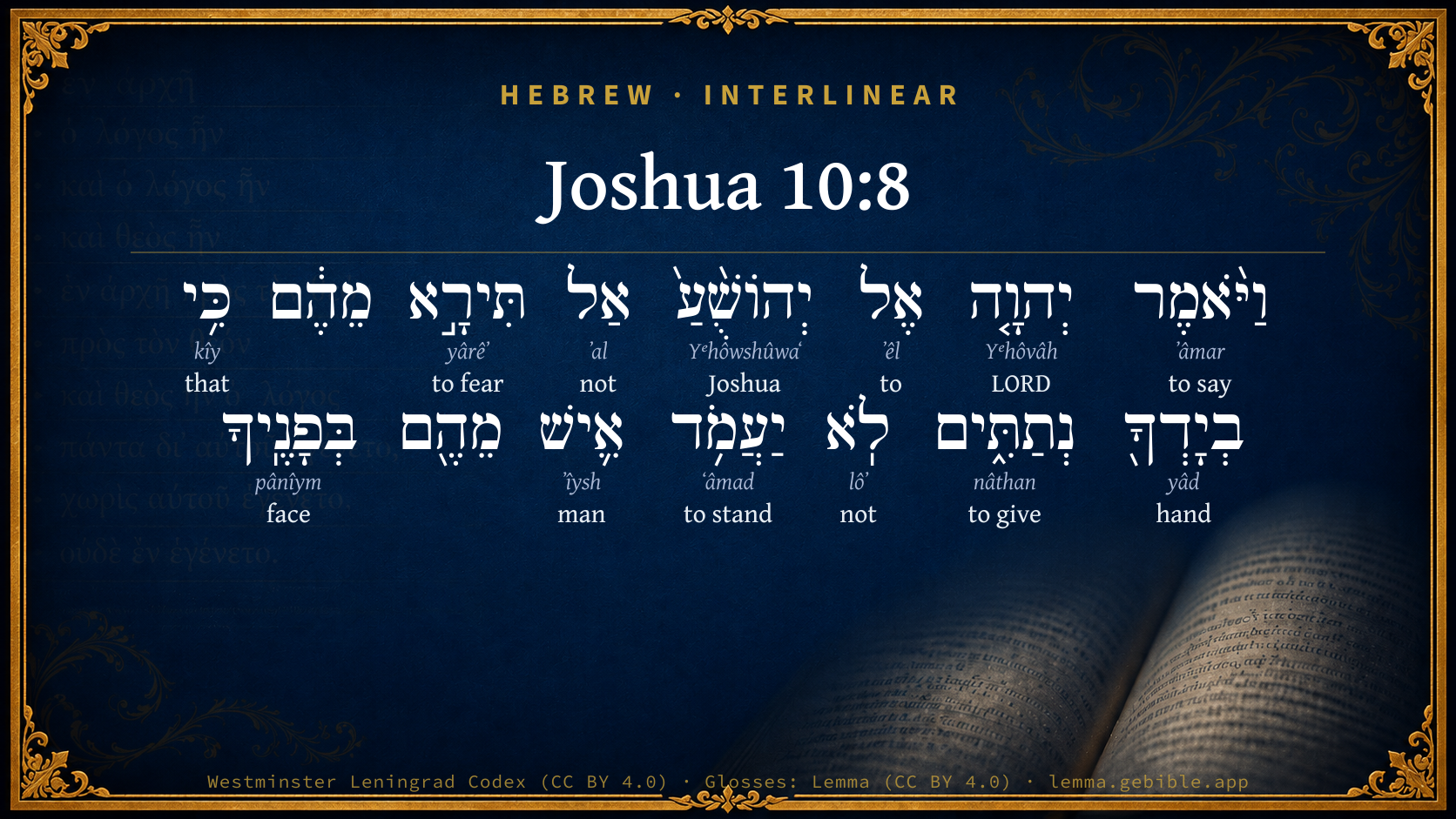
Hebrew (Westminster Leningrad Codex) Joshua 10:8 appears in the Hebrew Old Testament. The text above is from the Westminster Leningrad Codex. Each word links to its Strong’s number, a concise gloss, and parsing drawn from the Open Scriptures Hebrew Bible morphology. Click any word for its full Brown-Driver-Briggs (BDB) entry.
Download image
Cite this verse

Joshua 10:8 (World English Bible). Public Domain. Lemma interlinear Bible study tool, https://lemma.gebible.app/v/joshua/10/8.

Show BibTeX & RIS
BibTeX
RIS
English Translation
Yahweh said to Joshua, Don't fear them: for I have delivered them into your hands; there shall not a man of them stand before you.
World English Bible · Public Domain
Download a study sheet

One document with this verse’s original text, its word-by-word gloss line, the meaning frame, cross-references with their text, attributed commentary, and full source and license credits — printable, and it pastes into notes with its structure intact.

This verse Autodidact and up

Study sheet (.html) Plain text (.txt)

A passage Seminary Student

Up to 50 verses in one chapter. A passage sheet keeps up to 6 commentary sources and 12 cross-references per verse, in the order this page ranks them, and says so on the sheet whenever that leaves anything out. Ask for a single verse and you get the Autodidact verse sheet above.

Everything on this page stays free to read, with no account — the sheet is a download of what is already on screen, not access to it.

Want to remove ads? Support Godless Engineer
Compare translations 3

The same verse in 3 English versions, stacked beneath the original-language interlinear above. Click any original word for its lexicon entry.

Each is an independent rendering of the whole verse — the interlinear is not word-aligned to these translations.

Highlighted words mark where these versions differ — a whole-verse word diff, not a word-by-word alignment.

  • World English Bible Public Domain
    Yahweh said to Joshua, Don't fear them: for I have delivered them into your hands; there shall not a man of them stand before you.
  • King James Version Public Domain
    And the LORD said unto Joshua, Fear them not: for I have delivered them into thine hand; there shall not a man of them stand before thee.
  • unfoldingWord Literal Text CC BY-SA 4.0
    And Yahweh said to Joshua, “Do not be afraid of them, because I have given them into your hand. Not a man from them will stand at your face.”

unfoldingWord Literal Text — © unfoldingWord, licensed CC BY-SA 4.0. Word-aligned USFM3 via Door43 (git.door43.org/unfoldingWord/en_ult).

Versions to compare (up to 4)

3 of 4 selected

Show all 18 translations

Every available English version of this verse, each an independent rendering of the whole verse.

  • World English Bible Public Domain
    Yahweh said to Joshua, Don't fear them: for I have delivered them into your hands; there shall not a man of them stand before you.
  • Berean Standard Bible Public Domain
    The LORD said to Joshua, “Do not be afraid of them, for I have delivered them into your hand. Not one of them shall stand against you.”
  • Majority Standard Bible Public Domain
    The LORD said to Joshua, “Do not be afraid of them, for I have delivered them into your hand. Not one of them shall stand against you.”
  • King James Version Public Domain
    And the LORD said unto Joshua, Fear them not: for I have delivered them into thine hand; there shall not a man of them stand before thee.
  • American Standard Version (1901) Public Domain
    And Jehovah said unto Joshua, Fear them not: for I have delivered them into thy hands; there shall not a man of them stand before thee.
  • Revised Version (1885) Public Domain
    And the LORD said unto Joshua, Fear them not: for I have delivered them into thine hands; there shall not a man of them stand before thee.
  • Geneva Bible (1599) Public Domain
    And the Lord sayd vnto Ioshua, Feare them not: for I haue giuen them into thine hand: none of them shall stand against thee.
  • Douay-Rheims (1899) Public Domain
    And the Lord said to Josue: Fear them not: for I have delivered them into thy hands: none of them shall be able to stand against thee.
  • Young's Literal Translation Public Domain
    And Jehovah saith unto Joshua, `Be not afraid of them, for into thy hand I have given them, there doth not stand a man of them in thy presence.'
  • Literal Standard Version CC BY-SA 4.0
    And YHWH says to Joshua, “Do not be afraid of them, for I have given them into your hand, there does not stand a man of them in your presence.”
  • Unlocked Literal Bible CC BY-SA 4.0
    Yahweh said to Joshua, “Do not be afraid of them. I have given them into your hand. Not one of them will be able to stop your attack.”
  • unfoldingWord Literal Text CC BY-SA 4.0
    And Yahweh said to Joshua, “Do not be afraid of them, because I have given them into your hand. Not a man from them will stand at your face.”
  • Darby Bible Public Domain
    And Jehovah said to Joshua, Fear them not; for into thy hand have I given them: not a man of them shall stand before thee.
  • World Messianic Bible Public Domain
    The LORD said to Joshua, “Don’t fear them, for I have delivered them into your hands. Not a man of them will stand before you.”
  • Webster's Bible Public Domain
    And the LORD said to Joshua, Fear them not: for I have delivered them into thy hand; there shall not a man of them stand before thee.
  • Free Bible Version CC BY-SA 4.0
    The Lord had said to Joshua, “Don't be afraid of them, for you will defeat them. Not a single one will be able to stand against you.”
  • Bible in Basic English Public Domain
    And the Lord said to Joshua, Have no fear of them, for I have given them into your hands; they will all give way before you.
  • JPS Tanakh (1917) Public Domain
    And the LORD said unto Joshua: 'Fear them not; for I have delivered them into thy hand; there shall not a man of them stand against thee.'

Literal Standard Version (2020), Covenant Press — licensed CC BY-SA 4.0. Text via the HelloAO Bible API (eBible.org). Unlocked Literal Bible (unfoldingWord) — licensed CC BY-SA 4.0. Text via the HelloAO Bible API (eBible.org). unfoldingWord Literal Text — © unfoldingWord, licensed CC BY-SA 4.0. Word-aligned USFM3 via Door43 (git.door43.org/unfoldingWord/en_ult). Free Bible Version, Dr. Jonathan Gallagher — licensed CC BY-SA 4.0. Text via the HelloAO Bible API (eBible.org).

Word by word

More ways to search: Search by grammar → Find every occurrence → Compare this word →

Practice this passage: Drill this verse → Learn its vocabulary →

יְהוֹשֻׁ֨עַ֙
Yᵉhôwshûwaʻ
H3091
“Joshua”
Noun, Proper
Part of Speech
Noun
Type
Proper
Full BDB Definition

Origin: from H3068 and H3467

TWOT: None

Joshua or Jehoshua = "Jehovah is salvation" - son of Nun of the tribe of Ephraim and successor to Moses as the leader of the children of Israel; led the conquest of Canaan - a resident of Beth-shemesh on whose land the Ark of the Covenant came to a stop after the Philistines returned it - son of Jehozadak and high priest after the restoration - governor of Jerusalem under king Josiah who gave his name to a gate of the city of Jerusalem
  1. וַיֹּ֨אמֶר ʼâmar H559 “and · to say” Conjunction + Verb, Qal, Sequential Imperfect, 3rd Person, Masculine, Singular
  2. יְהוָ֤ה Yᵉhôvâh H3068 “LORD” Noun, Proper
  3. אֶל ʼêl H413 “to” Preposition
  4. אַל ʼal H408 “not” Particle, Negative
  5. תִּירָ֣א yârêʼ H3372 “to fear” Verb, Qal, Jussive, 2nd Person, Masculine, Singular
  6. כִּ֥י kîy H3588 “that” Conjunction
  7. בְיָדְךָ֖ yâd H3027 “in/at · hand · your” Preposition + Noun, Common, Both, Singular, Construct + Suffix, Personal, 2nd Person, Masculine, Singular
  8. נְתַתִּ֑ים nâthan H5414 “to give · them” Verb, Qal, Perfect, 1st Person, Common, Singular + Suffix, Personal, 3rd Person, Masculine, Plural
  9. לֹֽא lôʼ H3808 “not” Particle, Negative
  10. יַעֲמֹ֥ד ʻâmad H5975 “to stand” Verb, Qal, Imperfect, 3rd Person, Masculine, Singular
  11. אִ֛ישׁ ʼîysh H376 “man” Noun, Common, Masculine, Singular, Absolute
  12. בְּפָנֶֽיךָ pânîym H6440 “in/at · face(s) · your” Preposition + Noun, Common, Both, Plural, Construct + Suffix, Personal, 2nd Person, Masculine, Singular

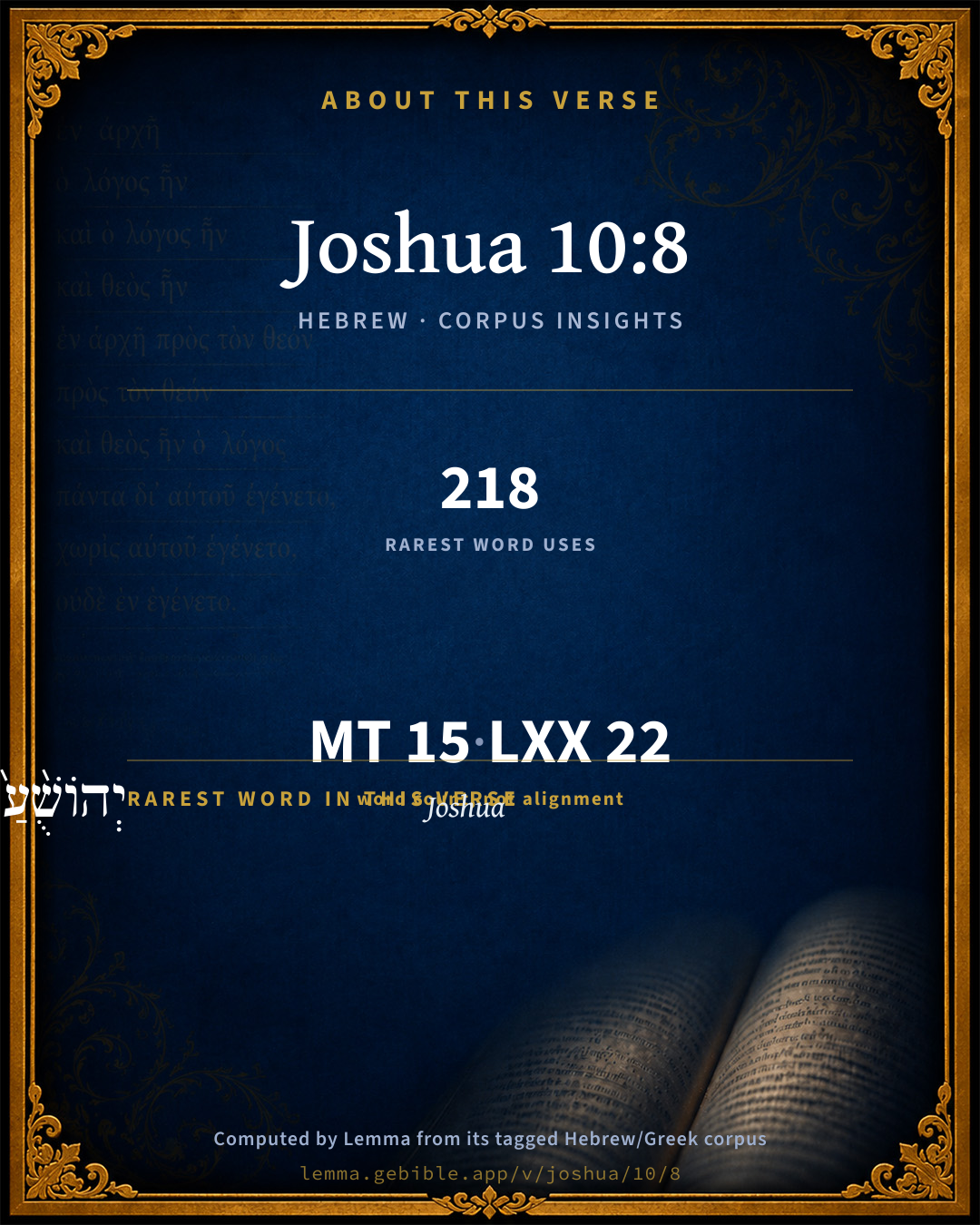
About this verse

These counts appear in no published source. They are computed here, from the morphology-tagged text and Lemma’s own curated glosses. What Lemma adds →

15
words
13
distinct lemmas
Historical
section

Grammatical profile

  • 4 verbs
  • 5 nouns
  • 3 prepositions
  • 1 conjunction
  • 2 particles

Verb forms

  • וַיֹּ֨אמֶר Qal · Sequential Imperfect
  • תִּירָ֣א Qal · Jussive
  • נְתַתִּ֑ים Qal · Perfect
  • יַעֲמֹ֥ד Qal · Imperfect

Hebrew & Septuagint length

In English translation the verse runs 25 words from the Hebrew and 27 from the Septuagint (LXX English) — closely comparable.

A rough comparison of the two English renderings, which tokenize alike — not a word-level alignment.

Word counts can differ between the Hebrew and the Greek without any difference in meaning — e.g. the Hebrew direct-object marker אֵת has no separate Greek word, and Greek often adds the article ὁ.

In the original languages it is 15 Hebrew tokens and 22 Greek tokens — but the two are counted differently (Hebrew bundles its prefixes and suffixes into one token; the Greek is in lemma form), so that isn’t a like-for-like length.

Cross-references

9

Topical passages linked to Joshua 10:8 in the Treasury of Scripture Knowledge — connected by theme and wording, ordered by reader-vote popularity; previews shown in the World English Bible.

  • Romans 8:31 What then shall we say about these things? If God is for us, who can be against us?
  • Deuteronomy 3:2 Yahweh said to me, Don't fear him; for I have delivered him, and all his people, and his land, into your hand; and you shall do to him as you did to Sihon king of the Amorites, who lived at Heshbon.
  • Psalms 27:1–2 Yahweh is my light and my salvation. Whom shall I fear? Yahweh is the strength of my life. Of whom shall I be afraid?
  • Isaiah 41:10–15 Don't you be afraid, for I am with you; don't be dismayed, for I am your God; I will strengthen you; yes, I will help you; yes, I will uphold you with the right hand of my righteousness.
  • Joshua 11:6 Yahweh said to Joshua, Don't be afraid because of them; for tomorrow at this time will I deliver them up all slain before Israel: you shall hamstring their horses, and burn their chariots with fire.
  • Joshua 1:5–9 There shall not any man be able to stand before you all the days of your life. As I was with Moses, so I will be with you; I will not fail you, nor forsake you.
  • Judges 4:14–15 Deborah said to Barak, Up; for this is the day in which Yahweh has delivered Sisera into your hand; hasn't Yahweh gone out before you? So Barak went down from Mount Tabor, and ten thousand men after him.
  • Joshua 8:1 Yahweh said to Joshua, Don't be afraid, neither be dismayed: take all the people of war with you, and arise, go up to Ai; behold, I have given into your hand the king of Ai, and his people, and his city, and his land;
  • Deuteronomy 20:1–4 When you go forth to battle against your enemies, and see horses, and chariots, [and] a people more than you, you shall not be afraid of them; for Yahweh your God is with you, who brought you up out of the land of Egypt.

Cross-references courtesy of OpenBible.info (CC BY 4.0).

Hebrew and Greek witnesses Masoretic Hebrew ↔ Greek Septuagint

The same verse in the two great witnesses to the Old Testament, shown verse-for-verse.

These are two independent witnesses, not word-aligned to each other, and the Septuagint is shown in lemma (dictionary) form.

Hebrew Joshua 10:8 Masoretic · Westminster Leningrad Codex

וַיֹּ֨אמֶר יְהוָ֤ה אֶל יְהוֹשֻׁ֨עַ֙ אַל תִּירָ֣א מֵהֶ֔ם כִּ֥י בְיָדְךָ֖ נְתַתִּ֑ים לֹֽא יַעֲמֹ֥ד אִ֛ישׁ מֵהֶ֖ם בְּפָנֶֽיךָ

Yahweh said to Joshua, Don't fear them: for I have delivered them into your hands; there shall not a man of them stand before you.

World English Bible · Public Domain

Greek LXX Joshua 10:8 Septuagint · lemma form

καί εἶπον κύριος πρός ἰησοῦς μή φοβέω αὐτός εἰς γάρ ὁ χείρ σύ παραδίδωμι αὐτός οὐ ὑπολείπω ἐκ αὐτός οὐδείς ἐνώπιον σύ

And the Lord said to Joshua, Fear them not, for I have delivered them into your hands; there shall not one of them be left before you.

LXX2012 (modern English Septuagint) · Public Domain

Hebrew: Westminster Leningrad Codex (CC BY 4.0). Greek: Septuagint (public domain); English from LXX2012 (modern English Septuagint) (Public Domain). How the Septuagint differs from the Hebrew →

Targum (Aramaic paraphrase)

1

The Targum is the ancient Jewish Aramaic paraphrase of the Hebrew Scriptures — an interpretive translation, not the Hebrew text itself. Onkelos (literal) and Pseudo-Jonathan (expansive) render the Torah, and Jonathan the Prophets. Coverage is partial: where no permissively-licensed English translation exists for a verse, only the Aramaic is shown. This is verse-level text, not a word-by-word alignment to the Hebrew.

  1. Targum Jonathan Prophets (Joshua–Malachi)
    וַאֲמַר יְיָ לִיהוֹשֻׁעַ לָא תִדְחַל מִנְהוֹן אֲרֵי בִּידָךְ מְסַרְתִּינוּן לָא יִתְעַתַּד אֱנַשׁ מִנְהוֹן קָדָמָךְ:

    (no public-domain English translation for this verse)

    Targum Jonathan — Aramaic: “Mikraot Gedolot” (public domain). English: “Sefaria Community Translation” (CC0 1.0 (public-domain dedication)); “London "Chaldee Paraphrase," 1871” (public domain). Text via Sefaria.

Commentary

Notes on Joshua 10:8 from classic Christian and Jewish commentators (each source and its license shown beneath its notes). The classic Christian expositions comment on the surrounding passage and are grouped to its opening verse, so a note may address several verses; the Jewish commentaries on the Tanakh (Rashi and others) are per-verse, so they appear only where the commentator wrote on this verse.

Lemma curates 59 commentaries, every one of them public domain or Creative Commons licensed, each selected and text-cleaned for this edition rather than reprinted as found. About our sources →

Trapp's Complete Commentary

John Trapp

Jos 10:8 And the LORD said unto Joshua, Fear them not: for I have delivered them into thine hand; there shall not a man of them stand before thee.

Ver. 8. Fear them not, &c.] Joshua, though valiant, had his fears and frailties. Of Charles V, emperor, it is storied, that while he was putting on his armour to go into the battle, his countenance was pale and perplexed: but when the battle was once begun, he was bold as a lion, and did great exploits.

John Trapp, A Commentary or Exposition upon All the Books of the Old and New Testament (1647–1656) — public domain. Text from a community e-Sword module.

Tyndale Open Study Notes

Tyndale Open Resources

10:8 God once again urged Joshua not to be afraid, assuring him of victory over Israel’s enemies (see also 1:9; 8:1).

Tyndale Open Study Notes — © Tyndale Open Resources, licensed CC BY-SA 4.0. Text via the HelloAO Bible API.

Geneva Bible (1599)

Geneva Bible translators

Lest Joshua should have thought that God had sent this great power against him for his unlawful league with the Gibeonites, the Lord here strengtheneth him.

Geneva Bible (1599) marginal notes — public domain. Text via Bolls.life.

John Calvin's Commentaries

8. And the Lord discomfited them, etc It is uncertain whether the Lord anticipated the movement, and armed Joshua by his oracle, drawing him forth from Gilgal before he had taken any step, or whether he only confirmed him after he had made his preparations for setting out. It seems to me more likely that Joshua did not rush forth as soon as he was asked without consulting God, but at length, after being informed of his will, took up arms boldly and speedily. As he had lately been chastised for excessive facility, it is at least a probable conjecture that in this case of difficulty, he attempted nothing except in so far as he had a divine command. The Lord, therefore, had respect to the wretched Gibeonites when he did not allow them to remain destitute without the assistance of his people.

Joshua is made confident of victory in order that he may succor them; for God stimulates us more powerfully to the performance of duty by promising than by ordering. That which is here promised to one belongs to all, but for the sake of honoring Joshua, it is specially deposited with him that he may afterwards be the bearer of it to his army. For God does not speak from heaven indiscriminately to all sorts of persons, but confers the honor only on excellent servants and chosen prophets.

It is moreover worthy of notice that Joshua did not abuse the divine promise by making it an excuse for sluggishness, but felt the more vehemently inflamed after he was assured of a happy issue. Many, while they ostentatiously express their faith, become lazy and slothful from perverse security. Joshua hears that victory is in his hand, and that he may gain it, runs swiftly to battle. For he knew that the happy issue was revealed, not for the purpose of slackening his pace or making him more remiss, but of making him exert himself with greater zeal. Hence it was that he took the enemy by surprise.

John Calvin's Commentaries (1540-1563) — public domain. Text from the Calvin Translation Society English edition (1840s-50s) via the Christian Classics Ethereal Library (ccel.org). Calvin's coverage is partial (roughly two-thirds of the Bible); uncommented books and verses are honest gaps, never fabricated. The 19th-century editor's footnotes and remarks are omitted so the notes are faithfully Calvin's own voice.

Ellicott's Commentary for English Readers

(8) And the Lord said unto Joshua.—A distinct command is given for the commencement of this attack, as for all the important steps in the conquest of Canaan.

A Bible Commentary for English Readers, edited by Charles John Ellicott (1878–1897) — public domain. Text from a community e-Sword module.

The Cambridge Bible for Schools and Colleges

gen. ed. J. J. S. Perowne

8. Fear them not] Comp. Jos_11:6; Jdg_4:14.

The Cambridge Bible for Schools and Colleges (gen. ed. J. J. S. Perowne; Cambridge University Press, 1878–1918) — public domain. Text from a community e-Sword module.

John Gill's Exposition

And the Lord said unto Joshua,.... Either when upon the march, and while he was proceeding on in his journey to the assistance of the Gibeonites, or rather before he set out; and it is highly probable he consulted the Lord on this occasion, having, it may be, some doubt on his mind, whether he should go to their assistance, since the league between them was obtained by fraud; and the words may be rendered, "and the Lord hath said" (n): before he set forward with his men of war:

fear them not; the five kings, and their combined army:

for I have delivered them into thine hand; had determined to do it, and which was as certain as if it had been actually done:

there shall not a man of them stand before thee; but be either cut off, or obliged to flee.

(n) "et dixerat", Masius, Drusius, Junius & Tremellius, Piscator.

John Gill's Exposition of the Whole Bible (1746–1763) — public domain (CC PDM 1.0). Text via the HelloAO Bible API.

Whedon's Commentary on the Bible

Daniel D. Whedon

8. Fear them not — He was constrained to aid Gibeon not only by military necessity, but also by the encouraging assurance of the Lord that he should be victorious. As Joshua up to this time had fought only single cities, he needed additional assurance when he was about to meet for the first time the allied armies of Canaan.

Daniel D. Whedon (gen. ed.), Commentary on the Old and New Testaments (1874–1909) — public domain. Text from a community e-Sword module.

The Pulpit Commentary

Fear not. The key-note of Joshua"s career, as of the career of every soldier of God. (see Jos_1:9 Jos_11:6)

HOMILIES BY R. GLOVER Vers. 8-11. The battle of Beth-horon and its lessons.

It may seem as if there was too much carnage about this account for Scripture purposes. Yet it is well to dwell on it. Dean Stanley treats this battle as the Marathon of the religious history of the world. It was the crisis in which the hosts who were, unconsciously to some extent, fighting for truth, righteousness, progress, and liberty, met with those fighting, to some extent unconsciously, for a depraved religion, licentious morals, for retrogression and decay. Like the siege of Leyden, or the defeat of the Armada, such a battle means far more than is obvious on the surface. The sacred cause of man is involved in it. And it is worth our while, to linger over some of its lessons. Mark at least these.

I GOD USES OUR EFFORT TO FULFIL HIS PROMISES, Israel was apt, perhaps, to expect the possession of the land to come too easily. Jericho was got by a miracle, Ai by stratagem, Gibeon by submission; and perhaps the ease of these successes led them to dream dreams of gaining the whole land without an effort. But all the steps of progress are not to be so easy. Miracles come only where weakness needs them. In the degree in which they develop vigour and self reliance, the miraculous element in their experience will grow less. Always sufficient there will never be more help of God than is needed. And so with the confidence and vigour developed by their successes, comes greater strain upon their powers. The nations of southern Canaan gather together to oppose their progress: to gain possession of that Gibeon which commands the entrance by the pass of Beth-horon to the land. And at once "foemen worthy of their steel" confront them. God will fulfil His promise to give them the land of Canaan; but He will employ their effort and their prowess to realise the fulfilment of His promise. And to some extent by their efforts is His promise fulfilled. Such is all life. It is the heir of promises which, however, require our effort for their fulfilment.

(a) For instance: Truth is a land of promise. Only when God gives can we get it. "The Spirit of truth" alone can impart it. It is a land flowing with milk and honey the home of God"s elect. But though thus a land of God"s promises, and in a special sense His gift, it comes not to the inert or the supine to the critics that are at ease in Zion. It comes to the fighters only. When we face bravely all lies, strive fearlessly to see and grasp and own the truth, get lodgment for it in the heart by obeying it, strive against doubts that rise within us, and fears disabling us, then do we gain "the promised possession.

(b) Salvation is God"s promise, and a Divine gift in all its elements. Obviously it is beyond our power to compass it. Only the God that made us can mend us. And atonement, grace, repentance, faith, perseverance to the end, are all God"s gift. But there is the battle of Beth-horon at the outset of every Christian life, and many a conflict afterwards, a strait gate to begin with, and a narrow way to follow. And if we do not make the effort and fight for the attainment of what we desire, we shall not find it.

(c) Character is another Canaan. A thing of promise, but only reached by effort. Daily deeds of self denial lead to it; and daffy conflicts with doubts and disinclinations.

(d) Usefulness is, perhaps, the grandest of all God"s promises. It is that in which we most resemble God. Its joys are the likest of any to those of the everlasting home. It comes not to the dreamer, but to the fighter. The abolition of slavery was a fight. Mary Carpenter"s triumph in getting a place for Ragged Schools, Industrial Schools, and Reformatories in English legislation, required thirty years of effort. When the Church faces the abounding drunkenness of the land, she will find God will help her to destroy it, but that His help will be conditioned on a tremendous effort. Do not believe in salvation made easy. It is always simple, it is never easy. The possession of every Canaan is a Divine promise, and needs Divine power; but one of the conditions of its fulfilment is the forth putting of human effort. Take a second lesson.

II THE HEARTIER THE EFFORT IS, THE MORE SURELY AND EASILY SUCCESS WILL COME. Joshua saw the need for action, had God"s guidance in it, and then with an energy which had something Napoleonic in it, threw himself into his task. Was Gibeon threatened? within a few hours of his knowing it, Israel is on the march. Doubtless there were counsellors advising caution, consideration, and delay. Joshua had gathered the wisdom, but not the weakness, of old age, and knew the value of energy. That night the host is marshalled for its uphill, moonlit march over the fifteen or eighteen miles of valley intervening between them and Gilgal. And before the five kings have any thought of his approach, he rushes "like a torrent" on the foe. And such is the energy, the surprise of that charge, that, martial as are the habits of the enemy, they are obliged to yield. Apparently a long fight takes place, the enemy disputing every inch of ground so long as the gradual rising to the Upper Beth-horon gives them the advantage. But the sun stands still over Gibeon to let them finish the fight; and then a headlong flight down to Lower Beth-boron, and then to the valley of Ajalon and the plains that skirt the Mediterranean, subjects them to terrible destruction. A great hailstorm breaks on the fugitive masses, not extending far enough eastward to affect Israel. And the moon stands over the valley of Ajalon after the sun has set, to let them finish their pursuit and complete their victory. It is as fine an instance of the value of decision, of energy, of heartiness in our work as the whole Bible gives. "What thy hand finds to do, do it with thy might." The impact of any projectile is in the ratio of its mass, multiplied by its velocity. And a thing of slight mass, but of high velocity, will be more effective than one of much greater mass, whose velocity is sluggish. So is it in the world of morals. Weight multiplied by momentum measures the power. Most of us are inefficient, because, while weighty enough, we have little or no momentum. We languidly pursue the good, and half-heartedly oppose the evil. Unlike St. Paul, it is not one thing, but twenty-one, that we do. In everything decision and heartiness is needed, but in religion it is indispensable. Be cold or hot, not lukewarm. If the gospel be true, it is tremendously true; if a dream, ignore it altogether. Half-hearted fighting prolongs the contest, invites defeat, loses the benefits of victory. In march, attack, pursuit, we have an example of the supreme advantage of doing heartily whatever has to be done by us. Take a third lesson.

III THE GOOD FIGHT, WHEN WELL FOUGHT, ALWAYS ENDS IN VICTORY. It might have seemed a very dubious affair, this war with the nations of Canaan. The Canaanites were the English of that period: the nation leading the world in maritime enterprise and daring, and wealthy and strong in their successful commerce. Israel had been for generations in slavery, debased and weakened by servitude. But against these odds on the side of Canaan there were some things to be set.

1. Immorality is destructive of courage. Paganism, with its debasements, destroyed self respect and that interest in life, home, and liberty which is the soul of patriotism. For heroism religion is an essential element. Cromwell"s Ironsides, Nelson"s Methodists, Havelock"s regiment of Teetotallers, the rower of resistance to oppression developed by religion in Holland and in Scotland, show how immediate and direct is the influence of godliness in vitalising all the manlier virtues. Corruption of character followed corruption of creed, and was followed by deterioration of courage.

2. The enemy of the good has never Divine guidance. These nations were badly advised. Their true policy was a defensive one. Within their ramparts the labour of conquering them would have been terrific and inevitably slow. All uniting, in the open they lose the advantage of their cities "walled up to heaven," and a single disaster is a fatal one. "A good understanding have they that love God"s law;" and all others unwatchful in presumption, or feverish in solicitude, lack wisdom which they Deed.

3. And God fights on behalf of those who fight for Him. The long day, the moonlight night, the destructive hail, are all Divine, however we may abate the miraculous significance of the poetic history. And they who aim at any form of good find a secret providence furthering their enterprise: many influences cooperating with them, strange providential openings, a Divine backing which, all uniting, make it that, however weak they may be, they are more than conquerors through Christ that loved them. "Wherefore take to yourselves the whole armour of God," and FIGHT THE GOOD FIGHT OF FAITH. G.

HOMILIES BY E. DE PRESSENSE Vers. 8-11. The victory over the five kings.

The battle against the five kings is the most remarkable episode in the conquest of the Canaanites. Israel might well have had cause to tremble in presence of such allied enemies. But Divine aid gives it a signal victory. That aid comes under two forms:

1. It consists, first, in a miraculous intervention of the Divine power, which sends down a fierce storm of hailstones upon the Canaanitish armies, and so lengthens out the day as to make the conflict decisive. No one believes now that the sun stood still. Holy Scripture speaks the popular language of the day, and makes no pretension to being scientific in its records. God reveals only that which man has no power to discover, and it was not the calling of Joshua to be a Galileo or Copernicus. Do we not still speak in common parlance of the rising and setting of the sun? All that is essential is, that we hold fast our faith in the miracle itself. Let us not marvel that such a prodigy was wrought for so small a nation; for that nation was the depository of the promise that in it should all nations of the earth be blessed. The God of nature may surely show Himself the King and Master of nature, and it is most fitting that the heavens which declare His glory should do His commandments. The supreme law of the universe is not the physical law, but the dependence of that law upon the sovereign will of the Almighty.

2. This Divine aid was manifested, in the second place, by the heroic confidence and courage infused into the hearts of his people. "Fear them not," was the message to Joshua, who might well nave been dismayed at so powerful a league of enemies, "for I have delivered them into thine hands." "Therefore," as we read in the following verse, "Joshua came unto them suddenly." The Divine word alone gave him courage to go forward, and courage is in itself an irresistible power, even more formidable than the storm of hailstones from heaven. With more than redoubled force, Israel rushes on to certain victory. Thus the noble words of the Psalm 21. are anticipated and fulfilled: "Some trust in chariots and some in horses, but we will trust in the name of the Lord our God" (ver. 8). Did not Elisha describe Elijah as the chariot and the horsemen of Israel? Let us place unwavering trust in all our conflicts in this Divine aid, and that confidence will be the first condition of victory. E. DE P.

The Pulpit Commentary (1880–1919), ed. H.D.M. Spence-Jones & Joseph S. Exell — public domain. Text from a community e-Sword module.

unfoldingWord translationNotes

Door43 World Missions Community

I have given them into your hand

Here "hand" represents the people of Israel's strength and their ability to defeat their enemy. The word "them" refers to the attacking army. (See: Metonymy)

I have given them

Here the word "them" refers to the attacking armies.

translationWords

Yahweh

Joshua

unfoldingWord translationNotes — © Distant Shores Media and the Door43 World Missions Community, licensed CC BY-SA 4.0. Source: git.door43.org/Door43/en_tn.

Lesson kit

Teaching starters — assembled from the data on this page, not authored interpretation. Every prompt links to the verse data it draws on. Edit before teaching.

Joshua, in the Historical, opens this verse with 15 words (13 distinct Hebrew lemmas). Its most distinctive word is Yᵉhôwshûwaʻ (“Joshua”). A historical commentator’s framing appears above. Read the whole chapter for the surrounding context.

Discussion questions

  1. How does “Joshua” (Yᵉhôwshûwaʻ) shape what this verse is saying?
  2. How does Romans 8:31, which shares this passage’s theme, read alongside this verse?
  3. These translations render this verse differently; the difference is in the English rendering, not the original. What questions does that raise?
  4. «וַיֹּ֨אמֶר» is a Qal Sequential Imperfect verb. How does that grammatical form shape the action described?
  5. Compare how Trapp's Complete Commentary and Tyndale Open Study Notes read this verse. Where do they agree or differ?

Things to notice

Reading settings

Reading text

Shown beneath each verse's original-language words.

Old Testament
Old Testament edition

Read the OT as the Masoretic Hebrew (MT) or the Greek Septuagint (LXX).

English shown for the Greek Septuagint (in the Hebrew ↔ Greek comparison).

Comparing translations? Open the Compare panel on any verse page to stack up to four side by side.