Ruth 1:20

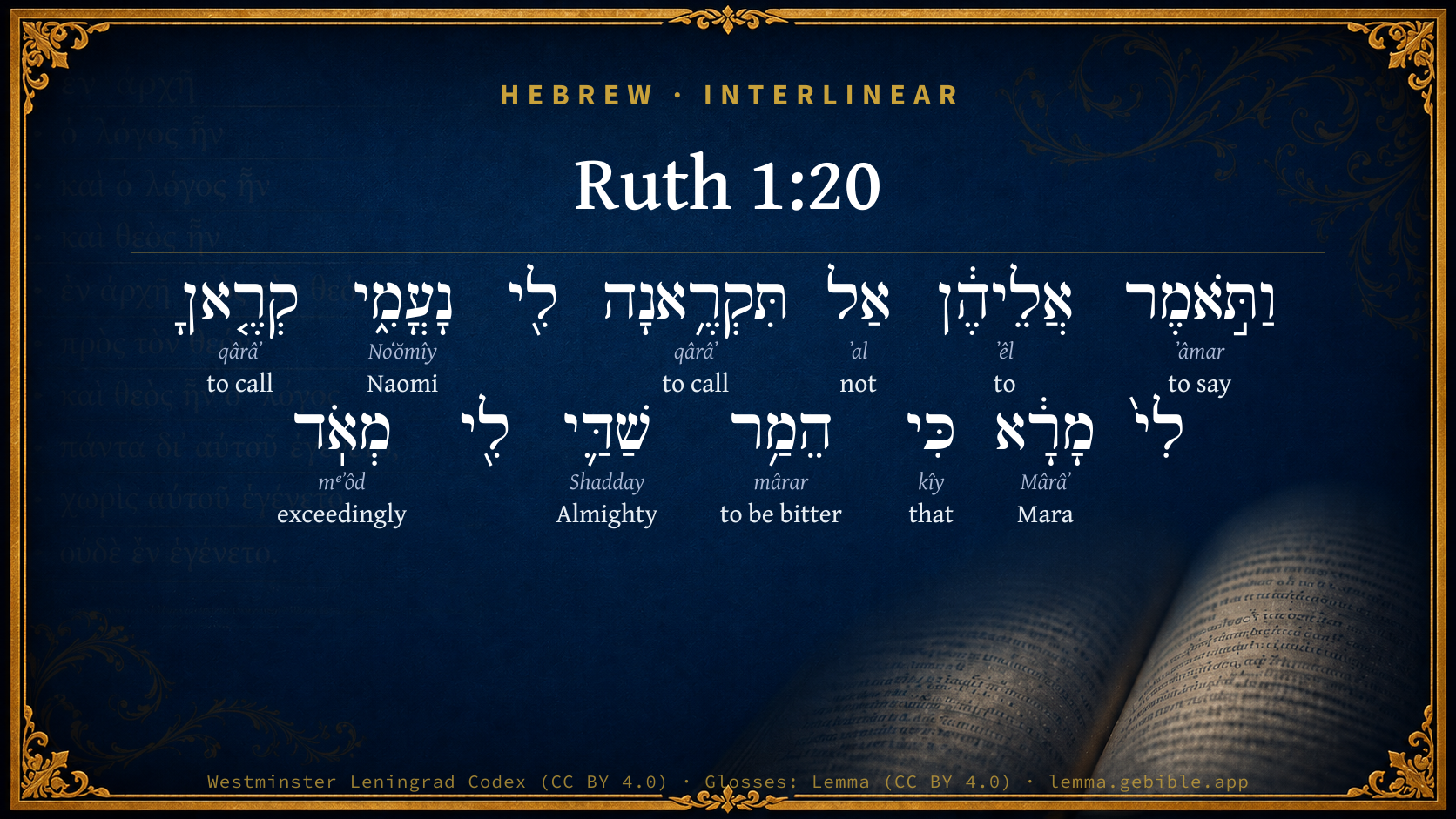
Hebrew (Westminster Leningrad Codex) Ruth 1:20 appears in the Hebrew Old Testament. The text above is from the Westminster Leningrad Codex. Each word links to its Strong’s number, a concise gloss, and parsing drawn from the Open Scriptures Hebrew Bible morphology. Click any word for its full Brown-Driver-Briggs (BDB) entry.
Download image
Cite this verse

Ruth 1:20 (World English Bible). Public Domain. Lemma interlinear Bible study tool, https://lemma.gebible.app/v/ruth/1/20.

Show BibTeX & RIS
BibTeX
RIS
English Translation
She said to them, "Don't call me Naomi, call me Mara; for the Almighty has dealt very bitterly with me.
World English Bible · Public Domain
Highlights
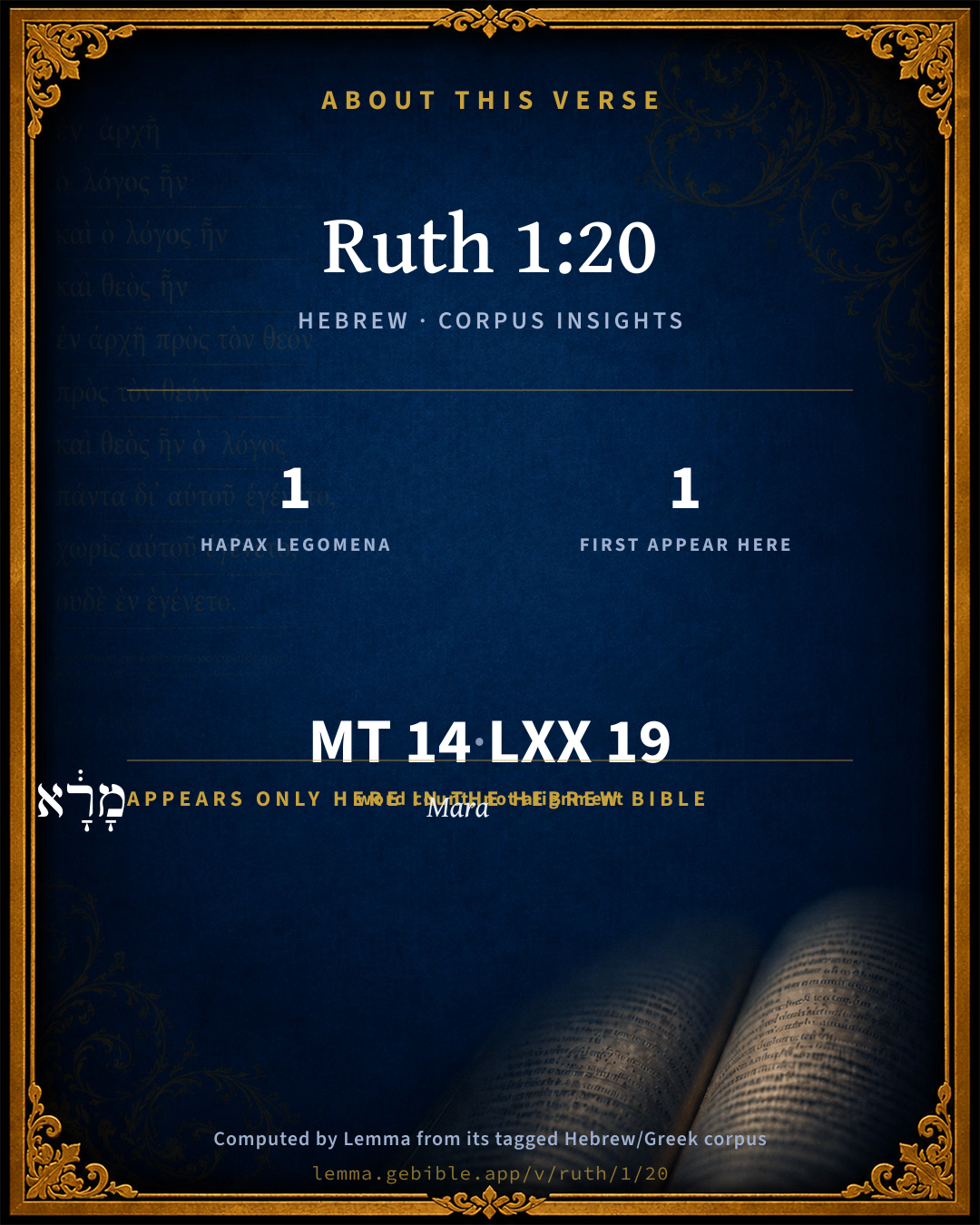
  • 1 hapax legomenon — only here in the Hebrew Bible
  • 1 first appearance in the Hebrew Bible
Full analysis ↓
Download a study sheet

One document with this verse’s original text, its word-by-word gloss line, the meaning frame, cross-references with their text, attributed commentary, and full source and license credits — printable, and it pastes into notes with its structure intact.

This verse Autodidact and up

Study sheet (.html) Plain text (.txt)

A passage Seminary Student

Up to 50 verses in one chapter. A passage sheet keeps up to 6 commentary sources and 12 cross-references per verse, in the order this page ranks them, and says so on the sheet whenever that leaves anything out. Ask for a single verse and you get the Autodidact verse sheet above.

Everything on this page stays free to read, with no account — the sheet is a download of what is already on screen, not access to it.

Want to remove ads? Support Godless Engineer
Compare translations 3

The same verse in 3 English versions, stacked beneath the original-language interlinear above. Click any original word for its lexicon entry.

Each is an independent rendering of the whole verse — the interlinear is not word-aligned to these translations.

Highlighted words mark where these versions differ — a whole-verse word diff, not a word-by-word alignment.

  • World English Bible Public Domain
    She said to them, "Don't call me Naomi, call me Mara; for the Almighty has dealt very bitterly with me.
  • King James Version Public Domain
    And she said unto them, Call me not Naomi, call me Mara: for the Almighty hath dealt very bitterly with me.
  • unfoldingWord Literal Text CC BY-SA 4.0
    But she said to them, “Do not call me Naomi. Call me Mara, for the Almighty has acted exceedingly bitterly to me.

unfoldingWord Literal Text — © unfoldingWord, licensed CC BY-SA 4.0. Word-aligned USFM3 via Door43 (git.door43.org/unfoldingWord/en_ult).

Versions to compare (up to 4)

3 of 4 selected

Show all 18 translations

Every available English version of this verse, each an independent rendering of the whole verse.

  • World English Bible Public Domain
    She said to them, "Don't call me Naomi, call me Mara; for the Almighty has dealt very bitterly with me.
  • Berean Standard Bible Public Domain
    “Do not call me Naomi,” she replied. “Call me Mara, because the Almighty has dealt quite bitterly with me.
  • Majority Standard Bible Public Domain
    “Do not call me Naomi,” she replied. “Call me Mara, because the Almighty has dealt quite bitterly with me.
  • King James Version Public Domain
    And she said unto them, Call me not Naomi, call me Mara: for the Almighty hath dealt very bitterly with me.
  • American Standard Version (1901) Public Domain
    And she said unto them, Call me not Naomi, call me Mara; for the Almighty hath dealt very bitterly with me.
  • Revised Version (1885) Public Domain
    And she said unto them, Call me not Naomi, call me Mara: for the Almighty hath dealt very bitterly with me.
  • Geneva Bible (1599) Public Domain
    And she answered them, Call me not Naomi, but call me Mara: for the Almightie hath giuen me much bitternes.
  • Douay-Rheims (1899) Public Domain
    But she said to them: Call me not Noemi, (that is, beautiful,) but call me Mara, (that is, bitter,) for the Almighty hath quite filled me with bitterness.
  • Young's Literal Translation Public Domain
    And she saith unto them, `Call me not Naomi; call me Mara, for the Almighty hath dealt very bitterly to me,
  • Literal Standard Version CC BY-SA 4.0
    And she says to them, “Do not call me Naomi; call me Mara, for the Almighty has dealt very bitterly to me,
  • Unlocked Literal Bible CC BY-SA 4.0
    But she said to them, “Do not call me Naomi. Call me Bitter, for the Almighty has dealt very bitterly with me.
  • unfoldingWord Literal Text CC BY-SA 4.0
    But she said to them, “Do not call me Naomi. Call me Mara, for the Almighty has acted exceedingly bitterly to me.
  • Darby Bible Public Domain
    And she said to them, Call me not Naomi -- call me Mara; for the Almighty has dealt very bitterly with me.
  • World Messianic Bible Public Domain
    She said to them, “Don’t call me Naomi. Call me Mara, for the Almighty has dealt very bitterly with me.
  • Webster's Bible Public Domain
    And she said to them, Call me not Naomi, call me Mara: for the Almighty hath dealt very bitterly with me.
  • Free Bible Version CC BY-SA 4.0
    She said to them, “Don't call me Naomi! Call me Mara, for the Almighty has treated me very bitterly.
  • Bible in Basic English Public Domain
    And she said to them, Do not let my name be Naomi, but Mara, for the Ruler of all has given me a bitter fate.
  • JPS Tanakh (1917) Public Domain
    And she said unto them: 'Call me not Naomi, call me Marah; for the Almighty hath dealt very bitterly with me.

Literal Standard Version (2020), Covenant Press — licensed CC BY-SA 4.0. Text via the HelloAO Bible API (eBible.org). Unlocked Literal Bible (unfoldingWord) — licensed CC BY-SA 4.0. Text via the HelloAO Bible API (eBible.org). unfoldingWord Literal Text — © unfoldingWord, licensed CC BY-SA 4.0. Word-aligned USFM3 via Door43 (git.door43.org/unfoldingWord/en_ult). Free Bible Version, Dr. Jonathan Gallagher — licensed CC BY-SA 4.0. Text via the HelloAO Bible API (eBible.org).

Word by word

More ways to search: Search by grammar → Find every occurrence → Compare this word →

Practice this passage: Drill this verse → Learn its vocabulary →

מָרָ֔א
Mârâʼ
H4755
“Mara”
Noun, Proper
Part of Speech
Noun
Type
Proper
Full BDB Definition

Origin: for H4751

TWOT: None

Mara = "bitterness" - a name that Naomi called herself due to her calamities
  1. וַתֹּ֣אמֶר ʼâmar H559 “and · to say” Conjunction + Verb, Qal, Sequential Imperfect, 3rd Person, Feminine, Singular
  2. אֲלֵיהֶ֔ן ʼêl H413 “to · them” Preposition + Suffix, Personal, 3rd Person, Feminine, Plural
  3. אַל ʼal H408 “not” Particle, Negative
  4. תִּקְרֶ֥אנָה qârâʼ H7121 “to call” Verb, Qal, Jussive, 2nd Person, Feminine, Plural
  5. נָעֳמִ֑י Noʻŏmîy H5281 “Naomi” Noun, Proper
  6. קְרֶ֤אןָ qârâʼ H7121 “call” Verb, Qal, Imperative, 2nd Person, Feminine, Plural
  7. כִּי kîy H3588 “that” Conjunction
  8. הֵמַ֥ר mârar H4843 “to be bitter” Verb, Hiphil, Perfect, 3rd Person, Masculine, Singular
  9. שַׁדַּ֛י Shadday H7706 “Almighty” Noun, Proper
  10. מְאֹֽד mᵉʼôd H3966 “exceedingly” Adverb

About this verse

These counts appear in no published source. They are computed here, from the morphology-tagged text and Lemma’s own curated glosses. What Lemma adds →

14
words
10
distinct lemmas
Historical
section

Notable vocabulary

1 hapax legomenon — a word that appears only here in the entire Hebrew Bible:

  • מָרָ֔א Mara H4755

First appearance in Scripture

This word makes its first canonical appearance in the Hebrew Bible here:

  • מָרָ֔א Mara H4755

Shared distinctive vocabulary

הֵמַ֥ר to be bitter H4843 occurs in 13 verses of the Hebrew Bible. Also found in:

Grammatical profile

  • 4 verbs
  • 3 nouns
  • 4 prepositions
  • 1 conjunction
  • 1 adverb
  • 1 particle

Verb forms

  • וַתֹּ֣אמֶר Qal · Sequential Imperfect
  • תִּקְרֶ֥אנָה Qal · Jussive
  • קְרֶ֤אןָ Qal · Imperative
  • הֵמַ֥ר Hiphil · Perfect

Repetition

A word recurs within this verse — often emphatic in Hebrew:

  • תִּקְרֶ֥אנָה to call H7121 ×2

Hebrew & Septuagint length

In English translation the verse runs 20 words from the Hebrew and 24 from the Septuagint (LXX English) — closely comparable.

A rough comparison of the two English renderings, which tokenize alike — not a word-level alignment.

Word counts can differ between the Hebrew and the Greek without any difference in meaning — e.g. the Hebrew direct-object marker אֵת has no separate Greek word, and Greek often adds the article ὁ.

In the original languages it is 14 Hebrew tokens and 19 Greek tokens — but the two are counted differently (Hebrew bundles its prefixes and suffixes into one token; the Greek is in lemma form), so that isn’t a like-for-like length.

Cross-references

14

Topical passages linked to Ruth 1:20 in the Treasury of Scripture Knowledge — connected by theme and wording, ordered by reader-vote popularity; previews shown in the World English Bible.

  • Job 6:4 For the arrows of the Almighty are within me, My spirit drinks up their poison. The terrors of God set themselves in array against me.
  • Hebrews 12:11 All chastening seems for the present to be not joyous but grievous; yet afterward it yields the peaceful fruit of righteousness to those who have been exercised thereby.
  • Psalms 88:15 I am afflicted and ready to die from my youth up. While I suffer your terrors, I am distracted.
  • Job 19:6 Know now that God has subverted me, And has surrounded me with his net.
  • Psalms 73:14 For all day long have I been plagued, And punished every morning.
  • Isaiah 38:13 I quieted [myself] until morning; as a lion, so he breaks all my bones: From day even to night will you make an end of me.
  • Lamentations 3:1–20 I am the man that has seen affliction by the rod of his wrath.
  • Job 5:17 "Behold, happy is the man whom God corrects: Therefore do not despise the chastening of the Almighty.
  • Genesis 17:1 When Abram was ninety-nine years old, Yahweh appeared to Abram, and said to him, "I am God Almighty. Walk before me, and be blameless.
  • Genesis 43:14 May God Almighty give you mercy before the man, that he may release to you your other brother and Benjamin. If I am bereaved of my children, I am bereaved."
  • Exodus 6:3 and I appeared to Abraham, to Isaac, and to Jacob, as God Almighty; but by my name Yahweh I was not known to them.
  • Job 11:7 "Can you fathom the mystery of God? Or can you probe the limits of the Almighty?
  • Revelation 1:8 "I am the Alpha and the Omega," says the Lord God, "who is and who was and who is to come, the Almighty."
  • Revelation 21:22 I saw no temple in it, for the Lord God, the Almighty, and the Lamb, are its temple.

Cross-references courtesy of OpenBible.info (CC BY 4.0).

Hebrew and Greek witnesses Masoretic Hebrew ↔ Greek Septuagint

The same verse in the two great witnesses to the Old Testament, shown verse-for-verse.

These are two independent witnesses, not word-aligned to each other, and the Septuagint is shown in lemma (dictionary) form.

Hebrew Ruth 1:20 Masoretic · Westminster Leningrad Codex

וַתֹּ֣אמֶר אֲלֵיהֶ֔ן אַל תִּקְרֶ֥אנָה לִ֖י נָעֳמִ֑י קְרֶ֤אןָ לִי֙ מָרָ֔א כִּי הֵמַ֥ר שַׁדַּ֛י לִ֖י מְאֹֽד

She said to them, "Don't call me Naomi, call me Mara; for the Almighty has dealt very bitterly with me.

World English Bible · Public Domain

Greek LXX Ruth 1:20 Septuagint · lemma form

καί εἶπον πρός αὐτός μή δή καλέω ἐγώ νωεμιν καλέω ἐγώ πικράν ὅτι πικραίνω ἐν ἐγώ ὁ ἱκανός σφόδρα

And she said to them, Nay, do not call me Noemin; call me 'Bitter,' for the Mighty One has dealt very bitterly with me.

LXX2012 (modern English Septuagint) · Public Domain

On this verse, The Pulpit Commentary discusses the Septuagint’s reading. Read the note in Commentary ↓

Hebrew: Westminster Leningrad Codex (CC BY 4.0). Greek: Septuagint (public domain); English from LXX2012 (modern English Septuagint) (Public Domain). How the Septuagint differs from the Hebrew →

Commentary

Notes on Ruth 1:20 from classic Christian and Jewish commentators (each source and its license shown beneath its notes). The classic Christian expositions comment on the surrounding passage and are grouped to its opening verse, so a note may address several verses; the Jewish commentaries on the Tanakh (Rashi and others) are per-verse, so they appear only where the commentator wrote on this verse.

Lemma curates 59 commentaries, every one of them public domain or Creative Commons licensed, each selected and text-cleaned for this edition rather than reprinted as found. About our sources →

Trapp's Complete Commentary

John Trapp

Rth 1:20 And she said unto them, Call me not Naomi, call me Mara: for the Almighty hath dealt very bitterly with me.

Ver. 20. And she said unto them.] She put her mouth in the dust, and spake in a low language, suitable to her present condition. God had afflicted her, and she would carry her sails accordingly. Many are humbled, but not humble; low, but not lowly. These have lost the fruit of their afflictions, saith Augustine, and are therefore most miserable. God, saith another, calls no man Benjamin, but those whom their own hearts call Benoni in their humility. He salutes them not "Naomi," beautiful, who do not humbly feel themselves Marah, bitter.

Call me not Naomi, call me Marah.] Non Amaeham sed Amaram. Sic, Da obolum Bellisario. How soon can the Almighty alter our condition, for the better, or for the worse!

“ Magna repente ruunt, summa cadunt subito. ”

John Trapp, A Commentary or Exposition upon All the Books of the Old and New Testament (1647–1656) — public domain. Text from a community e-Sword module.

The Biblical Illustrator

Joseph S. Exell

Rth_1:20

Call me not Naomi, call me Mara.

Naomi

I. Incidents in her life. This world is to all, in some measure, a vale of tears. The pilgrimage of the true Christian is not through verdant plains and flowery fields, but through a waste howling wilderness, where much toil is exercised, many troubles undergone, many perils encountered, and many severe privations endured. God is a Sovereign in the distribution of sufferings and tribulations. His own people have frequently the greatest share of troubles in this life--that their souls, which are too full of earthly attachments, may be weaned from the world. We should learn hence not to murmur nor charge God foolishly under our trials, for if we compare them with those of many of Gods people who were more gracious in their dispositions and tempers than we are they will appear light indeed. We find this bereaved and distressed individual returning towards her native land. She acted wisely, for she was more likely to fare well in her own country--among her relatives and acquaintance, and where the knowledge and fear of God prevailed, than among strangers and idolaters in a foreign land. It would be well if we imitated Naomi in a spiritual point of view. At length we find Naomi in Canaan. When she returned her former acquaintance were greatly astonished at her appearance. Her affluence was gone, her earthly glory had faded away, and her circumstances were mean and narrow. God, however, in mercy, calmed the evening of her day. The troubles of the Christian are not only to end, but to end blessedly--even in bliss and honour!

II. Moral excellences which stood prominently forth in the conduct of naomi under the weight of her tribulations.

1. Her benevolence. Behold it delightfully displayed towards both her daughters-in-law. See how ardently she wished their prosperity, how fervently she prayed for it. Herein she, and all who are under the governance of the same superhuman principle, resemble their Divine Master. He also felt intensely for others--even when He was Himself involved in dangers.

2. Her acknowledgment of God in her troubles. See how piously she develops this feeling (Rth_1:13; Rth_1:20-21). Nothing enables a man to behave as he should in the day of adversity, nothing enables him to keep down an envious and impatient spirit, but the viewing his troubles as the allotments of Heaven, the all-wise appointments of his Father and of his God.

3. Her gratitude both to God and man.

(1) Her gratitude to God. If a few handfuls of corn excited Naomi to offer to her heavenly Father a sacrifice of such fervent praise, how fervent should our praise be for abundance of spiritual food, for Christ Himself to be the strength and joy of our souls? If a little earthly food is a mercy to be acknowledged in songs of adoring praise, how much warmer should our affection be for endless and unmingled felicity for the whole man in the land of everlasting life?

(2) Her gratitude to man. Inasmuch as Ruth had shown kindness to her in Moab, she showed her all possible kindness in Judah. (John Hughes.)

The Almighty hath dealt very bitterly with me.

Unfinished providences not to be rashly judged

How unfit are we to judge of an unfinished providence, and how necessary it is, if we would understand aright the reasons of Gods ways, that we should wait and see the web with its many colours woven out! Three short months, during which those dark providences were suddenly to blossom into prosperity and joy, would give to that sorrowful woman another interpretation of her long exile in Moab. And one Gentile proselyte was thereby to be brought to the feet of Israels God, who was not only to be the ancestress of Israels illustrious line of kings, but of that Divine Seed in whom all the nations of the earth were to be Blessed. When the night seems at the darkest we are often nearest the dawn. Begin to tune thy harp, O weeping saint and weary pilgrim! The night is far spent, the day is at hand. Learn to wait. When the great drama of our earths history is ended; when Christs glorious redemption-work is seen in all its wondrous issues and ripened fruits; when order has evolved itself out of confusion, and light has come out of the bosom of darkness, and the evil passions of wicked men and the malignant devices of evil spirits have been so overruled as to work out the sovereign will of Heaven; when all the enemies of Christ have been put in subjection under His feet, and death itself has died then shall the words spoken at the creation be repeated at the consummation of the higher work of a lost worlds redemption, and God will again pronounce all to be very good. (A. Thomson, D.D.)

Naomis error

Naomi began to err when she ceased to believe in the wisdom and benignity of all those dark events, when she looked upon them, not as expressive of paternal discipline, but of Divine indifference and desertion, when they appeared to her distressed soul as the arrows of judgment rather than the strokes of love; like those affrighted disciples on the Galilean lake who failed to recognize Jesus in Him who was walking in such calm majesty on the tossing waves. She was also wrong in this morbid concentration of her thoughts upon her trials, and in not realizing the many blessings and comforts that yet remained to her. Elimelech and her two sons had been taken, but this lovely and devoted Ruth had been raised up. She was now poor, but she had health; and God had brought her back to those altars and courts of the Lord after which her soul had longed, yea, even fainted. And then there were blessings which she could not lose, and which were of more value to her than a thousand worlds. Besides, how greatly did she err, as devout persons in a despondent mood are so apt to do, in measuring Gods providence, as it were, by her human line, and imagining that the cloud which had hung over her like a shadow of death could not possibly be turned into the morning; just as we may imagine the people near the pole, with their many months of unbroken night, beginning at length to doubt whether the sun will ever rise again. An eloquent writer on astronomy imagines the different aspect in which our earth would appear to us could we be projected from its surface and permitted to look on it from one of the nearest planets, or from the moon. And how different would the afflictions of Gods people often look could they only be projected a few years into the future, and permitted to regard them even in some of their earliest explanations and consequences. Lift up thy head. O thou bruised reed, thou too desponding woman, for lo, the winter of thine adversity is past! Cease to clothe everything in sackcloth. Take down thy long silent harp from the willows, and tune it anew for notes of loudest praise. Thou hast long exercised the duty of self-denial; it is time for thee now to exhibit the duty of delight. (A. Thomson, D.D.)

No bitterness in Gods dealings

Naomi was not wrong in tracing all her changes in condition to God, but she erred in ascribing any bitterness to God in His treatment of her. The father loves the child as really when he administers the disagreeable medicine which is to recover him from disease as when he is dandling him upon his knees. The only difference is in the manner in which the love is shown, and that is accounted for by the differences in the circumstances of the child. In like manner adversity, how bitter soever it may be, is a manifestation of Gods love to us, designed for our ultimate and highest welfare. Now this may well reconcile us to trial. It will not make the trial less, but it will help us to bear it, just as the wounded man is braced for the amputation of a limb when he is told that it is indispensable if his life is to be preserved. (W. M. Taylor, D. D.)

The different effects of affliction

How different are summer storms from winter ones! In winter they rush over the earth with their violence; and if any poor remnants of foliage or flowers have lingered behind, these are swept along at one gust. Nothing is left but desolation; and long after the rain has ceased, pools of water and mud bear tokens of what has been. But when the clouds have poured out their torrents in summer, when the winds have spent their fury, and the sun breaks forth again in glory, all things seem to rise with renewed loveliness from their refreshing bath. The flowers, glistening with rainbows, smell sweeter than before; the air, too, which may previously have been oppressive, is become clear, and soft, and fresh. Such, too, is the difference, when the storms of affliction fall on hearts unrenewed by Christian faith, and on those who abide in Christ. In the former they bring out the dreariness and desolation which may before have been unapparent. But in the true Christian soul, though weeping may endure for a night, joy cometh in the morning, and tribulation itself is turned into the chief of blessings. (C. H. Spurgeon.)

The Biblical Illustrator, edited by Joseph S. Exell (c. 1880s–1900s) — public domain. Text from a community e-Sword module.

Tyndale Open Study Notes

Tyndale Open Resources

1:20 Almighty translates the Hebrew word shadday, which pictures God’s strength and provision. Naomi’s complaint was real, but God provided exactly what she needed (see 4:14-17).

Tyndale Open Study Notes — © Tyndale Open Resources, licensed CC BY-SA 4.0. Text via the HelloAO Bible API.

Geneva Bible (1599)

Geneva Bible translators

Or, beautiful.

Or, bitter.

Geneva Bible (1599) marginal notes — public domain. Text via Bolls.life.

Adam Clarke's Commentary

Verse 20. Call me not Naomi] That is, beautiful or pleasant.

Call me Mara] That is, bitter; one whose life is grievous to her.

The Almighty] שדי Shaddai, He who is self-sufficient, has taken away the props and supports of my life.

Adam Clarke's Commentary on the Bible (1810–1826) — public domain. Text from a community e-Sword/MySword module.

Ellicott's Commentary for English Readers

(20) Call me not Naomi, call me Mara.—Here we have one of the constant plays on words and names found in the Hebrew Bible. Naomi, we have already said, means pleasant, or, perhaps, strictly, my pleasantness. Mara is bitter, as in Exo_15:23. The latter word has no connection with Miriam or Mary, which is from a different root.

The Almighty.—Heb., Shaddai. According to one derivation of the word, “He who is All Sufficient,” all sufficing; the God who gives all things in abundance is He who takes back (see Note on Gen_17:1).

Hath dealt very bitterly.—Heb., hemar, referring to the preceding Mara. The pleasantness and joys of life are at an end for me, my dear ones passed away, bitterness and sadness are now my lot.

A Bible Commentary for English Readers, edited by Charles John Ellicott (1878–1897) — public domain. Text from a community e-Sword module.

The Cambridge Bible for Schools and Colleges

gen. ed. J. J. S. Perowne

20. Mara] The word has the Aramaic, not the Hebr. fem. ending.

the Almighty hath dealt very bitterly with me] Almost the same words as in Job_27:2. For Almighty the Heb. has Shaddai, perhaps an intentional archaism, see Gen_49:25. Shaddaialone (not El Shaddai) occurs elsewhere only in poetry, e.g. Num_24:4; Num_24:16 and in Job; Naomi’s words in Rth_1:21 fall into poetic rhythm, as the language of emotion usually does in the O. T.

The Cambridge Bible for Schools and Colleges (gen. ed. J. J. S. Perowne; Cambridge University Press, 1878–1918) — public domain. Text from a community e-Sword module.

John Gill's Exposition

And she said, call me not Naomi, call me Mara,.... The one signifying "prosperity", according to Josephus (m), and the other "grief"; but he is not always correct in his interpretation of Hebrew words, or to be depended on; by this indeed her different states are well enough expressed, and he rightly observes, that she might more justly be called the one than the other; but the words signify, the one "sweet" and pleasant, and the other "bitter", see Exo 15:23, and the reason she gives confirms it:

for the Almighty hath dealt very bitterly with me; had wrote bitter things against her, brought bitter afflictions on her, which were very disagreeable to the flesh, as the loss of her husband, her children, and her substance; see Lam 3:15.

(m) Antiqu. l. 5. c. 9. sect. 2.

John Gill's Exposition of the Whole Bible (1746–1763) — public domain (CC PDM 1.0). Text via the HelloAO Bible API.

Albert Barnes' Notes on the Bible

See the margin. Similar allusions to the meaning of names are seen in Gen 27:36; Jer 20:3.

The Almighty - שׁדי shadday (see the Gen 17:1 note). The name “Almighty” is almost unique to the Pentateuch and to the Book of Job. It occurs twice in the Psalms, and four times in the Prophets.

Albert Barnes' Notes on the Bible (1834–1885) — public domain. Text from a community e-Sword/MySword module.

Haydock's Catholic Bible Commentary

That is. The explanations are added by St. Jerome. (Haydock) --- Noemi had formerly a husband and two sons, with great riches, of which she was now deprived. (Worthington)

George Leo Haydock (1774–1849), Haydock's Catholic Family Bible and Commentary, 1859 edition — public domain. Excludes Psalms (Douay-Rheims chapter numbering differs from Protestant) and Deuterocanonical books (Catholic canon only).

Matthew Poole's English Annotations

Naomi signifies pleasant or cheerful, or amiable.

Mara signifies bitter or sorrowful.

Matthew Poole's English Annotations on the Holy Bible (1683–1685) — public domain. Text from a community e-Sword/MySword module.

Whedon's Commentary on the Bible

Daniel D. Whedon

20. Call me not Naomi, call me Mara — Naomi means pleasant, or, more exactly, my pleasantness; Mara signifies bitter or sorrowful. The mysterious and severe dispensations of the Almighty had turned all her former pleasures into bitterness and woe.

Daniel D. Whedon (gen. ed.), Commentary on the Old and New Testaments (1874–1909) — public domain. Text from a community e-Sword module.

The Pulpit Commentary

And she said to them, Call me not Naomi, call me Mara: for the Almighty hath dealt very bitterly with me. Salutations were respectfully addressed to her as she walked along in quest of some humble abode. And when thus spoken to by the sympathetic townspeople, she was called, of course, by her old sweet name. But as it fell in its own rich music on her ears, its original import flashed vividly upon her mind. Her heart "filled" at the contrast which her circumstances represented, and she said, "Address me not as Naomi, call not to me (yle) Naomi: address me as Mara, that is, bitter, the Almighty has caused bitterness to me exceedingly" (see on ver. 2). The Almighty, or yDv, an ancient polytheistic name that had at length like and yndoa been reclaimed in all its fullness for the one living and true God. It had become a thorough proper name, and hence it is used without the article. In the Septuagint it is sometimes rendered, as here, oo ikanov , the Sufficient; in Job, where it frequently occurs, o pantokratwr , the Omnipotent. But it is one of those peculiar nouns that never can be fully reproduced in any Aryan language, Naomi"s theology as indicated in the expression, "the Almighty hath caused bitterness to me exceedingly," need not be to its minutest jot endorsed. God was not the only agent with whom she had had to do. Much of the bitterness of her lot may have been attributable to her husband or to herself, and perhaps to forefathers and foremothers. It is not fair to ascribe all the embittering element of things to God. Much rather might the sweetness, which had so often relieved the bitterness, be traced to the band of him who is "the Lord God, merciful and gracious, abundant in goodness."

The Pulpit Commentary (1880–1919), ed. H.D.M. Spence-Jones & Joseph S. Exell — public domain. Text from a community e-Sword module.

John Wesley's Explanatory Notes

Naomi - Which signifies pleasant, and chearful. Mara - Which signifies bitter or sorrowful.

John Wesley, Explanatory Notes Upon the Whole Bible (1754–1765) — public domain. Text via the GEBible commentary corpus.

Ibn Ezra

Rabbi Abraham ibn Ezra

"Call me not Naomi, call me Mara." Even though it is written with an 'aleph', it comes as in the way of the 'heh' that disappears at the end of an 'aleph'. 'Mara' instead of 'ha'. Similar to 'as a young calf' according to Rabbi Judah's opinion. In my view, 'Naomi' means something delightful, and 'Mara' is the opposite of delight, and the delightful thing is the sweet food.

Ibn Ezra on the Tanakh — English translations: “Sefaria Community Translation” (CC0 1.0 (public-domain dedication)); “Yalkut, Sifsei Chachomim Chumash, Metsudah Publications, 2009” (CC BY 4.0); and “Commentary of Ibn Ezra on Isaiah - trans. by M. Friedlander, 1873” (public domain). Text via Sefaria.

Lesson kit

Teaching starters — assembled from the data on this page, not authored interpretation. Every prompt links to the verse data it draws on. Edit before teaching.

Ruth, in the Historical, opens this verse with 14 words (10 distinct Hebrew lemmas). Its most distinctive word is Mârâʼ (“Mara”). A historical commentator’s framing appears above. Read the whole chapter for the surrounding context.

Discussion questions

  1. The word Mârâʼ carries the sense “Mara.” How does it shape the verse?
  2. This verse holds 1 word here found nowhere else in the Hebrew Bible. What might the rare word draw attention to?
  3. The word “Mara” first appears here in Scripture. What is being introduced at this debut?
  4. Genesis 49:23 shares the word «to be bitter» with this verse. How do the two illuminate each other?
  5. “to call” occurs 2× in this one verse. What is the effect of the repetition?
  6. These translations render this verse differently. What is at stake in choosing one wording over another?
  7. The verb «וַתֹּ֣אמֶר» is Qal Sequential Imperfect. How does its form color the action?
  8. Reading how Trapp's Complete Commentary and The Biblical Illustrator read this verse, where do the two commentators agree and where do they part?

Things to notice

  • 1 word in this verse appears nowhere else in the Hebrew Bible.
  • 1 word makes its first canonical appearance in Scripture here.
  • This verse counts 14 Hebrew ↔ 19 Greek words.
  • These translations choose different wording for 7 words in this verse.
  • “to call” occurs 2× in this single verse.

Reading settings

Reading text

Shown beneath each verse's original-language words.

Old Testament
Old Testament edition

Read the OT as the Masoretic Hebrew (MT) or the Greek Septuagint (LXX).

English shown for the Greek Septuagint (in the Hebrew ↔ Greek comparison).

Comparing translations? Open the Compare panel on any verse page to stack up to four side by side.