
2 Samuel 9:7

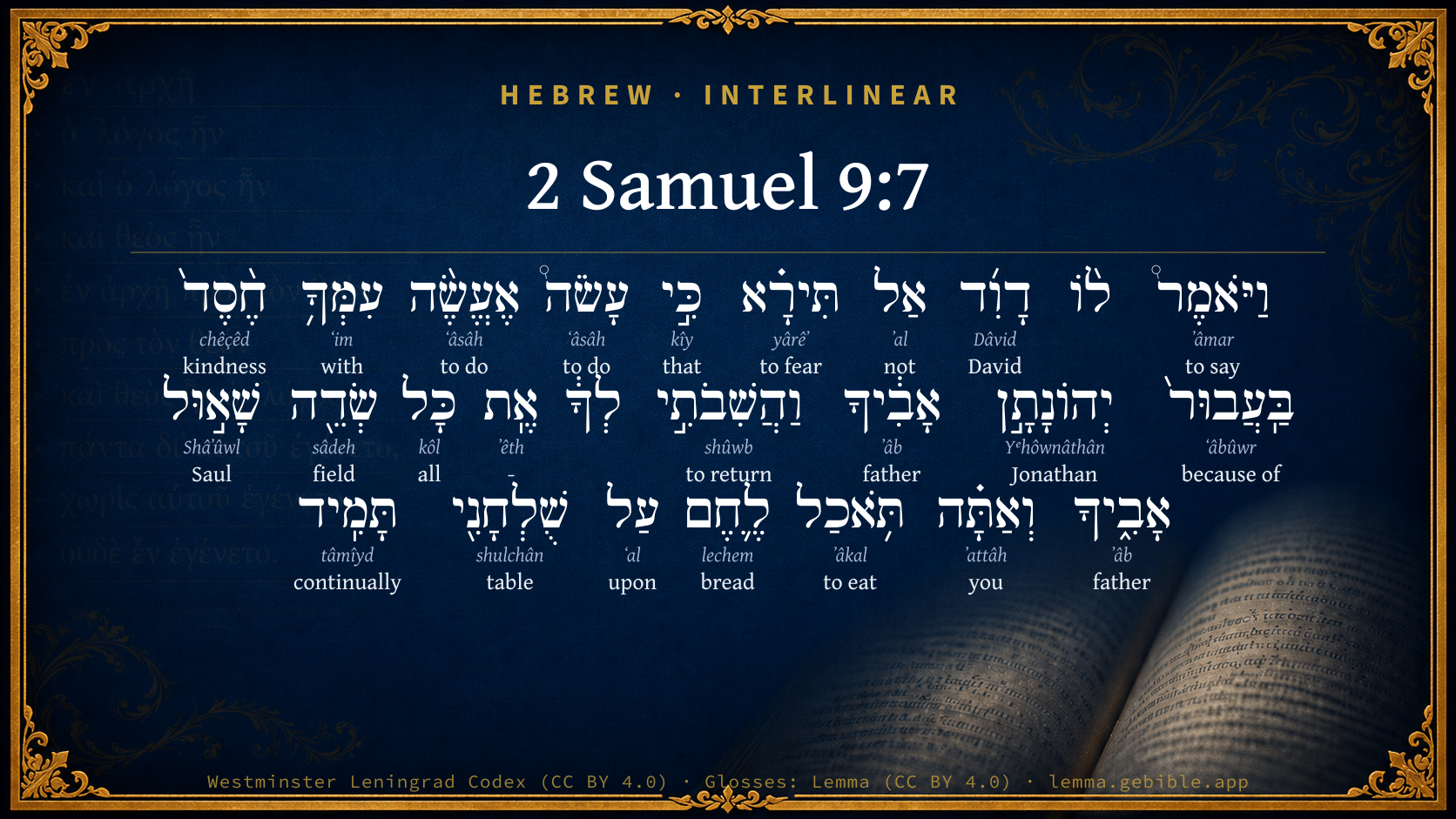
Hebrew (Westminster Leningrad Codex) 2 Samuel 9:7 appears in the Hebrew Old Testament. The text above is from the Westminster Leningrad Codex. Each word links to its Strong’s number, a concise gloss, and parsing drawn from the Open Scriptures Hebrew Bible morphology. Click any word for its full Brown-Driver-Briggs (BDB) entry.
Download image
Cite this verse

2 Samuel 9:7 (World English Bible). Public Domain. Lemma interlinear Bible study tool, https://lemma.gebible.app/v/2-samuel/9/7.

Show BibTeX & RIS
BibTeX
RIS
English Translation
David said to him, "Don't be afraid of him; for I will surely show you kindness for Jonathan your father's sake, and will restore you all the land of Saul your father; and you shall eat bread at my table continually."
World English Bible · Public Domain
Download a study sheet

One document with this verse’s original text, its word-by-word gloss line, the meaning frame, cross-references with their text, attributed commentary, and full source and license credits — printable, and it pastes into notes with its structure intact.

This verse Autodidact and up

Study sheet (.html) Plain text (.txt)

A passage Seminary Student

Up to 50 verses in one chapter. A passage sheet keeps up to 6 commentary sources and 12 cross-references per verse, in the order this page ranks them, and says so on the sheet whenever that leaves anything out. Ask for a single verse and you get the Autodidact verse sheet above.

Everything on this page stays free to read, with no account — the sheet is a download of what is already on screen, not access to it.

Want to remove ads? Support Godless Engineer
Compare translations 3

The same verse in 3 English versions, stacked beneath the original-language interlinear above. Click any original word for its lexicon entry.

Each is an independent rendering of the whole verse — the interlinear is not word-aligned to these translations.

Highlighted words mark where these versions differ — a whole-verse word diff, not a word-by-word alignment.

  • World English Bible Public Domain
    David said to him, "Don't be afraid of him; for I will surely show you kindness for Jonathan your father's sake, and will restore you all the land of Saul your father; and you shall eat bread at my table continually."
  • King James Version Public Domain
    And David said unto him, Fear not: for I will surely show thee kindness for Jonathan thy father's sake, and will restore thee all the land of Saul thy father; and thou shalt eat bread at my table continually.
  • unfoldingWord Literal Text CC BY-SA 4.0
    And David said to him, “Do not fear, for doing, I will do covenant faithfulness with you for the sake of Jonathan your father. And I will restore to you all of the field of Saul your father, and you yourself will eat bread at my table continually.”

unfoldingWord Literal Text — © unfoldingWord, licensed CC BY-SA 4.0. Word-aligned USFM3 via Door43 (git.door43.org/unfoldingWord/en_ult).

Versions to compare (up to 4)

3 of 4 selected

Show all 18 translations

Every available English version of this verse, each an independent rendering of the whole verse.

  • World English Bible Public Domain
    David said to him, "Don't be afraid of him; for I will surely show you kindness for Jonathan your father's sake, and will restore you all the land of Saul your father; and you shall eat bread at my table continually."
  • Berean Standard Bible Public Domain
    “Do not be afraid,” said David, “for surely I will show you kindness for the sake of your father Jonathan. I will restore to you all the land of your grandfather Saul, and you will always eat at my table.”
  • Majority Standard Bible Public Domain
    “Do not be afraid,” said David, “for surely I will show you kindness for the sake of your father Jonathan. I will restore to you all the land of your grandfather Saul, and you will always eat at my table.”
  • King James Version Public Domain
    And David said unto him, Fear not: for I will surely show thee kindness for Jonathan thy father's sake, and will restore thee all the land of Saul thy father; and thou shalt eat bread at my table continually.
  • American Standard Version (1901) Public Domain
    And David said unto him, Fear not; for I will surely show thee kindness for Jonathan thy father's sake, and will restore thee all the land of Saul thy father; and thou shalt eat bread at my table continually.
  • Revised Version (1885) Public Domain
    And David said unto him, Fear not: for I will surely shew thee kindness for Jonathan thy father’s sake, and will restore thee all the land of Saul thy father; and thou shalt eat bread at my table continually.
  • Geneva Bible (1599) Public Domain
    Then Dauid sayd vnto him, Feare not: for I wil surely shewe thee kindnes for Ionathan thy fathers sake, and will restore thee all the fieldes of Saul thy father, and thou shalt eate bread at my table continually.
  • Douay-Rheims (1899) Public Domain
    And David said to him: Fear not, for I will surely shew thee mercy for Jonathan thy father's sake, and I will restore the lands of Saul thy father, and thou shalt eat bread at my table always.
  • Young's Literal Translation Public Domain
    And David saith to him, `Be not afraid; for I certainly do with thee kindness because of Jonathan thy father, and have given back to thee all the field of Saul thy father, and thou dost eat bread at my table continually.'
  • Literal Standard Version CC BY-SA 4.0
    And David says to him, “Do not be afraid; for I certainly do with you kindness because of your father Jonathan, and have given back to you all the field of your father Saul, and you continually eat bread at my table.”
  • Unlocked Literal Bible CC BY-SA 4.0
    David said to him, “Do not be afraid, for I will surely show you kindness for Jonathan your father's sake, and I will restore to you all the land of Saul your grandfather, and you will always eat at my table.”
  • unfoldingWord Literal Text CC BY-SA 4.0
    And David said to him, “Do not fear, for doing, I will do covenant faithfulness with you for the sake of Jonathan your father. And I will restore to you all of the field of Saul your father, and you yourself will eat bread at my table continually.”
  • Darby Bible Public Domain
    And David said to him, Fear not; for I will certainly shew thee kindness for Jonathan thy father's sake, and will restore thee all the land of Saul thy father; and thou shalt eat bread at my table continually.
  • World Messianic Bible Public Domain
    David said to him, “Don’t be afraid, for I will surely show you kindness for Jonathan your father’s sake, and will restore to you all the land of Saul your father. You will eat bread at my table continually.”
  • Webster's Bible Public Domain
    And David said to him, Fear not: for I will surely show thee kindness for the sake of Jonathan thy father, and will restore thee all the land of Saul thy father; and thou shalt eat bread at my table continually.
  • Free Bible Version CC BY-SA 4.0
    “Do not be afraid,” said David, “for I will truly be kind to you for the sake of your father Jonathan. I will return to you all the land owned by your grandfather Saul, and you will always eat at my table.”
  • Bible in Basic English Public Domain
    And David said to him, Have no fear: for truly I will be good to you, because of your father Jonathan, and I will give back to you all the land which was Saul's; and you will have a place at my table at all times.
  • JPS Tanakh (1917) Public Domain
    And David said unto him: 'Fear not; for I will surely show thee kindness for Jonathan thy father's sake, and will restore thee all the land of Saul thy father; and thou shalt eat bread at my table continually.'

Literal Standard Version (2020), Covenant Press — licensed CC BY-SA 4.0. Text via the HelloAO Bible API (eBible.org). Unlocked Literal Bible (unfoldingWord) — licensed CC BY-SA 4.0. Text via the HelloAO Bible API (eBible.org). unfoldingWord Literal Text — © unfoldingWord, licensed CC BY-SA 4.0. Word-aligned USFM3 via Door43 (git.door43.org/unfoldingWord/en_ult). Free Bible Version, Dr. Jonathan Gallagher — licensed CC BY-SA 4.0. Text via the HelloAO Bible API (eBible.org).

Word by word

More ways to search: Search by grammar → Find every occurrence → Compare this word →

Practice this passage: Drill this verse → Learn its vocabulary →

בַּֽעֲבוּר֙
ʻâbûwr
H5668
“in/at · because of of”
Preposition + Noun, Common, Masculine, Singular, Construct
Part of Speech
Preposition + Noun
Type
Common
Gender
Masculine
Number
Singular
State
Construct
Full BDB Definition

Origin: pass part of H5674

TWOT: 1556g

for the sake of, on account of, because of, in order to (preposition) - in order that (conjunction)
  1. וַיֹּאמֶר֩ ʼâmar H559 “and · to say” Conjunction + Verb, Qal, Sequential Imperfect, 3rd Person, Masculine, Singular
  2. דָוִ֜ד Dâvid H1732 “David” Noun, Proper
  3. אַל ʼal H408 “not” Particle, Negative
  4. תִּירָ֗א yârêʼ H3372 “to fear” Verb, Qal, Jussive, 2nd Person, Masculine, Singular
  5. כִּ֣י kîy H3588 “that” Conjunction
  6. עָשֹׂה֩ ʻâsâh H6213 “to do” Verb, Qal, Infinitive Absolute
  7. אֶעֱשֶׂ֨ה ʻâsâh H6213 “to do” Verb, Qal, Imperfect, 1st Person, Common, Singular
  8. עִמְּךָ֥ ʻim H5973 “with · you” Preposition + Suffix, Personal, 2nd Person, Masculine, Singular
  9. חֶ֨סֶד֙ chêçêd H2617 “kindness” Noun, Common, Masculine, Singular, Absolute
  10. יְהוֹנָתָ֣ן Yᵉhôwnâthân H3083 “Jonathan” Noun, Proper
  11. אָבִ֔יךָ ʼâb H1 “father · your” Noun, Common, Masculine, Singular, Construct + Suffix, Personal, 2nd Person, Masculine, Singular
  12. וַהֲשִׁבֹתִ֣י shûwb H7725 “and · to return” Conjunction + Verb, Hiphil, Sequential Perfect, 1st Person, Common, Singular
  13. אֶֽת ʼêth H853 “-” Particle, Direct Object
  14. כָּל kôl H3605 “all of” Noun, Common, Masculine, Singular, Construct
  15. שְׂדֵ֖ה sâdeh H7704 “field of” Noun, Common, Masculine, Singular, Construct
  16. שָׁא֣וּל Shâʼûwl H7586 “Saul” Noun, Proper
  17. אָבִ֑יךָ ʼâb H1 “father · your” Noun, Common, Masculine, Singular, Construct + Suffix, Personal, 2nd Person, Masculine, Singular
  18. וְאַתָּ֗ה ʼattâh H859 “and · you” Conjunction + Pronoun, Personal, 2nd Person, Masculine, Singular
  19. תֹּ֥אכַל ʼâkal H398 “to eat” Verb, Qal, Imperfect, 2nd Person, Masculine, Singular
  20. לֶ֛חֶם lechem H3899 “bread” Noun, Common, Both, Singular, Absolute
  21. עַל ʻal H5921 “upon” Preposition
  22. שֻׁלְחָנִ֖י shulchân H7979 “table · my” Noun, Common, Masculine, Singular, Construct + Suffix, Personal, 1st Person, Common, Singular
  23. תָּמִֽיד tâmîyd H8548 “continually” Noun, Common, Masculine, Singular, Absolute

About this verse

These counts appear in no published source. They are computed here, from the morphology-tagged text and Lemma’s own curated glosses. What Lemma adds →

26
words
22
distinct lemmas
Historical
section

Shared distinctive vocabulary

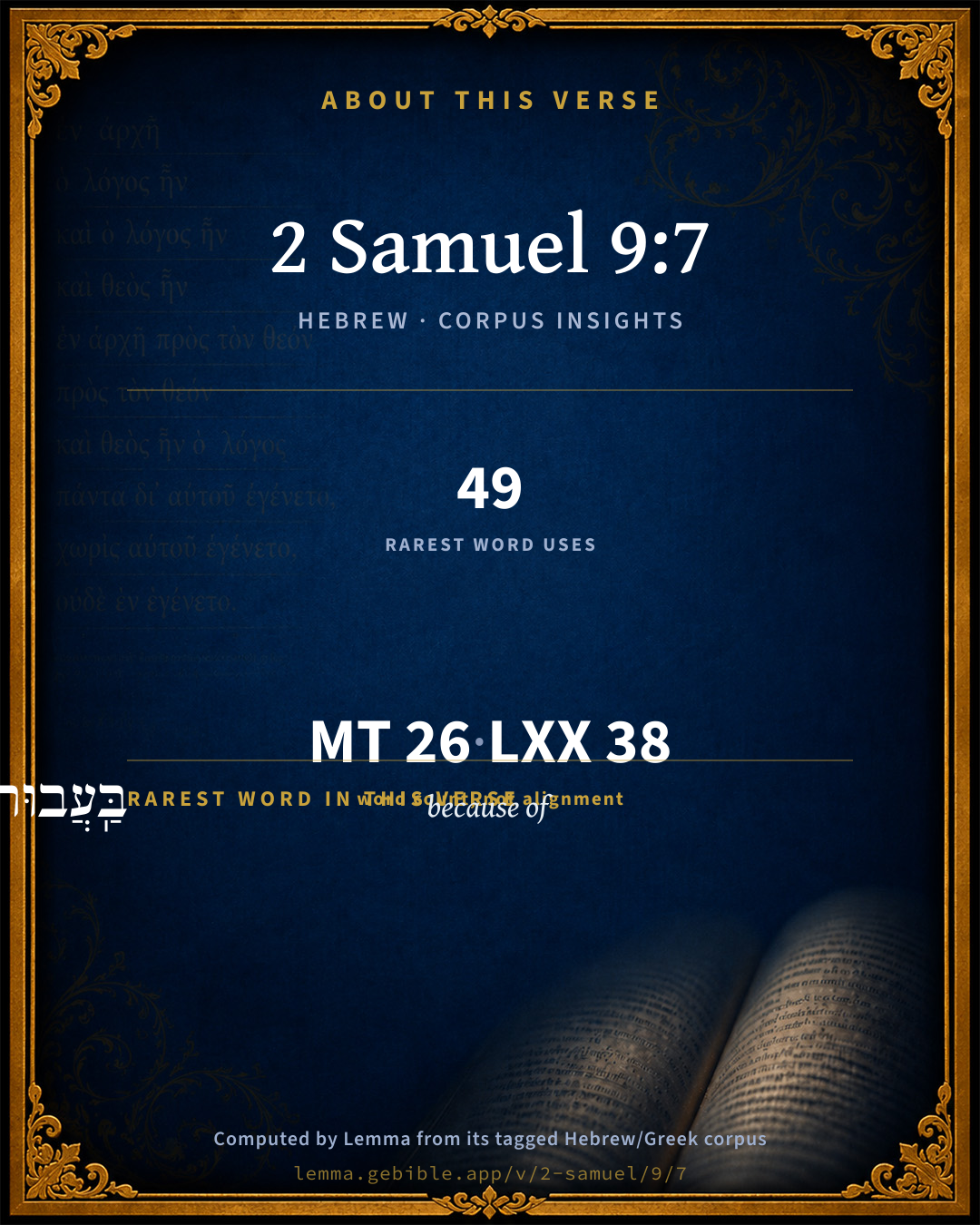
בַּֽעֲבוּר֙ because of H5668 occurs in 47 verses of the Hebrew Bible. Also found in:

Grammatical profile

  • 6 verbs
  • 12 nouns
  • 1 pronoun
  • 4 prepositions
  • 1 conjunction
  • 2 particles

Verb forms

  • וַיֹּאמֶר֩ Qal · Sequential Imperfect
  • תִּירָ֗א Qal · Jussive
  • עָשֹׂה֩ Qal · Infinitive Absolute
  • אֶעֱשֶׂ֨ה Qal · Imperfect
  • וַהֲשִׁבֹתִ֣י Hiphil · Sequential Perfect
  • תֹּ֥אכַל Qal · Imperfect

Repetition

Words recur within this verse — often emphatic in Hebrew:

  • עָשֹׂה֩ to do H6213 ×2
  • אָבִ֔יךָ father H1 ×2

Hebrew & Septuagint length

In English translation the verse runs 41 words from the Hebrew and 47 from the Septuagint (LXX English) — closely comparable.

A rough comparison of the two English renderings, which tokenize alike — not a word-level alignment.

Word counts can differ between the Hebrew and the Greek without any difference in meaning — e.g. the Hebrew direct-object marker אֵת has no separate Greek word, and Greek often adds the article ὁ.

In the original languages it is 26 Hebrew tokens and 38 Greek tokens — but the two are counted differently (Hebrew bundles its prefixes and suffixes into one token; the Greek is in lemma form), so that isn’t a like-for-like length.

Cross-references

24

Topical passages linked to 2 Samuel 9:7 in the Treasury of Scripture Knowledge — connected by theme and wording, ordered by reader-vote popularity; previews shown in the World English Bible.

  • 2 Samuel 9:1 David said, Is there yet any who is left of the house of Saul, that I may show him kindness for Jonathan's sake?
  • 2 Samuel 9:3 The king said, Is there not yet any of the house of Saul, that I may show the kindness of God to him? Ziba said to the king, Jonathan has yet a son, who is lame of his feet.
  • 2 Samuel 19:28 For all my father's house were but dead men before my lord the king; yet you set your servant among those who ate at your own table. What right therefore have I yet that I should cry any more to the king?
  • 1 Kings 2:7 But show kindness to the sons of Barzillai the Gileadite, and let them be of those who eat at your table; for so they came to me when I fled from Absalom your brother.
  • Ruth 2:11–12 Boaz answered her, It has fully been shown me, all that you have done to your mother-in-law since the death of your husband; and how you have left your father and your mother, and the land of your birth, and have come to a people that you didn't know before.
  • Luke 1:29–30 But when she saw him, she was greatly troubled at the saying, and considered what kind of salutation this might be.
  • Luke 22:30 that you may eat and drink at my table in my Kingdom. You will sit on thrones, judging the twelve tribes of Israel."
  • Genesis 50:18–21 His brothers also went and fell down before his face; and they said, "Behold, we are your servants."
  • 2 Kings 25:29 and changed his prison garments. [Jehoiachin] ate bread before him continually all the days of his life:
  • Psalms 41:9 Yes, my own familiar friend, in whom I trusted, Who ate bread with me, Has lifted up his heel against me.
  • Mark 5:33–34 But the woman, fearing and trembling, knowing what had been done to her, came and fell down before him, and told him all the truth.
  • Luke 1:12–13 Zacharias was troubled when he saw him, and fear fell upon him.
  • Genesis 43:23 He said, "Peace be to you. Don't be afraid. Your God, and the God of your father, has given you treasure in your sacks. I received your money." He brought Simeon out to them.
  • 1 Samuel 12:24 Only fear Yahweh, and serve him in truth with all your heart; for consider how great things he has done for you.
  • 2 Samuel 12:8 I gave you your master's house, and your master's wives into your bosom, and gave you the house of Israel and of Judah; and if that would have been too little, I would have added to you many more such things.
  • Isaiah 35:3–4 Strengthen you the weak hands, and confirm the feeble knees.
  • 2 Timothy 1:16–18 May the Lord grant mercy to the house of Onesiphorus, for he often refreshed me, and was not ashamed of my chain,
  • Revelation 3:20 Behold, I stand at the door and knock. If anyone hears my voice and opens the door, then I will come in to him, and will dine with him, and he with me.
  • Genesis 43:18 The men were afraid, because they were brought to Joseph's house; and they said, "Because of the money that was returned in our sacks at the first time are we brought in; that he may seek occasion against us, and fall on us, and take us for bondservants, along with our donkeys."
  • 1 Samuel 12:19–20 All the people said to Samuel, Pray for your servants to Yahweh your God, that we not die; for we have added to all our sins [this] evil, to ask us a king.
  • 2 Samuel 9:11 Then said Ziba to the king, According to all that my lord the king commands his servant, so shall your servant do. As for Mephibosheth, [said the king], he shall eat at my table, as one of the king's sons.
  • 2 Samuel 19:33 The king said to Barzillai, Come you over with me, and I will sustain you with me in Jerusalem.
  • Jeremiah 25:33–34 The slain of Yahweh shall be at that day from one end of the earth even to the other end of the earth: they shall not be lamented, neither gathered, nor buried; they shall be dung on the surface of the ground.
  • Matthew 6:11 Give us today our daily bread.

Cross-references courtesy of OpenBible.info (CC BY 4.0).

Hebrew and Greek witnesses Masoretic Hebrew ↔ Greek Septuagint

The same verse in the two great witnesses to the Old Testament, shown verse-for-verse.

These are two independent witnesses, not word-aligned to each other, and the Septuagint is shown in lemma (dictionary) form.

Hebrew 2 Samuel 9:7 Masoretic · Westminster Leningrad Codex

וַיֹּאמֶר֩ ל֨וֹ דָוִ֜ד אַל תִּירָ֗א כִּ֣י עָשֹׂה֩ אֶעֱשֶׂ֨ה עִמְּךָ֥ חֶ֨סֶד֙ בַּֽעֲבוּר֙ יְהוֹנָתָ֣ן אָבִ֔יךָ וַהֲשִׁבֹתִ֣י לְךָ֔ אֶֽת כָּל שְׂדֵ֖ה שָׁא֣וּל אָבִ֑יךָ וְאַתָּ֗ה תֹּ֥אכַל לֶ֛חֶם עַל שֻׁלְחָנִ֖י תָּמִֽיד

David said to him, "Don't be afraid of him; for I will surely show you kindness for Jonathan your father's sake, and will restore you all the land of Saul your father; and you shall eat bread at my table continually."

World English Bible · Public Domain

Greek LXX 2 Samuel 9:7 Septuagint · lemma form

καί εἶπον αὐτός δαυίδ μή φοβέω ὅτι ποιέω ποιέω μετά σύ ἔλεος διά ιωναθα ὁ πατήρ σύ καί ἀπο καταἵστημι σύ πᾶς ἀγρός σαούλ πατήρ ὁ πατήρ σύ καί σύ ἐσθίω ἄρτος ἐπί ὁ τράπεζα ἐγώ διά πᾶς

And David said to him, Fear not, for I will surely deal mercifully with you for the sake of Jonathan your father, and I will restore to you all the land of Saul the father of your father; and you shall eat bread at my table continually.

LXX2012 (modern English Septuagint) · Public Domain

Hebrew: Westminster Leningrad Codex (CC BY 4.0). Greek: Septuagint (public domain); English from LXX2012 (modern English Septuagint) (Public Domain). How the Septuagint differs from the Hebrew →

Targum (Aramaic paraphrase)

1

The Targum is the ancient Jewish Aramaic paraphrase of the Hebrew Scriptures — an interpretive translation, not the Hebrew text itself. Onkelos (literal) and Pseudo-Jonathan (expansive) render the Torah, and Jonathan the Prophets. Coverage is partial: where no permissively-licensed English translation exists for a verse, only the Aramaic is shown. This is verse-level text, not a word-by-word alignment to the Hebrew.

  1. Targum Jonathan Prophets (Joshua–Malachi)
    וַאֲמַר לֵיהּ דָוִד לָא תִדְחַל אֲרֵי מֶעְבַד אַעְבִּיד עִמָךְ טִיבוּ בְּדִיל יְהוֹנָתָן אֲבוּךְ וְאָתֵיב לָךְ יַת כָּל אַחֲסָנַת שָׁאוּל אֲבוּךְ וְאַתְּ תֵּיכוּל לַחְמָא עַל פְּתוֹרִי תְּדִירָא:

    (no public-domain English translation for this verse)

    Targum Jonathan — Aramaic: “Mikraot Gedolot” (public domain). English: “Sefaria Community Translation” (CC0 1.0 (public-domain dedication)); “London "Chaldee Paraphrase," 1871” (public domain). Text via Sefaria.

Commentary

Notes on 2 Samuel 9:7 from classic Christian and Jewish commentators (each source and its license shown beneath its notes). The classic Christian expositions comment on the surrounding passage and are grouped to its opening verse, so a note may address several verses; the Jewish commentaries on the Tanakh (Rashi and others) are per-verse, so they appear only where the commentator wrote on this verse.

Lemma curates 59 commentaries, every one of them public domain or Creative Commons licensed, each selected and text-cleaned for this edition rather than reprinted as found. About our sources →

Trapp's Complete Commentary

John Trapp

2Sa 9:7 And David said unto him, Fear not: for I will surely shew thee kindness for Jonathan thy father’s sake, and will restore thee all the land of Saul thy father; and thou shalt eat bread at my table continually.

Ver. 7. And David said unto him, Fear not.] Mephi-bosheth feared, belike, that he was sent for to be put to death, as being Saul’s nephew. Kings are not without their jealousies; that Mephi-bosheth well knew, and afterwards smarted for. {2Sa 16:4}

For I will surely show thee kindness.] It would be a great stay of mind if some great man should say to us, as David here doth to Mephibosheth, and as afterwards he did to Barzillai the Gileadite. Behold, God, the only potentate, saith more than all this; and shall we not trust him?

And will restore thee all the land.] Which had been confiscated for Ishbosheth’s rebellion, saith Vatablus.

And thou shalt eat bread at my table continually,] i.e., At fit times; like as we are commanded to pray continually. Here take notice how they that humble themselves are exalted. Mephi-bosheth, who made himself a dog, and therefore fit only to lie under the table; yea, a dead dog, and therefore fit only for the ditch; is raised up to the table of a king.

John Trapp, A Commentary or Exposition upon All the Books of the Old and New Testament (1647–1656) — public domain. Text from a community e-Sword module.

Tyndale Open Study Notes

Tyndale Open Resources

9:7 David had confiscated all the property that had belonged to . . . Saul.

Tyndale Open Study Notes — © Tyndale Open Resources, licensed CC BY-SA 4.0. Text via the HelloAO Bible API.

Geneva Bible (1599)

Geneva Bible translators

Or, lands.

Geneva Bible (1599) marginal notes — public domain. Text via Bolls.life.

Adam Clarke's Commentary

Verse 7. Will restore thee all the land] I believe this means the mere family estate of the house of Kish, which David as king might have retained, but which most certainly belonged, according to the Israelitish law, to the descendants of the family.

And thou shalt eat bread at my table] This was kindness, (the giving up the land was justice,) and it was the highest honour that any subject could enjoy, as we may see from the reference made to it by our Lord, Lu 22:30: That ye may eat and drink at my table in my kingdom. For such a person David could do no more. His lameness rendered him unfit for any public employment.

Adam Clarke's Commentary on the Bible (1810–1826) — public domain. Text from a community e-Sword/MySword module.

The Cambridge Bible for Schools and Colleges

gen. ed. J. J. S. Perowne

7. Fear not] Mephibosheth might be afraid that David had only hunted him out to treat him after the common fashion of Oriental usurpers, who often put all their predecessor’s kindred to death. He seems to have lived in concealment at Lo-debar.

the land of Saul thy father] Saul’s private estate at Gibeah, which passed into David’s possession when he came to the throne (ch. 2Sa_12:8). Father = grandfather, as frequently: so in 2Sa_9:9 son = grandson.

thou shalt eat bread at my table] A common mark of honour in Oriental countries. See 1Ki_2:7; 2Ki_25:29. The physician Democedes, who cured Darius, was made “a member of the king’s table” (ὁμοτράπεζος βασιλέϊ, Herod. III. 132): and Histiaeus of Miletus was invited to come up to Susa, and be Darius’ “mess-companion” (σύσσιτος, Herod, v. 24).

The Cambridge Bible for Schools and Colleges (gen. ed. J. J. S. Perowne; Cambridge University Press, 1878–1918) — public domain. Text from a community e-Sword module.

John Gill's Exposition

And David said unto him, fear not,.... He might observe a dejection in his countenance, a trembling in his limbs, and might discover signs of fear lest David should cut him off, because he was of the seed royal:

for I will surely show thee kindness for Jonathan thy father's sake; whom he loved as his own soul, and to whom he had sworn that he would not cut off his kindness from his house for ever, and now remembering his oath was determined to observe it:

and will restore thee all the land of Saul thy father; his grandfather, such sometimes being called fathers; which David had taken to him, as crown lands, or in the right of his wife; or as being confiscated by Ishbosheth's rebellion:

and thou shall eat bread at my table continually; he gave him an apartment in the court, a place at his table, admitted him to be a guest with him as long as he should live; which was a very great favour and high honour, and showed what an unshaken friendship he had for his father, and would maintain with him. This was the kindness of God he meant to show to him.

John Gill's Exposition of the Whole Bible (1746–1763) — public domain (CC PDM 1.0). Text via the HelloAO Bible API.

Haydock's Catholic Bible Commentary

Father, or grandfather. (Haydock) --- It is thought that all his goods had been confiscated, in consequence of Isboseth’s assuming the regal dignity. (Calmet) --- David might give the property to whom he pleased. (Menochius) --- Always. This was a mark of the greatest distinction, Luke xxii. 30. The Romans sometimes made their slaves free, in this manner, per mensam. (Calmet)

George Leo Haydock (1774–1849), Haydock's Catholic Family Bible and Commentary, 1859 edition — public domain. Excludes Psalms (Douay-Rheims chapter numbering differs from Protestant) and Deuterocanonical books (Catholic canon only).

Matthew Poole's English Annotations

All the land of Saul is now seized and possessed by David, as due to him, either in right of his wife, to whom the inheritance was devolved, Saul’s sons by his wives being all dead; see Num 27:8; or by Divine donation, as belonging to the crown which God had now given him; or by forfeiture, because of Ish-bosheth’s rebellion against his lord and king.

Matthew Poole's English Annotations on the Holy Bible (1683–1685) — public domain. Text from a community e-Sword/MySword module.

Whedon's Commentary on the Bible

Daniel D. Whedon

7. Restore thee all the land of Saul — The private estate of Saul is doubtless meant, comprising both what fell to him by inheritance from Kish, and what he had himself acquired. “The landed property belonging to Saul had either fallen to David as crown lands, or had been taken possession of by distant relations after the death of Saul.” — Keil.

Eat bread at my table — Be a royal courtier, and receive the treatment and familiarity of a member of the royal family.

Daniel D. Whedon (gen. ed.), Commentary on the Old and New Testaments (1874–1909) — public domain. Text from a community e-Sword module.

The Pulpit Commentary

All the land of Saul thy father. David probably restored to Mephibosheth not only the lands at Gibeah, which Ziba had managed to hold, but Saul"s estates generally. There seems, nevertheless, to have been on Ziba"s part a grudge against Mephibosheth for thus getting back from the king what he had hoped to keep as his own. The privilege of being the king"s friend, and eating at his table, was an honour that would be more highly prized than even the possession of the estates.

The Pulpit Commentary (1880–1919), ed. H.D.M. Spence-Jones & Joseph S. Exell — public domain. Text from a community e-Sword module.

unfoldingWord translationNotes

Door43 World Missions Community

for Jonathan your father's sake

"because I loved your father, Jonathan"

you will always eat at my table

Here "my table" represents being together with David or in his presence. Eating with the king at his table was a great honor. AT: "you will always eat with me" (See: Metonymy)

What is your servant, that you should look with favor on such a dead dog as I am?

This rhetorical question shows that Mephibosheth understands that he is not important enough for the king to take care of him. This can be translated as a statement. AT: "I am like a dead dog. I do not deserve for you to be kind to me." (See: Rhetorical Question)

such a dead dog

Here Mephibosheth represents the line of Saul, and he compares himself to a "dead dog." Dogs were feral animals, not cared for, and of little importance. A dead dog would be considered even less important. AT: "such a person like me who is worthless as a dead dog" (See: Metaphor)

translationWords

fear

restore

favor

die

unfoldingWord translationNotes — © Distant Shores Media and the Door43 World Missions Community, licensed CC BY-SA 4.0. Source: git.door43.org/Door43/en_tn.

Lesson kit

Teaching starters — assembled from the data on this page, not authored interpretation. Every prompt links to the verse data it draws on. Edit before teaching.

2 Samuel, in the Historical, opens this verse with 26 words (22 distinct Hebrew lemmas). Its most distinctive word is ʻâbûwr (“because of”). A historical commentator’s framing appears above. Read the whole chapter for the surrounding context.

Discussion questions

  1. The word ʻâbûwr carries the sense “because of.” How does it shape the verse?
  2. How does Genesis 3:17, which shares the word «because of», read alongside this verse?
  3. What does the repetition of “to do” (2× in this one verse) do in this verse?
  4. The translations on this page render this verse differently — a whole-verse word diff, not a word-by-word alignment. What might account for the different wordings?
  5. «וַיֹּאמֶר֩» is a Qal Sequential Imperfect verb. How does that grammatical form shape the action described?
  6. Compare how Trapp's Complete Commentary and Tyndale Open Study Notes read this verse. Where do they agree or differ?

Things to notice

Reading settings

Reading text

Shown beneath each verse's original-language words.

Old Testament
Old Testament edition

Read the OT as the Masoretic Hebrew (MT) or the Greek Septuagint (LXX).

English shown for the Greek Septuagint (in the Hebrew ↔ Greek comparison).

Comparing translations? Open the Compare panel on any verse page to stack up to four side by side.