
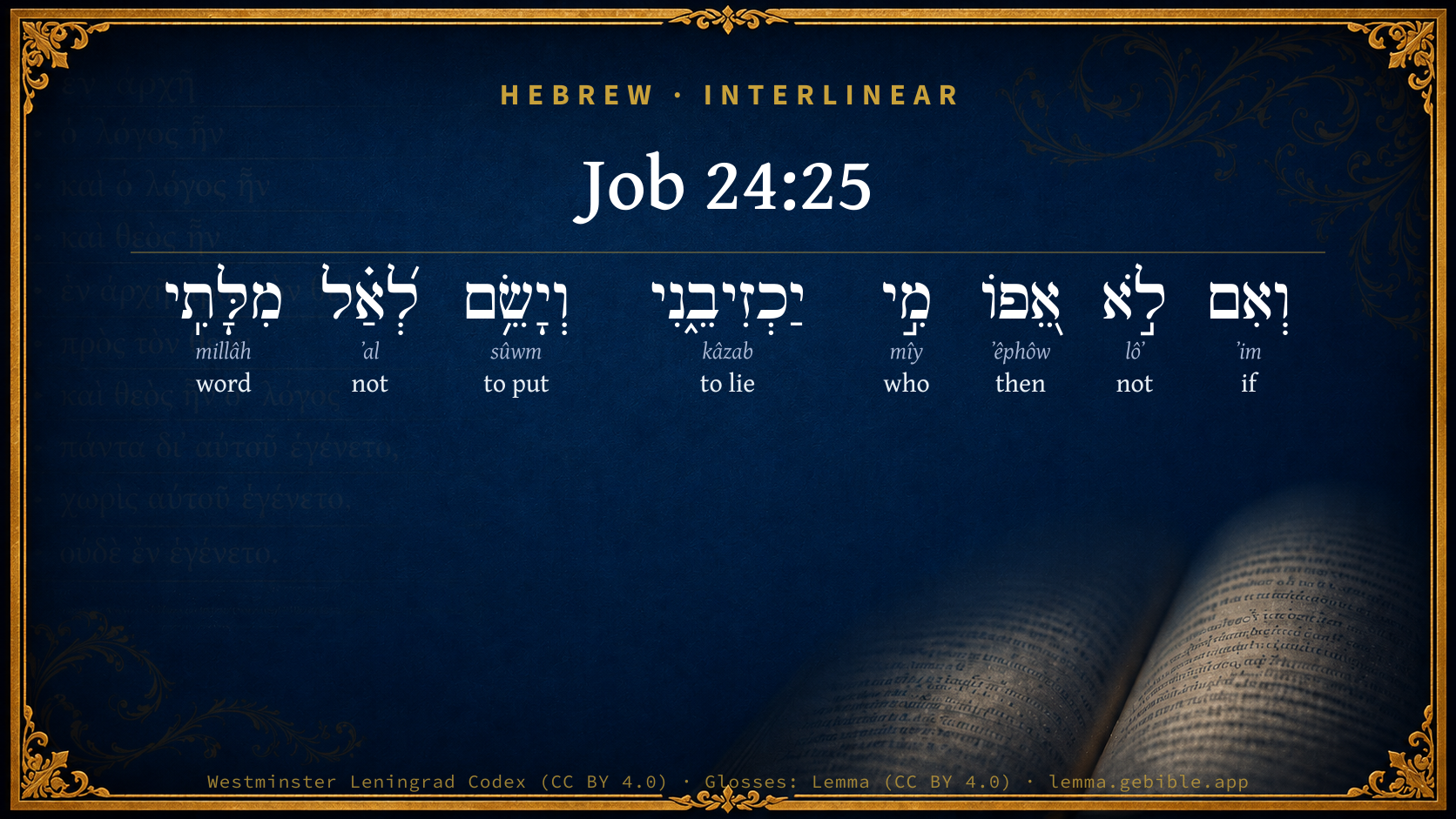
Job 24:25

Hebrew (Westminster Leningrad Codex) Job 24:25 appears in the Hebrew Old Testament. The text above is from the Westminster Leningrad Codex. Each word links to its Strong’s number, a concise gloss, and parsing drawn from the Open Scriptures Hebrew Bible morphology. Click any word for its full Brown-Driver-Briggs (BDB) entry.
Download image
Cite this verse

Job 24:25 (World English Bible). Public Domain. Lemma interlinear Bible study tool, https://lemma.gebible.app/v/job/24/25.

Show BibTeX & RIS
BibTeX
RIS
English Translation
If it isn't so now, who will prove me a liar, And make my speech worth nothing?"
World English Bible · Public Domain
Download a study sheet

One document with this verse’s original text, its word-by-word gloss line, the meaning frame, cross-references with their text, attributed commentary, and full source and license credits — printable, and it pastes into notes with its structure intact.

This verse Autodidact and up

Study sheet (.html) Plain text (.txt)

A passage Seminary Student

Up to 50 verses in one chapter. A passage sheet keeps up to 6 commentary sources and 12 cross-references per verse, in the order this page ranks them, and says so on the sheet whenever that leaves anything out. Ask for a single verse and you get the Autodidact verse sheet above.

Everything on this page stays free to read, with no account — the sheet is a download of what is already on screen, not access to it.

Want to remove ads? Support Godless Engineer
Compare translations 3

The same verse in 3 English versions, stacked beneath the original-language interlinear above. Click any original word for its lexicon entry.

Each is an independent rendering of the whole verse — the interlinear is not word-aligned to these translations.

Highlighted words mark where these versions differ — a whole-verse word diff, not a word-by-word alignment.

  • World English Bible Public Domain
    If it isn't so now, who will prove me a liar, And make my speech worth nothing?"
  • King James Version Public Domain
    And if it be not so now, who will make me a liar, and make my speech nothing worth?
  • unfoldingWord Literal Text CC BY-SA 4.0
    And if not, then who will falsify me and make my word nothing?”

unfoldingWord Literal Text — © unfoldingWord, licensed CC BY-SA 4.0. Word-aligned USFM3 via Door43 (git.door43.org/unfoldingWord/en_ult).

Versions to compare (up to 4)

3 of 4 selected

Show all 18 translations

Every available English version of this verse, each an independent rendering of the whole verse.

  • World English Bible Public Domain
    If it isn't so now, who will prove me a liar, And make my speech worth nothing?"
  • Berean Standard Bible Public Domain
    If this is not so, then who can prove me a liar and reduce my words to nothing?”
  • Majority Standard Bible Public Domain
    If this is not so, then who can prove me a liar and reduce my words to nothing?”
  • King James Version Public Domain
    And if it be not so now, who will make me a liar, and make my speech nothing worth?
  • American Standard Version (1901) Public Domain
    And if it be not so now, who will prove me a liar, And make my speech nothing worth?
  • Revised Version (1885) Public Domain
    And if it be not so now, who will prove me a liar, and make my speech nothing worth?
  • Geneva Bible (1599) Public Domain
    But if it be not so, where is he? or who wil proue me a lyer, and make my words of no value?
  • Douay-Rheims (1899) Public Domain
    And if it be not so, who can convince me that I have lied, and set my words before God?
  • Young's Literal Translation Public Domain
    And if not now, who doth prove me a liar, And doth make of nothing my word?
  • Literal Standard Version CC BY-SA 4.0
    And if not now, who proves me a liar, || And makes my word of nothing?”
  • Unlocked Literal Bible CC BY-SA 4.0
    If it is not so, who can prove me to be a liar; who can make my speech worth nothing?”
  • unfoldingWord Literal Text CC BY-SA 4.0
    And if not, then who will falsify me and make my word nothing?”
  • Darby Bible Public Domain
    If it be not so now, who will make me a liar, and make my speech nothing worth?
  • World Messianic Bible Public Domain
    If it isn’t so now, who will prove me a liar, and make my speech worth nothing?”
  • Webster's Bible Public Domain
    And if it is not so now, who will make me a liar, and make my speech of no worth?
  • Free Bible Version CC BY-SA 4.0
    If this isn't so, who can prove I'm a liar and there's nothing to what I say?”
  • Bible in Basic English Public Domain
    And if it is not so, now, who will make it clear that my words are false, and that what I say is of no value?
  • JPS Tanakh (1917) Public Domain
    And if it be not so now, who will prove me a liar, and make my speech nothing worth?

Literal Standard Version (2020), Covenant Press — licensed CC BY-SA 4.0. Text via the HelloAO Bible API (eBible.org). Unlocked Literal Bible (unfoldingWord) — licensed CC BY-SA 4.0. Text via the HelloAO Bible API (eBible.org). unfoldingWord Literal Text — © unfoldingWord, licensed CC BY-SA 4.0. Word-aligned USFM3 via Door43 (git.door43.org/unfoldingWord/en_ult). Free Bible Version, Dr. Jonathan Gallagher — licensed CC BY-SA 4.0. Text via the HelloAO Bible API (eBible.org).

Word by word

More ways to search: Search by grammar → Find every occurrence → Compare this word →

Practice this passage: Drill this verse → Learn its vocabulary →

About this verse

These counts appear in no published source. They are computed here, from the morphology-tagged text and Lemma’s own curated glosses. What Lemma adds →

8
words
8
distinct lemmas
Wisdom
section

Notable vocabulary

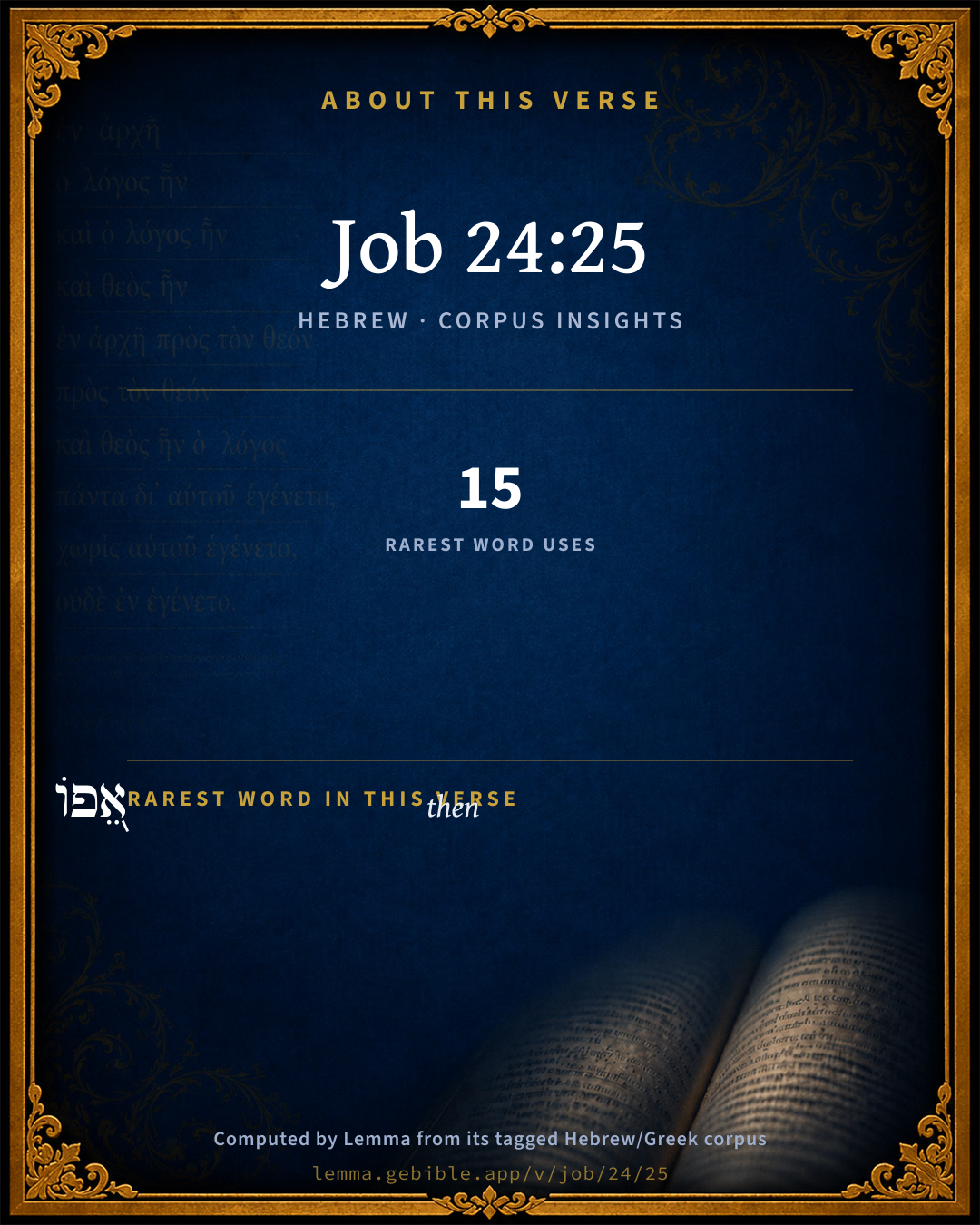
The rarest word here is אֵ֭פוֹ then H645 — appearing just 15 times in the whole Hebrew Bible.

Shared distinctive vocabulary

אֵ֭פוֹ then H645 occurs in 15 verses of the Hebrew Bible. Also found in:

Grammatical profile

  • 2 verbs
  • 1 noun
  • 1 conjunction
  • 1 adverb
  • 3 particles

Verb forms

  • יַכְזִיבֵ֑נִי Hiphil · Imperfect
  • וְיָשֵׂ֥ם Qal · Jussive

Hebrew & Septuagint length

In English translation the verse runs 17 words from the Hebrew and 19 from the Septuagint (LXX English) — closely comparable.

A rough comparison of the two English renderings, which tokenize alike — not a word-level alignment.

Word counts can differ between the Hebrew and the Greek without any difference in meaning — e.g. the Hebrew direct-object marker אֵת has no separate Greek word, and Greek often adds the article ὁ.

Cross-references

5

Topical passages linked to Job 24:25 in the Treasury of Scripture Knowledge — connected by theme and wording, ordered by reader-vote popularity; previews shown in the World English Bible.

  • Job 9:24 The earth is given into the hand of the wicked. He covers the faces of the judges of it. If not he, then who is it?
  • Job 6:28 Now therefore be pleased to look at me, For surely I shall not lie to your face.
  • Job 11:2–3 "Shouldn't the multitude of words be answered? Should a man full of talk be justified?
  • Job 27:4 Surely my lips shall not speak unrighteousness, Neither shall my tongue utter deceit.
  • Job 15:2 "Should a wise man answer with vain knowledge, And fill himself with the east wind?

Cross-references courtesy of OpenBible.info (CC BY 4.0).

Hebrew and Greek witnesses Masoretic Hebrew ↔ Greek Septuagint

The same verse in the two great witnesses to the Old Testament, shown verse-for-verse.

These are two independent witnesses, not word-aligned to each other, and the Septuagint is shown in lemma (dictionary) form.

Hebrew Job 24:25 Masoretic · Westminster Leningrad Codex

וְאִם לֹ֣א אֵ֭פוֹ מִ֣י יַכְזִיבֵ֑נִי וְיָשֵׂ֥ם לְ֝אַ֗ל מִלָּתִֽי

If it isn't so now, who will prove me a liar, And make my speech worth nothing?"

World English Bible · Public Domain

Greek LXX Job 24:25 Septuagint · lemma form

εἰ δέ μή τίς εἰμί ὁ φημί ψευδής ἐγώ λέγω καί τίθημι εἰς οὐδείς ὁ ῥῆμα ἐγώ

But if not, who is he that says I speak falsely, and will make my words of no account?

LXX2012 (modern English Septuagint) · Public Domain

On this verse, Haydock's Catholic Bible Commentary discusses the Septuagint’s reading. Read the note in Commentary ↓

Hebrew: Westminster Leningrad Codex (CC BY 4.0). Greek: Septuagint (public domain); English from LXX2012 (modern English Septuagint) (Public Domain). How the Septuagint differs from the Hebrew →

Commentary

Notes on Job 24:25 from classic Christian and Jewish commentators (each source and its license shown beneath its notes). The classic Christian expositions comment on the surrounding passage and are grouped to its opening verse, so a note may address several verses; the Jewish commentaries on the Tanakh (Rashi and others) are per-verse, so they appear only where the commentator wrote on this verse.

Lemma curates 59 commentaries, every one of them public domain or Creative Commons licensed, each selected and text-cleaned for this edition rather than reprinted as found. About our sources →

Trapp's Complete Commentary

John Trapp

Job 24:25 And if [it be] not [so] now, who will make me a liar, and make my speech nothing worth?

Ver. 25. And if it be not so now, who will make me a liar?] Quis ementietur me? Who shall disprove or confute what I have affirmed? viz. That God doth many things, the depth whereof we cannot fathom, and that he let wicked men many times spend their days in pleasure, and end them without pain. This I will abide by, and I would fain see the man, qui ausit et possit, who can and will maintain the contrary.

John Trapp, A Commentary or Exposition upon All the Books of the Old and New Testament (1647–1656) — public domain. Text from a community e-Sword module.

Joseph Benson's Commentary

Job 24:25. And if it be not so now — Namely, as I have discoursed; if God does not often suffer wicked men to live long and prosperously in the world, before he punishes them; and if good men be not sometimes sorely afflicted here; if all things do not fall alike to all men in these matters; and if it do not from hence follow, that I am unjustly injured and condemned: who will make me a liar? Or, as Sol. Jarchi interprets the words, Let one of you come and make me a liar, and make my speech nothing worth — Let them that can undertake to prove that my discourse is either false in itself, and then they prove me a liar; or foreign, and nothing to the purpose, and then they prove it frivolous and nothing worth. That, indeed, which is false is nothing worth: where there is not truth, how can there be goodness? But they that speak the words of truth and soberness, need not fear having what they say brought to the test, but can cheerfully submit it to a fair examination, as Job here submits what he had spoken.

Joseph Benson's Commentary on the Old and New Testaments (1811–1818) — public domain. Text from a community e-Sword module.

Geneva Bible (1599)

Geneva Bible translators

That is, that contrary to your reasoning no man can give perfect reasons of God’s judgments, let me be reproved.

Geneva Bible (1599) marginal notes — public domain. Text via Bolls.life.

Jamieson, Fausset & Brown

Robert Jamieson, A. R. Fausset & David Brown

(So Job 9:24).

He tries to show Job's rashness (Job 23:3), by arguments borrowed from Eliphaz (Job 15:15, with which compare Job 11:17.

Next: Job Chapter 25

Jamieson, Fausset & Brown — Commentary Critical and Explanatory on the Whole Bible (1871) — public domain (CC PDM 1.0). Text via the HelloAO Bible API.

Adam Clarke's Commentary

Verse 25. And if it be not so now] Job has proved by examples that the righteous are often oppressed; that the wicked often triumph over the just, that the impious are always wretched even in the midst of their greatest prosperity; and he defies his friends to show one flaw in his argument, or an error in his illustration of it; and that existing facts are farther proofs of what he has advanced.

IN the preceding chapters we find Job's friends having continual recourse to this assertion, which it is the grand object of all their discourses to prove, viz., The righteous are so distinguished in the approbation of God, that they live always in prosperity, and die in peace.

On the other hand, Job contends that the dispensations of Providence are by no means thus equal in this life; that experience shows that the righteous are often in adversity, and the wicked in power and prosperity.

Job's friends had also endeavoured to prove that if a reported good man fell into adversity, it was a proof that his character had been mistaken, that he was an internal sinner and hypocrite; and that God, by these manifest proofs of his disapprobation, unmasked him. Hence they charged Job with hypocrisy and secret sins, because he was now suffering adversity, and that his sins must be of the most heinous nature, because his afflictions were uncommonly great. This Job repels by appeals to numerous facts where there was nothing equivocal in the character; where the bad was demonstrably bad, and yet in prosperity; and the good demonstrably good, and yet in adversity. It is strange that none of these could hit on a middle way: viz., The wicked may be in prosperity, but he is ever miserable in his soul: the righteous may be in adversity, but he is ever happy in his God. In these respects, God's ways are always equal.

On Job 24:14, I have referred to the case of unfortunate men who, falling into adversity, madly have recourse to plunder to restore their ruined circumstances. The following anecdote is told of the justly celebrated Dr. Sharp, archbishop of York, the grandfather of that highly benevolent, useful, learned, and eminent man, Granville Sharp, Esq., with whom I had for several years the honour of a personal acquaintance.

"Never was any man, as well by the tenderness of his nature as by the impulse of religion, better disposed to succour the distressed, and relieve the necessities of the poor; to which merciful offices he had so strong an inclination that no reasonable solicitations were ever in danger of meeting with a repulse. Nay, he was more prone to seek out proper objects of his bounty, than to reject them when recommended; and so far was his charity from any suspicion of being extorted by importunity, that it appeared rather a delight than uneasiness to him to extend his liberality upon all proper occasions."

For the same reason, a singular anecdote of the archbishop, related in the London Chronicle of Aug. 13, 1785, and always credited by his family, may be thought worth preserving.

"It was his lordship's custom to have a saddle-horse attend his carriage, that in case of fatigue from sitting, he might take the refreshment of a ride. As he was thus going to his episcopal residence, and was got a mile or two before his carriage, a decent, well-looking young man came up with him; and, with a trembling hand and a faltering tongue presented a pistol to his lordship's breast, and demanded his money. The archbishop, with great composure, turned about; and, looking steadfastly at him, desired he would remove that dangerous weapon, and tell him fairly his condition. 'Sir! sir!' with great agitation, cried the youth; 'no words, 'tis not a time; your money instantly.' 'Hear me, young man,' said the archbishop; 'you see I am an old man, and my life is of very little consequence: yours seems far otherwise. I am named Sharp, and am archbishop of York; my carriage and servants are behind. Tell me what money you want, and who you are, and I will not injure you, but prove a friend. Here, take this; and now ingenuously tell me how much you want to make you independent of so destructive a business as you are now engaged in.' 'O sir,' replied the man, 'I detest the business as much as you. I am-but-but-at home there are creditors who will not stay - fifty pounds, my lord, indeed would do what no tongue besides my own can tell.' 'Well, sir, I take it on your word; and, upon my honour, if you will, in a day or two, call on me at ___, what I have now given you shall be made up that sum.' The highwayman looked at him, was silent, and went off; and, at the time appointed, actually waited on the archbishop, and assured his lordship his words had left impressions which nothing could ever destroy.

"Nothing more transpired for a year and a half or more; when one morning a person knocked at his grace's gate, and with peculiar earnestness desired to see him. The archbishop ordered the stranger to be brought in. He entered the room where his lordship was, but had scarce advanced a few steps before his countenance changed, his knees tottered, and he sank almost breathless on the floor. On recovering, he requested an audience in private. The apartment being cleared, 'My lord,' said he, 'you cannot have forgotten the circumstances at such a time and place; gratitude will never suffer them to be obliterated from my mind. In me, my lord, you now behold that once most wretched of mankind; but now, by your inexpressible humanity, rendered equal, perhaps superior, in happiness to millions. O, my lord!' tears for a while preventing his utterance, ''tis you, 'tis you that have saved me, body and soul; 'tis you that have saved a dear and much-loved wife, and a little brood of children, whom I tendered dearer than my life. Here are the fifty pounds; but never shall I find language to testify what I feel. Your God is your witness; your deed itself is your glory; and may heaven and all its blessings be your present and everlasting reward! I was the younger son of a wealthy man; your lordship knows him; his name was ___. My marriage alienated his affection; and my brother withdrew his love, and left me to sorrow and penury. A month since my brother died a bachelor and intestate. What was his, is become mine; and by your astonishing goodness, I am now at once the most penitent, the most grateful, and happiest of my species.'"

See Prince Hoar's life of Granville Sharp, Esq., page 13.

I have no doubt there have been several cases of a similar kind, when the first step in delinquency was urged by necessity; but few of such wretched adventurers have met with an Archhishop Sharp. An early and pious education is the only means under God to prevent such dangerous steps, which generally lead to the most fearful catastrophe. Teach a child, that whom God loveth he chasteneth. Teach him, that God suffers men to hunger, and be in want, that he may try them if they will be faithful, and do them good in their latter end. Teach him, that he who patiently and meekly bears providential afflictions, shall be relieved and exalted in due time. Teach him, that it is no sin to die in the most abject poverty and affliction, brought on in the course of Divine providence, but that any attempts to alter his condition by robbery, knavery, cozening, and fraud, will be distinguished with heavy curses from the Almighty, and necessarily end in perdition and ruin. A child thus educated is not likely to abandon himself to unlawful courses.

Adam Clarke's Commentary on the Bible (1810–1826) — public domain. Text from a community e-Sword/MySword module.

Ellicott's Commentary for English Readers

(25) And if it be not so now.—Job also has his facts, as ready and as incontrovertible as those of his friends, and yet irreconcilable with theirs.

A Bible Commentary for English Readers, edited by Charles John Ellicott (1878–1897) — public domain. Text from a community e-Sword module.

The Cambridge Bible for Schools and Colleges

gen. ed. J. J. S. Perowne

25. Job alas! is only too sure of his facts, and conscious that he has history and experience at his back he victoriously exclaims, Who will make me a liar?

Job has gained his victory over his friends, but he has received, or rather inflicted on himself, an almost mortal wound in achieving it. He has shewn that God’s rule of the world is not just, in the sense in which the friends insisted that it was just, and in the sense in which his own moral feeling demanded that it should be just. God is not righteous, in the sense that he punishes wickedness with outward calamity and rewards the righteous with outward good. So far the three friends are defeated, and with their defeat on the general question their inferences from Job’s calamities as to his guilt fall to the ground. To this extent Job has gained a victory. But his victory, if it secures the possibility of his own innocence, leaves to his mind a God whom he believes to be unrighteous. For his view of what could be called “righteousness” in the Ruler of the world coincides entirely with the view of his friends.

The Cambridge Bible for Schools and Colleges (gen. ed. J. J. S. Perowne; Cambridge University Press, 1878–1918) — public domain. Text from a community e-Sword module.

John Gill's Exposition

And if it be not so now,.... If this is not the case of men of such wicked lives as above described, do not prosper in the world, and increase in riches, and do not pass through the world with impunity, and die quietly, in the full possession of their honour and wealth:

who will make me a liar? where is the man? let him stand forth and appear, and disprove what has been said, and make out the doctrine delivered to be false doctrine, and a lie; for no lie is of the truth:

and make my speech nothing worth; vain, useless, and unprofitable; truth is valuable, like gold, silver and precious stones; but error is as wood, hay, and stubble, and nothing worth, yea, to be detested and rejected: or let him make what I have said to stand "for nothing" (l); let him show, if he can, that it is impertinent, and not to the purpose, that it does not prove the point for which it is brought: thus Job was willing to have what he had said tried by every method that could be made use of, that it might appear whether what he had said was true or false, worthy to be regarded, or worthless; and he here bids defiance to his friends, or to any other, and triumphs over them, as having gained his point; and, as it appears by the sequel, he had, at least in a great measure, and however with respect to this matter, that good men are afflicted in this life, and wicked men prosper; of which there are many instances,

(l) "ad nihilum", Pagninus, Montanus; so Junius & Tremellius, Piscator, Mercerus, Cocceius, Michaelis, Schultens.

Next: Job Chapter 25

John Gill's Exposition of the Whole Bible (1746–1763) — public domain (CC PDM 1.0). Text via the HelloAO Bible API.

Albert Barnes' Notes on the Bible

And if it be not so now, who will make me a liar? - A challenge to anyone to prove the contrary to what he had said. Job had now attacked their main position, and had appealed to facts in defense of what he held. He maintained that, as a matter of fact, the wicked were prospered, that they often lived to old age, and that they then died a peaceful death, without any direct demonstration of the divine displeasure. He boldly appeals, now, to anyone to deny this, or to prove the contrary. The appeal was decisive. The fact was undeniable, and the controversy was closed. Bildad Job 25:1-6 attempts a brief reply, but he does not touch the question about the facts to which Job had appealed, but utters a few vague and irrelevant proverbial maxims, about the greatness of God, and is silent. His proverbs appear to be exhausted, and the theory which he and his friends had so carefully built up, and in which they had been so confident, was now overthrown. Perhaps this was one design of the Holy Spirit, in recording the argument thus far conducted, to show that the theory of the divine administration, which had been built up with so much care, and which was sustained by so many proverbial maxims, was false. The overthrow of this theory was of sufficient importance to justify this protracted argument, because:

(1) it was and is of the highest importance that correct views should prevail of the nature of the divine administration; and

(2) it is of special importance in comforting the afflicted people of God.

Job had experienced great aggravation, in his sufferings, from the position which his friends had maintained, and from the arguments which they had been able to adduce, to prove that his sufferings were proof that he was a hypocrite. But it is worth all which it has cost; all the experience of the afflicted friends of God, and all the pains taken to reveal it, to show that affliction is no certain proof of the divine displeasure, and that important ends may be accomplished by means of trial.

Albert Barnes' Notes on the Bible (1834–1885) — public domain. Text from a community e-Sword/MySword module.

Haydock's Catholic Bible Commentary

And set. Septuagint and Protestants, "and make my speech nothing worth." (Haydock) --- This conclusion come frequently, chap. ix. 15., and xvii. 15. Job defies his friends to shew the fallacy of his arguments, or that the wicked do not enjoy prosperity, though they may be inwardly miserable. (Calmet)

George Leo Haydock (1774–1849), Haydock's Catholic Family Bible and Commentary, 1859 edition — public domain. Excludes Psalms (Douay-Rheims chapter numbering differs from Protestant) and Deuterocanonical books (Catholic canon only).

Matthew Poole's English Annotations

If it be not so now, to wit, as I have discoursed; if God doth not suffer wicked men to live long and prosperously in the world before he punisheth them; and if good men be not sometimes sorely afflicted there, if all things do not fall alike to all men in these matters.

Matthew Poole's English Annotations on the Holy Bible (1683–1685) — public domain. Text from a community e-Sword/MySword module.

The Pulpit Commentary

And if it be not so now; i.e. "if these things be not as I say." Who will make me a liar? Which of you will stand forth and disprove them, and so "make me a liar"? And make my speech nothing worth! Show, i.e. , my whole discourse to be valueless. This bold challenge no one attempts to take up.

The Pulpit Commentary (1880–1919), ed. H.D.M. Spence-Jones & Joseph S. Exell — public domain. Text from a community e-Sword module.

Rashi

Rabbi Shlomo Yitzchaki (Rashi)

And if it is not so, then [If it is not] as I said, let one of you come and prove me a liar.

and make my words as nought [That is, my words] with which I criticize Him to know His standards, that He is slow to anger with the wicked, but He chastises those who love Him as I do, and He does not put them to death, as he complains above (23:17): “Because I was not cut off from before the darkness,” but those who remove the landmarks and commit all these [crimes] were not smitten with suffering.

Rashi on the Tanakh — English translations: “The Judaica Press complete Tanach with Rashi, translated by A. J. Rosenberg” (CC BY 4.0); “Pentateuch with Rashi's commentary by M. Rosenbaum and A.M. Silbermann, 1929-1934” (public domain); “The Metsudah Tanach series, Lakewood, N.J” (CC BY 4.0); and “The Book of Joshua, Metsudah Publications, 1997” (CC BY 4.0). Text via Sefaria.

Lesson kit

Teaching starters — assembled from the data on this page, not authored interpretation. Every prompt links to the verse data it draws on. Edit before teaching.

Job, in the Wisdom, opens this verse with 8 words (8 distinct Hebrew lemmas). Its most distinctive word is ʼêphôw (“then”). A historical commentator’s framing appears above. Read the whole chapter for the surrounding context.

Discussion questions

  1. How does “then” (ʼêphôw) shape what this verse is saying?
  2. Genesis 27:33 shares the word «then» with this verse. How do the two illuminate each other?
  3. The translations on this page render this verse differently — a whole-verse word diff, not a word-by-word alignment. What might account for the different wordings?
  4. The verb «יַכְזִיבֵ֑נִי» is Hiphil Imperfect. How does its form color the action?
  5. Reading how Trapp's Complete Commentary and Joseph Benson's Commentary read this verse, where do the two commentators agree and where do they part?

Things to notice

Reading settings

Reading text

Shown beneath each verse's original-language words.

Old Testament
Old Testament edition

Read the OT as the Masoretic Hebrew (MT) or the Greek Septuagint (LXX).

English shown for the Greek Septuagint (in the Hebrew ↔ Greek comparison).

Comparing translations? Open the Compare panel on any verse page to stack up to four side by side.