
2 Kings 10:19

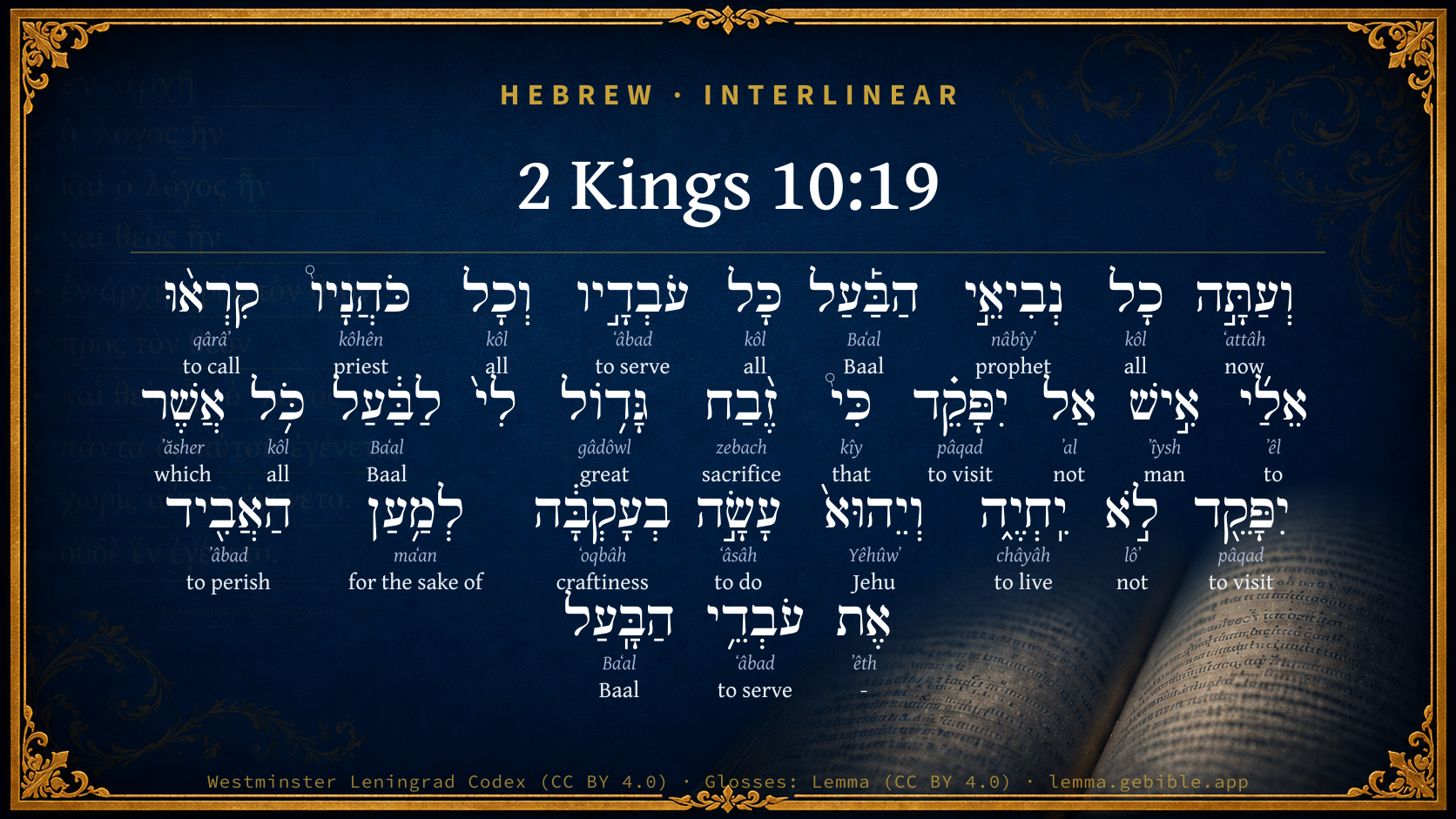
Hebrew (Westminster Leningrad Codex) 2 Kings 10:19 appears in the Hebrew Old Testament. The text above is from the Westminster Leningrad Codex. Each word links to its Strong’s number, a concise gloss, and parsing drawn from the Open Scriptures Hebrew Bible morphology. Click any word for its full Brown-Driver-Briggs (BDB) entry.
Download image
Cite this verse

2 Kings 10:19 (World English Bible). Public Domain. Lemma interlinear Bible study tool, https://lemma.gebible.app/v/2-kings/10/19.

Show BibTeX & RIS
BibTeX
RIS
English Translation
Now therefore call to me all the prophets of Baal, all his worshippers, and all his priests; let none be wanting: for I have a great sacrifice [to do] to Baal; whoever shall be wanting, he shall not live. But Jehu did it in subtlety, to the intent that he might destroy the worshippers of Baal.
World English Bible · Public Domain
Highlights
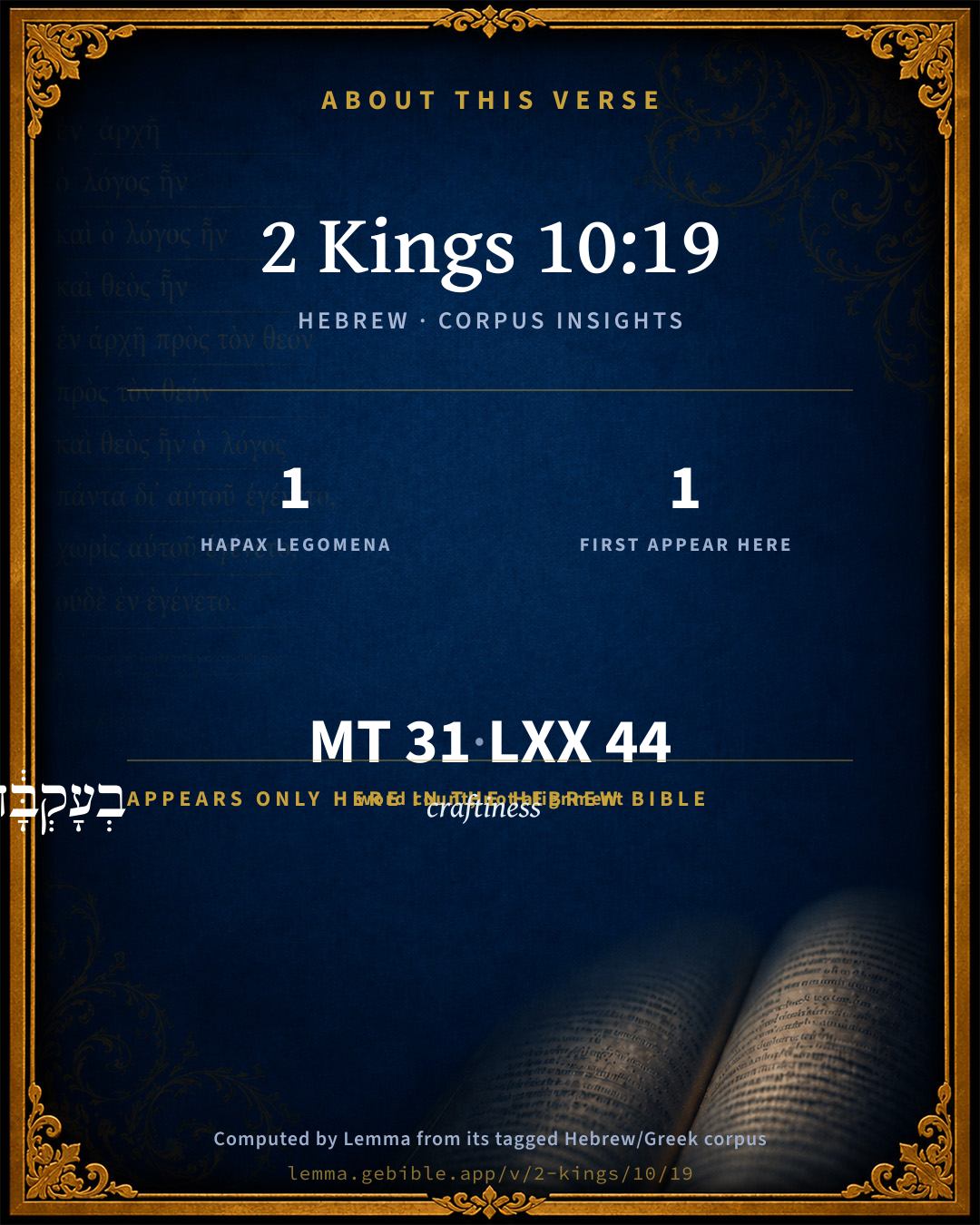
  • 1 hapax legomenon — only here in the Hebrew Bible
  • 1 first appearance in the Hebrew Bible
Full analysis ↓
Download a study sheet

One document with this verse’s original text, its word-by-word gloss line, the meaning frame, cross-references with their text, attributed commentary, and full source and license credits — printable, and it pastes into notes with its structure intact.

This verse Autodidact and up

Study sheet (.html) Plain text (.txt)

A passage Seminary Student

Up to 50 verses in one chapter. A passage sheet keeps up to 6 commentary sources and 12 cross-references per verse, in the order this page ranks them, and says so on the sheet whenever that leaves anything out. Ask for a single verse and you get the Autodidact verse sheet above.

Everything on this page stays free to read, with no account — the sheet is a download of what is already on screen, not access to it.

Want to remove ads? Support Godless Engineer
Compare translations 3

The same verse in 3 English versions, stacked beneath the original-language interlinear above. Click any original word for its lexicon entry.

Each is an independent rendering of the whole verse — the interlinear is not word-aligned to these translations.

Highlighted words mark where these versions differ — a whole-verse word diff, not a word-by-word alignment.

  • World English Bible Public Domain
    Now therefore call to me all the prophets of Baal, all his worshippers, and all his priests; let none be wanting: for I have a great sacrifice [to do] to Baal; whoever shall be wanting, he shall not live. But Jehu did it in subtlety, to the intent that he might destroy the worshippers of Baal.
  • King James Version Public Domain
    Now therefore call unto me all the prophets of Baal, all his servants, and all his priests; let none be wanting: for I have a great sacrifice to do to Baal; whosoever shall be wanting, he shall not live. But Jehu did it in subtilty, to the intent that he might destroy the worshippers of Baal.
  • unfoldingWord Literal Text CC BY-SA 4.0
    And now, call to me all of the prophets of Baal, all of his servants, and all of his priests. Let not a man be missing, for a great sacrifice to me for Baal. Everyone who is missing will not live.” But Jehu was acting with cunning in order to destroy the servants of Baal.

unfoldingWord Literal Text — © unfoldingWord, licensed CC BY-SA 4.0. Word-aligned USFM3 via Door43 (git.door43.org/unfoldingWord/en_ult).

Versions to compare (up to 4)

3 of 4 selected

Show all 18 translations

Every available English version of this verse, each an independent rendering of the whole verse.

  • World English Bible Public Domain
    Now therefore call to me all the prophets of Baal, all his worshippers, and all his priests; let none be wanting: for I have a great sacrifice [to do] to Baal; whoever shall be wanting, he shall not live. But Jehu did it in subtlety, to the intent that he might destroy the worshippers of Baal.
  • Berean Standard Bible Public Domain
    Now, therefore, summon to me all the prophets of Baal, all his servants, and all his priests. See that no one is missing, for I have a great sacrifice for Baal. Whoever is missing will not live.” But Jehu was acting deceptively in order to destroy the servants of Baal.
  • Majority Standard Bible Public Domain
    Now, therefore, summon to me all the prophets of Baal, all his servants, and all his priests. See that no one is missing, for I have a great sacrifice for Baal. Whoever is missing will not live.” But Jehu was acting deceptively in order to destroy the servants of Baal.
  • King James Version Public Domain
    Now therefore call unto me all the prophets of Baal, all his servants, and all his priests; let none be wanting: for I have a great sacrifice to do to Baal; whosoever shall be wanting, he shall not live. But Jehu did it in subtilty, to the intent that he might destroy the worshippers of Baal.
  • American Standard Version (1901) Public Domain
    Now therefore call unto me all the prophets of Baal, all his worshippers, and all his priests; let none be wanting: for I have a great sacrifice `to do' to Baal; whosoever shall be wanting, he shall not live. But Jehu did it in subtlety, to the intent that he might destroy the worshippers of Baal.
  • Revised Version (1885) Public Domain
    Now therefore call unto me all the prophets of Baal, all his worshippers, and all his priests; let none be wanting: for I have a great sacrifice to do to Baal; whosoever shall be wanting, he shall not live. But Jehu did it in subtilty, to the intent that he might destroy the worshippers of Baal.
  • Geneva Bible (1599) Public Domain
    Now therefore call vnto me all ye prophets of Baal, all his seruants, and all his priests, and let not a man be lacking: for I haue a great sacrifice for Baal: whosoeuer is lacking, he shall not liue. But Iehu did it by a subtiltie to destroy ye seruats of Baal.
  • Douay-Rheims (1899) Public Domain
    Now therefore call to me all the prophets of Baal, and all his servants, and all his priests: let none be wanting, for I have a great sacrifice to offer to Baal: whosoever shall be wanting shall not live. Now Jehu did this craftily, that he might destroy the worshippers of Baal.
  • Young's Literal Translation Public Domain
    and now, all the prophets of Baal, all his servants, and all his priests, call ye unto me; let not a man be lacking, for a great sacrifice I have for Baal; every one who is lacking -- he doth not live;' and Jehu hath done `it' in subtilty, in order to destroy the servants of Baal.
  • Literal Standard Version CC BY-SA 4.0
    and now, all the prophets of Ba‘al, all his servants, and all his priests, call to me; do not let a man be lacking, for I have a great sacrifice for Ba‘al; everyone who is lacking—he does not live”; and Jehu has done [it] in subtlety, in order to destroy the servants of Ba‘al.
  • Unlocked Literal Bible CC BY-SA 4.0
    Now therefore call to me all the prophets of Baal, all his worshipers, and all his priests. Let no one be left out, for I have a great sacrifice to offer to Baal. Whoever does not come will not live.” But Jehu did this deceitfully, with the intent to kill the worshipers of Baal.
  • unfoldingWord Literal Text CC BY-SA 4.0
    And now, call to me all of the prophets of Baal, all of his servants, and all of his priests. Let not a man be missing, for a great sacrifice to me for Baal. Everyone who is missing will not live.” But Jehu was acting with cunning in order to destroy the servants of Baal.
  • Darby Bible Public Domain
    And now call me all the prophets of Baal, all his servants, and all his priests: let none be wanting; for I have a great sacrifice [to do] to Baal; whoever shall be wanting shall not live. But Jehu did it in subtilty, in order that he might bring destruction upon the servants of Baal.
  • World Messianic Bible Public Domain
    Now therefore call to me all the prophets of Baal, all of his worshipers, and all of his priests. Let no one be absent, for I have a great sacrifice to Baal. Whoever is absent, he shall not live.” But Jehu did deceptively, intending to destroy the worshipers of Baal.
  • Webster's Bible Public Domain
    Now therefore call to me all the prophets of Baal, all his servants, and all his priests; let none be wanting: for I have a great sacrifice to do to Baal: whoever shall be wanting, he shall not live. But Jehu did it in subtilty, to the intent that he might destroy the worshipers of Baal.
  • Free Bible Version CC BY-SA 4.0
    So summon all the prophets of Baal, all his servants and all his priests. Make sure no one is missing, because I'm organizing a great sacrifice for Baal. Anyone who doesn't attend will be executed.” But Jehu's plan was a trick to destroy the followers of Baal.
  • Bible in Basic English Public Domain
    Now send for all the prophets of Baal and all his servants and all his priests, to come to me; let no one keep away: for I have a great offering to make to Baal; anyone who is not present, will be put to death. This Jehu did with deceit, his purpose being the destruction of the servants of Baal.
  • JPS Tanakh (1917) Public Domain
    Now therefore call unto me all the prophets of Baal, all his worshippers, and all his priests, let none be wanting; for I have a great sacrifice to do to Baal; whosoever shall be wanting, he shall not live.' But Jehu did it in subtlety, to the intent that he might destroy the worshippers of Baal.

Literal Standard Version (2020), Covenant Press — licensed CC BY-SA 4.0. Text via the HelloAO Bible API (eBible.org). Unlocked Literal Bible (unfoldingWord) — licensed CC BY-SA 4.0. Text via the HelloAO Bible API (eBible.org). unfoldingWord Literal Text — © unfoldingWord, licensed CC BY-SA 4.0. Word-aligned USFM3 via Door43 (git.door43.org/unfoldingWord/en_ult). Free Bible Version, Dr. Jonathan Gallagher — licensed CC BY-SA 4.0. Text via the HelloAO Bible API (eBible.org).

Word by word

More ways to search: Search by grammar → Find every occurrence → Compare this word →

Practice this passage: Drill this verse → Learn its vocabulary →

בְעָקְבָּ֔ה
ʻoqbâh
H6122
“in/at · craftiness”
Preposition + Noun, Common, Feminine, Singular, Absolute
Part of Speech
Preposition + Noun
Type
Common
Gender
Feminine
Number
Singular
State
Absolute
Full BDB Definition

Origin: from an unused form from H6117 meaning a trick

TWOT: 1676d

subtlety, insidiousness, craftiness
  1. וְעַתָּ֣ה ʻattâh H6258 “and · now” Conjunction + Adverb
  2. כָל kôl H3605 “all of” Noun, Common, Masculine, Singular, Construct
  3. נְבִיאֵ֣י nâbîyʼ H5030 “prophets of” Noun, Common, Masculine, Plural, Construct
  4. הַבַּ֡עַל Baʻal H1168 “the · Baal” Particle, Definite Article + Noun, Proper
  5. כָּל kôl H3605 “all of” Noun, Common, Masculine, Singular, Construct
  6. עֹבְדָ֣יו ʻâbad H5647 “serving · him” Verb, Qal, Participle Active, Masculine, Plural, Construct + Suffix, Personal, 3rd Person, Masculine, Singular
  7. וְכָל kôl H3605 “and · all of” Conjunction + Noun, Common, Masculine, Singular, Construct
  8. כֹּהֲנָיו֩ kôhên H3548 “priests · his” Noun, Common, Masculine, Plural, Construct + Suffix, Personal, 3rd Person, Masculine, Singular
  9. קִרְא֨וּ qârâʼ H7121 “call” Verb, Qal, Imperative, 2nd Person, Masculine, Plural
  10. אֵלַ֜י ʼêl H413 “to · me” Preposition + Suffix, Personal, 1st Person, Common, Singular
  11. אִ֣ישׁ ʼîysh H376 “man” Noun, Common, Masculine, Singular, Absolute
  12. אַל ʼal H408 “not” Particle, Negative
  13. יִפָּקֵ֗ד pâqad H6485 “to visit” Verb, Niphal, Jussive, 3rd Person, Masculine, Singular
  14. כִּי֩ kîy H3588 “that” Conjunction
  15. זֶ֨בַח zebach H2077 “sacrifice” Noun, Common, Masculine, Singular, Absolute
  16. גָּד֥וֹל gâdôwl H1419 “great” Adjective, Adjective, Masculine, Singular, Absolute
  17. לַבַּ֔עַל Baʻal H1168 “to/for the · Baal” Preposition, Determined + Noun, Proper
  18. כֹּ֥ל kôl H3605 “all” Noun, Common, Masculine, Singular, Absolute
  19. אֲשֶׁר ʼăsher H834 “which” Particle, Relative
  20. יִפָּקֵ֖ד pâqad H6485 “to visit” Verb, Niphal, Imperfect, 3rd Person, Masculine, Singular
  21. לֹ֣א lôʼ H3808 “not” Particle, Negative
  22. יִֽחְיֶ֑ה châyâh H2421 “to live” Verb, Qal, Imperfect, 3rd Person, Masculine, Singular
  23. וְיֵהוּא֙ Yêhûwʼ H3058 “and · Jehu” Conjunction + Noun, Proper
  24. עָשָׂ֣ה ʻâsâh H6213 “to do” Verb, Qal, Perfect, 3rd Person, Masculine, Singular
  25. לְמַ֥עַן maʻan H4616 “for the sake of” Preposition
  26. הַאֲבִ֖יד ʼâbad H6 “to perish” Verb, Hiphil, Infinitive Construct
  27. אֶת ʼêth H853 “-” Particle, Direct Object
  28. עֹבְדֵ֥י ʻâbad H5647 “serving” Verb, Qal, Participle Active, Masculine, Plural, Construct
  29. הַבָּֽעַל Baʻal H1168 “the · Baal” Particle, Definite Article + Noun, Proper

About this verse

These counts appear in no published source. They are computed here, from the morphology-tagged text and Lemma’s own curated glosses. What Lemma adds →

31
words
23
distinct lemmas
Historical
section

Notable vocabulary

1 hapax legomenon — a word that appears only here in the entire Hebrew Bible:

  • בְעָקְבָּ֔ה craftiness H6122

First appearance in Scripture

This word makes its first canonical appearance in the Hebrew Bible here:

  • בְעָקְבָּ֔ה craftiness H6122

Shared distinctive vocabulary

וְיֵהוּא֙ Jehu H3058 occurs in 54 verses of the Hebrew Bible. Also found in:

Grammatical profile

  • 8 verbs
  • 13 nouns
  • 1 adjective
  • 3 prepositions
  • 1 conjunction
  • 1 adverb
  • 4 particles

Verb forms

  • עֹבְדָ֣יו Qal · Participle Active
  • קִרְא֨וּ Qal · Imperative
  • יִפָּקֵ֗ד Niphal · Jussive
  • יִפָּקֵ֖ד Niphal · Imperfect
  • יִֽחְיֶ֑ה Qal · Imperfect
  • עָשָׂ֣ה Qal · Perfect
  • הַאֲבִ֖יד Hiphil · Infinitive Construct
  • עֹבְדֵ֥י Qal · Participle Active

Repetition

Words recur within this verse — often emphatic in Hebrew:

  • כָל all H3605 ×4
  • הַבַּ֡עַל Baal H1168 ×3
  • עֹבְדָ֣יו to serve H5647 ×2
  • יִפָּקֵ֗ד to visit H6485 ×2

Hebrew & Septuagint length

In English translation the verse runs 56 words from the Hebrew and 56 from the Septuagint (LXX English) — the same length.

A rough comparison of the two English renderings, which tokenize alike — not a word-level alignment.

Word counts can differ between the Hebrew and the Greek without any difference in meaning — e.g. the Hebrew direct-object marker אֵת has no separate Greek word, and Greek often adds the article ὁ.

In the original languages it is 31 Hebrew tokens and 44 Greek tokens — but the two are counted differently (Hebrew bundles its prefixes and suffixes into one token; the Greek is in lemma form), so that isn’t a like-for-like length.

Cross-references

11

Topical passages linked to 2 Kings 10:19 in the Treasury of Scripture Knowledge — connected by theme and wording, ordered by reader-vote popularity; previews shown in the World English Bible.

  • 1 Kings 22:6 Then the king of Israel gathered the prophets together, about four hundred men, and said to them, Shall I go against Ramoth-gilead to battle, or shall I forbear? They said, Go up; for the Lord will deliver it into the hand of the king.
  • 1 Kings 18:19 Now therefore send, and gather to me all Israel to Mount Carmel, and the prophets of Baal four hundred fifty, and the prophets of the Asherah four hundred, who eat at Jezebel's table.
  • 2 Kings 3:13 Elisha said to the king of Israel, What have I to do with you? get you to the prophets of your father, and to the prophets of your mother. The king of Israel said to him, No; for Yahweh has called these three kings together to deliver them into the hand of Moab.
  • 2 Kings 10:18 Jehu gathered all the people together, and said to them, Ahab served Baal a little; but Jehu will serve him much.
  • Job 13:7 Will you speak unrighteously for God, And talk deceitfully for him?
  • Proverbs 29:5 A man who flatters his neighbor, Spreads a net for his feet.
  • 2 Corinthians 4:2 But we have renounced the hidden things of shame, not walking in craftiness, nor handling the word of God deceitfully; but by the manifestation of the truth commending ourselves to every man's conscience in the sight of God.
  • 2 Corinthians 11:3 But I am afraid that somehow, as the serpent deceived Eve in his craftiness, so your minds might be corrupted from the simplicity that is in Christ.

Cross-references courtesy of OpenBible.info (CC BY 4.0).

Hebrew and Greek witnesses Masoretic Hebrew ↔ Greek Septuagint

The same verse in the two great witnesses to the Old Testament, shown verse-for-verse.

These are two independent witnesses, not word-aligned to each other, and the Septuagint is shown in lemma (dictionary) form.

Hebrew 2 Kings 10:19 Masoretic · Westminster Leningrad Codex

וְעַתָּ֣ה כָל נְבִיאֵ֣י הַבַּ֡עַל כָּל עֹבְדָ֣יו וְכָל כֹּהֲנָיו֩ קִרְא֨וּ אֵלַ֜י אִ֣ישׁ אַל יִפָּקֵ֗ד כִּי֩ זֶ֨בַח גָּד֥וֹל לִי֙ לַבַּ֔עַל כֹּ֥ל אֲשֶׁר יִפָּקֵ֖ד לֹ֣א יִֽחְיֶ֑ה וְיֵהוּא֙ עָשָׂ֣ה בְעָקְבָּ֔ה לְמַ֥עַן הַאֲבִ֖יד אֶת עֹבְדֵ֥י הַבָּֽעַל

Now therefore call to me all the prophets of Baal, all his worshippers, and all his priests; let none be wanting: for I have a great sacrifice [to do] to Baal; whoever shall be wanting, he shall not live. But Jehu did it in subtlety, to the intent that he might destroy the worshippers of Baal.

World English Bible · Public Domain

Greek LXX 2 Kings 10:19 Septuagint · lemma form

καί νῦν πᾶς ὁ προφήτης ὁ βααλ πᾶς ὁ δοῦλος αὐτός καί ὁ ἱερεύς αὐτός καλέω πρός ἐγώ ἀνήρ μή ἐπισκέπτομαι ὅτι θυσία μέγας ἐγώ ὁ βααλ πᾶς ὅς ἐάν ἐπισκέπτομαι οὐ ζάω καί ιου ποιέω ἐν πτερνισμός ἵνα ἀποὀλλύω ὁ δοῦλος ὁ βααλ

Now then do all you⌃ the prophets of Baal call all his servants and his priests to me; let not a man be lacking: for I have a great sacrifice to offer to Baal; every one who shall be missing shall die. But Ju did it in subtilty, that he might destroy the servants of Baal.

LXX2012 (modern English Septuagint) · Public Domain

On this verse, Ellicott's Commentary for English Readers discusses the Septuagint’s reading. Read the note in Commentary ↓

Hebrew: Westminster Leningrad Codex (CC BY 4.0). Greek: Septuagint (public domain); English from LXX2012 (modern English Septuagint) (Public Domain). How the Septuagint differs from the Hebrew →

Targum (Aramaic paraphrase)

1

The Targum is the ancient Jewish Aramaic paraphrase of the Hebrew Scriptures — an interpretive translation, not the Hebrew text itself. Onkelos (literal) and Pseudo-Jonathan (expansive) render the Torah, and Jonathan the Prophets. Coverage is partial: where no permissively-licensed English translation exists for a verse, only the Aramaic is shown. This is verse-level text, not a word-by-word alignment to the Hebrew.

  1. Targum Jonathan Prophets (Joshua–Malachi)
    וּכְעַן כָּל נְבִיֵי בְעָלָא וְכָל פַּלְחוֹהִי וְכָל כּוּמְרוֹהִי זַמִינוּ לִי אֱנַשׁ לָא יִשְׁגֵי אֲרֵי דְבַח רַב לִי לִבְעָלָא כָּל דְיִשְׁגֵי לָא יִתְקַיֵם וְיֵהוּא עֲבַד בְּחוּכְמָא בְּדִיל לַאֲבָדָא יַת פַּלְחֵי בְעָלָא:

    (no public-domain English translation for this verse)

    Targum Jonathan — Aramaic: “Mikraot Gedolot” (public domain). English: “Sefaria Community Translation” (CC0 1.0 (public-domain dedication)); “London "Chaldee Paraphrase," 1871” (public domain). Text via Sefaria.

Commentary

Notes on 2 Kings 10:19 from classic Christian and Jewish commentators (each source and its license shown beneath its notes). The classic Christian expositions comment on the surrounding passage and are grouped to its opening verse, so a note may address several verses; the Jewish commentaries on the Tanakh (Rashi and others) are per-verse, so they appear only where the commentator wrote on this verse.

Lemma curates 59 commentaries, every one of them public domain or Creative Commons licensed, each selected and text-cleaned for this edition rather than reprinted as found. About our sources →

Trapp's Complete Commentary

John Trapp

2Ki 10:19 Now therefore call unto me all the prophets of Baal, all his servants, and all his priests; let none be wanting: for I have a great sacrifice [to do] to Baal; whosoever shall be wanting, he shall not live. But Jehu did [it] in subtilty, to the intent that he might destroy the worshippers of Baal.

Ver. 19. All the prophets of Baal, all his servants, and all his priests.] Baal had his prophets, his priests, and his servants, as Jehovah had. His priests also had their vestments; {2Ki 10:22} Faciunt et vespae favos: simiae imitantur homines.

John Trapp, A Commentary or Exposition upon All the Books of the Old and New Testament (1647–1656) — public domain. Text from a community e-Sword module.

Joseph Benson's Commentary

2Ki 10:19. Call unto me all the prophets of Baal, and all his servants — Either, 1st, All his ministers, of whom it seems there were several sorts, of which two are here distinctly mentioned, his prophets and priests; and the rest, of the inferior sort, may be comprehended under the general title of servants, because they were to attend upon the others in their ministrations. Or, 2d, All his worshippers, as the word here rendered servants is translated in the close of this verse. If it be inquired how all these could be contained in one house of Baal, it may be answered, that the number of the worshippers of Baal had been greatly diminished by the ministry of Elijah and Elisha, and the rest of the prophets; and by Joram’s neglect and disuse of that worship. Besides, this house or temple of Baal was probably very large and capacious, being in the royal city, nigh the king’s palace, and intended for the use of the king, queen, and whole court, and for great and high solemnities, and therefore was the chief building of the sort in the kingdom. Moreover, as by the house or temple of God, at Jerusalem, we are frequently to understand, not only the principal building, but all the other buildings or courts belonging to it, in which the worshippers stood when they worshipped, so it might be here; and in that case there would be space sufficient for all the worshippers of Baal that can reasonably be thought to have been at that time in Israel.

Joseph Benson's Commentary on the Old and New Testaments (1811–1818) — public domain. Text from a community e-Sword module.

Jamieson, Fausset & Brown

Robert Jamieson, A. R. Fausset & David Brown

HE DESTROYS THE WORSHIPPERS OF BAAL. (Kg2 10:18-29)

call unto me all the prophets of Baal--The votaries of Baal are here classified under the several titles of prophets, priests, and servants, or worshippers generally. They might be easily convened into one spacious temple, as their number had been greatly diminished both by the influential ministrations of Elijah and Elisha, and also from the late King Joram's neglect and discontinuance of the worship. Jehu's appointment of a solemn sacrifice in honor of Baal, and a summons to all his worshippers to join in its celebration, was a deep-laid plot, which he had resolved upon for their extinction, a measure in perfect harmony with the Mosaic law, and worthy of a constitutional king of Israel. It was done, however, not from religious, but purely political motives, because he believed that the existence and interests of the Baalites were inseparably bound up with the dynasty of Ahab and because he hoped that by their extermination he would secure the attachment of the far larger and more influential party who worshipped God in Israel. Jehonadab's concurrence must have been given in the belief of his being actuated solely by the highest principles of piety and zeal.

Jamieson, Fausset & Brown — Commentary Critical and Explanatory on the Whole Bible (1871) — public domain (CC PDM 1.0). Text via the HelloAO Bible API.

Adam Clarke's Commentary

Verse 19. Whosoever shall be wanting, he shall not live.] Because, as he will thereby show himself without zeal for the service of his God, he will justly forfeit his life. All this was done in the very spirit of deceit.

Adam Clarke's Commentary on the Bible (1810–1826) — public domain. Text from a community e-Sword/MySword module.

Ellicott's Commentary for English Readers

(19) Call unto me all the prophets of Baal.—Comp. the similar convocation of the prophets of the Baal and Asherah by the prophet Elijah, 1Ki_18:19 seq.

His servants.—The same word as “worshippers,” infra.

To do.—Omit.

To Baal.—For the Baal.

But Jehu did it.—Or, Now Jehu had done it; a parenthesis.

In subtilty.—Or, in guile, treacherously. The word (‘oqbâh) occurs only here. It is connected with the proper name Jacob. (See Gen_25:26; Hos_12:4.) The LXX. renders literally, ἐν πτερνισμφ, “in heeling”—i.e., striking with the heel, tripping up.

A Bible Commentary for English Readers, edited by Charles John Ellicott (1878–1897) — public domain. Text from a community e-Sword module.

The Cambridge Bible for Schools and Colleges

gen. ed. J. J. S. Perowne

19. call unto me all the prophets of Baal] The LXX. represents Jehu’s words as an address to the prophets of Baal, ‘Now, O ye prophets of Baal, call ye unto me all his servants &c.’

all his servants] R.V. worshippers. As the same word is so translated at the close of this verse, and again in 21, 22, and 23, there can be no warrant for a change in this place. R.V. makes the whole consistent.

all his priests] These were not the same as the prophets. The latter gave oracles to enquirers and taught the mysteries of the worship, the priests attended on the numerous sacrifices.

Jehu did it in subtilty] The word in the original is one connected with the same root as the name Jacob, a name interpreted by Esau to signify ‘supplanter’. Such an action as his implies a certain degree of guile, and hence the sense in this verse.

The Cambridge Bible for Schools and Colleges (gen. ed. J. J. S. Perowne; Cambridge University Press, 1878–1918) — public domain. Text from a community e-Sword module.

John Gill's Exposition

All that were employed in the several parts of religious worship given him, and in performing any rite and ceremony belonging to it; in invocation of him, and singing praises to him, as the prophets; in offering sacrifices to him, as the priests; or in assisting them in their service, who may be meant by his servants or ministers:

for I have a great sacrifice to do to Baal; by which, though he might mean a sacrifice of his prophets, priests, servants, and worshippers, he would have it otherwise understood, and his design was to deceive, which cannot be justified:

whosoever shall be wanting, he shall not live: but be put to death; this he said, pretending his great zeal for Baal, when his view was by this threatening to get all his worshippers together to destroy them, that none might escape as follows:

but Jehu did it in subtlety, to the intent that he might destroy the worshippers of Baal: the Targum renders it, "with wisdom"; but Jarchi and Ben Gersom much better, "in deceit"; the word signifies supplantation, such as Esau charged Jacob with.

John Gill's Exposition of the Whole Bible (1746–1763) — public domain (CC PDM 1.0). Text via the HelloAO Bible API.

Albert Barnes' Notes on the Bible

It appears from this verse that the “prophets” and “priests” of Baal were not identical. The former would correspond to the dervishes, the latter to the mullahs, of Muslim countries. By the “servants” of Baal are meant the ordinary worshippers.

Albert Barnes' Notes on the Bible (1834–1885) — public domain. Text from a community e-Sword/MySword module.

Haydock's Catholic Bible Commentary

Servants. The number had greatly decreased under Joram. (Menochius)

George Leo Haydock (1774–1849), Haydock's Catholic Family Bible and Commentary, 1859 edition — public domain. Excludes Psalms (Douay-Rheims chapter numbering differs from Protestant) and Deuterocanonical books (Catholic canon only).

Matthew Poole's English Annotations

All his servants; either,

1. All his ministers; of whom there may seem to have been several sorts, whereof two are here distinctly mentioned, his prophets and priests; and the rest of the inferior sort may be comprehended under this general title of servants, because they were to attend upon the others in their sacred ministrations. And these being once destroyed, Jehu rightly concluded that the rest would fall of course. And this sense may seem to be favoured by 2Ki 10:22, wherein vestments were brought forth

for all these worshippers of Baal; which were not commonly used by the people in the worship either of God or of Baal, but only by the priests or ministers. Or,

2. All his worshippers, as the same word is translated in the close of this verse.

Quest. How could all these be contained in one house of Baal?

Answ. Well enough, for the number of Baal’s worshippers had been vastly diminished by the ministry of Elijah and Elisha, and the rest of the prophets, and by Joram’s neglect and disuse of that worship. For the generality of the Israelites had too much knowledge to have any real and religious respect to such senseless idols; only they practised it in compliance with the humour of their king and queen, and for worldly or wicked ends; and therefore when the king deserted it, they generally forsook it, some few silly and besotted persons excepted, who are here gathered together. Besides, this house or temple of Baal might be very large and capacious, and probably was so, because it was the chief of that sort, as being in the king’s city, and nigh his palace, and for the use of the king and queen, and the while court, and for great and high solemnities. Moreover, as the name of the house or temple of God at Jerusalem oft signifies not only the principal building, but all the other buildings and courts belonging to it, in which all the worshippers stood when they worshipped; so it might be here; and so there was space sufficient for all the worshippers of Baal which can reasonably be thought to have been at this time in all Israel.

I have a great sacrifice to do to Baal; I will offer to him a noble and acceptable sacrifice; not of sheep, or oxen, &c., as they understood it, but of his own beloved priests, and prophets, and servants, as he meant it.

In subtlety; with another design, that he might both certainly discover and utterly destroy them all, without any further trouble, or danger of sedition or tumult in his kingdom.

Matthew Poole's English Annotations on the Holy Bible (1683–1685) — public domain. Text from a community e-Sword/MySword module.

Whedon's Commentary on the Bible

Daniel D. Whedon

19. The prophets… servants… priests — Every representative and devotee of the Baal worship must be present at this great sacrifice.

Jehu did it in subtilty — His craft and guile on this occasion were in fearfulness equal to the duplicity and baseness which prepared the way for the massacre of St. Bartholomew. His Divine commission doubtless authorized him to cut off the worshippers of Baal, but not by guile. God praised his zeal in rooting out idolatry, but not his subtilty.

Daniel D. Whedon (gen. ed.), Commentary on the Old and New Testaments (1874–1909) — public domain. Text from a community e-Sword module.

The Pulpit Commentary

Now therefore call unto me all the prophets of Baal, all his servants, and all his priests. In Phoenicia, it would seem, as in Egypt and among the Jews, "prophets" and "priests" were distinct classes of persons. The Egyptians called the priest ab, the prophet neter hen, literally, "servant of God." They held the priest in the greater honor. In Phoenicia, on the contrary, judging from the scanty notices that we possess, prophets appear to have taken precedence of priests, and to have had the more important functions assigned to them. (see 1Ki_18:19-40 1Ki_22:6) Let none be wanting literally, let not a man failfor I have a great sacrifice to do to Baal. Like the other gods of the heathen, Baal and Ashtoreth were worshipped chiefly by sacrifice. The sacrifice was sometimes human, but more Commonly a sacrificial animal, such as a bull, a ram, or a he-goat. In the greater festivals several hundreds of victims were offered; and their flesh was served up at the banquets by which the festivals were accompanied. Whosoever shall be wanting, he shall not live. His absence would be regarded as an act of contumacy verging on rebellion, and so as deserving of capital punishment. But Jehu did it in subtilty, to the intent that he might destroy the worshippers of Baal. "Subtilty" was characteristic of John, who always preferred to gain his ends by cunning rather than in a straightforward way. Idolaters were by the Law liable to death, and Jehu would have had a perfect right to crush the Baal-worship throughout the land, by sending his emissaries everywhere, with orders to slay all whom they found engaged in it. But to draw some thousands of his subjects by false pretences into a trap, and then to kill them in it for doing what he had himself invited them to do, was an act that was wholly unjustifiable, and that savored, not of the wisdom which is from above, but of that bastard wisdom which is "earthly, sensual, devilish". (Jam_3:15) Jehu"s religious reformation did not succeed, and it was conducted in such a way that it did not deserve to succeed. A little more honest boldness, and a little less frequent resort to subterfuge and craft, might have had a different result, and have been better both for himself and for his people.

The Pulpit Commentary (1880–1919), ed. H.D.M. Spence-Jones & Joseph S. Exell — public domain. Text from a community e-Sword module.

Rashi

Rabbi Shlomo Yitzchaki (Rashi)

With cunning. With guile, an expression of “וַיַּעְקְבֵנִי [=he beguiled me].”

Rashi on the Tanakh — English translations: “The Judaica Press complete Tanach with Rashi, translated by A. J. Rosenberg” (CC BY 4.0); “Pentateuch with Rashi's commentary by M. Rosenbaum and A.M. Silbermann, 1929-1934” (public domain); “The Metsudah Tanach series, Lakewood, N.J” (CC BY 4.0); and “The Book of Joshua, Metsudah Publications, 1997” (CC BY 4.0). Text via Sefaria.

Lesson kit

Teaching starters — assembled from the data on this page, not authored interpretation. Every prompt links to the verse data it draws on. Edit before teaching.

2 Kings, in the Historical, opens this verse with 31 words (23 distinct Hebrew lemmas). Its most distinctive word is ʻoqbâh (“craftiness”). A historical commentator’s framing appears above. Read the whole chapter for the surrounding context.

Discussion questions

  1. What does “craftiness” (ʻoqbâh) contribute to the verse as a whole?
  2. 1 word here appears nowhere else in the Hebrew Bible. Why might the author reach for such rare wording?
  3. This is the first place “craftiness” appears in Scripture (first appears here). What does its debut here establish?
  4. How does 1 Kings 16:1, which shares the word «Jehu», read alongside this verse?
  5. What does the repetition of “all” (4× in this one verse) do in this verse?
  6. These translations render this verse differently; the difference is in the English rendering, not the original. What questions does that raise?
  7. «עֹבְדָ֣יו» is a Qal Participle Active verb. How does that grammatical form shape the action described?
  8. Compare how Trapp's Complete Commentary and Joseph Benson's Commentary read this verse. Where do they agree or differ?

Things to notice

  • 1 word in this verse appears nowhere else in the Hebrew Bible.
  • 1 word makes its first canonical appearance in Scripture here.
  • This verse counts 31 Hebrew ↔ 44 Greek words.
  • These translations choose different wording for 24 words in this verse.
  • “all” occurs 4× in this single verse.

Reading settings

Reading text

Shown beneath each verse's original-language words.

Old Testament
Old Testament edition

Read the OT as the Masoretic Hebrew (MT) or the Greek Septuagint (LXX).

English shown for the Greek Septuagint (in the Hebrew ↔ Greek comparison).

Comparing translations? Open the Compare panel on any verse page to stack up to four side by side.