
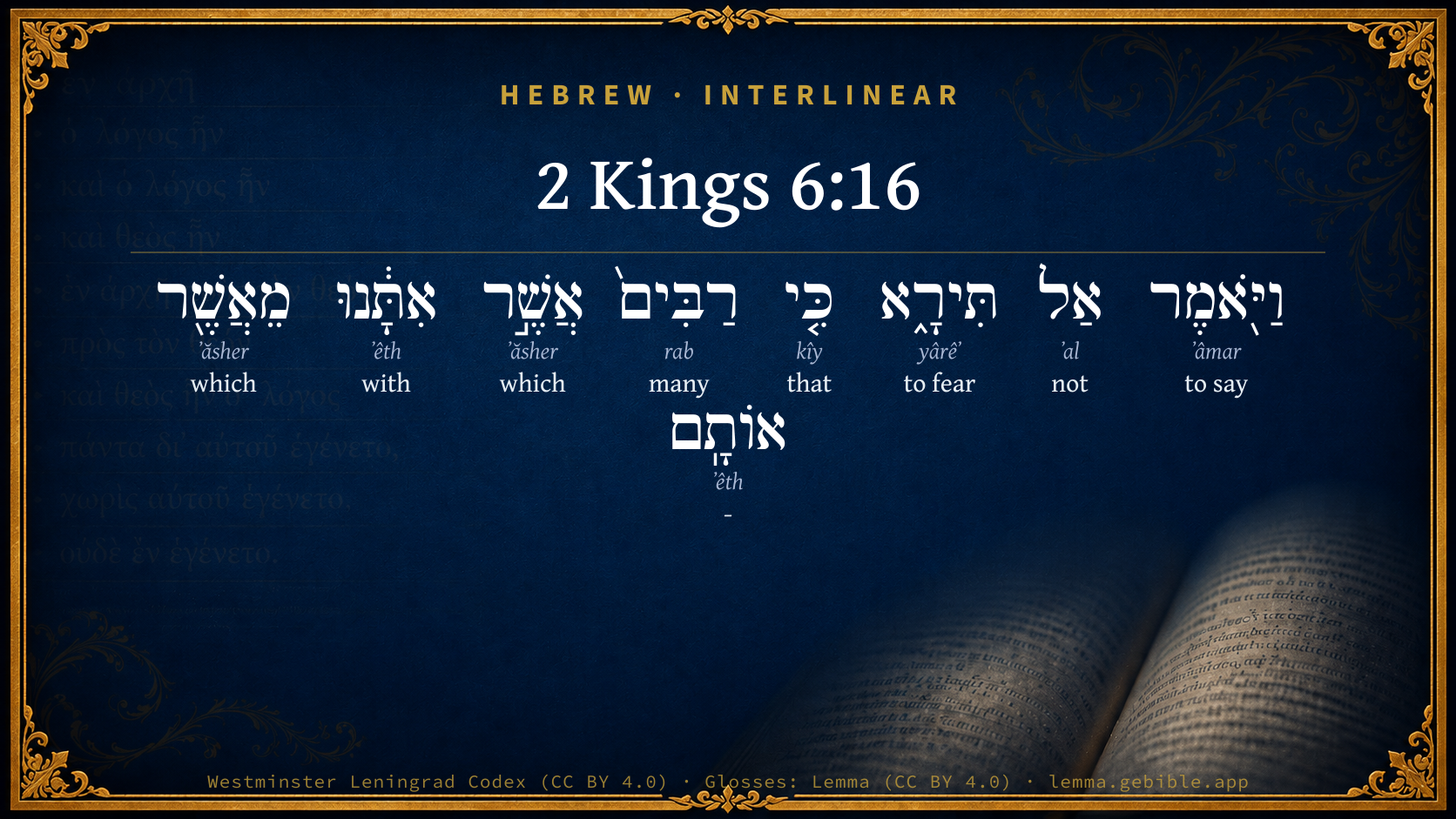
2 Kings 6:16

Hebrew (Westminster Leningrad Codex) 2 Kings 6:16 appears in the Hebrew Old Testament. The text above is from the Westminster Leningrad Codex. Each word links to its Strong’s number, a concise gloss, and parsing drawn from the Open Scriptures Hebrew Bible morphology. Click any word for its full Brown-Driver-Briggs (BDB) entry.
Download image
Cite this verse

2 Kings 6:16 (World English Bible). Public Domain. Lemma interlinear Bible study tool, https://lemma.gebible.app/v/2-kings/6/16.

Show BibTeX & RIS
BibTeX
RIS
English Translation
He answered, Don't be afraid; for those who are with us are more than those who are with them.
World English Bible · Public Domain
Download a study sheet

One document with this verse’s original text, its word-by-word gloss line, the meaning frame, cross-references with their text, attributed commentary, and full source and license credits — printable, and it pastes into notes with its structure intact.

This verse Autodidact and up

Study sheet (.html) Plain text (.txt)

A passage Seminary Student

Up to 50 verses in one chapter. A passage sheet keeps up to 6 commentary sources and 12 cross-references per verse, in the order this page ranks them, and says so on the sheet whenever that leaves anything out. Ask for a single verse and you get the Autodidact verse sheet above.

Everything on this page stays free to read, with no account — the sheet is a download of what is already on screen, not access to it.

Want to remove ads? Support Godless Engineer
Compare translations 3

The same verse in 3 English versions, stacked beneath the original-language interlinear above. Click any original word for its lexicon entry.

Each is an independent rendering of the whole verse — the interlinear is not word-aligned to these translations.

Highlighted words mark where these versions differ — a whole-verse word diff, not a word-by-word alignment.

  • World English Bible Public Domain
    He answered, Don't be afraid; for those who are with us are more than those who are with them.
  • King James Version Public Domain
    And he answered, Fear not: for they that be with us are more than they that be with them.
  • unfoldingWord Literal Text CC BY-SA 4.0
    And he said, “Do not fear, for those who with us more numerous than those who with them.”

unfoldingWord Literal Text — © unfoldingWord, licensed CC BY-SA 4.0. Word-aligned USFM3 via Door43 (git.door43.org/unfoldingWord/en_ult).

Versions to compare (up to 4)

3 of 4 selected

Show all 18 translations

Every available English version of this verse, each an independent rendering of the whole verse.

  • World English Bible Public Domain
    He answered, Don't be afraid; for those who are with us are more than those who are with them.
  • Berean Standard Bible Public Domain
    “Do not be afraid,” Elisha answered, “for those who are with us are more than those who are with them.”
  • Majority Standard Bible Public Domain
    “Do not be afraid,” Elisha answered, “for those who are with us are more than those who are with them.”
  • King James Version Public Domain
    And he answered, Fear not: for they that be with us are more than they that be with them.
  • American Standard Version (1901) Public Domain
    And he answered, Fear not; for they that are with us are more than they that are with them.
  • Revised Version (1885) Public Domain
    And he answered, Fear not: for they that be with us are more than they that be with them.
  • Geneva Bible (1599) Public Domain
    And he answered, Feare not: for they that be with vs, are moe then they that be with them.
  • Douay-Rheims (1899) Public Domain
    But he answered: Fear not: for there are more with us than with them.
  • Young's Literal Translation Public Domain
    And he saith, `Fear not, for more `are' they who `are' with us than they who `are' with them.'
  • Literal Standard Version CC BY-SA 4.0
    And he says, “Do not fear, for more [are] they who [are] with us than they who [are] with them.”
  • Unlocked Literal Bible CC BY-SA 4.0
    Elisha answered, “Do not fear, for those who are with us are more than those who are with them.”
  • unfoldingWord Literal Text CC BY-SA 4.0
    And he said, “Do not fear, for those who with us more numerous than those who with them.”
  • Darby Bible Public Domain
    And he said, Fear not, for they that are with us are more than they that are with them.
  • World Messianic Bible Public Domain
    He answered, “Don’t be afraid, for those who are with us are more than those who are with them.”
  • Webster's Bible Public Domain
    And he answered, Fear not: for they that are with us are more than they that are with them.
  • Free Bible Version CC BY-SA 4.0
    Elisha replied, “Don't be afraid, for there are many more who are with us than there are with them!”
  • Bible in Basic English Public Domain
    And he said in answer, Have no fear; those who are with us are more than those who are with them.
  • JPS Tanakh (1917) Public Domain
    And he answered: 'Fear not: for they that are with us are more than they that are with them.'

Literal Standard Version (2020), Covenant Press — licensed CC BY-SA 4.0. Text via the HelloAO Bible API (eBible.org). Unlocked Literal Bible (unfoldingWord) — licensed CC BY-SA 4.0. Text via the HelloAO Bible API (eBible.org). unfoldingWord Literal Text — © unfoldingWord, licensed CC BY-SA 4.0. Word-aligned USFM3 via Door43 (git.door43.org/unfoldingWord/en_ult). Free Bible Version, Dr. Jonathan Gallagher — licensed CC BY-SA 4.0. Text via the HelloAO Bible API (eBible.org).

Word by word

More ways to search: Search by grammar → Find every occurrence → Compare this word →

Practice this passage: Drill this verse → Learn its vocabulary →

תִּירָ֑א
yârêʼ
H3372
“to fear”
Verb, Qal, Jussive, 2nd Person, Masculine, Singular
Part of Speech
Verb
Stem
Qal
Form
Jussive
Person
2nd Person
Gender
Masculine
Number
Singular
Full BDB Definition

Origin: a primitive root

TWOT: 907 , 908

to fear, revere, be afraid - (Qal) - to fear, be afraid - to stand in awe of, be awed - to fear, reverence, honour, respect - (Niphal) - to be fearful, be dreadful, be feared - to cause astonishment and awe, be held in awe - to inspire reverence or godly fear or awe - (Piel) to make afraid, terrify - (TWOT) to shoot, pour
  1. וַיֹּ֖אמֶר ʼâmar H559 “and · to say” Conjunction + Verb, Qal, Sequential Imperfect, 3rd Person, Masculine, Singular
  2. אַל ʼal H408 “not” Particle, Negative
  3. כִּ֤י kîy H3588 “that” Conjunction
  4. רַבִּים֙ rab H7227 “many” Adjective, Adjective, Masculine, Plural, Absolute
  5. אֲשֶׁ֣ר ʼăsher H834 “which” Particle, Relative
  6. אִתָּ֔נוּ ʼêth H854 “with · us” Preposition + Suffix, Personal, 1st Person, Common, Plural
  7. מֵאֲשֶׁ֖ר ʼăsher H834 “from · which” Preposition + Particle, Relative
  8. אוֹתָֽם ʼêth H853 “- · them” Particle, Direct Object + Suffix, Personal, 3rd Person, Masculine, Plural

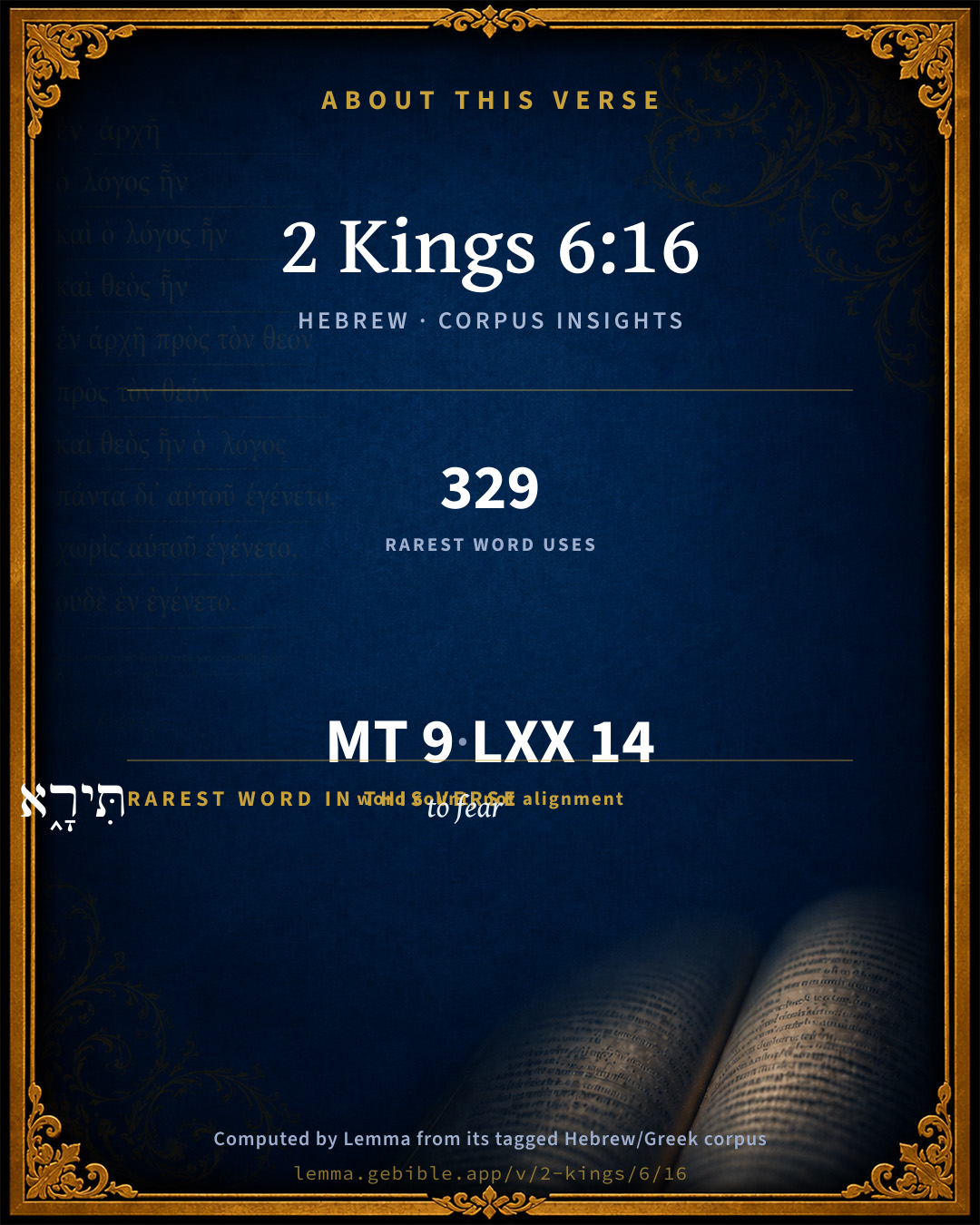
About this verse

These counts appear in no published source. They are computed here, from the morphology-tagged text and Lemma’s own curated glosses. What Lemma adds →

9
words
8
distinct lemmas
Historical
section

Grammatical profile

  • 2 verbs
  • 1 adjective
  • 1 preposition
  • 1 conjunction
  • 4 particles

Verb forms

  • וַיֹּ֖אמֶר Qal · Sequential Imperfect
  • תִּירָ֑א Qal · Jussive

Repetition

A word recurs within this verse — often emphatic in Hebrew:

  • אֲשֶׁ֣ר which H834 ×2

Hebrew & Septuagint length

In English translation the verse runs 19 words from the Hebrew and 19 from the Septuagint (LXX English) — the same length.

A rough comparison of the two English renderings, which tokenize alike — not a word-level alignment.

Word counts can differ between the Hebrew and the Greek without any difference in meaning — e.g. the Hebrew direct-object marker אֵת has no separate Greek word, and Greek often adds the article ὁ.

In the original languages it is 9 Hebrew tokens and 14 Greek tokens — but the two are counted differently (Hebrew bundles its prefixes and suffixes into one token; the Greek is in lemma form), so that isn’t a like-for-like length.

Cross-references

19

Topical passages linked to 2 Kings 6:16 in the Treasury of Scripture Knowledge — connected by theme and wording, ordered by reader-vote popularity; previews shown in the World English Bible.

  • Romans 8:31 What then shall we say about these things? If God is for us, who can be against us?
  • Isaiah 41:10–14 Don't you be afraid, for I am with you; don't be dismayed, for I am your God; I will strengthen you; yes, I will help you; yes, I will uphold you with the right hand of my righteousness.
  • 1 John 4:4 You are of God, little children, and have overcome them; because greater is he who is in you than he who is in the world.
  • 2 Chronicles 32:7–8 Be strong and of good courage, don't be afraid nor dismayed for the king of Assyria, nor for all the multitude who is with him; for there is a greater with us than with him:
  • Acts 18:9–10 The Lord said to Paul in the night by a vision, "Don't be afraid, but speak and don't be silent;
  • Exodus 14:13 Moses said to the people, "Don't be afraid. Stand still, and see the salvation of Yahweh, which he will work for you today: for the Egyptians whom you have seen today, you shall never see them again.
  • Psalms 55:18 He has redeemed my soul in peace from the battle that was against me, Although there are many who oppose me.
  • Isaiah 8:10 Take counsel together, and it shall be brought to nothing; speak the word, and it shall not stand: for God is with us.
  • Psalms 27:3 Though a host should encamp against me, My heart shall not fear. Though war should rise against me, Even then I will be confident.
  • Psalms 118:11–12 They surrounded me, yes, they surrounded me. In the name of Yahweh I indeed cut them off.
  • Matthew 26:53 Or do you think that I couldn't ask my Father, and he would even now send me more than twelve legions of angels?
  • Philippians 1:28 and in nothing frightened by the adversaries, which is for them a proof of destruction, but to you of salvation, and that from God.
  • Psalms 46:11 Yahweh of Hosts is with us. The God of Jacob is our refuge. Selah.
  • 2 Chronicles 16:9 For the eyes of Yahweh run back and forth throughout the whole earth, to show himself strong in the behalf of them whose heart is perfect toward him. Herein you have done foolishly; for from henceforth you shall have wars.
  • Psalms 46:7 Yahweh of Hosts is with us. The God of Jacob is our refuge. Selah.
  • Isaiah 8:12–13 Don't you say, "A conspiracy!" concerning all about which this people shall say, "A conspiracy!" neither fear their fear, nor be in dread [of it].
  • Psalms 3:6 I will not be afraid of tens of thousands of people Who have set themselves against me on every side.
  • Mark 16:6 He said to them, "Don't be amazed. You seek Jesus, the Nazarene, who has been crucified. He has risen. He is not here. Behold, the place where they laid him!
  • Psalms 11:1 In Yahweh, I take refuge. How can you say to my soul, "Flee as a bird to your mountain!"

Cross-references courtesy of OpenBible.info (CC BY 4.0).

Hebrew and Greek witnesses Masoretic Hebrew ↔ Greek Septuagint

The same verse in the two great witnesses to the Old Testament, shown verse-for-verse.

These are two independent witnesses, not word-aligned to each other, and the Septuagint is shown in lemma (dictionary) form.

Hebrew 2 Kings 6:16 Masoretic · Westminster Leningrad Codex

וַיֹּ֖אמֶר אַל תִּירָ֑א כִּ֤י רַבִּים֙ אֲשֶׁ֣ר אִתָּ֔נוּ מֵאֲשֶׁ֖ר אוֹתָֽם

He answered, Don't be afraid; for those who are with us are more than those who are with them.

World English Bible · Public Domain

Greek LXX 2 Kings 6:16 Septuagint · lemma form

καί εἶπον ελισαιε μή φοβέω ὅτι πολύς ὁ μετά ἐγώ ὑπέρ ὁ μετά αὐτός

And Elisaie said, Fear not, for they who are with us are more than they that are with them.

LXX2012 (modern English Septuagint) · Public Domain

Hebrew: Westminster Leningrad Codex (CC BY 4.0). Greek: Septuagint (public domain); English from LXX2012 (modern English Septuagint) (Public Domain). How the Septuagint differs from the Hebrew →

Targum (Aramaic paraphrase)

1

The Targum is the ancient Jewish Aramaic paraphrase of the Hebrew Scriptures — an interpretive translation, not the Hebrew text itself. Onkelos (literal) and Pseudo-Jonathan (expansive) render the Torah, and Jonathan the Prophets. Coverage is partial: where no permissively-licensed English translation exists for a verse, only the Aramaic is shown. This is verse-level text, not a word-by-word alignment to the Hebrew.

  1. Targum Jonathan Prophets (Joshua–Malachi)
    וַאֲמַר לָא תִדְחָל אֲרֵי סַגִיאִין דְעִמָנָא מִדְעִמְהוֹן:

    (no public-domain English translation for this verse)

    Targum Jonathan — Aramaic: “Mikraot Gedolot” (public domain). English: “Sefaria Community Translation” (CC0 1.0 (public-domain dedication)); “London "Chaldee Paraphrase," 1871” (public domain). Text via Sefaria.

Commentary

Notes on 2 Kings 6:16 from classic Christian and Jewish commentators (each source and its license shown beneath its notes). The classic Christian expositions comment on the surrounding passage and are grouped to its opening verse, so a note may address several verses; the Jewish commentaries on the Tanakh (Rashi and others) are per-verse, so they appear only where the commentator wrote on this verse.

Lemma curates 59 commentaries, every one of them public domain or Creative Commons licensed, each selected and text-cleaned for this edition rather than reprinted as found. About our sources →

Trapp's Complete Commentary

John Trapp

2Ki 6:16 And he answered, Fear not: for they that [be] with us [are] more than they that [be] with them.

Ver. 16. Fear not: for they that be with us, &c.] How many do ye reckon me for? said Antigonus to his soldiers, fearing the numbers of their enemies. God is for us, and so are all his hosts, his upper and nether forces, as the Rabbis style the creatures in heaven and earth.

John Trapp, A Commentary or Exposition upon All the Books of the Old and New Testament (1647–1656) — public domain. Text from a community e-Sword module.

Joseph Benson's Commentary

2Ki 6:16. He answered, Fear not — He was concerned to remove the fears of his servant, and impart to him the same satisfaction and peace of mind he possessed himself in this time of extraordinary danger; for good men desire not only to be easy themselves, but to make those about them easy. And all those whose faith is strong, ought tenderly to consider and compassionate those who are weak, and of a timorous spirit, and do what they can to strengthen their hands. For they that be with us — To protect us, Are more than they that be against us — To destroy us: the angels are unspeakably more numerous, and God infinitely more powerful.

Joseph Benson's Commentary on the Old and New Testaments (1811–1818) — public domain. Text from a community e-Sword module.

Tyndale Open Study Notes

Tyndale Open Resources

6:16-17 Elisha asked the Lord to open the young man’s eyes, revealing an angelic force protecting the city. Angels are active in the affairs of the world (Ps 34:7; Dan 10:20–11:1; Heb 1:7).

Tyndale Open Study Notes — © Tyndale Open Resources, licensed CC BY-SA 4.0. Text via the HelloAO Bible API.

Geneva Bible (1599)

Geneva Bible translators

For he was assured of God’s help, and that millions of Angels camped about the godly to deliver them.

Geneva Bible (1599) marginal notes — public domain. Text via Bolls.life.

Adam Clarke's Commentary

Verse 16. For they that be with us are more, &c.] What astonishing intercourse had this man with heaven! It seems the whole heavenly host had it in commission to help him.

Adam Clarke's Commentary on the Bible (1810–1826) — public domain. Text from a community e-Sword/MySword module.

Ellicott's Commentary for English Readers

(16) They that be with us . . . with them.—Comp. Num_14:9; Psa_3:6, “I will not be afraid of ten thousands of people that have set themselves against me round about”; and 2Ch_32:7-8, with Notes.

A Bible Commentary for English Readers, edited by Charles John Ellicott (1878–1897) — public domain. Text from a community e-Sword module.

The Cambridge Bible for Schools and Colleges

gen. ed. J. J. S. Perowne

16. they that be with us] Elisha speaks as a man whose eyes are opened, and who in consequence is sure of Jehovah’s protection, whether he beholds the angelic host about him or not.

The Cambridge Bible for Schools and Colleges (gen. ed. J. J. S. Perowne; Cambridge University Press, 1878–1918) — public domain. Text from a community e-Sword module.

John Gill's Exposition

And when they came down to him,.... The Syrian army, from the hill on which they were first seen, who came down from thence to the bottom of the hill on which the city stood; and whither Elisha came out, in order both to meet them, and proceed on his journey to Samaria:

Elisha prayed unto the Lord, and said, smite this people, I pray thee, with blindness; or "blindnesses" (g); with great blindness, such as the men of Sodom were smitten with; the same word is here used as of them, Gen 19:11.

and he smote them with blindness, according to the word of Elisha; not in such manner that they could discern no object, for then they could not have followed Elisha; but their sight was so altered, that they knew not the objects they saw; they appeared quite otherwise to them than they were; they saw the city, but knew it not to be the same, and Elisha, but knew him not to be the man of God, though they might have some in the host that knew him personally.

(g) "in caecitatibus", Pagninus, Montanus, &c.

John Gill's Exposition of the Whole Bible (1746–1763) — public domain (CC PDM 1.0). Text via the HelloAO Bible API.

Albert Barnes' Notes on the Bible

They that be with us ... - Elisha gave utterance to the conviction of all God’s saints when the world persecutes them (compare marginal references). God - they know - is on their side; they need “not fear what flesh can do unto them.” His angels - an innumerable host - are ever guarding those who love Him.

Albert Barnes' Notes on the Bible (1834–1885) — public domain. Text from a community e-Sword/MySword module.

The Pulpit Commentary

And hei.e. Elishaanswered, Fear not: for they that be with us are more than they that be with them. Elisha did not need to see the forces arrayed on his side. He knew that God and God"s strength was "with him," and cared not who, or how many, might be against him. Psa_3:6, "I will not be afraid for ten thousands of people, that have set themselves against me round about;" and Psa_27:3, "Though a host should encamp against me, my heart shall not fear: though war should rise against me, in this will I be confident". His confidence reminds us of that shown by Hezekiah (2Ch_32:7) on the invasion of Sennacherib.

Vers. 16, 17. The spirit-world, and the power to discern it.

The little episode of the alarm felt by Elisha"s servant, and the manner in which Elisha removed it, teaches us principally three things.

I THE REALITY, AND PERPETUAL PRESENCE, AROUND US AND ABOUT US, OF THE SPIRIT-WORLD. The existence of an order of spirits intermediate between God and man, who are closely connected with man, and play an important part in the Divine government of the world wherein we live, is an essential part of the scheme of things set before us in the Scriptures. "The doctrine of angels," as it has been called, is this: "That there lives in the presence of God a vast assembly, myriads upon myriads of spiritual beings (Psa_68:17; Dan_7:10) higher than we, but infinitely removed from God, mighty in strength, doers of his word, who ceaselessly bless and praise God, wise also, to whom be gives charge to guard his own in all their ways, ascending and descending to and from heaven and earth (Gen_28:12, Gen_28:13; Joh_1:51) and who variously minister to men, most often invisibly. All these beings are interested in us and in our well-being. When our earth was created, " all the sons of God burst forth into jubilee" (Job_38:7) in prospect of our birth, who were to be their care here, their fellow-citizens hereafter in bliss. At the giving of the Law on Mount Sinai, they were present in myriads. When God vouchsafed his presence on Mount Zion, and the holy place became a new Sinai, "twice ten thousand angels, yea, thousands many times repeated" (were Psa_68:17) there. They are present with God, witnessing the trials of our race (Job_1:6 Job_2:1; 1Ki_22:19) Their love for man is indicated by the charge given to them when they are set to destroy the guilty in Jerusalem, "Let not your eye spare, neither have pity", (Eze_10:5) as though they would have pity, only that they must needs be of the same mind with God. There is a distinction, or gradation of ranks, among the members of the heavenly host Cherubim, seraphim, archangels, principalities, powers" (abridged from Fusey"s "Daniel the Prophet," pp. 517-524). It is irrational to explain away as embellishment or poetic imagery a representation of the actual condition of things in God"s universe, which is so frequent, so all-pervading, so harmonious, and, it may be added, so consistent with what we should have naturally expected apart from revelation.

II THE PERPETUAL REALIZATION OF THIS PRESENCE BY THOSE POSSESSED OF FAITH. There is no reason to believe that Elisha saw the angels that compassed him round, with his bodily eyes. But he knew that they were there. He was sure that God would not desert him in his peril, and had such a confident faith in "the doctrine of angels," that it was as if he could see them. And so it was with David. "The angel of the Lord," he says, "encampeth round about them that fear him, and delivereth. (Psa_34:7) So with Hezekiah, who, when Sennacherib invaded his land, "spake comfortably to the people, saying, Be strong and courageous, be not afraid nor dismayed for the King of Assyria, nor for all the multitude that is with him: for there be more with us than with him". (2Ch_32:7) Judas Maccabaeus had probably the same faith when he uttered the words, "It is no hard matter for many to be shut up in the hands of a few; and with the God of heaven it is all one, to deliver with a great multitude, or a small company: for the victory of battle standeth not in the multitude of a host; but strength cometh from heaven". (RAPC 1Ma 3:18, 19) St. Paul realized the continual angelic presence when he declared, "We are made a spectacle unto the world, and to angels, and to 1Co_4:9. The author of the Epistle to the Hebrews realized it when he told the Jewish converts, Ye are come unto Mount Zion, and unto the city of the living God, the heavenly Jerusalem, and to an innumerable company of angels". (Heb_12:22) St. John the divine realized it, when he gave the angels a large share in all the later judgments that should befall the earth, and made them dispensers of the blessings and of the wrath of God. (Rev 7:1-20:3) If the doctrine has been at any time obscured, it has been when faith wavered, and there was a tendency to confine the supernatural within the narrowest possible limits. It was easy to suggest that the expression, "the angels of God," was a periphrasis for God himself, and that he had no need to act, and therefore probably did not act, by intermediaries. But the faith of the Church has always been different. The festival of St. Michael and All Angels has been generally celebrated from a very ancient date; and the Collect for that festival has borne witness to the perpetual ministration of angels, not only in heaven, but also upon earth, and to the part borne by them in the succor and defense of God"s people.

III THE POSSIBILITY OF A MANIFESTATION OF THE PRESENCE IN QUESTION TO THE BODILY SENSES OF THOSE WHOSE FAITH IS TOO WEAK TO APPREHEND IT. Elisha"s servant did not see a vision. It was not his mind only that was impressed. His bodily eyes beheld an appearance as of chariots and horses of fire (ver. 17), which was based on the objective reality of the actual presence of an angelic host upon the hill whereon Dothan was situated. The prophet prayed that his eyes should be opened, and his, prayer was granted. "The Lord opened the eyes of the young man, and he saw. Physicists are probably right in saying that what is absolutely immaterial cannot be seen by the optic nerve. But we are nowhere told that angels are absolutely immaterial. It is the belief of many philosophers that all finite spirits are attached to bodies of some kind or other bodies more or less volatile and ethereal. We can readily conceive that the optic nerve may, by an increase of its sensitiveness, be made to see these; and in this way we may account, not only for the wonderful sight beheld on this occasion by Elisha"s servant, but for the many other appearances of angels to men and women recorded in Scripture (Gen_3:1 Gen_19:1-15 Gen_32:24-30; Jud 6:11-22; 2Sa_24:16, 2Sa_24:17; 1Ki_19:5-7; Dan_6:22 Dan_9:21 Dan_10:16-21; Zec_1:11-19 Zec_4:1, etc.; Luk_1:11-19, 26-38 2:9-13; Joh_20:12; Act_5:19 Act_8:26 Act_12:7-10; Revelation, passim) Miraculously, power is given to the optic nerve, which it does not ordinarily possess, and it is enabled to see beings actually present, who under ordinary circumstances are invisible to it.

The Pulpit Commentary (1880–1919), ed. H.D.M. Spence-Jones & Joseph S. Exell — public domain. Text from a community e-Sword module.

John Wesley's Explanatory Notes

They - Angels, unspeakably more numerous, God, infinitely more powerful.

John Wesley, Explanatory Notes Upon the Whole Bible (1754–1765) — public domain. Text via the GEBible commentary corpus.

Rashi

Rabbi Shlomo Yitzchaki (Rashi)

Those who are with us. To help us.

Rashi on the Tanakh — English translations: “The Judaica Press complete Tanach with Rashi, translated by A. J. Rosenberg” (CC BY 4.0); “Pentateuch with Rashi's commentary by M. Rosenbaum and A.M. Silbermann, 1929-1934” (public domain); “The Metsudah Tanach series, Lakewood, N.J” (CC BY 4.0); and “The Book of Joshua, Metsudah Publications, 1997” (CC BY 4.0). Text via Sefaria.

Lesson kit

Teaching starters — assembled from the data on this page, not authored interpretation. Every prompt links to the verse data it draws on. Edit before teaching.

2 Kings, in the Historical, opens this verse with 9 words (8 distinct Hebrew lemmas). Its most distinctive word is yârêʼ (“to fear”). A historical commentator’s framing appears above. Read the whole chapter for the surrounding context.

Discussion questions

  1. How does “to fear” (yârêʼ) shape what this verse is saying?
  2. How does Romans 8:31, which shares this passage’s theme, read alongside this verse?
  3. What does the repetition of “which” (2× in this one verse) do in this verse?
  4. These translations render this verse differently; the difference is in the English rendering, not the original. What questions does that raise?
  5. «וַיֹּ֖אמֶר» is a Qal Sequential Imperfect verb. How does that grammatical form shape the action described?
  6. Compare how Trapp's Complete Commentary and Joseph Benson's Commentary read this verse. Where do they agree or differ?

Things to notice

Reading settings

Reading text

Shown beneath each verse's original-language words.

Old Testament
Old Testament edition

Read the OT as the Masoretic Hebrew (MT) or the Greek Septuagint (LXX).

English shown for the Greek Septuagint (in the Hebrew ↔ Greek comparison).

Comparing translations? Open the Compare panel on any verse page to stack up to four side by side.