
2 Kings 18:32

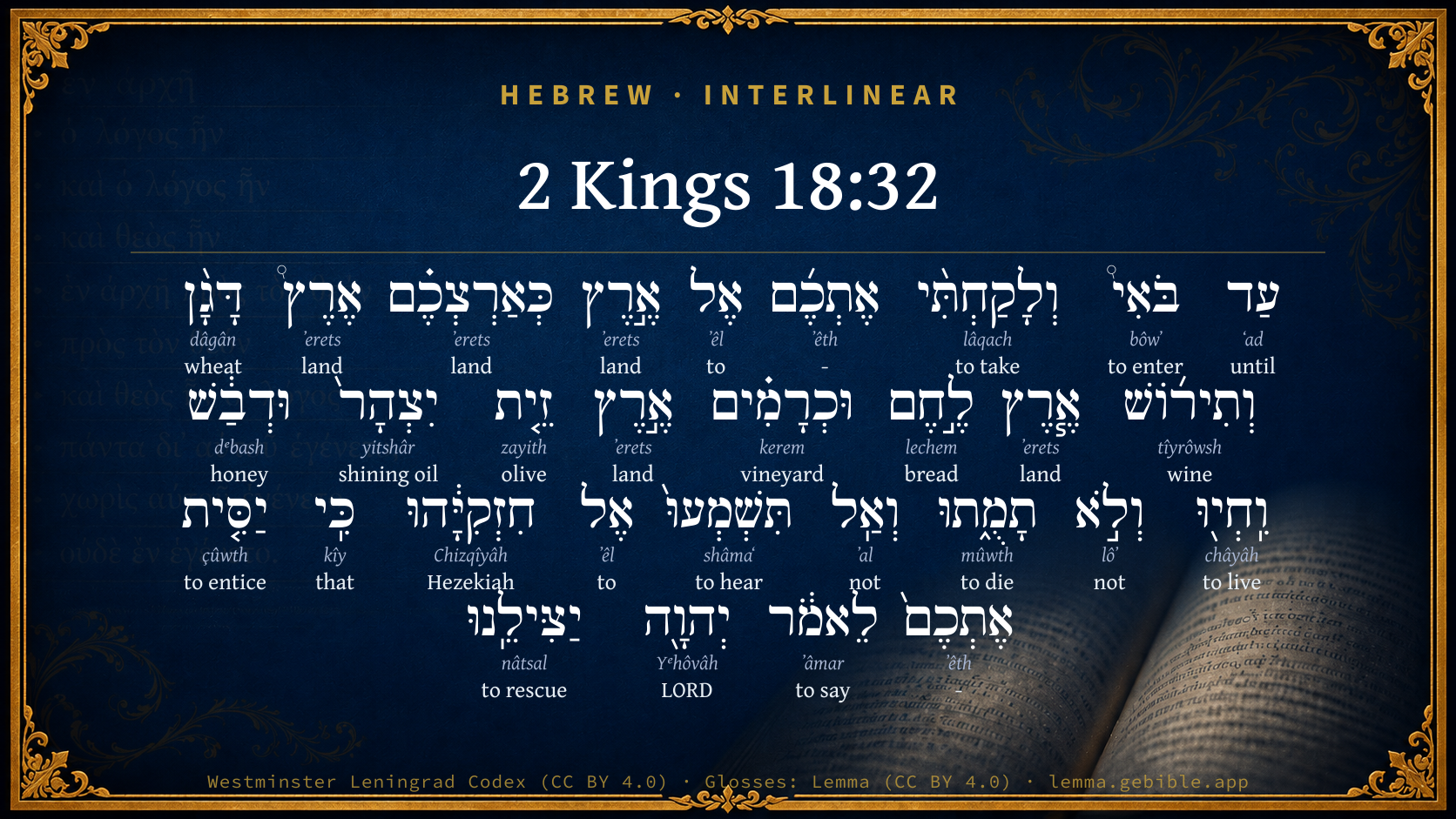
Hebrew (Westminster Leningrad Codex) 2 Kings 18:32 appears in the Hebrew Old Testament. The text above is from the Westminster Leningrad Codex. Each word links to its Strong’s number, a concise gloss, and parsing drawn from the Open Scriptures Hebrew Bible morphology. Click any word for its full Brown-Driver-Briggs (BDB) entry.
Download image
Cite this verse

2 Kings 18:32 (World English Bible). Public Domain. Lemma interlinear Bible study tool, https://lemma.gebible.app/v/2-kings/18/32.

Show BibTeX & RIS
BibTeX
RIS
English Translation
Until I come and take you away to a land like your own land, a land of grain and new wine, a land of bread and vineyards, a land of olive trees and of honey, that you may live, and not die: and don't listen to Hezekiah, when he persuades you, saying, Yahweh will deliver us.
World English Bible · Public Domain
Download a study sheet

One document with this verse’s original text, its word-by-word gloss line, the meaning frame, cross-references with their text, attributed commentary, and full source and license credits — printable, and it pastes into notes with its structure intact.

This verse Autodidact and up

Study sheet (.html) Plain text (.txt)

A passage Seminary Student

Up to 50 verses in one chapter. A passage sheet keeps up to 6 commentary sources and 12 cross-references per verse, in the order this page ranks them, and says so on the sheet whenever that leaves anything out. Ask for a single verse and you get the Autodidact verse sheet above.

Everything on this page stays free to read, with no account — the sheet is a download of what is already on screen, not access to it.

Want to remove ads? Support Godless Engineer
Compare translations 3

The same verse in 3 English versions, stacked beneath the original-language interlinear above. Click any original word for its lexicon entry.

Each is an independent rendering of the whole verse — the interlinear is not word-aligned to these translations.

Highlighted words mark where these versions differ — a whole-verse word diff, not a word-by-word alignment.

  • World English Bible Public Domain
    Until I come and take you away to a land like your own land, a land of grain and new wine, a land of bread and vineyards, a land of olive trees and of honey, that you may live, and not die: and don't listen to Hezekiah, when he persuades you, saying, Yahweh will deliver us.
  • King James Version Public Domain
    Until I come and take you away to a land like your own land, a land of corn and wine, a land of bread and vineyards, a land of oil olive and of honey, that ye may live, and not die: and hearken not unto Hezekiah, when he persuadeth you, saying, The LORD will deliver us.
  • unfoldingWord Literal Text CC BY-SA 4.0
    until I come and take you to a land like your land, a land of grain and new wine, a land of bread and vineyards, a land of olive of oil and honey. So live, and do not die. And do not listen to Hezekiah when he misleads you, saying, “Yahweh will deliver us.”

unfoldingWord Literal Text — © unfoldingWord, licensed CC BY-SA 4.0. Word-aligned USFM3 via Door43 (git.door43.org/unfoldingWord/en_ult).

Versions to compare (up to 4)

3 of 4 selected

Show all 18 translations

Every available English version of this verse, each an independent rendering of the whole verse.

  • World English Bible Public Domain
    Until I come and take you away to a land like your own land, a land of grain and new wine, a land of bread and vineyards, a land of olive trees and of honey, that you may live, and not die: and don't listen to Hezekiah, when he persuades you, saying, Yahweh will deliver us.
  • Berean Standard Bible Public Domain
    until I come and take you away to a land like your own—a land of grain and new wine, a land of bread and vineyards, a land of olive trees and honey—so that you may live and not die. But do not listen to Hezekiah, for he misleads you when he says, ‘The LORD will deliver us.’
  • Majority Standard Bible Public Domain
    until I come and take you away to a land like your own—a land of grain and new wine, a land of bread and vineyards, a land of olive trees and honey—so that you may live and not die. But do not listen to Hezekiah, for he misleads you when he says, ‘The LORD will deliver us.’
  • King James Version Public Domain
    Until I come and take you away to a land like your own land, a land of corn and wine, a land of bread and vineyards, a land of oil olive and of honey, that ye may live, and not die: and hearken not unto Hezekiah, when he persuadeth you, saying, The LORD will deliver us.
  • American Standard Version (1901) Public Domain
    Until I come and take you away to a land like your own land, a land of grain and new wine, a land of bread and vineyards, a land of olive-trees and of honey, that ye may live, and not die: and hearken not unto Hezekiah, when he persuadeth you, saying, Jehovah will deliver us.
  • Revised Version (1885) Public Domain
    Until I come and take you away to a land like your own land, a land of corn and wine, a land of bread and vineyards, a land of oil olive and of honey, that ye may live, and not die: and hearken not unto Hezekiah, when he persuadeth you, saying, The LORD will deliver us.
  • Geneva Bible (1599) Public Domain
    Till I come, and bring you to a land like your owne land, euen a land of wheate and wine, a land of bread and vineyardes, a lande of oliues oyle, and hony, that ye may liue and not die: and obey not Hezekiah, for he deceiueth you, saying, The Lord will deliuer vs.
  • Douay-Rheims (1899) Public Domain
    Till I come, and take you away to a land, like to your own land, a fruitful land, and plentiful in wine, a land of bread and vineyards, a land of olives, and oil and honey, and you shall live, and not die. Hearken not to Ezechias, who deceiveth you, saying: The Lord will deliver us.
  • Young's Literal Translation Public Domain
    till my coming in, and I have taken you unto a land like your own land, a land of corn and new wine, a land of bread and vineyards, a land of oil olive, and honey, and live, and die not; and do not hearken unto Hezekiah, when he persuadeth you, saying, Jehovah doth deliver us.
  • Literal Standard Version CC BY-SA 4.0
    until my coming in, and I have taken you to a land like your own land, a land of grain and new wine, a land of bread and vineyards, a land of olive oil, and honey; and live, and do not die; and do not listen to Hezekiah when he persuades you, saying, YHWH delivers us.
  • Unlocked Literal Bible CC BY-SA 4.0
    You will do this until I come and take you away to a land like your own land, a land of grain and new wine, a land of bread and vineyards, a land of olive trees and honey, so that you may live and not die.' Do not listen to Hezekiah when he tries to persuade you, saying, 'Yahweh will rescue us.'
  • unfoldingWord Literal Text CC BY-SA 4.0
    until I come and take you to a land like your land, a land of grain and new wine, a land of bread and vineyards, a land of olive of oil and honey. So live, and do not die. And do not listen to Hezekiah when he misleads you, saying, “Yahweh will deliver us.”
  • Darby Bible Public Domain
    until I come and take you away to a land like your own land, a land of corn and wine, a land of bread and vineyards, a land of olive-trees and of honey, that ye may live and not die; and hearken not to Hezekiah, when he persuades you, saying, Jehovah will deliver us.
  • World Messianic Bible Public Domain
    until I come and take you away to a land like your own land, a land of grain and new wine, a land of bread and vineyards, a land of olive trees and of honey, that you may live and not die. Don’t listen to Hezekiah when he persuades you, saying, “The LORD will deliver us.”
  • Webster's Bible Public Domain
    Until I come and take you away to a land like your own land, a land of corn and wine, a land of bread and vineyards, a land of olive-oil and of honey, that ye may live, and not die: and hearken not to Hezekiah, when he persuadeth you, saying, The LORD will deliver us.
  • Free Bible Version CC BY-SA 4.0
    I will come and take you to a land that's like your own, a land of grain and new wine, a land of bread and vineyards, a land of olive trees and honey. Then you will live and not die. But don't listen to Hezekiah, for he's tricking you when he says, ‘The Lord will deliver us.’
  • Bible in Basic English Public Domain
    Till I come and take you away to a land like yours, a land of grain and wine, a land of bread and vine-gardens, a land of oil-giving olives and of honey, so that life and not death may be your fate. Give no attention to Hezekiah when he says to you, The Lord will keep us safe.
  • JPS Tanakh (1917) Public Domain
    until I come and take you away to a land like your own land, a land of corn and wine, a land of bread and vineyards, a land of olive-trees and of honey, that ye may live, and not die; and hearken not unto Hezekiah, when he persuadeth you, saying: The LORD will deliver us.

Literal Standard Version (2020), Covenant Press — licensed CC BY-SA 4.0. Text via the HelloAO Bible API (eBible.org). Unlocked Literal Bible (unfoldingWord) — licensed CC BY-SA 4.0. Text via the HelloAO Bible API (eBible.org). unfoldingWord Literal Text — © unfoldingWord, licensed CC BY-SA 4.0. Word-aligned USFM3 via Door43 (git.door43.org/unfoldingWord/en_ult). Free Bible Version, Dr. Jonathan Gallagher — licensed CC BY-SA 4.0. Text via the HelloAO Bible API (eBible.org).

Word by word

More ways to search: Search by grammar → Find every occurrence → Compare this word →

Practice this passage: Drill this verse → Learn its vocabulary →

יַסִּ֤ית
çûwth
H5496
“to entice”
Verb, Hiphil, Imperfect, 3rd Person, Masculine, Singular
Part of Speech
Verb
Stem
Hiphil
Form
Imperfect
Person
3rd Person
Gender
Masculine
Number
Singular
Full BDB Definition

Origin: perhaps denominative from H7898

TWOT: 1481

to incite, allure, instigate, entice - (Hiphil) - to incite (to a request) - to allure, lure - to instigate (bad sense)
  1. עַד ʻad H5704 “until” Preposition
  2. בֹּאִי֩ bôwʼ H935 “to enter · me” Verb, Qal, Infinitive Construct + Suffix, Personal, 1st Person, Common, Singular
  3. וְלָקַחְתִּ֨י lâqach H3947 “and · to take” Conjunction + Verb, Qal, Sequential Perfect, 1st Person, Common, Singular
  4. אֶתְכֶ֜ם ʼêth H853 “- · you” Particle, Direct Object + Suffix, Personal, 2nd Person, Masculine, Plural
  5. אֶל ʼêl H413 “to” Preposition
  6. אֶ֣רֶץ ʼerets H776 “land” Noun, Common, Both, Singular, Absolute
  7. כְּאַרְצְכֶ֗ם ʼerets H776 “like/as · land · your” Preposition + Noun, Common, Both, Singular, Construct + Suffix, Personal, 2nd Person, Masculine, Plural
  8. אֶרֶץ֩ ʼerets H776 “land of” Noun, Common, Both, Singular, Construct
  9. דָּגָ֨ן dâgân H1715 “wheat” Noun, Common, Masculine, Singular, Absolute
  10. וְתִיר֜וֹשׁ tîyrôwsh H8492 “and · wine” Conjunction + Noun, Common, Masculine, Singular, Absolute
  11. אֶ֧רֶץ ʼerets H776 “land of” Noun, Common, Both, Singular, Construct
  12. לֶ֣חֶם lechem H3899 “bread” Noun, Common, Both, Singular, Absolute
  13. וּכְרָמִ֗ים kerem H3754 “and · vineyards” Conjunction + Noun, Common, Both, Plural, Absolute
  14. אֶ֣רֶץ ʼerets H776 “land of” Noun, Common, Both, Singular, Construct
  15. זֵ֤ית zayith H2132 “olive of” Noun, Common, Masculine, Singular, Construct
  16. יִצְהָר֙ yitshâr H3323 “shining oil” Noun, Common, Masculine, Singular, Absolute
  17. וּדְבַ֔שׁ dᵉbash H1706 “and · honey” Conjunction + Noun, Common, Masculine, Singular, Absolute
  18. וִֽחְי֖וּ châyâh H2421 “and · live” Conjunction + Verb, Qal, Imperative, 2nd Person, Masculine, Plural
  19. וְלֹ֣א lôʼ H3808 “and · not” Conjunction + Particle, Negative
  20. תָמֻ֑תוּ mûwth H4191 “to die” Verb, Qal, Imperfect, 2nd Person, Masculine, Plural
  21. וְאַֽל ʼal H408 “and · not” Conjunction + Particle, Negative
  22. תִּשְׁמְעוּ֙ shâmaʻ H8085 “to hear” Verb, Qal, Jussive, 2nd Person, Masculine, Plural
  23. אֶל ʼêl H413 “to” Preposition
  24. חִזְקִיָּ֔הוּ Chizqîyâh H2396 “Hezekiah” Noun, Proper
  25. כִּֽי kîy H3588 “that” Conjunction
  26. אֶתְכֶם֙ ʼêth H853 “- · you” Particle, Direct Object + Suffix, Personal, 2nd Person, Masculine, Plural
  27. לֵאמֹ֔ר ʼâmar H559 “to say” Preposition + Verb, Qal, Infinitive Construct
  28. יְהוָ֖ה Yᵉhôvâh H3068 “LORD” Noun, Proper
  29. יַצִּילֵֽנוּ nâtsal H5337 “to rescue · us” Verb, Hiphil, Imperfect, 3rd Person, Masculine, Singular + Suffix, Personal, 1st Person, Common, Plural

About this verse

These counts appear in no published source. They are computed here, from the morphology-tagged text and Lemma’s own curated glosses. What Lemma adds →

30
words
24
distinct lemmas
Historical
section

Notable vocabulary

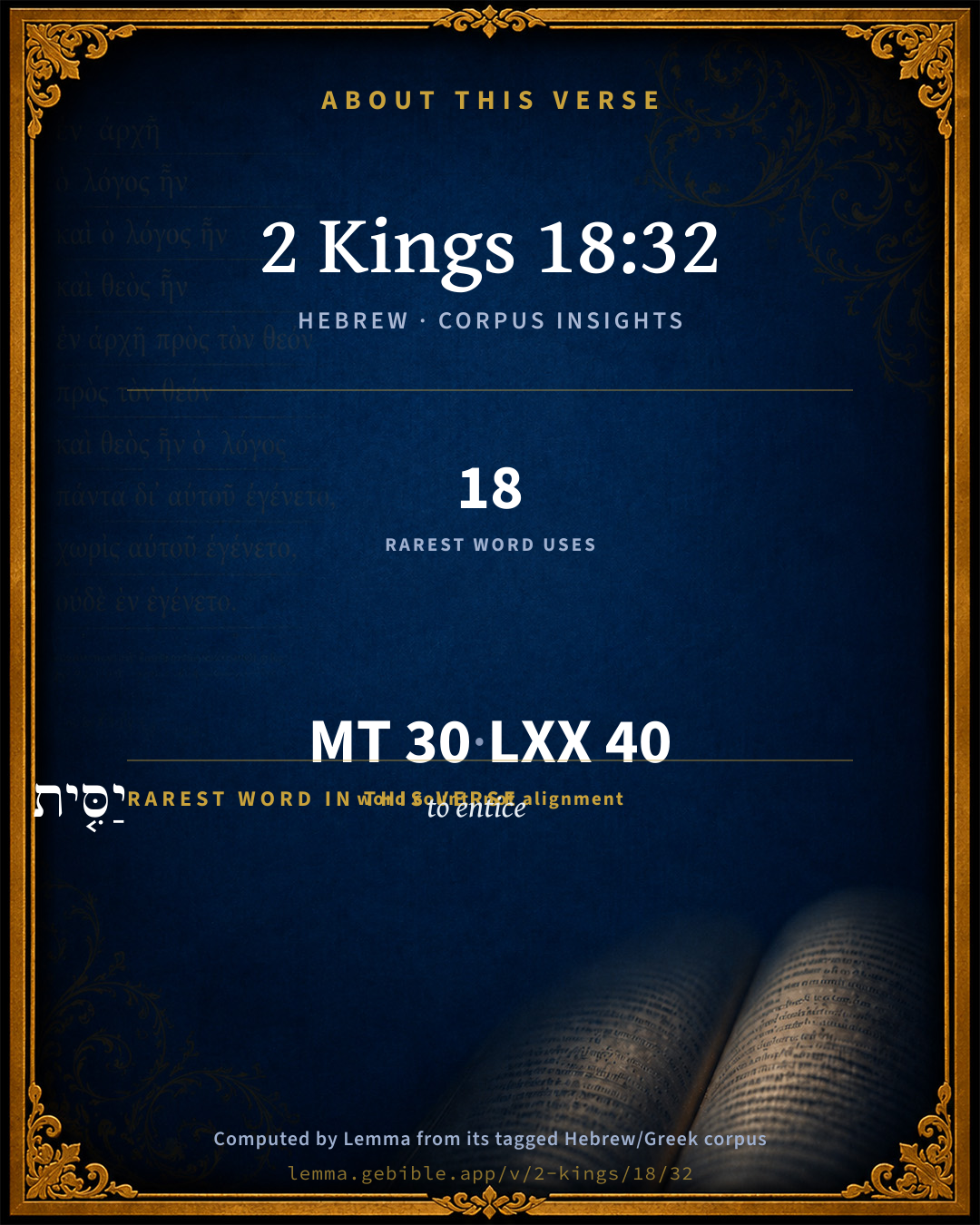
The rarest word here is יַסִּ֤ית to entice H5496 — appearing just 18 times in the whole Hebrew Bible.

Shared distinctive vocabulary

יַסִּ֤ית to entice H5496 occurs in 18 verses of the Hebrew Bible. Also found in:

Grammatical profile

  • 8 verbs
  • 14 nouns
  • 3 prepositions
  • 1 conjunction
  • 4 particles

Verb forms

  • בֹּאִי֩ Qal · Infinitive Construct
  • וְלָקַחְתִּ֨י Qal · Sequential Perfect
  • וִֽחְי֖וּ Qal · Imperative
  • תָמֻ֑תוּ Qal · Imperfect
  • תִּשְׁמְעוּ֙ Qal · Jussive
  • יַסִּ֤ית Hiphil · Imperfect
  • לֵאמֹ֔ר Qal · Infinitive Construct
  • יַצִּילֵֽנוּ Hiphil · Imperfect

Repetition

Words recur within this verse — often emphatic in Hebrew:

  • אֶ֣רֶץ land H776 ×5
  • אֶל to H413 ×2

Hebrew & Septuagint length

In English translation the verse runs 56 words from the Hebrew and 54 from the Septuagint (LXX English) — closely comparable.

A rough comparison of the two English renderings, which tokenize alike — not a word-level alignment.

Word counts can differ between the Hebrew and the Greek without any difference in meaning — e.g. the Hebrew direct-object marker אֵת has no separate Greek word, and Greek often adds the article ὁ.

In the original languages it is 30 Hebrew tokens and 40 Greek tokens — but the two are counted differently (Hebrew bundles its prefixes and suffixes into one token; the Greek is in lemma form), so that isn’t a like-for-like length.

Cross-references

11

Topical passages linked to 2 Kings 18:32 in the Treasury of Scripture Knowledge — connected by theme and wording, ordered by reader-vote popularity; previews shown in the World English Bible.

  • Deuteronomy 8:7–9 For Yahweh your God brings you into a good land, a land of brooks of water, of springs and springs, flowing forth in valleys and hills;
  • Exodus 3:8 I have come down to deliver them out of the hand of the Egyptians, and to bring them up out of that land to a good and large land, to a land flowing with milk and honey; to the place of the Canaanite, the Hittite, the Amorite, the Perizzite, the Hivite, and the Jebusite.
  • Deuteronomy 11:12 a land which Yahweh your God cares for: the eyes of Yahweh your God are always on it, from the beginning of the year even to the end of the year.
  • Numbers 13:26–27 They went and came to Moses, and to Aaron, and to all the congregation of the children of Israel, to the wilderness of Paran, to Kadesh; and brought back word to them, and to all the congregation, and shown them the fruit of the land.
  • Numbers 14:8 If Yahweh delight in us, then he will bring us into this land, and give it to us; a land which flows with milk and honey.
  • Deuteronomy 32:13–14 He made him ride on the high places of the earth, He ate the increase of the field; He made him to suck honey out of the rock, Oil out of the flinty rock;
  • 2 Kings 17:6 In the ninth year of Hoshea the king of Assyria took Samaria, and carried Israel away to Assyria, and placed them in Halah, and on the Habor, the river of Gozan, and in the cities of the Medes.
  • 2 Kings 17:23 until Yahweh removed Israel out of his sight, as he spoke by all his servants the prophets. So Israel was carried away out of their own land to Assyria to this day.
  • 2 Kings 18:11 The king of Assyria carried Israel away to Assyria, and put them in Halah, and on the Habor, the river of Gozan, and in the cities of the Medes,
  • 2 Kings 24:14–16 He carried away all Jerusalem, and all the princes, and all the mighty men of valor, even ten thousand captives, and all the craftsmen and the smiths; none remained, save the poorest sort of the people of the land.
  • 2 Kings 25:11 The residue of the people who were left in the city, and those who fell away, who fell to the king of Babylon, and the residue of the multitude, did Nebuzaradan the captain of the guard carry away captive.

Cross-references courtesy of OpenBible.info (CC BY 4.0).

Hebrew and Greek witnesses Masoretic Hebrew ↔ Greek Septuagint

The same verse in the two great witnesses to the Old Testament, shown verse-for-verse.

These are two independent witnesses, not word-aligned to each other, and the Septuagint is shown in lemma (dictionary) form.

Hebrew 2 Kings 18:32 Masoretic · Westminster Leningrad Codex

עַד בֹּאִי֩ וְלָקַחְתִּ֨י אֶתְכֶ֜ם אֶל אֶ֣רֶץ כְּאַרְצְכֶ֗ם אֶרֶץ֩ דָּגָ֨ן וְתִיר֜וֹשׁ אֶ֧רֶץ לֶ֣חֶם וּכְרָמִ֗ים אֶ֣רֶץ זֵ֤ית יִצְהָר֙ וּדְבַ֔שׁ וִֽחְי֖וּ וְלֹ֣א תָמֻ֑תוּ וְאַֽל תִּשְׁמְעוּ֙ אֶל חִזְקִיָּ֔הוּ כִּֽי יַסִּ֤ית אֶתְכֶם֙ לֵאמֹ֔ר יְהוָ֖ה יַצִּילֵֽנוּ

Until I come and take you away to a land like your own land, a land of grain and new wine, a land of bread and vineyards, a land of olive trees and of honey, that you may live, and not die: and don't listen to Hezekiah, when he persuades you, saying, Yahweh will deliver us.

World English Bible · Public Domain

Greek LXX 2 Kings 18:32 Septuagint · lemma form

ἕως ἔρχομαι καί λαμβάνω σύ εἰς γῆ ὡς γῆ σύ γῆ σῖτος καί οἶνος καί ἄρτος καί ἀμπελών γῆ ἐλαία ἔλαιον καί μέλι καί ζάω καί οὐ μή ἀποθνήσκω καί μή ἀκούω εζεκιας ὅτι ἀπατάω σύ λέγω κύριος ῥύομαι ἐγώ

until I come and remove you to a land like your own land, a land of corn and wine, and bread and vineyards, a land of olive oil, and honey, and you⌃ shall live and not die: and do not you⌃ listen to Ezekias, for he deceives you, saying, The Lord shall deliver you.

LXX2012 (modern English Septuagint) · Public Domain

Hebrew: Westminster Leningrad Codex (CC BY 4.0). Greek: Septuagint (public domain); English from LXX2012 (modern English Septuagint) (Public Domain). How the Septuagint differs from the Hebrew →

Targum (Aramaic paraphrase)

1

The Targum is the ancient Jewish Aramaic paraphrase of the Hebrew Scriptures — an interpretive translation, not the Hebrew text itself. Onkelos (literal) and Pseudo-Jonathan (expansive) render the Torah, and Jonathan the Prophets. Coverage is partial: where no permissively-licensed English translation exists for a verse, only the Aramaic is shown. This is verse-level text, not a word-by-word alignment to the Hebrew.

  1. Targum Jonathan Prophets (Joshua–Malachi)
    עַד מֵיתִי וְאֶדְבַּר יַתְכוֹן לְאַרְעָא טָבָא כְּאַרְעֲכוֹן אַרְעָא עִבּוּר וַחֲמַר אַרְעָא חַקְלִין וְכַרְמִין אַרְעָא דְזֵיתָהָא עָבְדִין מִשְׁחָא וְהִיא עַבְדָא דְבַשׁ וִחְיוּן וְלָא תְמוּתוּן וְלָא תְקַבְּלוּן מִן חִזְקִיָה אֲרֵי יַטְעֵי יַתְכוֹן לְמֵימָר יְיָ יְשֵׁיזְבִינָנָא:

    (no public-domain English translation for this verse)

    Targum Jonathan — Aramaic: “Mikraot Gedolot” (public domain). English: “Sefaria Community Translation” (CC0 1.0 (public-domain dedication)); “London "Chaldee Paraphrase," 1871” (public domain). Text via Sefaria.

Commentary

Notes on 2 Kings 18:32 from classic Christian and Jewish commentators (each source and its license shown beneath its notes). The classic Christian expositions comment on the surrounding passage and are grouped to its opening verse, so a note may address several verses; the Jewish commentaries on the Tanakh (Rashi and others) are per-verse, so they appear only where the commentator wrote on this verse.

Lemma curates 59 commentaries, every one of them public domain or Creative Commons licensed, each selected and text-cleaned for this edition rather than reprinted as found. About our sources →

Trapp's Complete Commentary

John Trapp

2Ki 18:32 Until I come and take you away to a land like your own land, a land of corn and wine, a land of bread and vineyards, a land of oil olive and of honey, that ye may live, and not die: and hearken not unto Hezekiah, when he persuadeth you, saying, The LORD will deliver us.

Ver. 32. To a land like your own land.] Which was a land that God himself had "espied for them, flowing with milk and honey, the glory of all lands." {Eze 20:6} Sumen totius orbis, in quo saxa durissima mel et oleum sudabant {Deu 32:13 Exo 3:17} This Rabshakeh here acknowledgeth, and is therein more ingenuous than Strabo the geographer ( strabus et pravus nimium), who traduceth Judea for dry and barren, nec satis dignam de qua magnopere pugnetur, not worth striving for. {a}

And hearken not unto Hezekiah.] This is a string that he much harpeth upon. It is our faith that Satan chiefly striketh at; {Luk 22:32} hold fast this shield. {Eph 6:16}

{a} Tacitus uber solum Iudaeis attribuit.

John Trapp, A Commentary or Exposition upon All the Books of the Old and New Testament (1647–1656) — public domain. Text from a community e-Sword module.

Joseph Benson's Commentary

2Ki 18:32. Until I take you away to a land like your own — That is, a fruitful and pleasant land. Because he could not conceal from them his intentions of transplanting them into another land, having already discovered these intentions in his dealing with the Israelites and other nations; he assures them they should be no losers by it, and should only change their place, but not their condition and comforts, which they should enjoy in that land no less than in their own.

Joseph Benson's Commentary on the Old and New Testaments (1811–1818) — public domain. Text from a community e-Sword module.

Tyndale Open Study Notes

Tyndale Open Resources

18:32-35 The Lord will rescue us: The chief of staff continued his psychological taunting by asserting that the Lord was just like the gods of the other nations and could not save Judah. • Arpad was a city-state located northwest of Aleppo. Like Hamath, it was a hub of Aramean activity and is mentioned on other occasions in the Old Testament (see Isa 10:9; Jer 49:23).

Tyndale Open Study Notes — © Tyndale Open Resources, licensed CC BY-SA 4.0. Text via the HelloAO Bible API.

Geneva Bible (1599)

Geneva Bible translators

He maketh himself so sure, that he will not grant them truce, except they render themselves to him to be led away captives.

Geneva Bible (1599) marginal notes — public domain. Text via Bolls.life.

Adam Clarke's Commentary

Verse 32. Until I come and take you away] This was well calculated to stir up a seditious spirit. Ye cannot be delivered; your destruction, if ye resist, is inevitable; Sennacherib will do with you, as he does with all the nations he conquers, lead you captive into another land: but if you will surrender without farther trouble, he will transport you into a land as good as your own.

Adam Clarke's Commentary on the Bible (1810–1826) — public domain. Text from a community e-Sword/MySword module.

Ellicott's Commentary for English Readers

(32) Oil olive.—The cultivated as distinct from the wild olive, or oleaster (1Ki_6:23), which yields less and worse oil.

That ye may live.—Or, and ye shall live; a general promise of immunity, if they obey. (There should be, in this case, a stop at “honey.”)

When he persuadeth you.—Or, if he prick you on (1Ch_21:1).

A Bible Commentary for English Readers, edited by Charles John Ellicott (1878–1897) — public domain. Text from a community e-Sword module.

The Cambridge Bible for Schools and Colleges

gen. ed. J. J. S. Perowne

32. until I come and take you] Submission was to be followed, as was usual with Assyria, by deportation, but the people are promised a land as good as their own. For the similar description of the land of Canaan see Deu_8:7-9.

and not die] Again he refers, as to an argument likely to be most powerful, to the famine which was imminent if the siege continued.

The Cambridge Bible for Schools and Colleges (gen. ed. J. J. S. Perowne; Cambridge University Press, 1878–1918) — public domain. Text from a community e-Sword module.

Haydock's Catholic Bible Commentary

Till. Sennacherib will remove you to another country, but it will be as good as this. He requires you to surrender at discretion. (Calmet) --- Deliver us. This will not be in his power, no more than it was in that of the other tutelary gods. (Menochius) --- Infidels and heretics are very foolish thus to compare their delusions with God, and his holy religion. (Worthington)

George Leo Haydock (1774–1849), Haydock's Catholic Family Bible and Commentary, 1859 edition — public domain. Excludes Psalms (Douay-Rheims chapter numbering differs from Protestant) and Deuterocanonical books (Catholic canon only).

Matthew Poole's English Annotations

Like your own land, i.e. a fruitful and pleasant land. Because he could not conceal from them his intentions of transplanting them into another land, which he had already discovered in his dealing with the Israelites, and other nations, he assures them they shall be no losers by it; and shall only change their place, but not their condition and comforts; which they should enjoy in that land, no less than in their own.

Matthew Poole's English Annotations on the Holy Bible (1683–1685) — public domain. Text from a community e-Sword/MySword module.

Whedon's Commentary on the Bible

Daniel D. Whedon

32. Until I come — From the siege of Lachish and the Egyptian campaign. Compare note on 2Ki_18:17. This seems to be the most natural reference of these words, for Rab-shakeh here speaks in the name of his absent master, who will finish the destruction of that “bruised reed” Egypt, and make the necessary preparations for returning to Assyria, and settling his captives in a pleasant land, before he comes to take them away. We need not attempt to define the land referred to; the whole promise was a mere pretext.

Daniel D. Whedon (gen. ed.), Commentary on the Old and New Testaments (1874–1909) — public domain. Text from a community e-Sword module.

The Pulpit Commentary

Until I come and take you away to a land like your own land. Rabshakeh did not dissemble the fact that they must look for a transplantation. Probably he felt that, if he did, he would not be believed.

The transplantations had been too numerous and too recent, the examples of Samaria, Damascus, Hamath, Ashdod, etc., were too notorious, for it to be worth his while to pretend that Judaea would have any other fate. He therefore set himself the task of persuading the Jews that transplantation had nothing about it displeasing or even disagreeable that, in fact, they were to be envied rather than pitied for being about to experience it. The King of Assyria, in the goodness of his paternal breast, would select for them a land as nearly as possible "like their own land a land teeming with corn and wine and oil, full of rich arable tracts, of vineyards and of olive-grounds, which would yield them those fruits of the earth to which they were accustomed, in abundance. What security they had that these promises would be fulfilled, he did not attempt to show them; much less did he explain to them why, if they were to gain rather than lose, it was worth while transplanting them at all; how that transplanted nations lost all spirit and patriotism, sank into apathy, and gave no trouble to their masters. A land of corn and wine, a land of bread and vineyards, a land of oil olive and of honey. (comp. Deu_8:8, Deu_8:9, which has, no doubt, affected the language of the reporter, who gives the general tenor of Rabshakeh"s speech, but could not have taken down or have remembered his exact words) that ye may live, and not die as you win if you follow Hezekiah"s adviceand therefore hearken not unto Hezekiah, when he persuadethi.e. , seeketh to persuadeyou, saying, The Lord will deliver us (see the comment on ver. 30).

The Pulpit Commentary (1880–1919), ed. H.D.M. Spence-Jones & Joseph S. Exell — public domain. Text from a community e-Sword module.

Rashi

Rabbi Shlomo Yitzchaki (Rashi)

To a land like you land. This is my custom to move the nations from province to province. He should have said, “to a land better than yours,” because he came to persuade them, but he knew that they would recognize that his statement was false.

A land of grain and wine. This is Africa.

Rashi on the Tanakh — English translations: “The Judaica Press complete Tanach with Rashi, translated by A. J. Rosenberg” (CC BY 4.0); “Pentateuch with Rashi's commentary by M. Rosenbaum and A.M. Silbermann, 1929-1934” (public domain); “The Metsudah Tanach series, Lakewood, N.J” (CC BY 4.0); and “The Book of Joshua, Metsudah Publications, 1997” (CC BY 4.0). Text via Sefaria.

Lesson kit

Teaching starters — assembled from the data on this page, not authored interpretation. Every prompt links to the verse data it draws on. Edit before teaching.

2 Kings, in the Historical, opens this verse with 30 words (24 distinct Hebrew lemmas). Its most distinctive word is çûwth (“to entice”). A historical commentator’s framing appears above. Read the whole chapter for the surrounding context.

Discussion questions

  1. The word çûwth carries the sense “to entice.” How does it shape the verse?
  2. Deuteronomy 13:6 shares the word «to entice» with this verse. How do the two illuminate each other?
  3. “land” occurs 5× in this one verse. What is the effect of the repetition?
  4. These translations render this verse differently; the difference is in the English rendering, not the original. What questions does that raise?
  5. The verb «בֹּאִי֩» is Qal Infinitive Construct. How does its form color the action?
  6. Reading how Trapp's Complete Commentary and Joseph Benson's Commentary read this verse, where do the two commentators agree and where do they part?

Things to notice

Reading settings

Reading text

Shown beneath each verse's original-language words.

Old Testament
Old Testament edition

Read the OT as the Masoretic Hebrew (MT) or the Greek Septuagint (LXX).

English shown for the Greek Septuagint (in the Hebrew ↔ Greek comparison).

Comparing translations? Open the Compare panel on any verse page to stack up to four side by side.