
Joshua 10:6

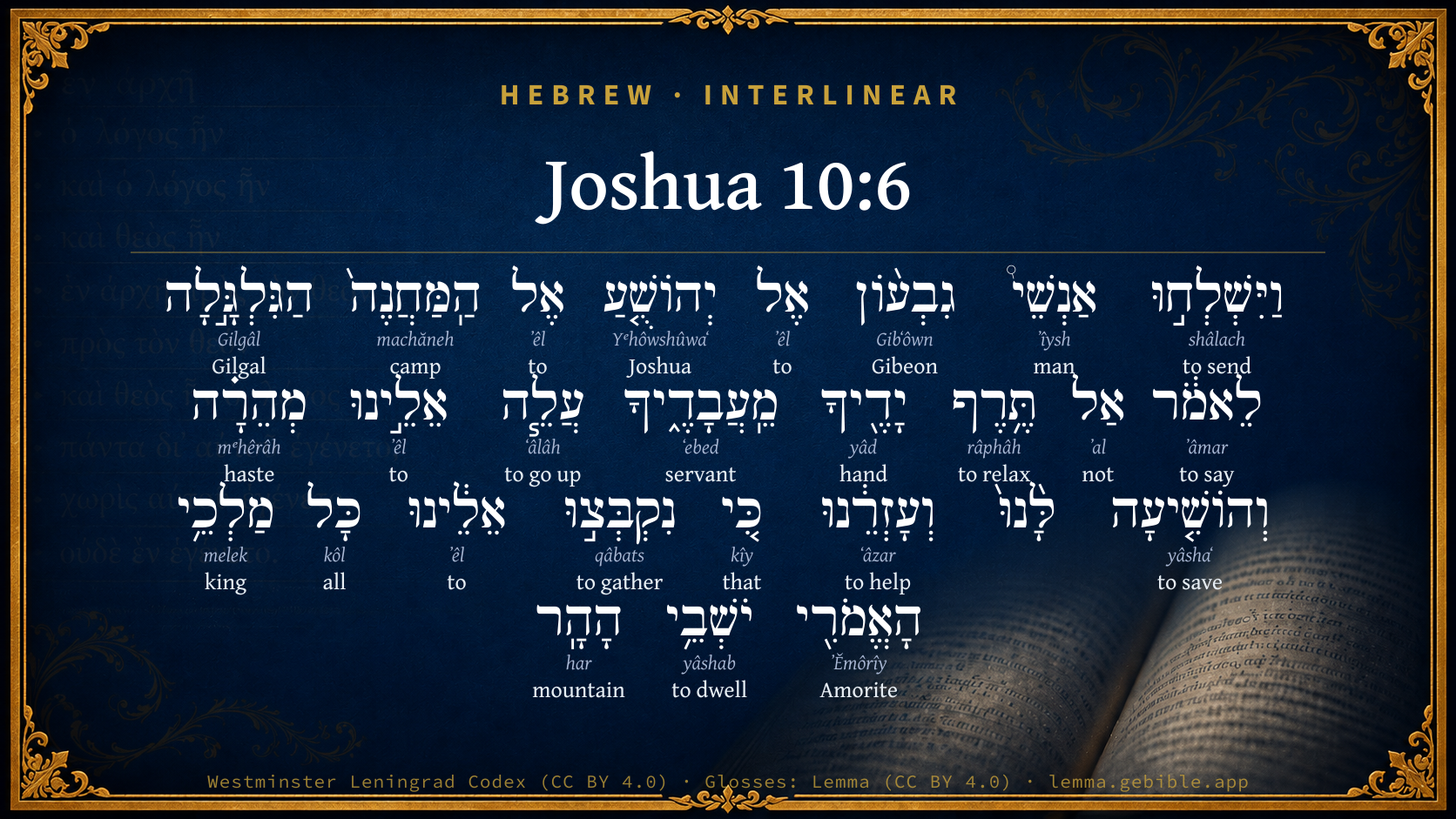
Hebrew (Westminster Leningrad Codex) Joshua 10:6 appears in the Hebrew Old Testament. The text above is from the Westminster Leningrad Codex. Each word links to its Strong’s number, a concise gloss, and parsing drawn from the Open Scriptures Hebrew Bible morphology. Click any word for its full Brown-Driver-Briggs (BDB) entry.
Download image
Cite this verse

Joshua 10:6 (World English Bible). Public Domain. Lemma interlinear Bible study tool, https://lemma.gebible.app/v/joshua/10/6.

Show BibTeX & RIS
BibTeX
RIS
English Translation
The men of Gibeon sent to Joshua to the camp to Gilgal, saying, Don't slack your hand from your servants; come up to us quickly, and save us, and help us: for all the kings of the Amorites that dwell in the hill-country are gathered together against us.
World English Bible · Public Domain
Download a study sheet

One document with this verse’s original text, its word-by-word gloss line, the meaning frame, cross-references with their text, attributed commentary, and full source and license credits — printable, and it pastes into notes with its structure intact.

This verse Autodidact and up

Study sheet (.html) Plain text (.txt)

A passage Seminary Student

Up to 50 verses in one chapter. A passage sheet keeps up to 6 commentary sources and 12 cross-references per verse, in the order this page ranks them, and says so on the sheet whenever that leaves anything out. Ask for a single verse and you get the Autodidact verse sheet above.

Everything on this page stays free to read, with no account — the sheet is a download of what is already on screen, not access to it.

Want to remove ads? Support Godless Engineer
Compare translations 3

The same verse in 3 English versions, stacked beneath the original-language interlinear above. Click any original word for its lexicon entry.

Each is an independent rendering of the whole verse — the interlinear is not word-aligned to these translations.

Highlighted words mark where these versions differ — a whole-verse word diff, not a word-by-word alignment.

  • World English Bible Public Domain
    The men of Gibeon sent to Joshua to the camp to Gilgal, saying, Don't slack your hand from your servants; come up to us quickly, and save us, and help us: for all the kings of the Amorites that dwell in the hill-country are gathered together against us.
  • King James Version Public Domain
    And the men of Gibeon sent unto Joshua to the camp to Gilgal, saying, Slack not thy hand from thy servants; come up to us quickly, and save us, and help us: for all the kings of the Amorites that dwell in the mountains are gathered together against us.
  • unfoldingWord Literal Text CC BY-SA 4.0
    And the men of Gibeon sent to Joshua at the camp at Gilgal, saying, “Do not let your hands drop from your servants. Come up to us quickly and save us and help us, because all of the kings of the Amorite dwelling the hill country have gathered against us.”

unfoldingWord Literal Text — © unfoldingWord, licensed CC BY-SA 4.0. Word-aligned USFM3 via Door43 (git.door43.org/unfoldingWord/en_ult).

Versions to compare (up to 4)

3 of 4 selected

Show all 18 translations

Every available English version of this verse, each an independent rendering of the whole verse.

  • World English Bible Public Domain
    The men of Gibeon sent to Joshua to the camp to Gilgal, saying, Don't slack your hand from your servants; come up to us quickly, and save us, and help us: for all the kings of the Amorites that dwell in the hill-country are gathered together against us.
  • Berean Standard Bible Public Domain
    Then the men of Gibeon sent word to Joshua in the camp at Gilgal: “Do not abandon your servants. Come quickly and save us! Help us, because all the kings of the Amorites from the hill country have joined forces against us.”
  • Majority Standard Bible Public Domain
    Then the men of Gibeon sent word to Joshua in the camp at Gilgal: “Do not abandon your servants. Come quickly and save us! Help us, because all the kings of the Amorites from the hill country have joined forces against us.”
  • King James Version Public Domain
    And the men of Gibeon sent unto Joshua to the camp to Gilgal, saying, Slack not thy hand from thy servants; come up to us quickly, and save us, and help us: for all the kings of the Amorites that dwell in the mountains are gathered together against us.
  • American Standard Version (1901) Public Domain
    And the men of Gibeon sent unto Joshua to the camp to Gilgal, saying, Slack not thy hand from thy servants; come up to us quickly, and save us, and help us: for all the kings of the Amorites that dwell in the hill-country are gathered together against us.
  • Revised Version (1885) Public Domain
    And the men of Gibeon sent unto Joshua to the camp to Gilgal, saying, Slack not thy hand from thy servants; come up to us quickly, and save us, and help us: for all the kings of the Amorites that dwell in the hill country are gathered together against us.
  • Geneva Bible (1599) Public Domain
    And the men of Gibeon sent vnto Ioshua, euen to the hoste to Gilgal, saying, Withdrawe not thine hand from thy seruants: come vp to vs quickly, and saue vs, and helpe vs: for all the Kings of the Amorites which dwell in the mountaines, are gathered together against vs.
  • Douay-Rheims (1899) Public Domain
    But the inhabitants of the city of Gabaon which was besieged, sent to Josue, who then abode in the camp at Galgal, and said to him: Withdraw not thy hands from helping thy servants: come up quickly and save us, and bring us succour: for all the kings of the Amorrhites, who dwell in the mountains, are gathered together against us.
  • Young's Literal Translation Public Domain
    And the men of Gibeon send unto Joshua, unto the camp at Gilgal, saying, `Let not thy hand cease from thy servants; come up unto us `with' haste, and give safety to us, and help us; for all the kings of the Amorite, dwelling in the hill-country, have been assembled against us.'
  • Literal Standard Version CC BY-SA 4.0
    And the men of Gibeon send to Joshua, to the camp at Gilgal, saying, “Do not let your hand cease from your servants; come up to us [with] haste, and give safety to us, and help us; for all the kings of the Amorite, dwelling in the hill-country, have been assembled against us.”
  • Unlocked Literal Bible CC BY-SA 4.0
    The people of Gibeon sent a message to Joshua and to the army at Gilgal. They said, “Hurry! Do not withdraw your hands from your servants. Come up to us quickly and save us. Help us, for all the kings of the Amorites who live in the hill country have gathered together to attack us.”
  • unfoldingWord Literal Text CC BY-SA 4.0
    And the men of Gibeon sent to Joshua at the camp at Gilgal, saying, “Do not let your hands drop from your servants. Come up to us quickly and save us and help us, because all of the kings of the Amorite dwelling the hill country have gathered against us.”
  • Darby Bible Public Domain
    And the men of Gibeon sent to Joshua, to the camp at Gilgal, saying, Withdraw not thy hand from thy servants: come up to us quickly, and save us and help us; for all the kings of the Amorites that dwell in the hill-country are gathered against us.
  • World Messianic Bible Public Domain
    The men of Gibeon sent to Joshua at the camp at Gilgal, saying, “Don’t abandon your servants! Come up to us quickly and save us! Help us; for all the kings of the Amorites that dwell in the hill country have gathered together against us.”
  • Webster's Bible Public Domain
    And the men of Gibeon sent to Joshua to the camp at Gilgal, saying, Slack not thy hand from thy servants; come up to us quickly, and save us, and help us: for all the kings of the Amorites that dwell in the mountains, are assembled against us.
  • Free Bible Version CC BY-SA 4.0
    The Gibeonites sent a message to Joshua at the camp in Gilgal, saying, “Please don't abandon us, your servants! Come quickly and save us! We need your help for all the Amorite kings of the hill country have joined in attacking us.”
  • Bible in Basic English Public Domain
    And the men of Gibeon sent to Joshua to the tent-circle at Gilgal, saying, Be not slow to send help to your servants; come up quickly to our support and keep us safe: for all the kings of the Amorites from the hill-country have come together against us.
  • JPS Tanakh (1917) Public Domain
    And the men of Gibeon sent unto Joshua to the camp to Gilgal, saying: 'Slack not thy hands from thy servants; come up to us quickly, and save us, and help us; for all the kings of the Amorites that dwell in the hill-country are gathered together against us.'

Literal Standard Version (2020), Covenant Press — licensed CC BY-SA 4.0. Text via the HelloAO Bible API (eBible.org). Unlocked Literal Bible (unfoldingWord) — licensed CC BY-SA 4.0. Text via the HelloAO Bible API (eBible.org). unfoldingWord Literal Text — © unfoldingWord, licensed CC BY-SA 4.0. Word-aligned USFM3 via Door43 (git.door43.org/unfoldingWord/en_ult). Free Bible Version, Dr. Jonathan Gallagher — licensed CC BY-SA 4.0. Text via the HelloAO Bible API (eBible.org).

Word by word

More ways to search: Search by grammar → Find every occurrence → Compare this word →

Practice this passage: Drill this verse → Learn its vocabulary →

מְהֵרָ֗ה
mᵉhêrâh
H4120
“haste”
Noun, Common, Feminine, Singular, Absolute
Part of Speech
Noun
Type
Common
Gender
Feminine
Number
Singular
State
Absolute
Full BDB Definition

Origin: from H4118

TWOT: 1152d

haste, speed - hastily, speedily (as adverb) - in haste (with preposition)
  1. וַיִּשְׁלְח֣וּ shâlach H7971 “and · to send” Conjunction + Verb, Qal, Sequential Imperfect, 3rd Person, Masculine, Plural
  2. אַנְשֵׁי֩ ʼîysh H376 “men of” Noun, Common, Masculine, Plural, Construct
  3. גִבְע֨וֹן Gibʻôwn H1391 “Gibeon” Noun, Proper
  4. אֶל ʼêl H413 “to” Preposition
  5. יְהוֹשֻׁ֤עַ Yᵉhôwshûwaʻ H3091 “Joshua” Noun, Proper
  6. אֶל ʼêl H413 “to” Preposition
  7. הַֽמַּחֲנֶה֙ machăneh H4264 “the · camp” Particle, Definite Article + Noun, Common, Both, Singular, Absolute
  8. הַגִּלְגָּ֣לָה Gilgâl H1537 “the · Gilgal · toward” Particle, Definite Article + Noun, Proper + Suffix, Demonstrative
  9. לֵאמֹ֔ר ʼâmar H559 “to say” Preposition + Verb, Qal, Infinitive Construct
  10. אַל ʼal H408 “not” Particle, Negative
  11. תֶּ֥רֶף râphâh H7503 “to relax” Verb, Hiphil, Jussive, 2nd Person, Masculine, Singular
  12. יָדֶ֖יךָ yâd H3027 “hands · your” Noun, Common, Both, Dual, Construct + Suffix, Personal, 2nd Person, Masculine, Singular
  13. מֵֽעֲבָדֶ֑יךָ ʻebed H5650 “from · servants · your” Preposition + Noun, Common, Masculine, Plural, Construct + Suffix, Personal, 2nd Person, Masculine, Singular
  14. עֲלֵ֧ה ʻâlâh H5927 “go up” Verb, Qal, Imperative, 2nd Person, Masculine, Singular
  15. אֵלֵ֣ינוּ ʼêl H413 “to · us” Preposition + Suffix, Personal, 1st Person, Common, Plural
  16. וְהוֹשִׁ֤יעָה yâshaʻ H3467 “and · save” Conjunction + Verb, Hiphil, Imperative, 2nd Person, Masculine, Singular + Suffix, h
  17. וְעָזְרֵ֔נוּ ʻâzar H5826 “and · help · us” Conjunction + Verb, Qal, Imperative, 2nd Person, Masculine, Singular + Suffix, Personal, 1st Person, Common, Plural
  18. כִּ֚י kîy H3588 “that” Conjunction
  19. נִקְבְּצ֣וּ qâbats H6908 “to gather” Verb, Niphal, Perfect, 3rd Person, Common, Plural
  20. אֵלֵ֔ינוּ ʼêl H413 “to · us” Preposition + Suffix, Personal, 1st Person, Common, Plural
  21. כָּל kôl H3605 “all of” Noun, Common, Masculine, Singular, Construct
  22. מַלְכֵ֥י melek H4428 “kings of” Noun, Common, Masculine, Plural, Construct
  23. הָאֱמֹרִ֖י ʼĔmôrîy H567 “the · Amorite” Particle, Definite Article + Noun, Gentilic, Masculine, Singular, Absolute
  24. יֹשְׁבֵ֥י yâshab H3427 “dwelling” Verb, Qal, Participle Active, Masculine, Plural, Construct
  25. הָהָֽר har H2022 “the · mountain” Particle, Definite Article + Noun, Common, Masculine, Singular, Absolute

About this verse

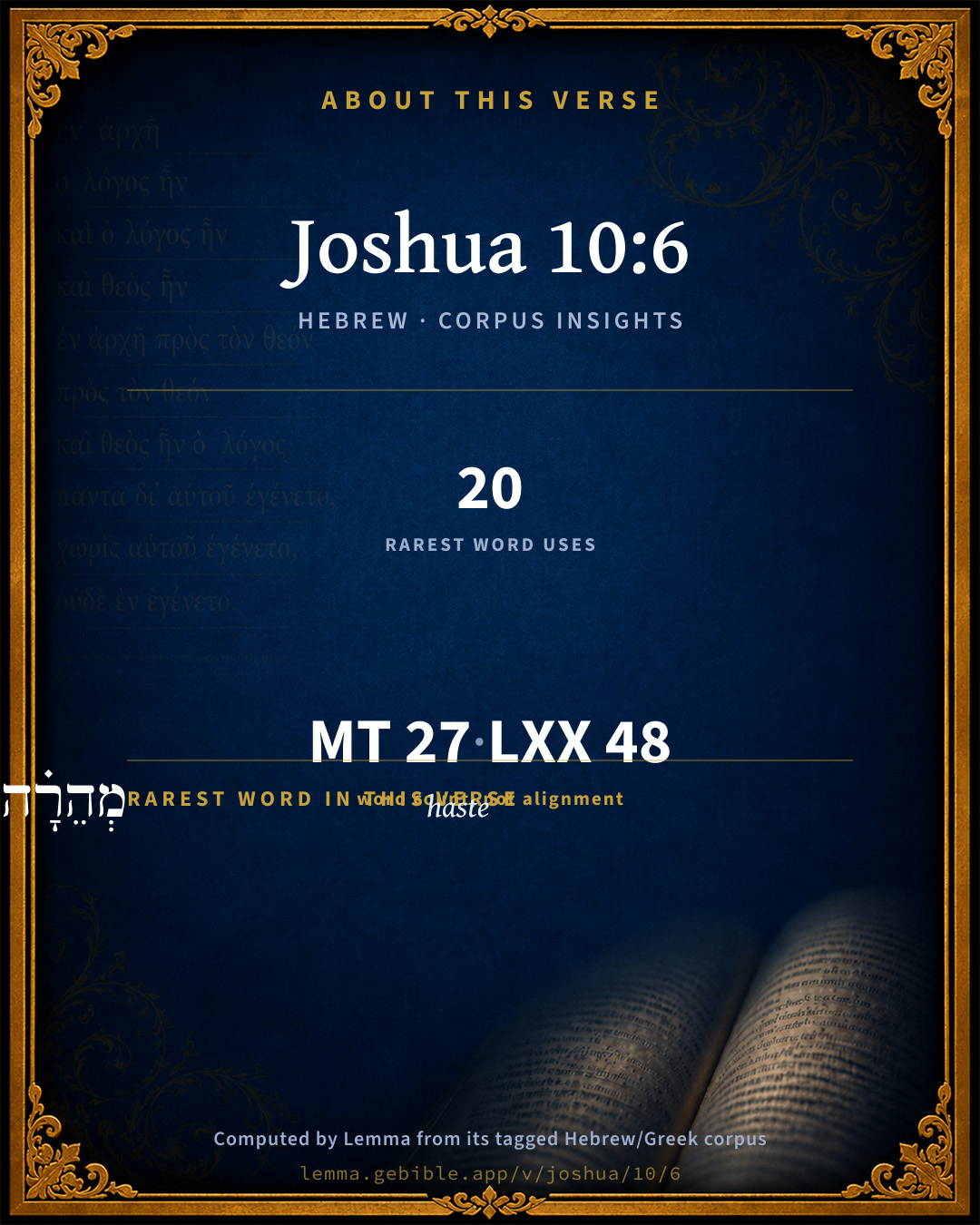
These counts appear in no published source. They are computed here, from the morphology-tagged text and Lemma’s own curated glosses. What Lemma adds →

27
words
23
distinct lemmas
Historical
section

Notable vocabulary

The rarest word here is מְהֵרָ֗ה haste H4120 — appearing just 20 times in the whole Hebrew Bible.

Shared distinctive vocabulary

מְהֵרָ֗ה haste H4120 occurs in 20 verses of the Hebrew Bible. Also found in:

Grammatical profile

  • 8 verbs
  • 12 nouns
  • 5 prepositions
  • 1 conjunction
  • 1 particle

Verb forms

  • וַיִּשְׁלְח֣וּ Qal · Sequential Imperfect
  • לֵאמֹ֔ר Qal · Infinitive Construct
  • תֶּ֥רֶף Hiphil · Jussive
  • עֲלֵ֧ה Qal · Imperative
  • וְהוֹשִׁ֤יעָה Hiphil · Imperative
  • וְעָזְרֵ֔נוּ Qal · Imperative
  • נִקְבְּצ֣וּ Niphal · Perfect
  • יֹשְׁבֵ֥י Qal · Participle Active

Repetition

A word recurs within this verse — often emphatic in Hebrew:

  • אֶל to H413 ×4

Hebrew & Septuagint length

In English translation the verse runs 48 words from the Hebrew and 50 from the Septuagint (LXX English) — closely comparable.

A rough comparison of the two English renderings, which tokenize alike — not a word-level alignment.

Word counts can differ between the Hebrew and the Greek without any difference in meaning — e.g. the Hebrew direct-object marker אֵת has no separate Greek word, and Greek often adds the article ὁ.

In the original languages it is 27 Hebrew tokens and 48 Greek tokens — but the two are counted differently (Hebrew bundles its prefixes and suffixes into one token; the Greek is in lemma form), so that isn’t a like-for-like length.

Cross-references

10

Topical passages linked to Joshua 10:6 in the Treasury of Scripture Knowledge — connected by theme and wording, ordered by reader-vote popularity; previews shown in the World English Bible.

  • Joshua 5:10 The children of Israel encamped in Gilgal; and they kept the Passover on the fourteenth day of the month at even in the plains of Jericho.
  • Joshua 9:6 They went to Joshua to the camp at Gilgal, and said to him, and to the men of Israel, We are come from a far country: now therefore make you a covenant with us.
  • Deuteronomy 1:15 So I took the heads of your tribes, wise men, and known, and made them heads over you, captains of thousands, and captains of hundreds, and captains of fifties, and captains of tens, and officers, according to your tribes.
  • Joshua 9:15 Joshua made peace with them, and made a covenant with them, to let them live: and the princes of the congregation swore to them.
  • Joshua 9:24–25 They answered Joshua, and said, Because it was certainly told your servants, how that Yahweh your God commanded his servant Moses to give you all the land, and to destroy all the inhabitants of the land from before you; therefore we were sore afraid for our lives because of you, and have done this thing.
  • Joshua 21:11 They gave them Kiriath Arba, [which Arba was] the father of Anak (the same is Hebron), in the hill-country of Judah, with the suburbs of it round about it.
  • 2 Kings 4:24 Then she saddled a donkey, and said to her servant, Drive, and go forward; don't slacken me the riding, except I bid you.
  • Psalms 125:2 As the mountains surround Jerusalem, So Yahweh surrounds his people from this time forth and forevermore.
  • Isaiah 33:22 For Yahweh is our judge, Yahweh is our lawgiver, Yahweh is our king; he will save us.
  • Luke 1:39 Mary arose in those days and went into the hill country with haste, into a city of Judah,

Cross-references courtesy of OpenBible.info (CC BY 4.0).

Hebrew and Greek witnesses Masoretic Hebrew ↔ Greek Septuagint

The same verse in the two great witnesses to the Old Testament, shown verse-for-verse.

These are two independent witnesses, not word-aligned to each other, and the Septuagint is shown in lemma (dictionary) form.

Hebrew Joshua 10:6 Masoretic · Westminster Leningrad Codex

וַיִּשְׁלְח֣וּ אַנְשֵׁי֩ גִבְע֨וֹן אֶל יְהוֹשֻׁ֤עַ אֶל הַֽמַּחֲנֶה֙ הַגִּלְגָּ֣לָה לֵאמֹ֔ר אַל תֶּ֥רֶף יָדֶ֖יךָ מֵֽעֲבָדֶ֑יךָ עֲלֵ֧ה אֵלֵ֣ינוּ מְהֵרָ֗ה וְהוֹשִׁ֤יעָה לָּ֨נוּ֙ וְעָזְרֵ֔נוּ כִּ֚י נִקְבְּצ֣וּ אֵלֵ֔ינוּ כָּל מַלְכֵ֥י הָאֱמֹרִ֖י יֹשְׁבֵ֥י הָהָֽר

The men of Gibeon sent to Joshua to the camp to Gilgal, saying, Don't slack your hand from your servants; come up to us quickly, and save us, and help us: for all the kings of the Amorites that dwell in the hill-country are gathered together against us.

World English Bible · Public Domain

Greek LXX Joshua 10:6 Septuagint · lemma form

καί ἀποστέλλω ὁ καταοἰκέω γαβαων πρός ἰησοῦς εἰς ὁ παρεμβολή ἰσραήλ εἰς γάλγαλα λέγω μή ἐκλύω ὁ χείρ σύ ἀπό ὁ παῖς σύ ἀναβαίνω πρός ἐγώ ὁ τάχος καί ἐκαἱρέω ἐγώ καί βοηθέω ἐγώ ὅτι συνἄγω εἰμί ἐπί ἐγώ πᾶς ὁ βασιλεύς ὁ ἀμορραῖος ὁ καταοἰκέω ὁ ὀρεινή

And the inhabitants of Gabaon sent to Joshua into the camp to Galgala, saying, Slack not your hands from your servants: come up quickly to us, and help us, and rescue us; for all the kings of the Amorites who dwell in the hill country are gathered together against us.

LXX2012 (modern English Septuagint) · Public Domain

Hebrew: Westminster Leningrad Codex (CC BY 4.0). Greek: Septuagint (public domain); English from LXX2012 (modern English Septuagint) (Public Domain). How the Septuagint differs from the Hebrew →

Targum (Aramaic paraphrase)

1

The Targum is the ancient Jewish Aramaic paraphrase of the Hebrew Scriptures — an interpretive translation, not the Hebrew text itself. Onkelos (literal) and Pseudo-Jonathan (expansive) render the Torah, and Jonathan the Prophets. Coverage is partial: where no permissively-licensed English translation exists for a verse, only the Aramaic is shown. This is verse-level text, not a word-by-word alignment to the Hebrew.

  1. Targum Jonathan Prophets (Joshua–Malachi)
    וּשְׁלַחוּ אֲנָשֵׁי גִבְעוֹן לְוַת יְהוֹשֻׁעַ לְמַשְׁרִיתָא לְגִלְגָלָא לְמֵיְמַר לָא תְרַשֵׁל יְדָךְ מַעֲבְדָךְ סַק לְוָתָנָא בִּפְרִיעַ וּפְרוֹק לָנָא וְסַעֲדָנָא אֲרֵי אִתְכְּנָשׁוּ עֲלָנָא כָּל מַלְכֵי אֱמוֹרָאָה יַתְבֵי טוּרָא:

    (no public-domain English translation for this verse)

    Targum Jonathan — Aramaic: “Mikraot Gedolot” (public domain). English: “Sefaria Community Translation” (CC0 1.0 (public-domain dedication)); “London "Chaldee Paraphrase," 1871” (public domain). Text via Sefaria.

Commentary

Notes on Joshua 10:6 from classic Christian and Jewish commentators (each source and its license shown beneath its notes). The classic Christian expositions comment on the surrounding passage and are grouped to its opening verse, so a note may address several verses; the Jewish commentaries on the Tanakh (Rashi and others) are per-verse, so they appear only where the commentator wrote on this verse.

Lemma curates 59 commentaries, every one of them public domain or Creative Commons licensed, each selected and text-cleaned for this edition rather than reprinted as found. About our sources →

Jamieson, Fausset & Brown

Robert Jamieson, A. R. Fausset & David Brown

JOSHUA RESCUES IT. (Jos 10:6-9)

the men of Gibeon sent unto Joshua--Their appeal was urgent and their claim to protection irresistible, on the ground, not only of kindness and sympathy, but of justice. In attacking the Canaanites, Joshua had received from God a general assurance of success (Jos 1:5). But the intelligence of so formidable a combination among the native princes seems to have depressed his mind with the anxious and dispiriting idea that it was a chastisement for the hasty and inconsiderate alliance entered into with the Gibeonites. It was evidently to be a struggle of life and death, not only to Gibeon, but to the Israelites. And in this view the divine communication that was made to him was seasonable and animating. He seems to have asked the counsel of God and received an answer, before setting out on the expedition.

Jamieson, Fausset & Brown — Commentary Critical and Explanatory on the Whole Bible (1871) — public domain (CC PDM 1.0). Text via the HelloAO Bible API.

Trapp's Complete Commentary

John Trapp

Jos 10:6 And the men of Gibeon sent unto Joshua to the camp to Gilgal, saying, Slack not thy hand from thy servants; come up to us quickly, and save us, and help us: for all the kings of the Amorites that dwell in the mountains are gathered together against us.

Ver. 6. Come up to us quickly.] Haste, haste, haste, cito, citius, citissime. a little delay may be the loss of all. Charles, king of Sicily, was called Cunctator, for his lingering to his loss.

John Trapp, A Commentary or Exposition upon All the Books of the Old and New Testament (1647–1656) — public domain. Text from a community e-Sword module.

The Biblical Illustrator

Joseph S. Exell

Jos_10:6-11

Come up . . . quickly, and save us, and help us.

Help! help!

The chapter opens with a cry from Jerusalem, the summons of Adoni-zedek--To arms! To arms! Here we have another and a very different cry, a cry from Gibeon; a cry to Joshua for help.

I. The trouble of the Gibeonites. They are in sore straits. What a vivid picture of spiritual truth have we here! He that departeth from evil maketh himself a prey. Do you make your peace with God? that instant, and by that act, you are at war with Satan. No sooner is the treaty of salvation signed than the infernal hosts are rallied. The ink is scarcely dry before he begins his attack. Old friends become new enemies. A mans foes are often those of his own household. When we come into such trouble let us not think that a strange thing has befallen us. It is the common fate of Gods children, from the highest to the meanest, and to the end of time. Though the Captain of salvation is the Prince of Peace, He has come not to send peace on the earth but a sword; and so will it be till every enemy is cast out and all flesh shall own Him Lord. These Gibeonites felt this attack all the more dangerous because it was the onset of men with whom in the past they had been on such intimate terms. All their conditions and resources were as well known to these five kings as to themselves. And the remembrance of these things made this attack all the more formidable. But what was all the knowledge which the five kings had of the Gibeonites compared with the knowledge Satan has of us? Therefore, how terrible must be his attack! If we are not ignorant of his devices, he is not ignorant of our weakness.

II. But if this cry suggests the trouble of the Gibeonites, it also points out their resources. If they are in great trouble they are not without resource, and at once they avail themselves of it. They dwelt in a fortified city, but they did not depend on its walls and bulwarks. They had no confidence in themselves. Their own resources were insufficient. All their confidence was placed in Joshua. Would that we always showed like wisdom! Sin and Satan are more than a match for the strongest saint. As they looked to Joshua, so must we look to Jesus. As they depended on that covenant of peace which had been ratified, so must we. As they dispatched runners post haste to Gilgal, so must we send out swift-footed messengers of prayer. Our very existence as saints depends on their success.

III. The earnestness of the Gibeonites. How keen and piercing is their cry! How urgent is their request! The message was no doubt short, they did not waste their words; but it was full of earnestness. It was the message of men thoroughly roused and anxious. Though short it was very full. They sought to stir up Joshuas energy. It is as if they said, We have no hope apart from you. We are all dead men if you fail us. We know you can save us and trust you will. They also manifested faithfulness to Joshua, by the last two words of their message--Help us. Why were these words added? Save is the word of dependence--Help suggests the determination to do what they can. It is as if they said, While we feel that in our own strength we must be worsted, yet we are determined to make a stand against them. On no account will we come to terms. We will never open our gates to the enemy. We will not even hold parley with him. Till you come, and even if you do not come, we will do the best we can. Accordingly this shows that they were faithful to their new leader. Surely their conduct in this emergency may well be imitated. Oh, for like earnestness in crying, Awake, awake, O arm of the Lord! How languid are our prayers! How unconscious are we of danger! It is good for God to open our eyes by trouble, if it leads us to cry like these Gibeonites.

IV. The succour of the Gibeonites. Help was sure. Joshua would have belied his name, would have been unfaithful to his covenant, would have been untrue to his nature, if he had not hastened to their relief. And help came speedily. Joshua lost not a moment. Help also came in time. Joshua was not too late. The Gibeonites did not become a prey; they had cause to rejoice over a great deliverance. Do we in every extremity cry to God? Help must come. God never said to any, Seek ye My face, in vain. Jesus, like Joshua, is never too late. If He tarries there is good reason for it. It is always for our good. He may come when Lazarus is laid in the grave, but He never comes too late. He is never too late in history. The world had a long time run its course before He came. Why? Because that time was set. In the fulness of time God set forth His Son. He has promised to come back again, and depend upon it He will not come back too late. What though 1,800 years have passed away? nothing will divert Him from His purpose; nothing will prevent His appearing. Amen, therefore we say, Amen, even so, in Thy good time, for that is quickly, come, Lord Jesus. And notice, in conclusion, that it may be said of these Gibeonites that they were twice saved, First they were saved from the wrath of God; then they were saved from the wrath of their enemies. So we are saved from the wrath of God and from the wrath of Satan. The Gibeonites were saved by faith, for they trusted in Joshua and in the God of Israel. They were saved by works, for they determined to oppose Adoni-zedek or die. They were saved by hope, for they looked to Joshua for succour and were not disappointed. So we are saved by faith when we fall at the feet of Jesus and put our trust in Him. We are saved by works, when in the strength of God we wrestle against principalities and powers and spiritual wickednesses in high places. We are saved by hope when we look for the glorious appearing of the great God and our Saviour. The Gibeonites were saved by coming to Joshua in their fear of judgment. They were saved by Joshua coming to them and extricating them out of all their trouble. So we are saved by coming to Jesus. The instant we fall at His feet we receive the salvation of our souls. And we are saved by Jesus coming to us (Heb_9:28). (A. B. Mackay.)

The newly-converted assailed

1. No sooner is the soul brought into the bonds of the covenant with our Joshua or Jesus, but presently the spiritual enemies of the soul muster up all their forces against it, as the five cursed kings did against Gibeon as soon as they had entered into a league with Joshua here (2Ti_3:12; Act_14:22).

2. The soul when thus assaulted must immediately send the messenger of prayer to its Joshua or Jesus.

3. As those new converts the Gibeonites showed their confidence in that God, whose religion they had newly embraced, therefore sent they for Joshua, not at all doubting of salvation by him. So the like confidence should be found in all new converted souls, that their Joshua will relieve them, and turn their spirit of bondage into the spirit of adoption. (C. Ness.)

Ready help

The help required was great: Slack not thy hand from thy servants. It is not little the Christian needs. How often, in seeking Divine aid and security, has the believer to say, Lord, how are they increased that trouble me! &c. Ready help was intreated. Come up to us quickly, and save us. It was well they were not what they once represented themselves to be--the inhabitants of a far remote country; for then help had come too late, had it come with bottles rent and bound up, shoes clouted and worn out, garments old and threadbare. Great is the mercy to be near our mercies, that when life, and all that is dear to us, lies at stake, salvation may be found at hand. (W. Seaton.)

Value of promptitude in action

Let us note not only the nobility of this acknowledgment of the claims of the new allies, but also the promptitude and energy with which their rescue is undertaken. How many good resolves are marred and made of none effect by lack of decision in their execution. We rest in the thought of our noble plans, and meanwhile we hesitate and defer to carry them out in the performance: thus the evils we might have stayed grow beyond control: the opportunity has sped away; the hearts of those who looked for our help are sick with hopes long deferred. Too late! too late! is the disappointed cry with which they greet our tardy steps. (G. W. Butler, M. A.)

Fear them not: for I have delivered them into thine hand.--

Courage!

On the eve of a great engagement a wise leader often rouses the enthusiasm of his followers by a few well-chosen words. We know how the message of Nelson, before the battle of Trafalgar, stimulated every man in his fleet to do his utmost; and not only so, but it has also come ringing down the years that intervene with telling effect on every noble heart in great emergencies. God deals with His servants after the same fashion; therefore, here, before Joshua passes forth to the rescue of the Gibeonites, he gives them words of cheer. Notice when God gave this encouragement. It was when Joshua had resolved to set out to the help of the Gibeonites. There is no evidence that Joshua asked for or even expected such encouragement. He felt bound to do his duty, to keep faith with the Gibeonites, and while in the act of responding to their cry, this encouragement came. The very fact that this cheering word was unsolicited made it doubly sweet. We may have similar experiences. When we walk in the path of duty we may always reckon on the Divine encouragement. If we go to Gods work with good will, however hard it may be, and whoever may oppose, we may always count on the good will and the good word of God, and surely that ought to suffice. How encouraging, how comforting, how strengthening, is the answer of a good conscience towards God! Notice, also, the terms of this encouragement now given. They were very clear. They had no particle of ambiguity. How the healthy soul rejoices in certainty! How freely does God delight to give it! And the fact that the words Joshua now heard were familiar to his ear, phrases repeated again and again, made this assurance doubly sweet. God is dealing with him now as He has graciously done in all the past; and every repetition and new fulfilment of a promise adds to its value. For the old promise has been tried and tested again and again, and proved to be sufficient. It is good when we have such experience as Joshua; when we have not only a true word, but one which in our own experience we have tried and proved to be sufficient for every emergency. Therefore notice next the effect that this encouragement has upon Joshua. It fills him with new energy. The clearest assurance of success does not do away with the use of means, rather is it a sharp spur to make the most of them. Joshua, though thus assured, yea, because thus assured, acts as if everything depended on his energy and the swiftness and strength of his attack. And so in a very important sense it did. But we may not only trace the effect of this promise in the energy with which it filled Joshua and his soldiers, but also in that marvellous prayer which rose to his lips in the great crisis of the fight that ensued. It is this great promise of God which justifies and explains that great prayer of Joshua. Joshua spoke to the Lord on that day, and his words were wonderful. His prayer was very Short, but we are startled by its boldness. The prayer was public, therefore Joshua risked all his reputation on its answer. The prayer was humble. He had no desire to parade his power; he had no need to win the allegiance of Israel. His one thought was the perfect fulfilment of that work which by this promise God had said would be accomplished. God had spoken. His power and glory are pledged to the fulfilment of that word. Can He not perform? God gave Joshua a large promise, and Joshua laid before God a large prayer. Thus both Gods power and Joshuas faith were magnified and made honourable. In like manner may we make use of all Gods promises; and we only prove our unbelief by leaving them a dead letter. Who can over-estimate the value of prayer, who can put a limit to its power? Did we believe in the promises of God as firmly as Joshua, we would be able more closely to imitate his prayers. Men make difficulties here where the simple soul can find none. As a living father can answer the request of his children, so the Lord can hear and answer the prayer of His people. And He answers every prayer addressed to Him; not always in the same way, but always in the best way. Now notice, lastly, the fulfilment of this promise. No doubt the good generalship of Joshua and the valour of his soldiers had much to do with it. They marched with swiftness, they laid on with might and main, they never paused in the pursuit, yet all that they did was obscured by the wonderful interposition of God. Joshua and Israel did what they could, and yet God did all. It is well to remember that nature may become one great arsenal for the defence of those that fear God, for the destruction of all His enemies. It was no superstition, but true godliness, which enabled our forefathers to see the finger of God in those storms which swept the great Armada to its doom. How often does God in His adorable Providence render the very objects in which men trust the means of filling them with shame and confusion of face! How manifestly was God with Israel! How evident is it that The Lord reigneth! Israel needed that assurance, and we need it too. Whatever may come to pass from year to year, from century to century, He and He alone is guiding the world and the Church to that goal which He has foreknown and appointed. This is the sheet-anchor of all our hopes for humanity. (A. B. Mackay.)

They were more which died with hailstones than they whom the children of Israel slew with the sword.

The Lords artillery

We have seen how Gibeon made peace with Joshua. Adoni-zedek, king of Jerusalem, was exceedingly displeased with the men of Gibeon for making peace with the enemy.

1. The Divine cause has enemies.

2. But the enemies of the Divine cause have both earth and heaven against them--the sword of Israel and the hail of God. The living God has two great forces; if you escape one, you fall under the power of the other. All things fight for God. The hailstones are His friends and allies; the stars in their courses beat and throb according to His purpose and express His intent. The bad cause has no friends; it comes to an ignominious end; it is overwhelmed by hailstones. It is so humbling. The bad cause perishes in contempt. The five kings ran away and hid themselves in a cave, and Joshua said, Bring them out! (J. Parker, D. D.)

The Biblical Illustrator, edited by Joseph S. Exell (c. 1880s–1900s) — public domain. Text from a community e-Sword module.

Joseph Benson's Commentary

Jos 10:6-7. Slack not thy hand from thy servants — Do not neglect or delay to help us, whom thou art obliged to protect both in duty, as thou art our master, and for thy own interest, we being part of thy possessions; and because we have given ourselves to thee, and put ourselves under thy protection. In the mountains — In the mountainous country. So Joshua ascended — Having no doubt asked counsel of God first, which is implied in the answer God gives him, Jos 10:8. All the mighty men — That is, an army of the most valiant men picked out from the rest: for it is not probable either that he would take the whole army with him, consisting of so many hundreds of thousands, who would only have embarrassed and hindered one another, or that he would leave the camp without an army to defend it.

Joseph Benson's Commentary on the Old and New Testaments (1811–1818) — public domain. Text from a community e-Sword module.

Whedon's Commentary on the Bible

Daniel D. Whedon

THE GIBEONITES APPEAL FOR AID, Jos_10:6.

6. Save us — As soon as the hostile army of the confederated Amorites pitched their camp before their walls the Gibeonites sent to Joshua for aid. It was of the first importance that Joshua should rescue them and retain their allegiance. Had the Gibeonites been neglected by Joshua they would have been either forced into a league with the Amorites, or defeated by their superior numbers.

Daniel D. Whedon (gen. ed.), Commentary on the Old and New Testaments (1874–1909) — public domain. Text from a community e-Sword module.

John Calvin's Commentaries

6. And the men of Gibeon sent unto Joshua, etc The course of the narrative is inverted; for the Gibeonites certainly did not wait till they were besieged, but on seeing an army levied and prepared, and having no doubt that they would have to sustain the first onset, as they had incurred general hatred, they anticipate the attack, and hasten to have recourse to the protection of Joshua. To desert those to whom life had been given, would have been at once unlawful, unjust, and inhumane. Nay, as their surrender had been consequent on the agreement, they were entitled to be defended against violence and injury. With justice, therefore, they implore the Israelites, under whose protection they were; and there is no hesitation on the part of Joshua, who judges it to be his duty to defend those whose submission he had agreed to accept. They had deceived him, it is true, but after the fraud had been detected, and they had confessed it, interposing some palliating circumstances, they had obtained pardon.

Equity and a sense of duty thus did not allow the Israelites to abandon the Gibeonites to their fate. Still, Joshua is entitled to praise for his promptitude in complying with the request, and sending assistance without delay. He is said to have marched during the whole night, and thus could not have proceeded with greater haste had the safety of the whole people been at stake. Had the same sincerity always been evinced by profane nations, they would rather have assisted their allies in due time than avenged their disasters after they had suffered them. The term suddenly ought not, however, to be confined to a single day, as if Joshua had accomplished three days’ journey in a single night, and made his appearance among the Gibeonites next morning. All that is meant to be expressed is his great speed, and his not delaying his departure till next day.

Though the Israelites moved their camp from Ai or that neighborhood, it was the third day before they entered the confines of the Gibeonites. Granting that they then proceeded slowly in order of battle, Joshua was still at some distance when application is made to him to assist the Gibeonites. We have seen that Gilgal was the first station after crossing the Jordan, and therefore more remote than Jericho. If any one deems it absurd, that after receiving the submission of several cities, he should have turned backwards, and left an empty district, the recovery of which from the enemy might again cost new labor, I answer, there was no ground to fear that the enemy would come forward to occupy it, and engage in an expedition attended with great danger and difficulty. It is probable that when a body of troops was selected to attack Jericho, the women, children, and all others unfit for war remained in that quiet corner, where they might have the protection of those of the Reubenites, Gadites, and half tribe of Manasseh, who had been left on the opposite bank of the Jordan. For to what end would they have carried with them into their battles children and women heavy with child, or nursing babes at their breasts? How, during the incursions of the enemy, could food be found for such a multitude, or water sufficient to supply all their flocks and herds? I conclude, therefore, that Joshua and his soldiers returned to their tents that they might refresh themselves for a little with their wives and children, and there deposit the spoils with which they had been enriched.

John Calvin's Commentaries (1540-1563) — public domain. Text from the Calvin Translation Society English edition (1840s-50s) via the Christian Classics Ethereal Library (ccel.org). Calvin's coverage is partial (roughly two-thirds of the Bible); uncommented books and verses are honest gaps, never fabricated. The 19th-century editor's footnotes and remarks are omitted so the notes are faithfully Calvin's own voice.

Ellicott's Commentary for English Readers

(6) The Amorites that dwell in the mountains—i.e., in the mountainous district lying on the south of Jerusalem.

A Bible Commentary for English Readers, edited by Charles John Ellicott (1878–1897) — public domain. Text from a community e-Sword module.

The Cambridge Bible for Schools and Colleges

gen. ed. J. J. S. Perowne

6. Slack not thy hand] The climax in the message is very noticeable; (1) slack not thy hand; (2) come up to us quickly; (3) save us; (4) help us. Compare the prayer of the persecuted Christians (Act_4:24-30).

Slack = “slacken,” “relax;” A. S. slæcan from the adjective slæc. It occurs in an intransitive sense in Deu_23:21, “When thou shalt vow a vow unto the Lord thy God, thou shalt not slack to pay it.” Comp. Latimer, Serm. p. 231, “What a remorse of conscience shall ye have, when ye remember how ye have slacked your duty.”

all the kings of the Amorites] This is a common designation of the five chiefs. Their march had evidently been very rapid, and the danger was urgent.

The Cambridge Bible for Schools and Colleges (gen. ed. J. J. S. Perowne; Cambridge University Press, 1878–1918) — public domain. Text from a community e-Sword module.

John Gill's Exposition

And the men of Gibeon sent unto Joshua to the camp to Gilgal,.... Which some think they did when besieged, and not before, which showed their faith in the power of God, whom they now professed; but it is not likely that they should defer sending for help so long, since it is reasonable to suppose they might have heard of the design of the five kings against them; or that they should be able to send out messengers when surrounded on all sides; it may be better therefore to render the words, "had sent" (m), which they did as soon as they heard of the preparations made by the five kings to war with them, and of their rendezvous at Jerusalem, and especially as soon as they had information of their march towards them:

saying, slack not thine hands from thy servants; they entreat that he would not neglect them, be indifferent to them, and delay to assist them, since they were his subjects; and were entitled to his protection:

come up to us quickly, and save us, and help us; they did not doubt, if he made haste and helped them, but they should be saved by him:

for all the kings of the Amorites that dwell in the mountains are gathered together against us. Jerusalem lay among mountains, and Hebron was in the hill country in Judea, see Psa 125:2; and the other cities were doubtless in a like situation.

(m) "sed miserant", Piscator; so Pool and Patrick.

John Gill's Exposition of the Whole Bible (1746–1763) — public domain (CC PDM 1.0). Text via the HelloAO Bible API.

Albert Barnes' Notes on the Bible

The language reflects the urgency of the crisis. Accordingly Joshua made a forced march, accompanied only by his soldiers Jos 10:7, and accomplished in a single night the distance from Gilgal to Gibeon (about 15 miles in a direct line), which on a former occasion had been a three days’ journey Jos 9:17.

Albert Barnes' Notes on the Bible (1834–1885) — public domain. Text from a community e-Sword/MySword module.

Matthew Poole's English Annotations

The men of Gibeon sent, or, had sent, when their enemies were drawn towards them, which they could easily learn. Slack not thy hand; do not neglect nor delay to help us. From thy servants, whom thou art obliged to protect both in duty, as thou art our master and ruler; and by thy own interest, we being part of thy possessions; and in ingenuity, because we have given ourselves to thee, and put ourselves under thy protection.

In the mountains; in the mountainous country.

Matthew Poole's English Annotations on the Holy Bible (1683–1685) — public domain. Text from a community e-Sword/MySword module.

The Pulpit Commentary

To Gilgal. See note on Jos_9:6. That dwell in the mountains. Another life like touch. The details of the confederacy were not fully known to the Gibeonites. There had not been time for that. It was only known that the storm was to break on them from the mountain region, Jerusalem (ver. 4) being the head quarters of the expedition. As a matter of fact, the kings who formed the confederacy principally inhabited the lowlands, as we have seen. No one could have hit upon this apparent contradiction yet real agreement but one whose narrative was compiled from authentic sources.

The Pulpit Commentary (1880–1919), ed. H.D.M. Spence-Jones & Joseph S. Exell — public domain. Text from a community e-Sword module.

John Wesley's Explanatory Notes

Slack not thy hand - Do not neglect or delay to help us. Whom thou art obliged to protect both in duty as thou art our master; and by thy owns interest, we being part of thy possessions; and in ingenuity, because we have given ourselves to thee, and put ourselves under thy protection. In the mountains - ln the mountainous country.

John Wesley, Explanatory Notes Upon the Whole Bible (1754–1765) — public domain. Text via the GEBible commentary corpus.

Keil & Delitzsch

C. F. Keil & F. Delitzsch

The Gibeonites then sent to Joshua to the camp at Gilgal, and entreated him to come to his help as speedily as possible. "Slack not thy hand from thy servants," i.e., withhold not thy help from us. The definition appended to "the kings of the Amorites" ("that dwelt in the mountains") is to be understood a potiori, and does not warrant us in drawing the conclusion, that all the towns mentioned in Jos 10:3 were in the mountains of Judah. The Amorites who dwelt in the mountains were the strongest of all the Canaanites.

Jos 10:7

In accordance with this petition Joshua advanced from Gilgal (ויּעל, not went up) with all the people of war, even (vav expl.) all the men of valour.

Jos 10:8

The Lord then renewed the assurance of His help in this particular war, in which Joshua was about to fight for the first time with several allied kings of Canaan (cf. Jos 2:24; Jos 6:2; Jos 8:1, Jos 8:18).

Jos 10:9

Joshua came suddenly upon them (the enemy), as he had marched the whole night from Gilgal, i.e., had accomplished the entire distance in a night. Jiljilia is fully fifteen miles from el-Jib.

Jos 10:10

"Jehovah threw them into confusion," as He had promised in Exo 23:27, and in all probability, judging from Jos 10:11, by dreadful thunder and lightning (vid., Sa1 7:10; Psa 18:15; Psa 144:6 : it is different in Exo 14:24). "Israel smote them in a great slaughter at Gibeon, and pursued them by the way of the ascent of Bethhoron," i.e., Upper Bethhoron (Beit Ur, el-Foka), which was nearest to Gibeon, only four hours distant on the north-west, on a lofty promontory between two valleys, one on the north, the other on the south, and was separated from Lower Bethhoron, which lies further west, by a long steep pass, from which the ascent to Upper Bethhoron is very steep and rocky, though the rock has been cut away in many places now, and a path made by means of steps (see Rob. Pal. iii. p. 59). This pass between the two places leads downwards from Gibeon towards the western plain, and was called sometimes the ascent, or going up to Bethhoron, and sometimes the descent, or going down from it (Jos 10:11), ἀνάβασις καὶ κατάβασις Βαιθωρῶν (1 Macc. 3:16, 24). Israel smote the enemy still further, "to Azekah and Makkedah:" so far were they pursued and beaten after the battle (cf. Jos 10:16, Jos 10:21). If we compare Jos 10:11, according to which the enemy was smitten, from Bethhoron to Azekah, by a violent fall of hail, it is very evident that the two places were on the west of Bethhoron. And it is in perfect harmony with this that we find both places described as being in the lowland; Azekah in the hill-country between the mountains and the plain (Jos 15:35), Makkedah in the plain itself (Jos 15:41). Azekah, which was fortified by Rehoboam (Ch2 11:9), besieged by Nebuchadnezzar (Jer 34:7), and still inhabited after the captivity (Neh 11:30), was not far from Socoh, according to Jos 15:35; whilst sideways between the two was Ephes-dammim (Sa1 17:1). Van de Velde has discovered the latter in the ruins of Damm, about an hour's journey east by south from Beit Nettif (Mem. p. 290), and consequently imagines that Azekah is to be found in the village of Ahbek, which stands upon a lofty mountain-top a mile and a half to the north of Damm, and about four of five miles N.N.E. of Shuweikeh, supposing this to be Aphek. The statement in the Onom. (s. v. Ἀζηκά), ἀνάμεσον Ἐλευθεροπολεως καὶ Αἰλίας, agrees with this. Makkedah is described in the Onom. as being eight Roman miles to the east of Eleutheropolis, and hence Knobel supposes it to have been near Terkumieh, or Morak; but he is wrong in his supposition, as in that case it would have been in the hill-country or upon the mountains, whereas it was one of the towns in the plain (Jos 15:41). Van de Velde's conjecture (p. 332) is a much more probable one, viz., that it is to be found in Summeil, a considerable village on an eminence in the plain, with a large public well 110 feet deep and 11 feet in diameter, with strongly built walls of hewn stones, where there is also part of an old wall, which to all appearance must formerly have belonged to a large square castle built of uncemented stones, resembling in some respects the oldest foundation wall of Beit Jibrin (Rob. Pal. ii. p. 368). It is two hours and a half to the north-west of Beit Jibrin, and there Van de Velde discovered the large cave (see at Jos 10:16), which Robinson has not observed (see his Journey through Syria and Palestine).

Jos 10:11

The large stones which the Lord threw upon the flying foe at the slope of Bethhoron were hail-stones (see Isa 30:30), not stone-hail, or a shower of stones, but a terrible hail-storm, in which hail fell upon the foe in pieces as large as stones (see Wis. 46:6), and slew a greater number of them than the swords of the Israelites. This phenomenon, which resembled the terrible hail in Egypt (Exo 9:24), was manifestly a miraculous occurrence produced by the omnipotent power of God, inasmuch as the hail-stones slew the enemy without injuring the Israelites, who were pursuing them. By this the Israelites were to be made to see that it was not their own power, but the supernatural help of their God, which had given them the victory; whilst the enemy discovered that it was not only the people of Israel, but the God of Israel, that had devoted them to destruction.

Keil & Delitzsch — Biblical Commentary on the Old Testament (1861–1891) — public domain (CC PDM 1.0). Text via the HelloAO Bible API. (Old Testament only.)

unfoldingWord translationNotes

Door43 World Missions Community

They said

The word "They" here refers to Gibeonites.

Do not withdraw your hands from your servants

This humble request is stated with two negatives to emphasize the need for a positive action. AT: "Please come and use your strength to protect us" (See: Litotes)

your hands

The word "hands" here refers to the people of Israel's strength. AT: "your strength" (See: Metonymy)

translationWords

people group

Gibeon

Joshua

Gilgal

servant

king

Amorite

unfoldingWord translationNotes — © Distant Shores Media and the Door43 World Missions Community, licensed CC BY-SA 4.0. Source: git.door43.org/Door43/en_tn.

Lesson kit

Teaching starters — assembled from the data on this page, not authored interpretation. Every prompt links to the verse data it draws on. Edit before teaching.

Joshua, in the Historical, opens this verse with 27 words (23 distinct Hebrew lemmas). Its most distinctive word is mᵉhêrâh (“haste”). A historical commentator’s framing appears above. Read the whole chapter for the surrounding context.

Discussion questions

  1. What does “haste” (mᵉhêrâh) contribute to the verse as a whole?
  2. How does Numbers 16:46, which shares the word «haste», read alongside this verse?
  3. What does the repetition of “to” (4× in this one verse) do in this verse?
  4. These translations render this verse differently. What is at stake in choosing one wording over another?
  5. «וַיִּשְׁלְח֣וּ» is a Qal Sequential Imperfect verb. How does that grammatical form shape the action described?
  6. Compare how Jamieson, Fausset & Brown and Trapp's Complete Commentary read this verse. Where do they agree or differ?

Things to notice

Reading settings

Reading text

Shown beneath each verse's original-language words.

Old Testament
Old Testament edition

Read the OT as the Masoretic Hebrew (MT) or the Greek Septuagint (LXX).

English shown for the Greek Septuagint (in the Hebrew ↔ Greek comparison).

Comparing translations? Open the Compare panel on any verse page to stack up to four side by side.