2 Kings 4:16

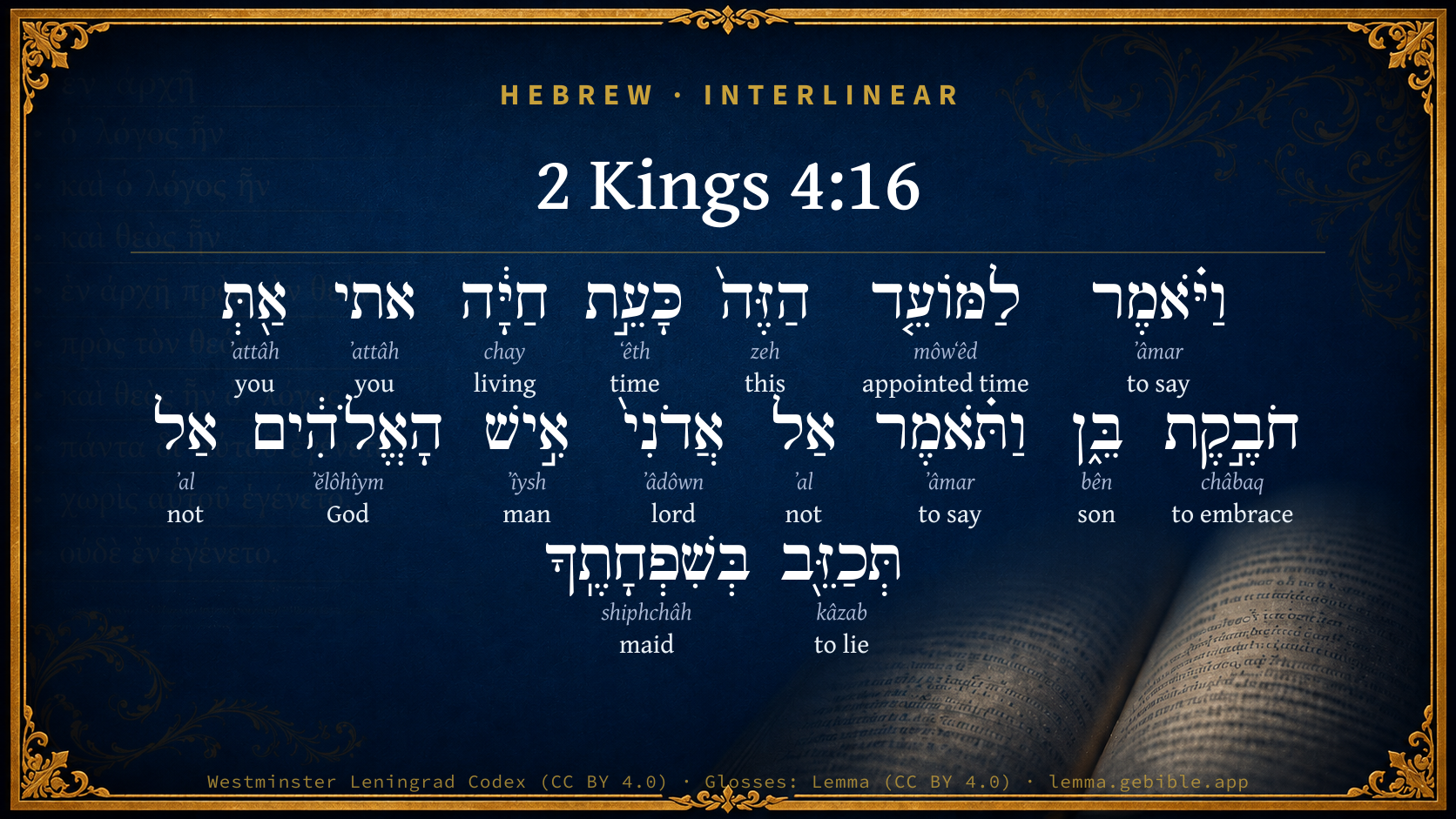
Hebrew (Westminster Leningrad Codex) 2 Kings 4:16 appears in the Hebrew Old Testament. The text above is from the Westminster Leningrad Codex. Each word links to its Strong’s number, a concise gloss, and parsing drawn from the Open Scriptures Hebrew Bible morphology. Click any word for its full Brown-Driver-Briggs (BDB) entry.
Download image
Cite this verse

2 Kings 4:16 (World English Bible). Public Domain. Lemma interlinear Bible study tool, https://lemma.gebible.app/v/2-kings/4/16.

Show BibTeX & RIS
BibTeX
RIS
English Translation
He said, At this season, when the time comes round, you shall embrace a son. She said, No, my lord, you man of God, do not lie to your handmaid.
World English Bible · Public Domain
Download a study sheet

One document with this verse’s original text, its word-by-word gloss line, the meaning frame, cross-references with their text, attributed commentary, and full source and license credits — printable, and it pastes into notes with its structure intact.

This verse Autodidact and up

Study sheet (.html) Plain text (.txt)

A passage Seminary Student

Up to 50 verses in one chapter. A passage sheet keeps up to 6 commentary sources and 12 cross-references per verse, in the order this page ranks them, and says so on the sheet whenever that leaves anything out. Ask for a single verse and you get the Autodidact verse sheet above.

Everything on this page stays free to read, with no account — the sheet is a download of what is already on screen, not access to it.

Want to remove ads? Support Godless Engineer
Compare translations 3

The same verse in 3 English versions, stacked beneath the original-language interlinear above. Click any original word for its lexicon entry.

Each is an independent rendering of the whole verse — the interlinear is not word-aligned to these translations.

Highlighted words mark where these versions differ — a whole-verse word diff, not a word-by-word alignment.

  • World English Bible Public Domain
    He said, At this season, when the time comes round, you shall embrace a son. She said, No, my lord, you man of God, do not lie to your handmaid.
  • King James Version Public Domain
    And he said, About this season, according to the time of life, thou shalt embrace a son. And she said, Nay, my lord, thou man of God, do not lie unto thine handmaid.
  • unfoldingWord Literal Text CC BY-SA 4.0
    And he said, “In this season, according to the time of reviving, you will embrace a son.” And she said, “No, my lord, man of God, do not lie to your maidservant.”

unfoldingWord Literal Text — © unfoldingWord, licensed CC BY-SA 4.0. Word-aligned USFM3 via Door43 (git.door43.org/unfoldingWord/en_ult).

Versions to compare (up to 4)

3 of 4 selected

Show all 18 translations

Every available English version of this verse, each an independent rendering of the whole verse.

  • World English Bible Public Domain
    He said, At this season, when the time comes round, you shall embrace a son. She said, No, my lord, you man of God, do not lie to your handmaid.
  • Berean Standard Bible Public Domain
    And Elisha declared, “At this time next year, you will hold a son in your arms.” “No, my lord,” she said. “Do not lie to your maidservant, O man of God.”
  • Majority Standard Bible Public Domain
    And Elisha declared, “At this time next year, you will hold a son in your arms.” “No, my lord,” she said. “Do not lie to your maidservant, O man of God.”
  • King James Version Public Domain
    And he said, About this season, according to the time of life, thou shalt embrace a son. And she said, Nay, my lord, thou man of God, do not lie unto thine handmaid.
  • American Standard Version (1901) Public Domain
    And he said, At this season, when the time cometh round, thou shalt embrace a son. And she said, Nay, my lord, thou man of God, do not lie unto thy handmaid.
  • Revised Version (1885) Public Domain
    And he said, At this season, when the time cometh round, thou shalt embrace a son. And she said, Nay, my lord, thou man of God, do not lie unto thine handmaid.
  • Geneva Bible (1599) Public Domain
    And he said, At this time appointed, according to the time of life, thou shalt embrace a sonne. And she sayd, Oh my Lord, thou man of God, doe not lye vnto thine handmayd.
  • Douay-Rheims (1899) Public Domain
    He said to her: At this time, and this same hour, if life accompany, thou shalt have a son in thy womb. But she answered: Do not, I beseech thee, my lord, thou man of God, do not lie to thy handmaid.
  • Young's Literal Translation Public Domain
    and he saith, `At this season, according to the time of life, thou art embracing a son;' and she saith, `Nay, my lord, O man of God, do not lie unto thy maid-servant.'
  • Literal Standard Version CC BY-SA 4.0
    and he says, “At this season, according to the time of life, you are embracing a son”; and she says, “No, my lord, O man of God, do not lie to your maidservant.”
  • Unlocked Literal Bible CC BY-SA 4.0
    Elisha said, “At this time of year, in one year's time, you will be holding a son.” She said, “No, my master and man of God, do not lie to your servant.”
  • unfoldingWord Literal Text CC BY-SA 4.0
    And he said, “In this season, according to the time of reviving, you will embrace a son.” And she said, “No, my lord, man of God, do not lie to your maidservant.”
  • Darby Bible Public Domain
    And he said, At this appointed time, when thy term is come, thou shalt embrace a son. And she said, No, my lord, man of God, do not lie to thy handmaid.
  • World Messianic Bible Public Domain
    He said, “At this season next year, you will embrace a son.” She said, “No, my lord, you man of God, do not lie to your servant.”
  • Webster's Bible Public Domain
    And he said, About this season, according to the time of life, thou shalt embrace a son. And she said, No, my lord, thou man of God, do not lie to thy handmaid.
  • Free Bible Version CC BY-SA 4.0
    Elisha told her, “Around this time next year, you will be holding a son in your arms.” “No, my lord!” she responded. “Man of God, don't tell your servant lies!”
  • Bible in Basic English Public Domain
    And Elisha said, At this time in the coming year you will have a son in your arms. And she said, No, my lord, O man of God, do not say what is false to your servant.
  • JPS Tanakh (1917) Public Domain
    And he said: 'At this season, when the time cometh round, thou shalt embrace a son.' And she said: 'Nay, my lord, thou man of God, do not lie unto thy handmaid.'

Literal Standard Version (2020), Covenant Press — licensed CC BY-SA 4.0. Text via the HelloAO Bible API (eBible.org). Unlocked Literal Bible (unfoldingWord) — licensed CC BY-SA 4.0. Text via the HelloAO Bible API (eBible.org). unfoldingWord Literal Text — © unfoldingWord, licensed CC BY-SA 4.0. Word-aligned USFM3 via Door43 (git.door43.org/unfoldingWord/en_ult). Free Bible Version, Dr. Jonathan Gallagher — licensed CC BY-SA 4.0. Text via the HelloAO Bible API (eBible.org).

Word by word

More ways to search: Search by grammar → Find every occurrence → Compare this word →

Practice this passage: Drill this verse → Learn its vocabulary →

חֹבֶ֣קֶת
châbaq
H2263
“embracing”
Verb, Qal, Participle Active, Feminine, Singular, Absolute
Part of Speech
Verb
Stem
Qal
Form
Participle Active
Gender
Feminine
Number
Singular
State
Absolute
Full BDB Definition

Origin: a primitive root

TWOT: 597

to embrace, clasp - (Qal) - to embrace - to fold one's hands in idleness (figuratively) - (Piel) to embrace
  1. וַיֹּ֗אמֶר ʼâmar H559 “and · to say” Conjunction + Verb, Qal, Sequential Imperfect, 3rd Person, Masculine, Singular
  2. לַמּוֹעֵ֤ד môwʻêd H4150 “to/for the · appointed time” Preposition, Determined + Noun, Common, Masculine, Singular, Absolute
  3. הַזֶּה֙ zeh H2088 “the · this” Particle, Definite Article + Pronoun, Demonstrative, Masculine, Singular
  4. כָּעֵ֣ת ʻêth H6256 “like/as the · time” Preposition, Determined + Noun, Common, Both, Singular, Absolute
  5. חַיָּ֔ה chay H2416 “living” Adjective, Adjective, Feminine, Singular, Absolute
  6. אתי ʼattâh H859 “you” Pronoun, Personal, 2nd Person, Feminine, Singular
  7. אַ֖תְּ ʼattâh H859 “you” Pronoun, Personal, 2nd Person, Feminine, Singular
  8. בֵּ֑ן bên H1121 “son” Noun, Common, Masculine, Singular, Absolute
  9. וַתֹּ֗אמֶר ʼâmar H559 “and · to say” Conjunction + Verb, Qal, Sequential Imperfect, 3rd Person, Feminine, Singular
  10. אַל ʼal H408 “not” Particle, Negative
  11. אֲדֹנִי֙ ʼâdôwn H113 “lord · my” Noun, Common, Masculine, Singular, Construct + Suffix, Personal, 1st Person, Common, Singular
  12. אִ֣ישׁ ʼîysh H376 “man of” Noun, Common, Masculine, Singular, Construct
  13. הָאֱלֹהִ֔ים ʼĕlôhîym H430 “the · God(s)” Particle, Definite Article + Noun, Common, Masculine, Plural, Absolute
  14. אַל ʼal H408 “not” Particle, Negative
  15. תְּכַזֵּ֖ב kâzab H3576 “to lie” Verb, Piel, Jussive, 2nd Person, Masculine, Singular
  16. בְּשִׁפְחָתֶֽךָ shiphchâh H8198 “in/at · maid · your” Preposition + Noun, Common, Feminine, Singular, Construct + Suffix, Personal, 2nd Person, Masculine, Singular

About this verse

These counts appear in no published source. They are computed here, from the morphology-tagged text and Lemma’s own curated glosses. What Lemma adds →

17
words
14
distinct lemmas
Historical
section

Notable vocabulary

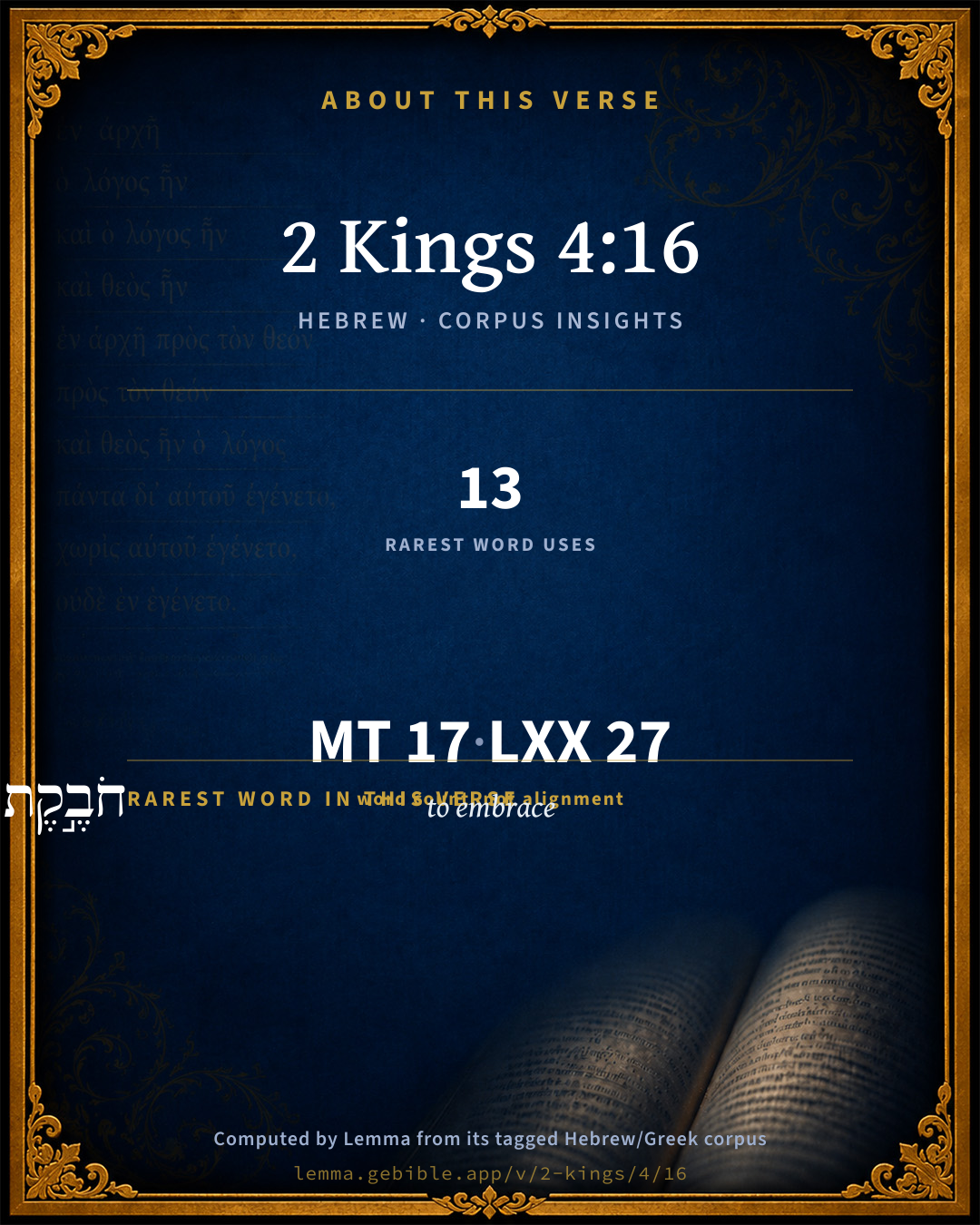
The rarest word here is חֹבֶ֣קֶת to embrace H2263 — appearing just 13 times in the whole Hebrew Bible.

Shared distinctive vocabulary

חֹבֶ֣קֶת to embrace H2263 occurs in 12 verses of the Hebrew Bible. Also found in:

Grammatical profile

  • 4 verbs
  • 7 nouns
  • 1 adjective
  • 3 pronouns
  • 2 particles

Verb forms

  • וַיֹּ֗אמֶר Qal · Sequential Imperfect
  • חֹבֶ֣קֶת Qal · Participle Active
  • וַתֹּ֗אמֶר Qal · Sequential Imperfect
  • תְּכַזֵּ֖ב Piel · Jussive

Repetition

Words recur within this verse — often emphatic in Hebrew:

  • וַיֹּ֗אמֶר to say H559 ×2
  • אתי you H859 ×2
  • אַל not H408 ×2

Hebrew & Septuagint length

In English translation the verse runs 30 words from the Hebrew and 34 from the Septuagint (LXX English) — closely comparable.

A rough comparison of the two English renderings, which tokenize alike — not a word-level alignment.

Word counts can differ between the Hebrew and the Greek without any difference in meaning — e.g. the Hebrew direct-object marker אֵת has no separate Greek word, and Greek often adds the article ὁ.

In the original languages it is 17 Hebrew tokens and 27 Greek tokens — but the two are counted differently (Hebrew bundles its prefixes and suffixes into one token; the Greek is in lemma form), so that isn’t a like-for-like length.

Cross-references

13

Topical passages linked to 2 Kings 4:16 in the Treasury of Scripture Knowledge — connected by theme and wording, ordered by reader-vote popularity; previews shown in the World English Bible.

  • Genesis 18:10 He said, "I will certainly return to you when the season comes round. Behold, Sarah your wife will have a son." Sarah heard in the tent door, which was behind him.
  • Luke 1:13 But the angel said to him, "Don't be afraid, Zacharias, because your request has been heard, and your wife, Elizabeth, will bear you a son, and you shall call his name John.
  • 2 Kings 4:28 Then she said, Did I desire a son of my lord? Didn't I say, Do not deceive me?
  • Genesis 17:21 But my covenant I establish with Isaac, whom Sarah will bear to you at this set time in the next year."
  • Genesis 18:12–15 Sarah laughed within herself, saying, "After I have grown old will I have pleasure, my lord being old also?"
  • Genesis 17:16–17 I will bless her, and moreover I will give you a son by her. Yes, I will bless her, and she will be a mother of nations. Kings of peoples will come from her."
  • 2 Kings 2:19 The men of the city said to Elisha, Behold, we pray you, the situation of this city is pleasant, as my lord sees: but the water is bad, and the land miscarries.
  • Psalms 116:11 I said in my haste, "All men are liars."
  • Luke 1:30–31 The angel said to her, "Don't be afraid, Mary, for you have found favor with God.
  • 1 Kings 17:18 She said to Elijah, What have I to do with you, you man of God? You have come to me to bring my sin to memory, and to kill my son!
  • Luke 1:18–20 Zacharias said to the angel, "How can I be sure of this? For I am an old man, and my wife is well advanced in years."
  • 1 Kings 18:9 He said, Wherein have I sinned, that you would deliver your servant into the hand of Ahab, to kill me?
  • 2 Kings 5:10–11 Elisha sent a messenger to him, saying, Go and wash in the Jordan seven times, and your flesh shall come again to you, and you shall be clean.

Cross-references courtesy of OpenBible.info (CC BY 4.0).

Hebrew and Greek witnesses Masoretic Hebrew ↔ Greek Septuagint

The same verse in the two great witnesses to the Old Testament, shown verse-for-verse.

These are two independent witnesses, not word-aligned to each other, and the Septuagint is shown in lemma (dictionary) form.

Hebrew 2 Kings 4:16 Masoretic · Westminster Leningrad Codex

וַיֹּ֗אמֶר לַמּוֹעֵ֤ד הַזֶּה֙ כָּעֵ֣ת חַיָּ֔ה אתי אַ֖תְּ חֹבֶ֣קֶת בֵּ֑ן וַתֹּ֗אמֶר אַל אֲדֹנִי֙ אִ֣ישׁ הָאֱלֹהִ֔ים אַל תְּכַזֵּ֖ב בְּשִׁפְחָתֶֽךָ

He said, At this season, when the time comes round, you shall embrace a son. She said, No, my lord, you man of God, do not lie to your handmaid.

World English Bible · Public Domain

Greek LXX 2 Kings 4:16 Septuagint · lemma form

καί εἶπον ελισαιε πρός αὐτός εἰς ὁ καιρός οὗτος ὡς ὁ ὥρα ζάω σύ περιλαμβάνω υἱός ὁ δέ εἶπον μή κύριος ἐγώ μή διαψεύδομαι ὁ δούλη σύ

And Elisaie said to her, At this time next year, as the season is, you shall be alive, and embrace a son. And she said, Nay, my lord, do not lie to your servant.

LXX2012 (modern English Septuagint) · Public Domain

Hebrew: Westminster Leningrad Codex (CC BY 4.0). Greek: Septuagint (public domain); English from LXX2012 (modern English Septuagint) (Public Domain). How the Septuagint differs from the Hebrew →

Targum (Aramaic paraphrase)

1

The Targum is the ancient Jewish Aramaic paraphrase of the Hebrew Scriptures — an interpretive translation, not the Hebrew text itself. Onkelos (literal) and Pseudo-Jonathan (expansive) render the Torah, and Jonathan the Prophets. Coverage is partial: where no permissively-licensed English translation exists for a verse, only the Aramaic is shown. This is verse-level text, not a word-by-word alignment to the Hebrew.

  1. Targum Jonathan Prophets (Joshua–Malachi)
    וַאֲמַר לְזִמְנָא הָדֵין בְּעִדַן דְאַתּוּן קַיָמִין תְּהֵא מְחַבְּקָא בְרָא וַאֲמַרַת בְּבָעוּ רִבּוֹנִי נְבִיָא דַייָ לָא יִתְכַּדֵיב פִּתְגָמָךְ בְאַמְתָךְ:

    (no public-domain English translation for this verse)

    Targum Jonathan — Aramaic: “Mikraot Gedolot” (public domain). English: “Sefaria Community Translation” (CC0 1.0 (public-domain dedication)); “London "Chaldee Paraphrase," 1871” (public domain). Text via Sefaria.

Commentary

Notes on 2 Kings 4:16 from classic Christian and Jewish commentators (each source and its license shown beneath its notes). The classic Christian expositions comment on the surrounding passage and are grouped to its opening verse, so a note may address several verses; the Jewish commentaries on the Tanakh (Rashi and others) are per-verse, so they appear only where the commentator wrote on this verse.

Lemma curates 59 commentaries, every one of them public domain or Creative Commons licensed, each selected and text-cleaned for this edition rather than reprinted as found. About our sources →

Trapp's Complete Commentary

John Trapp

2Ki 4:16 And he said, About this season, according to the time of life, thou shalt embrace a son. And she said, Nay, my lord, [thou] man of God, do not lie unto thine handmaid.

Ver. 16. About this season,] i.e., About this time twelve months from now.

Thou shalt embrace a son.] God dealeth with his servants, as the prophet here did with this Shunammite, when he bade her ask what she needed, and tell him what he should do for her, and she found not anything to request at his hands; he sends for her, and makes her a free promise of that which she most wanted and desired - a son. So, oft God is pleased to give his servants what they forget or presume not to ask.

John Trapp, A Commentary or Exposition upon All the Books of the Old and New Testament (1647–1656) — public domain. Text from a community e-Sword module.

Joseph Benson's Commentary

2Ki 4:16-17. About this season, according to the time of life — About this time next year; see on Gen 18:10; thou shall embrace a son — She had received this prophet in the name of a prophet, and now she receives, not a courtier’s reward, in being spoken for to the king, but a prophet’s reward, a signal mercy, given in answer to a prophet’s prayer. Nay, my lord, do not lie unto thy handmaid — Do not delude me with vain hopes. She could not believe it for joy. The woman — bare a son at that season that Elisha had said unto her — The event, within the time limited, confirmed the truth of the promise. God built up her house in reward of her kindness in building the prophet a chamber.

Joseph Benson's Commentary on the Old and New Testaments (1811–1818) — public domain. Text from a community e-Sword module.

Adam Clarke's Commentary

Verse 16. Thou shalt embrace a son.] This promise, and the circumstances of the parties, are not very dissimilar to that relative to the birth of Isaac, and those of Abraham and Sarah.

Do not lie] That is, Let thy words become true; or, as the rabbins understand it, Do not mock me by giving me a son that shall soon be removed by death; but let me have one that shall survive me.

Adam Clarke's Commentary on the Bible (1810–1826) — public domain. Text from a community e-Sword/MySword module.

Ellicott's Commentary for English Readers

(16) About this season.—At this set time.

According to the time of life.—Rather, at the reviving time—i.e., next spring; or, when the time revives—i.e., in the following year: a phrase occurring in Gen_18:10; Gen_18:15. Böttcher renders, “when the year has revolved,” assuming the ground meaning of the term “life” to be something joined in a circle.

Thou shalt embrace.—Thou art about to embrace.

Do not lie—i.e., raise no delusive hopes. (Comp. Isa_58:11.) We can imagine the emotion with which this would be said. (Comp. the incredulity of Sarah, Gen_18:12-13.)

A Bible Commentary for English Readers, edited by Charles John Ellicott (1878–1897) — public domain. Text from a community e-Sword module.

The Cambridge Bible for Schools and Colleges

gen. ed. J. J. S. Perowne

16. according to the time of life] R.V. when the time cometh round. The literal sense of the verb is explained on the margin of R.V. = liveth, or reviveth. The phrase is the same which is used Gen_18:14 to the childless Sarah before the birth of Isaac.

thou man of God] She appeals to him in the character which she felt to be most sacred; the character which had at first (see verse 9) made her desirous to entertain him.

do not lie unto thine handmaid] The verb in all its directness is common in Hebrew in very solemn expressions. Thus Num_23:19, ‘God is not a man that he should lie’, and of God’s word (Hab_2:3), ‘It shall speak and not lie’. The blessing promised was so great, and appeared so unlikely of fulfilment, that the woman implores Elisha not to raise false expectations in such a matter.

The Cambridge Bible for Schools and Colleges (gen. ed. J. J. S. Perowne; Cambridge University Press, 1878–1918) — public domain. Text from a community e-Sword module.

John Gill's Exposition

And he said, about this season,.... In the next year:

according to the time of life; the usual time women go with child:

thou shalt embrace a son; in thine arms, that shall be born of thee, which she should have in her lap, and in her bosom:

and she said, nay, my lord, do not lie unto thine handmaid; or speak unto her what was not truth; it was so great, and so unaccountable, how it could be in her circumstances, that she could not believe it to be true, though she wished it might; or do not deceive me with vain and false words, or flatter me, jest with me, which would be unbecoming his character as a man of God, and prophet of the Lord; according to the Targum, she wished it might prove true, and she not deceived; see Kg2 4:28.

John Gill's Exposition of the Whole Bible (1746–1763) — public domain (CC PDM 1.0). Text via the HelloAO Bible API.

Albert Barnes' Notes on the Bible

Do not lie - Compare a similar incredulity in Gen 17:17; Gen 18:12; Luk 1:20. The expression, “do not lie,” which is harsh to us, accords with the plain, straightforward simplicity of ancient speech. It would not mean more than “deceive” (compare the marginal reference).

Albert Barnes' Notes on the Bible (1834–1885) — public domain. Text from a community e-Sword/MySword module.

Haydock's Catholic Bible Commentary

Womb. Hebrew, "At this season, according to the time of life, (Haydock; or of a woman with child, Menochius) thou shalt embrace a son" in thy arms. (Haydock) See Genesis xviii. 10. (Calmet) --- If is added by St. Jerome, agreeably to an usual form of speaking. (Menochius) --- The prophet assures the woman, that she will not only live, but also bear a son, and nurse him. --- Lie, deceive, (ver. 28; Haydock) or flatter me with vain hopes. (Calmet) She might think that the prophet was not actually inspired. (Menochius) --- Through joy, she could hardly believe. See Luke xxiv. 41. (Haydock)

George Leo Haydock (1774–1849), Haydock's Catholic Family Bible and Commentary, 1859 edition — public domain. Excludes Psalms (Douay-Rheims chapter numbering differs from Protestant) and Deuterocanonical books (Catholic canon only).

Matthew Poole's English Annotations

According to the time of life; of which phrase See Poole on "Gen 18:10".

Do not lie unto thine handmaid; do not delude me with vain hopes. She could not believe it for joy, and supposed the prophet might say thus either for her trial, or from his own private judgment and affection, and not by warrant from God.

Matthew Poole's English Annotations on the Holy Bible (1683–1685) — public domain. Text from a community e-Sword/MySword module.

Whedon's Commentary on the Bible

Daniel D. Whedon

16. About this season, according to the time of life — That is, about this time next year.

Embrace a son — Fold in thy arms a child. To estimate the value of this promise we must remember that childlessness was a reproach and disgrace to an Israelitish wife. Compare Gen_30:23; Luk_1:25.

Daniel D. Whedon (gen. ed.), Commentary on the Old and New Testaments (1874–1909) — public domain. Text from a community e-Sword module.

The Pulpit Commentary

And hei.e. Elishasaid, About this season, according to the time of life rather, when the time comes round; literally, revives; i.e. about this time next yearthou shalt embrace a son; i.e. "a son shall be born to thee, whom thou wilt embrace, as mothers are wont to do." And she said, Nay, my lord, thou man of God, do not lie unto thine handmaid. Like Sarah, the woman was incredulous; she could not believe the good tidings, and thought the prophet was only raising hopes to disappoint them. Her words, "Do not lie unto thy servant," are less harsh in the original, being merely equivalent to the "Do not deceive me" of ver. 28.

The Pulpit Commentary (1880–1919), ed. H.D.M. Spence-Jones & Joseph S. Exell — public domain. Text from a community e-Sword module.

John Wesley's Explanatory Notes

Do not lie - Do not delude me with vain hopes. She could not believe it for joy.

John Wesley, Explanatory Notes Upon the Whole Bible (1754–1765) — public domain. Text via the GEBible commentary corpus.

Rashi

Rabbi Shlomo Yitzchaki (Rashi)

“At this season [next year] when the time comes to give birth.” Just as you are alive and well today, so will you be alive at this season [next year] at this time and embracing a son.

“Do not my master.” Do not say, “embracing a son.” Why do I need to embrace him if I will end up burying him? This is what she said to him when he died, “Did I not say, ‘Do not mislead me’?”

Do not deceive. Do not show me something that will fail. You have power to beg mercy, so that a son will be given to me. But I beg you, do not give me [any child], rather a child who will live.

Do not deceive. Like “whose waters will not fail.”

Rashi on the Tanakh — English translations: “The Judaica Press complete Tanach with Rashi, translated by A. J. Rosenberg” (CC BY 4.0); “Pentateuch with Rashi's commentary by M. Rosenbaum and A.M. Silbermann, 1929-1934” (public domain); “The Metsudah Tanach series, Lakewood, N.J” (CC BY 4.0); and “The Book of Joshua, Metsudah Publications, 1997” (CC BY 4.0). Text via Sefaria.

Lesson kit

Teaching starters — assembled from the data on this page, not authored interpretation. Every prompt links to the verse data it draws on. Edit before teaching.

2 Kings, in the Historical, opens this verse with 17 words (14 distinct Hebrew lemmas). Its most distinctive word is châbaq (“to embrace”). A historical commentator’s framing appears above. Read the whole chapter for the surrounding context.

Discussion questions

  1. The word châbaq carries the sense “to embrace.” How does it shape the verse?
  2. How does Genesis 29:13, which shares the word «to embrace», read alongside this verse?
  3. What does the repetition of “to say” (2× in this one verse) do in this verse?
  4. These translations render this verse differently. What is at stake in choosing one wording over another?
  5. «וַיֹּ֗אמֶר» is a Qal Sequential Imperfect verb. How does that grammatical form shape the action described?
  6. Compare how Trapp's Complete Commentary and Joseph Benson's Commentary read this verse. Where do they agree or differ?

Things to notice

Reading settings

Reading text

Shown beneath each verse's original-language words.

Old Testament
Old Testament edition

Read the OT as the Masoretic Hebrew (MT) or the Greek Septuagint (LXX).

English shown for the Greek Septuagint (in the Hebrew ↔ Greek comparison).

Comparing translations? Open the Compare panel on any verse page to stack up to four side by side.